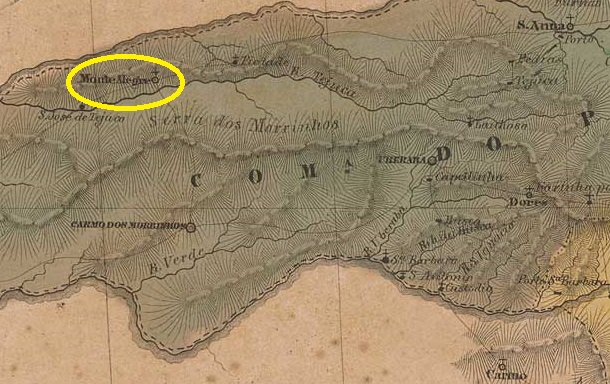
Villiers de l’Ile Adam: Carta (…) da Provincia de Minas Geraes (1849)
Other names: Toribaté, Monte Alegre de Minas (since 1948)
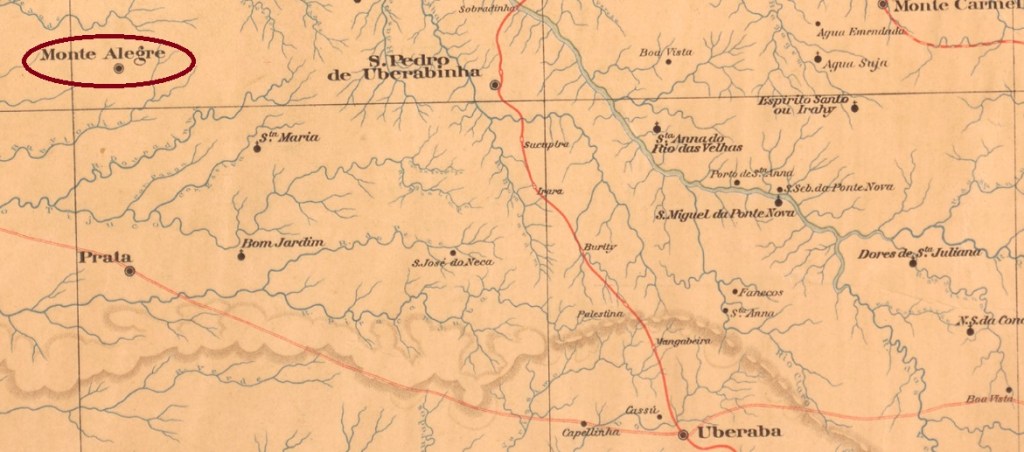
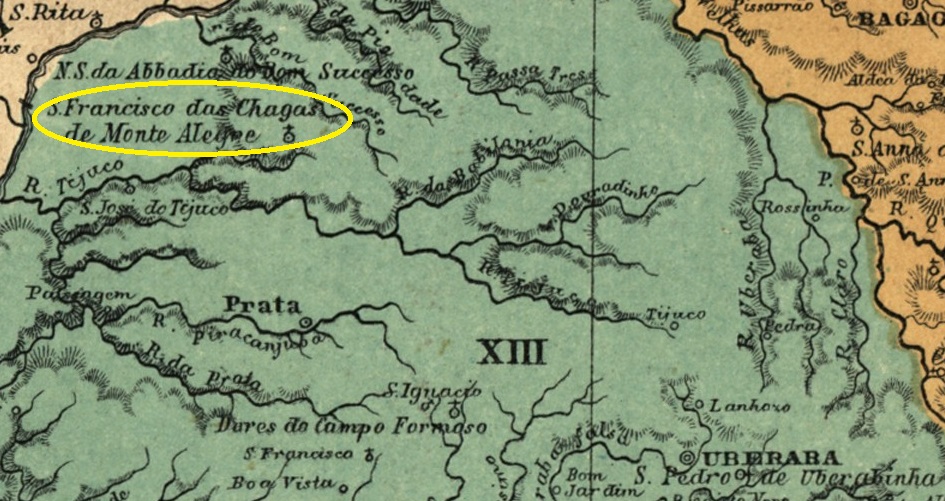
Since July 1843, the Freguesia de São Francisco de Chagas do Monte Alegre belonged to the Vila de Uberaba. It was located on the north bank of the Ribeirão Monte Alegre, 700 kilometres west of the provincial capital Ouro Preto. In April 1854, the Freguesia came under the administration of Vila do Prata and became Vila de Monte Alegre in September 1870. In January 1880, it became a city.
Since then, the place name has changed twice: in December 1943 to Município de Toribaté and five years later to Município de Monte Alegre de Minas.
Both Paula Sobrinho (História Postal de Minas Gerais, Belo Horizonte, 1997) and R. Koester (Carimbologia XXVII) agree that there has been a post office there since June 1872. The
However, the postal report (Relatório dos Correios) for the year 1886 mentions a date in July of that year, which may correspond to the opening of the agency.
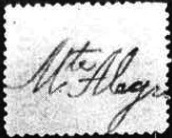
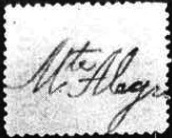
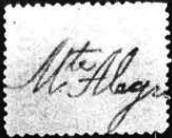
In the beginning, there were probably only handwritten cancellations, as R. Koester (op. cit.) shows.
1882ff (RK)
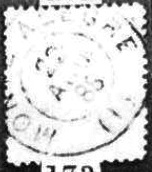
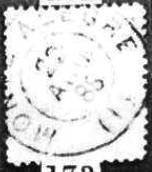
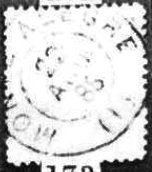
The oldest postmark here to date is MMG-1615a (Fig. Koester), which also exists in dark purple:
MMG-1615a (RK) 1883ff-1888
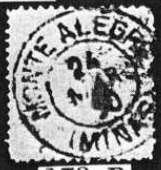
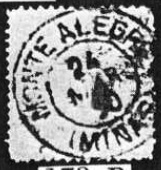
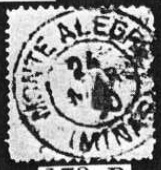
This was followed by MMG-1615b (Fig. Koester):
MMG-1615b (RK) 1890-1898Estado de Minas Geraes, 1910
Outros nomes: Toribaté, Monte Alegre de Minas (desde 1948)
Desde julho de 1843, a Freguesia de São Francisco de Chagas do Monte Alegre pertencia à Vila de Uberaba. Situava-se na margem norte do Ribeirão Monte Alegre, 700 quilômetros a oeste da capital provincial, Ouro Preto. Em abril de 1854, a Freguesia passou para a administração da Vila do Prata e, em setembro de 1870, tornou-se Vila de Monte Alegre. Em janeiro de 1880, esta tornou-se uma cidade. Desde então, o nome do local mudou duas vezes: em dezembro de 1943 para Município de Toribaté e, cinco anos depois, para Município de Monte Alegre de Minas.
Tanto Paula Sobrinho (História Postal de Minas Gerais, Belo Horizonte, 1997) quanto R. Koester (Carimbologia XXVII) escrevem que havia uma agência dos correios no local desde junho de 1872. O Relatório dos Correios de 1886, por outro lado, menciona uma data em julho do mesmo ano, que pode corresponder ao início das atividades da agência.
No início, provavelmente havia apenas obliterações manuscritas, como mostra R. Koester (op. cit.).
1882ff (RK)
O carimbo postal mais antigo aqui é o MMG-1615a (fig. Koester), que também existia em violeta escuro:
MMG-1615a (RK) 1883ff-1888
Depois veio o MMG-1615b (fig. Koester):
MMG-1615b (RK) 1890-1898Atlas do Imperio do Brasil, 1868
Andere Namen: Toribaté, Monte Alegre de Minas (seit 1948)
Seit Juli 1843 gehörte die Freguesia de São Francisco de Chagas do Monte Alegre zur Vila de Uberaba. Sie lag am Nordufer des Ribeirão Monte Alegre, 700 Kilometer westlich der Provinzhauptstadt Ouro Preto. Im April 1854 ging die Freguesia unter der Verwaltung der Vila do Prata über und wurde im September 1870 zur Vila de Monte Alegre. Im Januar 1880 wurde diese zu einer Stadt.
Seitdem hat sich der Ortsname zweimal geändert: im Dezember 1943 zu Município de Toribaté und fünf Jahre später zu Município de Monte Alegre de Minas.
Sowohl Paula Sobrinho (História Postal de Minas Gerais, Belo Horizonte, 1997) als auch R. Koester (Carimbologia XXVII) schreiben übereinstimmend, dass es dort seit Juni 1872 ein Postamt gab. Der
Der Postbericht (Relatorio dos Correios) für das Jahr 1886 nennt hingegen ein Datum aus dem Juli desselben Jahres, das der Inbetriebnahme der Agentur entsprechen kann.
Zu Beginn gab es vermutlich nur handschriftliche Entwertungen, wie R. Koester (op. cit.) zeigt.
1882ff (RK)
Der bisher älteste Poststempel hier ist MMG-1615a (Abb. Koester), den es auch in dunkelviolett gab:
Carta da Republica dos Estados Unidos do Brazil, 1892
Other names: Mairi (1943)
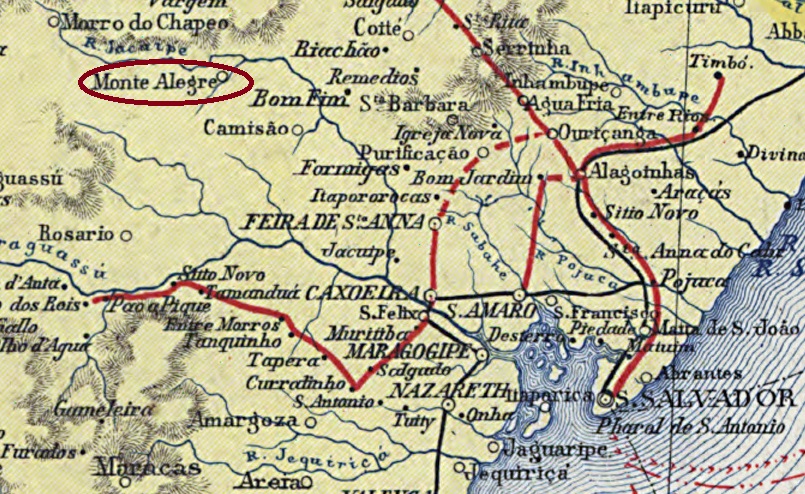
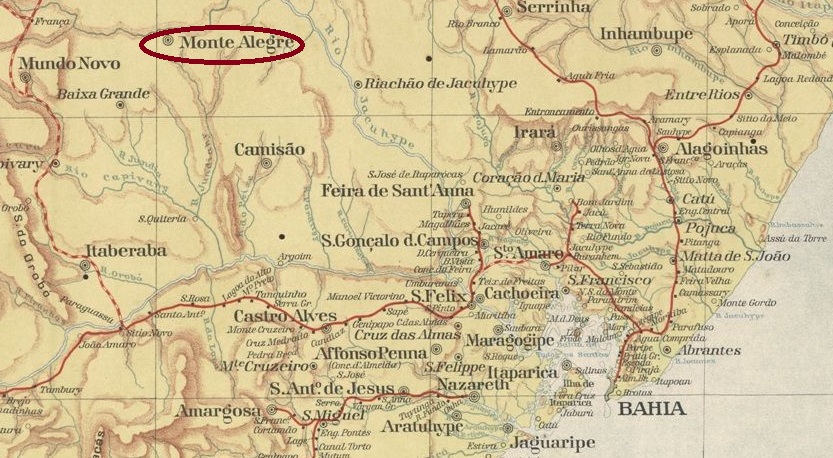
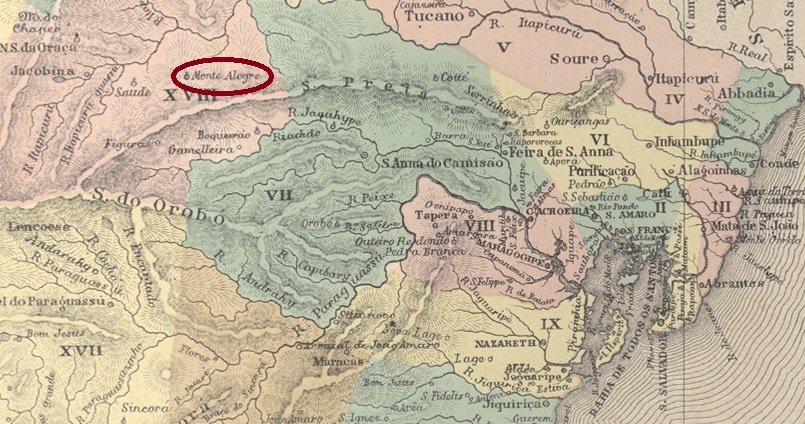
The Freguesia de Nossa Senhora das Dores de Monte Alegre existed since July 1838 and belonged to the Vila de Jacobina. It was located on the eastern bank of the Cariru, 300 kilometres northwest of the provincial capital Salvador da Bahia. In December 1857, it was elevated to the status of a vila and in August 1897 to that of a city, which has been called Mairi since December 1943.
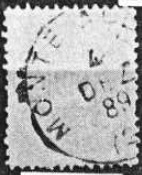
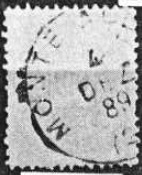
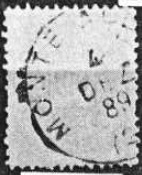
As Nova Monteiro writes in Administrações e Agencias Postaes do Brasil Imperio (Brasil Filatelico/RJ, 1934–1935; reprinted by SPP, 1994–1999), there had been a post office there since March 1864. The oldest postmark to date is MBA-0485b (illustration R. Koester, Carimbologia XXVII), although its definitive attribution to this locality is not yet sure:
MBA-0485b (RK) 1889
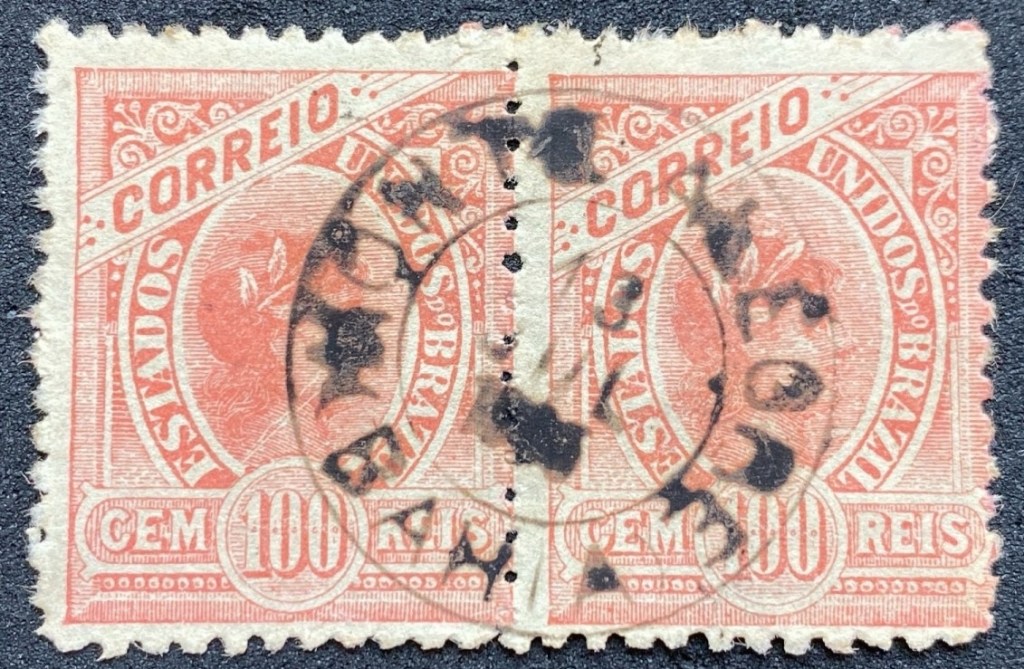
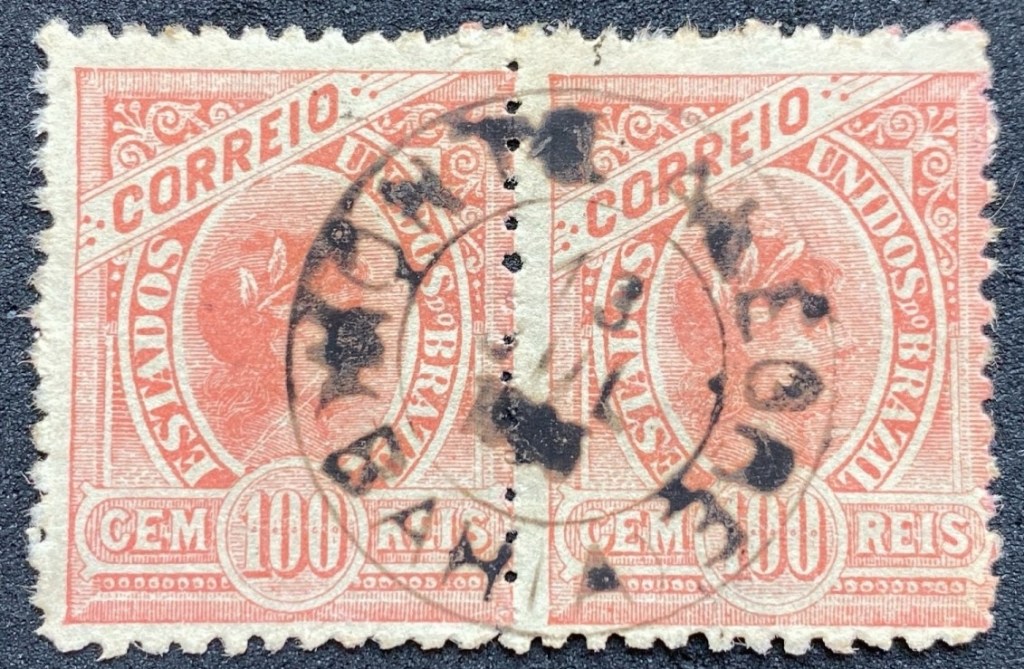
In contrast, the following postmark MBA-0485c (illustration Felipe Piccinini) is undoubtedly from Monte Alegre in Bahia:
MBA-0485c (FP) 1905Estado da Bahia, 1913
Outros nomes: Mairi (1943)
A Freguesia de Nossa Senhora das Dores de Monte Alegre existia desde julho de 1838 e pertencia à Vila de Jacobina. Situava-se na margem leste do rio Cariru, 300 quilômetros a noroeste da capital da província, Salvador da Bahia. Em dezembro de 1857, foi elevada à categoria de vila e, em agosto de 1897, à de cidade, que desde dezembro de 1943 se chama Mairi.
Como escreve Nova Monteiro em Administrações e Agências Postais do Brasil Império (Brasil Filatélico/RJ, 1934–1935; reimpressão SPP, 1994–1999), havia uma agência dos correios desde março de 1864. O carimbo postal mais antigo até agora deve ser o MBA-0485b (ilustração R. Koester, Carimbologia XXVII), embora a atribuição definitiva a esta localidade ainda não tenha sido confirmada:
MBA-0485b (RK) 1889
Por outro lado, o seguinte carimbo postal MBA-0485c (fig. Felipe Piccinini) é, sem dúvida, de Monte Alegre, na Bahia:
MBA-0485c (FP) 1905Atlas do Imperio do Brasil, 1868
Andere Namen: Mairi (1943)
Die Freguesia de Nossa Senhora das Dores de Monte Alegre bestand seit Juli 1838 und gehörte zur Vila de Jacobina. Sie lag am Ostufer des Cariru, 300 Kilometer nordwestlich der Provinzhauptstadt Salvador da Bahia. Im Dezember 1857 wurde sie zur Vila und im August 1897 zur Stadt erhoben, die seit Dezember 1943 Mairi heißt.
Wie Nova Monteiro im Administrações e Agencias Postaes do Brasil Imperio (Brasil Filatelico/RJ, 1934–1935; Nachdruck SPP, 1994–1999) schreibt, gab es dort seit März 1864 ein Postamt. Der bisher älteste Poststempel ist MBA-0485b (Abbildung R. Koester, Carimbologia XXVII), wobei die endgültige Zuordnung zu dieser Ortschaft noch nicht gesichert ist:
MBA-0485b (RK) 1889
Dagegen ist der folgende Poststempel MBA-0485c (Abb. Felipe Piccinini) zweifelsfrei aus Monte Alegre in Bahia:
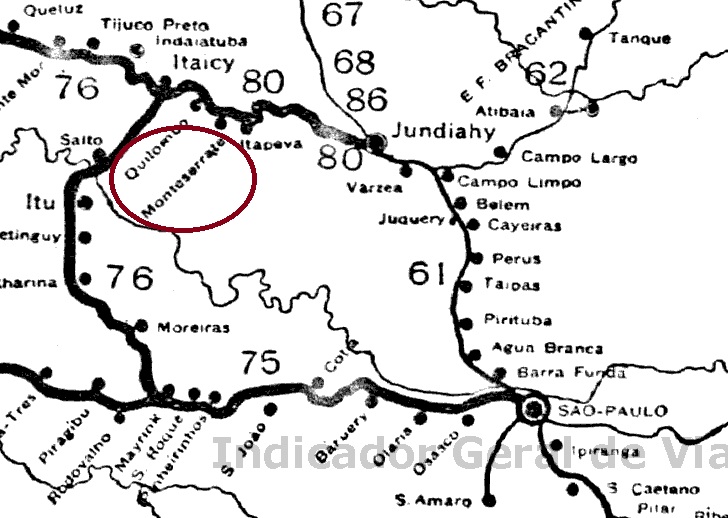
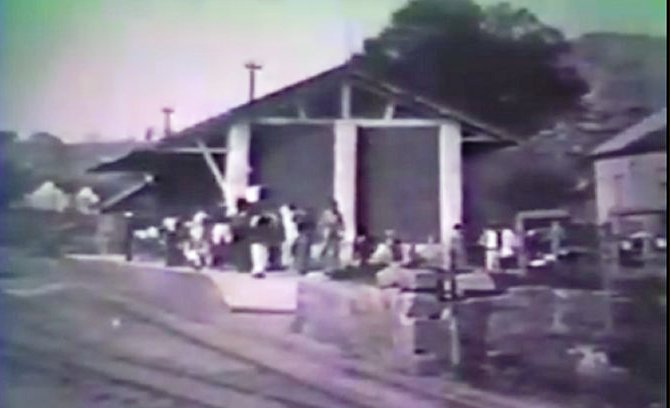
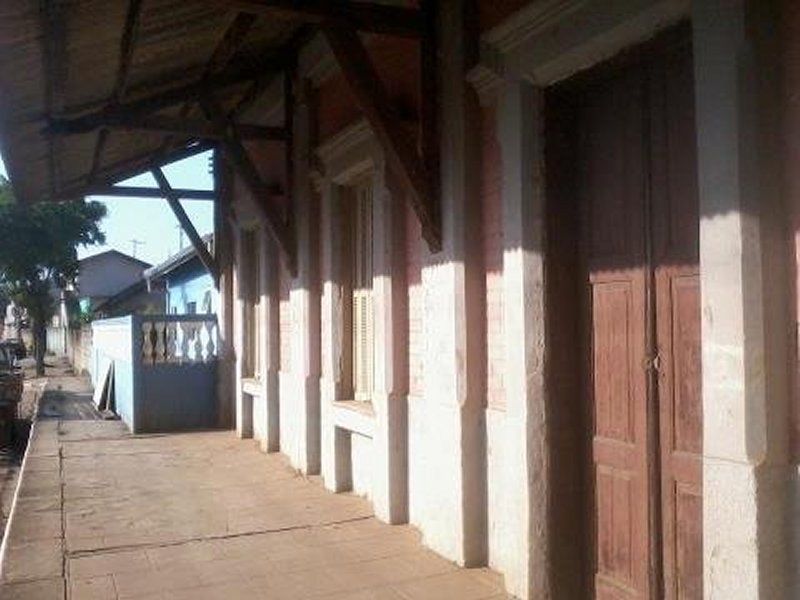
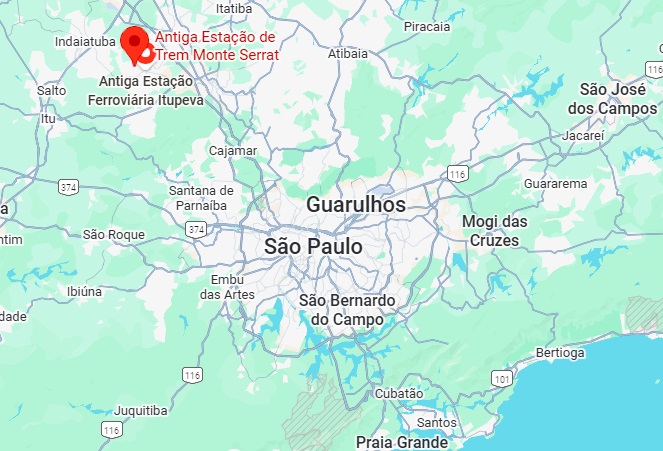
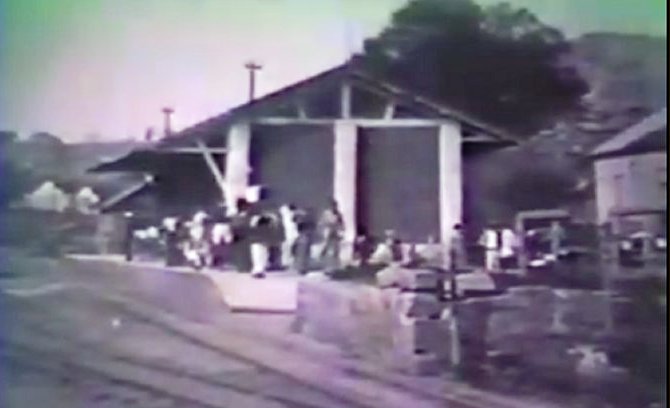
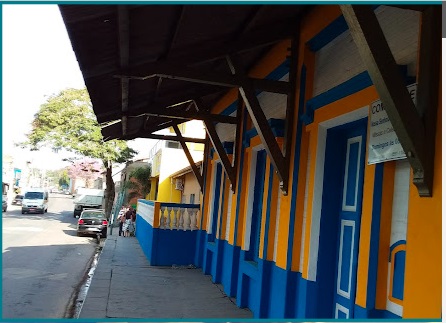
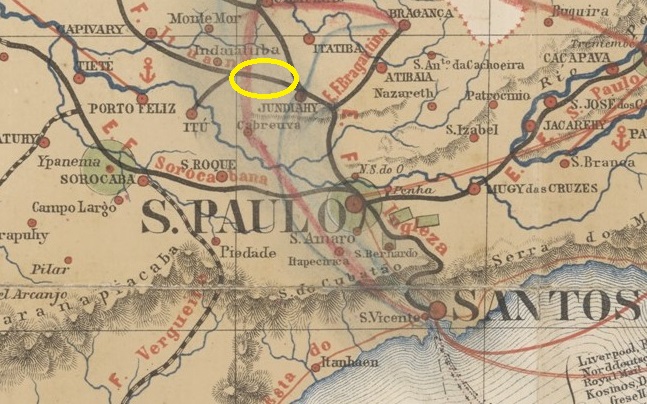
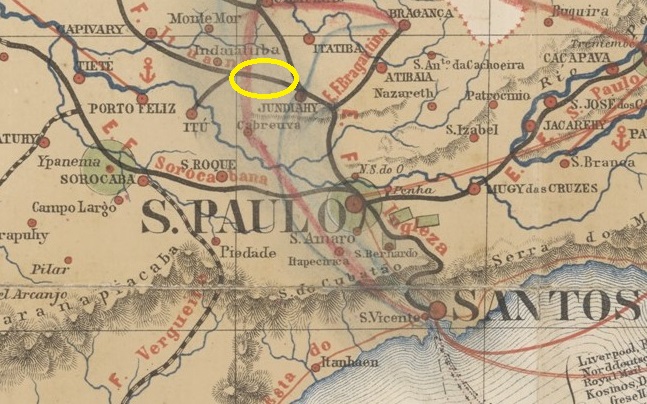
Mont Serrat station was opened in June 1889 by E. F. Ytuana (Jundiaí branch) and was located on the north bank of the Jundiaí River, 80 kilometres north of the provincial capital São Paulo. The railway line was transferred to Cia. União Sorocabana e Ytuana in 1892, to Sorocabana Railway in 1907, to E.F. Sorocabana in 1919, and belonged to the FEPASA consortium from 1971 until its closure in 1973.
In 1928 (photo: Rosangela M. Martins, on estacoesferroviarias.com.br)In February 2013 (photo: Artur Silva, on estacoesferroviarias.com.br)
Since February 1964, the station had been in the município de Itupeva.
According to the Postal Bulletin (Boletim Postal), the following have been available at the station since October 1889:
Boletim Postal, 1889
To date, no imperial postmark from the station has been identified with certainty.
Google Maps
A estação ferroviária de Mont Serrat foi inaugurada em junho de 1889 pela E. F. Ytuana (Ramal de Jundiaí) e ficava na margem norte do rio Jundiaí, 80 quilômetros ao norte da capital provincial, São Paulo. A linha ferroviária passou para a Cia. União Sorocabana e Ytuana em 1892, para a Sorocabana Railway em 1907, para a E.F. Sorocabana em 1919 e pertenceu ao consórcio FEPASA de 1971 até seu fechamento em 1973.
Em 1928 (Foto: Rosangela M. Martins, fonte: estacoesferroviarias.com.br)Em julho de 2022 (Foto: Marçal Carboneri, Google Maps)
Desde fevereiro de 1964, a estação ferroviária está localizada no município de Itupeva.
Conforme consta no Boletim Postal, desde outubro de 1889 havia na estação:
Boletim Postal, 1889
Até o momento, não foi possível identificar com certeza nenhum carimbo postal imperial da estação.
Mappa da Provincia de São Paulo, 1886
Der Bahnhof Mont Serrat wurde im Juni 1889 von der E. F. Ytuana (Jundiaí-Zweig) eröffnet und lag am Nordufer des Jundiaí, 80 Kilometer nördlich der Provinzhauptstadt São Paulo. Die Bahnlinie ging 1892 an die Cia. União Sorocabana e Ytuana, 1907 an die Sorocabana Railway, 1919 an die E.F. Sorocabana und gehörte von 1971 bis zur Stilllegung im Jahr 1973 dem FEPASA-Konsortium.
Im Jahr 1928 (Foto: Rosangela M. Martins, Quelle: estacoesferroviarias.com.br)Im Februar 2013 (Foto: Artur Silva, estacoesferroviarias.com.br)
Seit Februar 1964 befindet sich der Bahnhof im Município de Itupeva.
Wie aus dem Postbulletin (Boletim Postal) hervorgeht, gab es am Bahnhof seit Oktober 1889:
Boletim Postal, 1889
Bisher konnte kein kaiserlicher Poststempel aus dem Bahnhof mit Sicherheit zugeordnet werden.
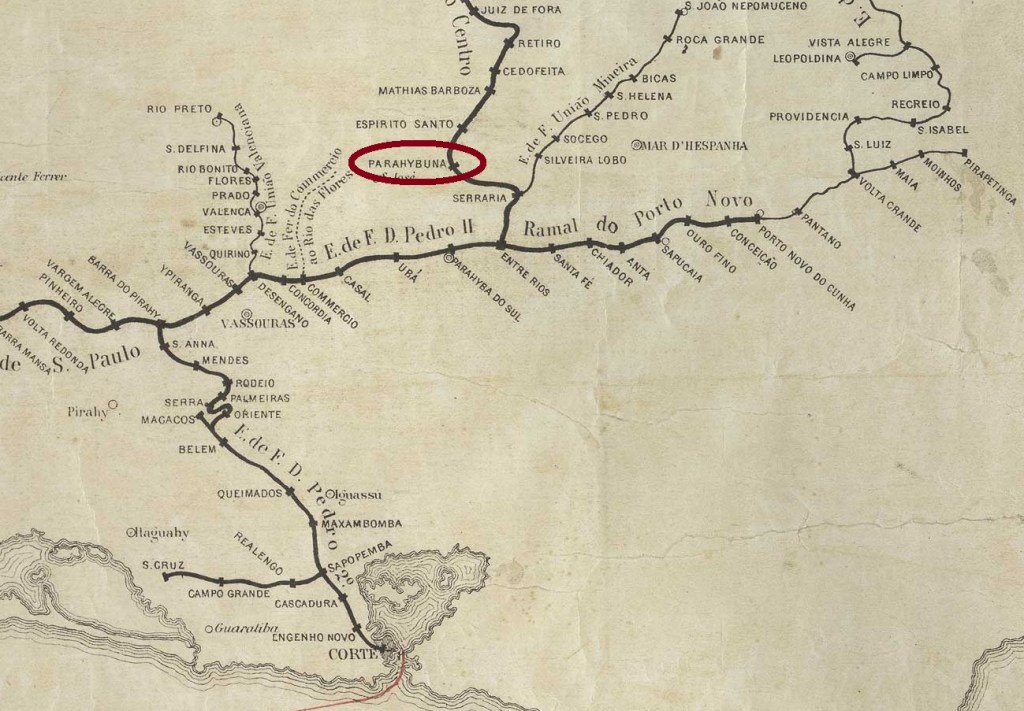
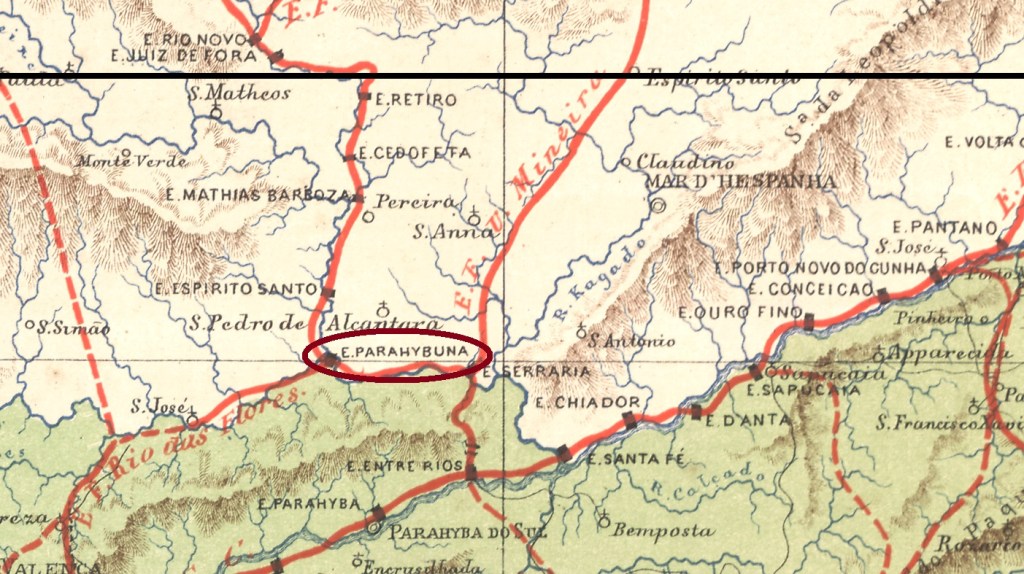
Estações (…) de São Paulo, Rio de Janeiro e Minas Geraes, 1880
Other names: Est. Parahybuna
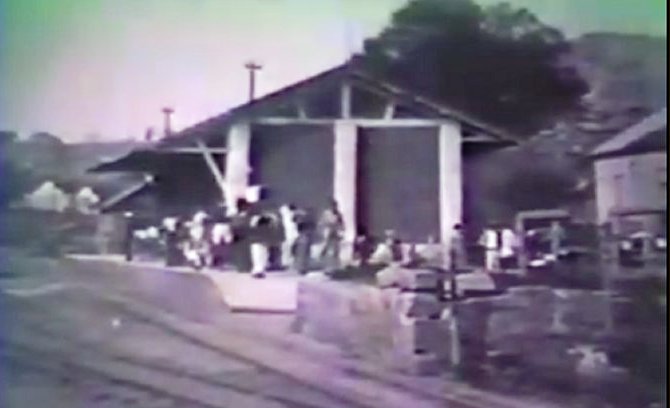
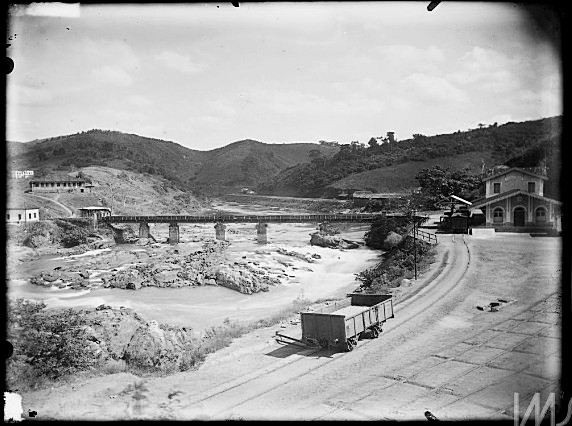
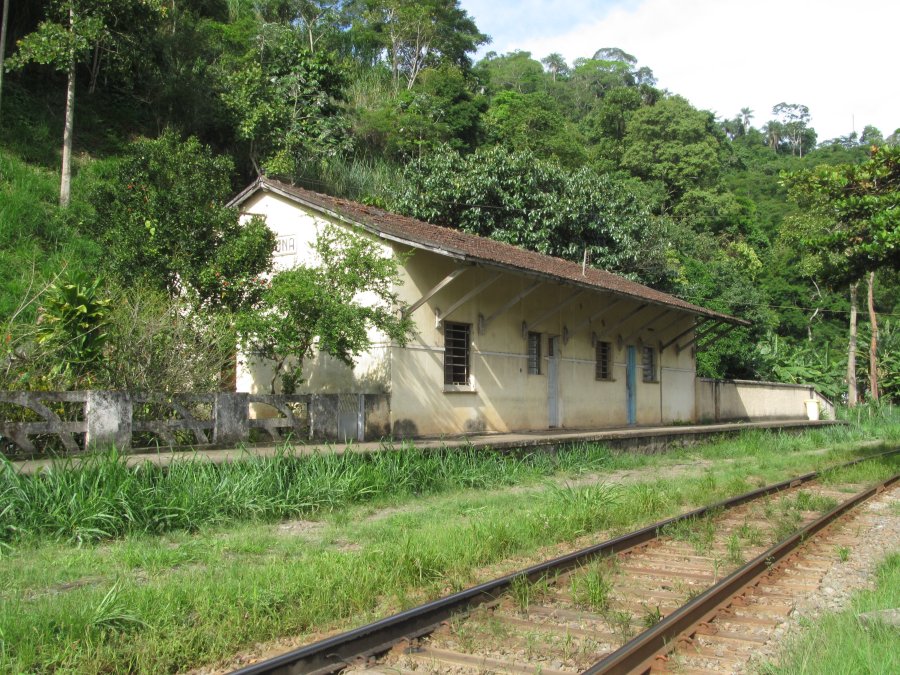
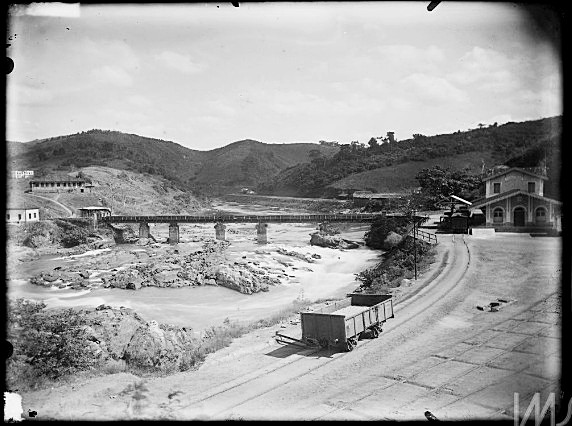
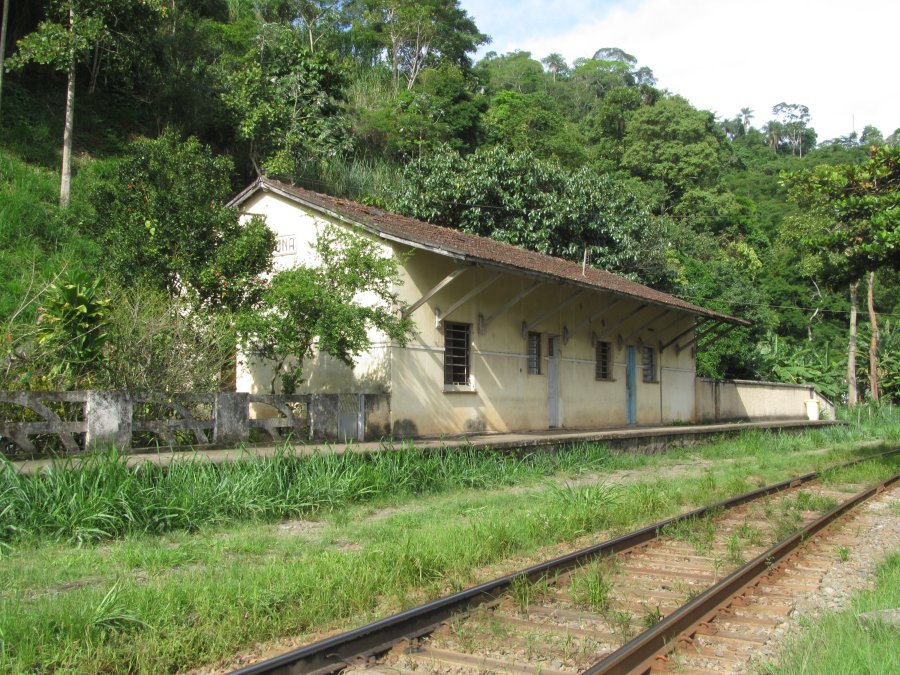
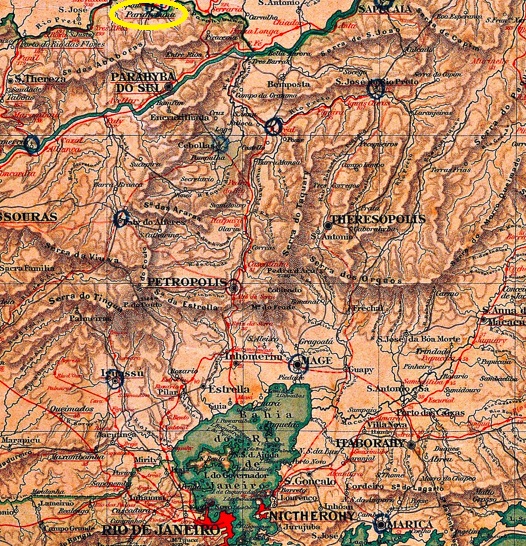
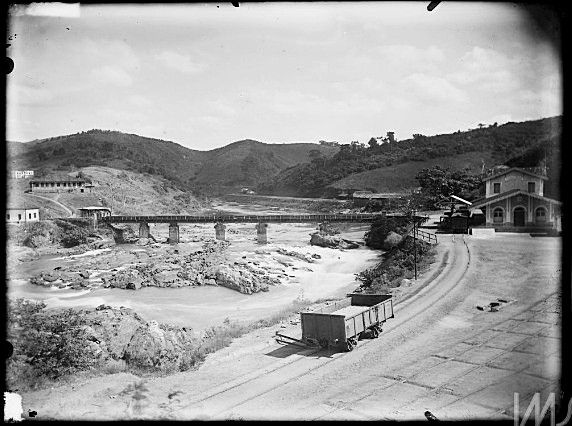
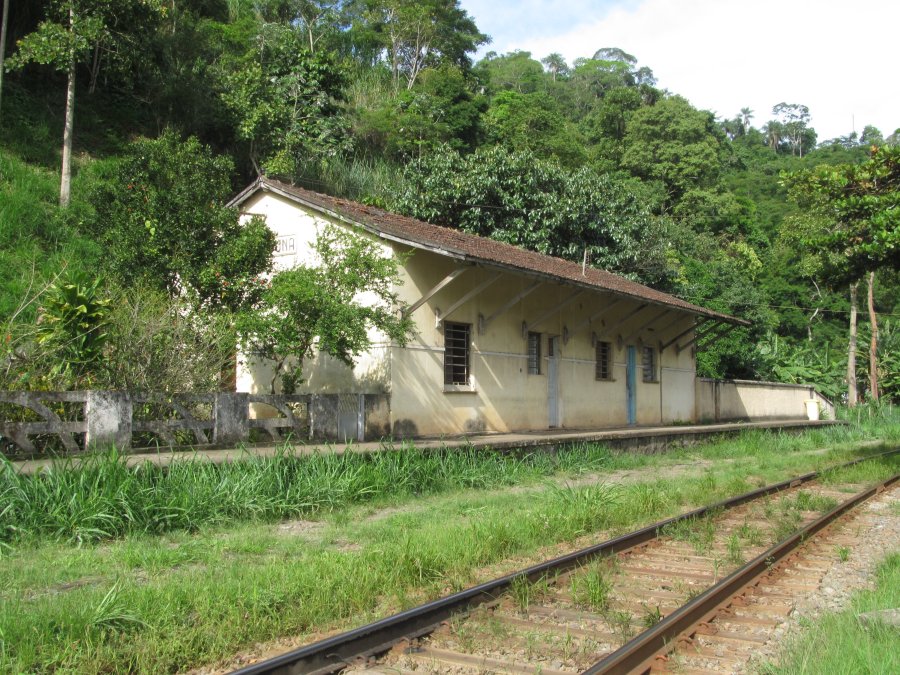
The station was originally called Parahybuna and was built in September 1874 by the E. F. D. Pedro II railway company (Central Line) on the north bank of the Paraibuna in the municipality of Juiz de Fora, 250 kilometres south of the provincial capital Ouro Preto. The railway line was transferred to E.F. Central do Brasil in 1889 and belonged to Rede Ferroviária Federal S.A. (estacoesferroviarias.com.br) from 1975 until its closure in 1996. In September 1923, the area around the station was assigned to the municipality of Matias Barbosa. Since March 1963, it has been part of the municipality of Simão Pereira.
In 1884, the station was then called Parahybuna (photo: Marc Ferrez).In January 2019 (photo: Júlio Alves, estacoesferroviarias.com.br)
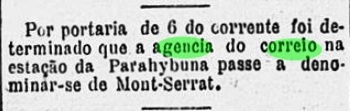
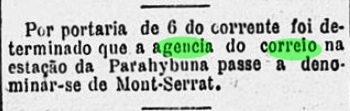
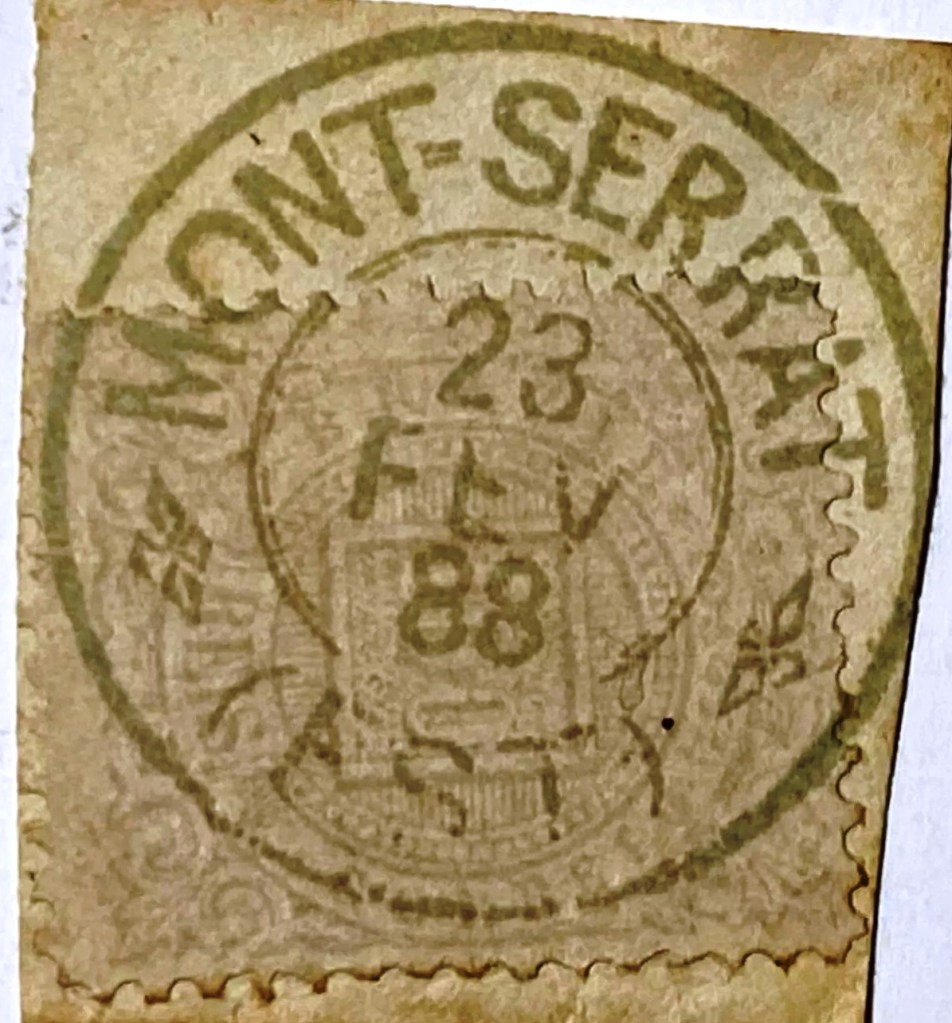
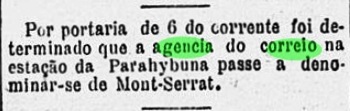
The station post office was established in 1875 and renamed ‘Mont-Serrat’ in November 1886, probably to avoid confusion with the Parahybuna station near Juiz de Fora. This was announced in the Rio press:
Gazeta de Noticias, 28 November 1886
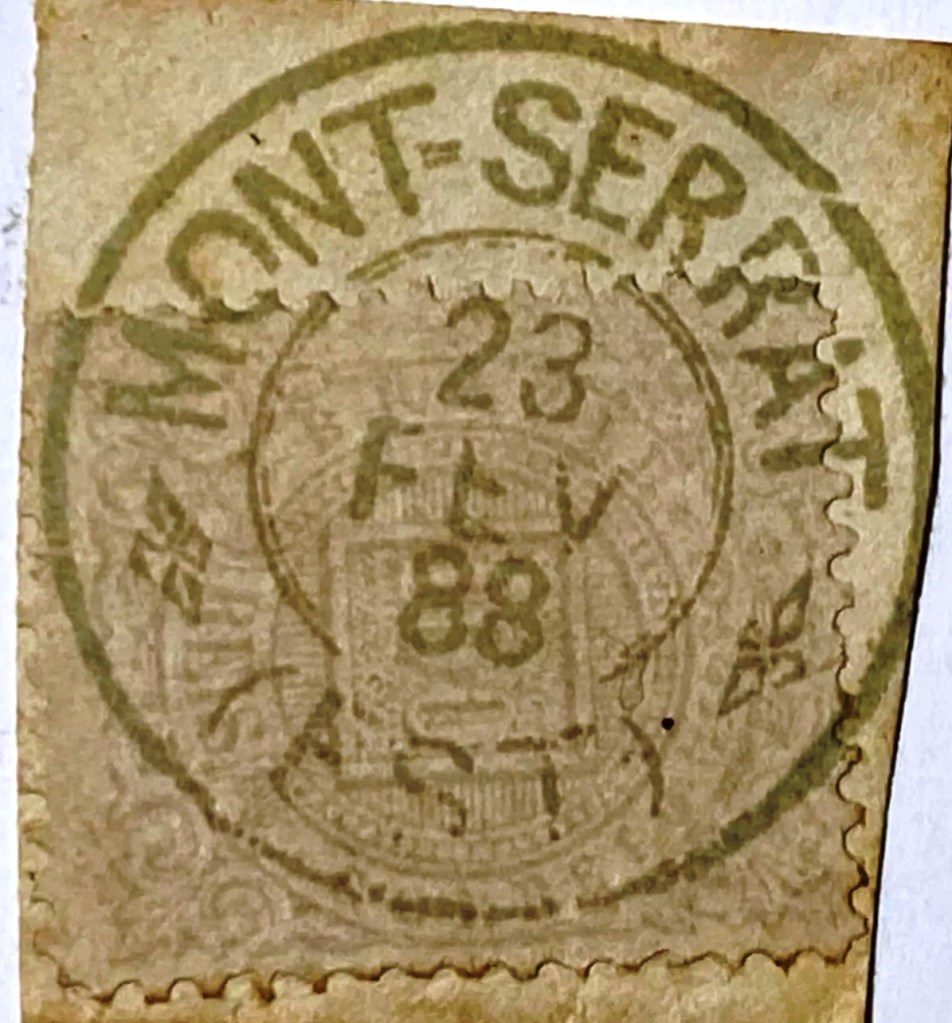
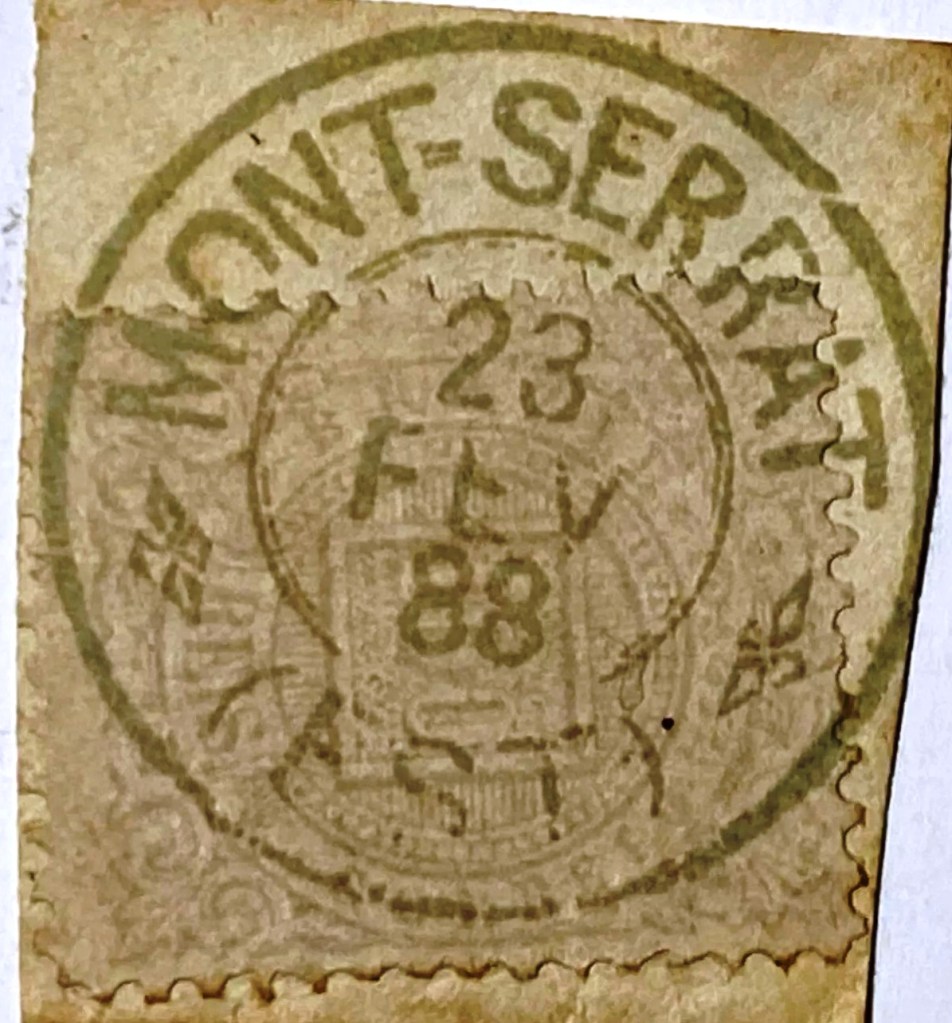
The oldest imperial postmark is MMG-1646a (Fig. Felipe Piccinini), which also appears in blue and brown.
MMG-1646a (FP) 1887-1906
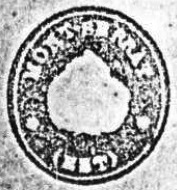
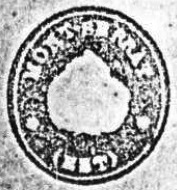
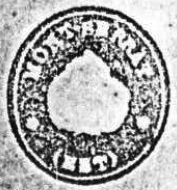
In Carimbologia XXIX, R. Koester also showed the postmark with the imperial seal MMG-1646b:
MMG-1646b (RK)Estrada de Ferro Central do Brasil, 1890
Outros nomes: Est. Parahybuna
A estação ferroviária chamava-se originalmente Parahybuna e foi inaugurada em setembro de 1874 pela E. F. D. Pedro II (Linha do Centro) na margem norte do Paraibuna, no município de Juiz de Fora, 250 quilômetros ao sul da capital provincial Ouro Preto. A linha ferroviária passou para a E.F. Central do Brasil em 1889 e pertenceu à Rede Ferroviária Federal S.A. de 1975 a 1996 (estacoesferroviarias.com.br). Em setembro de 1923, a área ao redor da estação foi atribuída ao município de Matias Barbosa. Desde março de 1963, ela pertence ao município de Simão Pereira.
Em 1884, a estação ainda se chamava Parahybuna (foto: Marc Ferrez)Em janeiro de 2019 (foto: Júlio Alves, estacoesferroviarias.com.br):
A agência dos correios da estação foi criada em 1875 e, a partir de novembro de 1886, passou a se chamar “Mont-Serrat”, provavelmente para evitar confusão com a estação Parahybuna, em Juiz de Fora. Isso foi anunciado na imprensa do Rio:
Gazeta de Notícias, 28/11/1886
O carimbo postal imperial mais antigo é o MMG-1646a (fig. Felipe Piccinini), que também existe em azul e marrom.
MMG-1646a (FP) 1887-1906
R. Koester também mostrou na Carimbologia XXIX o carimbo postal com o sinete imperial MMG-1646b:
MMG-1646b (RK)Almanak Laemmert, 1892
Andere Namen: Est. Parahybuna
Der Bahnhof hieß ursprünglich Parahybuna und wurde im September 1874 von der Bahngesellschaft E. F. D. Pedro II (Zentrallinie) am Nordufer des Paraibuna im Munizip Juiz de Fora, 250 Kilometer südlich der Provinzhauptstadt Ouro Preto, errichtet. Die Bahnlinie ging 1889 an die E.F. Central do Brasil über und gehörte von 1975 bis 1996 zur Rede Ferroviária Federal S.A. (estacoesferroviarias.com.br). Im September 1923 wurde das Gebiet um den Bahnhof dem Município de Matias Barbosa zugeordnet. Seit März 1963 liegt er im Município de Simão Pereira.
Im Jahr 1884, als der Bahnhof noch Parahybuna hieß (Foto: Marc Ferrez)Im Januar 2019 (Foto: Júlio Alves, estacoesferroviarias.com.br)
Das Bahnhofspostamt wurde 1875 ins Leben gerufen und ab November 1886 „Mont-Serrat” genannt, wohl um Verwechslungen mit dem Bahnhof Parahybuna bei Juiz de Fora zu vermeiden. Dies wurde in der Presse aus Rio bekannt gegeben:
Gazeta de Noticias, 28.11.1886
Der älteste kaiserliche Poststempel ist MMG-1646a (Abb. Felipe Piccinini), der auch in Blau und Braun vorkommt.
MMG-1646a (FP) 1887-1906
R. Koester zeigte in Carimbologia XXIX auch den Poststempel mit dem kaiserlichen Siegel MMG-1646b:
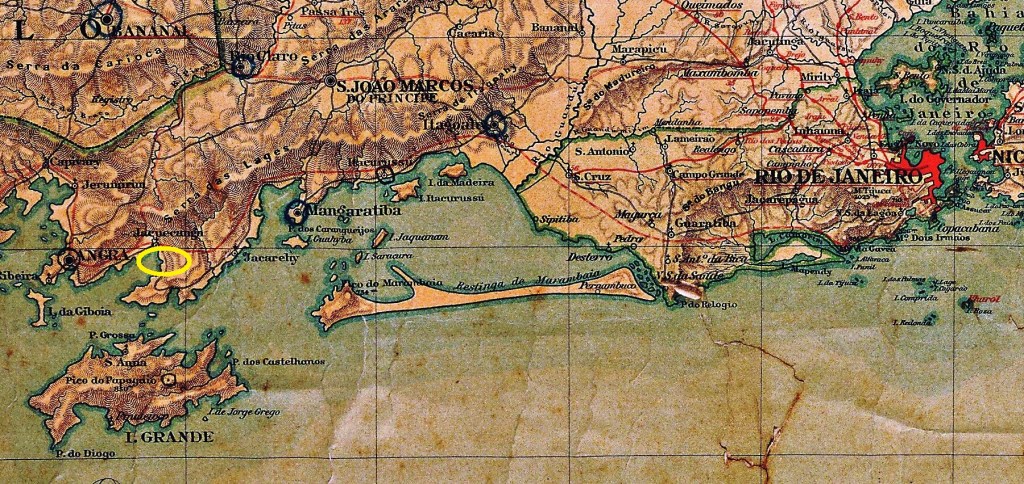
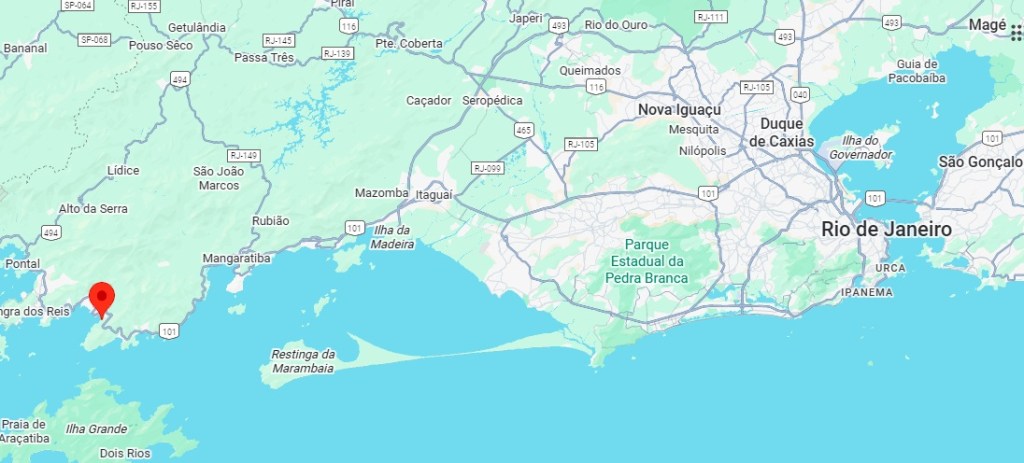
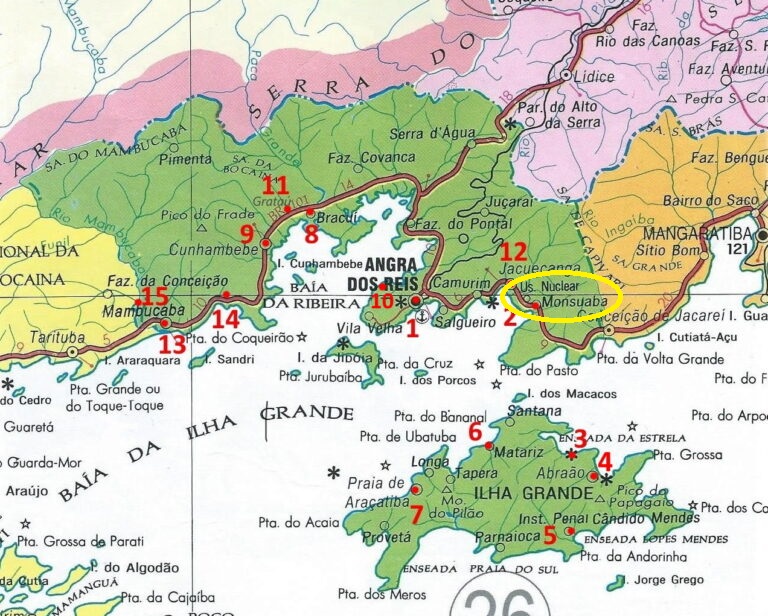
In the 19th century, this settlement was idyllically located on a bay in the Freguesia de Jacuecanga in the Vila da Angra dos Reis, 140 kilometres west of the capital Rio de Janeiro. After the proclamation of the republic, a district became part of the Jacuecanga district.
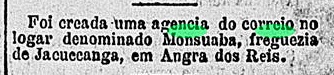
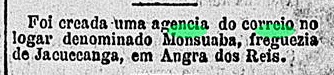
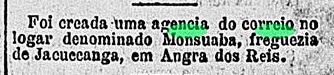
As reported by the Rio press, there had been a post office there since January 1881.
Gazeta de Noticias, 19 January 1881
Paulo Novaes writes on agenciaspostais.com.br that the agency closed in August 1902 and did not reopen until November 1907. The first imperial postmark is MRJ-2420a (Fuad Ferreira Fo. collection).
MRJ-2420a (FF) 1882ff
It was followed by MRJ-2420b, here also with an image from the Fuad Ferreira Fo. collection.
MRJ-2420b (FF) 1890Google Maps
No século XIX, esse povoado ficava em uma baía idílica na Freguesia de Jacuecanga, na Vila da Angra dos Reis, 140 quilômetros a oeste da capital Rio de Janeiro. Após a proclamação da República, uma parte do povoado passou a fazer parte do distrito de Jacuecanga.
Conforme divulgado pela imprensa do Rio, havia uma agência dos correios no local desde janeiro de 1881.
Gazeta de Notícias, 19/01/1881
Paulo Novaes escreve no site agenciaspostais.com.br que a agência fechou em agosto de 1902 e só foi reaberta em novembro de 1907. O primeiro carimbo postal imperial é MRJ-2420a (coleção Fuad Ferreira Fo.).
MRJ-2420a (FF) 1882ff
Seguiu-se o MRJ-2420b, também aqui numa imagem da coleção Fuad Ferreira Fo.
MRJ-2420b (FF) 1890agenciaspostais.com.br
Textaktualisierung vom 25. Dezember 2025
Diese Siedlung lag im 19. Jahrhundert idyllisch an einer Bucht in der Freguesia de Jacuecanga in der Vila da Angra dos Reis, 140 Kilometer westlich der Hauptstadt Rio de Janeiro. Nach der Ausrufung der Republik wurde ein Ortsteil Teil des Distrikts Jacuecanga.
Wie die Presse aus Rio bekannt gab, gab es dort seit Januar 1881 ein Postamt.
Gazeta de Noticias, 19.01.1881
Paulo Novaes schreibt auf agenciaspostais.com.br, dass die Agentur im August 1902 schloss und erst im November 1907 wiedereröffnet wurde. Der erste kaiserliche Poststempel ist MRJ-2420a (Sammlung Fuad Ferreira Fo.).
MRJ-2420a (FF) 1882ff
Es folgte MRJ-2420b, ebenfalls abgebildet aus der Sammlung Fuad Ferreira Fo.
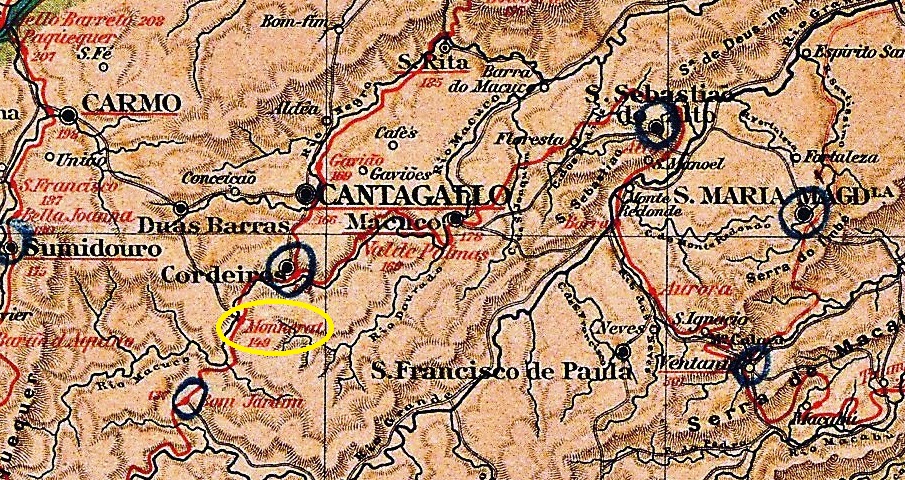
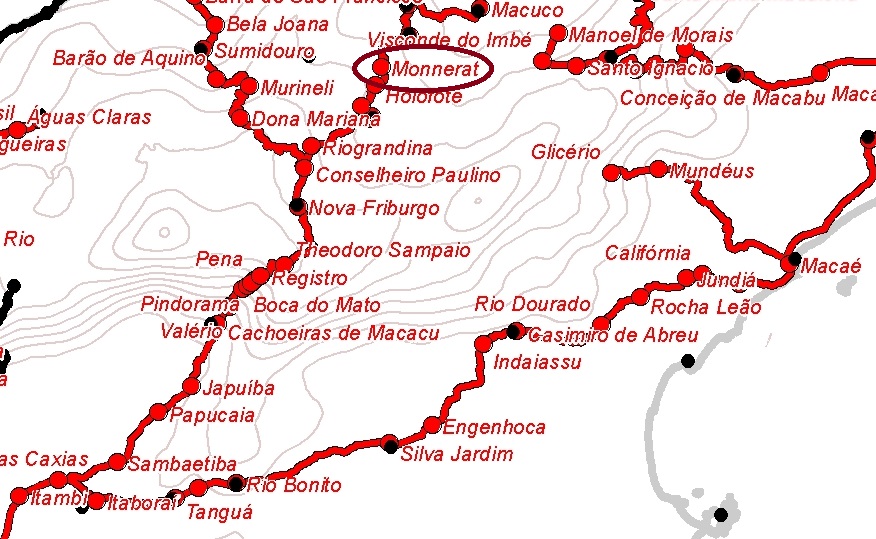
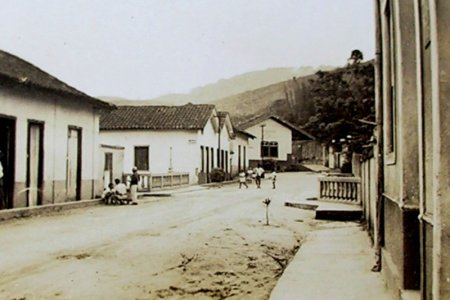
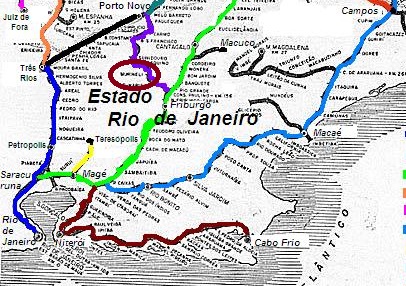
Monerat railway station (actually Monnerat, now spelled Monerá) was built around 1885 by the E.F. do Cantagallo railway company in the municipality of the same name on the Cantagallo line on the eastern bank of the Macuco, 180 km northeast of the capital Rio de Janeiro. The railway line was transferred to E.F. Leopoldina in 1887 and closed in 1967. The station is now a bus station and has been in the district of Monerá, Município de Duas Barras, since May 1891. The tracks have since been removed.
As Paulo Novaes writes on agenciaspostais.com.br, there had been a post office there since January 1886. The imperial postmark is MRJ-2100a and was already illustrated in P. Ayres, ‘Catálogo de Carimbos Brasil-Império’ (São Paulo, 1937, 1942), on page 117:
MRJ-2100a (P.A. p. 117) 1887-1895André S. Carvalho: E.F. Leopoldina em 1910 (2020)
Outras grafias: Monnerat, Monerá
A estação ferroviária de Monerat (na verdade Monnerat, hoje escrita Monerá) foi construída por volta de 1885 pela Companhia Ferroviária E.F. do Cantagallo no município de mesmo nome, na linha Cantagallo, na margem leste do Macuco, 180 km a nordeste da capital Rio de Janeiro. A linha ferroviária passou para a E.F. Leopoldina em 1887 e foi desativada em 1967. Hoje, a estação é uma rodoviária e está localizada desde maio de 1891 no distrito de Monerá, município de Duas Barras. Os trilhos já foram removidos.
Em 1946 (Foto: Edson de Lima Lucas, em estacoesferroviarias.com.br)Em março de 2022 (Foto: Wagna Ouverney, em Google Maps)
Como escreve Paulo Novaes em agenciaspostais.com.br, havia uma agência dos correios no local desde janeiro de 1886. O carimbo postal imperial é MRJ-2100a e já foi reproduzido em P. Ayres, “Catálogo de Carimbos Brasil-Império” (São Paulo, 1937, 1942), na página 117:
MRJ-2100a (P.A. p. 117) 1887-1895Estrada de Ferro Leopoldina
Andere Schreibweisen: Monnerat, Monerá
Der Bahnhof Monerat (eigentlich Monnerat, heute Monerá geschrieben) wurde um 1885 von der Eisenbahngesellschaft E.F. do Cantagallo im gleichnamigen Município an der Cantagallo-Linie am Ostufer des Macuco, 180 km nordöstlich der Hauptstadt Rio de Janeiro, gebaut. Die Bahnlinie ging 1887 an die E.F. Leopoldina über und wurde 1967 stillgelegt. Der Bahnhof ist heute ein Busbahnhof und befindet sich seit Mai 1891 im Distrikt Monerá, município de Duas Barras. Die Gleise sind inzwischen entfernt worden.
Wie Paulo Novaes auf agenciaspostais.com.br schreibt, gab es dort seit Januar 1886 ein Postamt. Der kaiserliche Poststempel ist MRJ-2100a und wurde bereits in P. Ayres, „Catálogo de Carimbos Brasil-Império” (São Paulo, 1937, 1942) auf Seite 117 abgebildet:
Villiers de l’Ile Adam: Carta (…) da Provincia do Maranhão, 1850
Other names: Aldeia de Carará
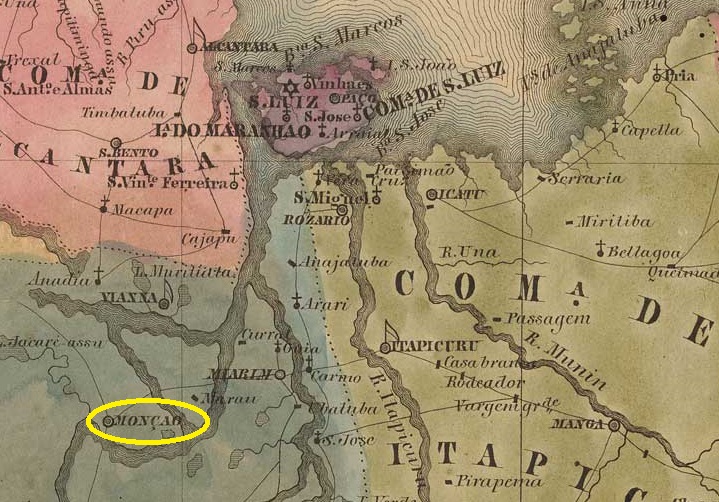
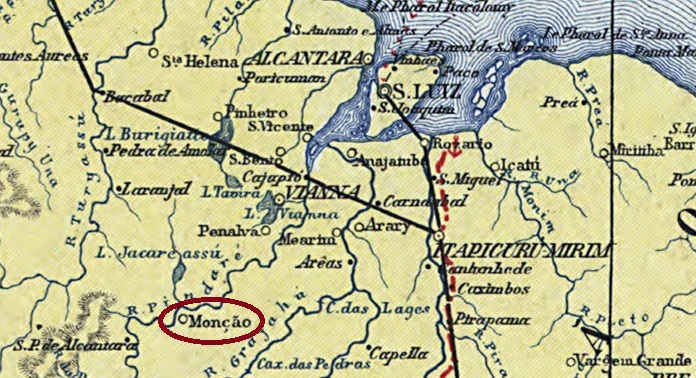
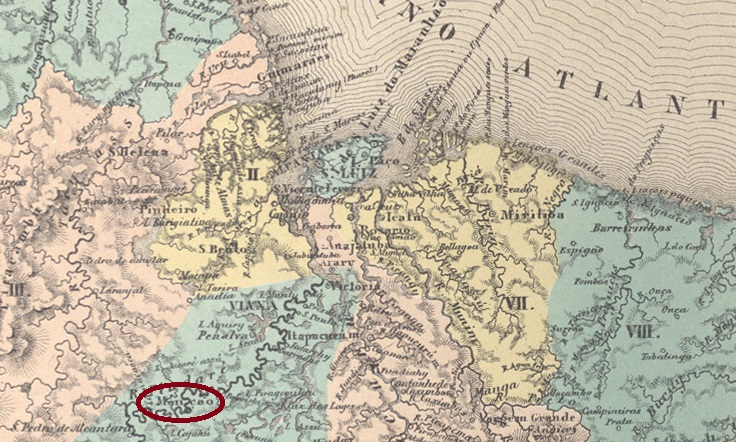
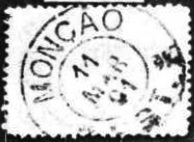
The Freguesia de São Francisco Xavier de Monção existed since June 1757 and was located on the north bank of the Pindaré River, next to Lake Jacareí, 240 kilometres southwest of the future provincial capital São Luís do Maranhão. In June 1859, it was elevated to the status of a vila. In April 1932, however, it was incorporated as a district in the municipality of São Pedro. In September 1935, however, the municipality of Monção was restored.
As can be seen from the postal report for 1886, there had been a post office there since January 1872. However, according to the regional press, postal services had already been operating in Monção between 1859 and 1865.
To date, no imperial postmark has been definitively attributed to this locality.
Carta da Republica dos Estados Unidos do Brazil, 1892
Outros nomes: Aldeia de Carará
A Freguesia de São Francisco Xavier de Monção existia desde junho de 1757 e ficava na margem norte do rio Pindaré, próximo ao lago Jacareí, 240 quilômetros a sudoeste da futura capital do estado, São Luís do Maranhão. Em junho de 1859, foi elevada à categoria de vila. Em abril de 1932, porém, foi incorporada como distrito ao município de São Pedro. Em setembro de 1935, o município de Monção foi restaurado.
Conforme consta no relatório postal de 1886, havia uma agência dos correios no local desde janeiro de 1872. No entanto, já havia serviço postal em Monção entre 1859 e 1865, conforme pode ser lido na imprensa regional.
Até o momento, nenhum carimbo postal imperial pôde ser atribuído com certeza a essa localidade.
Atlas do Imperio do Brasil, 1868
Andere Namen: Aldeia de Carará
Die Freguesia de São Francisco Xavier de Monção bestand seit Juni 1757 und lag am Nordufer des Pindaré, neben dem Jacareísee, 240 Kilometer südwestlich der späteren Provinzhauptstadt São Luís do Maranhão. Im Juni 1859 wurde sie zur Vila erhoben. Im April 1932 wurde sie jedoch als Distrito im Município de São Pedro eingegliedert. Im September 1935 wurde der Município de Monção jedoch wiederhergestellt.
Wie aus dem Postbericht für 1886 hervorgeht, gab es dort seit Januar 1872 ein Postamt. Allerdings gab es bereits zwischen 1859 und 1865 Postverkehr in Monção, wie in der regionalen Presse zu lesen ist.
Bisher konnte kein kaiserlicher Poststempel dieser Ortschaft mit Sicherheit zugeordnet werden.
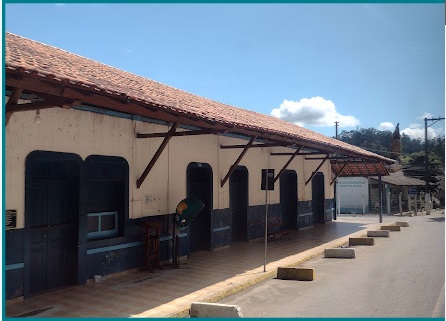
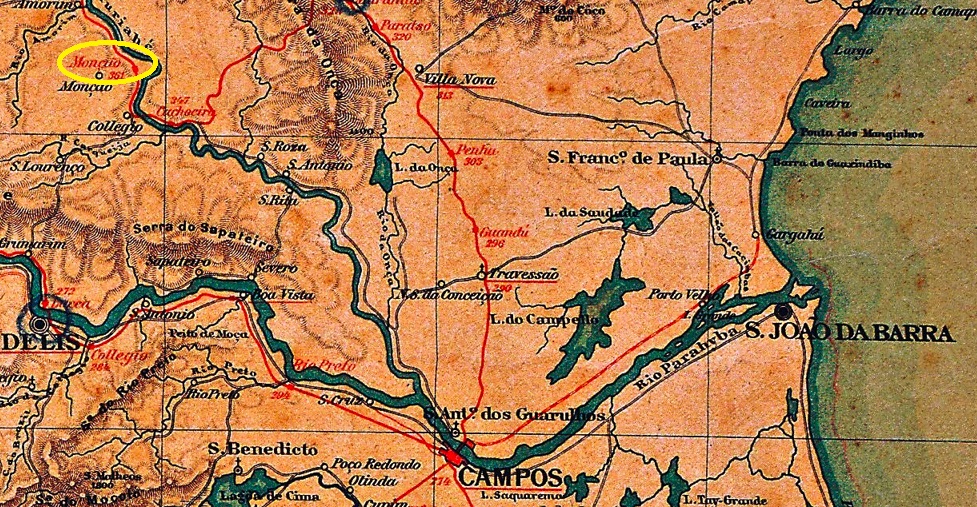
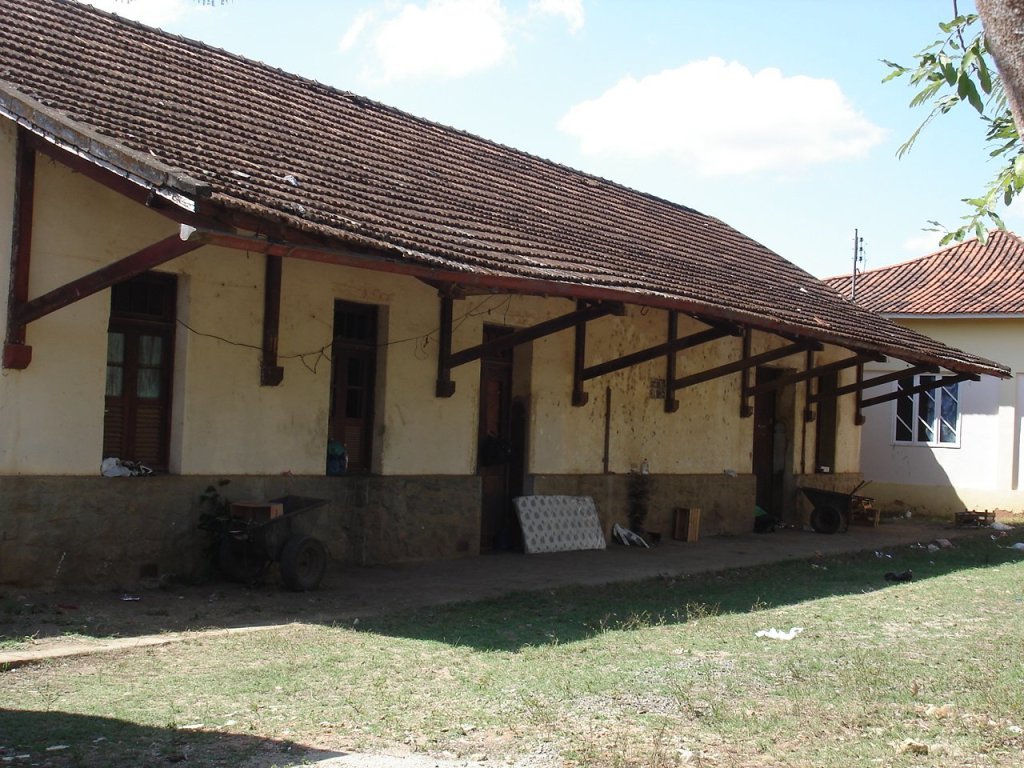
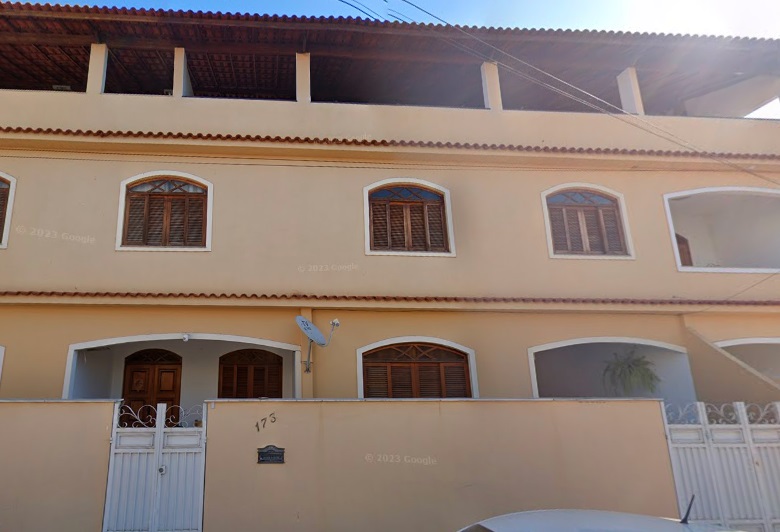
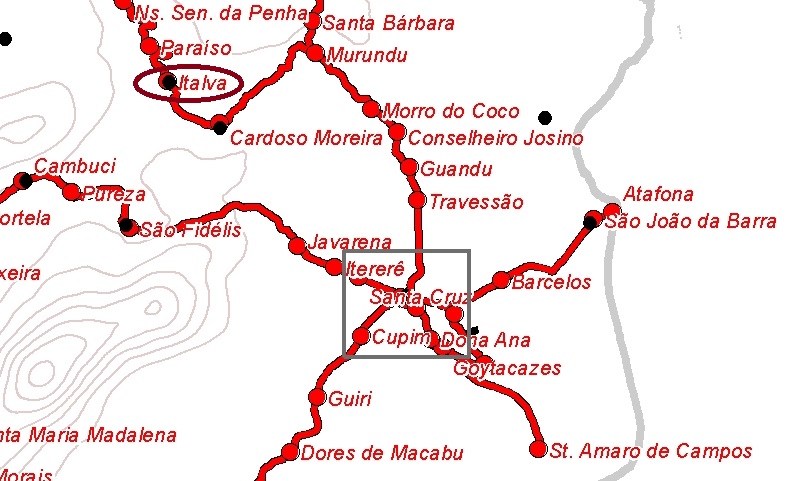
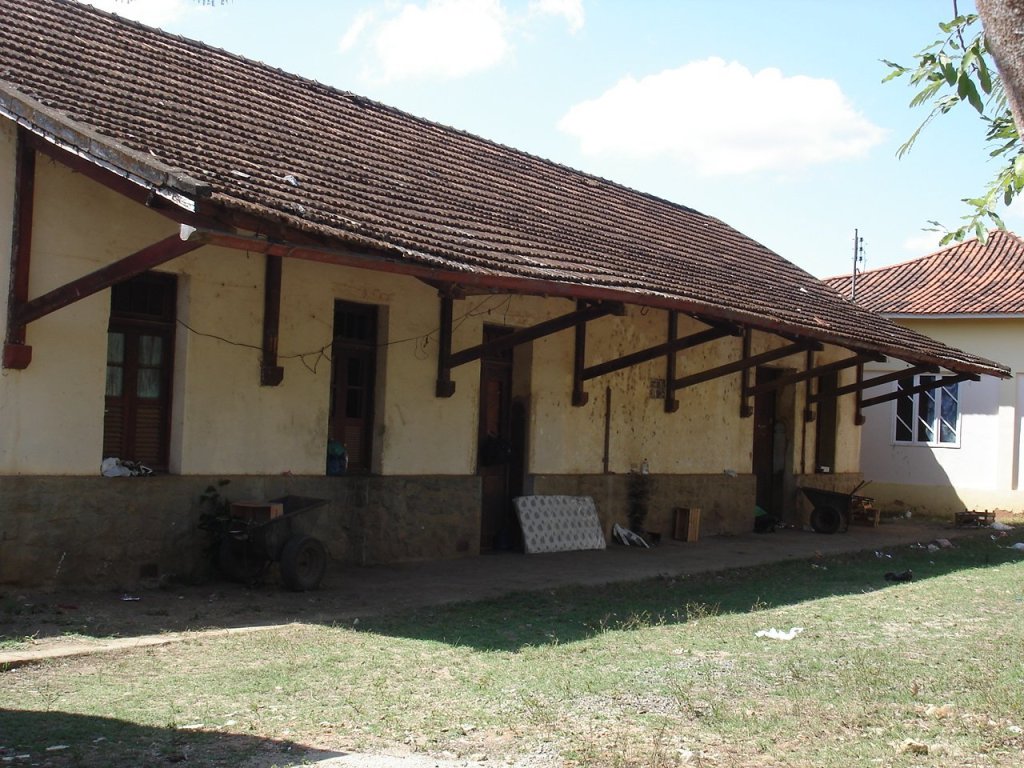
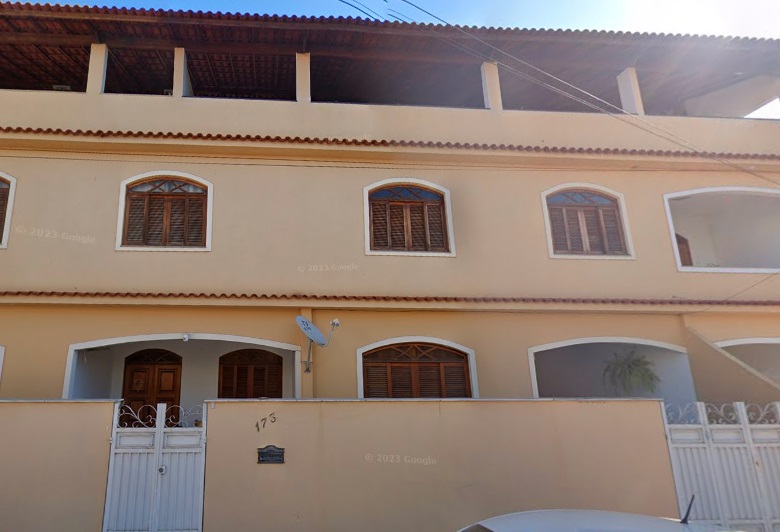
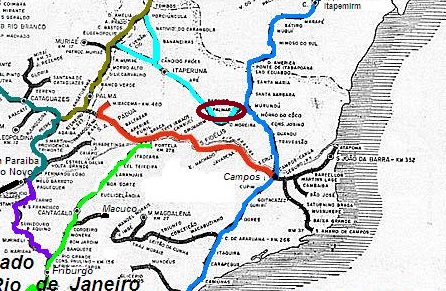
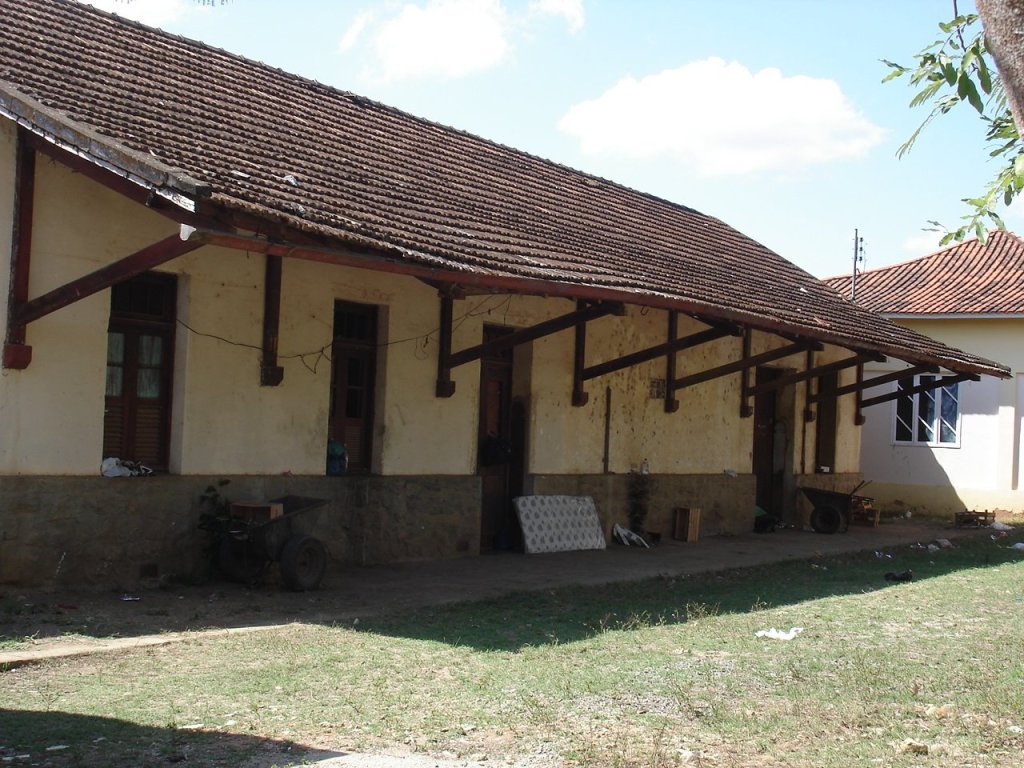
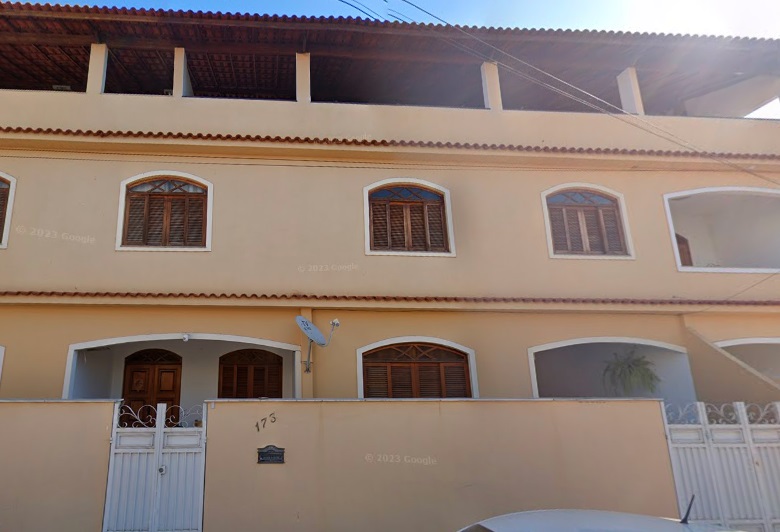
Monção railway station was opened in June 1880 by the railway company E. F. Campos e Carangola. It was in the Freguesia de Sto. Antonio das Cachoeiras do Muriaé in the municipality of Campos on the west bank of the Muriaé River, 340 kilometres northeast of the capital Rio de Janeiro. The railway line changed hands in 1890 and belonged from then on to Cia. Barão de Araruama and shortly afterwards to E. F. Leopoldina. From 1975 until its closure in 1977, it belonged to Rede Ferroviária Federal S. A. (estacoesferroviarias.com.br). Today, the tracks have disappeared and the building, which was still in a state of disrepair in 2007, appears to have been renovated as an apartment building.
Photo: Gutierrez L. Coelho, estacoesferroviarias.com.br, September 2007Photo: Google Street View, August 2023
The area around the station became the Distrito de Monção in December 1930, which was called Purus 13 years later, in 1943. Since October 1944, it has been in the district of Italva, which has been an independent município since November 1983.
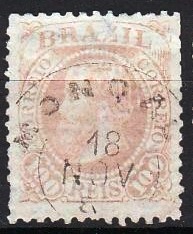
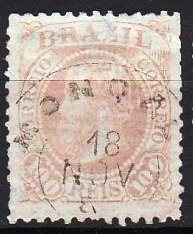
As Paulo Novaes writes on agenciaspostais.com.br, there had been a post office there since August 1880. The first postmark MRJ-2415a (illustration from the Internet) has yet to be definitively confirmed, as it could also come from Monção in the province of Maranhão:
MRJ-2415a (EB) 1883
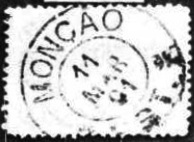
The successor MRJ-2415b (illustration by Koester, in Carimbologia XXVII) is undoubtedly from this station:
MRJ-2415b (RK) 1891Andre S. Carvalho: E.F. Leopoldina em 1910 (2020)
Outros nomes: Italva (1944)
A estação ferroviária de Monção foi inaugurada em junho de 1880 pela E. F. Campos e Carangola, localizada no território da Freguesia de Sto. Antonio das Cachoeiras do Muriaé, no município de Campos, na margem oeste do rio Muriaé, 340 quilômetros a nordeste da capital Rio de Janeiro. A linha férrea mudou de proprietário em 1890, passando a pertencer à Cia. Barão de Araruama e, pouco depois, à E. F. Leopoldina. De 1975 até ao seu encerramento em 1977, pertenceu à Rede Ferroviária Federal S. A. (estacoesferroviarias.com.br). Hoje, os trilhos desapareceram e a estação, que em 2007 ainda estava abandonada, parece ter sido reformada e transformada em um prédio residencial.
Foto: Gutierrez L. Coelho, estacoesferroviarias.com.br, setembro de 2007Foto: Google Street View
A área ao redor da estação ferroviária tornou-se em dezembro de 1930 o Distrito de Monção e, 13 anos depois, em 1943, chamava-se Purus. Desde outubro de 1944, ela está localizada no distrito de Italva, que é um município independente desde novembro de 1983.
Como escreve Paulo Novaes em agenciaspostais.com.br, havia uma agência dos correios no local desde agosto de 1880. O primeiro carimbo postal MRJ-2415a (imagem da Internet) ainda precisa ser confirmado definitivamente, pois também poderia ser de Monção na província do Maranhão:
MRJ-2415a (EB) 1883
O sucessor MRJ-2415b (fig. Koester, em Carimbologia XXVII) é, sem dúvida, desta estação:
MRJ-2415b (RK) 1891Estrada de Ferro Leopoldina
Andere Namen: Italva (1944)
Der Bahnhof Monção wurde im Juni 1880 von der Eisenbahngesellschaft E. F. Campos e Carangola eröffnet, er lag im Gebiet der Freguesia de Sto. Antonio das Cachoeiras do Muriaé im Munizip Campos am Westufer des Muriaé, 340 Kilometer nordöstlich der Hauptstadt Rio de Janeiro. Die Bahnlinie wechselte 1890 den Besitzer und gehörte fortan der Cia. Barão de Araruama und kurz darauf zur E. F. Leopoldina. Von 1975 bis zur Stilllegung 1977 gehörte sie zur Rede Ferroviária Federal S. A. (estacoesferroviarias.com.br). Heute sind die Gleise verschwunden und das Gebäude, das im Jahr 2007 noch verwahrlost war, scheint inzwischen als Mehrfamilienhaus renoviert worden zu sein.
Foto: Gutierrez L. Coelho, estacoesferroviarias.com.br, September 2007Foto: Google Street View, August 2023
Das Gebiet um den Bahnhof wurde im Dezember 1930 zum Distrito de Monção und 13 Jahre später, im Jahr 1943, zu Purus umbenannt. Seit Oktober 1944 liegt er im Distrikt Italva, der seit November 1983 ein eigenständiger Município ist.
Wie Paulo Novaes auf agenciaspostais.com.br schreibt, gab es dort seit August 1880 ein Postamt. Der erste Poststempel MRJ-2415a (Abbildung aus dem Internet) muss noch endgültig bestätigt werden, da er auch aus Monção in der Provinz Maranhão stammen könnte:
MRJ-2415a (EB) 1883
Der Nachfolger MRJ-2415b (Abb. Koester, in Carimbologia XXVII) ist ohne Zweifel aus diesem Bahnhof:
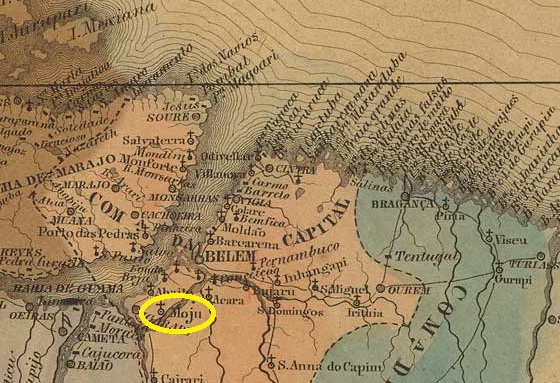
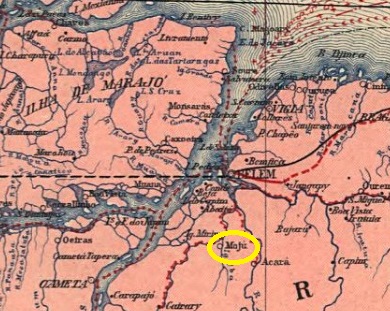
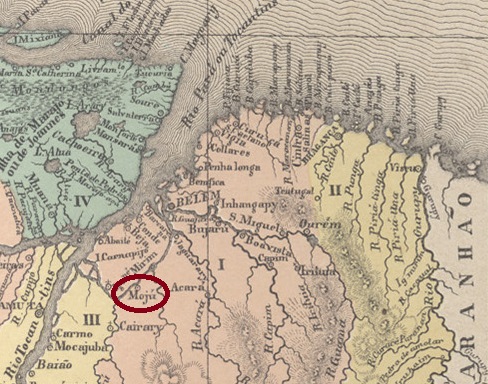
Villiers de l’Ile Adam: Carta (…) das Provincias do Grão-Pará e Alto Amazonas, 1850
The Freguesia de Espírito Santo de Moju existed since September 1839 and belonged to the Vila de Igarapé-Miri. It was located on the south bank of the Moju (today without an accent), 120 kilometres southwest of the provincial capital Belém do Pará. It was elevated to the status of municipality three times: in August 1856, in October 1889 and most recently in October 1835.
In between, Moju was twice subordinated to the municipality of Igarapé-Miri as a parish or district: in November 1887 and in December 1930.
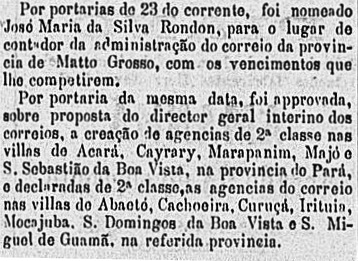
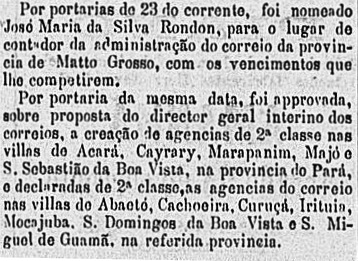
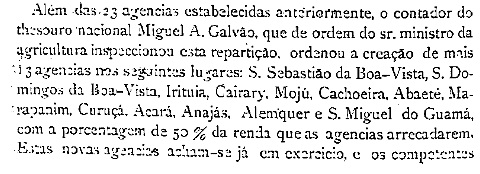
R. Koester writes in Carimbologia XXVII that there has been a post office there since 1882. This is confirmed by the press in Rio.
O Globo/RJ, 24 March 1882
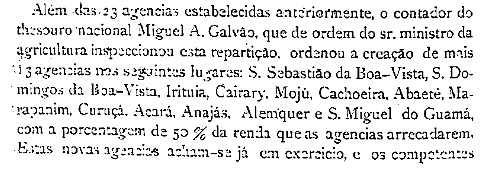
However, this could be a reopening, as the agency was already listed in the Imperial Postal Guide (Guia Postal do Império, Rio de Janeiro, 1880). Furthermore, the provincial president’s report from February 1881 indicates that a post office was already in operation in Moju at that time:
Relatorio do Presidente da Provincia, 02/1881
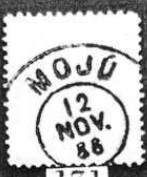
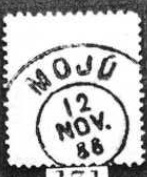
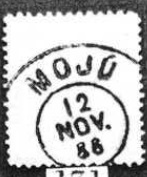
The imperial postmark is MPA-0170a (Fig. Koester, op. cit.):
MPA-0170a (RK) 1888Carta da Republica dos Estados Unidos do Brazil, 1892
A Freguesia de Espírito Santo de Moju existia desde setembro de 1839 e pertencia à Vila de Igarapé-Miri. Situava-se na margem sul do rio Moju (hoje sem acento), 120 quilômetros a sudoeste da capital do estado, Belém do Pará. Foi elevada três vezes à categoria de município: em agosto de 1856, em outubro de 1889 e, pela última vez, em outubro de 1835. Nesse intervalo, Moju foi subordinada duas vezes como freguesia ou distrito ao município de Igarapé-Miri: em novembro de 1887 e em dezembro de 1930. O nome Moju é uma variante do Mogy, que se encontra no Sul do Brasil, e significa também Rio das Cobras.
R. Koester escreve em Carimbologia XXVII que havia uma agência dos correios lá desde 1882. Isso é confirmado pela imprensa do Rio.
O Globo/RJ, 24/03/1882
No entanto, pode ter sido uma reabertura, pois a agência já constava no Guia Postal do Império (Rio de Janeiro, 1880). Além disso, o relatório do presidente da província de fevereiro de 1881 indica que já havia uma agência dos correios em Moju funcionando naquela época:
Relatório do Presidente da Província 02/1881
O carimbo postal imperial é MPA-0170a (fig. Koester, op. cit.):
MPA-0170a (RK) 1888Atlas do Imperio do Brasil, 1850
Die Freguesia de Espírito Santo de Moju bestand seit September 1839 und gehörte zur Vila de Igarapé-Miri. Sie lag am Südufer des Moju (heute ohne Akzent), 120 Kilometer südwestlich der Provinzhauptstadt Belém do Pará. Sie wurde dreimal zum Município erhoben: im August 1856, im Oktober 1889 und zuletzt im Oktober 1835.
Zwischendurch wurde Moju zweimal als Freguesia oder Distrikt dem Município de Igarapé-Miri untergeordnet: im November 1887 und im Dezember 1930.
R. Koester schreibt in Carimbologia XXVII, dass es dort seit 1882 ein Postamt gab. Dies wird durch die Presse aus Rio bestätigt.
O Globo/RJ, 24.03.1882
Allerdings könnte es sich hierbei um eine Wiedereröffnung handeln, denn die Agentur wurde bereits im Kaiserlichen Postführer (Guia Postal do Império, Rio de Janeiro, 1880) aufgeführt. Außerdem geht aus dem Bericht des Provinzpräsidenten vom Februar 1881 hervor, dass ein Postamt in Moju damals bereits in Betrieb war:
Relatorio do Presidente da Provincia 02/1881
Der kaiserliche Poststempel ist MPA-0170a (Abb. Koester, op. cit.):
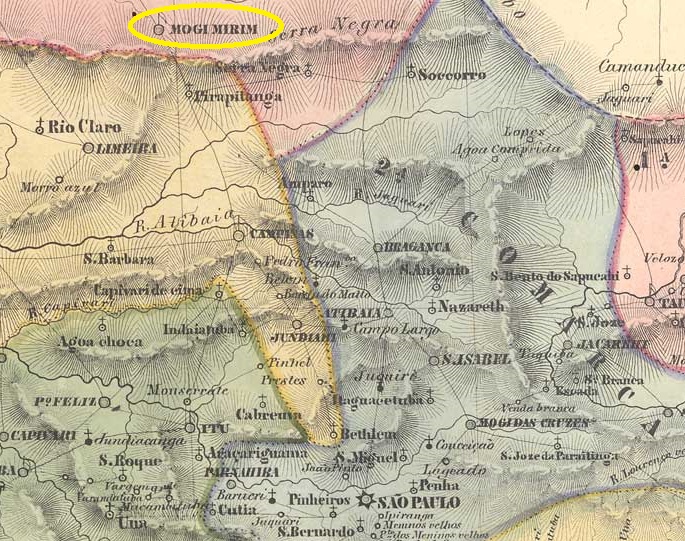
Villiers de l’Ile Adam: Carta (…) da Provincia de São Paulo, 1847
Other spellings: Mogy Merim, Mogi Mirim
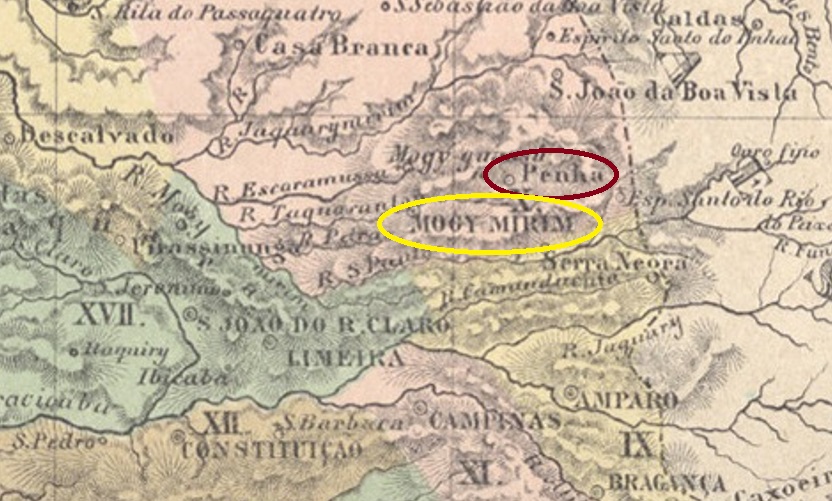
Of the three localities in the imperial province of São Paulo that bore the name Mogy, this was the largest and had the most postmarks. The Freguesia de S. José de Mogy Mirim, which had been in existence since November 1751, belonged to the Vila de Jundiaí and was located 150 kilometres north of the capital São Paulo. In October 1769, it was elevated to the status of a vila and in April 1849 to that of a city.
Three different dates have been found for the establishment of the local post office. Nova Monteiro writes in Administrações e Agencias Postaes do Brasil Imperio (Brasil Filatelico/RJ, 1934–35; reprinted by SPP 1994–99) that it was founded in August 1828. A preliminary announcement in the regional press supports this date.
O Farol Paulistano, 30 July 1828
However, the directory of imperial post offices (Tabella das Agencias do Correio do Imperio, Rio de Janeiro) gives the year 1844, which could mean either a reopening or the transfer of the post office to the administration of Rio de Janeiro. Finally, R. Koester mentions the year 1848 in Carimbologia XXVII, but without citing a source.
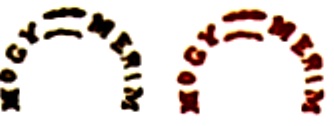
The oldest postmark to date is the pre-philatelic MSP-0820a, which also appears in sepia and is listed in the RHM catalogue under P-SP-22.
MSP-0820a (RHM P-SP-22) 1830-1843ff
This was followed by MSP-0820b, also available in red, with a change in the place name, and listed in the RHM catalogue (now under P-SP-23):
MSP-0820b (RHM P-SP-23) 1842-1843
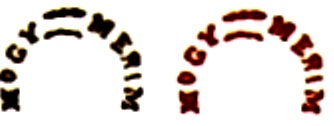
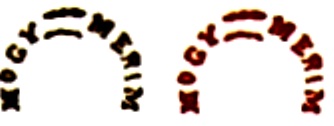
This was followed by MSP-0820c, which is available in both sepia and red, listed in the RHM under P-SP-24:
MSP-0820c (RHM P-SP-24) 1843ff
The last prephilatelistic cancel is MSP-0820d, which also exists in red and brown, was given the number 1155 in P. Ayres’ Catálogo de Carimbos Brasil-Império (S. Paulo, 1937, 1942) and was also recorded in the RHM:
MSP-0820d (P.A. 1155, RHM P-SP-25) 1843ff
At around the same time, a special type of postmark also appeared, MSP-0820e (Fig. RHM):
MSP-0820e (RHM) 1843ff
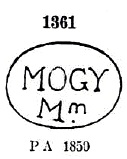
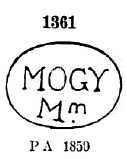
Paulo Ayres (op. cit.) shows MSP-0820f, which appeared in the 1850s, with the number 1361:
MSP-0820f (P.A. 1361) 1850ff
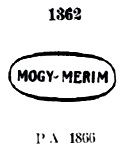
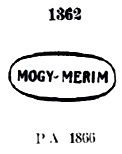
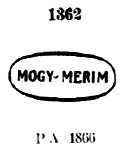
About 10 years later, the oval successor MSP-0820g appeared, also shown in P. Ayres (No. 1362):
MSP-0820g (P.A. 1362) 1864ff-1866ff
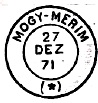
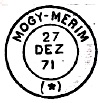
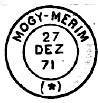
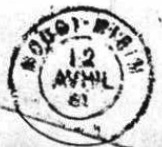
Shortly afterwards, the French type MSP-0820h (P.A. p. 117) came into use:
MSP-0820h (P.A. p. 117) 1868-1876
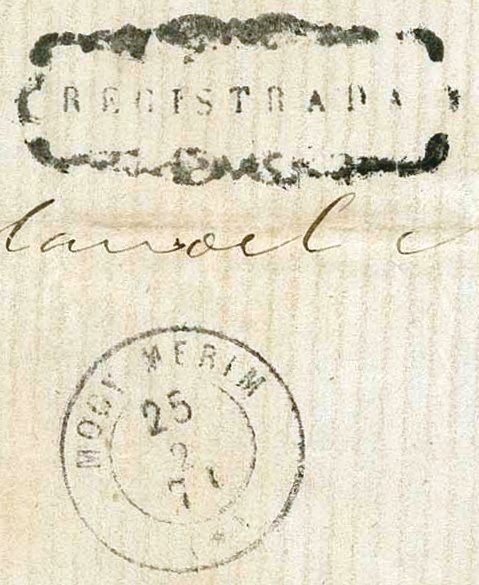
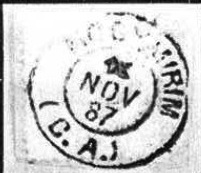
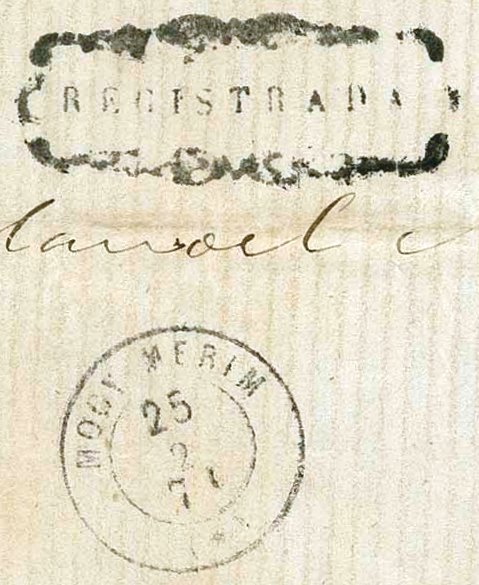
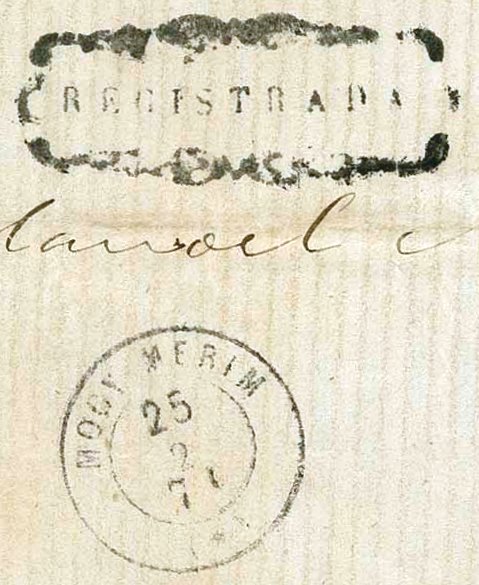
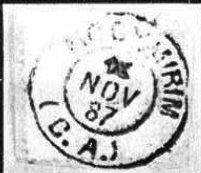
Around this time, the registration cancel MSP-0820i (Fig. Corinphila Auctions) was also used:
MSP-0820i (CO) 1870
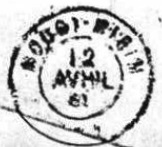
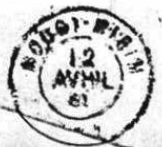
Subsequently, we find a second postmark of the French type, this time with a changed place name, MSP-0820j (Fig. Koester, op. cit.):
MSP-0820j (RK) 1877-1881
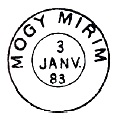
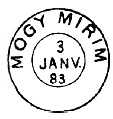
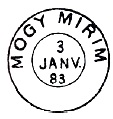
P. Ayres showed the following double circle MSP-0820k:
MSP-0820k (P.A. p. 120) 1882-1883
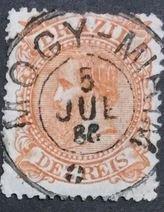
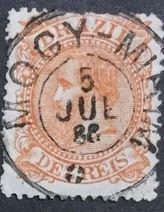
At the end of the imperial era, MSP-0820l also appears (illustration from the Internet):
MSP-0820l (EB) 1885-1889
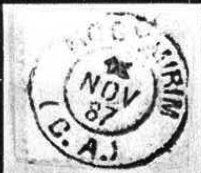
Around this time, the railway mail wagon postmark MSP-0821a (illustration Koester) also appears:
MSP-0821a (RK) 1887
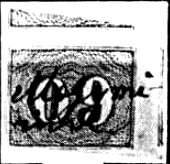
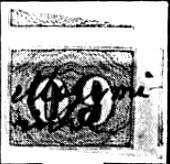
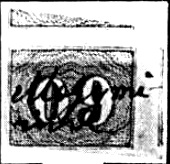
Koester also showed a handwritten cancellation from 1866:
1866 (RK)
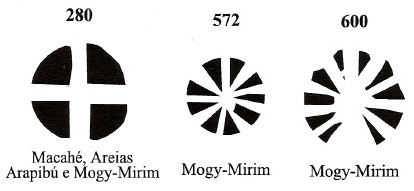
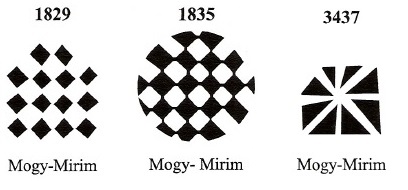
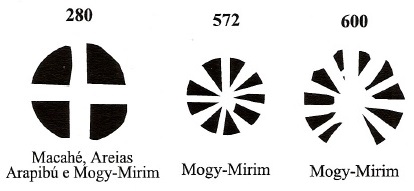
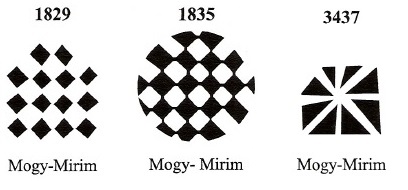
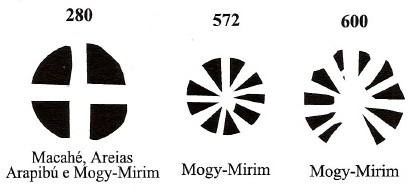
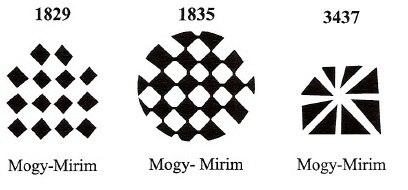
Finally, there are also some silent cancels from Mogy-Mirim, which were recorded by James Dingler and Klerman W. Lopes in Mute Cancellations of the Brazil Empire / Carimbos Mudos do Brasil Império (Brazil Philatelic Association, Rio de Janeiro, 2000):
BPA 280 – 572 -600BPA 1829 (P.A. 652 – 1883ff) – 1835 (1884) – 3437 (P.A. 117 – 1866ff)J.M. Ribeiro Lisboa: Provincia de São Paulo, 1884
Outras grafias: Mogy Merim, Mogi Mirim
Das três localidades da província imperial de São Paulo que levavam o nome Mogy, esta era a maior e tinha o maior número de carimbos postais. A Freguesia de S. José de Mogy Mirim, fundada em novembro de 1751, pertencia à Vila de Jundiaí e ficava a 150 quilômetros ao norte da capital São Paulo. Em outubro de 1769, foi elevada a vila e, em abril de 1849, a cidade.
Foram encontradas três datas diferentes para a criação da agência postal local. Nova Monteiro escreve em Administrações e Agencias Postaes do Brasil Imperio (Brasil Filatelico/RJ, 1934–35; reimpressão SPP 1994–99) que ela foi fundada em agosto de 1828. Um anúncio prévio na imprensa regional corrobora essa data.
O Farol Paulistano, 30/07/1828
Na Tabella das Agencias do Correio do Império (Rio de Janeiro, 1885), por outro lado, é indicado o ano de 1844, o que pode significar uma reabertura ou a incorporação da agência postal à administração do Rio de Janeiro. Finalmente, R. Koester menciona em Carimbologia XXVII o ano de 1848, porém sem indicar a fonte.
O carimbo postal mais antigo até agora é o pré-filatélico MSP-0820a, que também existe em sépia e está listado no catálogo RHM sob P-SP-22.
MSP-0820a (RHM P-SP-22) 1830-1843ff
Seguiu-se o MSP-0820b, também existente em vermelho, com uma alteração no nome do local, e também presente no catálogo RHM (agora sob P-SP-23):
MSP-0820b (RHM P-SP-23) 1842-1843
Depois veio o MSP-0820c, que existe tanto em sépia quanto em vermelho, listado no RHM sob P-SP-24:
MSP-0820c (RHM P-SP-24) 1843ff
O último carimbo pré-filatélico é o MSP-0820d, que também ocorre em vermelho e marrom, recebeu o número 1155 por P. Ayres (Catálogo de Carimbos Brasil-Império, São Paulo, 1937, 1942) e também foi registrado no RHM:
MSP-0820d (P.A. 1155, RHM P-SP-25) 1843ff
Mais ou menos na mesma época, aparece também um carimbo postal especial, o MSP-0820e (fig. RHM):
MSP-0820e (RHM) 1843ff
Paulo Ayres (op. cit.) mostra sob nº 1361 o MSP-0820f, que apareceu na década de 1850:
MSP-0820f (P.A. 1361) 1850ff
Cerca de 10 anos depois, surgiu o sucessor oval MSP-0820g, também encontrado em P. Ayres (n.º 1362):
MSP-0820g (P.A. 1362) 1864ff-1866ff
Pouco depois, passou a ser utilizado o tipo francês MSP-0820h (P.A. p. 117):
MSP-0820h (P.A. p. 117) 1868-1876
Nessa época, também foi utilizado o carimbo de registrados MSP-0820i (fig. Corinphila):
MSP-0820i (CO) 1870
Em seguida, encontramos um segundo carimbo postal do tipo francês, desta vez com o nome da localidade alterado, MSP-0820j (fig. Koester, op. cit.):
MSP-0820j (RK) 1877-1881
P. Ayres mostrou o seguinte círculo duplo MSP-0820k:
MSP-0820k (P.A. p. 120) 1882-1883
No final do Império, aparece também o MSP-0820l (fig. da Internet):
MSP-0820l (EB) 1885-1889
Nessa época, também aparece o carimbo ferroviário MSP-0821a (fig. Koester):
MSP-0821a (RK) 1887
Koester também mostrou uma obliteração manuscrita de 1866:
1866 (RK)
Por fim, alguns carimbos mudos também são originários de Mogy-Mirim, registrados por James Dingler e Klerman W. Lopes em Mute Cancellations of the Brazil Empire / Carimbos Mudos do Brasil Império (Clube Filatélico do Brasil, Rio de Janeiro, 2000):
BPA 280 – 572 -600BPA 1829 (P.A. 652 – 1883ff) – 1835 (1884) – 3437 (P.A. 117 – 1866ff)Atlas do Imperio do Brasil, 1868
Andere Schreibweisen: Mogy Merim, Mogi Mirim
Von den drei Ortschaften in der kaiserlichen Provinz São Paulo, die den Namen Mogy trugen, war diese die größte und hatte die meisten Poststempel. Die seit November 1751 überlieferte Freguesia de S. José de Mogy Mirim gehörte zur Vila de Jundiaí und lag 150 Kilometer nördlich der Hauptstadt São Paulo. Im Oktober 1769 wurde sie zur Vila und im April 1849 zur Stadt erhoben.
Es wurden drei verschiedene Jahresangaben für die Entstehung des örtlichen Postamts gefunden. Nova Monteiro schreibt in Administrações e Agencias Postaes do Brasil Imperio (Brasil Filatelico/RJ, 1934–35; Nachdruck SPP 1994–99), dass es im August 1828 gegründet wurde. Eine Vorankündigung in der regionalen Presse unterstützt dieses Datum.
O Farol Paulistano, 30.07.1828
Im Verzeichnis der kaiserlichen Postämter (Tabella das Agencias do Correio do Imperio, Rio de Janeiro) wird hingegen das Jahr 1844 angegeben, was entweder eine Wiedereröffnung oder die Übernahme des Postamts in die Verwaltung von Rio de Janeiro bedeuten kann. Schließlich nennt R. Koester in Carimbologia XXVII das Jahr 1848, allerdings ohne Quellenangabe.
Der bisher älteste Poststempel ist der vorphilatelistische MSP-0820a, der auch in Sepia vorkommt und im RHM-Katalog unter P-SP-22 aufgeführt wird.
MSP-0820a (RHM P-SP-22) 1830-1843ff
Es folgte der MSP-0820b, auch in Rot vorkommend, mit einer Änderung des Ortsnamens, und ebenfalls im RHM-Katalog (nun unter P-SP-23) zu sehen:
MSP-0820b (RHM P-SP-23) 1842-1843
Danach kam MSP-0820c, den es sowohl in Sepia als auch in Rot gibt, im RHM unter P-SP-24 aufgeführt:
MSP-0820c (RHM P-SP-24) 1843ff
Der letzte Vorphila-Stempel ist MSP-0820d, er existiert auch in Rot und Braun, bekam die Nr. 1155 in P. Ayres’ Catálogo de Carimbos Brasil-Império (S. Paulo, 1937, 1942) und wurde auch im RHM erfasst:
MSP-0820d (P.A. 1155, RHM P-SP-25) 1843ff
Etwa zur gleichen Zeit erscheint auch ein Poststempel der besonderer Art, MSP-0820e (Abb. RHM):
MSP-0820e (RHM) 1843ff
Paulo Ayres (op. cit.) zeigt mit Nr. 1361 den in den 50er Jahren vorkommenden MSP-0820f:
MSP-0820f (P.A. 1361) 1850ff
Etwa 10 Jahre später kam der ovale Nachfolger MSP-0820g, auch in P. Ayres (Nr. 1362) zu sehen:
MSP-0820g (P.A. 1362) 1864ff-1866ff
Kurz darauf kam der französische Typ MSP-0820h (P.A. S. 117) zu Gebrauch:
MSP-0820h (P.A. S. 117) 1868-1876
Um diese Zeit wurde auch der Einschreibestempel MSP-0820i (Abb. Corinphila Auktionen) verwendet:
MSP-0820i (CO) 1870
Anschließend finden wir einen zweiten Poststempel französischen Typs, diesmal mit verändertem Ortsnamen, MSP-0820j (Abb. Koester, op. cit.):
MSP-0820j (RK) 1877-1881
P. Ayres zeigte den folgenden Doppelkreis MSP-0820k:
MSP-0820k (P.A. S. 120) 1882-1883
Am Ende der Kaiserzeit erscheint auch MSP-0820l (Abb. aus dem Internet):
MSP-0820l (EB) 1885-1889
Um diese Zeit findet sich auch der Eisenbahn-Postwagonstempel MSP-0821a (Abb. Koester):
MSP-0821a (RK) 1887
Koester zeigte auch eine handschriftliche Entwertung aus 1866:
1866 (RK)
Schließlich stammen auch einige stumme Stempel aus Mogy-Mirim, die von James Dingler und Klerman W. Lopes in Mute Cancellations of the Brazil Empire / Carimbos Mudos do Brasil Império (Brazil Philatelic Association, Rio de Janeiro, 2000) erfasst wurden:



























 Carimbologia