Categories
Carimbologia C-D

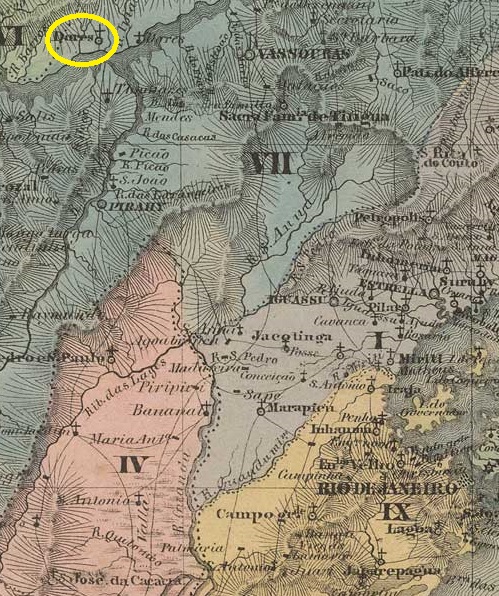
Dores (do Pirahy), Rio de Janeiro (DRJ-0450)

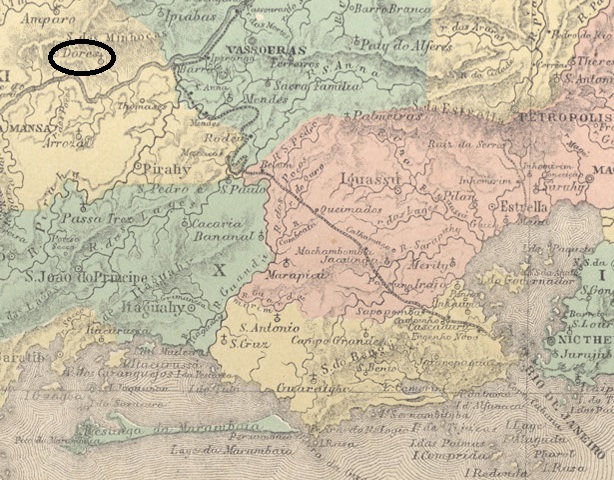
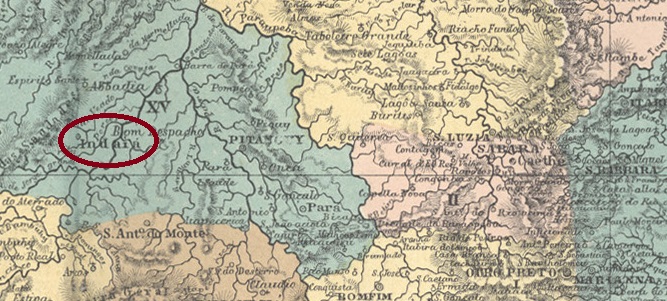
Atlas do Imperio do Brasil, 1868

Other names: Dorândia (1943)

N. Sra. das Dores was the name of a freguesia belonging to the Vila de Piraí near the north bank of the Paraíba do Sul, 140 km north-west of the capital Rio de Janeiro, from March 1844. In February 1890 it was incorporated as a distrito into the Município de Barra do Piraí, which has been called Dorândia since December 1943.

The local post office was founded twice. The first time was in May 1841, as Nova Monteiro writes in Administrações e Agencias Postaes do Brasil Imperio (Brasil Filatelico/RJ, 1934-5; reprint SPP 1994-1999). The agency was closed in June 1861, as reported in the Rio press:
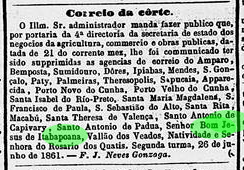
Correio Mercantil, 29/06/1861

It reopened in November of the same year:
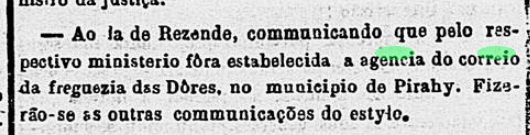
Correio Mercantil, 24/11/1861

The oldest cancel is DRJ-0450a, it also occurs in dark violet and was already introduced by P. Ayres in the Catálogo de Carimbos Brasil-Império (S. Paulo, 1937, 1942) under no. 1291:

DRJ-0450a (P.A. 1291) 1843ff-1883ff

This was followed by DRJ-0460a (fig. R. Koester, Carimbologia XVI), which also occurs in blue and dark violet:

DRJ-0460a (RK) 1877-1883

Then came DRJ-0460b, which also occurs in dark violet and is illustrated by P. Ayres (op. cit.):

DRJ-0460b (P.A. p. 121) 1884-1889

DRJ-0460c (fig. agenciaspostais.com.br) was also used in the early Republic:
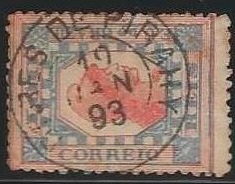
DRJ-0460c (PN) 1892-1893

P. Ayres also showed a handwritten cancellation which, according to R. Koester, could be assigned to this place.

(P.A. p. 147) 1866ff
Villiers de l’Ile Adam: Carta (…) da Provincia do Rio de Janeiro, 1850

Andere Namen: Dorândia (1943)

N. Sra. das Dores war ab März 1844 der Name einer zur Vila de Piraí gehörenden Freguesia nah am Nordufer des Paraíba do Sul, 140 km nordwestlich der Hauptstadt Rio de Janeiro. Im Februar 1890 wurde es als Distrito in das Município de Barra do Piraí eingegliedert, das seit Dezember 1943 Dorândia heißt.

Das örtliche Postamt wurde zweimal gegründet. Das erste Mal im Mai 1841, wie Nova Monteiro in Administrações e Agencias Postaes do Brasil Imperio (Brasil Filatelico/RJ, 1934-5; Nachdruck SPP 1994-1999) schreibt. Im Juni 1861 wurde die Agentur geschlossen, wie die Presse in Rio berichtete:
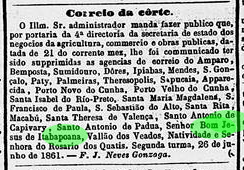
Correio Mercantil, 29.06.1861

Die Wiedereröffnung erfolgte im November desselben Jahres:
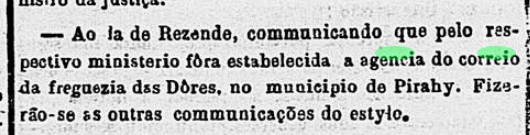
Correio Mercantil, 24.11.1861

Der älteste Stempel ist DRJ-0450a, er kommt auch in dunkelviolett vor und wurde bereits von P. Ayres im Catálogo de Carimbos Brasil-Império (S. Paulo, 1937, 1942) unter Nr. 1291 vorgestellt:

DRJ-0450a (P.A. 1291) 1843ff-1883ff

Es folgte DRJ-0460a (Abb. R. Koester, Carimbologia XVI), die auch in blau und dunkelviolett vorkommt: DRJ-0460a (RK) 1877-1883

Danach kam DRJ-0460b, die auch in dunkelviolett vorkommt und bei P. Ayres (op. cit.) abgebildet ist:

DRJ-0460b (P.A. S. 121) 1885-1889

In der frühen Republik wurde auch DRJ-0460c (Abb. agenciaspostais.com.br) verwendet:
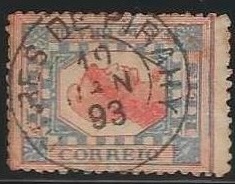
DRJ-0460c (PN) 1892-1893

P. Ayres zeigte auch eine handschriftliche Entwertung, die nach R. Koester diesem Ort zuzuordnen ist.

(P.A. S. 147) 1866ff
Categories
Carimbologia C-D

Dores do Indaiá, Minas Gerais (DMG-1070)

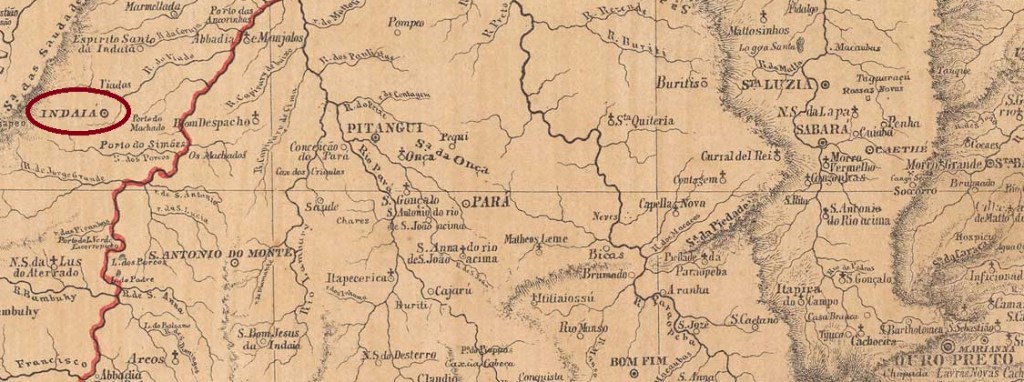
Atlas do Imperio do Brasil, 1868

N. Sra. das Dores do (also de) Indaiá was a freguesia belonging to the Vila de Pitangui from November 1842, located south of the Serra do Indaiá, 330 km north-west of the provincial capital Ouro Preto. The village was elevated to a Vila in May 1850, but lost this status in September 1870 when it became the Freguesia of Patrocinio da Marmellada. In November 1880, Dores de Indaiá regained its status as a Vila and was elevated to a town in October 1885.

Three foundation dates have been found for the local post office. The first was in February 1857, according to Nova Monteiro (Administrações e Agencias Postaes do Brasil Imperio, in Brasil Filatelico/RJ, 1934-5; reprint SPP 1994-1999). Then again in March 1857, as can be seen from Paula Sobrinho’s História Postal de Minas Gerais (Belo Horizonte, 1997). And finally, the agency is listed in the Imperial Postal Guide (Tabella de Agencias de Correio do Imperio, Rio de Janeiro, 1885) from 1881. Since it is listed in the Postal Guide (Guia Postal do Império, Rio de Janeiro, 1880),it was presumably closed for a short period around 1879.

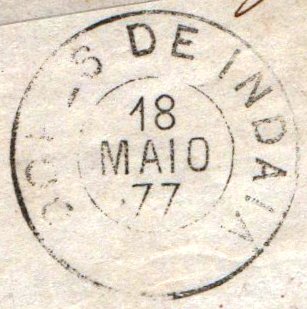
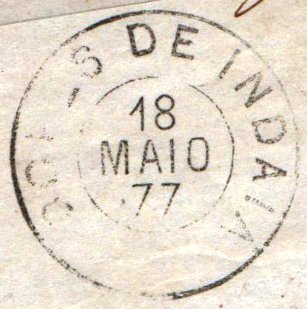
The oldest postmark has not yet been found. Its successor DMG-1070b (coll. José A. Junges) bears dates from 1877 onwards:

DMG-1070b (JJ) 1877-1883ff

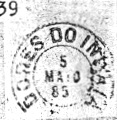
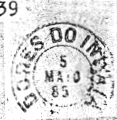
It was followed by DMG-1070c (fig. R. Koester in Carimbologia XVI), which also exists in blue:

DMG-1070c (RK) 1885-1891

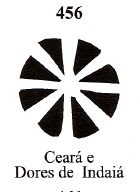
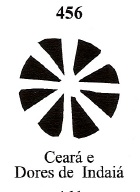
James Dingler and Klerman W. Lopes have also presented a mute cancellation from Dores de Indaiá in Mute Cancellations of the Brazil Empire / Carimbos Mudos do Brasil Império (Brazil Philatelic Association, Rio de Janeiro, 2000) under no. 456:

BPA 456 (1882)
Provincia de Minas Gerais, 1873

N. Sra. das Dores do (auch de) Indaiá war ab November 1842 eine zur Vila de Pitangui gehörende Freguesia und lag südlich der Serra do Indaiá, 330 km nordwestlich der Provinzhauptstadt Ouro Preto. Der Ort wurde im Mai 1850 zur Vila erhoben, verlor diesen Status jedoch im September 1870, als er zur Freguesia von der Vila de Patrocinio da Marmellada wurde. Im November 1880 erhielt Dores de Indaiá den Status einer Vila zurück und wurde im Oktober 1885 zur Stadt erhoben.

Für das örtliche Postamt wurden drei Gründungsdaten gefunden. Zum ersten Mal im Februar 1857, wie Nova Monteiro (Administrações e Agencias Postaes do Brasil Imperio, in Brasil Filatelico/RJ, 1934-5; Nachdruck SPP 1994-1999) schreibt. Dann wieder im März 1857, wie aus Paula Sobrinhos História Postal de Minas Gerais (Belo Horizonte, 1997) hervorgeht. Und schließlich ist die Agentur ab 1881 im Kaiserlichen Postführer (Tabella de Agencias de Correio do Imperio, Rio de Janeiro, 1885) verzeichnet. Da sie auch im Postführer (Guia Postal do Império, Rio de Janeiro, 1880) angeführt wird, wurde sie wohl für eine kurze Zeit um 1879 geschlossen.

Der älteste Poststempel ist bis heute nicht gefunden worden. Sein Nachfolger DMG-1070b (Samml. José A. Junges) trägt Daten ab 1877:

DMG-1070b (JJ) 1877-1883ff

Es folgte DMG-1070c (Abb. R. Koester in Carimbologia XVI), den es auch in blau gibt:

DMG-1070c (RK) 1885-1891

James Dingler und Klerman W. Lopes haben in Mute Cancellations of the Brazil Empire / Carimbos Mudos do Brasil Império (Brazil Philatelic Association, Rio de Janeiro, 2000) unter Nr. 456 auch eine stumme Entwertung aus Dores de Indaiá vorgestellt:

BPA 456 (1882)
Categories
Carimbologia C-D

Dores do Guaxupé, Minas Gerais (DMG-1065)

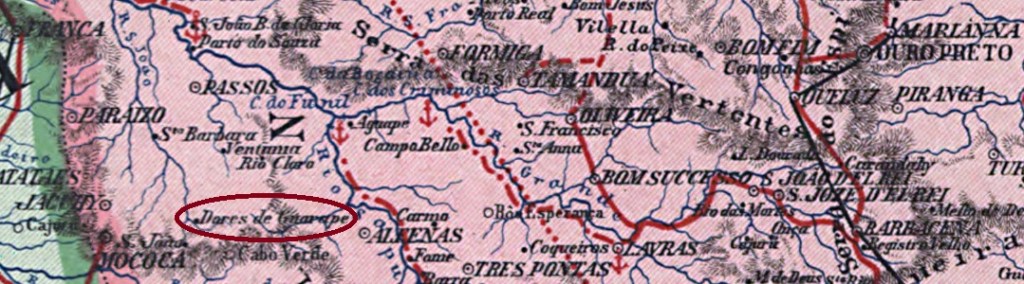
Atlas do Imperio do Brasil, 1868

Other names: Guaxupé (1923)

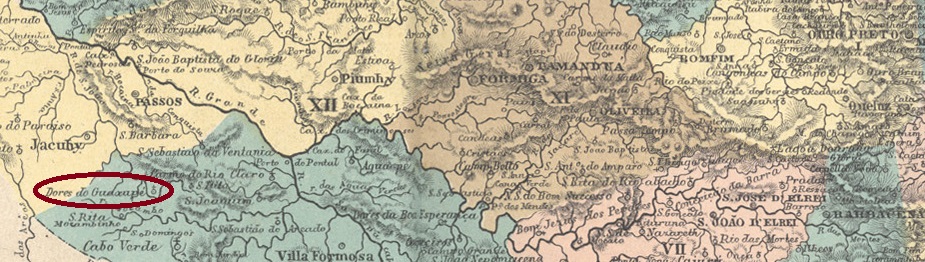
N. Sra. das Dores do Guaxupé was a distrito in the Município de Jacuí from May 1853, located on the south bank of the Guaxupé, 490 km west of the provincial capital Ouro Preto. The village was elevated to a freguesia in July 1864 and as such was incorporated into the Vila de Muzambinho in December 1878. Since August 1911, Guaxupé (as it is now abbreviated) has been an independent município. The name comes from the Tupi language and means bee that nests in the ground.

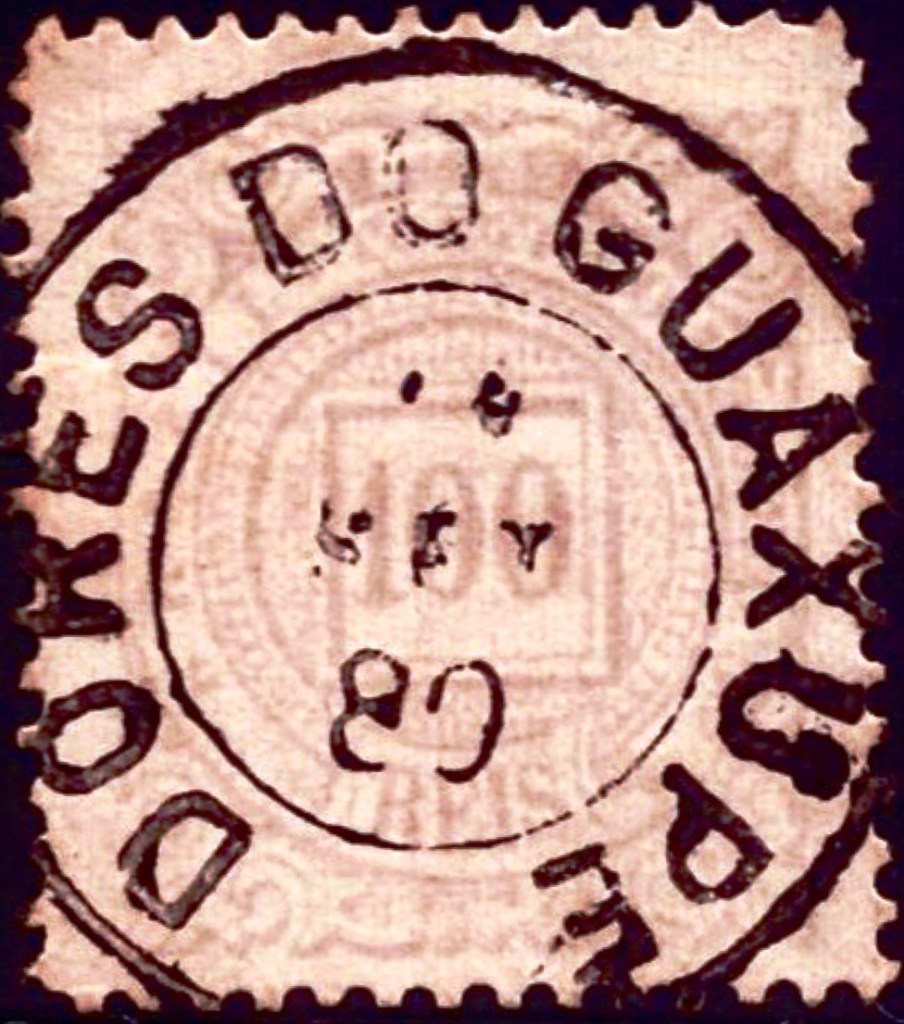
Paula Sobrinho (História Postal de Minas Gerais, Belo Horizonte, 1997) and R. Koester (Carimbologia XVI) agree that there has been a post office there since November 1878. The only imperial postmark to date is DMG-1065a (fig. Claudio Coelho):

DMG-1065a (CC) 1883-1908
Carta da Republica dos Estados Unidos do Brazil, 1892

Andere Namen: Guaxupé (1923)

N. Sra. das Dores do Guaxupé war seit Mai 1853 ein Distrito im Município de Jacuí und lag am Südufer des Guaxupé, 490 km westlich der Provinzhauptstadt Ouro Preto. Der Ort wurde im Juli 1864 zur Freguesia erhoben und als solche im Dezember 1878 in die Vila de Muzambinho eingegliedert. Seit August 1911 ist Guaxupé (wie es jetzt abgekürzt wird) ein eigenständiges Município. Der Name stammt aus der Tupi-Sprache und bedeutet Biene, die in der Erde nistet.

Paula Sobrinho (História Postal de Minas Gerais, Belo Horizonte, 1997) und R. Koester (Carimbologia XVI) sind sich einig, dass es dort seit November 1878 ein Postamt gab. Der bisher einzige kaiserliche Poststempel ist DMG-1065a (Abb. Claudio Coelho):

DMG-1065a (CC) 1883-1908
Categories
Carimbologia C-D

Dores do Campo Formoso, Minas Gerais (DMG-1060)

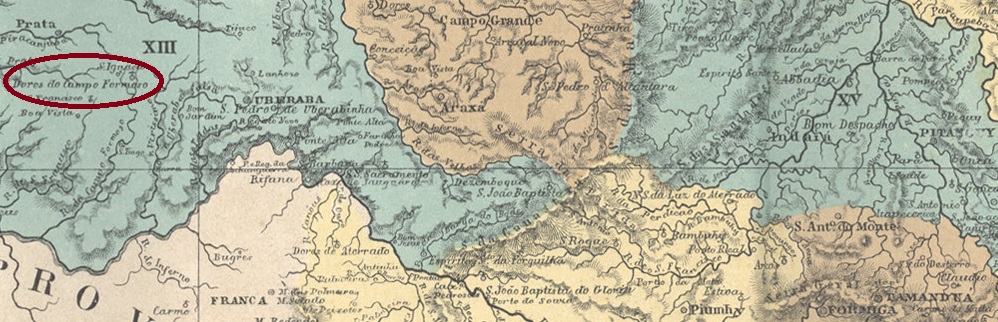
Atlas do Imperio do Braisl, 1868

Other names: Campo Formoso, Campo Florido (1943)

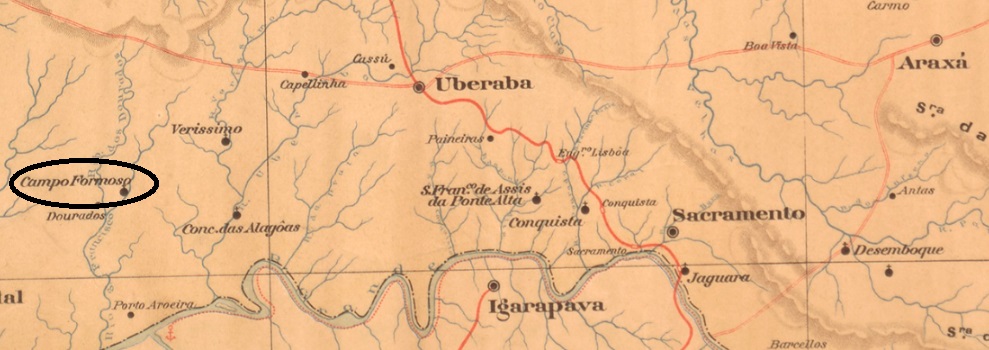
N. Sra. das Dores do Campo Formoso had been a distrito of the Vila de Uberaba since March 1846 and was located on the west bank of the Ribeirão Dourado, 740 kilometres west of the provincial capital Ouro Preto. The village was elevated to a freguesia in November 1875 and renamed Campo Formoso in September 1923. Under this name, it was elevated to Município in December 1938. In December 1943, however, the place name was changed to Campo Florido (Flower Meadow), probably to avoid confusion with the município of the same name in Bahia.

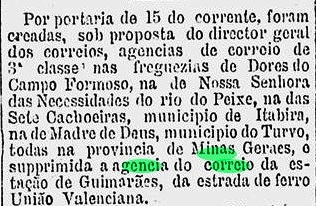
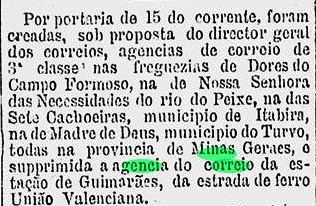
Three dates close to each other were found for the creation of the local post office. The first time was in December 1881, according to the press in Rio:

Gazeta de Noticias/RJ, 18/12/1881

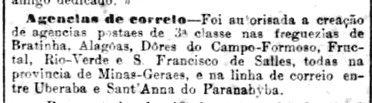
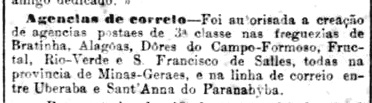
Then again in January 1882, as also reported from Rio:

Jornal do Commercio/RJ 11 Jan. 1882

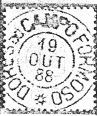
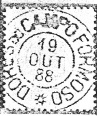
Finally, both Paula Sobrinho (História Postal de Minas Gerais, Belo Horizonte, 1997) and R. Koester (Carimbologia XVI) have registered February 1882 for it. The only imperial postmark to date is DMG-1060a (fig. Koester, op. cit.):

DMG-1060a (RK) 1887-1890
Estado de Minas Geraes, 1910

Andere Namen: Campo Formoso, Campo Florido (1943)

N. Sra. das Dores do Campo Formoso war seit März 1846 ein Distrito der Vila de Uberaba und lag am Westufer des Ribeirão Dourado, 740 km westlich der Provinzhauptstadt Ouro Preto. Der Ort wurde im November 1875 zur Freguesia erhoben und im September 1923 in Campo Formoso umbenannt. Unter diesem Namen erfolgte im Dezember 1938 die Erhebung zum Município. Im Dezember 1943 wurde der Ortsname jedoch in Campo Florido (Blumenwiese) geändert, wahrscheinlich um Verwechslungen mit dem gleichnamigen Município in Bahia zu vermeiden.

Für die Gründung des örtlichen Postamtes wurden drei Daten gefunden, die nahe beieinander liegen. Zum ersten Mal im Dezember 1881, wie aus der Presse in Rio hervorgeht:

Gazeta de Noticias/RJ, 18.12.1881

Dann wieder im Januar 1882, wie ebenfalls aus Rio berichtet wird:

Jornal do Commercio/RJ 11.01.1882

Schließlich haben sowohl Paula Sobrinho (História Postal de Minas Gerais, Belo Horizonte, 1997) als auch R. Koester (Carimbologia XVI) den Februar 1882 dafür registriert. Der bisher einzige kaiserliche Poststempel ist DMG-1060a (Abb. Koester, op. cit.):

DMG-1060a (RK) 1887-1890
Categories
Carimbologia C-D

Dores do Atterrado, Minas Gerais (DMG-1055)

Estado de Minas Geraes, 1910

Other names: Ibiraci (1923)

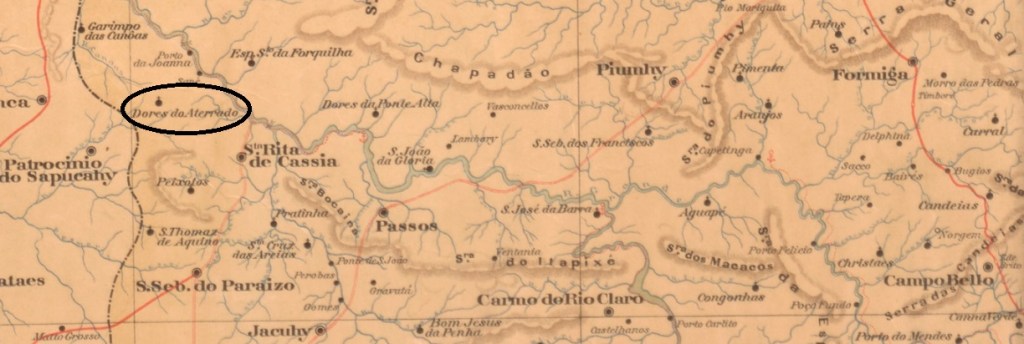
The Freguesia de N. Sra. das Dores do Aterrado was founded in June 1850 and belonged to the Vila de Jacuí, 530 kilometres west of the provincial capital Ouro Preto. In September 1870 it was incorporated into the newly founded Vila S. Sebastião do Paraíso and twenty years later into the Vila de Sta. Rita de Cássia. In September 1923 it was elevated to the Município de Ibiraci, which became a town two years later. The name is of Indian origin and means mother of trees.

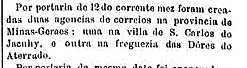
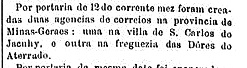
As Paula Sobrinho (História Postal de Minas Gerais, Belo Horizonte, 1997) and R. Koester (Carimbologia XVI) write, there has been a post office there since September 1883. This is confirmed by the press in Rio:

Brazil/RJ, 20/09/1883

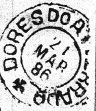
The only imperial postmark to date is DMG-1055a (fig. R. Koester, op. cit.):

DMG-1055a (RK) 1886
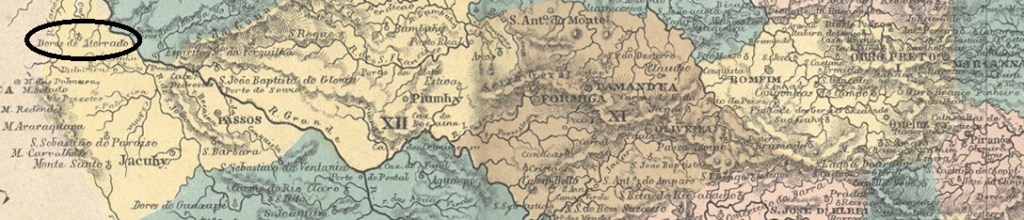
Atlas do Imperio do Brasil, 1868

Andere Namen: Ibiraci (1923)

Die Freguesia de N. Sra. das Dores do Aterrado wurde im Juni 1850 gegründet und gehörte zur Vila de Jacuí, 530 km westlich der Provinzhauptstadt Ouro Preto. Im September 1870 kam es zur neu gegründeten Vila S. Sebastião do Paraíso und zwanzig Jahre später zur Vila de Sta. Rita de Cássia. Im September 1923 erfolgte die Erhebung zum Município de Ibiraci, das zwei Jahre später zur Stadt wurde. Der Name ist indianischen Ursprungs und bedeutet Mutter der Bäume.

Wie Paula Sobrinho (História Postal de Minas Gerais, Belo Horizonte, 1997) und R. Koester (Carimbologia XVI) schreiben, gab es dort seit September 1883 ein Postamt. Dies wird von der Presse in Rio bestätigt:

BrazillRJ, 20.09.1883

Der bisher einzige kaiserliche Poststempel ist DMG-1055a (Abb. R. Koester, op. cit.):

DMG-1055a (RK) 1886
Categories
Carimbologia C-D

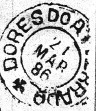
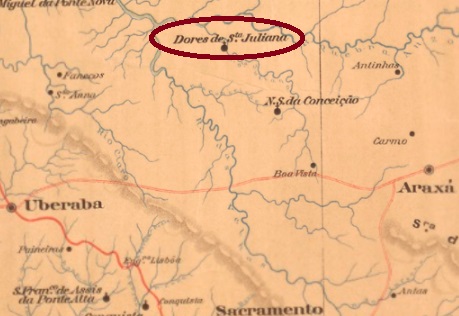
Dores de Santa Juliana, Minas Gerais (DMG-1050)

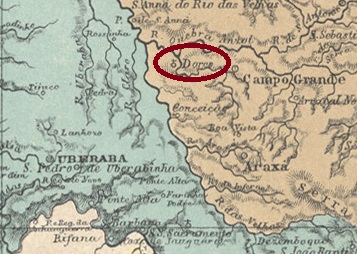
Estado de Minas Geraes, 1910

Other names: Santa Juliana (1938)

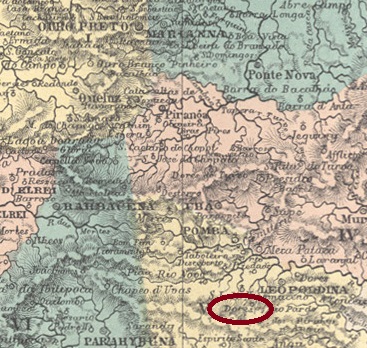
Nossa Senhora das Dores de Santa Juliana had been a district of the Vila de Araxá since October 1851, near the south bank of the Ribeirão Santa Juliana, 600 kilometres west of the provincial capital Ouro Preto. The village was elevated to a freguesia in November 1875 and has been Município de Santa Juliana since December 1938.

Paula Sobrinho (História Postal de Minas Gerais, Belo Horizonte, 1997) and R. Koester (Carimbologia XVI) agree that there has been a post office there since July 1884. The only imperial postmark to date is DMG-1050a (fig. R. Koester, op. cit.):

DMG-1050a (RK) 1886-1889ff
Atlas do Imperio do Brasil, 1868

Andere Namen: Santa Juliana (1938)

Nossa Senhora das Dores de Santa Juliana war seit Oktober 1851 ein Distrito der Vila de Araxá, nahe dem Südufer des Ribeirão Santa Juliana, 600 km westlich der Provinzhauptstadt Ouro Preto. Die Ortschaft wurde im November 1875 zur Freguesia erhoben und ist seit Dezember 1938 Município de Santa Juliana.

Paula Sobrinho (História Postal de Minas Gerais, Belo Horizonte, 1997) und R. Koester (Carimbologia XVI) schreiben übereinstimmend, dass es dort seit Juli 1884 ein Postamt gab. Der bisher einzige kaiserliche Poststempel ist DMG-1050a (Abb. R. Koester, op. cit.):

DMG-1050a (RK) 1886-1889ff
Categories
Carimbologia C-D

Dores de Monte Alegre, Minas Gerais (DMG-1045)

Provincia de Minas Geraes, 1873

Other names: Rabicho, Taruaçu (1892)

Dores de Monte Alegre was a district of the Vila de Mar d’Espanha from June 1858, located 230 kilometres south of the provincial capital Ouro Preto. In July 1868 the district changed to the Vila de S. João Nepomuceno and in July 1872 Dores de Monte Alegre became a freguesia in the Município Rio Novo, which returned to S. João Nepomuceno in November 1880 and was renamed Taruassú in 1892. The Indian word means “big sky”.

Paula Sobrinho in História Postal de Minas Gerais (Belo Horizonte, 1997) and R. Koester in Carimbologia XVI write that there has been a post office there since September 1878. The oldest postmark to date is DMG-1045a (image from the Internet):

DMG-1045a (EB) 1881-1890

R. Koester (op. cit.) also shows a handwritten cancellation from 1884:

1884 (RK)
Atlas do Imperio do Brasil, 1868

Andere Namen: Rabicho, Taruaçu (1892)

Dores de Monte Alegre war ab Juni 1858 ein Distrito der Vila de Mar d’Espanha und lag 230 km südlich der Provinzhauptstadt Ouro Preto. Im Juli 1868 wechselte der Distrikt zur Vila de S. João Nepomuceno und im Juli 1872 wurde Dores de Monte Alegre eine Freguesia im Município Rio Novo, die im November 1880 wieder zu S. João Nepomuceno zurückkehrte und 1892 in Taruassú umbenannt wurde. Das indianische Wort bedeutet “Großer Himmel”.

Paula Sobrinho in História Postal de Minas Gerais (Belo Horizonte, 1997) und R. Koester in Carimbologia XVI schreiben, dass es dort seit September 1878 ein Postamt gab. Der bisher älteste Poststempel ist DMG-1045a (Abbildung aus dem Internet):

DMG-1045a (EB) 1881-1890

R. Koester (op. cit.) zeigt auch eine handschriftliche Entwertung aus dem Jahr 1884:

1884 (RK)
Categories
Carimbologia C-D

Dores de Macabu (train station/Bahnhof), Rio de Janeiro (DRJ-0455)

Almanak Laemmert, 1892

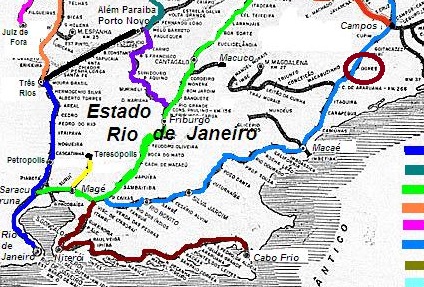
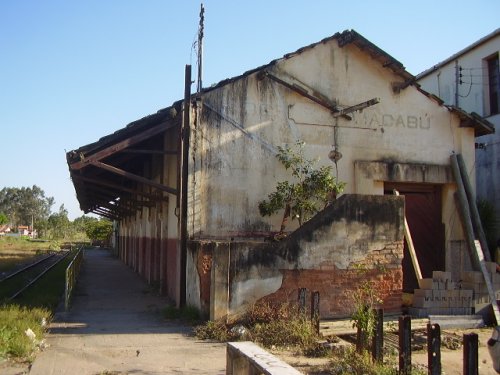
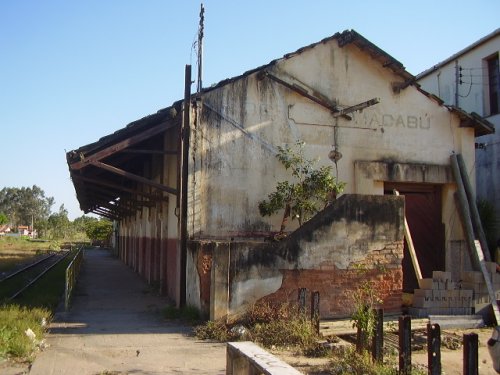
Dores de Macabu station was opened in 1875 by the railway company E.F. Macaé e Campos (Coastline) and was located near the north bank of the Macabu in the Município de Campos, 320 km north-east of the capital Rio de Janeiro. The line went to E.F. Leopoldina in 1887 and belonged to Rede Ferroviária Federal S.A. from 1975 until it was closed in 1996 (estacoesferroviarias.com.br). The tracks are still there today, but the station building was derelict in 2008.

In July 2008 (photo Ricardo Q. Mattos, on estacoesferroviarias.com.br)

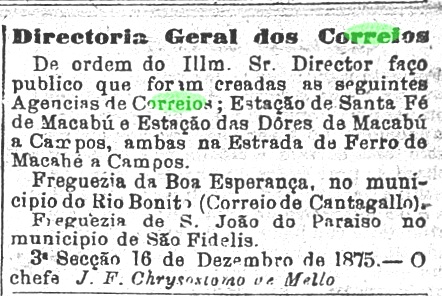
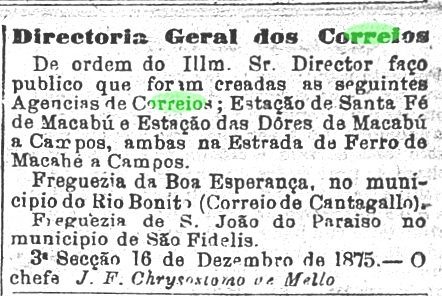
As the capital’s press reported, there had been a post office in the station since December 1875:

O Globo, 17/12/1875

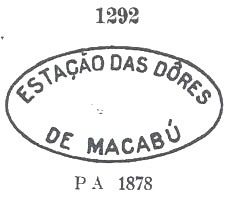
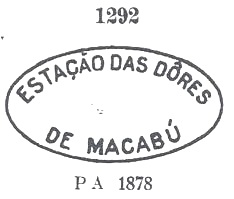
The oldest postmark is DRJ-0455a and was already presented by Paulo Ayres in the Catálogo de Carimbos Brasil-Império (S. Paulo, 1937, 1942) with no. 1292:

DRJ-0455a (P.A. 1292) 1876ff-1878

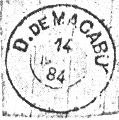
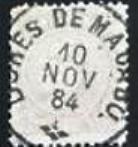
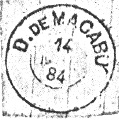
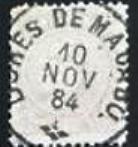
DRJ-0455b (fig. R. Koester in Brasil Filatélico 170) and DRJ-0455c (fig. from the internet) followed almost simultaneously:

DRJ-0455b (RK) 1884
DRJ-0455c (EB) 1884

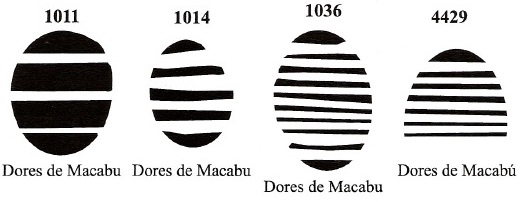
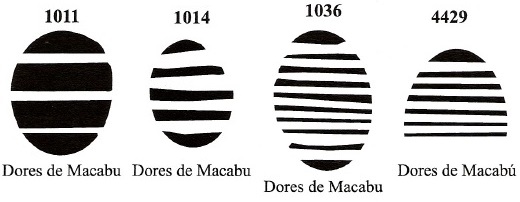
James Dingler and Klerman W. Lopes have also shown four mute cancellations from the Dores de Macabu station in Mute Cancellations of the Brazil Empire / Carimbos Mudos do Brasil Império (Brazil Philatelic Association, Rio de Janeiro, 2000):

BPA 1011 – 1014 – 1036 – 4429 (1877ff-1879)
Estrada de Ferro Leopoldina

Der Bahnhof Dores de Macabu wurde 1875 von der Bahngesellschaft E.F. Macaé e Campos (Küstenlinie) eröffnet und lag nah am Nordufer des Macabu im Município de Campos, 320 km nordöstlich der Hauptstadt Rio de Janeiro. Die Strecke ging 1887 an die E.F. Leopoldina und gehörte von 1975 bis zu ihrer Stilllegung 1996 der Rede Ferroviária Federal S.A. (estacoesferroviarias.com.br). Heute sind die Gleise noch vorhanden, das Bahnhofsgebäude war 2008 noch verfallen.

Im Juli 2008 (Foto Ricardo Q. Mattos, auf estacoesferroviarias.com.br)

Wie die Hauptstadtpresse berichtete, gab es im Bahnhof seit Dezember 1875 ein Postamt:

O Globo, 17.12.1875

Der älteste Poststempel ist DRJ-0455a und wurde bereits von Paulo Ayres im Catálogo de Carimbos Brasil-Império (S. Paulo, 1937, 1942) mit Nr. 1292 vorgestellt:

DRJ-0455a (P.A. 1292) 1876ff-1878

Fast gleichzeitig folgten DRJ-0455b (Abb. R. Koester in Brasil Filatélico 170) und DRJ-0455c (Abb. aus dem Internet):

DRJ-0455b (RK) 1884
DRJ-0455c (EB) 1884

James Dingler und Klerman W. Lopes haben in Mute Cancellations of the Brazil Empire / Carimbos Mudos do Brasil Império (Brazil Philatelic Association, Rio de Janeiro, 2000) auch vier stumme Stempel aus dem Bahnhof Dores de Macabu abgebildet:

BPA 1011 – 1014 – 1036 – 4429 (1877ff-1879)
Categories
Carimbologia C-D

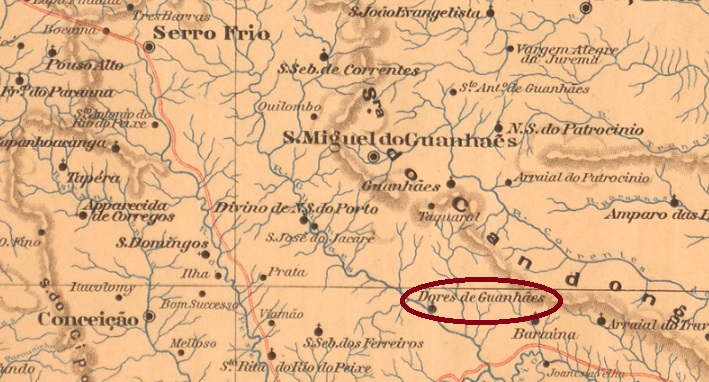
Dores de Guanhães, Minas Gerais (DMG-1040)

Estado de Minas Geraes, 1910

See also Capellinha das Dores (CMG-0565)

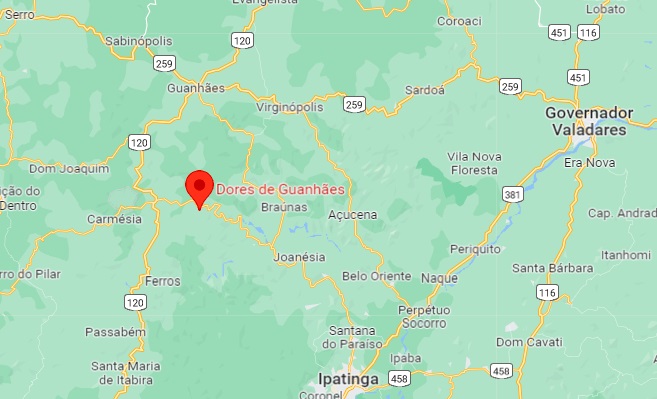
The locality of Capellinha das Dores became a district in April 1854, belonged to the Vila of Conceição do Mato Dentro and was located on the south bank of the Guanhães, 260 km north of the provincial capital of Ouro Preto. In September 1870, it was elevated to a freguesia and assigned to the Vila of S. Miguel de Guanhães under the name N. Sra. das Dores. In September 1923, the place name was simplified to Dores de Guanhães, which has been an independent município since December 1962.

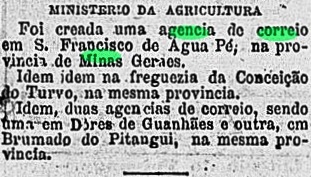
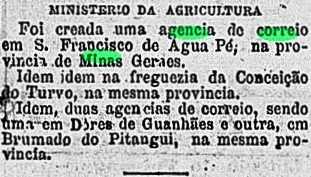
Of the three creation dates for the local post office, one is probably wrong, the other two possibly belong together. In the Directory of Imperial Post Offices (Tabella das Agencias do Correio do Imperio, Rio de Janeiro, 1885) the year 1862 is given, but this is more likely a case of confusion with the other Capellinha in Minas Gerais (CMG-0555), where a post office was founded in that year. Both Paula Sobrinho in História Postal de Minas Gerais (Belo Horizonte, 1997) and R. Koester in Carimbologia IX write February 1881 for the creation of the post office in Dores de Guanhães, which is confirmed by the press in Rio:

Gazeta de Noticias/RJ, 21/02/1881

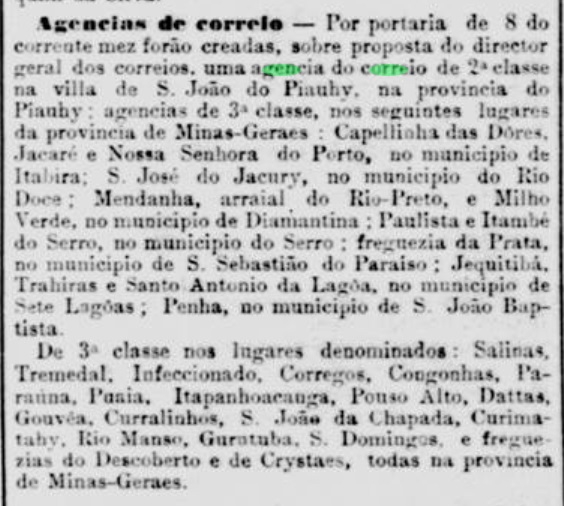
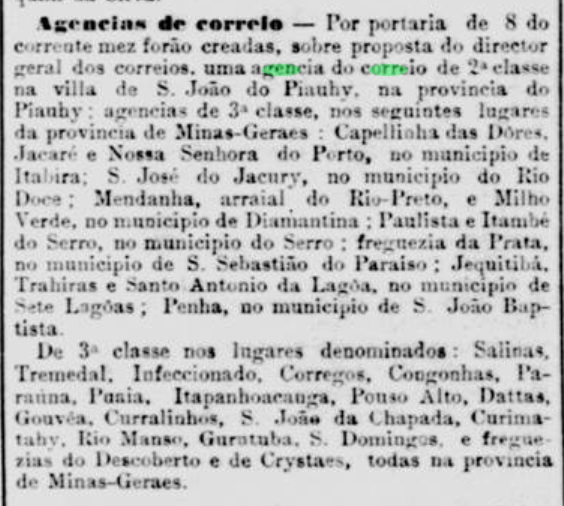
In November of the same year, the capital’s press reported on the establishment of a post office in Capellinha das Dores:

Jornal do Commercio/RJ, 12.11.1881

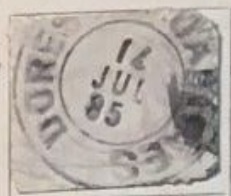
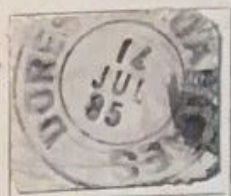
No imperial postmark with Capellinha das Dores has yet been found. With the place name Dores de Guanhães there is DMG-1040a (illustration from the Internet), which also occurs in dark violet:

DMG-1040a (EB) 1885-1889
Google Maps

Siehe auch Capellinha das Dores (CMG-0565)

Die Siedlung Capellinha das Dores wurde ein Distrikt im April 1854, gehörte zur Vila von Conceição do Mato Dentro und lag am Südufer des Guanhães, 260 km nördlich der Provinzhauptstadt Ouro Preto. Im September 1870 wurde es zur Freguesia erhoben und unter dem Namen N. Sra. das Dores der Vila von S. Miguel de Guanhães zugeordnet. Im September 1923 wurde der Ortsname in Dores de Guanhães vereinfacht, der Ort ist seit Dezember 1962 ein eigenständiges Município.

Von den drei gefundenen Gründungsdaten für das örtliche Postamt dürfte das älteste falsch sein, die beiden anderen gehören möglicherweise zusammen. Im Verzeichnis der kaiserlichen Postämter (Tabella das Agencias do Correio do Imperio, Rio de Janeiro, 1885) wird das Jahr 1862 angegeben, aber hier liegt eher eine Verwechslung mit dem anderen Capellinha in Minas Gerais (CMG-0555) vor, wo in diesem Jahr ein Postamt gegründet wurde. Paula Sobrinho in História Postal de Minas Gerais (Belo Horizonte, 1997) und R. Koester in Carimbologia IX schreiben den Februar 1881 für die Postamtgründung in Dores de Guanhães, was durch die Presse in Rio bestätigt wird:

Gazeta de Noticias/RJ, 21.02.1881

Die Hauptstadtpresse berichtete im November desselben Jahres von einer Postamtsgründung in Capellinha das Dores:

Jornal do Commercio/RJ, 12.11.1881

Bisher wurde noch kein kaiserlicher Poststempel aus diesem Ort unter Capellinha das Dores gefunden. Mit dem Ortsnamen Dores de Guanhães haben wir DMG-1040a (Abb. aus dem Internet), der auch in dunkelviolett vorkommt:

DMG-1040a (EB) 1885-1889
Categories
Carimbologia C-D

Dores de Camaquam, Rio Grande do Sul (DRS-0155)

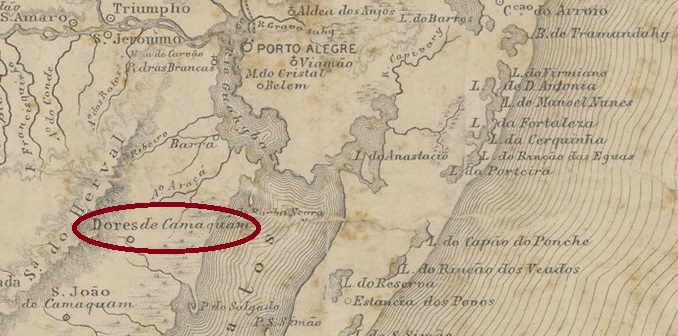
Provincia de São Pedro do Rio Grande, 1877

Other names: Vila Vasconcelos, Sentinela do Sul (1992)

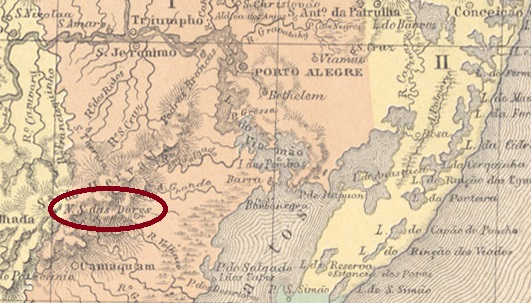
The chapel of N. Sra. das Dores was built in 1819. It was located on the east bank of the Sanga das Capivaras and belonged to the capital of Capitania, Porto Alegre, 100 kilometres to the north. In October 1831, it was incorporated as a district of the newly founded Vila de Triunfo. This was followed by no fewer than four promotions to freguesia: in August 1833 (to Triunfo), in April 1846 and December 1851 (under Porto Alegre) and in April 1864 (belonging to Vila de S. João Do Camaquan). In between, Dores do Camaquan was twice an independent vila, in December 1857 and April 1875.

The administrative chages continued in the 20th centur. In January 1911, Dores do Camaquan became a district of the Município de Porto Alegre, in January 1929 this district was transferred to the Município de Tapes and in November 1938 the place name was changed to Vila Vasconcelos. Since March 1992, the locality has been the Município Sentinela do Sul.

Nova Monteiro (Administrações e Agencias Postaes do Brasil Imperio, in Brasil Filatelico/RJ, 1934-5; reprint SPP 1994-1999) and R. Koester (Carimbologia XVI) write that there was a post office there from October 1860. The oldest postmark to date is probably not the first. DRS-0155b (fig. André Matzenbacher und Claudio Coelho) was previously seen with dates from 1880-1901:

DRS-0155b (AM-CC) 1880-1901

R . Koester (op. cit.) also shows the seal postmark DRS-0155c:

DRS-0155c (RK XVI)
Atlas do Imperio do Brasil, 1868

Andere Namen: Vila Vasconcelos, Sentinela do Sul (1992)

Die Kapelle N. Sra. das Dores wurde 1819 erbaut. Sie lag am Ostufer des Kleinflusses Sanga das Capivaras und gehörte zur 100 km nördlich gelegenen Hauptstadt der Capitania, Porto Alegre. Im Oktober 1831 wurde es als Distrito der neu gegründeten Vila de Triunfo eingegliedert. Es folgten nicht weniger als vier Aufstiege zur Freguesia: im August 1833 (zu Triunfo), im April 1846 und im Dezember 1851 (zu Porto Alegre) und im April 1864 (zu Vila de S. João Do Camaquan). Dazwischen war Dores do Camaquan zweimal eine unabhängige Vila, im Dezember 1857 und im April 1875.
Im 20. Jahrhundert ging die wechselvolle Geschichte der Gemeindeverwaltung munter weiter: Im Januar 1911 wurde Dores do Camaquan ein Distrito des Município de Porto Alegre, im Januar 1929 ging dieser Distrikt an das Município de Tapes über und im November 1938 wurde der Ortsname in Vila Vasconcelos geändert. Seit März 1992 ist der Ort der Município Sentinela do Sul.

Nova Monteiro (Administrações e Agencias Postaes do Brasil Imperio, in Brasil Filatelico/RJ, 1934-5; Reprint SPP 1994-1999) und R. Koester (Carimbologia XVI) schreiben, dass es dort ab Oktober 1860 ein Postamt gab. Der bisher älteste Poststempel ist wahrscheinlich nicht der erste. DRS-0155b (Abb. André Matzenbacher und Claudio Coelho) wurde bisher mit Daten von 1880-1901 gesehen:

DRS-0155b (AM-CC) 1880-1901

R . Koester (op. cit.) zeigt auch den Siegelstempel DRS-0155c:

DRS-0155c (RK)