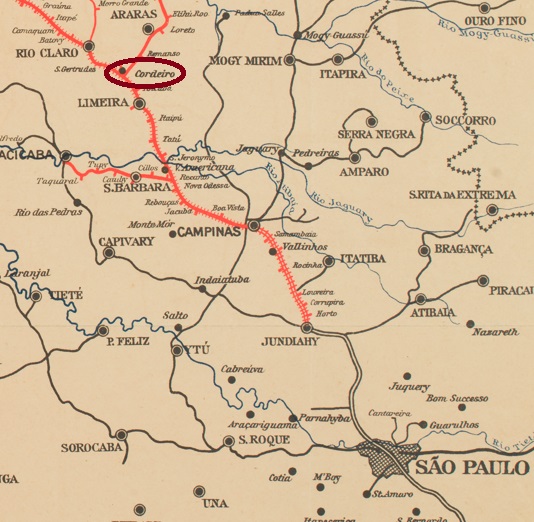
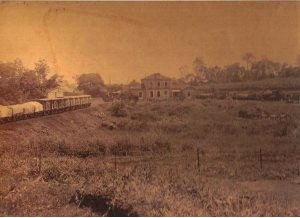
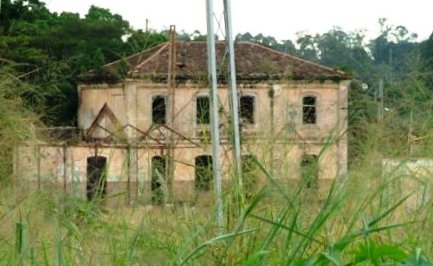
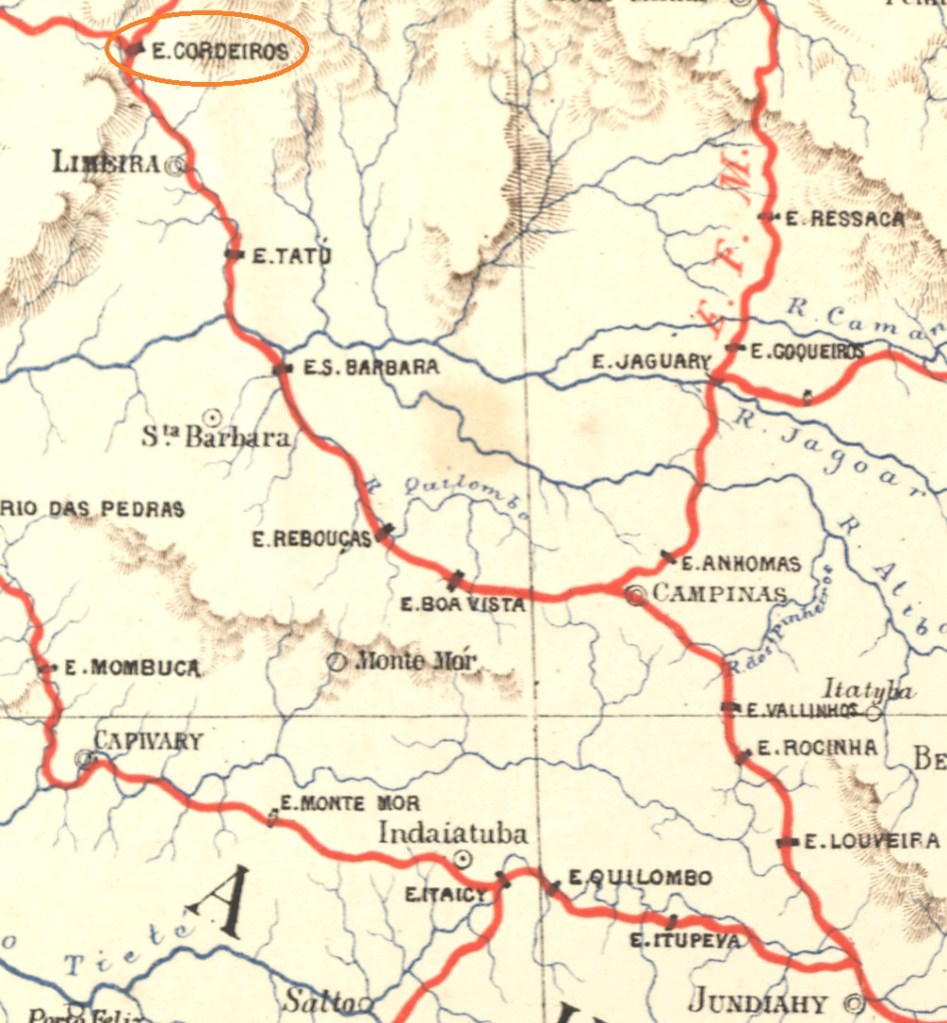
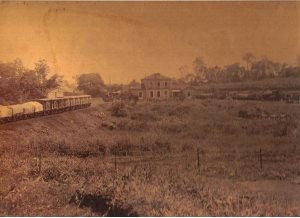
Cordeiros station in the province of São Paulo was opened in August 1876 by the railway company Cia. Paulista (main line) and was located on the west bank of the Ribeirão do Tatu in the Município de Limeira, 160 km north-west of the provincial capital. The line belonged to FEPASA from 1971 until its closure. Today, the tracks still exist, the station is being renovated and will house both a railway museum and the municipality’s cultural office.
In 1901 (Photo: Adolfo Pinto, on estacoesferroviarias.com.br)In 2008, before the restoration (Photo: Ralph M. Giesbrecht, on estacoesferroviarias.com.br)
The area around the railway station became the district of Cordeiro in August 1899 and was renamed Cordeirópolis in November 1944, becoming an independent município in December 1948.
According to the regional press, there has been a post office at the railway station since December 1879:
Correio Paulistano, 27/12/1879
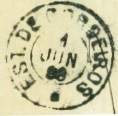
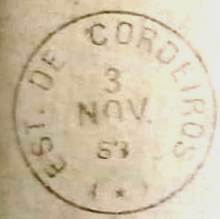
The oldest postmark is the French type CSP-0375a (coll. Fuad Ferreira Fo.):
CSP-0375a (FF) 1883
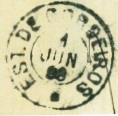
It was followed towards the end of the Empire by CSP-0375b (coll. Mário Celso Orsi Jr.):
CSP-0375b (MO) 1888-1890Estrada de Ferro Central do Brasil, 1890
Andere Namen: Cordeirópolis (1944)
Der Bahnhof Cordeiros in der Provinz São Paulo wurde im August 1876 von der Eisenbahngesellschaft Cia. Paulista (Hauptstrecke) eröffnet und lag am Westufer des Ribeirão do Tatu im Município de Limeira, 160 km nordwestlich der Provinzhauptstadt. Die Strecke gehörte von 1971 bis zu ihrer Stilllegung der FEPASA. Heute sind die Gleise noch vorhanden, der Bahnhof wird renoviert und soll sowohl ein Eisenbahnmuseum als auch das Kulturbüro der Gemeinde beherbergen.
1901 (Foto: Adolfo Pinto, auf estacoesferroviarias.com.br)2008, vor der Restaurierung (Foto: Ralph M. Giesbrecht, auf estacoesferroviarias.com.br)
Das Gebiet um den Bahnhof wurde im August 1899 zum Distrikt Cordeiro und im November 1944 in Cordeirópolis umbenannt, der seit Dezember 1948 ein eigenständiges Município ist.
Wie der regionalen Presse zu entnehmen ist, gab es am Bahnhof seit Dezember 1879 ein Postamt:
Correio Paulistano, 27.12.1879
Der älteste Poststempel ist der französische Typ CSP-0375a (Samml. Fuad Ferreira Fo.):
CSP-0375a (FF) 1883
Ihm folgte gegen Ende des Kaiserreichs CSP-0375b (Slg. Mário Celso Orsi Jr.):
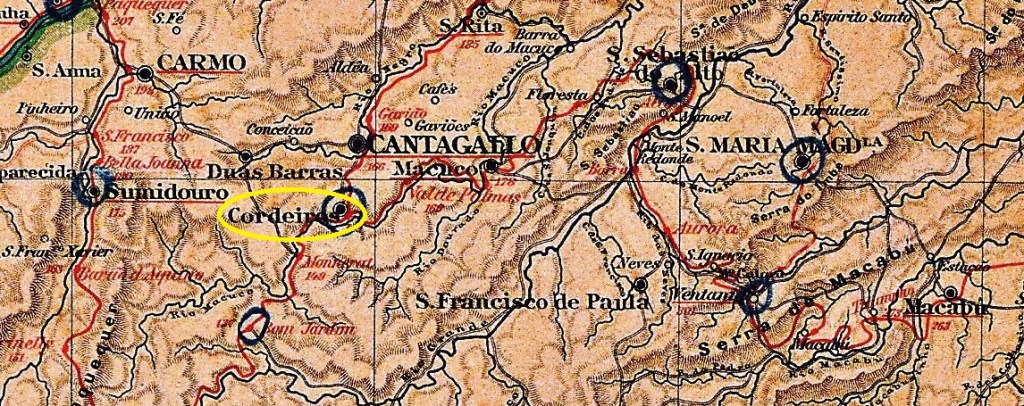
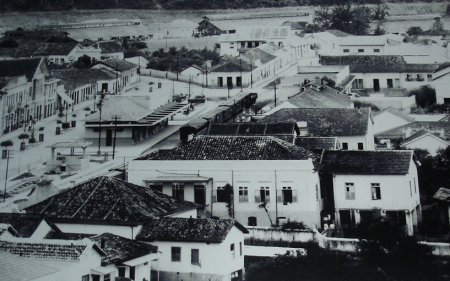
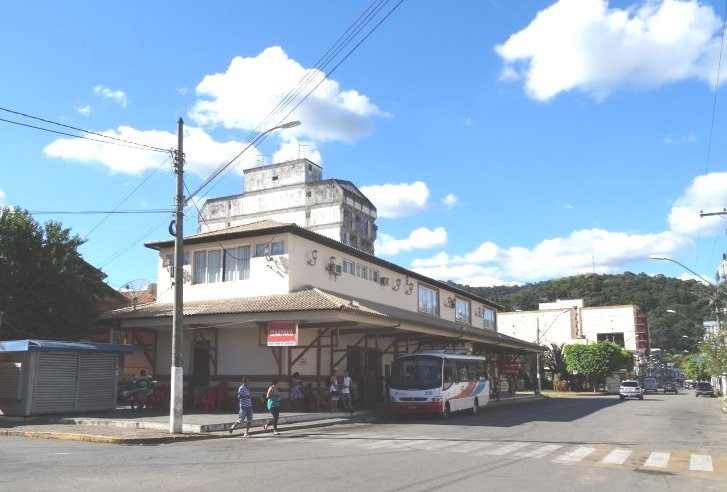
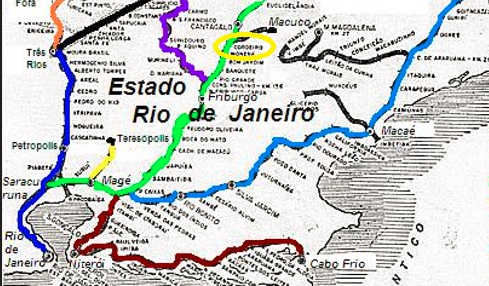
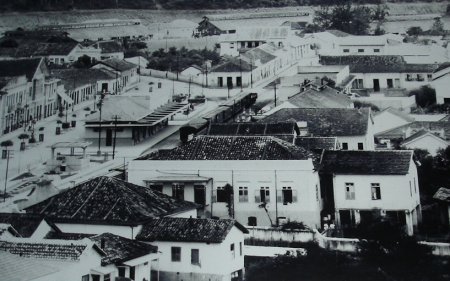
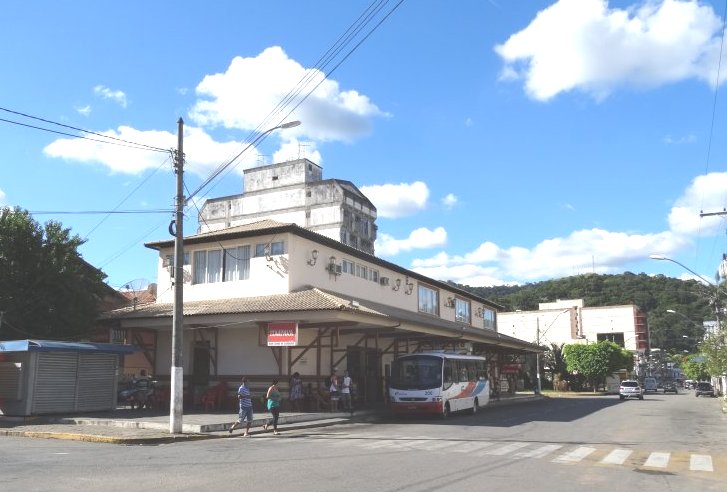
Cordeiros station (later called Cordeiro) was opened in October 1875 by the railway company E.F. do Cantagalo in the Município de Cantagalo, 190 km north-east of the capital Rio de Janeiro. The railway line was transferred to E.F. Leopoldina in 1887 and closed in 1967. Today, the tracks have disappeared and the station building serves as a bus station.
Around 1940 (Photo: Museu Municipal, apud estacoesferroviarias.com.br)March 2016 (Photo: Fernando Marietan, on estacoesferroviarias.com.br)
The area around the railway station was reclassified as Distrito de Cordeiro in September 1890, arose to município in March 1891 and then back to Distrito in May 1892, before being given the status of Município again in December 1943.
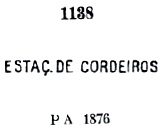
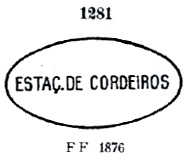
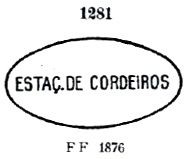
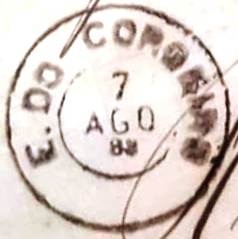
As can be seen from the list of imperial post offices (Tabella das Agencias do Correio do Imperio, Rio de Janeiro, 1885), there had been a post office at the railway station since 1877. The two oldest postmarks are so similar that some researchers believe they are the same postmark. Both CRJ-0395a and CRJ-0395b are also violet in colour, were used from the beginning and were given the numbers 1138 and 1281 respectively by P. Ayres (Catálogo de Carimbos Brasil-Império, S. Paulo, 1937, 1942):
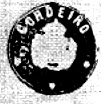
From the following postmark CRJ-0395c (coll. Klerman W. Lopes) the station was written CORDEIRO:
CRJ-0395c (KL) 1883-1884
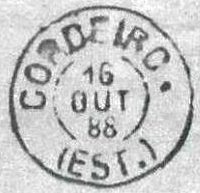
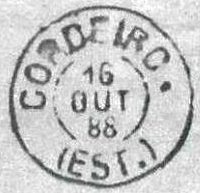
This was followed by CRJ-0395d (fig. R. Koester, in Carimbologia XIV):
CRJ-0395d (RK) 1887-1890
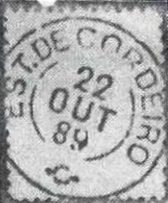
The following postmark CRJ-0395e (fig. R. Koester, op. cit.) has yet to be definitively confirmed, as it could also originate from the station of the same name in the province of São Paulo:
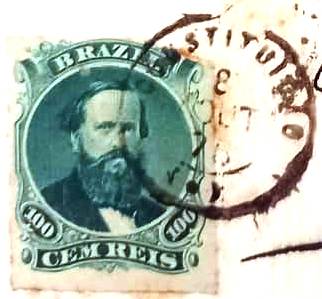
CRJ-0395e (RK) 1885
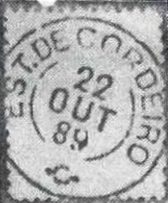
This doubt does not exist about CRJ-0395f (Fig. R. Koester):
CRJ-0395f (RK) 1889
R. Koester also shows the cachet cancel CRJ-0395g:
CRJ-0395g (RK)Estrada de Ferro Leopoldina
Der Bahnhof Cordeiros (später Cordeiro genannt) wurde im Oktober 1875 von der Eisenbahngesellschaft E.F. do Cantagalo eröffnet und lag im Município de Cantagalo, 190 km nordöstlich der Hauptstadt Rio de Janeiro. Die Bahnlinie ging 1887 an die E.F. Leopoldina über und wurde 1967 stillgelegt. Heute sind die Gleise verschwunden, das Bahnhofsgebäude dient als Busbahnhof.
Um 1940 (Foto: Museu Municipal, apud estacoesferroviarias.com.br)Im März 2016 (Foto: Fernando Marietan, auf estacoesferroviarias.com.br)
Das Gebiet um den Bahnhof wurde im September 1890 zum Distrito de Cordeiro, im März 1891 zum Município und im Mai 1892 wieder zum Distrito zurückgestuft, bevor es im Dezember 1943 erneut den Status eines Município erhielt.
Wie aus dem Verzeichnis der kaiserlichen Postämter (Tabella das Agencias do Correio do Imperio, Rio de Janeiro, 1885) hervorgeht, gab es seit 1877 ein Postamt am Bahnhof. Die beiden ältesten Poststempel sind einander so ähnlich, dass manche Forscher meinen, es handele sich um denselben Poststempel. Beide, CRJ-0395a und CRJ-0395b, existieren ebenfalls in violett, wurden von Anfang an verwendet und erhielten von P. Ayres (Catálogo de Carimbos Brasil-Império, S. Paulo, 1937, 1942) die Nummern 1138 bzw. 1281:
Ab dem folgenden Stempel CRJ-0395c (Samml. Klerman W. Lopes) wurde der Bahnhof CORDEIRO geschrieben:
CRJ-0395c (KL) 1883-1884
Es folgte CRJ-0395d (Abb. R. Koester, in Carimbologia XIV):
CRJ-0395d (RK) 1887-1890
Der folgende Stempel CRJ-0395e (Abb. R. Koester, op. cit.) muss noch endgültig bestätigt werden, da er auch vom gleichnamigen Bahnhof in der Provinz São Paulo stammen könnte:
CRJ-0395e (RK) 1885
Dieser Zweifel besteht bei CRJ-0395f (Abb. R. Koester) nicht:
CRJ-0395f (RK) 1889
R. Koester zeigt auch den Siegelstempel CRJ-0395g:
Carta da Republca dos Estados Unidos do Brazil, 1892
See also Barra do Corda (BMA-0035)
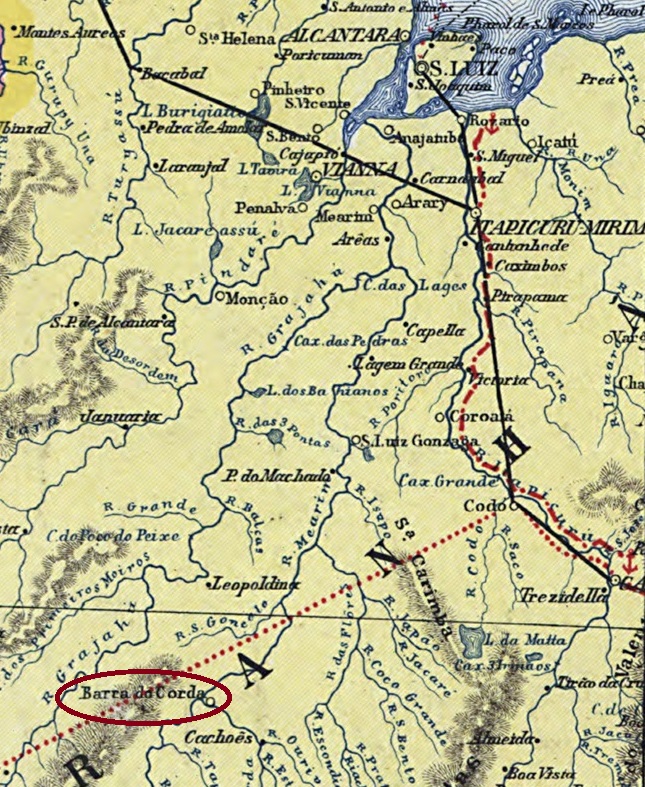
The chapel of Barra do Corda (or da Corda) was built in November 1849 at the mouth of the Corda River in the Mearim in the Município of Chapada, 450 km south of the provincial capital São Luís. The place rose to the status of vila in May 1854 and town in June 1894.
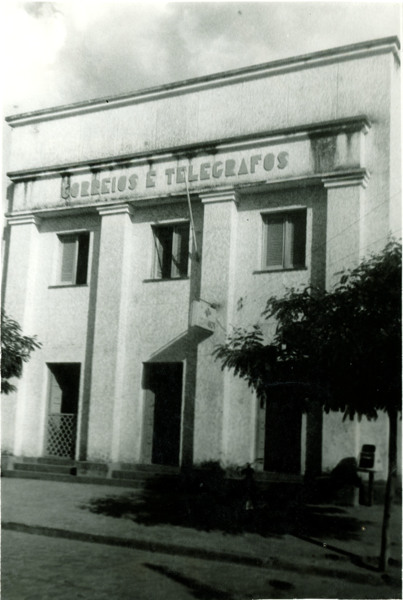
The post office, ca. 1975 (IBGE)
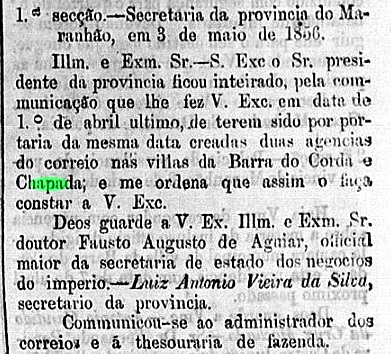
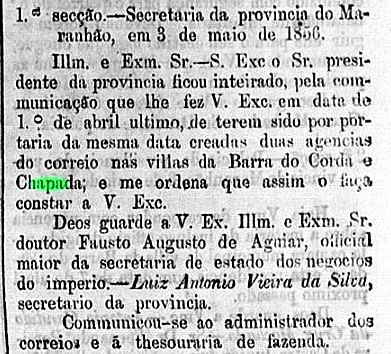
There had been a post office there since August 1856, as shown in the postal report (Relatorio Postal) for 1887. The regional official press gives April 1st of that year as the creation date:
Publicador Maranhense, 06/05/1856
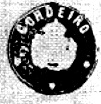
The oldest postmark BMA-0035a was found by philatelist Felipe Piccinini on a D. Pedro issue of 1866:
BMA-0035a (FP) 1866ff
BMA-0035c appeared much later (illustration from the Internet):
BMA-0035c (EB) 1891-1900ffAtlas do Imperio do Brasil, 1868
Siehe auch Barra do Corda (BMA-0035)
Die Kapelle von Barra do Corda (oder auch da Corda) wurde im November 1849 an der Mündung des Flusses Corda in den Mearim im Município von Chapada, 450 km südlich der Provinzhauptstadt São Luís. Der Ort stieg im Mai 1854 zur Vila und im Juni 1894 zur Stadt auf.
Das Postamt, ca. 1975 (IBGE)
Dort gab es ein Postamt seit August 1856, wie aus dem Postbericht (Relatorio Postal) für 1887 hervorgeht. Die regionale Amtspresse gibt dafür den 1. April d.J. an:
Publicador Maranhense, 06.05.1856
Der älteste Poststempel BMA-0035a wurde vom Philatelisten Felipe Piccinini auf einer D. Pedro-Ausgabe von 1866 gefunden:
BMA-0035a (FP) 1866ff
Viel später erschien BMA-0035c (Abb. aus dem Internet):
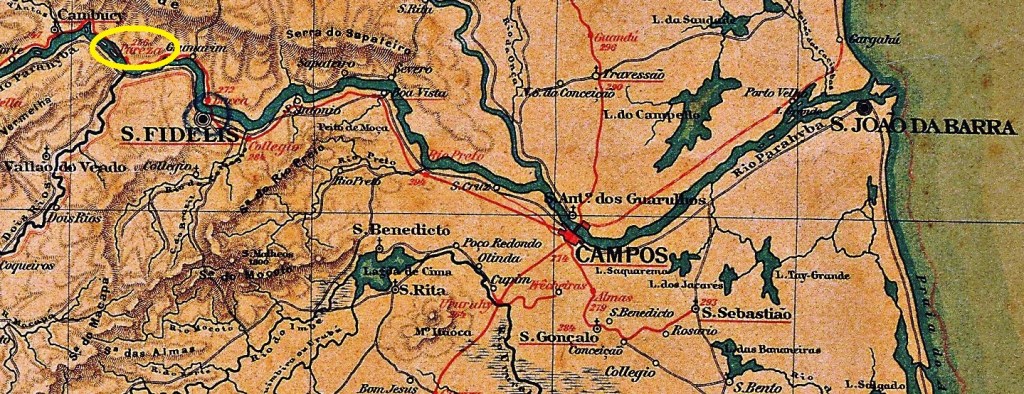
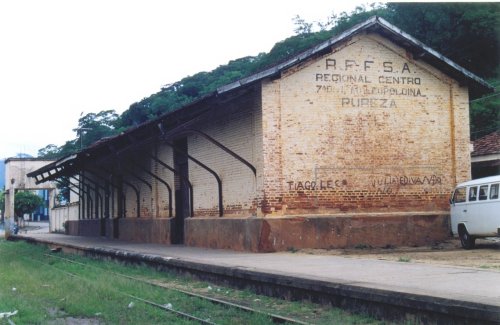
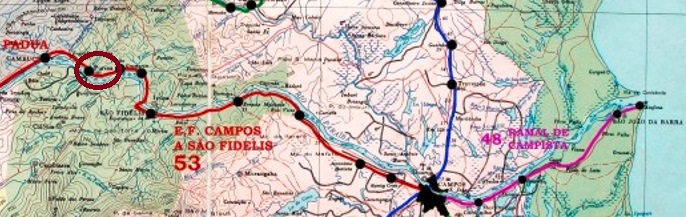
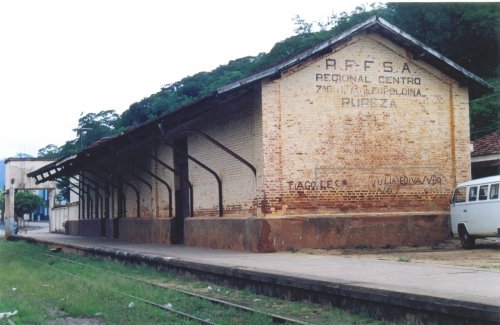
The Coqueiros railway station was opened in July 1880 by the railway company E.F. Sto. Antonio de Padua (Campos-Miracema Line) and was located on the north bank of the Paraíba do Sul in the Município de S. Fidélis, 280 km north-east of the capital Rio de Janeiro. The railway line changed hands in 1884 to E.F. Macahe e Campos, in 1887 to E.F. Leopoldina and belonged to Rede Ferroviária Federal S.A. from 1975 until its closure in 1996 (estacoesferroviarias.com.br). The tracks are still there today, but the current use of the station building (a listed building since 2010) is unknown.
In January 2004 (Photo: Gutierrez L. Coelho, on estacoesferroviarias.com.br)
According to the regional press, there has been a post office at the railway station since October 1883:
Jornal do Commercio, 17/10/1883
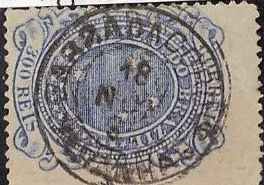
The imperial postmark – which also exists in blue – is CRJ-0390a (ill. Claudio Neumann):
CRJ-0390a (CN) 1883-1886
This station was renamed Pureza around 1886, after a large sugar factory in the region. Postmarks with the new name are known from 1887 onwards.
agenciaspostais.com.br
Andere Namen: Pureza (ca. 1886)
Der Bahnhof Coqueiros wurde im Juli 1880 von der Eisenbahngesellschaft E.F. Sto. Antonio de Padua (Strecke Campos-Miracema) eröffnet und lag am Nordufer des Paraíba do Sul im Município de S. Fidélis, 280 km nordöstlich der Hauptstadt Rio de Janeiro. Die Bahnlinie wechselte 1884 den Besitzer zu E.F. Macahe e Campos, 1887 zu E.F. Leopoldina und gehörte von 1975 bis zur Stilllegung 1996 der Rede Ferroviária Federal S.A. (estacoesferroviarias.com.br). Heute sind die Gleise noch vorhanden, die aktuelle Nutzung des Bahnhofsgebäudes (seit 2010 unter Denkmalschutz) ist unbekannt.
Im Januar 2004 (Foto: Gutierrez L. Coelho, auf estacoesferroviarias.com.br)
Aus der regionalen Presse geht hervor, dass es seit Oktober 1883 ein Postamt am Bahnhof gab:
Jornal do Commercio, 17.10.1883
Der kaiserliche Poststempel – den es auch in blau gibt – ist CRJ-0390a (Abb. Claudio Neumann):
CRJ-0390a (CN) 1883-1886
Dieser Bahnhof wurde um 1886 in Pureza umbenannt, nach einer großen Zuckerfabrik in der Region. Poststempel mit dem neuen Namen sind ab 1887 bekannt.
Other names: Sant’Anna de Contendas, Vila Brasilia, Brasilia, Brasília de Minas (1962)
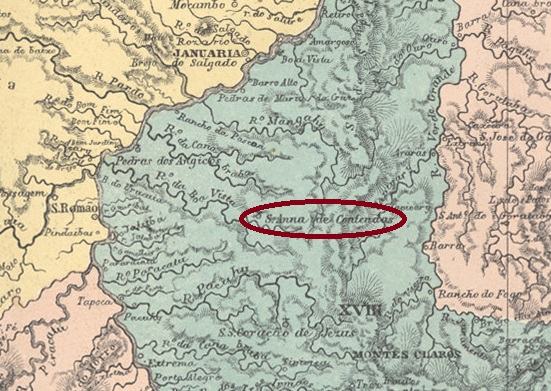
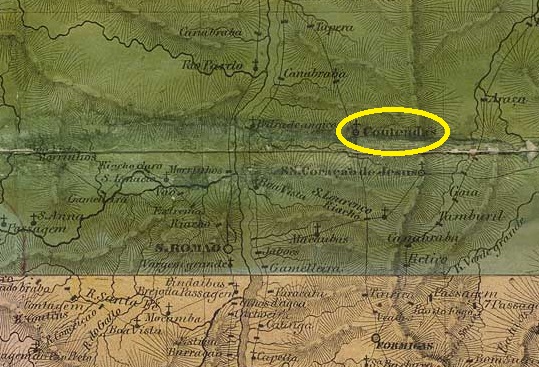
Sant’Anna de Contendas was the name of the freguesia of the Vila de Montes Claros, located on the north bank of the Paracatu, 610 kilometres north of the provincial capital Ouro Preto, from July 1832. In December 1890 it was elevated to Vila, after which the place name changed three times: in September 1901 to Vila Brasilia, in September 1923 to Brasilia (which became a city two years later) and finally in December 1962 to Brasília de Minas.
Two dates have been found for the foundation of the local post office. The first is in 1871, as shown in the Directory of Imperial Post Offices/Tabella das Agencias do Correio do Imperio (Rio de Janeiro, 1885). Then again in September 1877, as both Paula Sobrinho (História Postal de Minas Gerais, Belo Horizonte, 1997) and R. Koester (Carimbologia XIV) write. The latter also quotes the imperial postmark CMG-0890a as a common double circle from 1886, unfortunately without illustration.
Villiers de l’Ile Adam: Carta (…) da Provincia de Minas Geraes, 1849
Andere Namen: Sant’Anna de Contendas, Vila Brasilia, Brasilia, Brasília de Minas (1962)
Sant’Anna de Contendas war seit Juli 1832 der Name der am Nordufer des Paracatu, 610 km nördlich der Provinzhauptstadt Ouro Preto gelegenen Freguesia der Vila de Montes Claros. Im Dezember 1890 wurde sie zur Vila erhoben, danach änderte sich der Ortsname dreimal: im September 1901 in Vila Brasilia, im September 1923 in Brasilia (das zwei Jahre später zur Stadt ernannt wurde) und zuletzt im Dezember 1962 in Brasília de Minas.
Für die Gründung des örtlichen Postamtes wurden zwei Daten gefunden. Zum ersten Mal im Jahr 1871, wie aus dem Verzeichnis der kaiserlichen Postämter/Tabella das Agencias do Correio do Imperio (Rio de Janeiro, 1885) hervorgeht. Dann wieder im September 1877, wie sowohl Paula Sobrinho (História Postal de Minas Gerais, Belo Horizonte, 1997) als auch R. Koester (Carimbologia XIV) schreiben. Letzterer zitiert auch den kaiserlichen Poststempel CMG-0890a als gewöhnlichen Doppelkreis, datiert 1886, leider ohne Abbildung.
Villiers de l’Ile Adam: Carta (…) da Provincia de Minas Geraes, 1849
Other names: Contagem das Abóboras
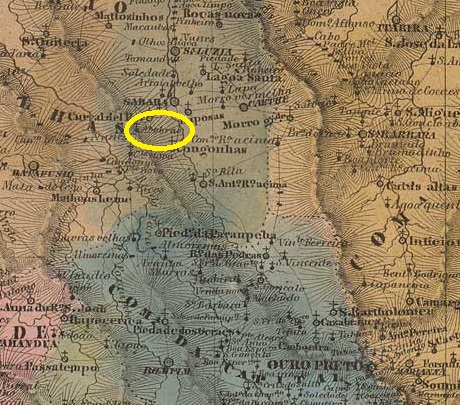
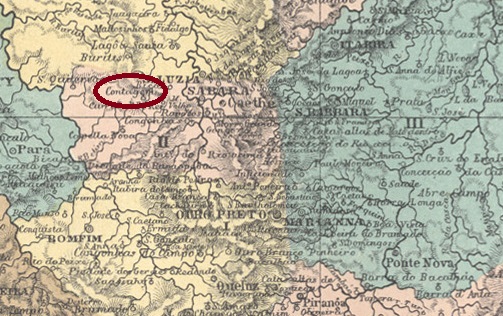
The Portuguese verb contar means, among other things, to count. From 1701, Contagem (counting point) was an official tax collection point on the Ribeirão das Abóboras (Pumpkin Stream), 100 km northwest of the later provincial capital of Ouro Preto. Even before 1750, the village became a district of the Freguesia de Curral d’El Rei (today: Belo Horizonte, a city of over a million inhabitants) and was transferred to the Vila de Sabará as Freguesia de S. Gonçalo da Contagem in April 1854. In August 1911, Contagem became a Vila, but lost this status in December 1938 when it was downgraded to a district of the Município de Betim, and only regained the status of a Município in December 1948.
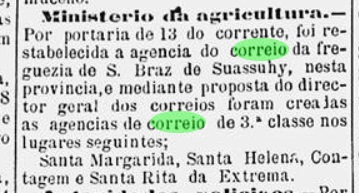
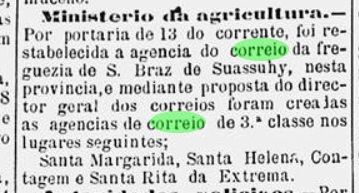
As far as the local post office is concerned, all sources agree on June 1881, which the Rio press can also confirm:
A Actualidade/RJ 18/06/1881
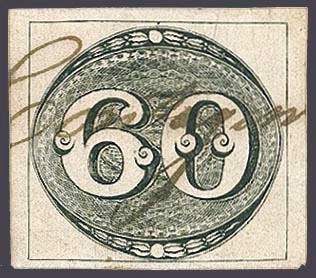
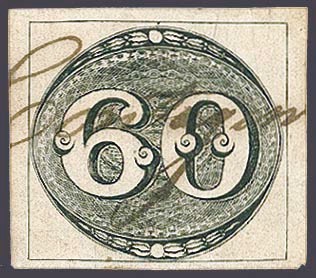
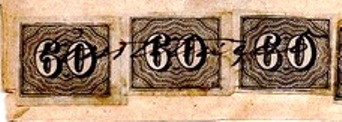
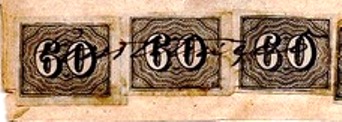
And thus we have the problem that a handwritten (postal?) cancellation on ox-eye issues from 1843 was known and occasionally confirmed as genuine, as the following pictures show:
Corinphila Auctions (181, 205-209)
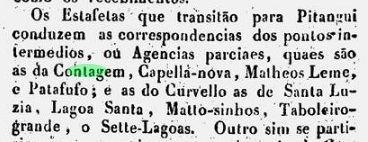
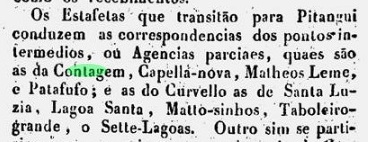
Either these are forgeries, or an “unofficial post office” was at least temporarily active at this tax office. In fact, in 1839 the regional press mentions “partial agencies” (Agencias parciaes), which dealt with postal traffic through Contagem, among other localities.
O Universal, 21 Oct. 1839
There is still a need for research into how and for how long such “partial post offices” were in operation.
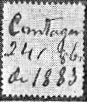
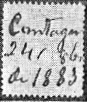
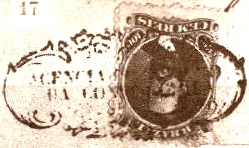
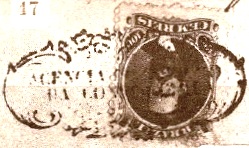
After the official opening of the post office in June 1881, the stamps were initially cancelled by hand (illustration by R. Koester in Carimbologia XIV):
1883 (RK)
The first postmark of Contagem, CMG-0880a, can be traced from 1885 (fig. Felipe Piccinini):
CMG-0880a (FP) 1885-1897
Andere Namen: Contagem das Abóboras
Das portugiesische Verb contar bedeutet unter anderem zählen. Contagem (Zählstelle) war ab 1701 eine offizielle Steuererhebungsstelle am Ribeirão das Abóboras (Kürbisbach), 100 km nordwestlich der späteren Provinzhauptstadt Ouro Preto. Noch vor 1750 wurde der Ort ein Distrikt der Freguesia de Curral d’El Rei (heute: Millionenstadt Belo Horizonte) und ging im April 1854 als Freguesia de S. Gonçalo da Contagem an die Vila de Sabará über. Im August 1911 wurde Contagem eine Vila, verlor diesen Status jedoch im Dezember 1938, als es zu einem Distrikt des Município de Betim herabgestuft wurde, und erlangte den Status eines Município erst im Dezember 1948 wieder.
Bezüglich des örtlichen Postamtes sind sich bisher alle Quellen über den Juni 1881 einig, was auch die Presse von Rio bestätigen kann:
A Actualidade/RJ 18.06.1881
Und damit haben wir das Problem, dass eine handschriftliche (postalische?) Entwertung auf Ochsenauge-Ausgaben von 1843 bekannt und gelegentlich als echt bestätigt wurde, wie die folgenden Bilder zeigen:
Corinphila-Auktionen (181, 205-209)
Entweder handelt es sich um Fälschungen, oder es war zumindest zeitweise ein „inoffizielles Postamt“ an dieser Steuerstelle tätig. Tatsächlich werden 1839 in der regionalen Presse „partielle Postagenturen“ (Agencias parciaes) erwähnt, die sich u.a. mit dem Postverkehr durch Contagem befassten.
O Universal, 21.10.1839
Hier besteht noch Forschungsbedarf, wie und wie lange solche „Teilpostämter“ in Betrieb waren.
Nach der offiziellen Eröffnung des Postamtes im Juni 1881 wurden die Marken zunächst noch von Hand entwertet (Abb. R. Koester in Carimbologia XIV):
1883 (RK)
Der erste Poststempel von Contagem, CMG-0880a, ist ab 1885 nachweisbar (Abb. Felipe Piccinini):
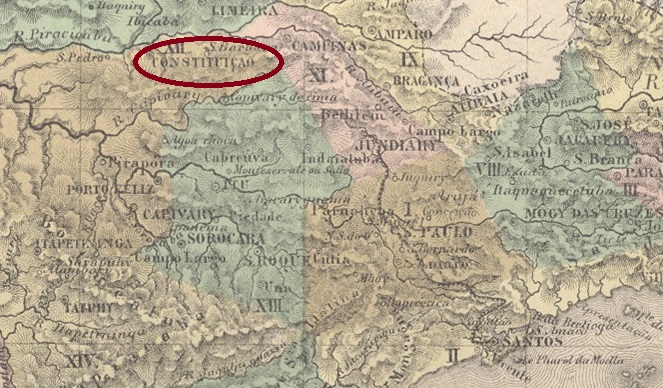
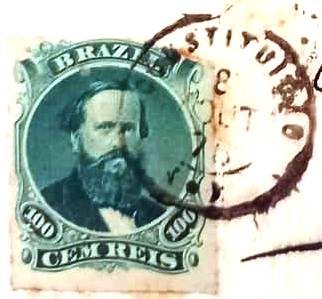
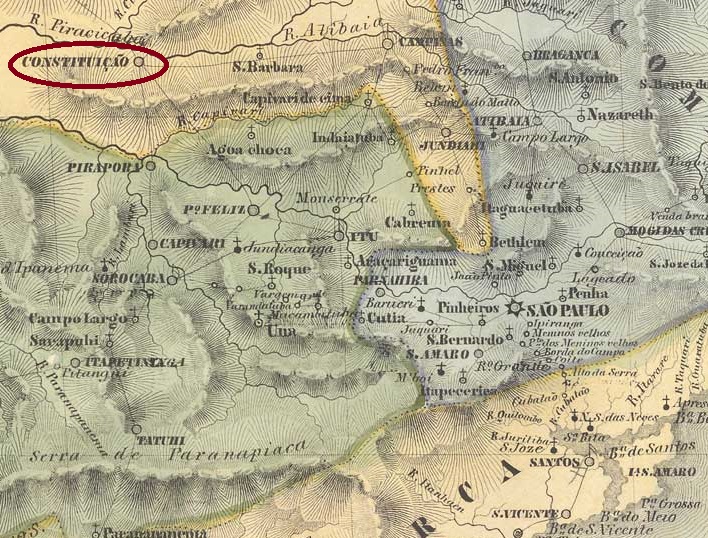
N. Sra. dos Prazeres de Piracicaba was a settlement on the south bank of the Piracicaba River, 160 kilometres northwest of the later provincial capital of São Paulo, from August 1767. In June 1774 it was incorporated as Freguesia de Sto. Antonio de Piracicaba to the Vila de Itu. In October 1821, the place name changed again, this time to Vila de Nova Constituição, in memory of the then new Portuguese constitution. It was declared a town under this name in April 1856 and returned to its original name of Piracicaba in March 1877.
Two dates have been found for the foundation of the local post office. The first around 1840, as indicated in the RHM catalogue (Catálogo Enciclopédico, São Paulo, 1999). Then again in July 1850, as Nova Monteiro writes in Administrações e Agencias Postaes do Brasil Imperio (Brasil Filatelico/RJ, 1934-5; reprint SPP 1994-1999).
The oldest postmark here is CSP-0370a; it exists also in sepia and was already listed in the RHM catalogue under P-SP-08:
CSP-0370a (RHM P-SP-08) ca. 1840-1843
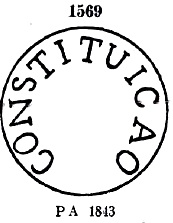
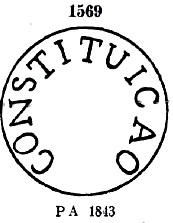
It was followed by CSP-0370b, which also occurs in brown and violet and which we know from P. Ayres (Catálogo de Carimbos Brasil-Império, S. Paulo, 1937, 1942) under no. 1569:
CSP-0370b (P.A. 1569) 1843ff-1845
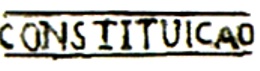
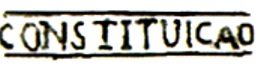
This postmark probably became unusable in the 50s, as the stamps were cancelled by hand around this time:
1850ff (fig. F. Piccinini)
R. Koester showed the rare CSP-0370c in Carimbologia XXXI:
CSP-0370c (RK) 1866ff
The last postmark with this place name is the French type CSP-0370d (collect. Fuad Ferreira Fo.):
CSP-0370d (FF) 1876-1879
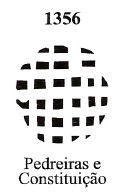
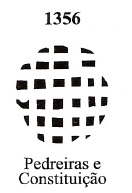
A mute cancellation was also used during this period, which was given the no. 254 by P. Ayres (op. cit.) and the no. 1356 by James Dingler and Klerman Lopes (Mute Cancellations of the Brazil Empire / Carimbos Mudos do Brasil Império, Brazil Philatelic Association, Rio de Janeiro, 2000):
BPA 1356 (P.A. 254) 1867
Later postmarks bear the place name Piracicaba (see there).
Villiers de l’Ile Adam: Carta (…) da Provincia de São Paulo, 1847
Andere Namen: Piracicaba (1767-1821, 1877ff)
N. Sra. dos Prazeres de Piracicaba war seit August 1767 eine Siedlung am Südufer des Piracicaba, 160 km nordwestlich der späteren Provinzhauptstadt São Paulo. Im Juni 1774 wurde sie als Freguesia de Sto. Antonio de Piracicaba an die Vila de Itu angeschlossen. Im Oktober 1821 änderte sich der Ortsname erneut, diesmal in Vila de Nova Constituição, in Erinnerung an die damals neue portugiesische Verfassung. Unter diesem Namen wurde es im April 1856 zur Stadt erklärt, und im März 1877 kehrte es zu seinem ursprünglichen Namen Piracicaba zurück.
Für die Gründung des örtlichen Postamtes wurden zwei Daten gefunden. Das erste um 1840, wie im RHM-Katalog (Catálogo Enciclopédico, São Paulo, 1999) angegeben. Dann wieder im Juli 1850, wie Nova Monteiro in Administrações e Agencias Postaes do Brasil Imperio (Brasil Filatelico/RJ, 1934-5; Nachdruck SPP 1994-1999) schreibt.
Der älteste Stempel ist hier CSP-0370a; er existiert ebenfalls in Sepia und wurde bereits im RHM-Katalog unter P-SP-08 geführt:
CSP-0370a (RHM P-SP-08) ca. 1840-1843
Ihm folgte CSP-0370b, den es auch in braun und violett gibt und den wir von P. Ayres (Catálogo de Carimbos Brasil-Império, S. Paulo, 1937, 1942) unter Nr. 1569 kennen:
CSP-0370b (P.A. 1569) 1843ff-1845
Dieser Poststempel wurde wohl in den 50er Jahren unbrauchbar, da die Briefmarken um diese Zeit per Hand entwertet wurden:
1850ff (Abb. F. Piccinini)
R. Koester zeigte in Carimbologia XXXI den seltenen CSP-0370c:
CSP-0370c (RK) 1866ff
Der letzte Poststempel mit diesem Ortsnamen ist der französische Typ CSP-0370d (Samml. Fuad Ferreira Fo.):
CSP-0370d (FF) 1876-1879
In dieser Zeit wurde auch ein stummer Stempel verwendet, der von P. Ayres (op. cit.) die Nr. 254 und von James Dingler und Klerman Lopes (Mute Cancellations of the Brazil Empire / Carimbos Mudos do Brasil Império, Brazil Philatelic Association, Rio de Janeiro, 2000) die Nr. 1356 erhalten hat:
BPA 1356 (P.A. 254) 1867
Spätere Poststempel tragen den Ortsnamen Piracicaba (s.d.).
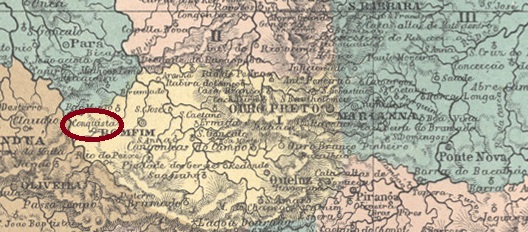
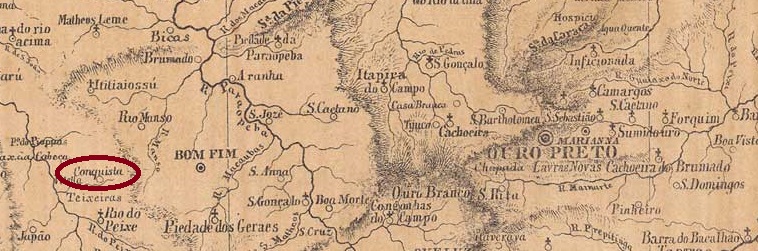
The Freguesia de N. Sra. das Dores da Conquista was founded in September 1870, belonged to the Vila de Bonfim and was located 150 km west of the provincial capital Ouro Preto. In September 1901, the municipality was incorporated into the município de Itaúna and was renamed Itaguara in September 1923. Itaguara has been an independent município since December 1943. The name from the Tupi language is said to mean stone well.
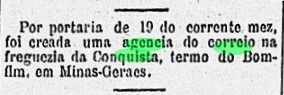
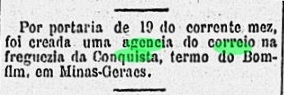
As the Rio press reported, there had been a post office there since January 1885:
Gazeta de Noticias/RJ, 20/01/1885
No imperial postmark from Conquista/MG has yet been found.
Provincia de Minas Geraes, 1873
Andere Namen: Itaguara (1923)
Die Freguesia de N. Sra. das Dores da Conquista wurde im September 1870 gegründet, gehörte zur Vila de Bonfim und lag 150 km westlich der Provinzhauptstadt Ouro Preto. Im September 1901 wurde die Gemeinde in das Município de Itaúna eingegliedert und im September 1923 in Itaguara umbenannt. Seit Dezember 1943 ist Itaguara ein eigenständiger Município. Der Name aus der Tupi-Sprache soll Steinbrunnen bedeuten.
Wie die Presse von Rio berichtete, gab es dort seit Januar 1885 ein Postamt:
Gazeta de Noticias/RJ, 20.01.1885
Bisher wurde kein kaiserlicher Poststempel aus Conquista/MG gefunden.
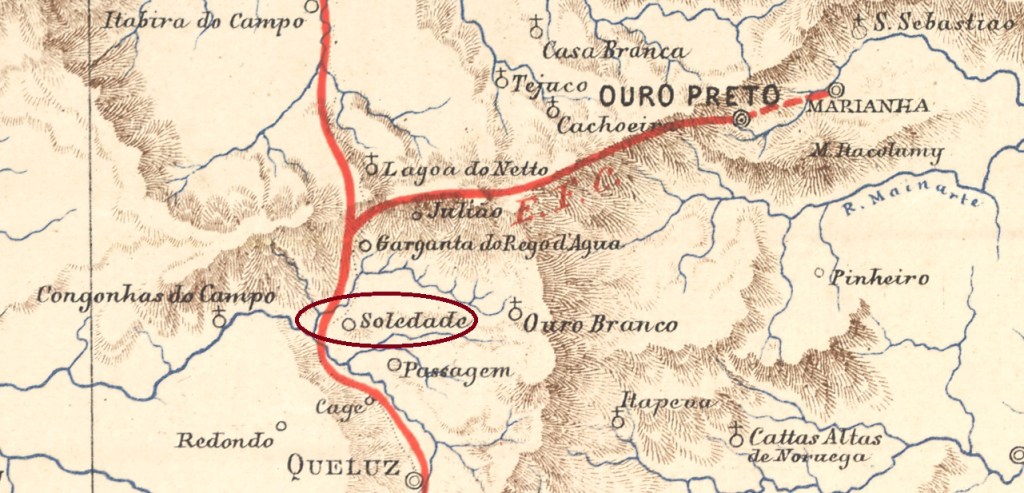
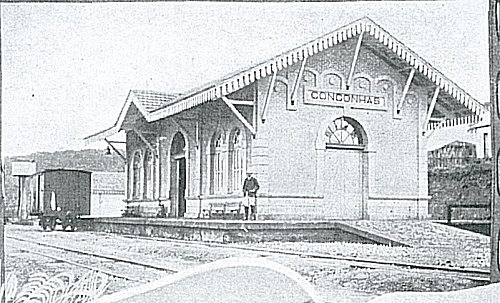
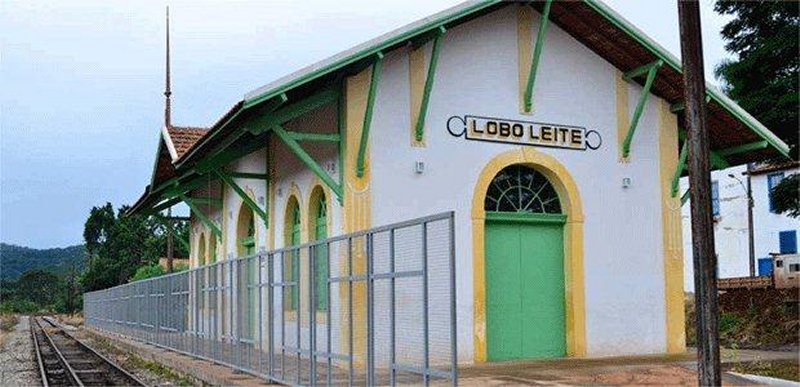
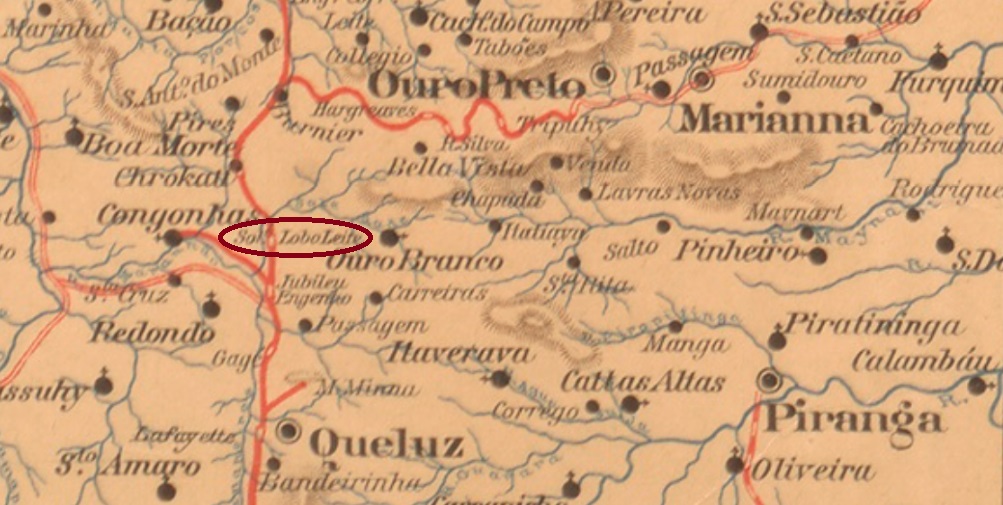
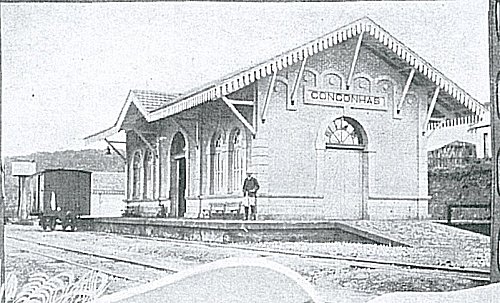
Congonhas station, originally called Soledade, was opened in August 1886 by the railway company E.F. D. Pedro II (main line) around Vila de Congonhas do Campo, a good 40 km west of the provincial capital Ouro Preto. The line was transferred to E.F. Central do Brasil in 1889 and belonged to Rede Ferroviária Federal S.A. (estacoesferroviarias.com.br) from 1975 until its closure in 1996. The tracks still exist today, the station building is a multi-purpose hall of the municipality.
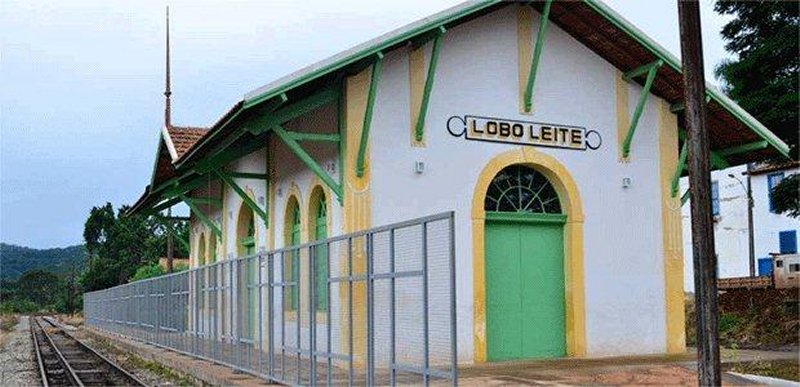
1910 (Photo: Impressões do Brasil, séc. XX, on estacoesferroviarias.com.br)2013 (Photo NN, on estacoesferroviarias.com.br)
The station was renamed Lobo Leite in August 1907, and the area surrounding the station has been called Distrito de Lobo Leite since December 1938. The name commemorates Francisco Lobo Leite, the engineer of E.F. Dom Pedro II who was responsible for this section of the line,
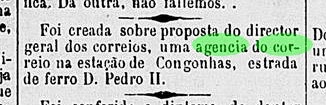
According to the Rio press, there had been a post office at the station since October 1886:
Gazeta da Tarde RJ, 06/10/1886
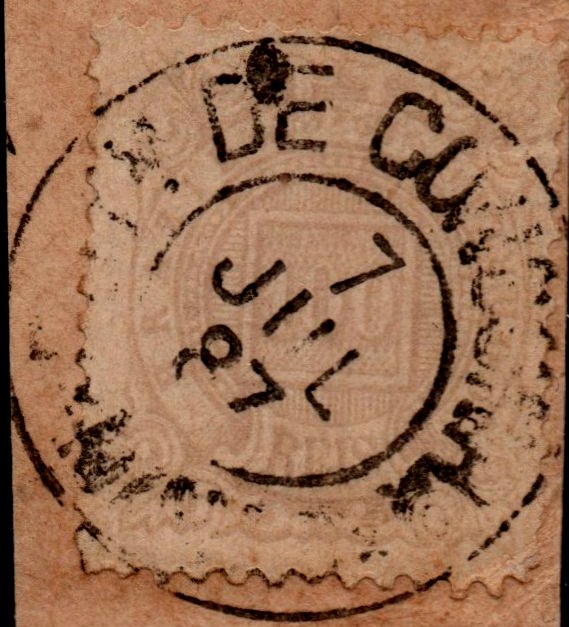
The imperial postmark is CMG-0840a (coll. José A. Junges):
CMG-0840a (JJ) 1887Estado do Minas Geraes, 1910
Andere Namen: Soledade, Lobo Leite (1907)
Der Bahnhof Congonhas, der ursprünglich Soledade heißen sollte, wurde im August 1886 von der Eisenbahngesellschaft E.F. D. Pedro II (Hauptlinie) eröffnet und lag auf dem Gebiet der Vila de Congonhas do Campo, gut 40 km westlich der Provinzhauptstadt Ouro Preto. Die Strecke ging 1889 an die E.F. Central do Brasil über und gehörte von 1975 bis zu ihrer Stilllegung 1996 der Rede Ferroviária Federal S.A. (estacoesferroviarias.com.br). Die Gleise sind heute noch vorhanden, das Bahnhofsgebäude ist eine Mehrzweckhalle der Gemeinde.
1910 (Foto: Impressões do Brasil, séc. XX, auf estacoesferroviarias.com.br)2013 (Foto NN, auf estacoesferroviarias.com.br)
Der Bahnhof wurde im August 1907 in Lobo Leite umbenannt, die Umgebung des Bahnhofs heißt seit Dezember 1938 auch Distrito de Lobo Leite. Der Name erinnert an Francisco Lobo Leite, der als Ingenieur der E.F. Dom Pedro II für diesen Streckenabschnitt verantwortlich war,
Wie die Presse aus Rio berichtet, gab es seit Oktober 1886 ein Postamt am Bahnhof:
Gazeta da Tarde RJ, 06.10.1886
Der kaiserliche Poststempel ist CMG-0840a (Samml. José A. Junges):
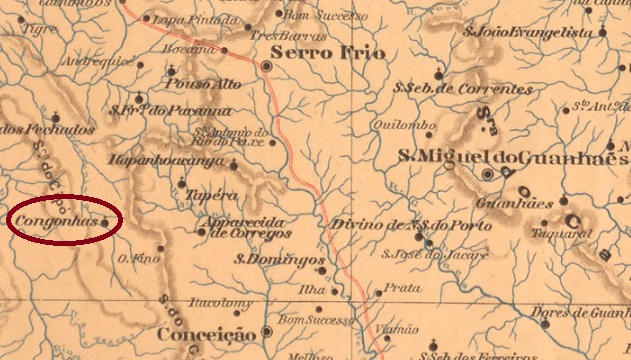
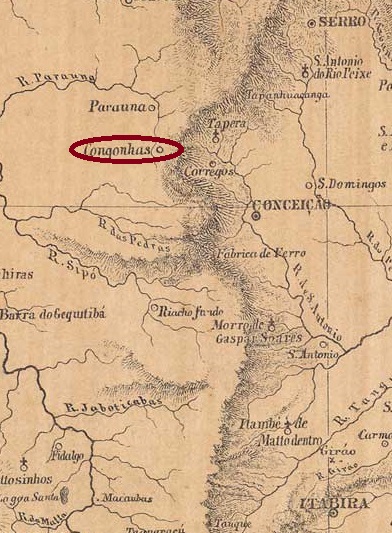
This Freguesia de Congonhas was founded in July 1857 and belonged to the Vila da Conceição do Serro, 310 kilometres north of the provincial capital Ouro Preto. It has been called Município de Congonhas do Norte since December 1962.
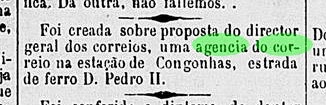
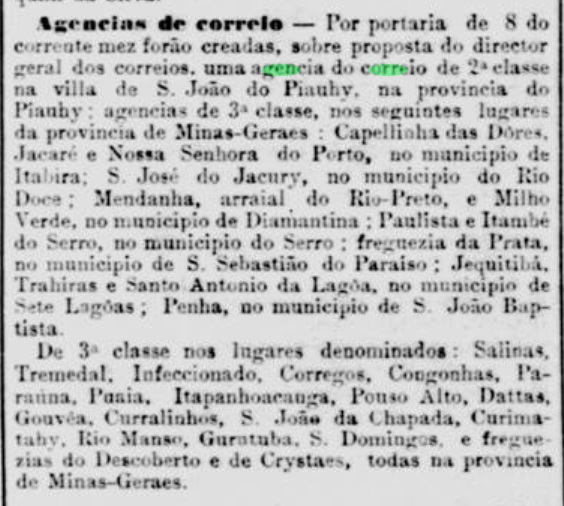
According to the press in Rio, there had been a post office there since November 1881:
Jornal do Commercio/RJ, 12/11/1881
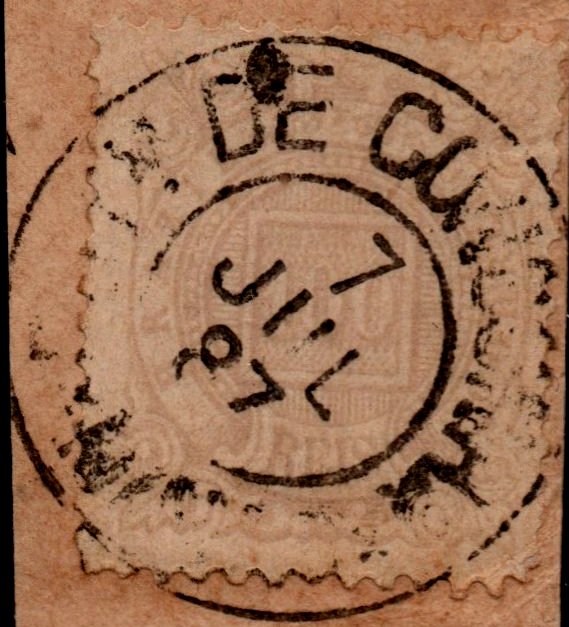
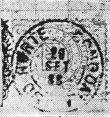
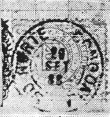
The imperial postmark here is CMG-0865a (fig. R. Koester in Carimbologia XIV):
CMG-0865a (RK) 1888Provincia de Minas Geraes, 1873
Andere Namen: Congonhas
Diese Freguesia de Congonhas wurde im Juli 1857 gegründet und gehörte zur Vila da Conceição do Serro, 310 km nördlich der Provinzhauptstadt Ouro Preto. Seit Dezember 1962 heißt sie Município de Congonhas do Norte.
Wie der Presse in Rio zu entnehmen ist, gab es dort seit November 1881 ein Postamt:
Jornal do Commercio/RJ, 12.11.1881
Der kaiserliche Poststempel ist hier CMG-0865a (Abb. R. Koester in Carimbologia XIV):

















 Carimbologia