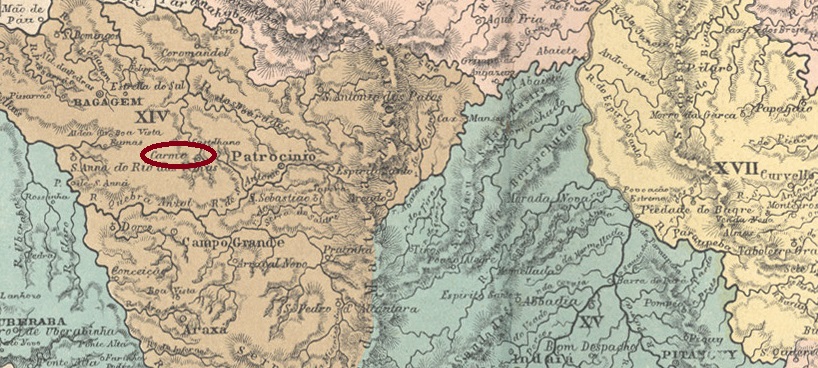
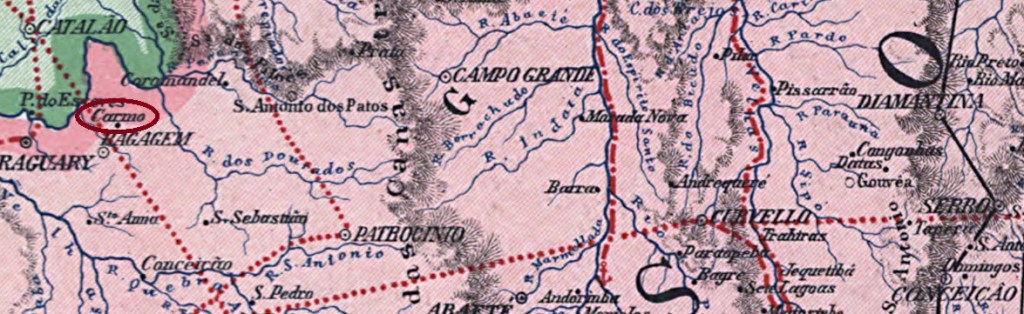
The settlement of Arraial de N. Sra. do Carmo was established around 1840 on the territory of the Vila da Bagagem, 580 km northwest of the provincial capital of Ouro Preto. In September 1870 it became a freguesia, in October 1882 a vila and in May 1892 a town, which has borne the name Monte Carmelo since June 1900.
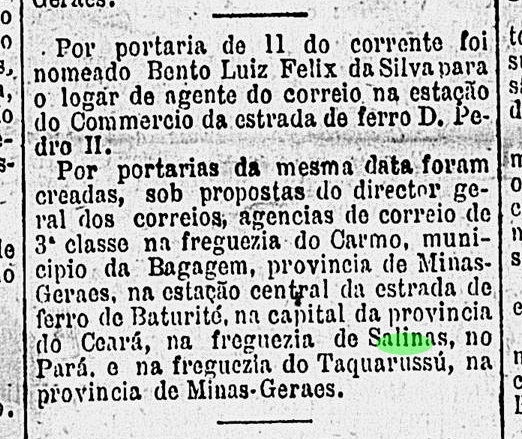
Reinhold Koester (Carimbologia IX) and Paula Sobrinho (História Postal de Minas Gerais, Belo Horizonte, 1997) agree that there was a post office since September 1882. This is also confirmed by the press in Rio:
Gazeta de Noticias/RJ, 15.09.1882
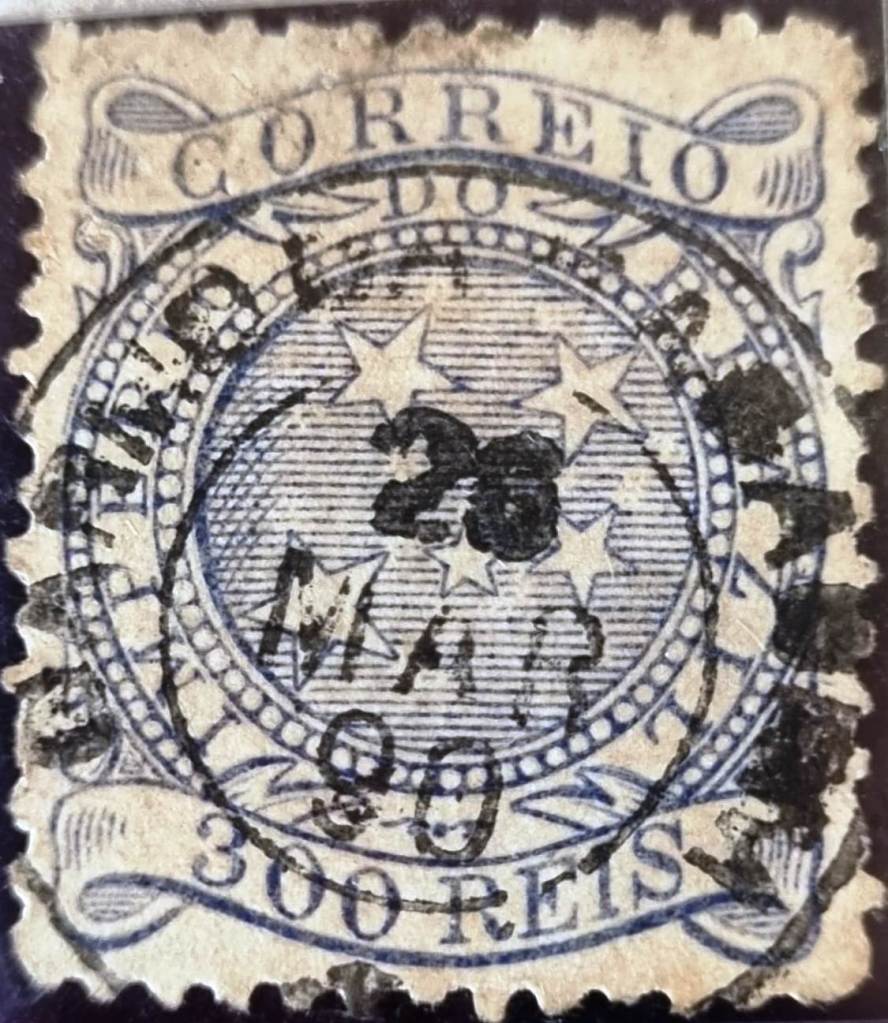
The oldest postmark to date is CMG-0625a (image: Márcio Duarte):
CMG-0625a (MD) 1890Carta da Republica dos Estados Unidos do Brazil, 1892
Textaktualisierung am 3. April 2024
Andere Namen: Monte Carmelo (1900)
Die Siedlung Arraial de N. Sra. do Carmo entstand um 1840 auf dem Gebiet der Vila da Bagagem, 580 km nordwestlich der Provinzhauptstadt Ouro Preto. Im September 1870 wurde es zur Freguesia, im Oktober 1882 zur Vila und im Mai 1892 zur Stadt, die seit Juni 1900 den Namen Monte Carmelo trägt.
Reinhold Koester (Carimbologia IX) und Paula Sobrinho (História Postal de Minas Gerais, Belo Horizonte, 1997) sind sich einig, dass es seit September 1882 ein Postamt gab. Dies wird auch von der Presse in Rio bestätigt:
Gazeta de Noticias/RJ, 15.09.1882
Der bisher älteste Stempel ist CMG-0625a (Bild: Márcio Duarte):
The name Carinhanha (or Carunhanha) is of Indian origin and means frog hole.
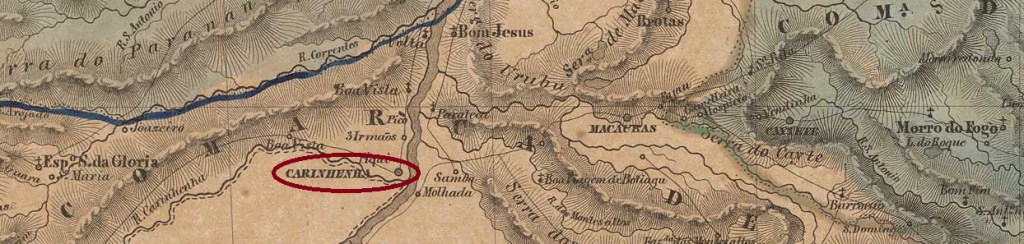
The Freguesia de S. José da Carinhanha was founded in August 1806, belonged to the Vila da Barra do Rio Grande and was located on the mouth of the river with the same name on the west bank of the São Francisco, then in the Capitania of Pernambuco. When it became a vila in April 1832, it was already in the imperial province of Bahia. Since August 1909, Carinhanha has been a town.
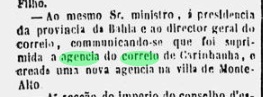
During the imperial period alone, there were three periods of operation for the local post office. The first began in December 1836, as Nova Monteiro writes in Administrações e Agencias Postaes do Brasil Imperio (Brasil Filatelico/RJ, 1934-5; Reprint SPP 1994-1999), and ended in May 1852, as reported by the Rio press:
Diario do Rio de Janeiro, 26.05.1852
The second establishment of the postal agency must have taken place before 1854, as shown in the 1859 report of the Imperial Ministry. Since the post office is still mentioned in an official bulletin in July 1861, it must have been closed later. The third period of operation probably began in 1866, as shown in the Directory of Imperial Post Offices (Tabella das Agencias do Correio do Imperio, Rio de Janeiro, 1885).
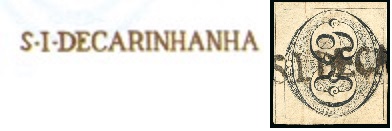
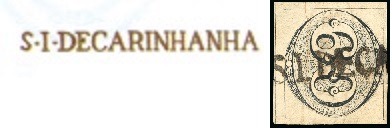
The oldest cancel so far is CBA-0260a and dates from the first period of operation, as it was found on Bull’s-Eye issues from 1843:
CBA-0260a (RHM, recte David Feldman Auctions) 1843ff
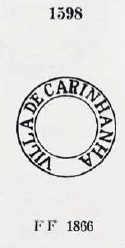
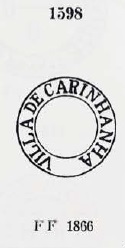
CBA-0260b appeared around 1866, listed in Paulo Ayres’s Catálogo de Carimbos Brasil-Império (S. Paulo, 1937, 1942) as no. 1598
CBA-0260b (P.A. 1598) 1866ff
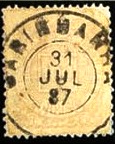
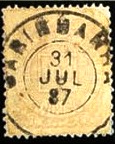
In the 1980s the double circle CBA-0260c (Fig. Felipe Piccinini) appeared:
CBA-0260c (FP) 1885ff-1887Villiers de l’Ile Adam: Carta (…) da Provincia da Bahia, 1848
Andere Namen: Carunhanha
Der Name Carinhanha oder Carunhanha ist indianischen Ursprungs und bedeutet Froschloch.
Die Freguesia de S. José da Carinhanha wurde im August 1806 gegründet, gehörte zur Vila da Barra do Rio Grande und lag an der Mündung des gleichnamigen Flusses am Westufer des São Francisco, damals noch in der Capitania von Pernambuco. Als es im April 1832 zur Vila wurde, lag es bereits in der kaiserlichen Provinz Bahia. Seit August 1909 ist Carinhanha eine Stadt.
Allein in der Kaiserzeit gab es drei Betriebsperioden für das örtliche Postamt. Die erste begann im Dezember 1836, wie Nova Monteiro in Administrações e Agencias Postaes do Brasil Imperio (Brasil Filatelico/RJ, 1934-5; Reprint SPP 1994-1999) schreibt, und endete im Mai 1852, wie die Presse von Rio berichtete:
Diario do Rio de Janeiro, 26.05.1852
Die zweite Gründung der Postagentur muss vor 1854 stattgefunden haben, wie aus einem Bericht des Reichsministeriums von 1859 hervorgeht. Da das Postamt noch im Juli 1861 in einem amtlichen Bulletin erwähnt wird, muss es später geschlossen worden sein. Die dritte Betriebsperiode begann vermutlich 1866, wie aus dem Verzeichnis der kaiserlichen Postämter (Tabella das Agencias do Correio do Imperio, Rio de Janeiro, 1885) hervorgeht.
Der bisher älteste Stempel ist CBA-0260a und stammt aus der ersten Betriebsperiode, da er auf Ochsenaugen-Ausgaben von 1843 gefunden wurde:
CBA-0260a (RHM, recte David Feldman Auktionen) 1843ff
Um 1866 erschien CBA-0260b, der in Paulo Ayres‘ Catálogo de Carimbos Brasil-Império (S. Paulo, 1937, 1942) unter der Nr. 1598 geführt wird.
CBA-0260b (P.A. 1598) 1866ff
In den 80er Jahren kam der Doppelkreis CBA-0260c (Abb. Felipe Piccinini) hinzu:
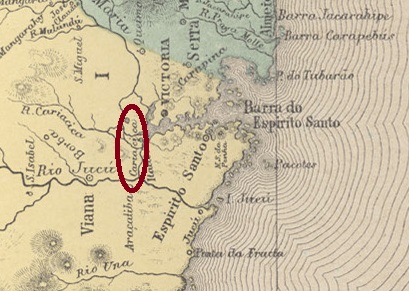
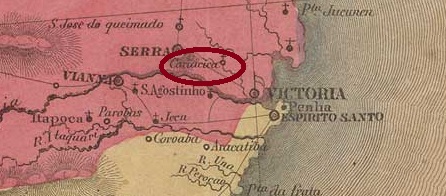
From a port of the Vila de Vitória, the Freguesia de S. João Baptista de Cariacica was created in December 1837, 15 km east of the provincial capital Vitória. In November 1890, Cariacica was elevated to the rank of vila. The name comes from the Tupi-guarani and means place of arrival of the white man.
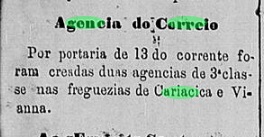
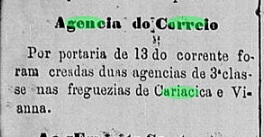
According to the regional press, there had been a post office there since February 1883:
O Horisonte, 20.02.1883
However, R. Koester writes in Carimbologia IX that a post relay service through Cariacica was already active in 1880. So far, no imperial postmarks are known from this place.
Villiers de l’Ile Adam: Carta (…) da Provincia do Espirito Santo, 1850
Aus einem Hafen der Vila de Vitória entstand im Dezember 1837 die Freguesia de S. João Baptista de Cariacica, 15 km östlich der Provinzhauptstadt Vitória. Im November 1890 wurde Cariacica in den Rang einer Vila erhoben. Der Name stammt aus dem Tupi-guarani und bedeutet Ankunftsort des weißen Mannes.
Wie aus der regionalen Presse hervorgeht, gab es dort seit Februar 1883 ein Postamt:
O Horisonte, 20.02.1883
Allerdings schreibt R. Koester in Carimbologia IX, dass bereits 1880 ein Stafettendienst durch Cariacica aktiv war. Bisher sind keine kaiserlichen Poststempel aus diesem Ort bekannt.
Villiers de l’Ile Adam: Carta (…) da Provincia da Bahia, 1848
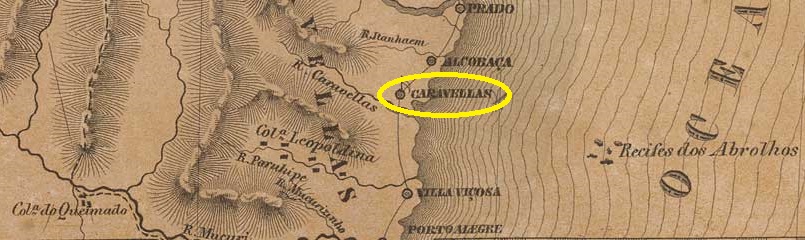
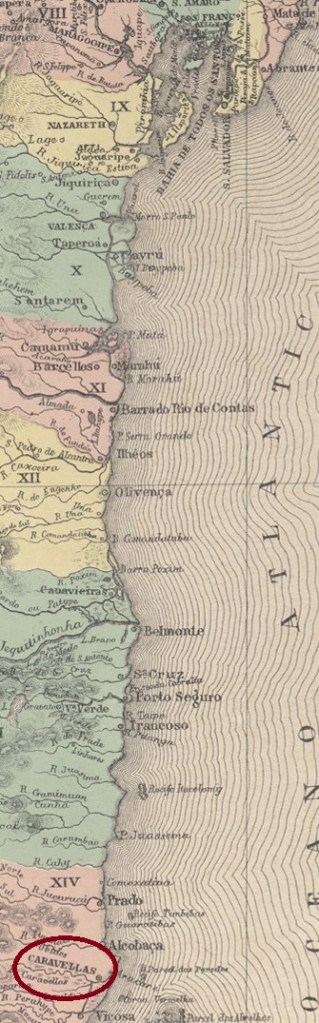
The Vila de Sto. Antonio do Rio das Caravellas was founded in 1701 and lies idyllically on the north bank of the mouth of the Rio das Caravellas into the Atlantic, 840 km south of the then colonial capital Salvador da Bahia. It was not until January 1755 that the place was declared a freguesia and a hundred years later a town.
Two dates have been found for the foundation of the local post office. Once in April 1845, as Nova Monteiro writes in Administrações e Agencias Postaes do Brasil Imperio (Brasil Filatelico/RJ, 1934-5; reprinted by SPP 1994-1999). Then again in 1866, as shown in the Directory of Imperial Post Offices (Tabella das Agencias do Correio do Imperio, Rio de Janeiro, 1885). Reinhold Koester (Carimbologia IX) assumes that this agency was moved to the station around 1887.
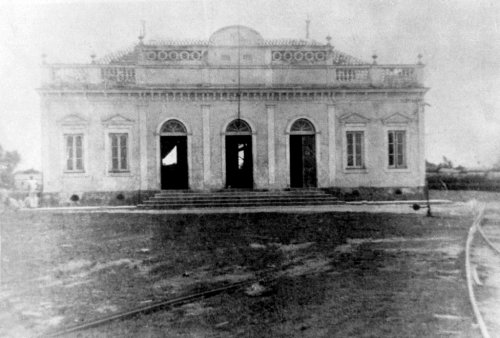
Caravellas station, around 1910 (estacoesferroviarias.com.br)
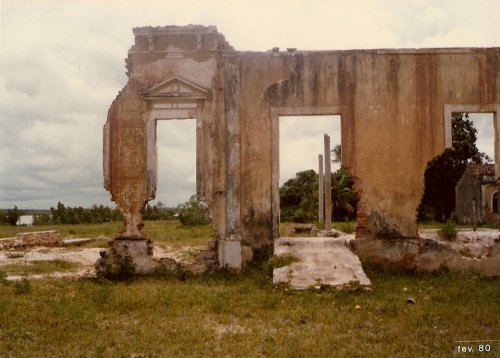
Caravellas station was located just outside the city, in Ponta de Areia, and was inaugurated by the E.F. Bahia-Minas railway company in 1881 or November 1882 (sources differ). Afterwards, the line changed hands three times: in 1912 it went to the Chemins de Fer Fédéraux de l’Est Brésilien, in 1936 again to the E.F. Bahia a Minas, and from 1965 until its closure in 1966 it belonged to the V.F. Centro-Oeste.
Caravellas station, feb. 1980 (photo: Carlos Alberto L. Pereira, on estacoesferroviarias.com.br)
The Directory of Imperial Post Offices (op. cit.) states that there had been a post office at the station since 1883.
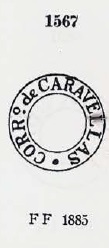
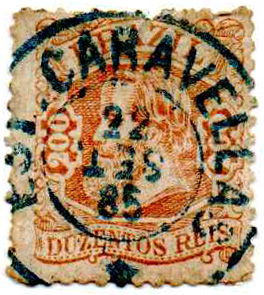
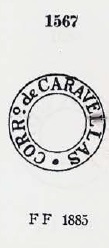
The oldest postmark so far is CBA-0250b, found with dates from about 1850 to about 1887 and bearing No. 1567 in the Catálogo de Carimbos Brasil-Império (S. Paulo, 1937, 1942) by Paulo Ayres:
CBA-0250b (P.A. 1567) 1850ff-1887ff
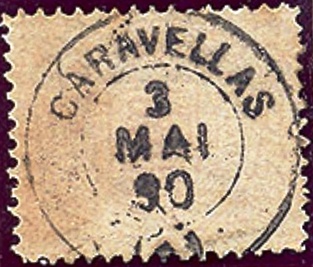
It was followed by the French type CBA-0250c (ill. Rodrigo Baldassare), which was also available in dark purple:
CBA-0250c (RB) 1877-1898
Two postmarks were also found from Caravellas station, starting with the enigmatic CBA-0255a, as shown by R. Koester (op. cit.):
CBA-0255a (RK) 1883ff
Then came the double circle CBA-0255b (fig. Paul Lepper):
CBA-0255b (PL) 1885-1886Atlas do Imperio do Brasil, 1868
Die Vila de Sto. Antonio do Rio das Caravellas wurde 1701 gegründet und liegt idyllisch am Nordufer der Mündung des Rio das Caravellas in den Atlantik, 840 km südlich der damaligen Kolonialhauptstadt Salvador da Bahia. Erst im Januar 1755 wurde der Ort zur Freguesia und hundert Jahre später zur Stadt erklärt.
Für die Gründung des örtlichen Postamtes wurden zwei Daten gefunden. Einmal im April 1845, wie Nova Monteiro in Administrações e Agencias Postaes do Brasil Imperio (Brasil Filatelico/RJ, 1934-5; Nachdruck SPP 1994-1999) schreibt. Dann wieder 1866, wie aus dem Verzeichnis der kaiserlichen Postämter (Tabella das Agencias do Correio do Imperio, Rio de Janeiro, 1885) hervorgeht. Reinhold Koester (Carimbologia IX) vermutet, dass diese Agentur um 1887 an den Bahnhof verlegt wurde.
Bahnhof Caravellas, um 1910 (estacoesferroviarias.com.br)
Der Bahnhof Caravellas lag etwas außerhalb der Stadt, hier Ponta de Areia, und wurde 1881 oder im November 1882 (die Quellen gehen auseinander) von der Eisenbahngesellschaft E.F. Bahia-Minas eingeweiht. Danach wechselte die Strecke dreimal den Besitzer: 1912 ging sie an die Chemins de Fer Fédéraux de l’Est Brésilien, 1936 wieder an die E.F. Bahia a Minas und von 1965 bis zu ihrer Stilllegung 1966 gehörte sie der V.F. Centro-Oeste.
Bahnhof Caravellas, Febr. 1980 (Foto: Carlos Alberto L. Pereira, auf estacoesferroviarias.com.br)
Im Verzeichnis der Kaiserlichen Postämter (a.a.O.) ist zu lesen, dass es seit 1883 ein Postamt am Bahnhof gab.
Der bisher älteste Poststempel ist CBA-0250b, der mit Daten um 1850 bis ca. 1887 gefunden wurde und im Catálogo de Carimbos Brasil-Império (S. Paulo, 1937, 1942) von Paulo Ayres die Nr. 1567 trägt:
CBA-0250b (P.A. 1567) 1850ff-1887ff
Ihm folgte der französische Typ CBA-0250c (Abb. Rodrigo Baldassare), den es auch in dunkelviolett gab:
CBA-0250c (RB) 1877-1898
Vom Bahnhof Caravellas wurden auch zwei Poststempel gefunden, beginnend mit dem rätselhaften CBA-0255a, wie von R. Koester (op. cit.) gezeigt:
CBA-0255a (RK) 1883ff
Dann kam der Doppelkreis CBA-0255b (Abb. Paul Lepper):
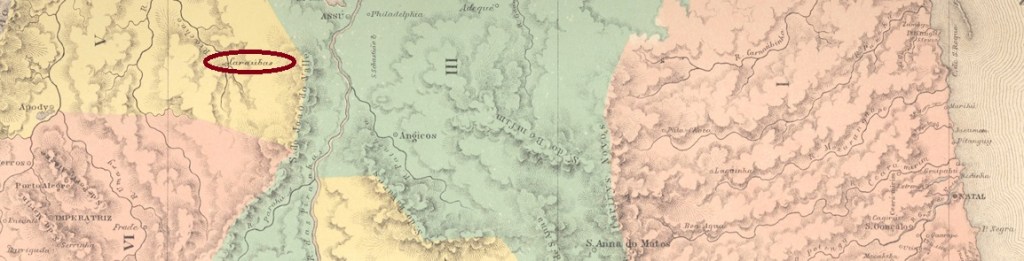
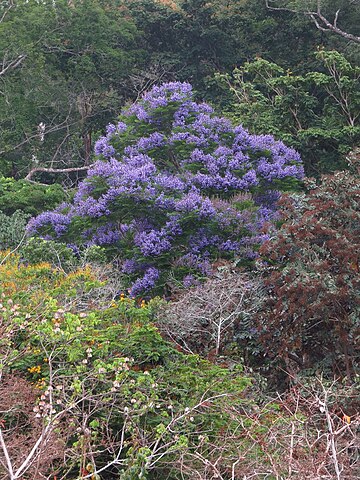
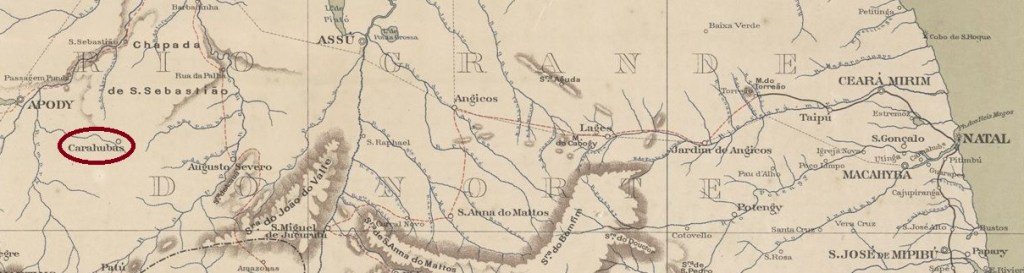
São Sebastião de Caraúbas was a district of the Vila de Apodi, 300 km west of the provincial capital Natal, from March 1852. The place was elevated to freguesia in September 1858, to vila in March 1868 and to town in November 1914. Caraúba is the indigenous name for a tree of the Bignoniaceae family, such as Jacaranda copaia:
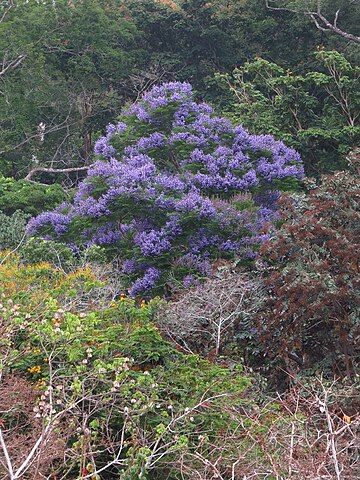
Jacaranda copaia (Photo: denisedd CC BY SA 3.0)
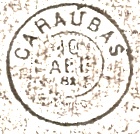
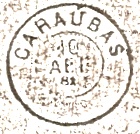
Nova Monteiro in Administrações e Agencias Postaes do Brasil Imperio (Brasil Filatelico/RJ, 1934-5; Reprint SPP 1994-1999) and R. Koester in Carimbologia IX agree that there was a post office there since August 1860. The only imperial postmark so far is CRN-0050b (ill. Jorge L. Pedreira), the only specimen of which dates from 1882:
CRN-0050b (JLP) 1882Serviço Geologico e Mineralogico, 1910
São Sebastião de Caraúbas war seit März 1852 ein Distrikt der Vila de Apodi, 300 km westlich der Provinzhauptstadt Natal. Der Ort wurde im September 1858 zur Freguesia, im März 1868 zur Vila und im November 1914 zur Stadt erhoben. Caraúba ist der einheimische Name für einen Baum aus der Familie der Bignoniaceae, wie z.B. Jacaranda copaia:
Jacaranda copaia (Foto: denisedd CC BY SA 3.0)
Nova Monteiro in Administrações e Agencias Postaes do Brasil Imperio (Brasil Filatelico/RJ, 1934-5; Reprint SPP 1994-1999) und R. Koester in Carimbologia IX sind sich einig, dass es dort seit August 1860 ein Postamt gab. Der bisher einzige kaiserliche Poststempel ist CRN-0050b (Abb. Jorge L. Pedreira), dessen einziges Exemplar aus dem Jahr 1882 stammt:
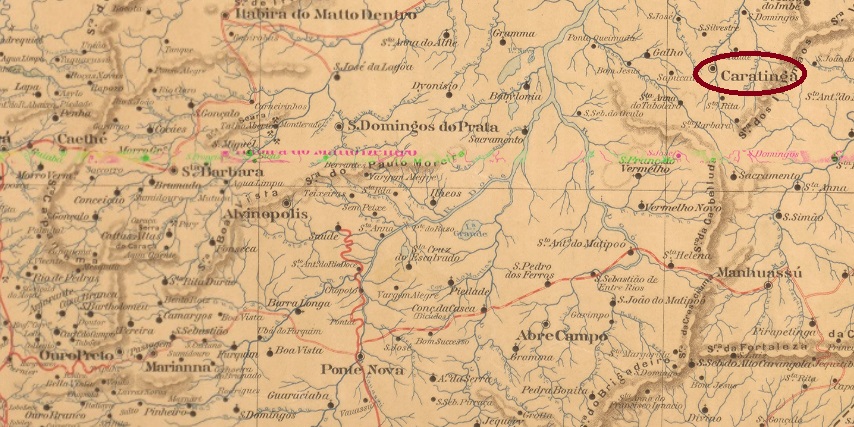
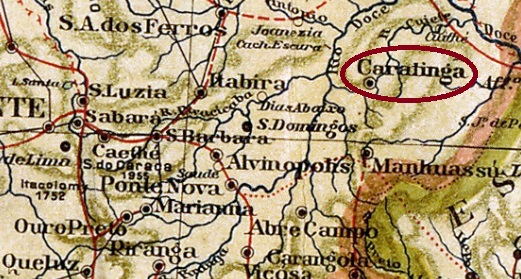
São João Baptista de Caratinga was the name of a district of the Vila de Manhuassú on the west bank of the Caratinga, 220 km northeast of the provincial capital Ouro Preto, from November 1866. The place became a freguesia in December 1873, a vila in February 1890 and a town in May 1892.
Two dates have been found for the foundation of the local post office. The first in 1872, as shown in the Directory of Imperial Post Offices (Tabella das Agencias do Correio do Imperio, Rio de Janeiro, 1885). Then again in September 1877, as Paula Sobrinho writes in História Postal de Minas Gerais (Belo Horizonte, 1997). Since the agency is not mentioned in the Imperial Postal Guide (Guia Postal do Imperio, Rio de Janeiro, 1880), one must assume that a third agency opening took place.
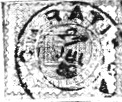
The only imperial postmark so far is CMG-0615b, found with dates between 1889 and 1902 and shown by R. Koester in Carimbologia IX:
CMG-0615b (RK) 1889-1902Mappa Geral do Brasil, 1911
São João Baptista de Caratinga war seit November 1866 der Name eines Distrikts der Vila de Manhuassú am Westufer des Caratinga, 220 km nordöstlich der Provinzhauptstadt Ouro Preto. Der Ort wurde im Dezember 1873 zur Freguesia, im Februar 1890 zur Vila und im Mai 1892 zur Stadt.
Für die Gründung des örtlichen Postamtes wurden zwei Daten gefunden. Das erste im Jahr 1872, wie aus dem Verzeichnis der kaiserlichen Postämter (Tabella das Agencias do Correio do Imperio, Rio de Janeiro, 1885) hervorgeht. Dann wieder im September 1877, wie Paula Sobrinho in História Postal de Minas Gerais (Belo Horizonte, 1997) schreibt. Da die Agentur im Kaiserlichen Postführer (Guia Postal do Imperio, Rio de Janeiro, 1880) nicht erwähnt wird, muss man davon ausgehen, dass eine dritte Agentureröffnung stattgefunden hat.
Der bisher einzige kaiserliche Poststempel ist CMG-0615b, der mit Daten zwischen 1889 und 1902 gefunden und von R. Koester in Carimbologia IX gezeigt wurde:
Villiers de l’Ile Adam: Carta (…) da Provincia do Rio de Janeiro, 1850
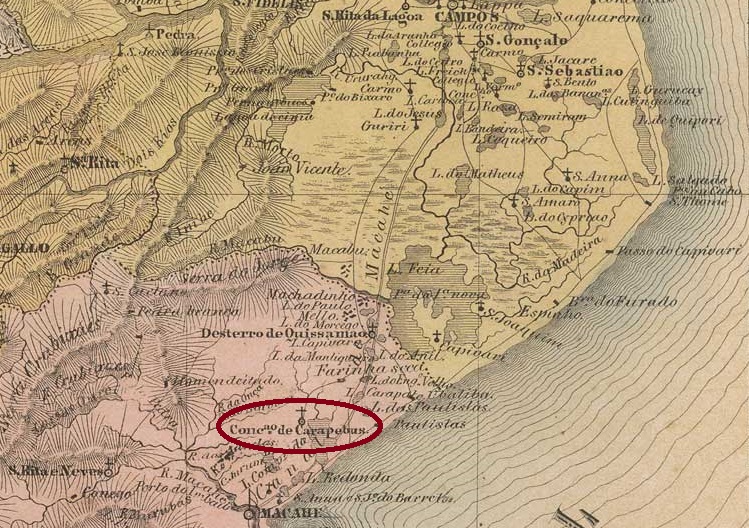
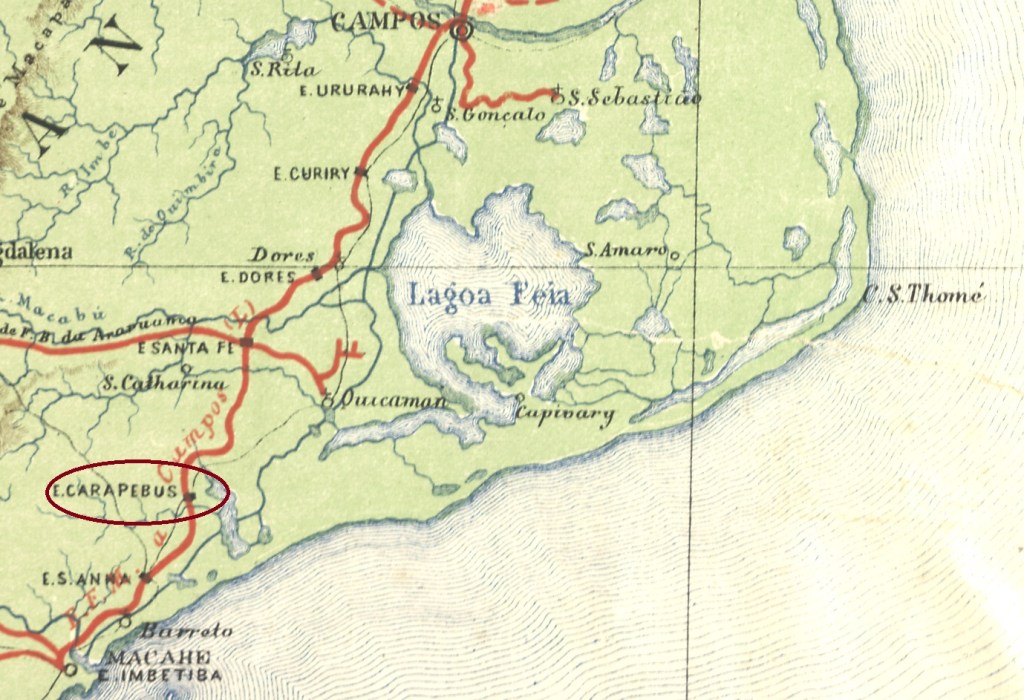
The Freguesia de N. Sra. da Conceição de Carapebus was founded in May 1842 and belonged to the Vila de Macaé, 210 km northeast of the capital Rio de Janeiro. It remained so until July 1995, when it was elevated to an independent município.
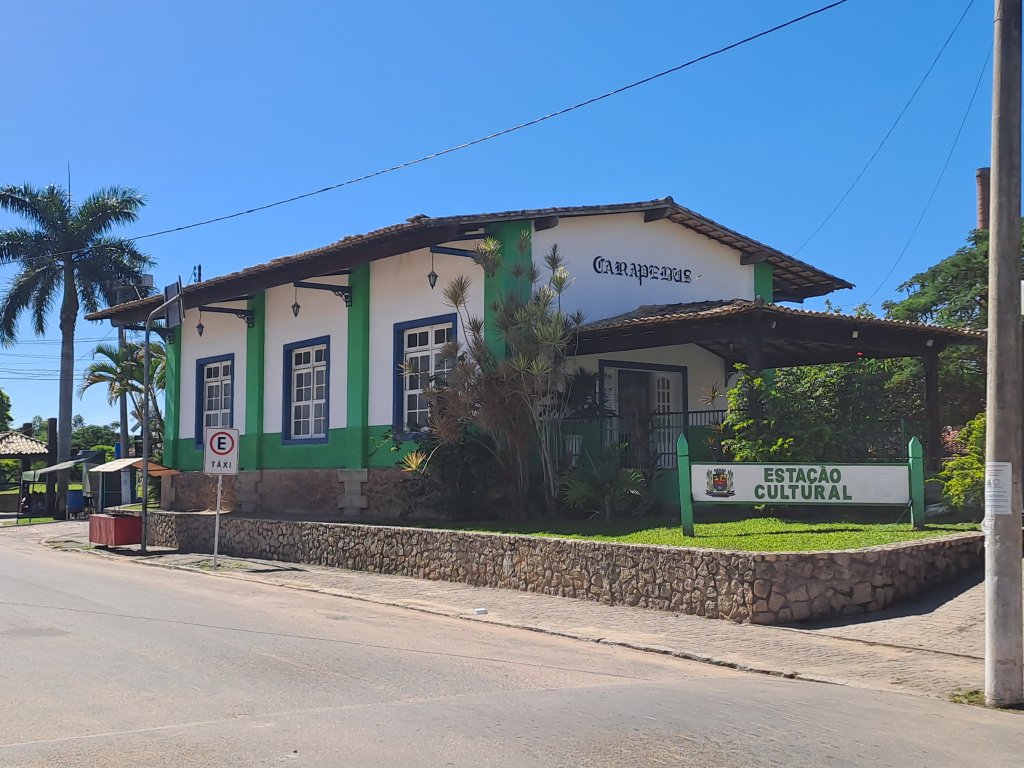
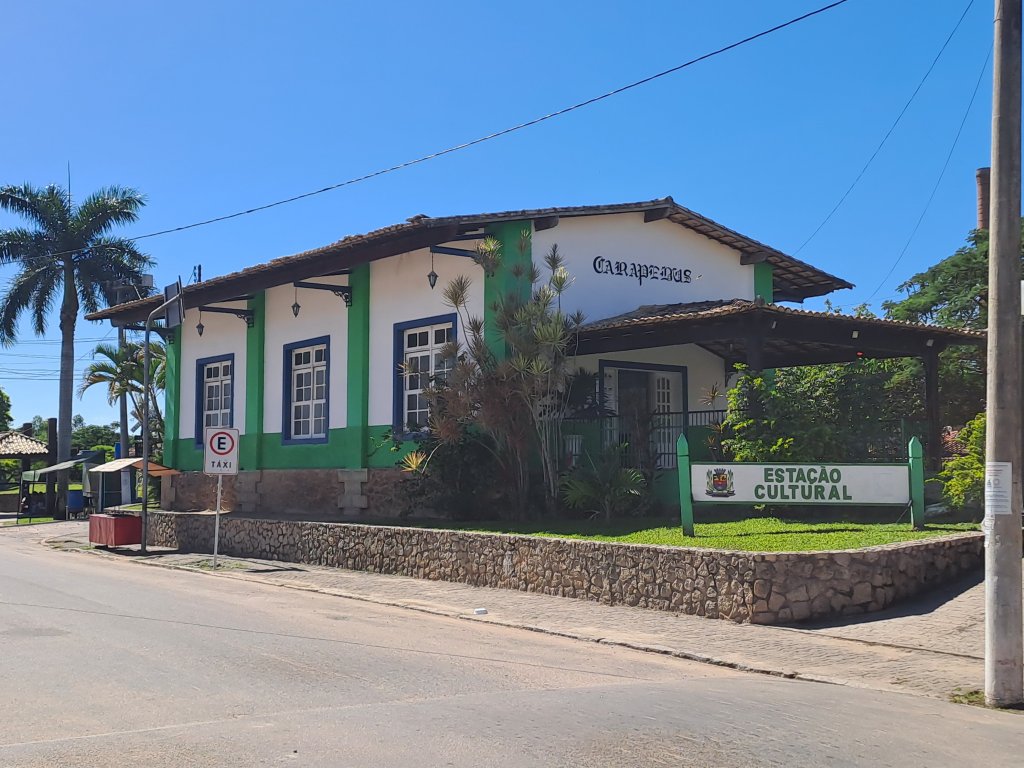
Around 1875, a railway station of the E.F. Macahe e Campos (Coastline) railway company was inaugurated there. The railway line passed to the E.F. Leopoldina around 1890 and belonged to Rede Ferroviária Federal S.A. (estacoesferroviarias.com.br) from 1975 until the line was closed in 1996.
Today, the tracks are still there, and the restored station building is used as a municipal cultural centre:
In 2023. photo: Renato Ramos in estacoesferroviarias.com.br
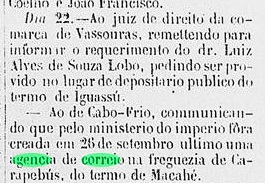
As the Rio Press reports, there has been a post office here since September 1857:
A Patria, 14.05.1858
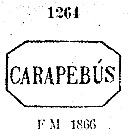
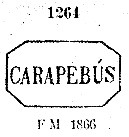
Paulo Novaes gives a date two months later for this in agenciaspostais.com.br, which is probably a transcription error. It is likely that the post office was moved there sometime after the inauguration of the station. The first cancel is CRJ-0305a, which also exists in dark purple and was already presented by Paulo Ayres in the Catálogo de Carimbos Brasil-Império (S. Paulo, 1937, 1942) under No. 1264:
CRJ-0305a (P.A. 1264) 1857ff-1866ff
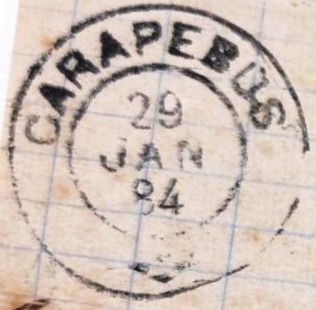
Of its successor CRJ-0305b, only one example from 1884 is known, from the Everaldo N. dos Santos collection:
CRJ-0305b (ENS) 1884
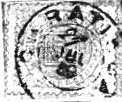
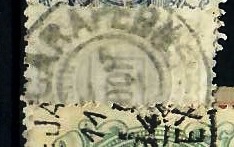
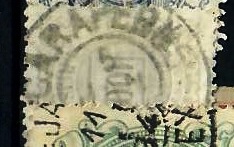
The last imperial postmark from Carapebus is CRJ-0305c (Ill. from the internet), which also exists in dark purple and, according to R. Koester (Carimbologia IX), bears also the inscription EST. DE. This would undoubtedly make it a station cancel.
CRJ-0306a (EB) 1887-1889
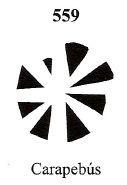
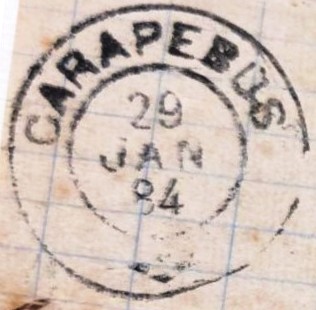
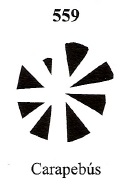
James Dingler and Klerman W. Lopes have found a mute postmark in Mute Cancellations of the Brazil Empire / Carimbos Mudos do Brasil Império (Brazil Philatelic Association, Rio de Janeiro, 2000) under no. 559, which is probably identical to no. 56 in Paulo Ayres’ (op. cit.):
BPA 559 (P.A. 56) 1881ff-1884Estrada de Ferro Central do Brasil, 1890
Die Freguesia de N. Sra. da Conceição de Carapebus wurde im Mai 1842 gegründet und gehörte zur Vila de Macaé, 210 km nordöstlich der Hauptstadt Rio de Janeiro. Dies blieb sie bis Juli 1995, als sie zu einem eigenständigen Município erhoben wurde.
Um 1875 wurde dort ein Bahnhof der Eisenbahngesellschaft E.F. Macahe e Campos (Küstenlinie) eingeweiht. Die Bahnlinie ging um 1890 an die E.F. Leopoldina über und gehörte von 1975 bis zur Stilllegung der Strecke 1996 der Rede Ferroviária Federal S.A. (estacoesferroviarias.com.br). Heute sind die Gleise noch vorhanden, das restaurierte Bahnhofsgebäude wird als kommunales Kulturzentrum genutzt:
2023. Foto: Renato Ramos in estacoesferroviarias.com.br
Wie die Rio-Presse berichtet, gab es hier seit September 1857 ein Postamt:
A Patria, 14.05.1858
Paulo Novaes gab in agenciaspostais.com.br dafür ein zwei Monate späteres Datum an, was wahrscheinlich ein Abschreibfehler ist. Es ist anzunehmen, dass das Postamt irgendwann nach der Einweihung des Bahnhofs dorthin verlegt wurde. Der erste Stempel ist CRJ-0305a, den es auch in dunkelviolett gibt und der bereits von Paulo Ayres im Catálogo de Carimbos Brasil-Império (S. Paulo, 1937, 1942) unter der Nr. 1264 vorgestellt wurde:
CRJ-0305a (P.A. 1264) 1857ff-1866ff
Von seinem Nachfolger CRJ-0305b ist nur ein Exemplar von 1884 aus der Sammlung Everaldo N. dos Santos bekannt:
CRJ-0305b (ENS) 1884
Der letzte kaiserliche Poststempel aus Carapebus ist CRJ-0306a (Abb. aus dem Internet), der auch in dunkelviolett existiert und nach R. Koester (Carimbologia IX) die Inschrift EST. DE trägt. Damit wäre er zweifellos ein Bahnhofsstempel.
CRJ-0306a (EB) 1887-1889
James Dingler und Klerman W. Lopes haben dazu in Mute Cancellations of the Brazil Empire / Carimbos Mudos do Brasil Império (Brazil Philatelic Association, Rio de Janeiro, 2000) unter Nr. 559 einen stummen Poststempel gefunden, der vermutlich mit Nr. 56 in Paulo Ayres’ (op. cit.) identisch ist:
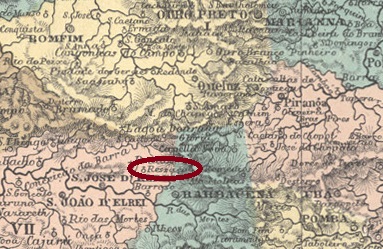
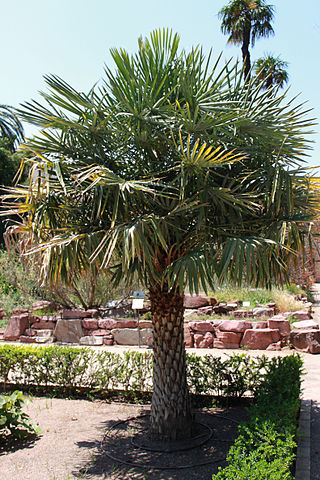
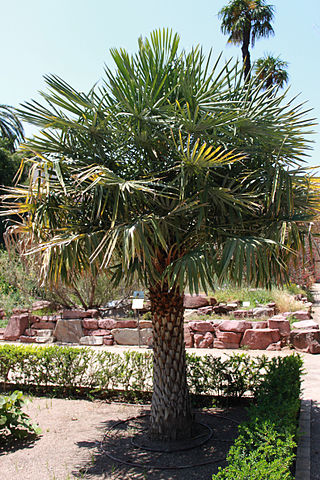
The Freguesia de Sant’Anna da Ressaca was founded in July 1872, belonged to the Vila de S. José d’El-Rei and was located on the south bank of the Carandaí, 90 km south of the provincial capital Ouro Preto. Already in July 1876, the name was changed to Sant’Anna de Carandahy, probably because the village was moved closer to the river. Ressaca was the name of an old fazenda in the area. The name Carandahy comes from the Tupi language and means river of the Carandás. Carandá is a palm from the Arecaceae family, such as Copernica australis.
Since September 1923, Carandaí (as it is written today) has been an independent município.
The local post office was opened in May 1875, as both Paula Sobrinho (História Postal de Minas Gerais, Belo Horizonte, 1997) and R. Koester (Carimbologia IX) write. According to them, the existence of a postmark with Sant’Anna da Ressaca would be possible, but it has not been seen so far. Since the post office is not mentioned in the postal guide (Guia Postal do Imperio) of 1880, it can be assumed that it has been closed in the meantime.
From Carandahy comes the imperial postmark CMG-0610a (image from the internet):
CMG-0610a (Delcampe) 1884-1906
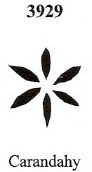
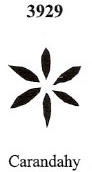
Two mute cancels were also found and registered by James Dingler and Klerman W. Lopes in Mute Cancellations of the Brazil Empire / Carimbos Mudos do Brasil Império (Brazil Philatelic Association, Rio de Janeiro, 2000):
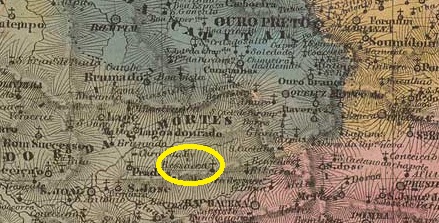
BPA 3921 (P.A. 607) 1875ff-1883ffBPA 3929Villiers de l’Ile Adam: Carta (…) da Provincia de Minas Geraes, 1849
Andere Namen: Sant’Anna da Ressaca
Die Freguesia de Sant’Anna da Ressaca wurde im Juli 1872 gegründet, gehörte zur Vila de S. José d’El-Rei und lag am Südufer des Carandaí, 90 km südlich der Provinzhauptstadt Ouro Preto. Bereits im Juli 1876 wurde der Name in Sant’Anna de Carandahy geändert, wahrscheinlich weil der Ort näher an den Fluss verlegt wurde. Ressaca war der Name einer alten Fazenda in der Gegend. Der Name Carandahy stammt aus der Tupi-Sprache und bedeutet Fluss der Carandás. Carandá ist eine Palme aus der Familie der Arecaceae, wie z.B. Copernica australis.
Seit September 1923 ist Carandaí (wie es heute geschrieben wird) ein eigenständiges Município.
Das örtliche Postamt wurde im Mai 1875 eröffnet, wie sowohl Paula Sobrinho (História Postal de Minas Gerais, Belo Horizonte, 1997) als auch R. Koester (Carimbologia IX) schreiben. Demnach wäre die Existenz eines Poststempels mit Sant‘Anna da Ressaca möglich, der aber bisher nicht gesehen wurde. Da das Postamt im Postführer (Guia Postal do Imperio) von 1880 nicht erwähnt wird, ist anzunehmen, dass es zwischenzeitlich geschlossen wurde.
Aus Carandahy stammt der kaiserliche Poststempel CMG-0610a (Abbildung aus dem Internet):
CMG-0610a (Delcampe) 1884-1906
Es wurden auch zwei stumme Stempel gefunden und von James Dingler und Klerman W. Lopes in Mute Cancellations of the Brazil Empire / Carimbos Mudos do Brasil Império (Brazil Philatelic Association, Rio de Janeiro, 2000) registriert:
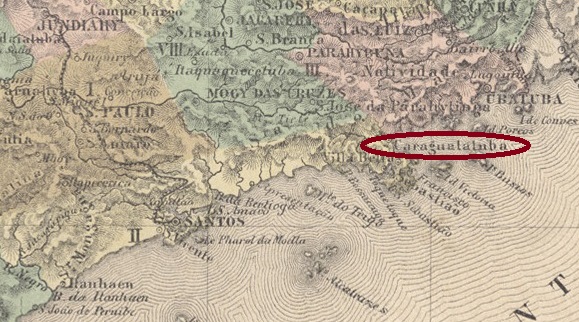
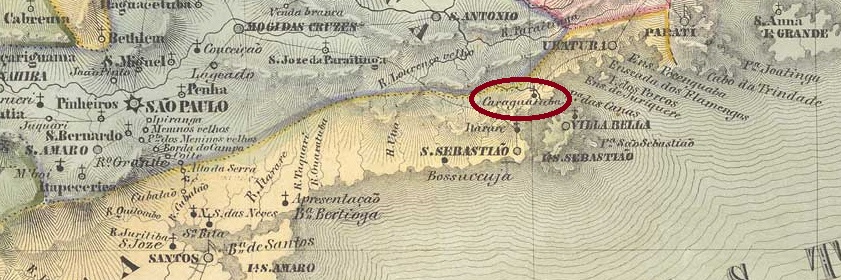
The Freguesia de Sto. Antonio de Caraguatatuba was founded in March 1847, belonged to the Vila de São Sebastião and was idyllically situated by the sea, 180 km east of the provincial capital São Paulo. It was elevated to the status of vila in April 1857 and city in December 1906. This name is also of indigenous origin and means a lot of Caraguatá. This is a plant from the bromelia family:
Caraguatá (Bromelia penguin, L )
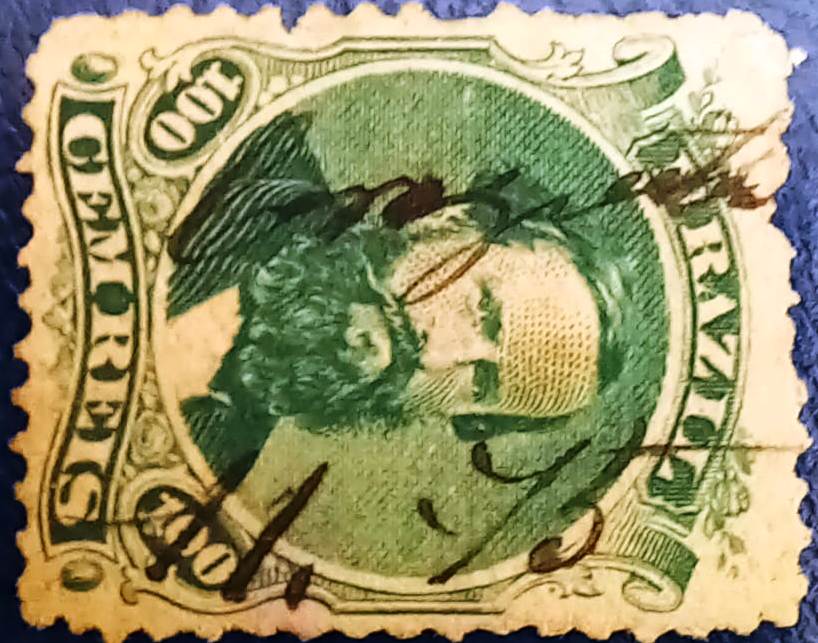
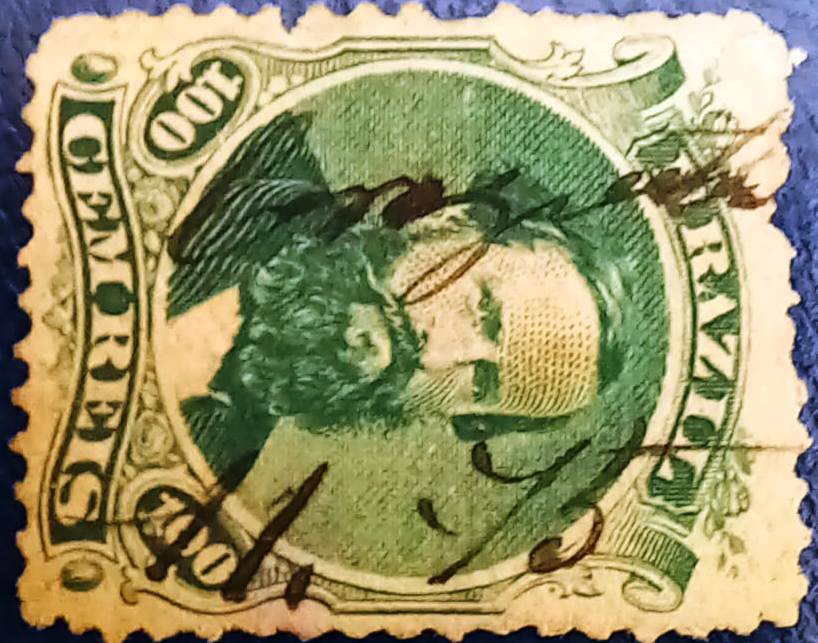
Two dates have been found for the foundation of the local post office. First in January 1846, as Nova Monteiro writes in Administrações e Agencias Postaes do Brasil Imperio (Brasil Filatelico/RJ, 1934-5; Reprint SPP 1994-1999), and then in 1848, as stated in the Directory of Imperial Post Offices (Tabella das Agencias do Correio do Imperio, Rio de Janeiro, 1885). Although Caraguatatuba had a port and was therefore of economic importance, no press report about its postal agency was found until 1853. The first postmark is also unknown, it went probably broken, because between 1875 and 1877 the stamps there were cancelled by hand, as this example from the Fuad Ferreira Fo. collection shows:
(FF) 1875-1877
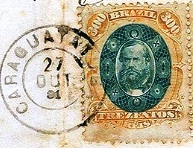
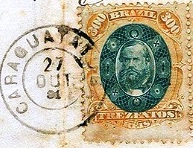
Then came the double circle CSP-0310b (Fig. RHM):
CSP-0310b (RHM) 1878-1881
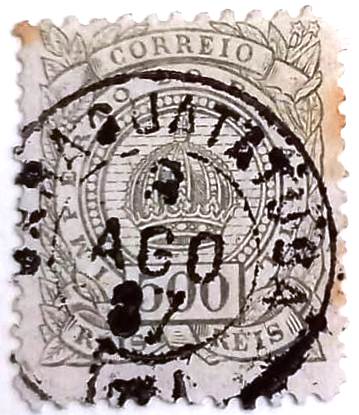
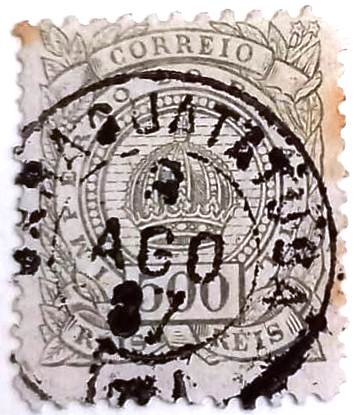
In the last imperial years there appeared the French type CSP-0310c (Coll. Fuad Ferreira Fo.)
CSP-0310c (FF) 1886-1887Villiers de l’Ile Adam: Carta (…) da Provincia de São Paulo, 1847
Textaktualisierung am 7. November 2023
Andere Namen: Caraguatuba
Die Freguesia de Sto. Antonio de Caraguatatuba wurde im März 1847 gegründet, gehörte zur Vila de São Sebastião und lag idyllisch am Meer, 180 km östlich der Provinzhauptstadt São Paulo. Im April 1857 wurde es zur Vila und im Dezember 1906 zur Stadt erhoben. Auch dieser Name ist indigenen Ursprungs und bedeutet viele Caraguatás. Es handelt sich hier um eine Pflanze aus der Familie der Bromeliengewächse:
Caraguatá (Bromelia pinguin, L )
Für die Gründung des örtlichen Postamtes wurden zwei Daten gefunden. Zuerst im Januar 1846, wie Nova Monteiro in Administrações e Agencias Postaes do Brasil Imperio (Brasil Filatelico/RJ, 1934-5; Reprint SPP 1994-1999) schreibt, und dann 1848, wie im Verzeichnis der kaiserlichen Postämter (Tabella das Agencias do Correio do Imperio, Rio de Janeiro, 1885) zu lesen ist. Obwohl Caraguatatuba über einen Hafen verfügte und somit von wirtschaftlicher Bedeutung war, findet sich bis 1853 keine Pressemeldung über seine Postagentur. Auch der erste Poststempel ist unbekannt, vermutlich ist er zerbrochen, denn zwischen 1875 und 1877 wurden die Marken dort von Hand entwertet, wie dieses Beispiel aus der Sammlung Fuad Ferreira Fo zeigt:
(FF) 1875-1877
Danach kam der Doppelkreis CSP-0310b (Abb. RHM):
CSP-0310b (RHM) 1878-1881
Gegen Ende des Kaiserreichs erschien auch der französische Typus CSP-0310c (Samml. Fuad Ferreira Fo.)
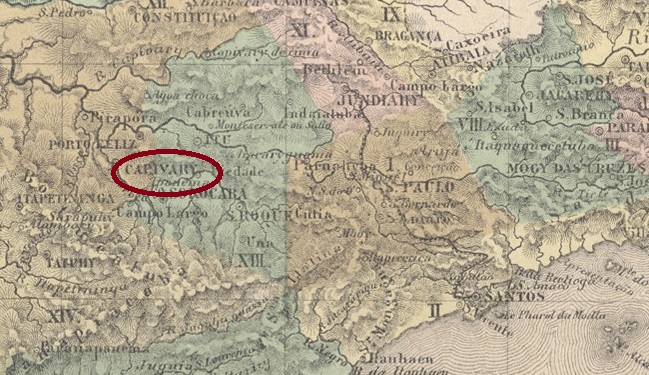
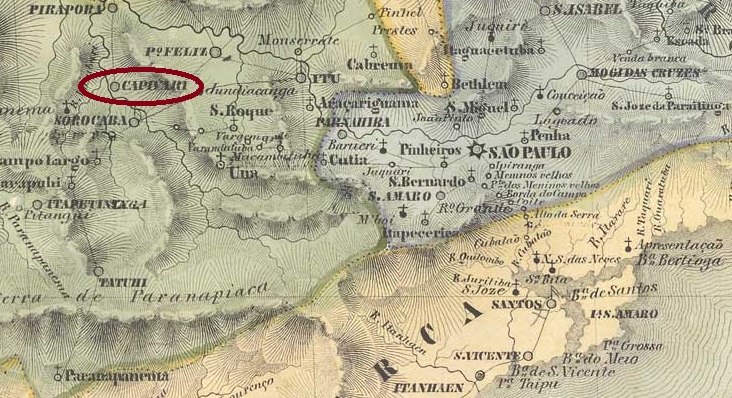
Founded in October 1826, the Freguesia de S. João Baptista do Capivary de Baixo belonged to the Vila de Porto Feliz and was located on the north bank of the Capivary, 140 km northwest of the provincial capital São Paulo. The place was elevated to vila in July 1832 and to town in April 1864.
Two dates have been found for the creation of the post office. Once in August 1833, as Nova Monteiro writes in Administrações e Agencias Postaes do Brasil Imperio (Brasil Filatelico/RJ, 1934-5; reprinted by SPP 1994-1999). Then in 1847, as shown in the Directory of Imperial Post Offices (Tabella das Agencias do Correio do Imperio, Rio de Janeiro. 1885).
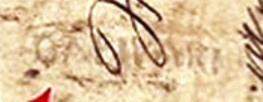
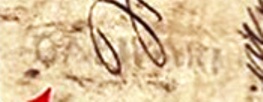
The oldest cancel is CSP-0305a (Fig. Mário Celso R. Orsi Jr.), used in the pre-philatelic period and often confused with a similar cancel (CRJ-0300a) from Capivary/RJ:
CSP-0305a (MO) 1834-1843ff
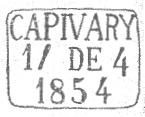
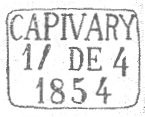
Its two successors, on the other hand, are unmistakable. CSP-0305b also occurs in blue and was assigned No. 1543 by Paulo Ayres (Catálogo de Carimbos Brasil-Império, S. Paulo, 1937, 1942):
CSP-0305b (P.A. 1543) 1844-1866
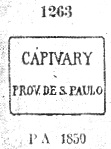
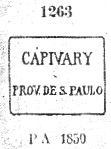
Somewhat later, CSP-0305c, also known by P. Ayres (op. cit.), also appeared, this time with no. 1263:
CSP-0305c (P.A. 1263) 1850ff-1875
This was followed by the double circle CSP-0305d (fig. R. Koester in Carimbologia IX):
CSP-0305d (RK) 1880-1884
The assignment of the following cancel CSP-0305e (Fig. José L. Fevereiro) has not yet been clarified beyond doubt, but its dates fit very well into the chronological gap until its successor:
CSP-0305e (JLF) 1885-1889
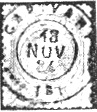
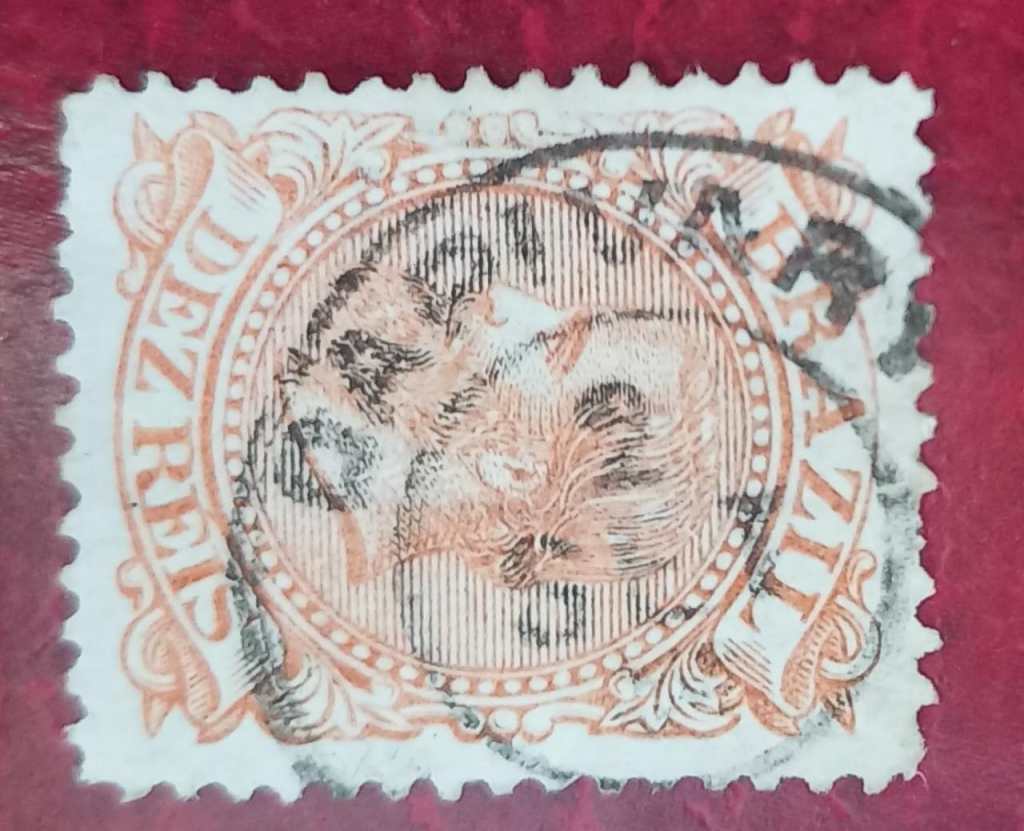
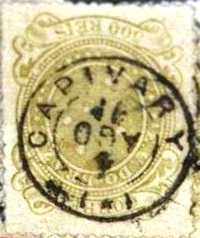
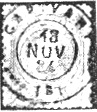
The French type CSP-0305f (picture from the internet) on the other hand is certainly from Capivary/SP:
CSP-0305f (EB) 1890-1897Villiers de l’Ile Adam: Carta (…) da Provincia de São Paulo, 1847
Die im Oktober 1826 gegründete Freguesia de S. João Baptista do Capivary de Baixo gehörte zur Vila de Porto Feliz und lag am Nordufer des Capivary, 140 km nordwestlich der Provinzhauptstadt São Paulo. Der Ort wurde im Juli 1832 zur Vila und im April 1864 zur Stadt erhoben.
Für die Gründung des Postamtes wurden zwei Daten gefunden. Einmal im August 1833, wie Nova Monteiro in Administrações e Agencias Postaes do Brasil Imperio (Brasil Filatelico/RJ, 1934-5; Nachdruck SPP 1994-1999) schreibt. Dann 1847, wie aus dem Verzeichnis der kaiserlichen Postämter (Tabella das Agencias do Correio do Imperio, Rio de Janeiro. 1885) hervorgeht.
Der älteste Stempel ist CSP-0305a (Abb. Mário Celso R. Orsi Jr.), der in der Vorphila-Zeit verwendet wurde und oft mit einem ähnlichen Stempel (CRJ-0300a) aus Capivary/RJ verwechselt wird:
CSP-0305a (MO) 1834-1843ff
Seine beiden Nachfolger sind dagegen unverwechselbar. CSP-0305b kommt auch in blau vor und wurde von Paulo Ayres (Catálogo de Carimbos Brasil-Império, S. Paulo, 1937, 1942) mit der Nr. 1543 versehen:
CSP-0305b (P.A. 1543) 1844-1866
Etwas später erschien auch CSP-0305c, ebenfalls bekannt durch P. Ayres (op. cit.), diesmal mit der Nr. 1263:
CSP-0305e (P.A. 1263) 1850ff-1875
Es folgte der Doppelkreis CSP-0305d (Abb. R. Koester in Carimbologia IX):
CSP-0305d (RK) 1880-1884
Die Zuordnung des folgenden Stempels CSP-0305e (Abb. José L. Fevereiro) ist noch nicht zweifelsfrei geklärt, aber seine Daten passen sehr gut in die zeitliche Lücke bis zu seinem Nachfolger:
CSP-0305e (JLF) 1885ff-1889
Der französische Typ CSP-0305f (Bild aus dem Internet) ist dagegen sicher aus Capivary/SP:










 Carimbologia