Categories
Carimbologia H-L

Jaicoz, Piauí (JPI-0080)

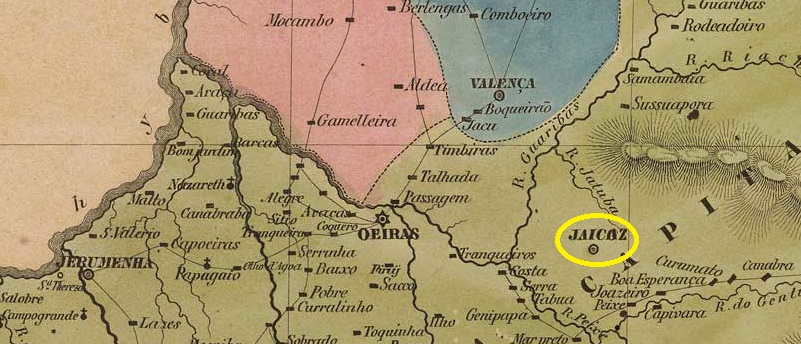
Villiers de l’Ile Adam: Carta (…) da Provincia do Piauhy, 1850

Other spelling: Jaicós

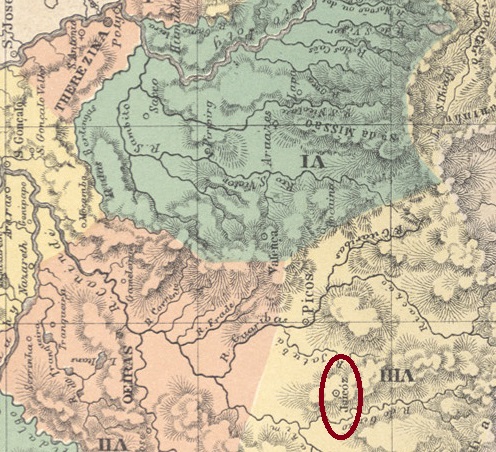
The Jaicós were members of an indigenous tribe in the hinterland of the Capitania de Piauí, after whom the Freguesia de N. Sra. das Mercês de Jaicoz was named in September 1801. It belonged to the Vila de Oeiras and was located on the west bank of the Bonsucesso, almost 400 kilometres south-east of the later provincial capital Teresina. In July 1832 it was elevated to the status of a Vila and since December 1889 Jaicós, as it is spelt today, has been a town.

R. Koester writes in Carimbologia XXV that there had been a post office there since 1882. However, this is probably either a mistake or a reopening, as Nova Monteiro gives a much earlier date – September 1817 – in Administrações e Agencias Postaes do Brasil Imperio (Brasil Filatelico/RJ, 1934-5; reprint SPP 1994-1999). This postal agency is then also listed in the postal guides of 1857 and 1880 and appears repeatedly in the regional press between 1839 and 1874.

Two postmarks were found for the 19th century. The rare JPI-0080b (fig. R. Koester, op. cit.) is shown in an unfortunately poor quality:
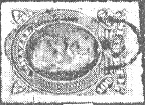
JPI-0080b (RK) 1877ff

It was followed by the double circle JPI-0080c (image by Felipe Piccinini):
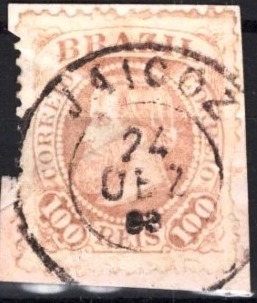
JPI-0080c (FP) 1883

Later came JPI-0080d (collect. Fuad Ferreira Fo.):
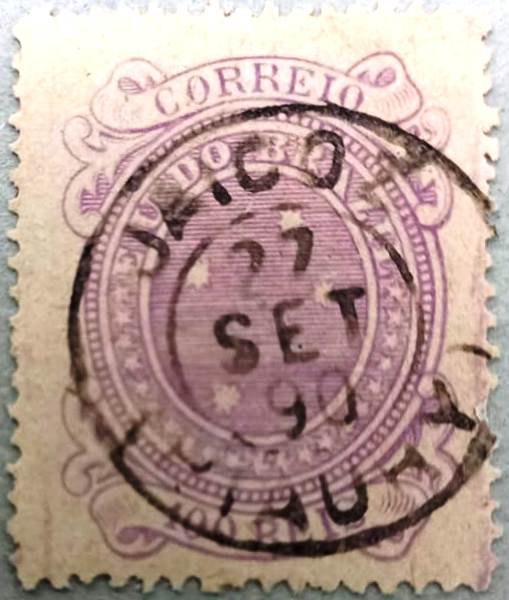
JPI-0080d (FF) 1890-1894
Atlas do Imperio do Brasil, 1868

Textaktualisierung vom 2. Juli 2025

Andere Schreibweise: Jaicós

Die Jaicós waren Angehörige eines indigenen Stammes im Hinterland der Capitania de Piauí, nach dem im September 1801 die Freguesia de N. Sra. das Mercês de Jaicoz benannt wurde. Sie gehörte zur Vila de Oeiras und lag am Westufer des Bonsucesso, knapp 400 km südöstlich der späteren Provinzhauptstadt Teresina. Im Juli 1832 erfolgte die Erhebung zur Vila und seit Dezember 1889 ist Jaicós, wie es heute geschrieben wird, eine Stadt.

R. Koester schreibt in Carimbologia XXV, dass es dort seit 1882 ein Postamt gab. Das dürfte aber entweder ein Irrtum oder eine Wiedereröffnung sein, denn Nova Monteiro gibt in Administrações e Agencias Postaes do Brasil Imperio (Brasil Filatelico/RJ, 1934-5; Reprint SPP 1994-1999) dafür ein viel früheres Datum – September 1817 (NM) – an. Diese Postagentur ist dann auch in den Postführern von 1857 und 1880 verzeichnet und taucht zwischen 1839 und 1874 wiederholt in der regionalen Presse auf.

Für das 19. Jahrhundert wurden zwei Poststempel gefunden. Der seltene JPI-0080b (Abb. R. Koester, op. cit.) ist in einer leider schlechten Abbildung dargestellt:
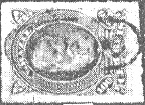
JPI-0080b (RK) 1877ff

Ihm folgte der Doppelkreis JPI-0080c (Abb. Felipe Piccinini):
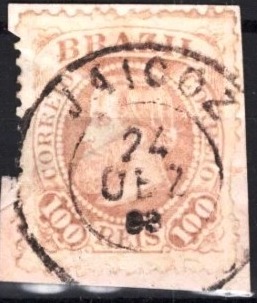
JPI-0080c (FP) 1883

Danach kam JPI-0080d (Samml. Fuad Ferreira Fo.):
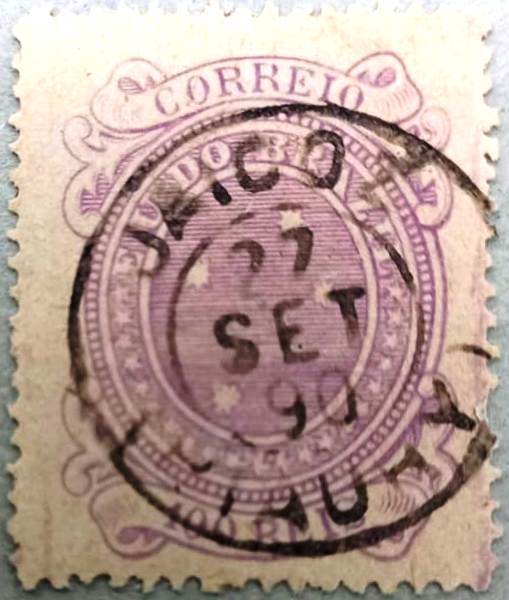
JPI-0080d (FF) 1890-1894
Categories
Carimbologia H-L

Jahu, São Paulo (JSP-0705)

J.M. Ribeiro Lisboa: Provincia de São Paulo, 1884

Other spelling: Juhu

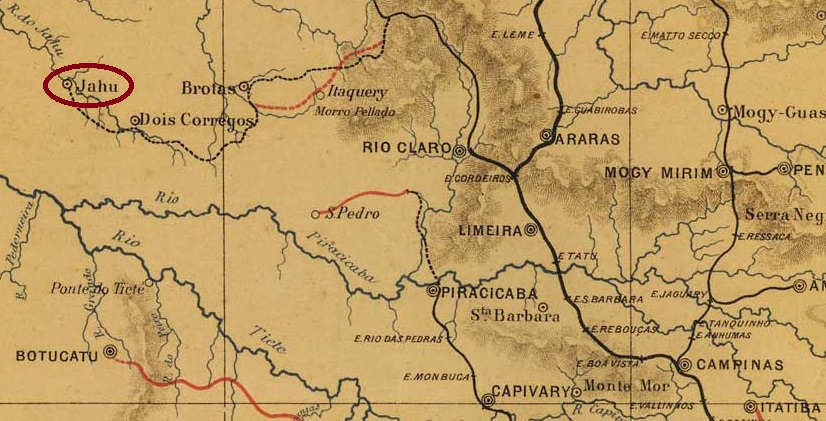
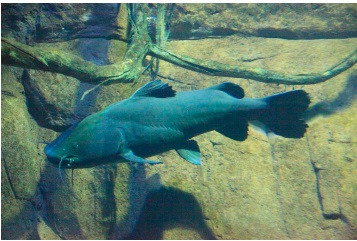
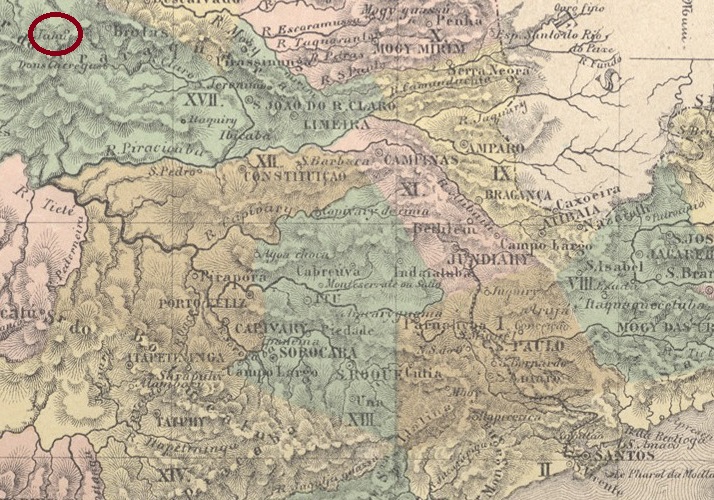
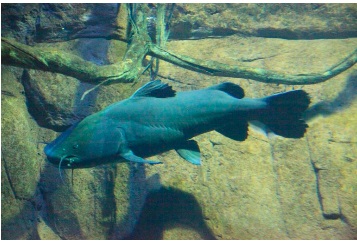
In March 1859, the Freguesia de N. Sra. do Patrocínio do Jahu was founded on the south bank of the Jaú in the Vila de Brotas, 300 kilometres northwest of the provincial capital of São Paulo. It was declared a vila in April 1866 and a town in February 1889. The indigenous name refers to a large catfish from the Pimelodidae family:

Zungaro zungaro (Humboldt & Valenciennes, 1821)

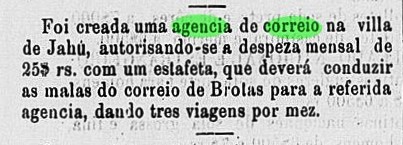
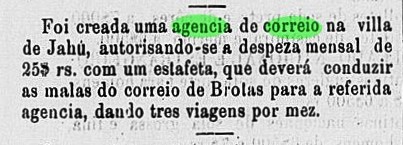
According to the São Paulo press, in December 1867 it was decided to set up a post office in the Vila:

Diario de São Paulo, 09.01.1868

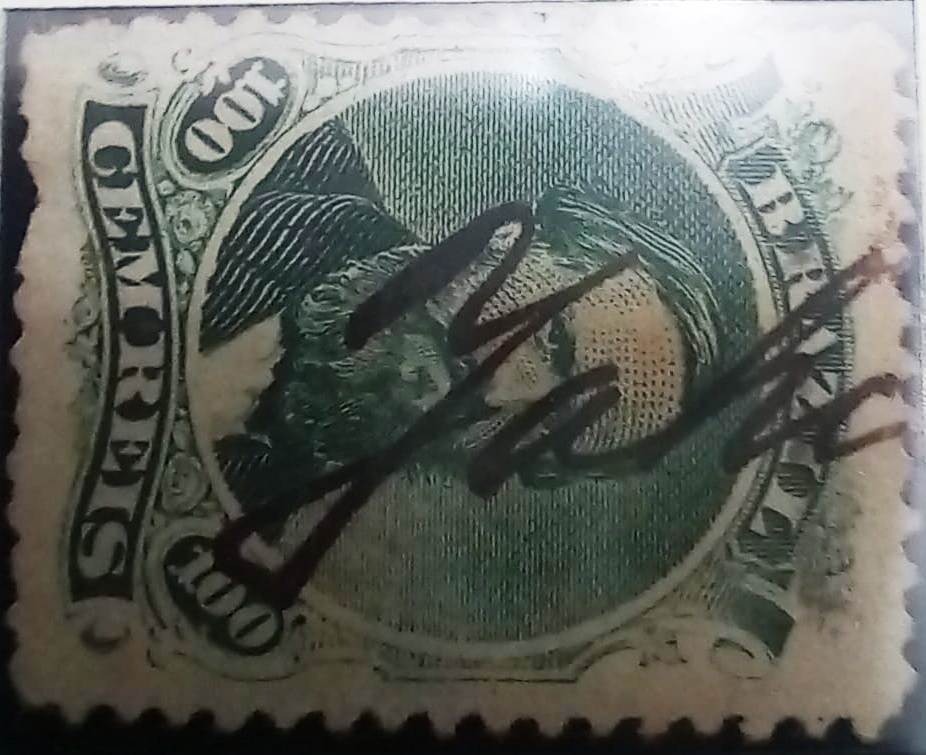
The first postmark was probably not delivered on time, as early hand cancellations are known:

1867ff (FF)

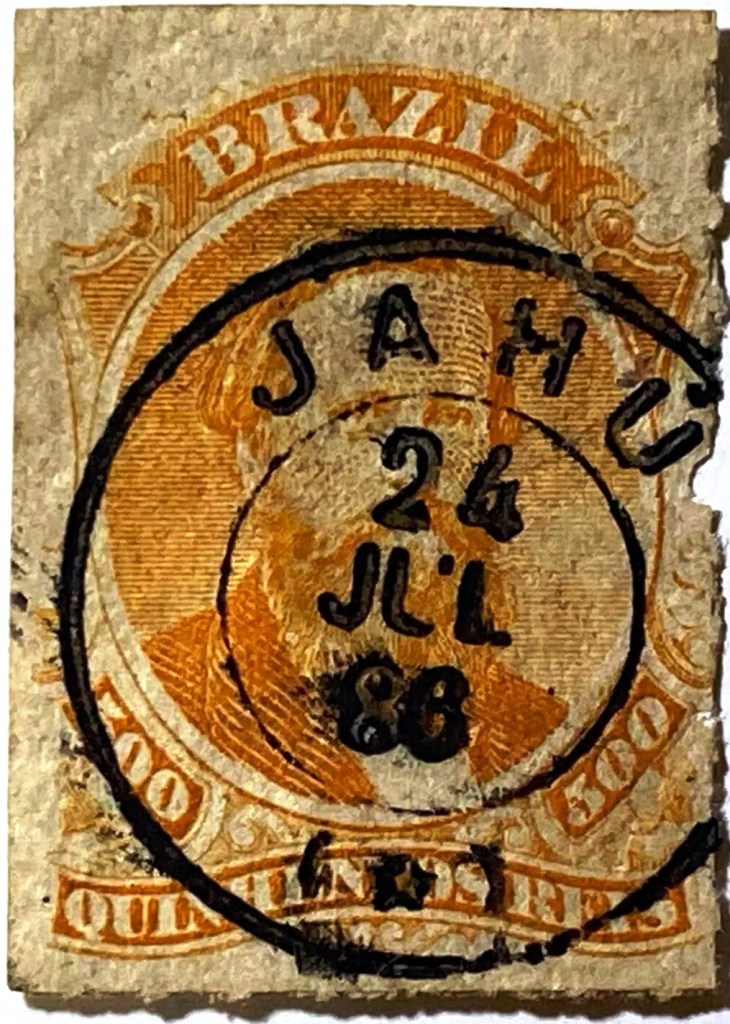
The beautiful double circle JSP-0705a (fig. Mário Celso Orsi Jr.), which is also available in blue and green, did not appear until the 70s:

JSP-0705a (MO) 1875-1880

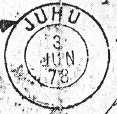
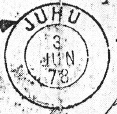
Shortly afterwards, JSP-0705b also appeared, with the incorrect spelling JUHU (fig. R. Koester, in Carimbologia XXV):

JSP-0705b (RK) 1878

The French type JSP-0705c (fig. Felipe Piccinini) was also used in the late imperial period:

JSP-0705c (FP) 1885-1892

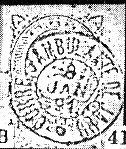
The railway postmark JSP-0706a (fig. Koester, op. cit.) came at about the same time:

JSP-0706a (RK) 1891

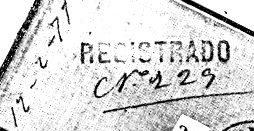
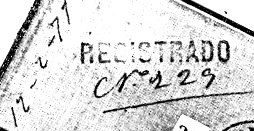
Koester also showed a registered postmark from the 70s:

1877 (RK)

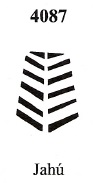
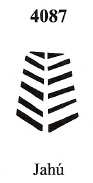
James Dingler and Klerman W. Lopes presented in Mute Cancellations of the Brazil Empire / Carimbos Mudos do Brasil Império (Brazil Philatelic Association, Rio de Janeiro, 2000) the mute cancellation with no. 4087:

BPA 4087

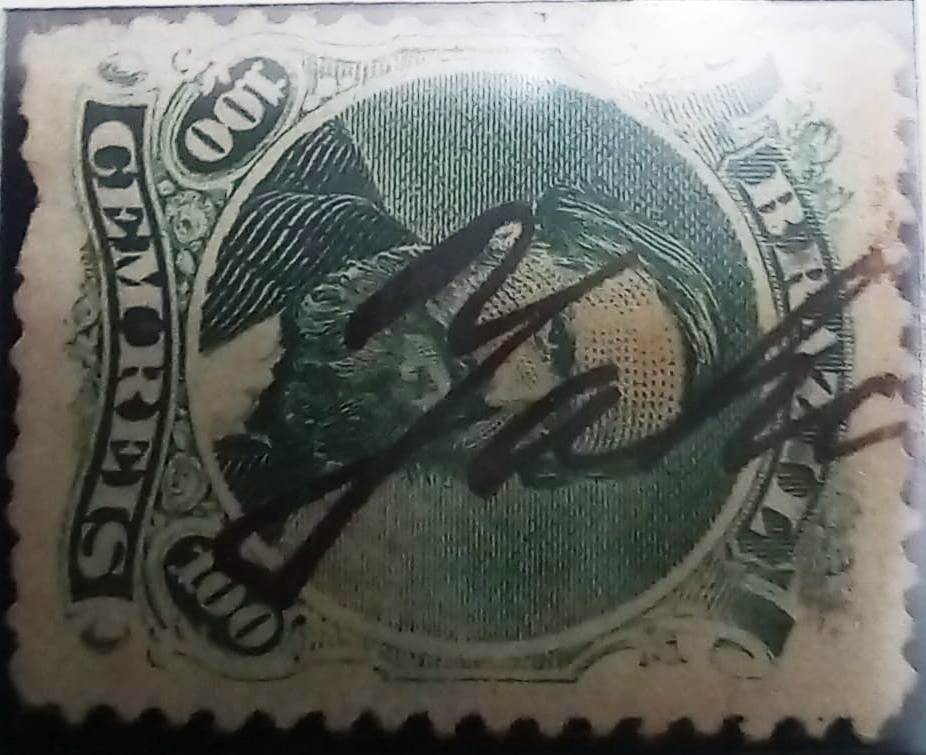
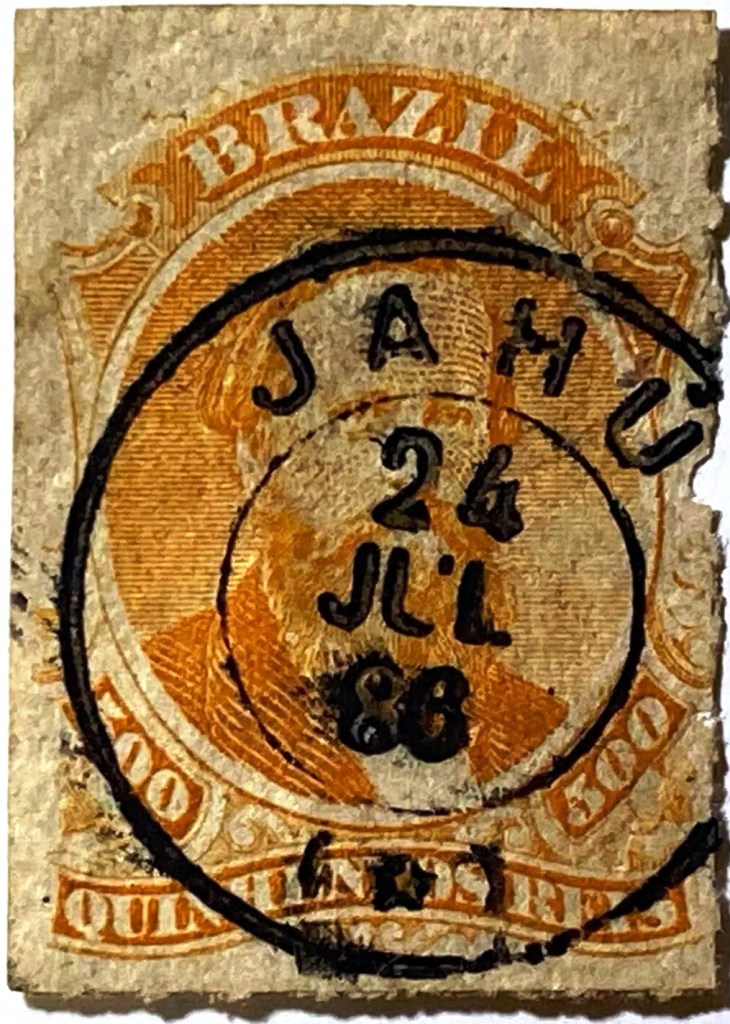
Further mute cancels of Jahú were presented by R. Koester:

1878 (RK)
1878 (RK)
Atlas do Imperio do Brasil, 1868

Andere Schreibweise: Juhu

Im März 1859 wurde die Freguesia de N. Sra. do Patrocínio do Jahu am Südufer des Jaú in der Vila de Brotas, 300 km nordwestlich der Provinzhauptstadt São Paulo, gegründet. Sie wurde im April 1866 zur Vila und im Februar 1889 zur Stadt ernannt. Der indigene Name bezeichnet einen großen Wels aus der Familie Pimelodidae:

Zungaro zungaro (Humboldt & Valenciennes, 1821)

Wie die Presse von São Paulo berichtet, wurde im Dezember 1867 beschlossen, in der Vila ein Postamt einzurichten:

Diario de São Paulo, 09.01.1868

Vermutlich wurde der erste Poststempel nicht rechtzeitig geliefert, da frühe Handentwertungen bekannt sind:

1867ff (FF)

Erst in den 70er Jahren erschien der schöne Doppelkreis JSP-0705a (Abb. Mário Celso Orsi Jr.), den es auch in blau und grün gibt:

JSP-0705a (MO) 1875-1880

Kurz danach erschien auch JSP-0705b, mit der falschen Schreibweise JUHU (Abb. R. Koester, in Carimbologia XXV):

JSP-0705b (RK) 1878

In der späten Kaiserzeit wurde auch der französische Typ JSP-0705c (Abb. Felipe Piccinini) verwendet:

JSP-0705c (FP) 1885-1892

Etwa zur gleichen Zeit kam der Bahnpoststempel JSP-0706a (Abb. Koester, op. cit.) hinzu:

JSP-0706a (RK) 1891

Koester zeigte auch einen Einschreibstempel aus den 70er Jahren:

1877 (RK)

James Dingler und Klerman W. Lopes zeigten in Mute Cancellations of the Brazil Empire / Carimbos Mudos do Brasil Império (Brazil Philatelic Association, Rio de Janeiro, 2000) den stummen Stempel mit Nr. 4087:

BPA 4087

Weitere stumme Stempel von Jahú wurden von R. Koester präsentiert:

1878 (RK)
1878 (RK)
Categories
Carimbologia H-L

Jaguary, Minas Gerais (JMG-1410)

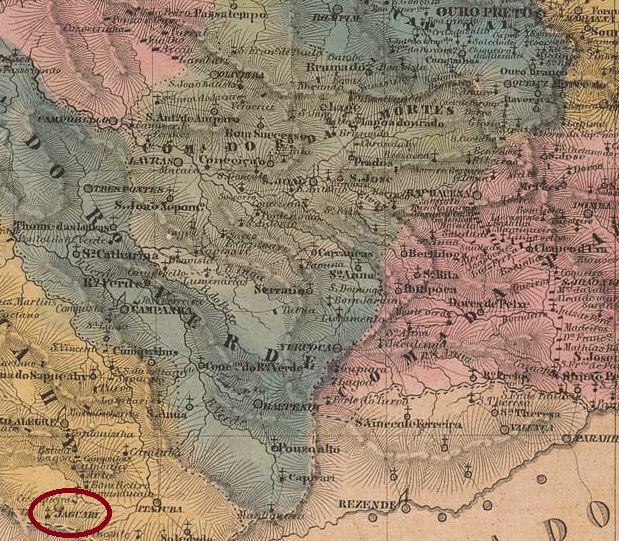
Villiers de l’Ile Adam: Carta (…) da Provincia de Minas Geraes, 1849

Other names: Camanducaia (1925)

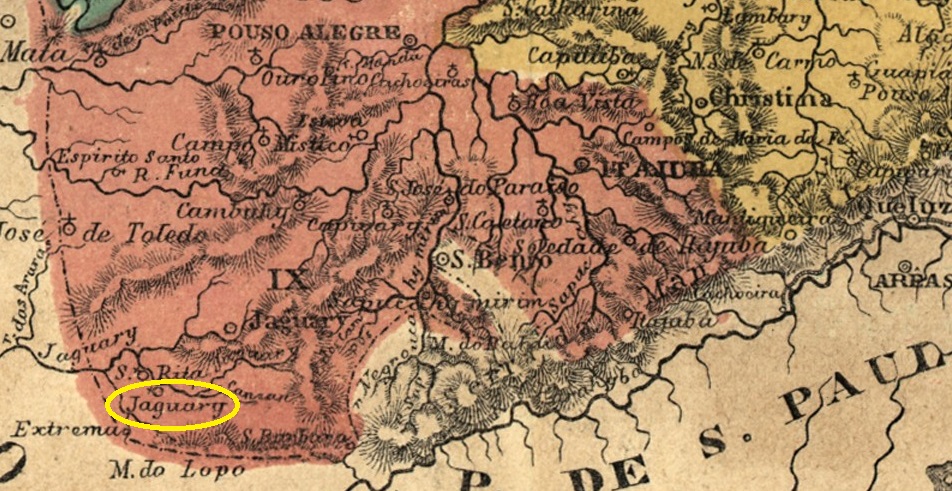
The Freguesia de Camanducaia on the north bank of the river of the same name, 500 kilometres southwest of the later provincial capital Ouro Preto, had existed since 1775. In March 1840 it became Vila de Jaguary (River of the Jaguars, in Tupi-guarani) and in July 1868 it was elevated to the status of a town. In September 1930, the original place name Camanducaia returned, probably to distinguish it from other Jaguaris (as it is spelt today). The meaning of the word Camanduacaia is not clear; some believe it means cooked beans, others are in favour of the translation ‘fireplace for hunting’.

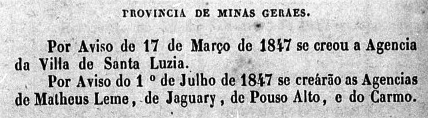
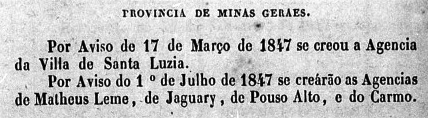
In July 1847, it was decided to establish a post office in Jaguary, according to the report of the Imperial Ministry:

Relatorio do Ministerio do Imperio, 1847

R. However, Koester shows in Carimbologia XXV that postal routes were routed via Jaguary (then Camanducaia) at least as early as 1835, as a tax control office (Registro) still existed there.

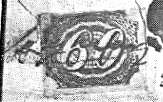
Initially, the stamps were cancelled by hand, as R. Koester (op. cit.) shows:

1849 (RK)

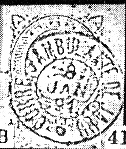
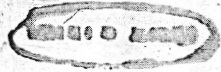
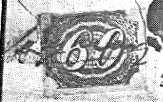
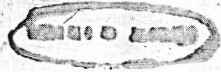
Then came the unfortunately poorly legible cancel JMG-1410a (fig. Koester). The inscription would read ‘Correio de Jaguary’:

JMG-1410a (RK) 1867

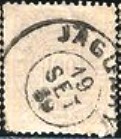
Later, the double circle JMG-1410b (ill. Claudio Neumann) was added, which also exists in blue:

JMG-1410b (CN) 1879-1891

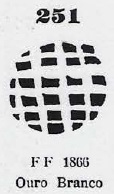
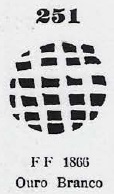
According to Koester, the following mute cancel no. 251 in P. Ayres (Catálogo de Carimbos Brasil-Império, S. Paulo, 1937, 1942) also comes from Jaguary:

P.A. 251 (BPA 1328) 1866ff-1879

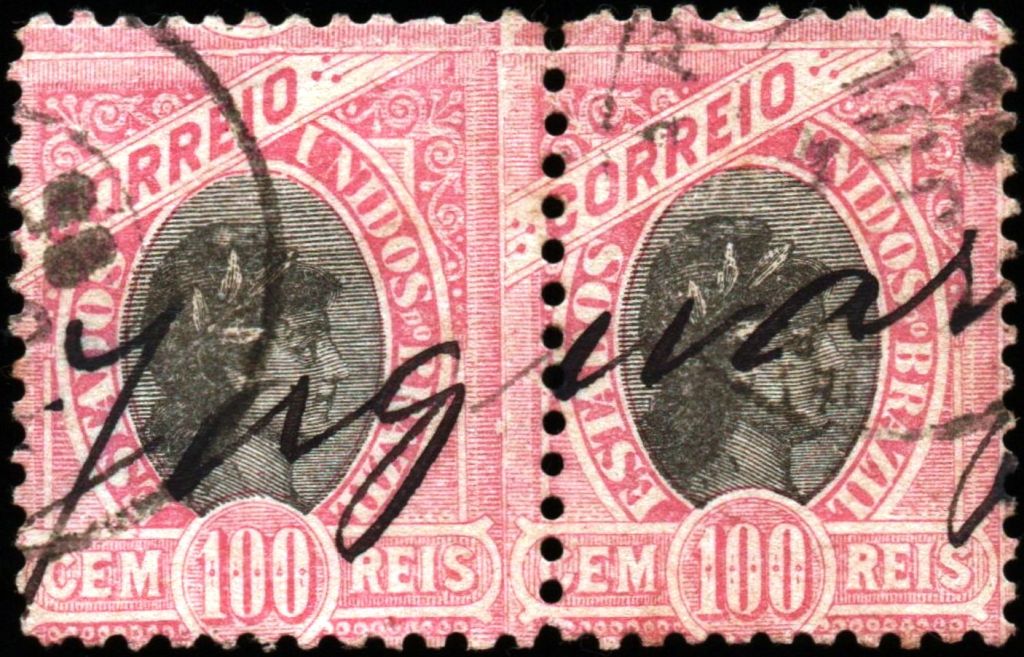
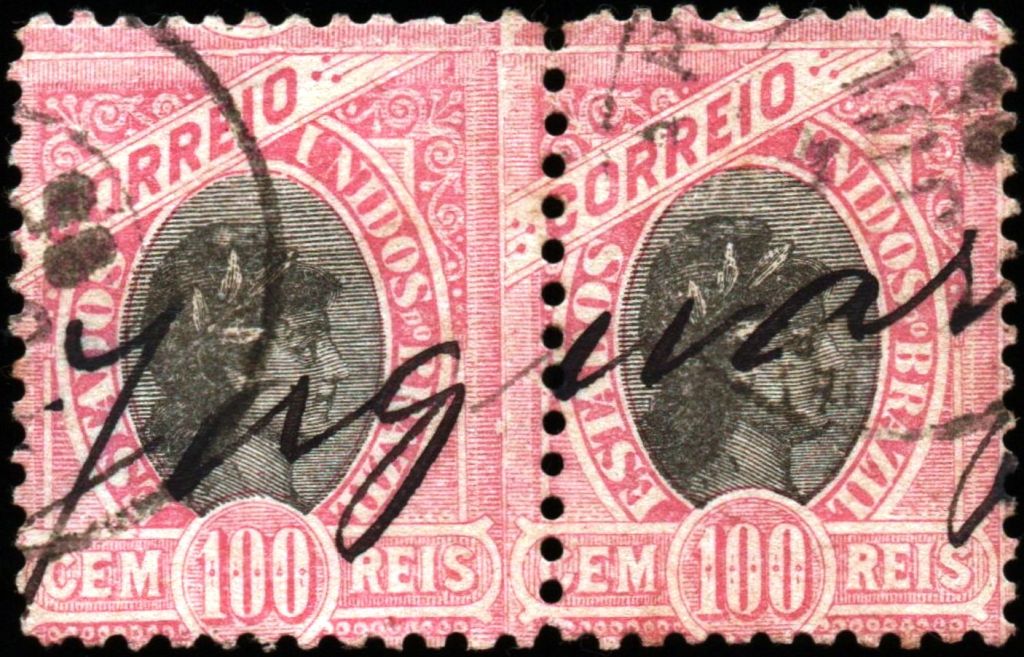
At the beginning of the Republic, cancellations were again made by hand, as the following image shows (ill. Cláudio Coelho):

1895 (CC)
Atlas do Imperio do Brasil, 1868

Andere Namen: Camanducaia (1925)

Seit 1775 bestand die Freguesia de Camanducaia am Nordufer des gleichnamigen Flusses, 500 km südwestlich der späteren Provinzhauptstadt Ouro Preto. Im März 1840 wurde sie zur Vila de Jaguary (Fluss der Jaguare, auf Tupi-guarani) und im Juli 1868 zur Stadt erhoben. Im September 1930 kehrte der ursprüngliche Ortsname Camanducaia zurück, wahrscheinlich um sich von anderen Jaguaris (wie es heute geschrieben wird) zu unterscheiden. Die Bedeutung des Wortes Camanduacaia ist nicht eindeutig; einige glauben, dass es gekochte Bohnen bedeutet, andere sind für die Übersetzung “Feuerstelle für die Jagd”.

Im Juli 1847 wurde beschlossen, in Jaguary ein Postamt einzurichten, wie aus dem Bericht des kaiserlichen Ministeriums hervorgeht:

Relatorio do Ministerio do Imperio, 1847

R. Koester weist jedoch in Carimbologia XXV nach, dass zumindest schon 1835 Postrouten über Jaguary (damals Camanducaia) geführt wurden, da dort noch eine Steuerkontrollstelle (Registro) existierte.

Anfangs wurden die Marken noch von Hand entwertet, wie R. Koester (op. cit.) zeigt:

1849 (RK)

Dann kam der leider schlecht lesbare Stempel JMG-1410a (Abb. Koester). Die Inschrift soll “Correio de Jaguary” lauten:

JMG-1410a (RK) 1867

Später kam der Doppelkreis JMG-1410b (Abb. Claudio Neumann) hinzu, den es auch in blau gibt:

JMG-1410b (CN) 1879-1891

Aus Jaguary stammt nach Koester auch der folgende stumme Stempel Nr. 251 in P. Ayres (Catálogo de Carimbos Brasil-Império, S. Paulo, 1937, 1942):

P.A. 251 (BPA 1328) 1866ff-1879

Zu Beginn der Republik wurde wieder von Hand gestempelt, wie das folgende Bild zeigt (Abb. Cláudio Coelho):

1895 (CC)
Categories
Carimbologia H-L

Jaguary (train station/Bahnhof), São Paulo (JSP-0695)

Estrada de Ferro Central do Brasil, 1890

Other names: Jaguariúna (1953)

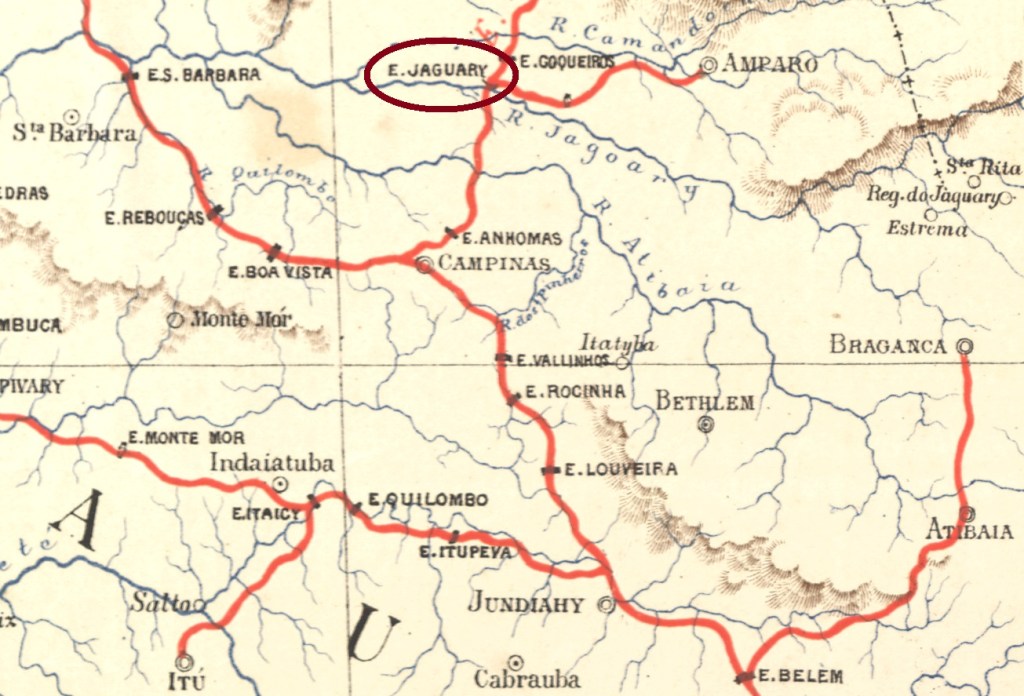
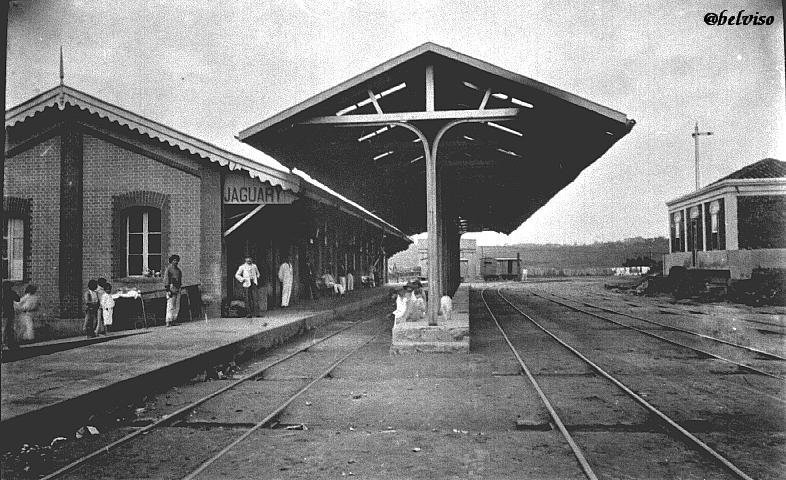
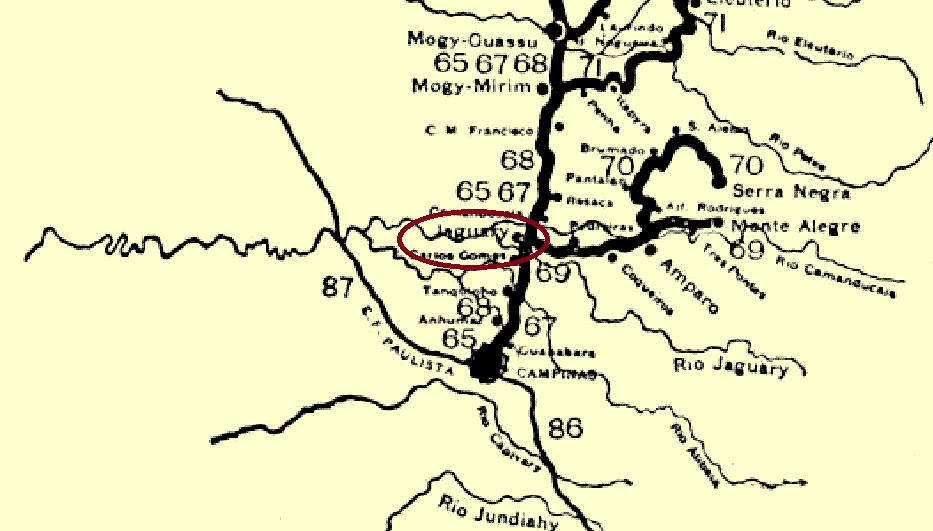
The Jaguary railway station was built in May 1875 by the E.F. Mogyana railway company (Amparo Branch) on the north bank of the Jaguari in the Município de Mogi-mirim, 150 km north of the provincial capital of São Paulo. The railway line was operated until 1945, and since December 1953 the property has been in the Município de Jaguariúna. The word from the indigenous language means black jaguar.

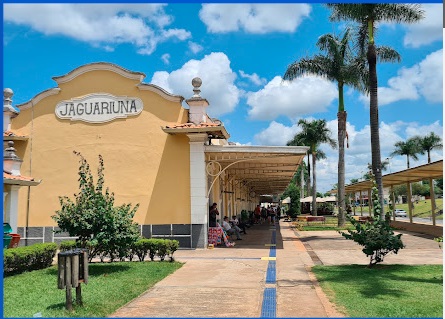
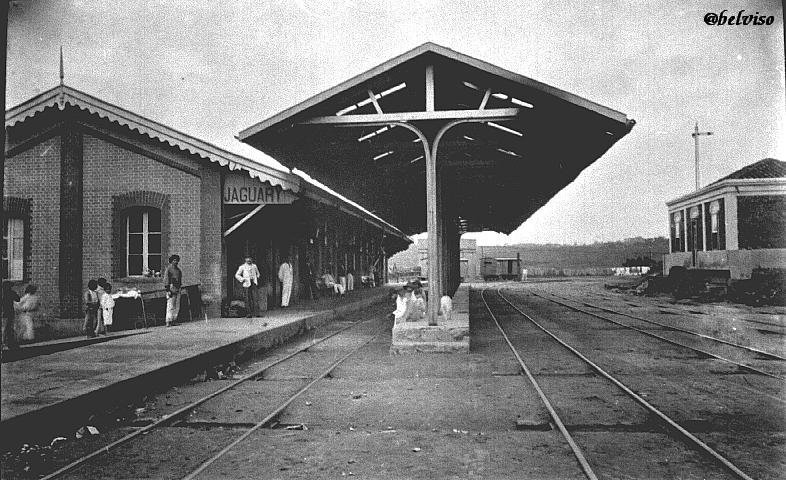
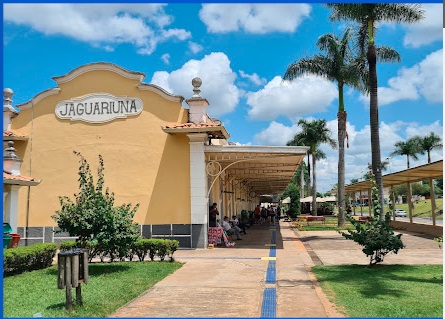
The original railway station has long since been demolished, the following station building has been restored as a museum and, following the re-routing of 1.2 km of track, tourist train journeys take place at weekends:

Around 1910 (Photo: Album da Mogiana, on estacoesferroviarias.com.br)
In February 2022 (photo: Fernando Weber, on Google Maps)

As reported in the regional press, there had been a post office at the railway station since December 1879:

Correio Paulistano, 27/12/1879

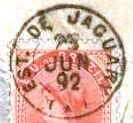
The imperial postmark is the French type JSP-0695a (illustration by Mário Celso Orsi Jr.):
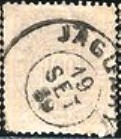
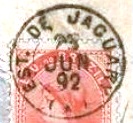
JSP-0695a (MO) 1889-1893
E. F. Mogyana, 1898 (IBGE)

Andere Namen: Jaguariúna (1953)

Der Bahnhof Jaguary wurde im Mai 1875 von der Eisenbahngesellschaft E.F. Mogyana (Amparo-Linie) am Nordufer des Jaguari im Município de Mogi-mirim, 150 km nördlich der Provinzhauptstadt São Paulo, errichtet. Die Bahnlinie wurde bis 1945 betrieben, seit Dezember 1953 befindet sich die Liegenschaft im Município de Jaguariúna. Das Wort aus der indigenen Sprache bedeutet schwarzer Jaguar.

Der ursprüngliche Bahnhof ist längst abgerissen, das anschließende Bahnhofsgebäude wurde als Museum restauriert, und nach der Neuverlegung von 1,2 km Gleisen finden an Wochenenden touristische Zugfahrten statt:

Um 1910 (Foto: Album da Mogiana, auf estacoesferroviarias.com.br)
Im Februar 2022 (Foto: Fernando Weber, auf Google Maps)

Wie die regionale Presse berichtete, gab es seit Dezember 1879 ein Postamt am Bahnhof:

Correio Paulistano, 27.12.1879

Der kaiserliche Poststempel ist der französische Typ JSP-0695a (Abb. Mário Celso Orsi Jr.):
JSP-0695a (MO) 1889-1893
Categories
Carimbologia H-L

Jaguary (Iguape), São Paulo (JSP-0695)

Mappa Geral do Brazil, 1911

Other names: Itaúna, Itapeúna (1944)
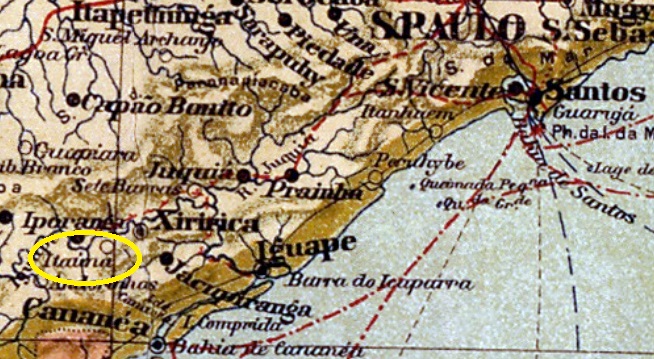
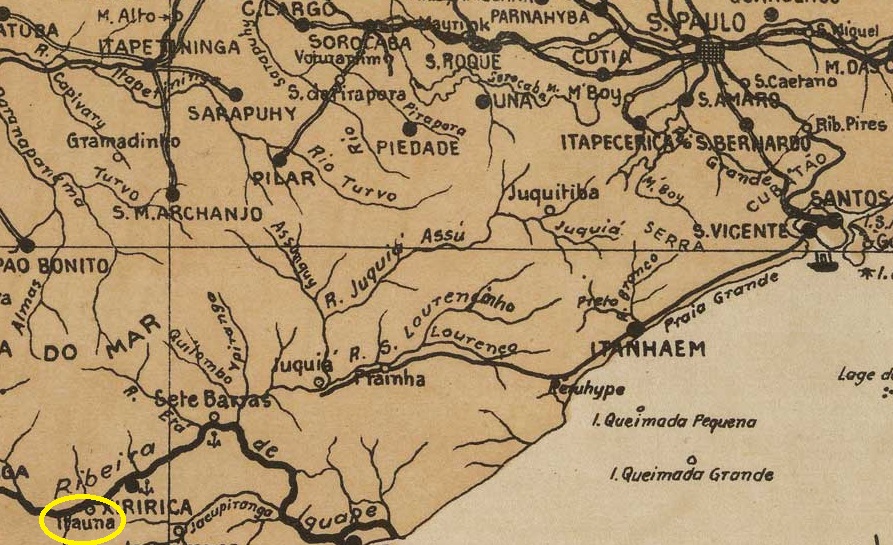
A settlement (Sítio) Jaquary was mentioned in documents as early as 1757. It was located on the south bank of the Ribeira de Iguape around Vila de Iguape, 260 kilometres southwest of the later provincial capital of São Paulo. In November 1900 it became a distrito of the Vila de Xiririca (today: Eldorado), and since then the place name has been changed twice: in October 1915 to Itaúna and in November 1944 to Itapeúna.

In July 1883 it was decided to establish a local post office:

Correio Paulistano, 31/07/1883

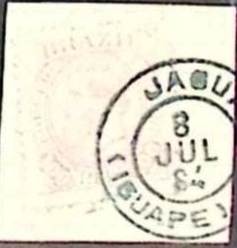
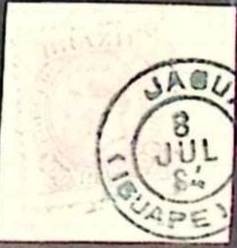
The imperial postmark is the rare JSP-0695a (fig. Felipe Piccinini):

JSP-0695a (FP) 1884
Arthur D. Ribeiro: Estado de São Paulo, 1924

Andere Namen: Itaúna, Itapeúna (1944)

Bereits 1757 wurde eine Siedlung (Sítio) Jaquary urkundlich erwähnt, sie lag am Südufer der Ribeira de Iguape im Gebiet der Vila de Iguape, 260 km südwestlich der späteren Provinzhauptstadt São Paulo. Im November 1900 wurde es ein Distrito der Vila de Xiririca, und seitdem wurde der Ortsname zweimal geändert: im Oktober 1915 in Itaúna und im November 1944 in Itapeúna.

Im Juli 1883 wurde beschlossen, ein örtliches Postamt einzurichten:

Correio Paulistano, 31.07.1883

Der kaiserliche Poststempel ist der seltene JSP-0695a (Abb. Felipe Piccinini):

JSP-0695a (FP) 1884
Categories
Carimbologia H-L

Jaguaruna, Santa Catarina (JSC-0140)

Atlas do Imperio do Brasil, 1868

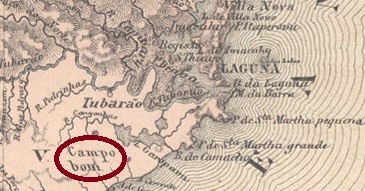
See also Campo Bom (CSC-0040)

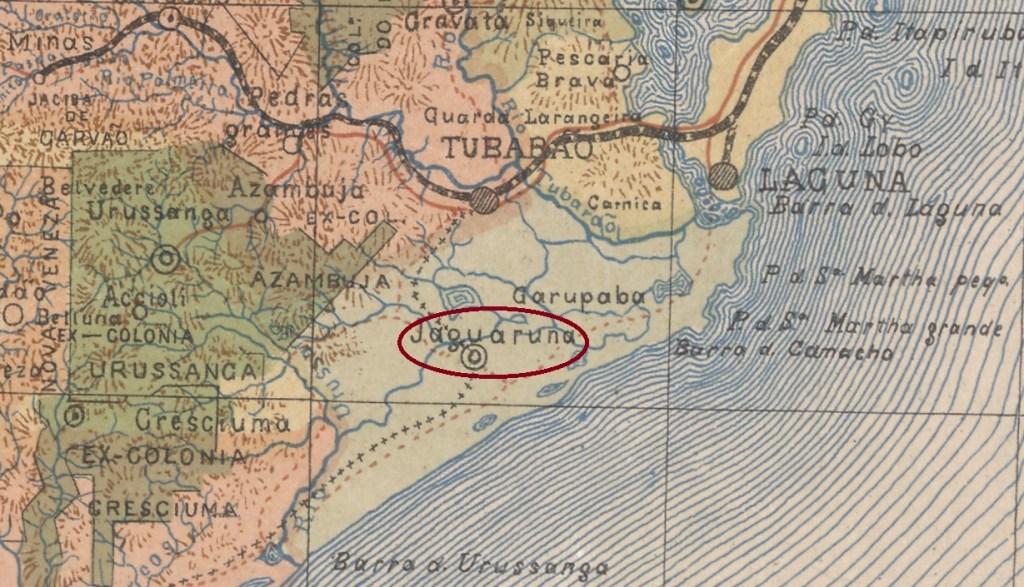
This Campo Bom of the imperial province of Santa Catarina was a settlement of the Vila de Laguna, 160 km south of the provincial capital Desterro (today: Florianópolis), from about 1869. In March 1880 it was declared a Freguesia de N. Sra. das Dores de Jaguaruna and in January 1891 it was elevated to the status of Vila. Between August 1923 and December 1930, it was downgraded to the District of Laguna, before regaining the Município status.

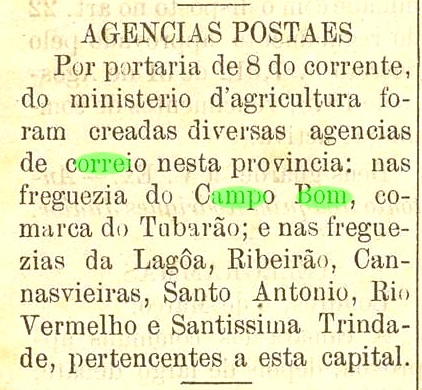
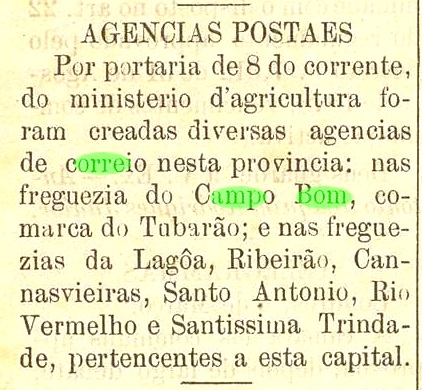
There was a post office since March 1884, according to the regional press:

Jornal do Commercio/SC, 14/03/1884

It is remarkable that the place was still mentioned as Campo Bom, although at that time the new official name Jaguaruna had already been in force for four years. It is therefore possible that there is an imperial postmark under Campo Bom, for the first Jaguaruna postmark JSC-0140a (image from the internet) is only known from 1890 onwards.

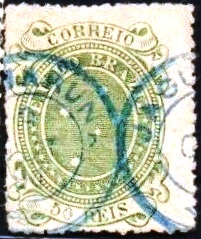
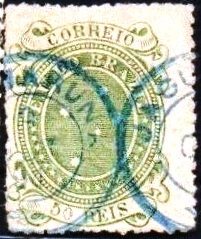
JSC-0140a (EB) 1890ff, in blue
Estado de Santa Catharina, 1907

Siehe auch Campo Bom (CSC-0040)

Dieser Campo Bom der kaiserlichen Provinz Santa Catarina war ab etwa 1869 eine Siedlung der Vila de Laguna, 160 km südlich der Provinzhauptstadt Desterro (heute: Florianópolis). Im März 1880 wurde sie zur Freguesia de N. Sra. das Dores de Jaguaruna erklärt und im Januar 1891 zur Vila erhoben. Zwischen August 1923 und Dezember 1930 wurde sie zum Distrikt von Laguna herabgestuft, bevor sie den Status eines Município wiedererlangte.

Seit März 1884 gab es dort ein Postamt, wie die regionale Presse berichtet:

Jornal do Commercio/SC, 14.03.1884

Bemerkenswert ist, dass der Ort noch als Campo Bom erwähnt wurde, obwohl zu diesem Zeitpunkt der neue offizielle Name Jaguaruna bereits seit vier Jahren in Kraft war. Es ist daher möglich, dass es einen kaiserlichen Poststempel unter Campo Bom gibt, zumal der erste Jaguaruna-Stempel JSC-0140a (Abb. aus dem Internet) erst ab 1890 bekannt ist.

JSC-0140a (EB) 1890ff
Categories
Carimbologia H-L

Jaguaripe, Bahia (JBA-0430)

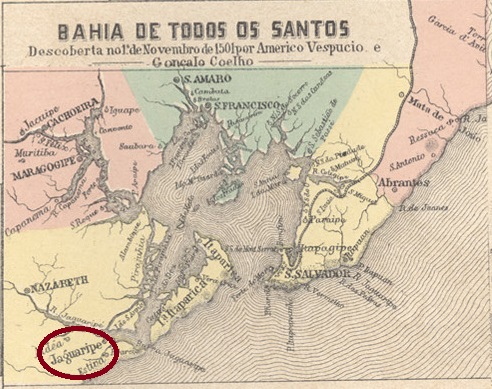
Villiers de l’Ile Adam: Carta (…) da Provincia da Bahia, 1848

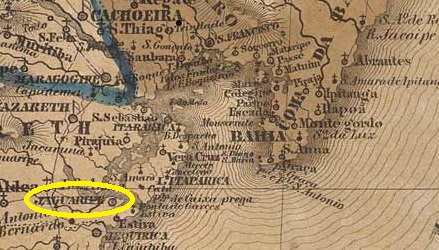
The settlement has been mentioned in documents since 1550 and was located on the south bank of the Jaguaripe, 100 kilometres south of the colonial capital Salvador da Bahia. In 1625 it became the Freguesia de Vela de N. Sra. da Ajuda de Jaguaripe and in December 1693 the first Vila of the Capitania outside the capital. In May 1899, Jaguaripe was declared a town, which it has remained to this day, except for one month, from July to August 1931, when Jaguaripe was downgraded to a distrito in the Município de Aratuípe.

Nova Monteiro writes in Administrações e Agencias Postaes do Brasil Imperio (Brasil Filatelico/RJ, 1934-5; reprint SPP 1994-1999) that the local post office was opened in March 1864, while R. Koester in Carimbologia XXV also mentions the year 1884.

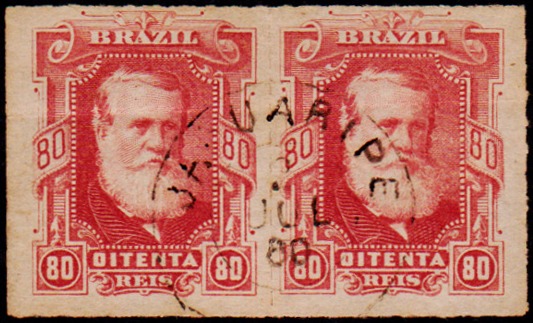
The only imperial postmark to date is JBA-0430b (fig. Felipe Piccinini), which also exists in grey-blue:

JBA-0430b (FP) 1880-1884
Atlas do Imperio do Brasil, 1868

Die Siedlung ist seit 1550 urkundlich erwähnt und lag am Südufer des Jaguaripe, 100 km südlich der Kolonialhauptstadt Salvador da Bahia. 1625 wurde sie zur Freguesia de Vela de N. Sra. da Ajuda de Jaguaripe und im Dezember 1693 zur ersten Vila der Capitania außerhalb der Hauptstadt. Im Mai 1899 wurde Jaguaripe zur Stadt ernannt, was es bis heute geblieben ist, mit Ausnahme eines Monats, von Juli bis August 1931, als Jaguaripe zu einem Distrito im Município de Aratuípe herabgestuft wurde.

Nova Monteiro schreibt in Administrações e Agencias Postaes do Brasil Imperio (Brasil Filatelico/RJ, 1934-5; Reprint SPP 1994-1999), dass das örtliche Postamt im März 1864 eröffnet wurde, während R. Koester in Carimbologia XXV auch das Jahr 1884 erwähnt.

Der bisher einzige kaiserliche Poststempel ist JBA-0430b (Abb. Felipe Piccinini), der auch in graublau existiert:

JBA-0430b (FP) 1880-1884
Categories
Carimbologia H-L

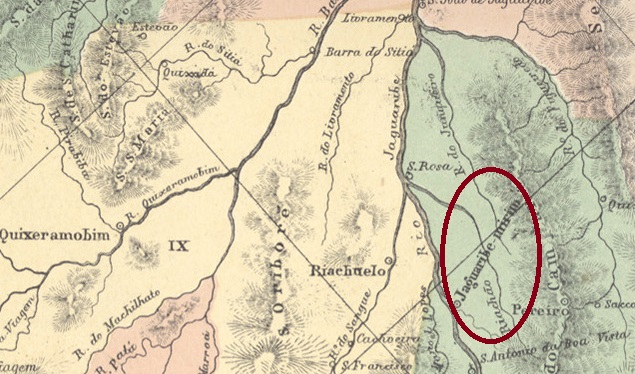
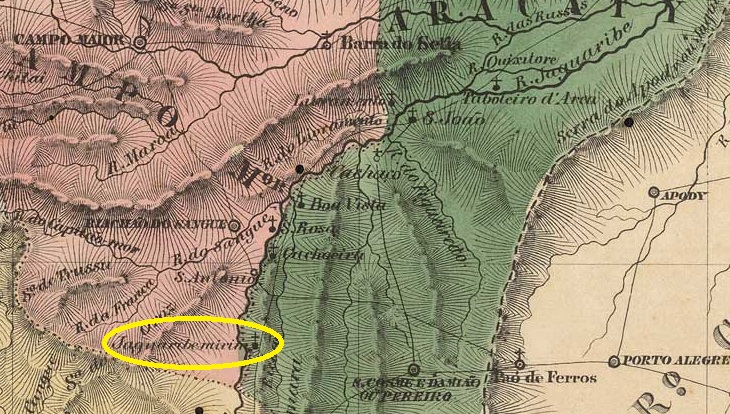
Jaguaribe-Mirim, Ceará (JCE-0180)

Atlas do Imperio do Brasil, 1868

Other names: Jaguaribe (1938)

The Freguesia de N. Sra. da Conceição do Jaguaribe-Mirim, which belonged to the Vila de Cachoeira (later: Solonópole) and was located on the east bank of the Jaguaribe-Mirim, 300 kilometres south of the provincial capital Fortaleza, had existed since August 1850. It became a vila in November 1864 and was elevated to a town in August 1918, which has been called just Jaguaribe since December 1938.

R. Koester writes in Carimbologia XXV that there had been a post office there since September 1865. The only imperial postmark to date is JCE-0180b (fig. Koester, op. cit.):
JCE-0180b (RK) 1883ff
Villiers de l’Ile Adam: Carta (…) da Provincia do Ceara, 1849

Andere Namen: Jaguaribe (1938)

Seit August 1850 bestand die Freguesia de N. Sra. da Conceição do Jaguaribe-Mirim, die zur Vila de Cachoeira (später: Solonópole) gehörte und am Ostufer des Jaguaribe-Mirim, 300 km südlich der Provinzhauptstadt Fortaleza, lag. Es wurde im November 1864 zur Vila und diese im August 1918 zur Stadt erhoben, die seit Dezember 1938 nur noch Jaguaribe heißt.

R. Koester schreibt in Carimbologia XXV, dass es dort seit September 1865 ein Postamt gab. Der bisher einzige kaiserliche Poststempel ist JCE-0180b (Abb. Koester, op. cit.):

JCE-0180b (RK) 1883ff

Categories
Carimbologia H-L

Jaguarão, Rio Grande do Sul (JRS-0200)

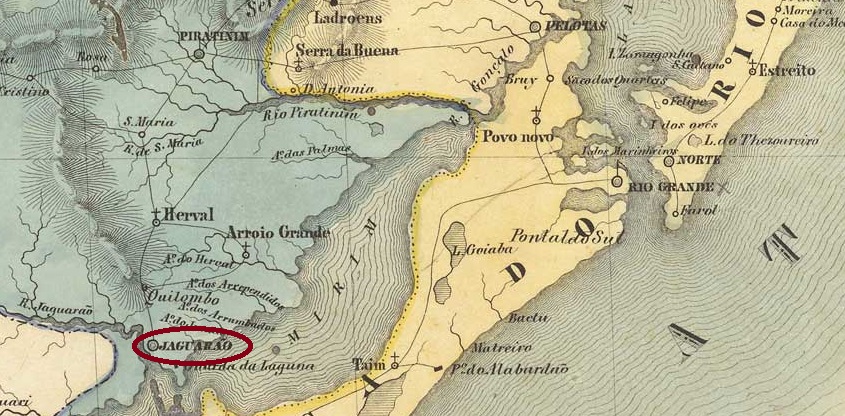
Villiers de l’Ile Adam: Carta (…) da Provincia de S. Pedro do Sul, 1847

Other names: Guarda da Lagoa, Cerrito

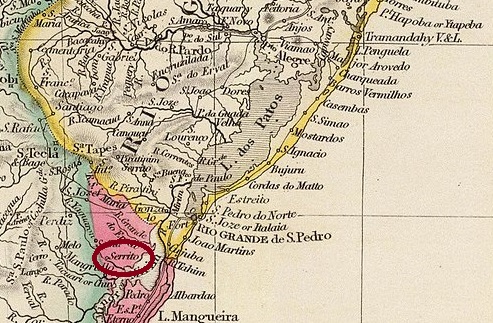
The Freguesia do Divino Espírito Santo do Cerrito on the north bank of the Jaguarão, 400 kilometres southwest of the later provincial capital Porto Alegre, had existed since January 1812. In July 1832, it became Vila de Jaguarão (also spelt Jagoarão), which was elevated to the status of a town in November 1855.

Two foundation dates have been found for the local post office. The first was in December 1844, towards the end of the Farroupilha Uprising, as can be seen in the 1846 yearbook:

 Annuario Politico, Historico e Estatistico 1846

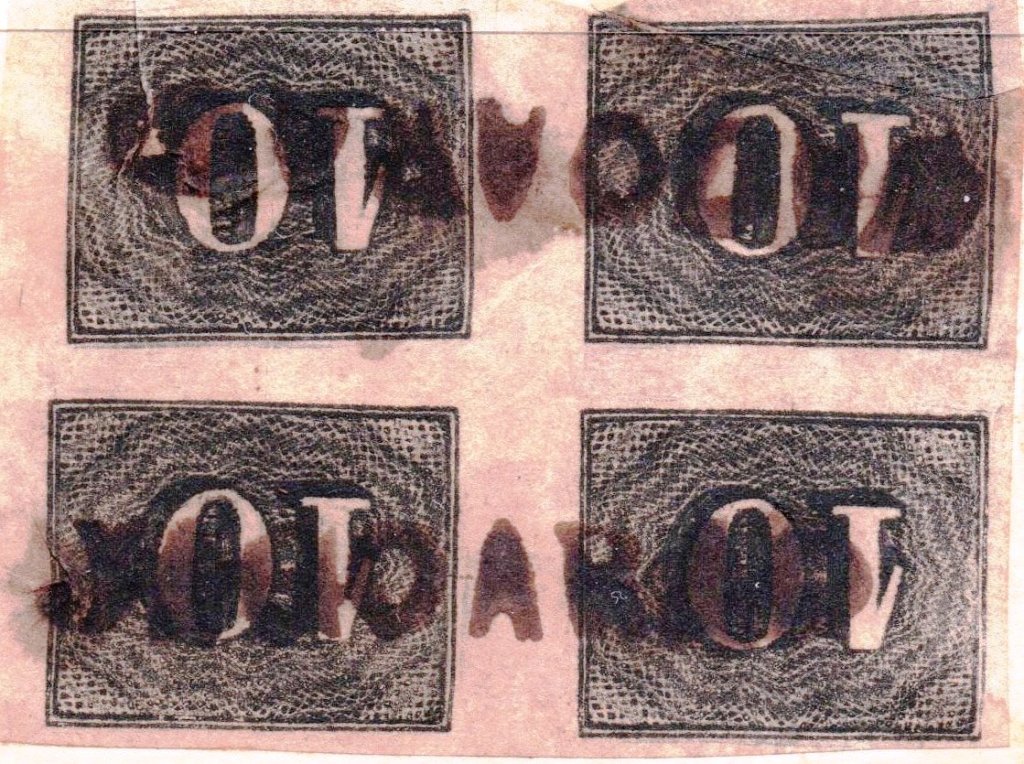
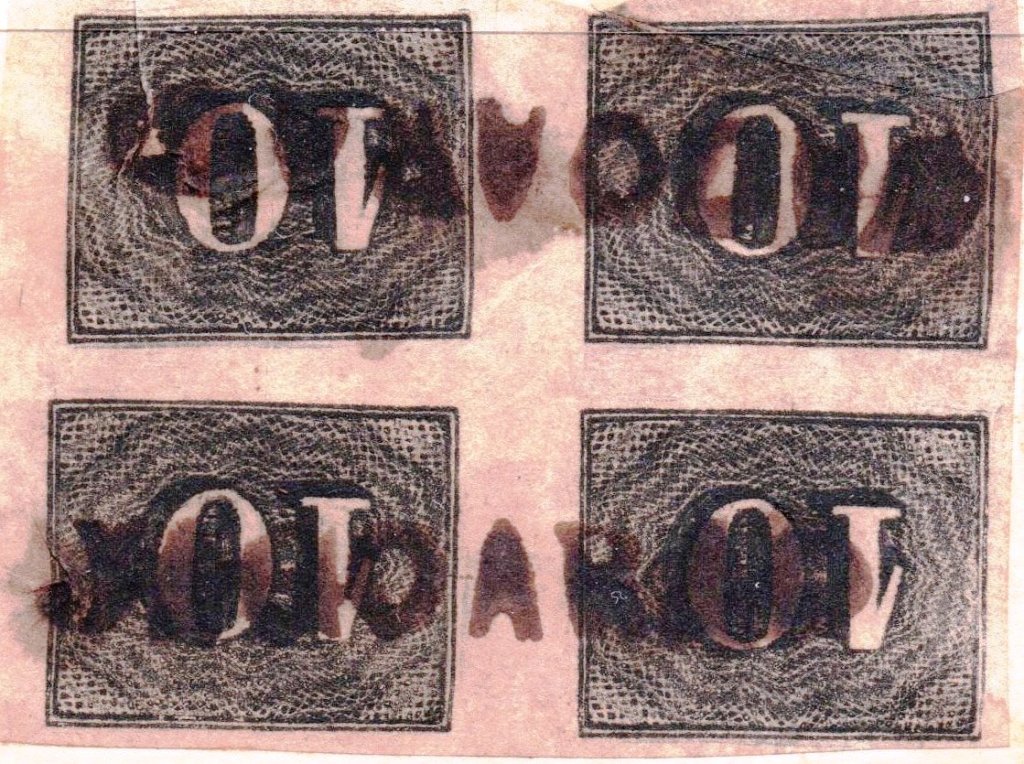
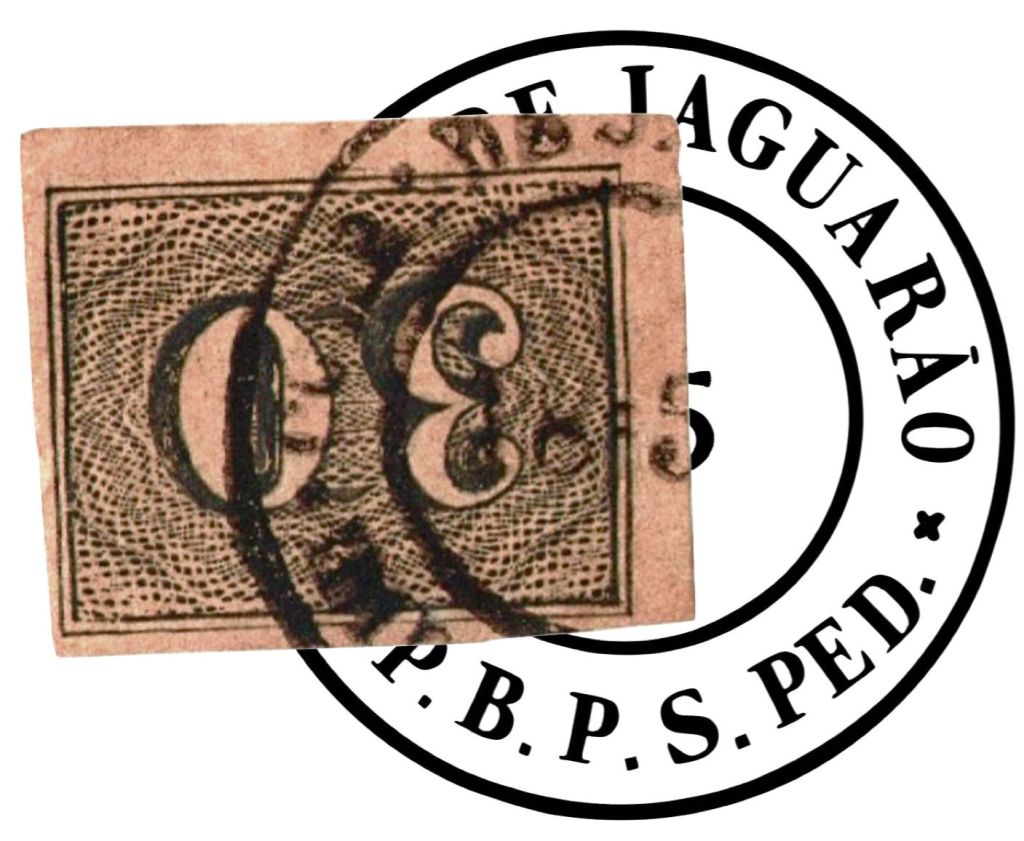
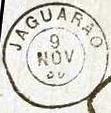
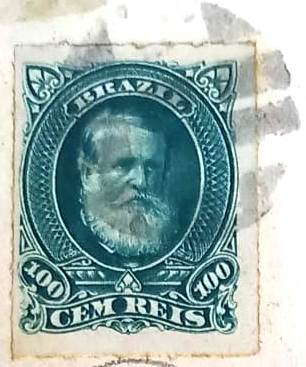
Then again in 1848, as can be seen in the Directory of Imperial Post Offices (Tabella das Agencias do Correio do Imperio, Rio de Janeiro, 1885). The oldest postmark to date is JRS-0200a (collect. José A. Junges), which appears on the 1850 numeral issue:

JRS-0200a (JJ) 1850ff

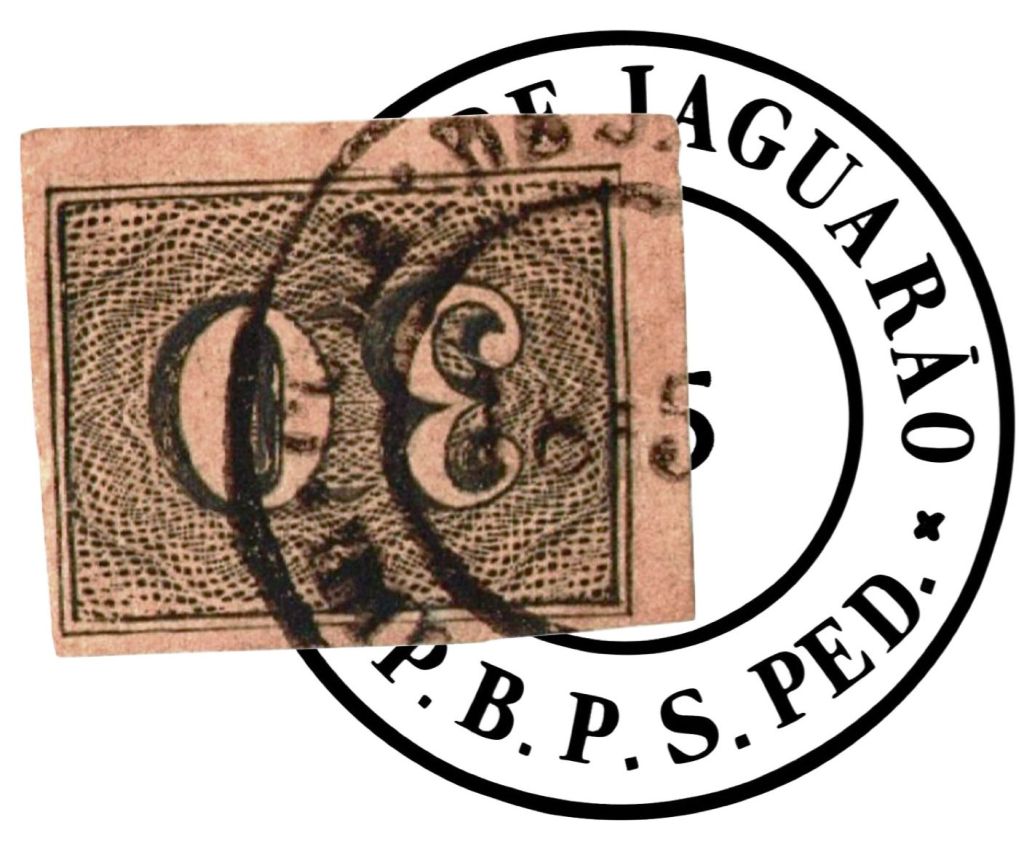
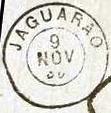
This was followed by the beautiful double circle JRS-0200b (illus. Claudio Coelho):

JRS-0200b (CC) 1850ff-1876ff

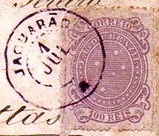
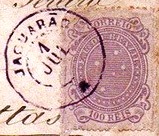
This was followed by JRS-0200c (Soler y Llach Auctions), which also occurs in dark violet:

JRS-0200c (SyL) 1879-1889

Towards the end of the Empire, JRS-0200d appeared – also in dark violet (illustration from the Internet):

JRS-0200d (EB) 1889-1891

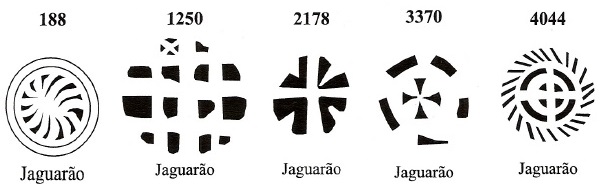
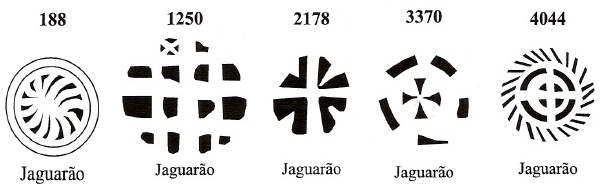
James Dingler and Klerman W. Lopes have listed five mute cancellations from Jaguarão in Mute Cancellations of the Brazil Empire / Carimbos Mudos do Brasil Império (Brazil Philatelic Association, Rio de Janeiro, 2000):

BPA 188 (P.A. 576, 1876ff-1880) – 1250 (1883ff) – 2178 (1877ff-1881) – 3370 (1877ff) – 4044 (P.A. 512, 1877ff)

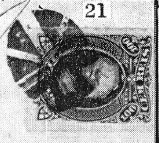
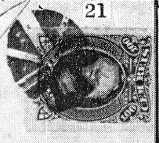
Three others were made known by R. Koester, Márcio Duarte and Fuad Ferreira Fo:

1877ff (RK)
1880 (MDu)
1883 (FF)

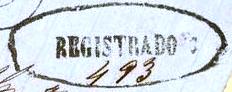
Then a registered postmark (fig. Soler y Llach) from Jaguarão was found:

1880 (SyL)
John Arrowsmith: Map of the Brazil, 1844

Andere Namen: Guarda da Lagoa, Cerrito

Seit Januar 1812 bestand die Freguesia do Divino Espírito Santo do Cerrito am Nordufer des Jaguarão, 400 km südwestlich der späteren Provinzhauptstadt Porto Alegre. Im Juli 1832 wurde daraus die Vila de Jaguarão (auch Jagoarão geschrieben), die im November 1855 zur Stadt erhoben wurde.

Für das örtliche Postamt wurden zwei Gründungsdaten gefunden. Das erste im Dezember 1844, gegen Ende des Farroupilha-Aufstandes, wie aus dem Jahrbuch 1846 hervorgeht:

 Annuario Politico, Historico e Estatistico 1846

Dann wieder 1848, wie man im Verzeichnis der kaiserlichen Postämter (Tabella das Agencias do Correio do Imperio, Rio de Janeiro, 1885) nachlesen kann. Der bisher älteste Poststempel ist JRS-0200a (Samml. José A. Junges), der auf der Ziffer-Ausgabe von 1850 erscheint:

JRS-0200a (JJ) 1850ff

Es folgte der schöne Doppelkreis JRS-0200b (Abb. Claudio Coelho):

JRS-0200b (CC) 1850ff-1876ff

Es folgte JRS-0200c (Soler y Llach Auktionen), der auch in dunkelviolett vorkommt:

JRS-0200c (SyL) 1879-1889

Gegen Ende des Kaiserreichs erschien – auch in dunkelviolett – JRS-0200d (Abbildung aus dem Internet):

JRS-0200d (EB) 1889-1891

James Dingler und Klerman W. Lopes haben in Mute Cancellations of the Brazil Empire / Carimbos Mudos do Brasil Império (Brazil Philatelic Association, Rio de Janeiro, 2000) fünf stumme Abstempelungen aus Jaguarão aufgeführt:

BPA 188 (P.A. 576, 1876ff-1880) – 1250 (1883ff) – 2178 (1877ff-1881) – 3370 (1877ff) – 4044 (P.A. 512, 1877ff)

Drei weitere wurden bekannt durch R. Koester, Márcio Duarte und Fuad Ferreira Fo:

1877ff (RK)
1880 (MDu)
1883 (FF)

Dann wurde noch ein Einschreibepoststempel (Abb. Soler y Llach) aus Jaguarão gefunden:

1880 (SyL)
Categories
Carimbologia H-L

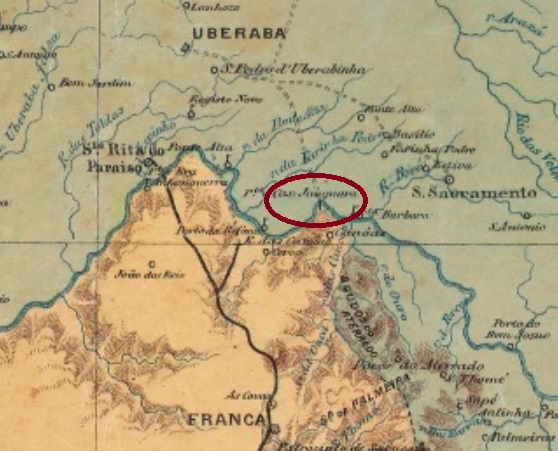
Jaguara, São Paulo (JSP-0690)

Provincia de São Paulo, 1886

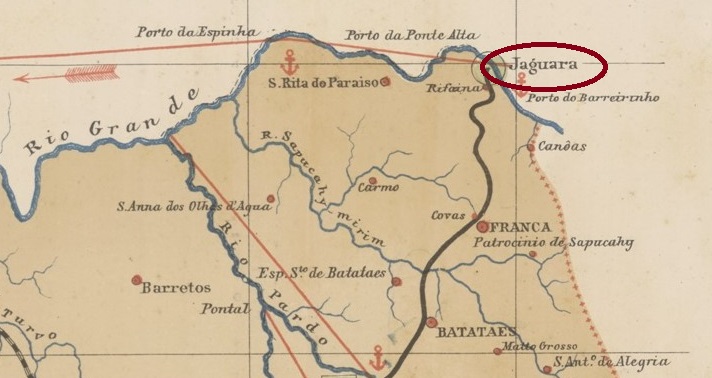
Jaguara was the name of a waterfall on the Rio Grande, 470 kilometres north of the provincial capital of São Paulo. In April 1873, a Jaguara harbour was built nearby, which belonged to the Vila de Sta. Rita do Paraíso. The responsible município changed twice more: in December 1907 to Igarapava and in December 1948 to Rifaina. In 1971, the Jaguara reservoir and hydroelectric power station were built there, and since then the harbour and settlement have disappeared from the map.

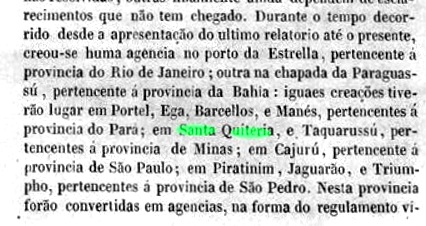
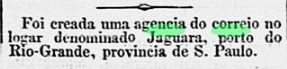
According to the Rio press, a post office was created at the harbour in September 1887:

Diario de Noticias/RJ, 16/09/1887

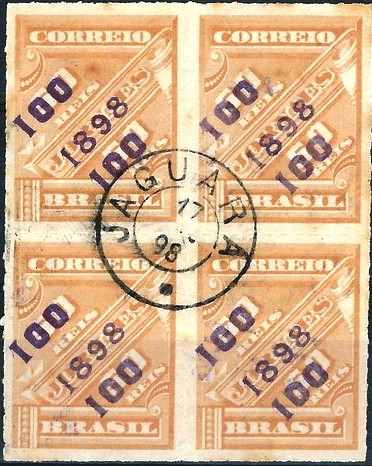
The imperial postmark is JSP-0690a (illus. Luiz C. Fritzen):

JSP-0690a (LCF) 1888-1898
Carlos D. Rath: Provincia de São Paulo, 1886

Jaguara war der Name eines Wasserfalls am Rio Grande, 470 km nördlich der Provinzhauptstadt São Paulo. Im April 1873 wurde in der Nähe, auf dem Gebiet von Vila de Sta. Rita do Paraíso, ein Hafen Jaguara gebaut. Das zuständige Município wechselte noch zweimal: im Dezember 1907 zu Igarapava und im Dezember 1948 zu Rifaina. 1971 wurde dort der Jaguara-Stausee mit Wasserkraftwerk gebaut, seitdem sind Hafen und Siedlung von der Landkarte verschwunden.

Wie aus der Presse von Rio zu erfahren war, gab es am Hafen seit September 1887 ein Postamt:

Diario de Noticias/RJ, 16.09.1887

Der kaiserliche Poststempel ist JSP-0690a (Abb. Luiz C. Fritzen):

JSP-0690a (LCF) 1888-1898