Categories
Carimbologia H-L

João Ayres (train station/Bahnhof), Minas Gerais (JMG-1440)

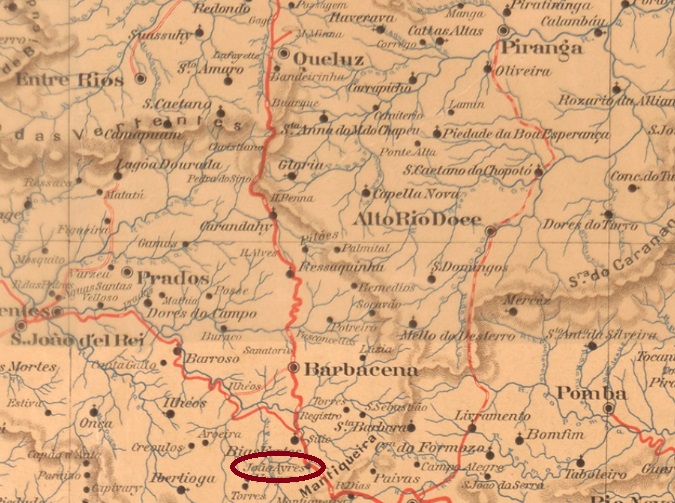
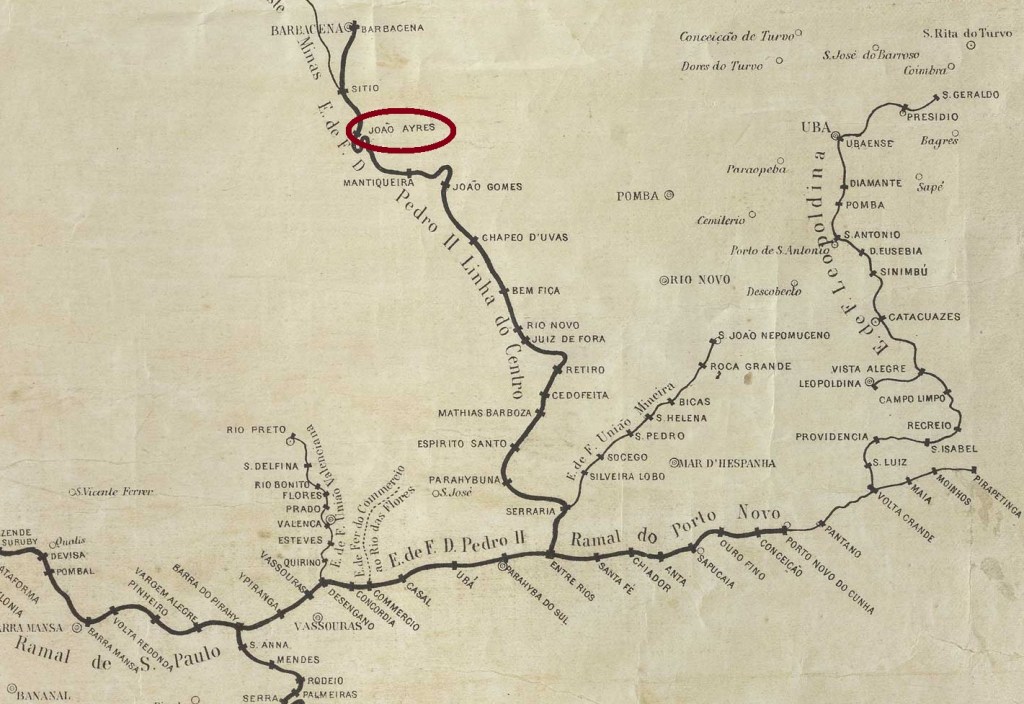
Estações (…) do Rio de Janeiro, São Paulo e Minas Geraes, 1880

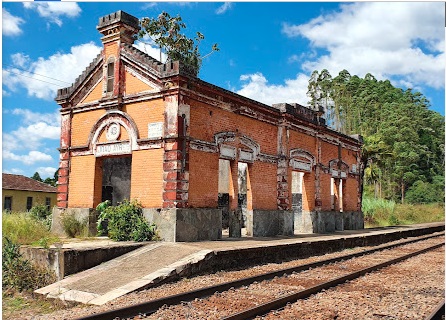
João Ayres station was opened in June 1878 by the railway company E.F.D. Pedro II (Center Line) in the Município de Barbacena, 150 km south of the provincial capital Ouro Preto. João Ayres Gomes was a major landowner in the region. The railway line was transferred to E.F. Central do Brasil in 1889 and belonged to Rede Ferroviária Federal S.A. (estacoesferroviarias.com.br) from 1975 until it was closed in 1996. Today the tracks are still there, the station building is an abandoned ruin.

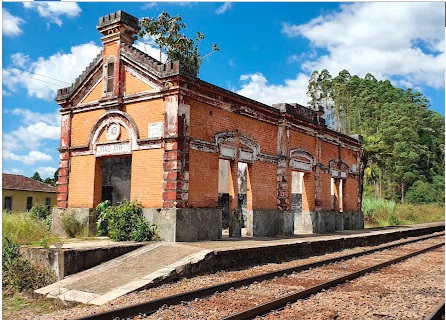
Around 1930 (photo: estacoesferroviarias.com.br)
In April 2022 (Photo: Christoffer R., on Google Maps)

The station area belonged to the Distrito de Curral Novo from September 1891, 4 years later to the Distrito de Bias Fortes, from December 1938 to the Distrito de Sítio, and since December 1948 it has been part of the Município de Antonio Carlos.

Two dates have been found for the foundation of the station post office. Both Paula Sobrinho (História Postal de Minas Gerais, Belo Horizonte, 1997) and R. Koester (Carimbologia XXV) write of July 1881, but the Rio press reported it as early as 1879:
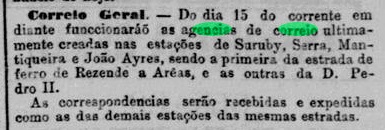
Jornal do Commercio/RJ, 11/02/1879

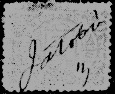
The later date presumably refers to the operation begin of the railway station post office. The oldest postmark to date is JMG-1440a (image from the Internet):
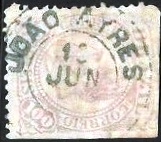
JMG-1440a (EB) 1883ff-1884

This was followed by JMG-1440b (ill. by Felipe Piccinini), which also occurs in turquoise blue:
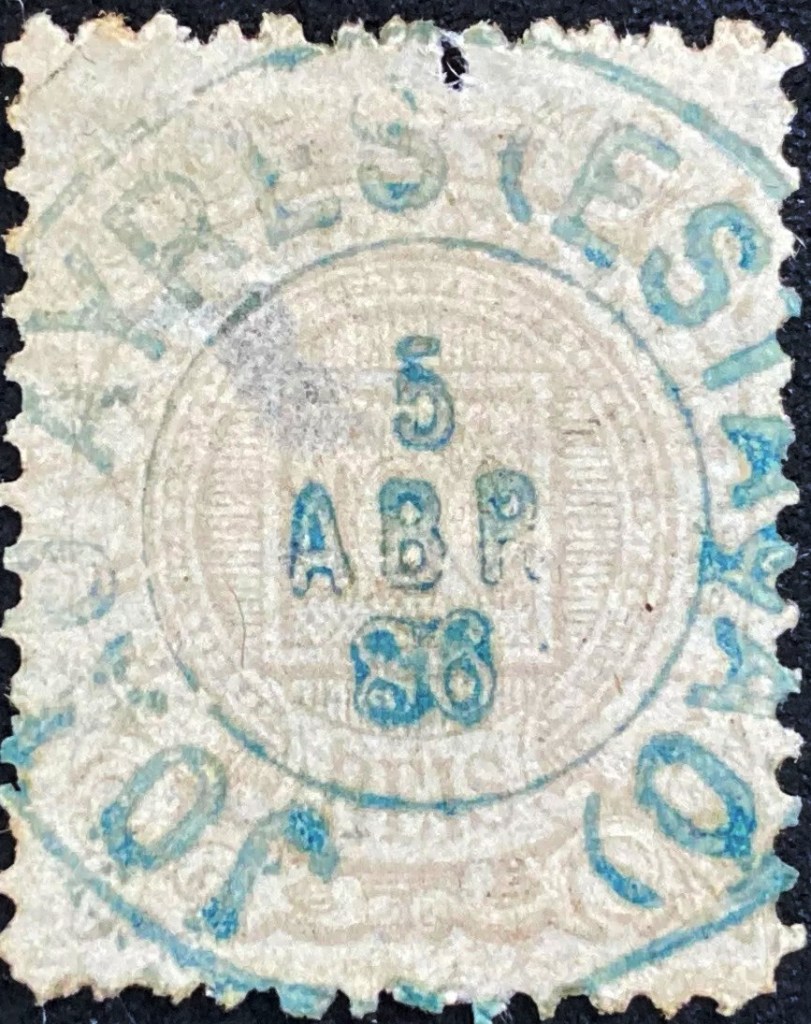
JMG-1440b (FP) 1886-1891
Estado de Minas Geraes, 1910

Der Bahnhof João Ayres wurde im Juni 1878 von der Eisenbahngesellschaft E.F.D. Pedro II (Hauptlinie) eröffnet und lag im Município de Barbacena, 150 km südlich der Provinzhauptstadt Ouro Preto. João Ayres Gomes war Großgrundbesitzer in der Region. Die Bahnlinie ging 1889 an die E.F. Central do Brasil über und gehörte von 1975 bis zu ihrer Stilllegung 1996 der Rede Ferroviária Federal S.A. (estacoesferroviarias.com.br). Heute sind die Gleise noch vorhanden, das Bahnhofsgebäude ist eine verlassene Ruine.
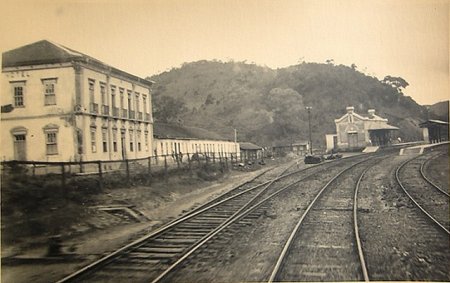
Um 1930 (Foto: estacoesferroviarias.com.br)
Im April 2022 (Foto: Christoffer R., auf Google Maps)

Das Bahnhofsgelände gehörte ab September 1891 zum Distrito de Curral Novo, 4 Jahre später zum Distrito de Bias Fortes, ab Dezember 1938 zum Distrito de Sítio, seit Dezember 1948 liegt es im Município de Antonio Carlos.

Für die Gründung des Bahnhofspostamtes wurden zwei Daten gefunden. Sowohl Paula Sobrinho (História Postal de Minas Gerais, Belo Horizonte, 1997) als auch R. Koester (Carimbologia XXV) schreiben von Juli 1881. Die Presse von Rio berichtete jedoch bereits 1879 darüber:
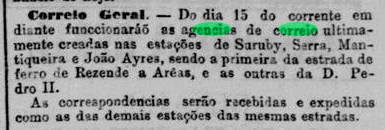
Jornal do Commercio/RJ, 11.02.1879

Vermutlich handelt es sich bei dem späteren Datum um die Inbetriebnahme des Bahnhofspostamtes. Der bisher älteste Poststempel ist JMG-1440a (Abb. aus dem Internet):
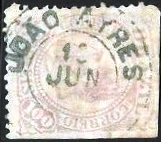
JMG-1440a (EB) 1883ff-1884

Es folgte JMG-1440b (Abb. Felipe Piccinini), der auch in türkisblau vorkommt:
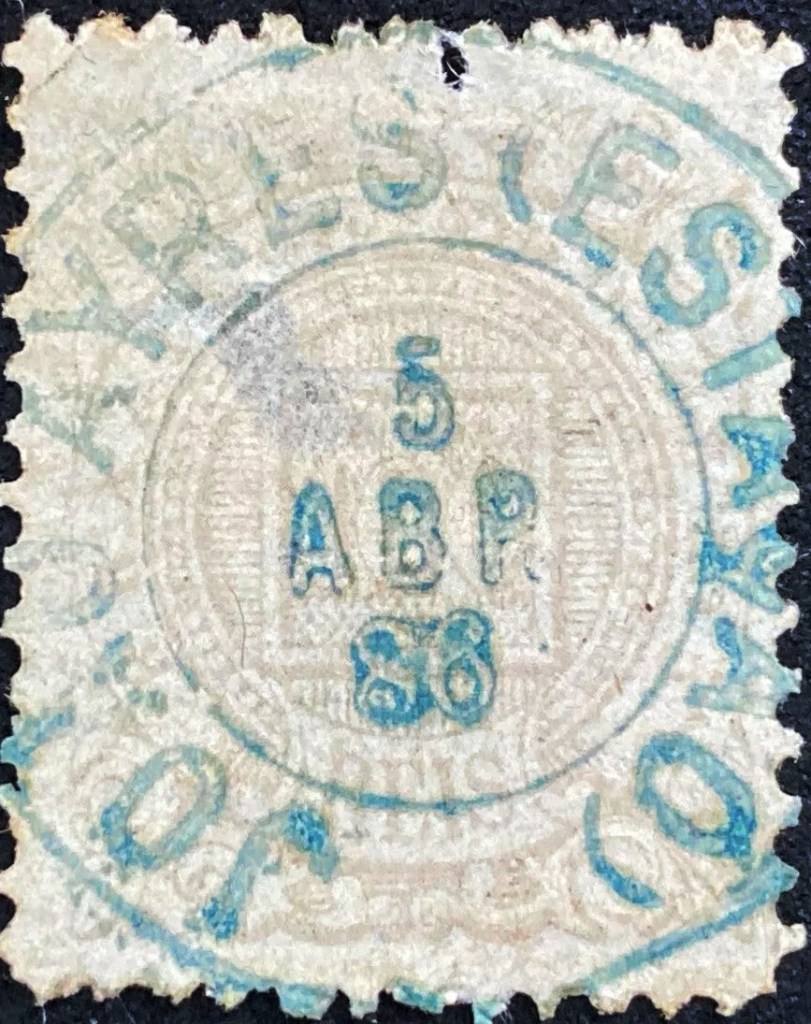
JMG-1440b (FP) 1886-1891
Categories
Carimbologia H-L

João Amaro (da Tapera), Bahia (JBA-0435)

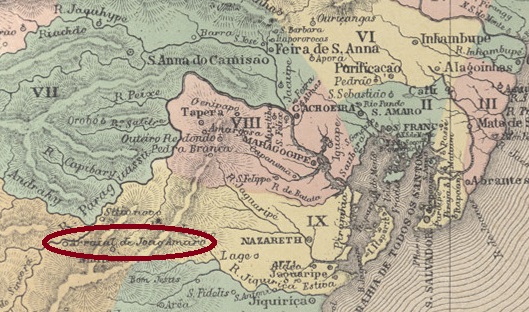
Atlas do Imperio do Brasil, 1868

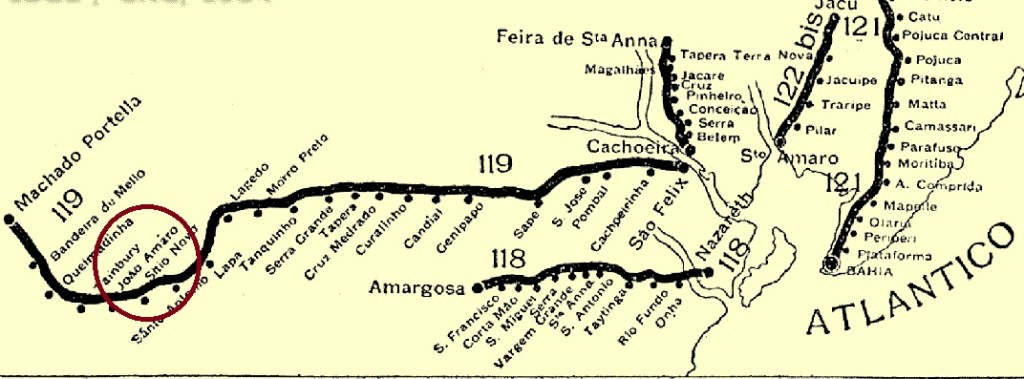
From May 1862 João Amaro was a district of the Vila de Tapera on the east bank of the Paraguaçu, 300 kilometres west of the provincial capital Salvador da Bahia. In May 1881, the village became the Freguesia de Sto. Antonio do João Amaro, but moved to the Município de Jibóia as a distrito in August 1892. Further changes in the respective municípios followed: in August 1899 to Monte Cruzeiro, in July 1921 again to Tapera, in July 1928 to Santa Terezinha and since August 1958 João Amaro has been a distrito in the Município de Iaçu. João Amaro Maciel Parente was a pioneer (sertanista) who explored the area at the end of the 17th century.

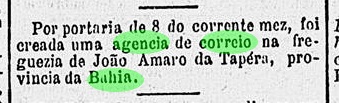
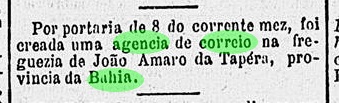
As reported in the Rio press, it was decided in August 1884 to set up a post office there:

Gazeta de Noticias/RJ, 09/08/1884

The establishment of the post office is presumably connected with the opening of a railway station of the E.F. Central da Bahia railway company (southern line) in October 1883, even if this is not officially mentioned.

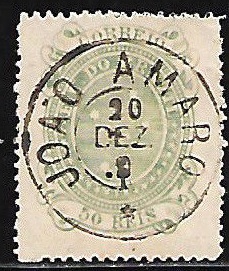
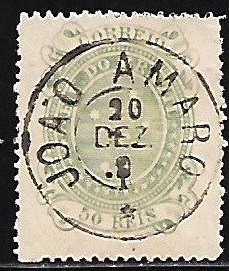
The oldest postmark to date is JBA-0435a (image from the Internet):

JBA-0435a (EB) 1891
Rede Ferroviária da Bahia, 1898 (IBGE)

Seit Mai 1862 war João Amaro ein Distrito der Vila de Tapera am Ostufer des Paraguaçu, 300 km westlich der Provinzhauptstadt Salvador da Bahia. Im Mai 1881 wurde der Ort zur Freguesia de Sto. Antonio do João Amaro, wechselte aber im August 1892 als Distrito zum Município de Jibóia. Weitere Wechsel in den zuständigen Municípios folgten: im August 1899 zu Monte Cruzeiro, im Juli 1921 wieder zu Tapera, im Juli 1928 zu Santa Terezinha und seit August 1958 ist João Amaro ein Distrito im Município de Iaçu. João Amaro Maciel Parente war ein Pionier (Sertanista), der das Gebiet Ende des 17. Jahrhunderts erforschte.

Wie die Presse in Rio berichtete, wurde im August 1884 beschlossen, dort ein Postamt einzurichten:

Gazeta de Noticias/RJ, 09.08.1884

Vermutlich hängt die Gründung des Postamtes mit der Eröffnung eines Bahnhofs der Eisenbahngesellschaft E.F. Central da Bahia (Südlinie) im Oktober 1883 zusammen, auch wenn dies nicht offiziell erwähnt wird.

Der bisher älteste Poststempel ist JBA-0435a (Abb. aus dem Internet):

JBA-0435a (EB) 1891
Categories
Carimbologia H-L

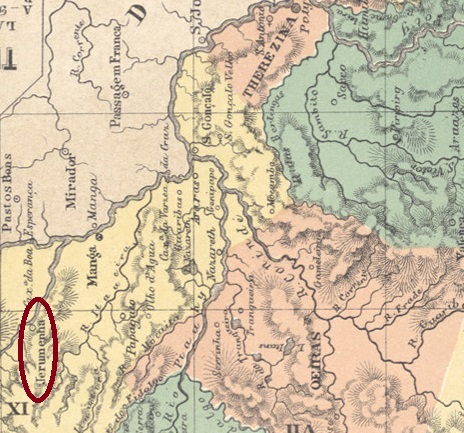
Jerumenha, Piauí (JPI-0240)

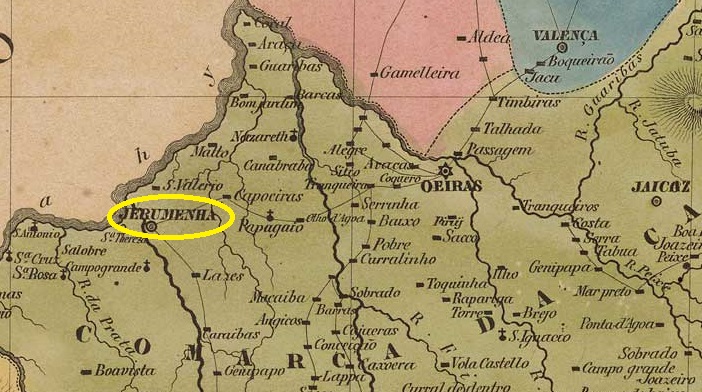
Villiers de l’Ile Adam: Carta (…) da Provincia do Piauhy, 1850

Other names: Sto. Antonio da Gurgueia, Jeromenha, Jurumenha

Jerumenha (also spelt Jeromenha or Jurumenha) has been mentioned since 1676 as Arraial, at that time of the Capitania de Pernambuco, on the east bank of the Gurgueia, 310 south of the later provincial capital of Piauí, Teresina. In 1740, the village became the Freguesia de Sto. Antonio da Gurgueia, which became a vila called Jerumenha in June 1761 and a town in December 1890.

Three dates have been found for the creation of the local post office. R. Koester (Carimbologia XXV) mentions the year 1824, the RHM catalogue gives the exact date 13.05.1843 and the directory of imperial post offices (Tabella das Agencias do Correio do Imperio, Rio de Janeiro, 1885) writes the year 1881. However, since Nova Monteiro (Administrações e Agencias Postaes do Brasil Imperio, in Brasil Filatelico/RJ, 1934-5; reprint SPP 1994-1999) writes that a postal clerk was appointed for Jerumenha in May 1842, these opening dates are either incorrect or incomplete.

The oldest postmark to date is JPI-0240a (fig. RHM catalogue):

JPI-0240a (RHM P-PI-01) 1843ff

JPI-0240c was only found before the end of the century (fig. Koester, op. cit.):

JPI-0240c (RK) 1891
Atlas do Imperio do Brasil, 1868

Andere Namen: Sto. Antonio da Gurgueia, Jeromenha, Jurumenha

Jerumenha (auch Jeromenha oder Jurumenha geschrieben) wird seit 1676 als Arraial noch in der Capitania de Pernambuco am Ostufer des Gurgueia, 310 südlich der späteren Provinzhauptstadt von Piauí, Teresina, erwähnt. 1740 wurde der Ort zur Freguesia de Sto. Antonio da Gurgueia, die im Juni 1761 zur Vila de Jerumenha und im Dezember 1890 zur Stadt erhoben wurde.

Für die Gründung des örtlichen Postamtes wurden drei Daten gefunden. R. Koester (Carimbologia XXV) nennt das Jahr 1824, der RHM-Katalog gibt das genaue Datum 13.05.1843 an und im Verzeichnis der kaiserlichen Postämter (Tabella das Agencias do Correio do Imperio, Rio de Janeiro, 1885) findet sich das Jahr 1881. Da jedoch Nova Monteiro (Administrações e Agencias Postaes do Brasil Imperio, in Brasil Filatelico/RJ, 1934-5; Reprint SPP 1994-1999) schreibt, dass ein Postbeamter für Jerumenha im Mai 1842 ernannt wurde, sind diese Eröffnungsdaten entweder falsch oder unvollständig.

Der bisher älteste Poststempel ist JPI-0240a (Abb. RHM-Katalog):

JPI-0240a (RHM P-PI-01) 1843ff

Erst vor dem Ende des Jahrhunderts fand sich auch JPI-0240c (Abb. Koester, op. cit.):

JPI-0240c (RK) 1891
Categories
Carimbologia H-L

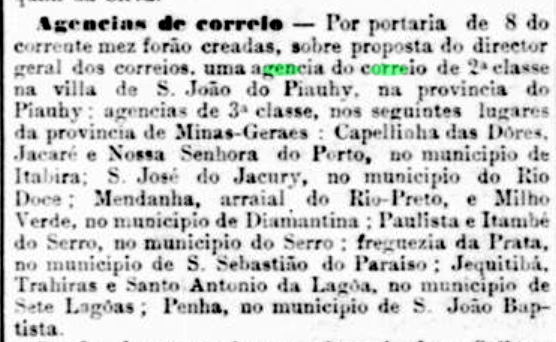
Jequitibá, Minas Gerais (JMG-1430)

Atlas do Imperio do Brasi, 1868

Other names: Trindade, Barra do Jequitibá

The Arraial de Trindade had existed since December 1849, belonged to the Vila de Sabará and was located at the mouth of the Jequitibá into the Rio das Velhas, 200 kilometres northwest of the provincial capital Ouro Preto. In May 1856 Jequitibá became a Distrito, now subordinate to the Vila de Sete Lagoas, and in June 1858 the Freguesia de Santíssimo Sacramento da Barra do Jequitibá. Jequitibá has been an independent município since December 1948.

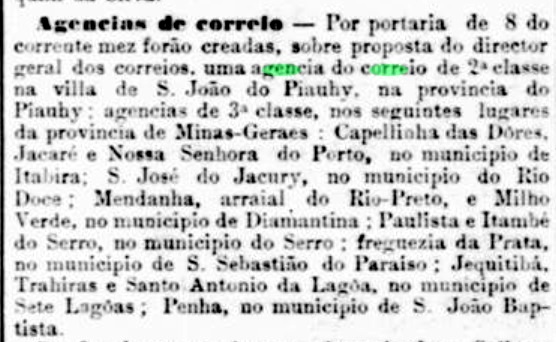
Paula Sobrinho (História Postal de Minas Gerais, Belo Horizonte, 1997) and R. Koester (Carimbologia XXV) agree that there has been a post office there since November 1881. This is confirmed by the press in Rio:

Jornal do Commercio/RJ, 12/11/1881

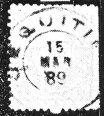
The imperial postmark is JMG-1430a (fig. Koester, op. cit.):

JMG-1430a (RK) 1889-1894ff
Villiers de l’Ile Adam: Carta (…) da Provincia de Minas Geraes, 1849

Andere Namen: Trindade, Barra do Jequitibá

Der Arraial de Trindade bestand seit Dezember 1849, gehörte zur Vila de Sabará und lag an der Mündung des Jequitibá in den Rio das Velhas, 200 km nordwestlich der Provinzhauptstadt Ouro Preto. Im Mai 1856 wurde Jequitibá ein Distrito, nun der Vila de Sete Lagoas untergeordnet, im Juni 1858 die Freguesia de Santíssimo Sacramento da Barra do Jequitibá. Seit Dezember 1948 ist Jequitibá ein eigenständiges Município.

Paula Sobrinho (História Postal de Minas Gerais, Belo Horizonte, 1997) und R. Koester (Carimbologia XXV) sind sich einig, dass es dort seit November 1881 ein Postamt gab. Dies wird von der Presse in Rio bestätigt:

Jornal do Commercio/RJ, 12.11.1881

Der kaiserliche Poststempel ist JMG-1430a (Abb. Koester, op. cit.):

JMG-1430a (RK) 1889-1894ff
Categories
Carimbologia H-L

Jequitahy, Minas Gerais (JMG-1428)

Atlas do Imperio do Brasil, 1868

See also Bomfim de Montes Claros (BMG-0370)

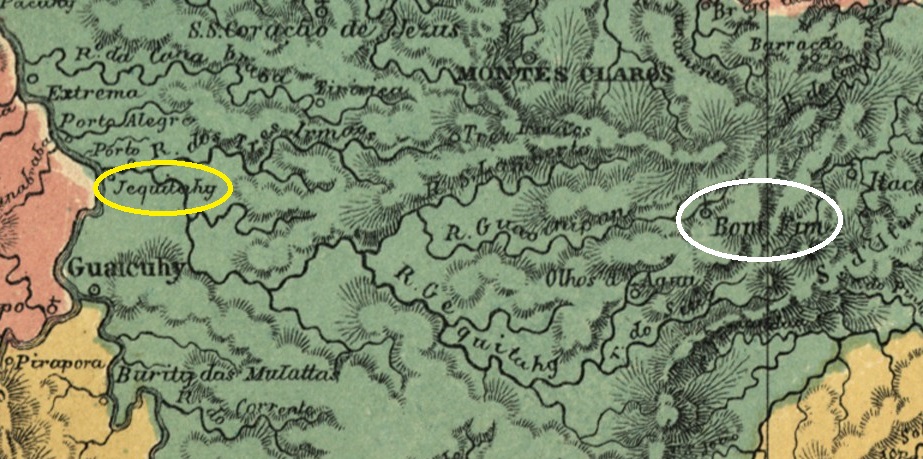
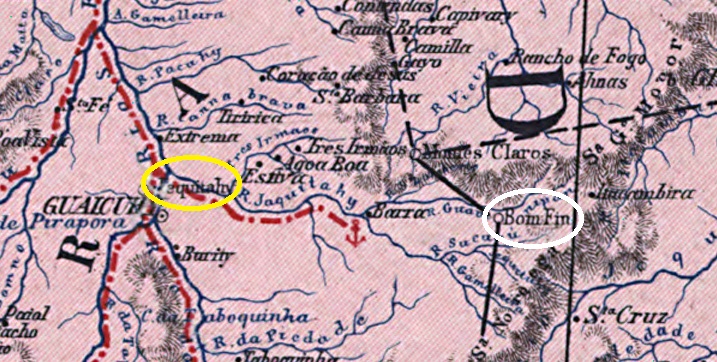
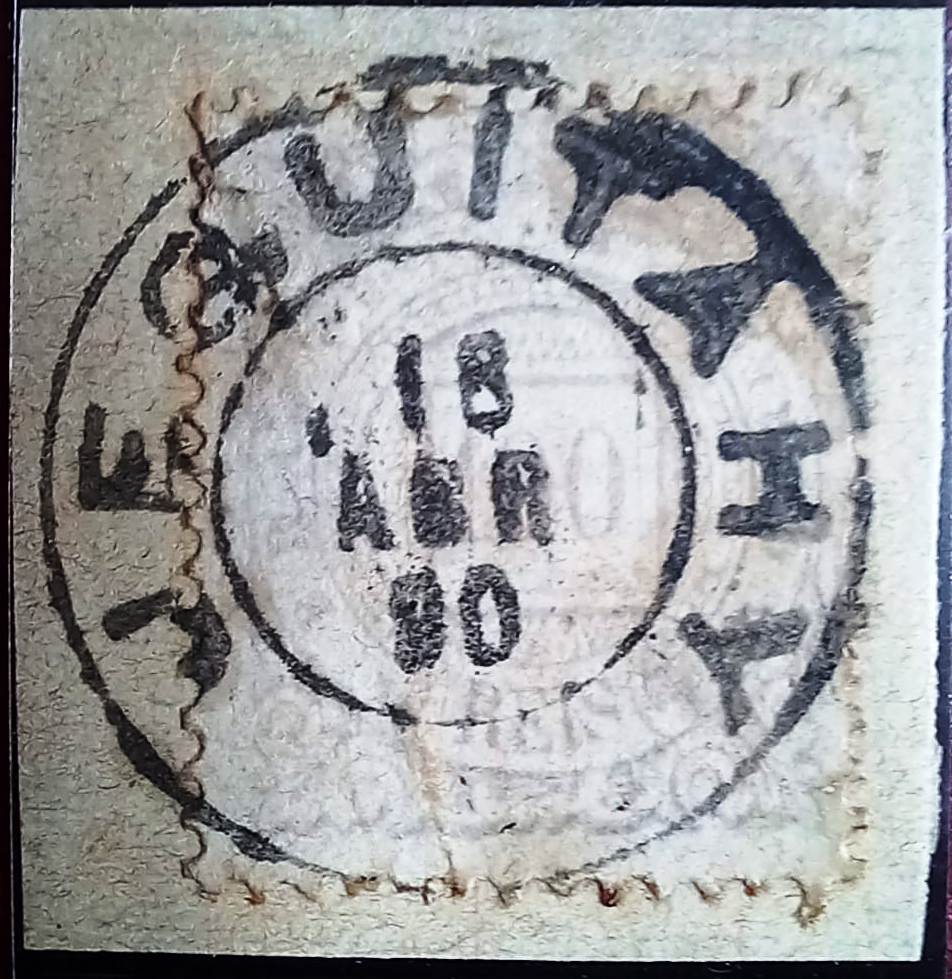
The history of this village is linked to that of Bomfim de Montes Claros (now Bocaiúva), 100 kilometres to the east. The Arraial de N. Sra. da Conceição do Jequitahy was founded around 1850, belonged to the Vila de Montes Claros and was located on the north bank of the Jequitaí, 500 km north of the provincial capital Ouro Preto. In November 1873, it was incorporated as a freguesia into the newly founded Vila de Jequitahy in Bonfim de Montes Claros. In October 1881, the seat of the Vila was moved to N. Sra. da Conceição do Jequitahy, which was elevated to city status three years later. In April 1890, it was downgraded to the Distrito de Vila Nova de Jequitahy, again subordinate to the Município de Montes Claros. Since December 1948, Jequitaí (as it is spelt today) has once again been an independent município. In the indigenous language, the place name means fish basket by the river of stones.

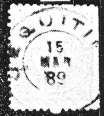
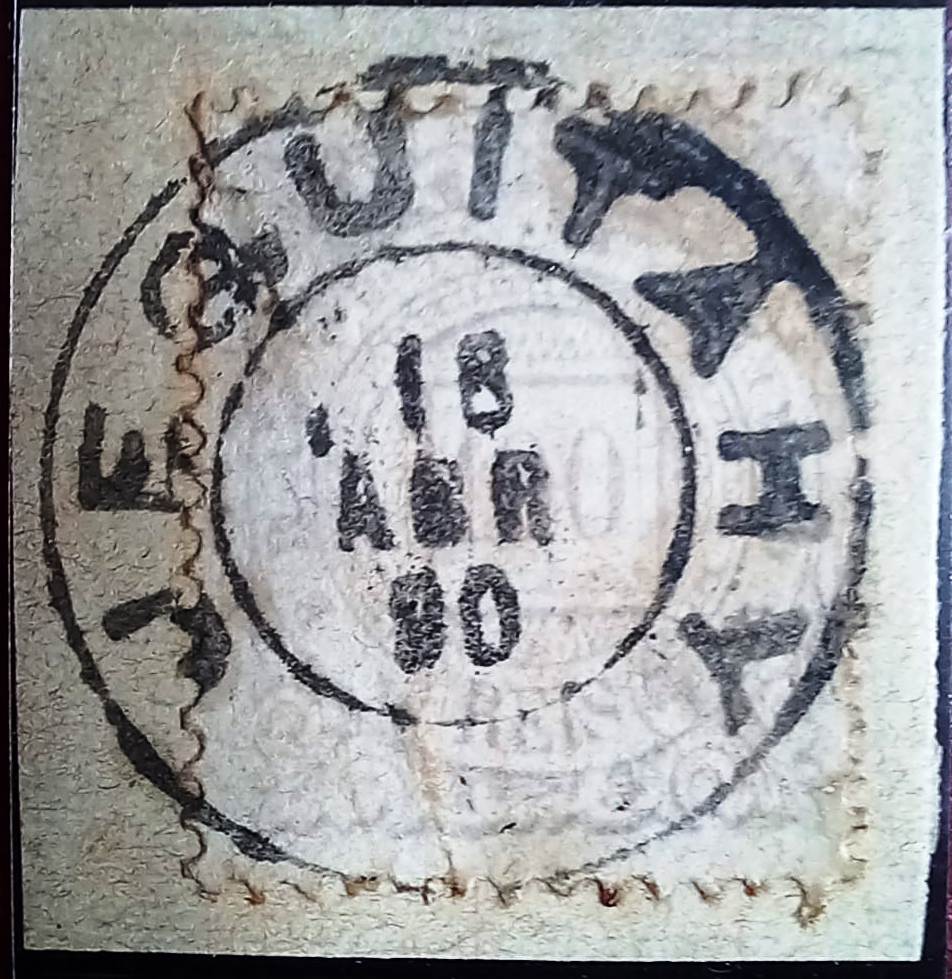
As Paula Sobrinho writes in História Postal de Minas Gerais (Belo Horizonte, 1997), there had been a post office there since July 1879; the oldest postmark to date is JMG-1428a (collect. Fuad Ferreira Fo.):

JMG-1428a (FF) 1885-1890
Carta da Republica dos Estados Unidos do Brazil, 1892

Siehe auch Bomfim de Montes Claros (BMG-0370)

Die Geschichte dieses Ortes ist mit der des 100 km östlich gelegenen Bomfim de Montes Claros (heute Bocaiúva) verbunden. Der Arraial de N. Sra. da Conceição do Jequitahy entstand um 1850, gehörte zur Vila de Montes Claros und lag am Nordufer des Jequitaí, 500 km nördlich der Provinzhauptstadt Ouro Preto. Im November 1873 wurde es als Freguesia in die neu gegründete Vila de Jequitahy in Bonfim de Montes Claros eingegliedert. Im Oktober 1881 wurde der Sitz der Vila nach N. Sra. da Conceição do Jequitahy verlegt, das drei Jahre später zur Stadt erhoben wurde. Im April 1890 erfolgte die Herabstufung zum Distrito de Vila Nova de Jequitahy, wieder untergeordnet zum Município de Montes Claros. Seit Dezember 1948 ist Jequitaí (wie es heute geschrieben wird) wieder ein eigenständiges Município. Der Ortsname bedeutet in der indigenen Sprache Fischkorb am Fluss der Steine.

Wie Paula Sobrinho in História Postal de Minas Gerais (Belo Horizonte, 1997) schreibt, gibt es dort seit Juli 1879 ein Postamt; der bisher älteste Poststempel ist JMG-1428a (Samml. Fuad Ferreira Fo.):

JMG-1428a (FF) 1885-1890

Categories
Carimbologia H-L

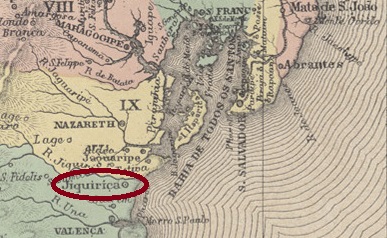
Jequiriçá, Bahia (JBA-0870)

Atlas do Imperio do Brasil, 1868

Other names: Capella Nova, Jiquiriçá (1944)

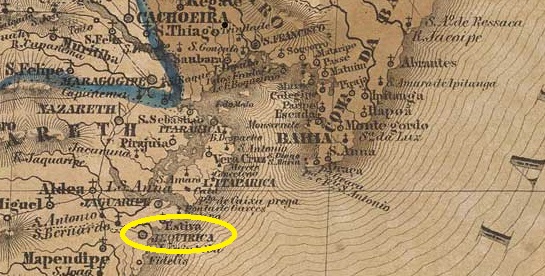
Jequiriçá supposedly became a Vila as early as November 1832, but this is rather unlikely as it only became a Freguesia do Senhor do Bomfim da Capella Nova in June 1868, which belonged to the Vila de S. Vicente Ferrer d’Areia and was situated on the west bank of the Jequiriçá, 180 kilometres west of the provincial capital Salvador da Bahia. As a freguesia, it was transferred to the Vila de Valença in September 1878. In January 1891 it became the Vila de Capella Nova de Jequiriçá and in March 1938 it became a town, which has been spelt Jiquiriçá since June 1944.

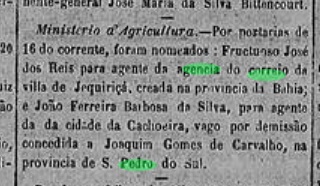
According to the Ceará press, there has been a post office there since around May 1864:

O Cearense/07/06/1864

R. Koester mentions a second opening in May 1890 in Carimbologia XXV. So far, no imperial postmarks from Jequiriçá have surfaced.

Villiers de l’Ile Adam: Carta (…) da Provincia da Bahia, 1848

Andere Namen: Capella Nova, Jiquiriçá (1944)

Angeblich wurde Jequiriçá bereits im November 1832 eine Vila, was aber eher unwahrscheinlich ist, da sie erst im Juni 1868 zur Freguesia do Senhor do Bomfim da Capella Nova wurde, die zur Vila de S. Vicente Ferrer d’Areia gehörte und am Westufer des Jequiriçá lag, 180 km westlich der Provinzhauptstadt Salvador da Bahia. Als Freguesia wechselte sie im September 1878 zur Vila de Valença. Im Januar 1891 wurde sie die Vila de Capella Nova de Jequiriçá und im März 1938 zur Stadt, die seit Juni 1944 Jiquiriçá geschrieben wird.

Wie aus der Presse von Ceará hervorgeht, gab es dort seit spätestens Mai 1864 ein Postamt:
O Cearense/07.06.1864

R. Koester erwähnt in Carimbologia XXV eine zweite Eröffnung im Mai 1890. Bisher sind keine kaiserlichen Poststempel aus Jequiriçá aufgetaucht.

Categories
Carimbologia H-L

Jequié, Bahia (JBA-0865)

Estado da Bahia, 1913

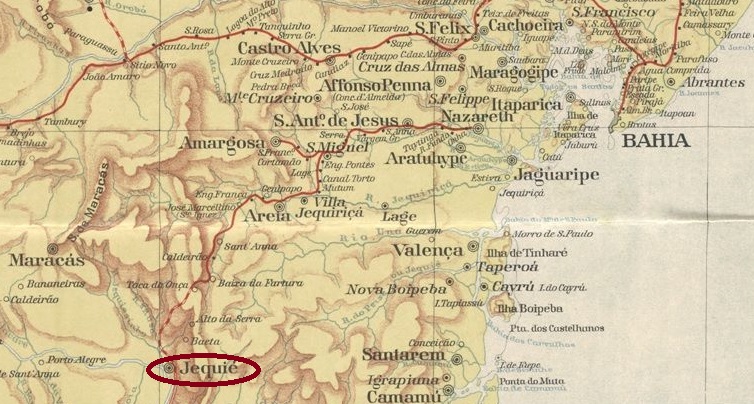
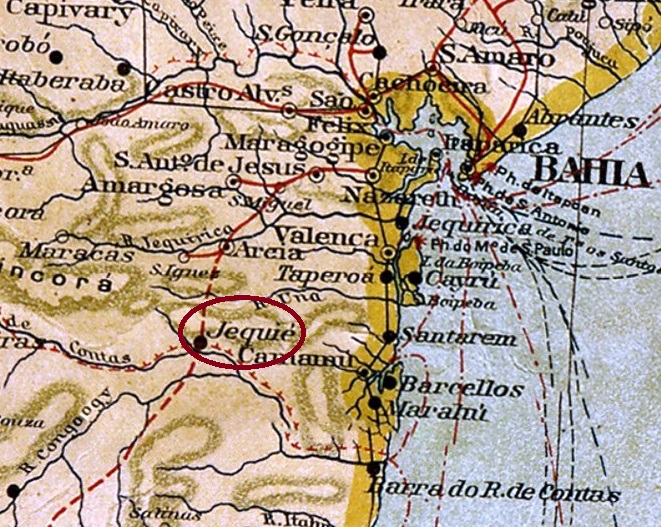
Today’s city of Jequié looks back on a young and eventful history. Since August 1880, it had been a district of the Vila de Maracás on the north bank of the Rio de Contas, 300 kilometres southwest of the provincial capital Salvador da Bahia. Jequié first became Município (July 1897) and then Freguesia (1899). Jequié has been a city since June 1910. Shortly afterwards, it became the capital of the state of Bahia for a few weeks, in one of the most bizarre episodes in Brazilian history: regional politicians from opposing camps allowed a provincial dispute to escalate into a civil war, during which the army bombed the state parliament in Salvador. The national library and the national archives went up in flames and countless historical documents were destroyed.

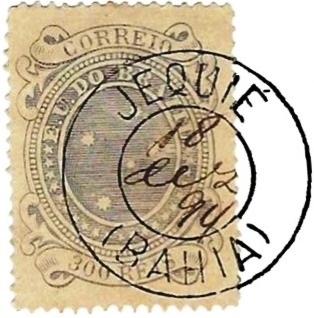
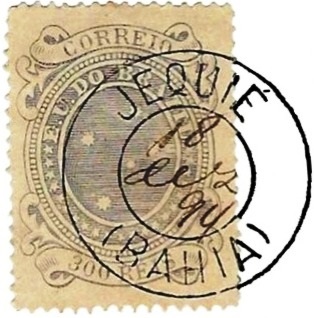
The postal bulletin (Boletim Postal) of 1889 shows that the local post office was established a few days before the end of the empire. This practically rules out the existence of imperial postmarks in Jequié. The oldest, JBA-0865a (fig. Felipe Piccinini), already bears Republican dates:

JBA-0865a (FP) 1894
Mappa Geral do Brasil, 1911

Die heutige Stadt Jequié blickt auf eine junge und bewegte Geschichte zurück. Sie war seit August 1880 ein Distrito der Vila de Maracás am Nordufer des Rio de Contas, 300 km südwestlich der Provinzhauptstadt Salvador da Bahia. Jequié wurde zuerst Município (Juli 1897) und dann Freguesia (1899). Seit Juni 1910 ist Jequié eine Stadt. Kurz darauf wurde sie für wenige Wochen Hauptstadt des Bundesstaates Bahia, in einer der bizarrsten Episoden der brasilianischen Geschichte: Regionalpolitiker verfeindeter Lager ließen eine Provinzposse zum Bürgerkrieg eskalieren, in dessen Verlauf die Armee das Landesparlament in Salvador bombardierte. Dabei gingen die Nationalbibliothek und das Nationalarchiv in Flammen auf, unzählige historische Dokumente wurden vernichtet.

Aus dem Postbulletin (Boletim Postal) von 1889 geht hervor, dass das lokale Postamt wenige Tage vor dem Ende des Kaiserreichs eingerichtet wurde. Dies schließt die Existenz von kaiserlichen Poststempeln in Jequié praktisch aus. Der älteste, JBA-0865a (Abb. Felipe Piccinini), trägt bereits republikanische Daten:

JBA-0865a (FP) 1894
Categories
Carimbologia H-L

Jequery, Minas Gerais (JMG-1420)

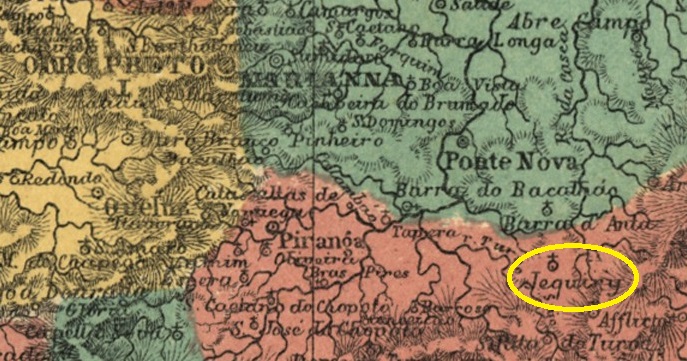
Provincia de Minas Geraes, 1873

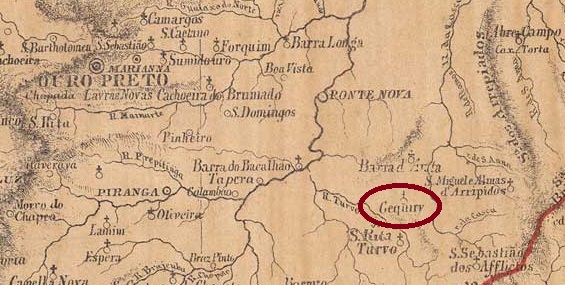
Other names: Vargem Alegre da Constituição, Jiquiri

From May 1855 Jequery was a district of the Vila de Ponte Nova, situated on the west bank of the river Casca, 120 kilometres east of the provincial capital Ouro Preto. In June 1858, the village became the Freguesia de Sant’Anna do Jequery and in September 1923 the Município de Jequeri (as it is spelt today).

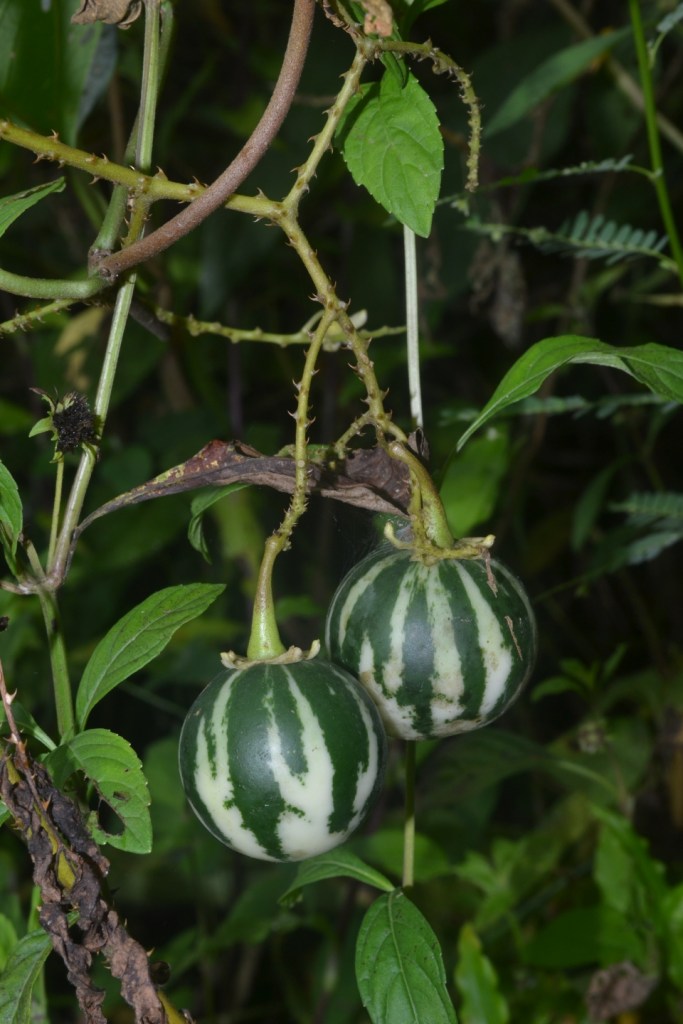
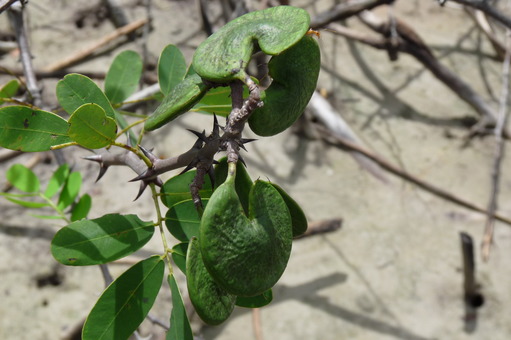
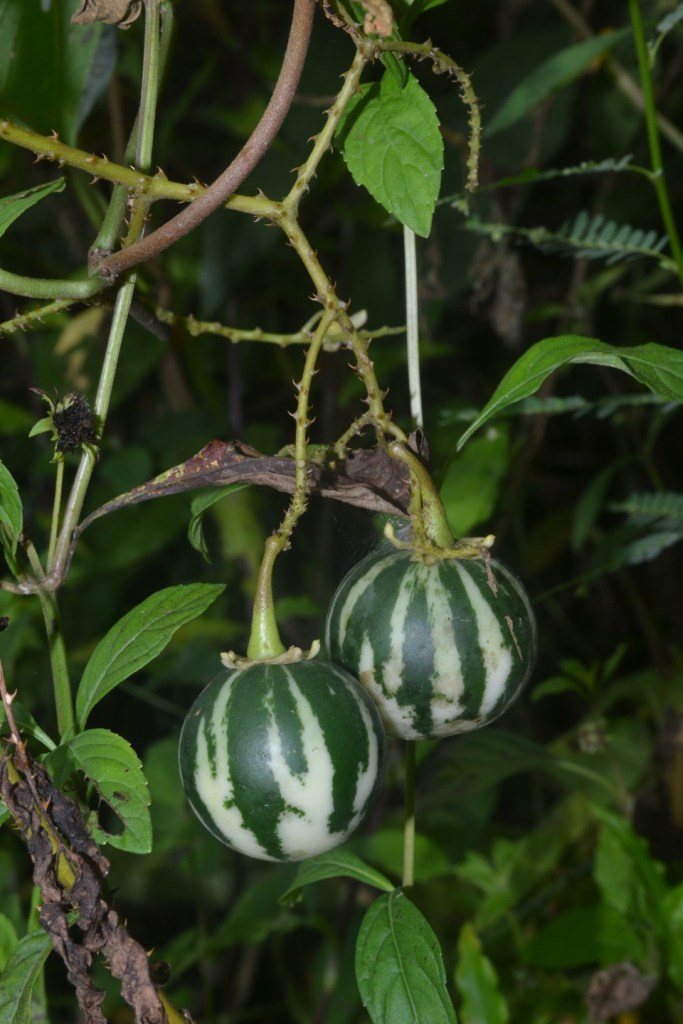
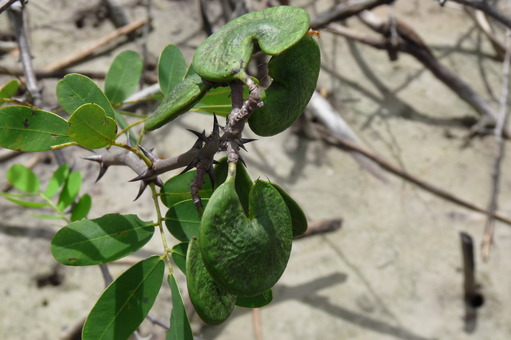
The name refers to several prickly climbing plants from the nightshade families (Solanaceae or Fabaceae):

Solanum alternatopinnatum, Steud (Photo: Leandro Jacomin, CC BY-SA)
Macherium lunatum, Ducke (Photo: Celine Pirat, CC BY-SA 2.0)

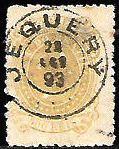
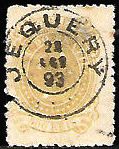
The directory of imperial post offices (Tabella das Agencias do Correio do Imperio, Rio de Janeiro, 1885) lists this agency as having been founded in 1840, which is probably an error. The postal report of 1886 gives September 1880, which is confirmed by Paula Sobrinho in História Postal de Minas Gerais (Belo Horizonte, 1997) and R. Koester (Carimbologia XXV). Earlier letters from Jequery are also known to bear the Ponte Nova cancellations. The imperial postmark here is JMG-1420a (illustration from the Internet):

JMG-1420a (EB) 1880ff-1893
Atlas do Imperio do Brasil, 1868

Andere Namen: Vargem Alegre da Constituição, Jiquiri

Seit Mai 1855 war Jequery ein Distrito der Vila de Ponte Nova, gelegen am Westufer des Flusses Casca, 120 km östlich der Provinzhauptstadt Ouro Preto. Im Juni 1858 wurde der Ort zur Freguesia de Sant’Anna do Jequery und im September 1923 zum Município de Jequeri (wie es heute geschrieben wird).

Der Name bezieht sich auf mehrere stachelige Kletterpflanzen aus den Familien der Nachtschattengewächse (Solanaceae oder Fabaceae):

Solanum alternatopinnatum, Steud (Foto: Leandro Jacomin, CC BY-SA)
Macherium lunatum, Ducke (Foto: Celine Pirat, CC BY-SA 2.0)

Das Verzeichnis der kaiserlichen Postämter (Tabella das Agencias do Correio do Imperio, Rio de Janeiro, 1885) führt diese Agentur mit dem Gründungsjahr 1840 auf, was ein Fehler sein dürfte. Der Postbericht von 1886 gibt September 1880 an, was von Paula Sobrinho in História Postal de Minas Gerais (Belo Horizonte, 1997) und R. Koester (Carimbologia XXV) bestätigt wird. Es sind auch frühere Briefe aus Jequery bekannt, die stumme Stempel aus Ponte Nova tragen. Der kaiserliche Portostempel ist hier JMG-1420a (Abbildung aus dem Internet):

JMG-1420a (EB) 1880ff-1893
Categories
Carimbologia H-L

Javary, Amazonas (JAM-0135)

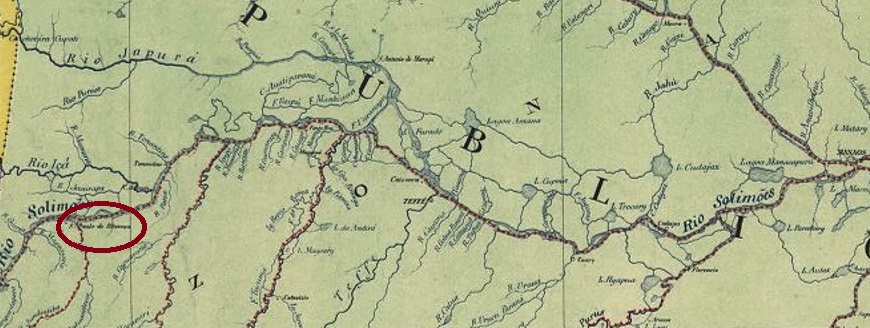
Carta da Republica dos Estados Unidos do Brazil, 1892

See also Olivença (R. Koester: Carimbologia XXIX), São Paulo de Olivença (SAM-0085)

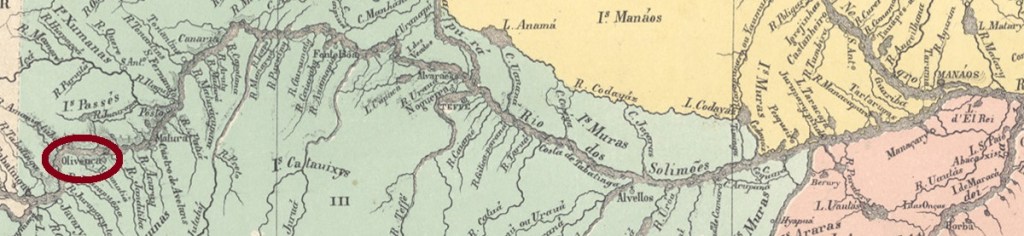
São Paulo de Olivença was already in the mid-18th century a freguesia in the Capitania of Grão-Pará, located on the south bank of the Amazon (the river is now called Solimões there), almost 1,000 km west of the future provincial capital Manaus. In 1833, it became a district called Javary in the municipality of Teffé, which was then elevated to a villa under the old place name in May 1882.

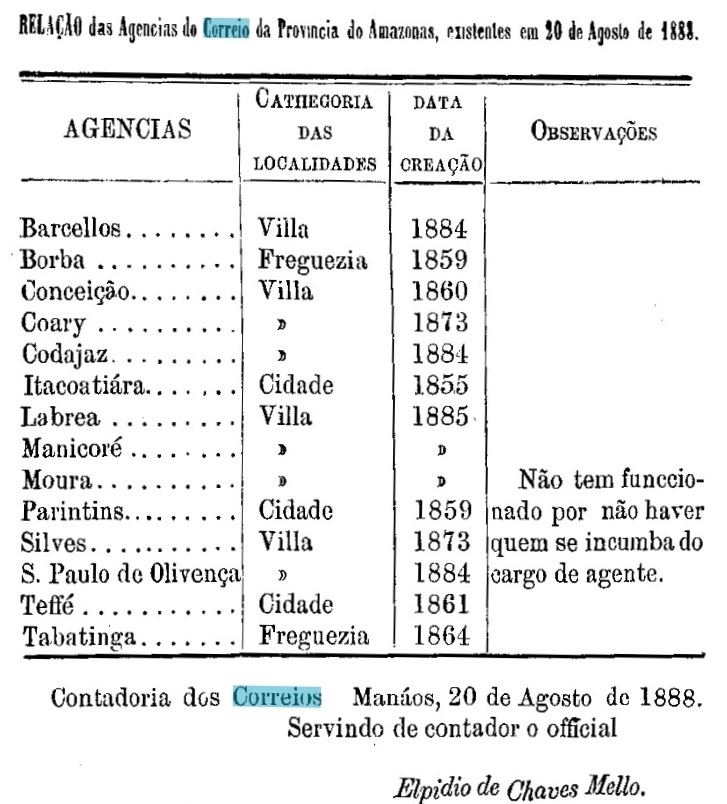
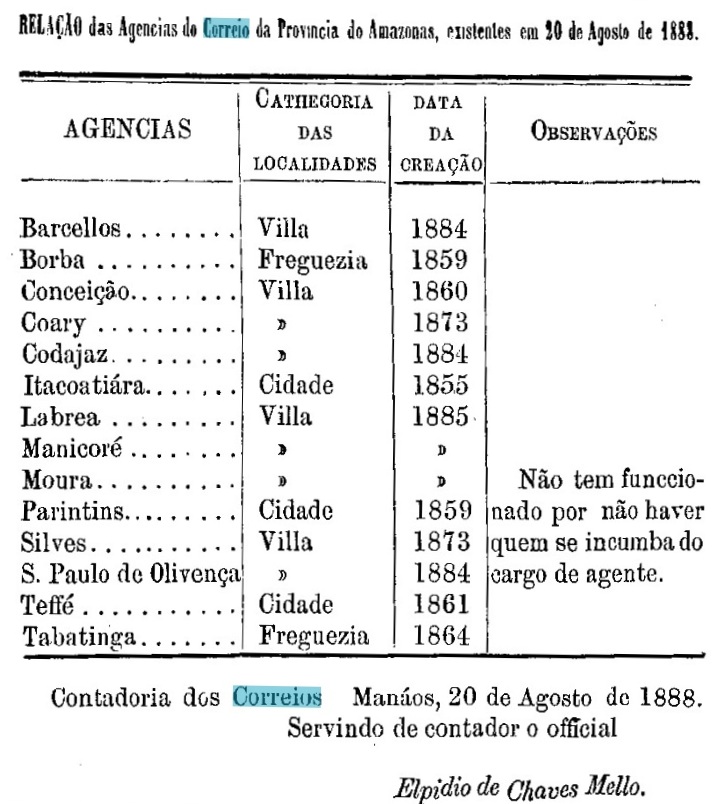
As can be read in the Provincial President’s Report for 1888, there has been a post office there since 1884:

Relatório do Presidente da Provincia, 1888

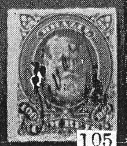
R. Koester shows in Carimbologia XXV a handwritten cancellation with the place name Javary:

1884ff (RK)
Atlas do Imperio do Brasil, 1868

Siehe auch Olivença (R. Koester: Carimbologia XXIX), São Paulo de Olivença (SAM-0085)

São Paulo de Olivença war bereits Mitte des 18. Jahrhunderts eine Freguesia in der Capitania von Grão-Pará, die am Südufer des Amazonas (der Fluss heißt dort eigentlich Solimões) lag, fast 1.000 km westlich der künftigen Provinzhauptstadt Manaus entfernt. In 1833 wurde daraus ein Distrikt namens Javary im Município von Teffé, der dann im Mai 1882 zu einer Villa mit dem alten Ortsnamen erhoben wurde.

Wie im Bericht des Provinzpräsidenten für 1888 zu lesen ist, gab es dort ein Postamt seit 1884:

Relatório do Presidente da Provincia, 1888

R. Koester zeigt in Carimbologia XXV eine handschriftliche Entwertung mit Ortsbezeichnung Javary:

1884ff (RK

Categories
Carimbologia H-L

Jatobá (Brejo), Pernambuco (JPE-0350)

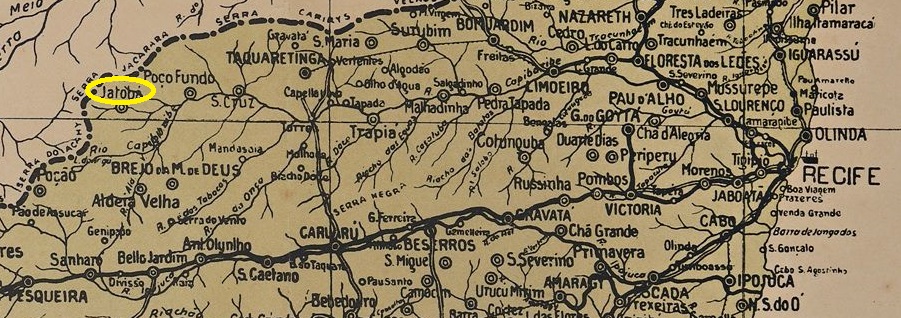
Arthur D. Ribeiro: Estado de Pernambuco, 1924

Other names: Jataúba (1943)

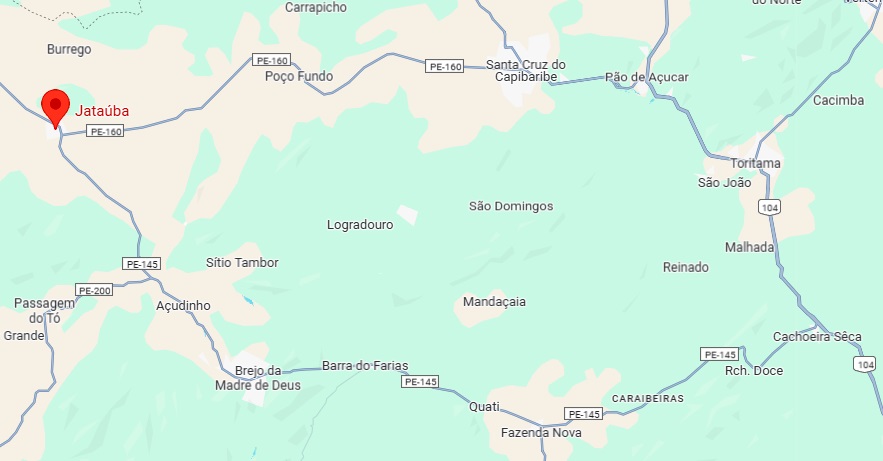
The village was located 220 kilometres west of the provincial capital Recife and since June 1862 was a district of the Freguesia de Jacarará, which in turn belonged to Vila do Brejo. In December 1943 the place name was changed to Jataúba and 15 years later it was elevated to Município under this name.

According to the Ceará press, in July 1883 it was decided to establish a post office in Jatobá:

O Cearense, 12/08/1883

However, as this agency does not appear in the list of imperial post offices (Tabella das Agencias do Correio do Imperio, Rio de Janeiro, 1885), it can be assumed that it was not put into operation until later.

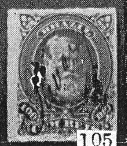
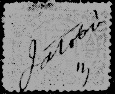
Only one handwritten cancellation is known from the imperial era on a cypher issue of 1885, as illustrated in Carimbologia XXV by R. Koester:

1885ff (RK)
Google Maps

Andere Namen: Jataúba (1943)

Der Ort liegt 220 km westlich der Provinzhauptstadt Recife und war seit Juni 1862 ein Distrikt der Freguesia de Jacarará, die wiederum zu Vila do Brejo gehörte. Im Dezember 1943 wurde der Ortsname in Jataúba geändert und 15 Jahre später erfolgte unter diesem Namen die Erhebung zum Município.

Wie aus der Presse von Ceará hervorgeht, wurde im Juli 1883 beschlossen, in Jatobá ein Postamt einzurichten:

O Cearense, 12.08.1883

Da diese Agentur jedoch nicht im Verzeichnis der kaiserlichen Postämter (Tabella das Agencias do Correio do Imperio, Rio de Janeiro, 1885) auftaucht, ist davon auszugehen, dass sie erst später in Betrieb genommen wurde.

Aus der Kaiserzeit ist nur eine handschriftliche Entwertung auf einer Ziffer-Ausgabe von 1885 bekannt, wie sie in der Carimbologia XXV von R. Koester abgebildet ist:
1885ff (RK)