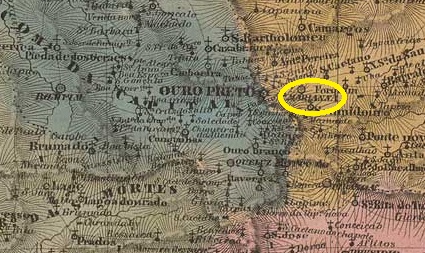
Other names: Albuquerque, Ribeirão do Carmo
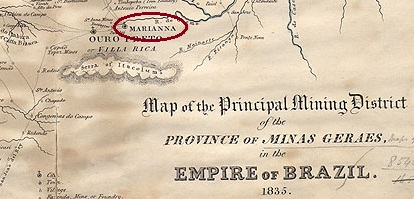
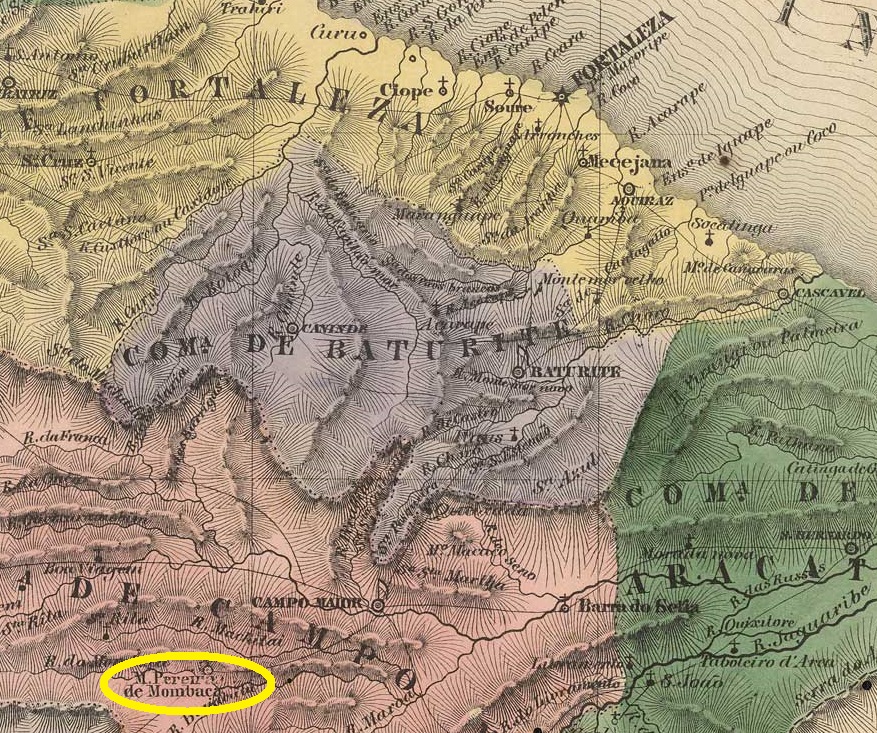
The Vila de Albuquerque existed since April 1711 at Ribeirão do Carmo, 15 kilometres east of the later provincial capital Vila Rica or Ouro Preto. In April 1712, it was renamed Ribeirão do Carmo. In April 1745, it was elevated to Freguesia de N. Sra. da Assumpção da Sé de Marianna and subsequently granted city status.
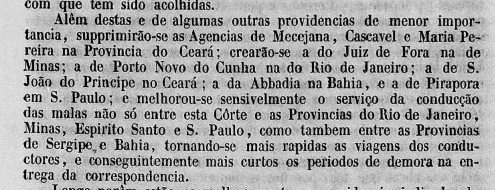
No fewer than four different dates have been found for the establishment of the local post office: first in March 1798, as Paula Sobrinho writes in História Postal de Minas Gerais (Belo Horizonte, 1997). A second time in March 1829, as stated in Administrações e Agencias Postaes do Brasil Imperio (Brasil Filatelico/RJ, 1934–1935; reprinted by SPP 1994–1999) by Nova Monteiro. The year 1833 is mentioned once more, as can be read in the postal report (Relatorio Postal) for the year 1886, and finally, the year 1846 is listed in the directory of imperial post offices (Tabella das Agencias do Correio do Imperio, Rio de Janeiro, 1885). We can therefore assume that this agency was closed more times.
The oldest postmark to date is MMG-1565a, which has been found in pink, sepia, red, green and yellow. Paulo Ayres gave it the number 1153 in his Catálogo de Carimbos Brasil-Império (S. Paulo, 1937, 1942).
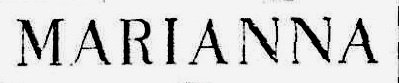
This was followed by the rare MMG-1565b (illustration by R. Koester in Carimbologia XXVII), which also occurs in sepia.
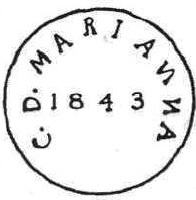
Next came MMG-1565c, which also exists in red and possibly in two variants, as shown in the illustrations by R. Koester (op. cit.) and Henrique B. Ferreira (Catálogo Ilustrado dos Carimbos Sobre os Olhos-de-Boi, Porto Alegre, 2017).
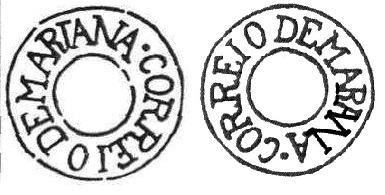
According to P. Ayres (op. cit., No. 1616), the archaic-looking MMG-1565d is also said to appear on Bull’s-eyes stamps, but this has not yet been confirmed.
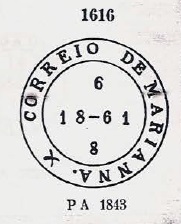
The subsequent double circle MMG-1565g (illustration from the Internet) was used until the end of the 19th century.
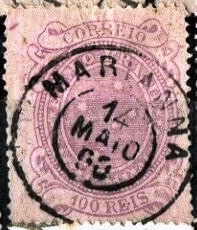
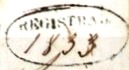
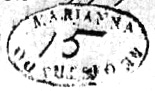
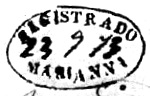
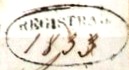
Marianna also used three own registered cancels.
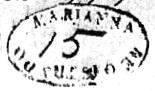
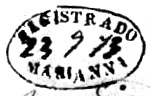
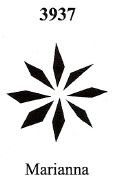
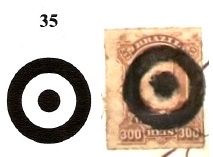
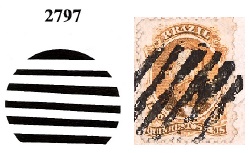
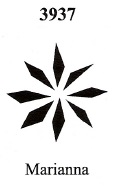
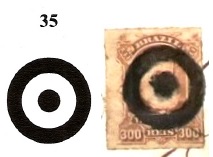
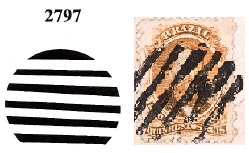
Three mute postmarks, which can be found in Mute Cancellations of the Brazil Empire/Carimbos Mudos do Brasil Império (Brazil Philatelic Association, Rio de Janeiro, 2000) by James Dingler and Klerman W. Lopes, could be attributed to Marianna:
Andere Namen: Albuquerque, Ribeirão do Carmo
Die Vila de Albuquerque bestand seit April 1711 am Ribeirão do Carmo, 15 Kilometer östlich der späteren Provinzhauptstadt Vila Rica bzw. Ouro Preto. Im April 1712 wurde sie zu Ribeirão do Carmo umbenannt. Im April 1745 wurde sie zur Freguesia de N. Sra. da Assumpção da Sé de Marianna erhoben und erhielt anschließend den Status einer Stadt.
Es wurden nicht weniger als vier verschiedene Daten für die Entstehung des örtlichen Postamts gefunden: erstmals im März 1798, wie Paula Sobrinho in História Postal de Minas Gerais (Belo Horizonte, 1997) schreibt. Ein zweites Mal im März 1829, wie aus Administrações e Agencias Postaes do Brasil Imperio (Brasil Filatelico/RJ, 1934–1935; Nachdruck SPP 1994–1999) von Nova Monteiro hervorgeht. Ein weiteres Mal wird das Jahr 1833 genannt, wie im Postbericht (Relatorio Postal) für das Jahr 1886 nachzulesen ist, und schließlich wird das Jahr 1846 im Verzeichnis der kaiserlichen Postämter (Tabella das Agencias do Correio do Imperio, Rio de Janeiro, 1885) aufgeführt. Wir können daher davon ausgehen, dass diese Agentur mehrmals geschlossen wurde.
Der bisher älteste Poststempel ist MMG-1565a, der bisher in den Farben Rosa, Sepia, Rot, Grün und Gelb gefunden wurde. Paulo Ayres gab ihm die Nr. 1153 in seinem Werk Catálogo de Carimbos Brasil-Império (S. Paulo, 1937, 1942).

Es folgte der seltene MMG-1565b (Abbildung bei R. Koester in Carimbologia XXVII), der ebenfalls in Sepia vorkommt.
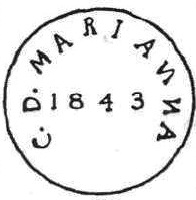
Danach kam MMG-1565c, der auch in Rot existiert und möglicherweise in zwei Varianten vorkommt, wie die Abbildungen von R. Koester (op. cit.) und Henrique B. Ferreira (Catálogo Ilustrado dos Carimbos Sobre os Olhos-de-Boi, Porto Alegre, 2017) zeigen.
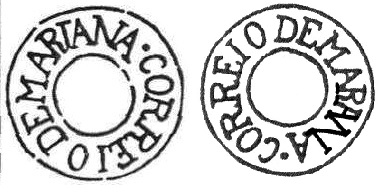
Der archaisch anmutende MMG-1565d soll laut P. Ayres (op. cit., Nr. 1616) auch auf Ochsenaugen vorkommen, was bisher jedoch nicht bestätigt werden konnte.

Der anschließende Doppelkreis MMG-1565g (Abbildung aus dem Internet) wurde bis gegen Ende des 19. Jahrhunderts verwendet.
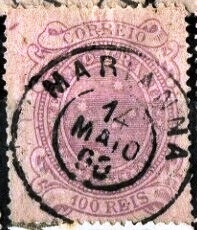
Marianna hatte auch drei eigene Einschreibstempel benutzt.
Drei stumme Poststempel, die in Mute Cancellations of the Brazil Empire/Carimbos Mudos do Brasil Império (Brazil Philatelic Association, Rio de Janeiro, 2000) von James Dingler und Klerman W. Lopes zu finden sind, konnten Marianna zugeordnet werden:




 Carimbologia