Categories
Carimbologia T-Z

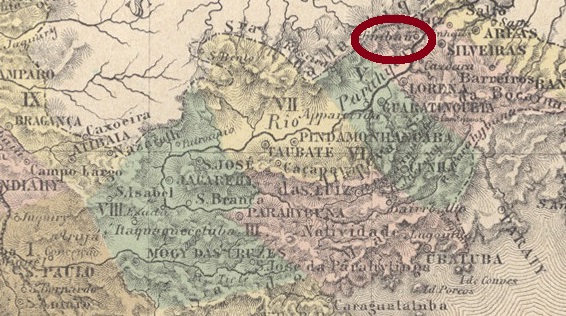
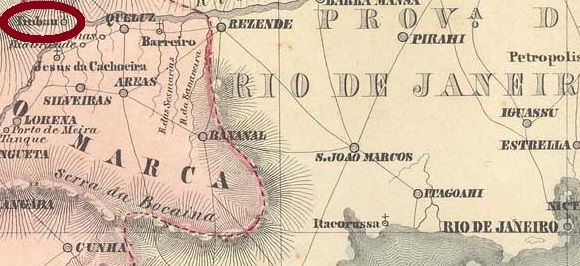
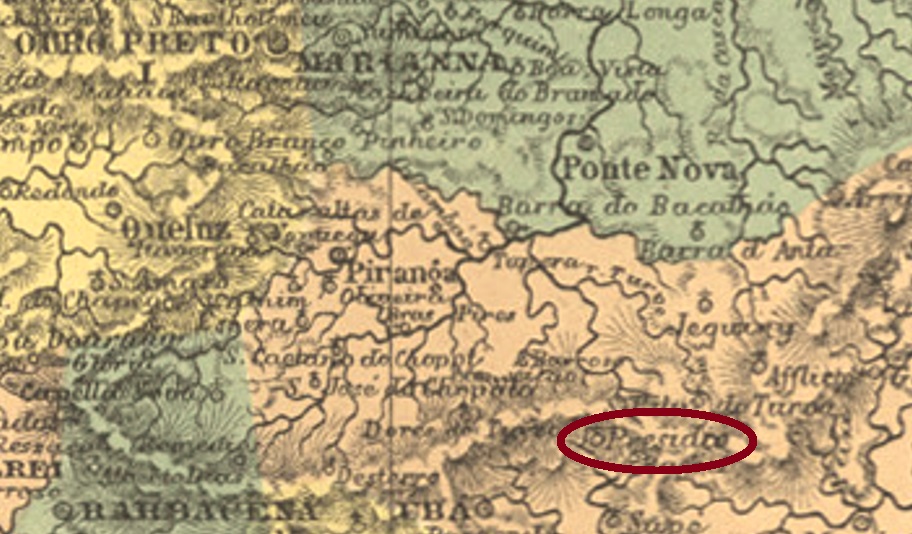
Villa do Prezidio, Minas Gerais (VMG-3790)

Atlas do Imperio do Brasil, 1868

See also: Presídio (Koester: Carimbologia XXXII), Rio Branco (RMG-2110)

Other names: Presídio, Presídio de Ubá, São João Baptista do Presídio, Rio Branco, Visconde do Rio Branco

The long rivalry between the neighbour towns of Visconde do Rio Branco and Ubá in southeast of Minas Gerais has historical roots. The former was originally a district of the municipality of Pomba in 1810, with the sonorous name Distrito de São João Baptista dos Índios Coropós. Eventually after that, the locality became an open prison, surrounded by woods and called S. João Baptista do Presídio, which was made a Villa in February or March 1839. Sometime later there must have been an economic decay, for in 1853 it was degraded to a district of the municipality of Ubá and therefore called Presídio de Ubá (= Ubá Prison). It recovered the old name and Villa status only in 1881, and in the following year was elevated to a town named Visconde do Rio Branco. Such measures show understandingly a wish to leave behind both names of prison and Ubá, even though José Maria da Silva Paranhos, the Viscount of Rio Branco (1819-1880), father of the famous Baron of Rio Branco, probably never visited Minas Gerais.

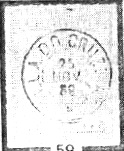
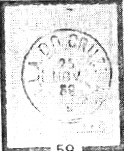
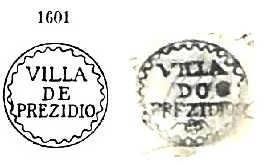
According to Nova Monteiro (Administrações e Agências Postaes do Brasil-Império 1798-1869), a post office was created in December 1839, but seems to have been closed by 1856, for it is absent in Guia do Correio do Brazil of 1857. A famous postal cancel from this early period was used on Bull’s Eyes and already presented by Paulo Ayres (1937) under #1601.

However, Ayres’ image differs considerably from the original, which is presented here through a letter of 1843 from the José L. Fevereiro collection:

VMG-3790a (P. A.1601-recte JLF) 1839-1843ff

Apparently, the post office reopened only in September 1870 (Paula Sobrinho: História Postal de Minas Gerais, Belo Horizonte, 1997). The postmarks from this period were already shown by R. Koester under Presídio (Carimbologia XXXII). Postmarks featuring Rio Branco appeared by 1882 an can be seen under RMG-2110.

Villiers de l’Ile Adam: Carta (…) da Provincia de Minas Geraes, 1849

Siehe auch: Presídio (Koester, Carimbologia XXXII), Rio Branco (RMG-2110)

Andere Namen: Presídio, Presídio de Ubá, São João Baptista do Presídio, Rio Branco, Visconde do Rio Branco

Die lange Rivalität zwischen den Nachbarstädtchen Visconde do Rio Branco und Ubá im Südosten von Minas Gerais hat eine ebenso lange Vorgeschichte. Erstes war ursprünglich (ab 1810) ein Distrikt im Município von Pomba, mit dem wohlklingenden Namen Distrito de São João Baptista dos Índios Coropós. Irgendwann danach wurde aus der Ortschaft ein offenes Gefängnis mitten im Urwald, das sich S. João Baptista do Presídio nannte, das im Februar oder März 1839 als Villa aufgewertet wurde. Aber später soll es wirtschaftlich so weit bergab gegangen sein, dass die Villa in 1853 zum Distrikt vom Nachbar Ubá degradiert wurde, unter dem – zugegeben nicht sehr schmeichelhaften – Namen Presídio de Ubá (= Ubás Gefängnis). Der Status einer Villa mit eigener Verwaltungsautonomie wurde erst in 1881 wieder erlangt, und ein Jahr später war der Ort zur Stadt Visconde do Rio Branco umbenannt. Die letzten Verwaltungsakte zeigen unmissverständlich den Wunsch, die Bezeichnungen Presídio und Ubá loszuwerden, auch wenn José Maria das Silva Paranhos (1819-1880), der Vicomte von Rio Branco und Vater des berühmten Baron von Rio Branco, womöglich niemals in Minas Gerais unterwegs war.

Laut Nova Monteiro (Administrações e Agências Postaes do Brasil-Império 1798-1869) wurde ein Postamt bereits im Dezember 1839 errichtet, das gleichwohl schon vor 1856 wieder geschlossen war, da es nicht im Guia do Correio do Brazil von 1857 aufgelistet wurde. Von dieser Frühzeit ist ein einziger Stempel überliefert, der auf Ochsenaugen zu finden ist und von Paulo Ayres (1937) unter Nr. 1601 registriert wurde. Dennoch zeigt die Ayres’ Abbildung erhebliche Abweichungen, wenn man sie mit dem Originalbild vergleicht, hier in einem Brief vom Jahr 1843 aus der Sammlung José L. Fevereiro:
VMG-3790a (P. A.1601-recte JLF) 1839-1843ff

Das Postamt wurde wohl erst im September 1870 (Paula Sobrinho: História Postal de Minas Gerais, Belo Horizonte, 1997) wieder eröffnet. Die Stempel aus dieser Zeit wurden bereits von R. Koester unter Presídio (Carimbologia XXXII) vorgestellt. Poststempel mit Rio Branco kamen erst um ca. 1882 und können unter RMG-2110 gesehen werden.
Categories
Carimbologia T-Z

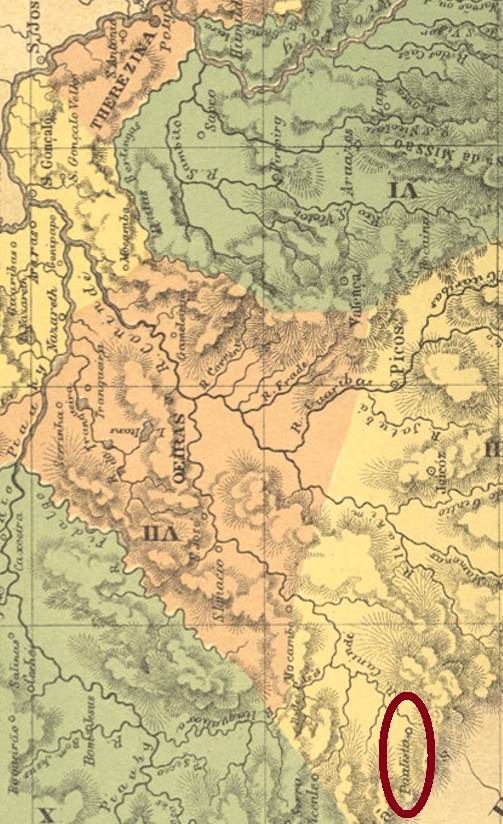
Villa do Paulista, Piauí (VPI-0255)

Atlas do Imperio do Brasil, 1868

Another name: Paulistana (1943).

See also Paulista (R. Koester: Carimbologia XXX)

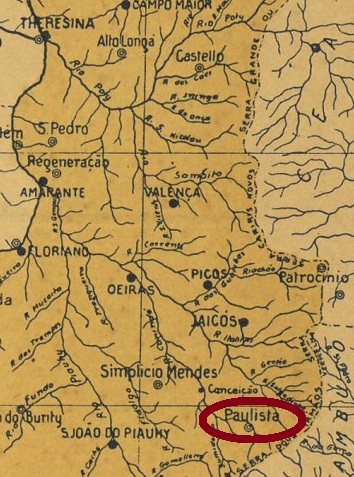
According to a legend, this villa was so named because it originated around 1663 from a large estate founded by the bandeirante Domingos Jorge Velho (1641-1705) from São Paulo, 460 km southeast of the later provincial capital of Teresina. In July 1883, the village was elevated to the district of Jaicós, and two years later Paulista was a villa. In June 1931 it was downgraded as a district of Jaicós, and in September 1933 it was elevated again to a município, which has been called Paulistana since December 1943.

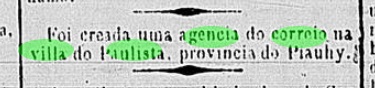
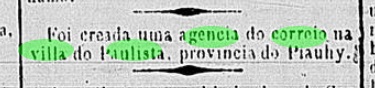
As Reinhold Koester writes in Carimbologia XXX, there had been a post office there since May 1887, which is confirmed by the Rio press:

Gazeta da Tarde/RJ, 31.05.1887

However, the agency is said to have started operations only the following year. So far, no imperial postmark has been seen from this place.

Arthur D. Ribeiro: Estado do Piauhy, 1924

Anderer Name: Paulistana (1943)

Siehe auch Paulista (R. Koester: Carimbologia XXX)

Einer Legende nach hieß diese Villa so, weil sie um 1663 aus einem durch den Bandeirante Domingos Jorge Velho (1641-1705) aus São Paulo gegründeten Großgrundbesitz entstanden ist, der 460 km südöstlich der späteren Provinzhauptstadt Teresina entfernt lag. Im Juli 1883 wurde der Ort zum Distrikt von Jaicós erhoben, zwei Jahre später war Paulista eine Villa. Im Juni 1931 folgte die Herabstufung als Distrikt von Jaicós, und im September 1933 der Wiederaufstieg zu einem Município, der seit Dezember 1943 Paulistana heißt.

Wie Reinhold Koester in Carimbologia XXX schreibt, gab es dort ein Postamt seit Mai 1887, was durch die Presse aus Rio bestätigt wird:

Gazeta da Tarde/RJ, 31.05.1887

Allerdings soll die Agentur den Betrieb erst im folgenden Jahr aufgenommen haben. Bisher war kein kaiserlicher Poststempel aus diesem Ort zu sehen.

Categories
Carimbologia T-Z

Villa do Paço, Maranhão (VMA-0295)

Atlas do Imperio do Brasil, 1868

See also Paço do Lumiar (R. Koester: Carimbologia XXIX)

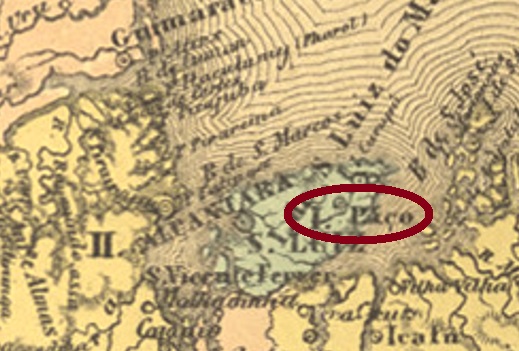
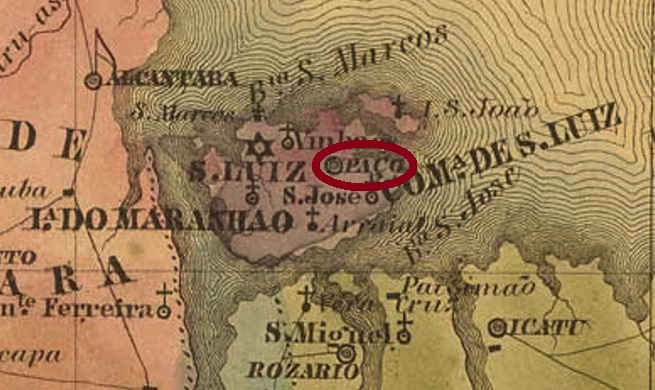
The freguesia of Paço do Lumiar originated as early as June 1757 and belonged to the vila of São Luiz do Maranhão, 13 km away. The village is said to have been promoted to vila twice, in June 1761 and in April 1835. It was not until the 20th century, in February 1931, that it was relegated as a district of São Luís, then 12 years later it changed to the município of Ribamar. Since December 1959, it has been the município of Paço do Lumiar.

As can be read in the postal report (Relatorio Postal) from 1886, there was a post office there since February 1875. So far, no imperial postmark has been found from this locality.

Villiers de l’Ile Adam: Carta (…) da Provincia do Meranhão, 1850

Siehe auch Paço do Lumiar (R. Koester: Carimbologia XXIX)

Die Freguesia von Paço do Lumiar entstand bereits im Juni 1757 und gehörte der 13 km weit entfernte Vila von São Luiz do Maranhão. Der Ort soll zweimal zur Vila aufgestiegen sein, im Juni 1761 und im April 1835. Erst im 20. Jahrhundert, im Februar 1931, erfolgte der Abstieg als Distrikt von São Luís, dann 12 Jahre später wechselte der Ort zum Município von Ribamar. Seit Dezember 1959 ist es der Município von Paço do Lumiar.

Wie im Postbericht (Relatorio Postal) aus 1886 zu lesen ist, gab es dort ein Postamt seit Februar 1875. Bisher wurde kein Poststempel aus der Kaiserzeit aus dieser Gemeinde gefunden.

Categories
Carimbologia T-Z

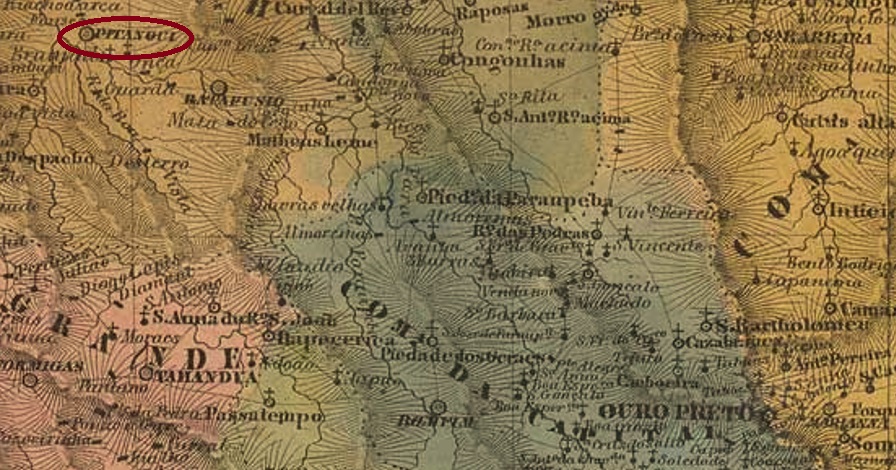
Villa do Cruzeiro, São Paulo (VSP-0405)

Atlas do Imperio do Brasil, 1868

Other names: Conceição do Embaú, Conceição do Cruzeiro, Vila Novais

See also Cruzeiro/SP (R. Koester: Carimbologia XIV)

The freguesia of N. Sra da Conceição do Embaú (also spelled Imbahú) was founded in February 1846 and was located on the west bank of the Paraíba do Sul River in the município of Lorena, 220 km northeast of the provincial capital São Paulo. In March 1871, the town was elevated to the status of a vila under the name Conceição do Cruzeiro. After the inauguration of a railway station of the E.F. Dom Pedro II Railway Company in March 1878, the village moved to and from the station several times and in between was given the name Villa Novais. Cruzeiro has been a city since December 1906.

As listed in the Directory of Imperial Post Offices (Tabella das Agencias do Correio do Imperio, Rio de Janeiro, 1885), there had been a post office there since 1876. The regional press reported the appointment of the local postal agent in the last week of that year:

Correio Paulistano, 11.01.1877

After the ascent to the Vila, VSP-0405a appeared, previously found with dates between 1887 and 1889 and already shown by R. Koester (Carimbologia XIV):

VSP-0405a (RK) 1887-1889

Koester (op. cit.) also shows three earlier cancellations, all bearing the simplified place name CRUZEIRO.

Villiers de l’Ile Adam: Carta (…) da Provincia de São Paulo, 1847

Andere Namen: Conceição do Embaú, Conceição do Cruzeiro, Vila Novais

Siehe auch Cruzeiro/SP (R. Koester: Carimbologia XIV)

Die Freguesia von N. Sra da Conceição do Embaú (auch Imbahú geschrieben) wurde im Februar 1846 gegründet und lag am Westufer des Flusses Paraíba do Sul im Município von Lorena, 220 km nordöstlich der Provinzhauptstadt São Paulo entfernt. Im März 1871 wurde der Ort unter dem Namen Conceição do Cruzeiro zur Vila erhoben. Nach der Einweihung eines Bahnhofs der E.F. Dom Pedro II Bahngesellschaft im März 1878 wechselte der Ort mehrmals zum und vom Bahnhof und bekam zwischendurch den Namen Villa Novais. Seit Dezember 1906 ist Cruzeiro eine Stadt.
Wie im Verzeichnis der kaiserlichen Postämter (Tabella das Agencias do Correio do Imperio, Rio de Janeiro, 1885) aufgelistet, gab es dort ein Postamt seit 1876. Die Regionalpresse berichtete über die Ernennung des örtlichen Postagenten in der letzten Jahreswoche:

Correio Paulistano, 11.01.1877

Nach dem Aufstieg zur Vila erschien VSP-0405a, der bisher mit Daten zwischen 1887 und 1889 gefunden und bereits durch R. Koester (Carimbologia XIV) gezeigt wurde:

VSP-0405a (RK) 1887-1889

Koester (op. cit.) zeigt ebenfalls drei frühere Entwertungen, alle tragen die vereinfachte Ortsbezeichnung CRUZEIRO.

Categories
Carimbologia T-Z

Villa do Corrente, Piauí (VPI-0066)

Atlas do Imperio do Brasil, 1868

See also Corrente (R. Koester: Carimbologia XIV)

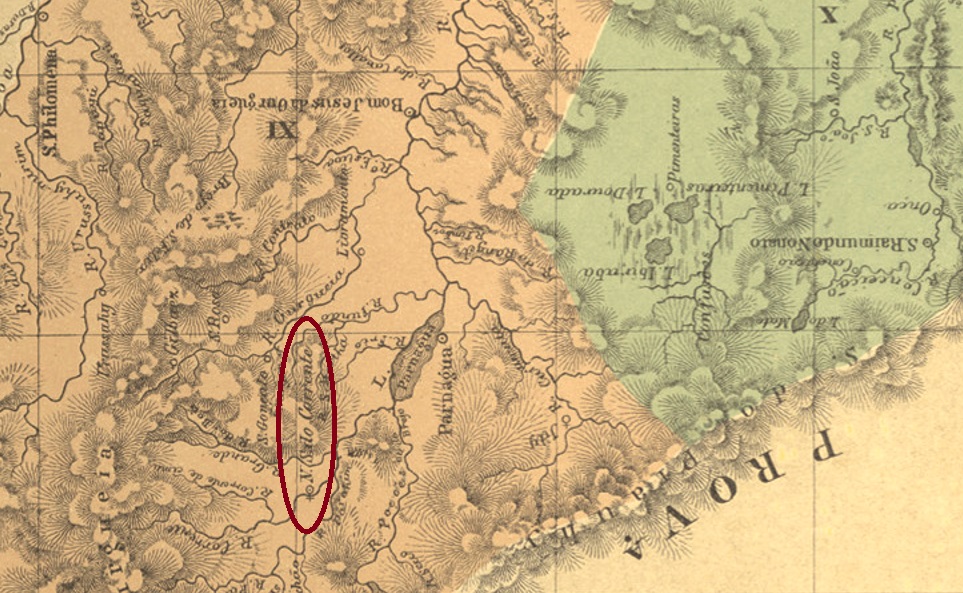
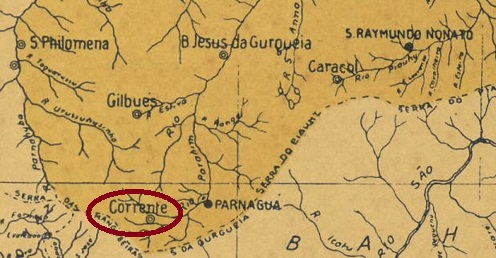
The parish of N. Sra da Conceição do Corrente was erected in August 1860 in the Município of Parnaguá and was situated on the north bank of the Corrente River, 840 km south of the provincial capital Teresina. In December 1872, it was elevated to the status of vila.

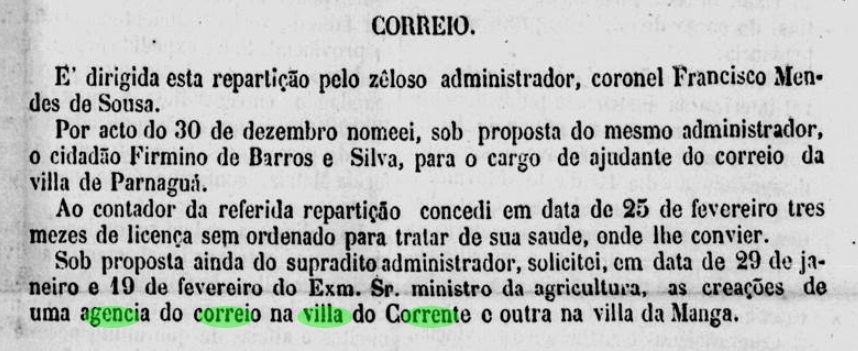
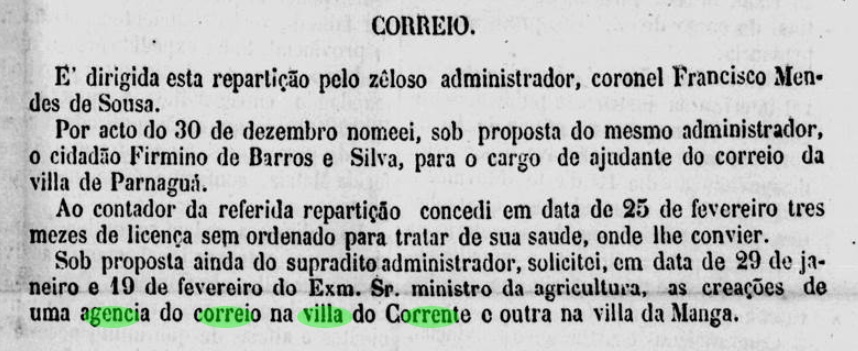
In the Directory of Imperial Post Offices (Tabella das Agencias do Correio do Imperio, Rio de Janeiro, 1885), one reads that there had been a post office there since 1883. However, this is probably either a transcription error or a reopening, because a postal agency was already asked for there in April 1879…

A Imprensa/PI/ 28.04.1879

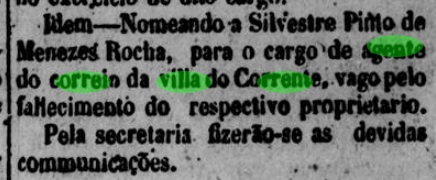
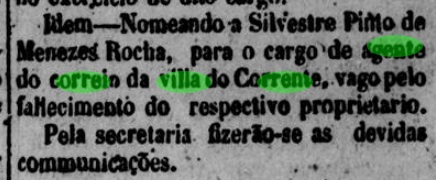
… and in February 1880 a postal clerk was named there after the death of the predecessor:

A Imprensa/PI/ 25.02.1880

The oldest postmark here is VPI-0066a (image from the internet): the only specimen so far shows a double circle with the inscriptions VILLA DO CORRENTE above and (PIAUHY) below. The date inside is from 1894.

Arthur D. Ribeiro: Estado do Piauhy, 1924

Siehe auch Corrente (R. Koester: Carimbologia XIV)

Die Pfarrei von N. Sra da Conceição do Corrente wurde im August 1860 im Município von Parnaguá errichtet und lag am Nordufer des Flusses Corrente, 840 km südlich der Provinzhauptstadt Teresina entfernt. Im Dezember 1872 erfolgte der Aufstieg zur Vila.

Im Verzeichnis der kaiserlichen Postämter (Tabella das Agencias do Correio do Imperio, Rio de Janeiro, 1885) liest man, dass es dort seit 1883 ein Postamt gab. Das dürfte aber entweder ein Abschreibfehler oder eine Wiedereröffnung sein, denn bereits im April 1879 wurde dort eine Postagentur beantragt…

A Imprensa/PI/ 28.04.1879

… und im Februar 1880 wurde ein Postangestellter dort nach dem Tod des Vorgängers genannt:

A Imprensa/PI/ 25.02.1880

Der älteste Poststempel hier ist VPI-0066a (Abb. aus dem Internet): das bisher einzige Exemplar zeigt einen Doppelkreis mit den Inschriften VILLA DO CORRENTE oben und (PIAUHY) unten. Das Datum im Inneren ist aus dem Jahr 1894.

Categories
Carimbologia T-Z

Villa do Carmo, Rio de Janeiro (VRJ-0995)

Atlas do Imperio do Brasil, 1868

Other names: Arraial de N.Sa. do Monte do Carmo, Carmo de Cantagallo

See also Carmo (R. Koester: Carimbologia IX)

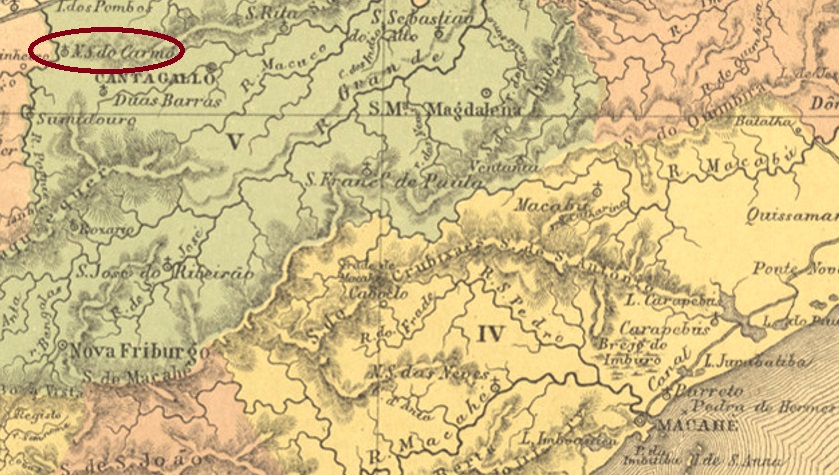
The Arraial of N. Sra. do Monte do Carmo (Our Lady of Carmel Mountain) was in the Município of Cantagalo almost 200 km northwest of the capital Rio de Janeiro and became a district in October 1845, a vila in October 1881 and the town of Carmo in December 1889.

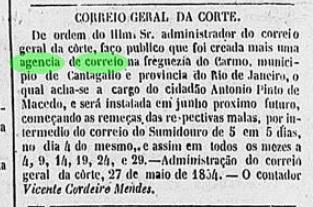
As for the origin of the local post office, there is some ambiguity here, as many dates are available. The Directory of Imperial Post Offices (Tabella das Agencias do Correio do Imperio, Rio de Janeiro, 1885) writes 1853 for it, and this is likely to be correct, as the Rio press reports a December 1853 appointment of the local postal clerk:

Diario do Rio de Janeiro, 09.01.1854_exped 23.12.1853

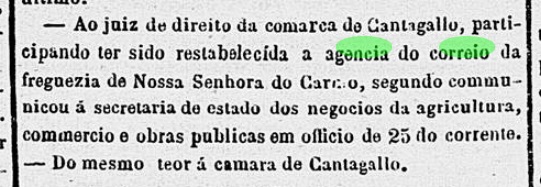
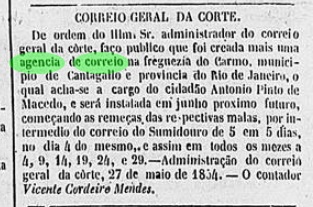
However, a few months later, another opening of the same post office with the same clerk was reported:

Diario do Rio de Janeiro, 30.05.1854

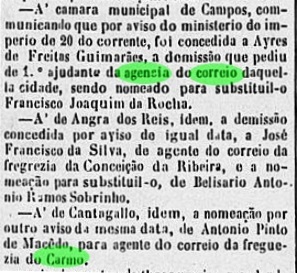
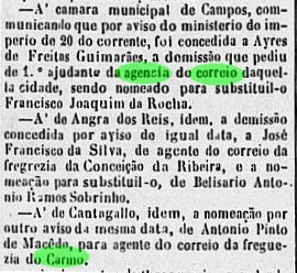
This second date coincides almost exactly with Paulo Novaes’s date of origin for June 1854, as can be read in agenciaspostais.com.br. But sometime around 1860, the post office was closed, as news of its reopening came in August 1861:

Correio Mercantil, 18.08.1861

After the ascent to the villa in October 1881, the postmark VRJ-0995a appeared (image from the Internet): a double circle with the inscription VILLA DO CARMO at the top and an ornament at the bottom, reminiscent of a wide X cut by two vertical strokes. Dates in the centre go from 1889 to 1890. For earlier postmarks see R. Koester’s Carimbologia IX.

Villiers de l’Ile Adam: Carta (…) da Provincia do Rio de Janeiro, 1850

Andere Namen: Arraial de N.Sa. do Monte do Carmo, Carmo de Cantagallo

Siehe auch Carmo (R. Koester: Carimbologia IX)

Der Arraial von N. Sra. do Monte do Carmo (Unsere Liebe Frau aus dem Carmelberg) lag im Município von Cantagalo knapp 200 km nordwestlich der Hauptstadt Rio de Janeiro und wurde im Oktober 1845 ein Distrikt, im Oktober 1881 eine Vila und im Dezember 1889 die Stadt Carmo.

Was die Entstehung des örtlichen Postamts betrifft, gibt es hier einige Unklarheiten, da viele Daten vorhanden sind. Das Verzeichnis der kaiserlichen Postämter (Tabella das Agencias do Correio do Imperio, Rio de Janeiro, 1885) schreibt dafür 1853, und das wird wohl stimmen, da die Presse aus Rio über eine Ernennung des Postangestellten vor Ort zum Dezember 1853 berichtet:

Diario do Rio de Janeiro, 09.01.1854_exped 23.12.1853

Allerdings wurde ein Paar Monate später wieder eine Eröffnung desselben Postamts mit demselben Angestellter:

Diario do Rio de Janeiro, 30.05.1854

Dieser zweite Termin deckt sich fast genau mit Paulo Novaes Entstehungsangabe für den Juni 1854, wie in agenciaspostais.com.br zu lesen ist. Aber irgendwann um 1860 wurde das Postamt geschlossen, denn im August 1861 kam die Meldung über seine Wiedereröffnung:

Correio Mercantil, 18.08.1861

Nach dem Aufstieg zur Villa im Oktober 1881 erschien der Poststempel VRJ-0995a (Abb. aus dem Internet): ein Doppelkreis mit der Inschrift VILLA DO CARMO oben und einem Ornament unten, das an einem breiten X erinnert, das durch zwei vertikale Striche geschnitten wird. Daten in der Mitte von 1889 bis 1890. Für frühere Poststempel siehe R. Koesters Carimbologia IX.

Categories
Carimbologia T-Z

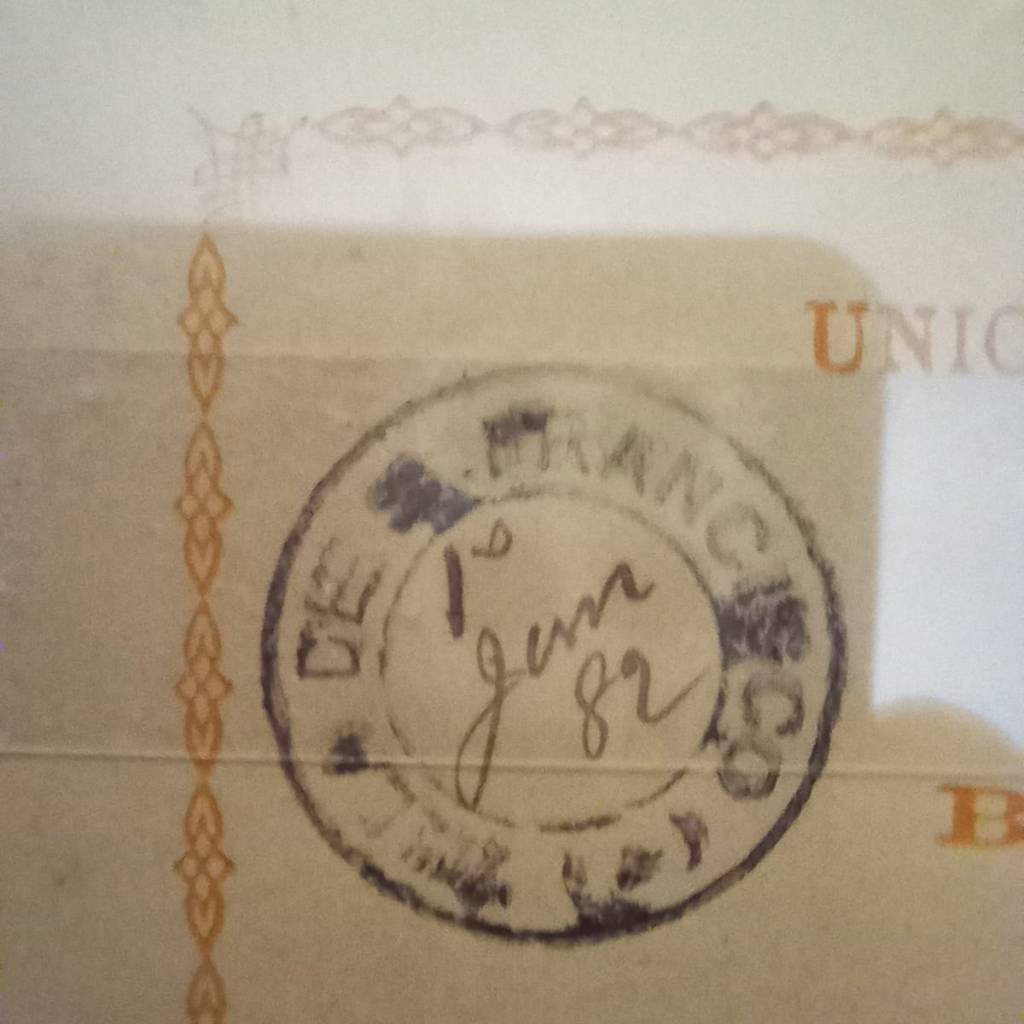
Villa de São Francisco, Bahia (VBA-0780)

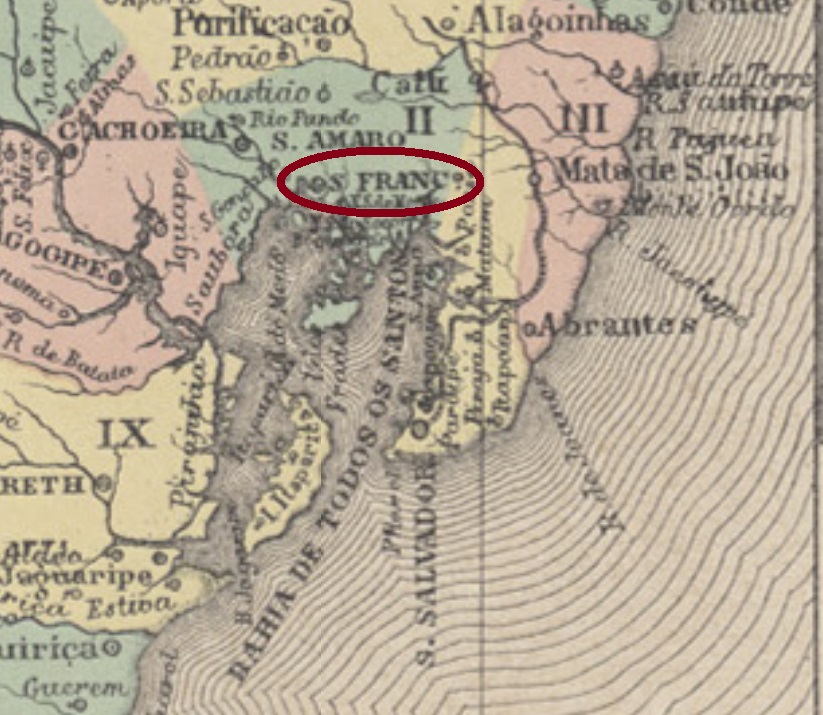
Atlas do Imperio do Brasil, 1868

Other names: Villa de Sao Francisco da Barra do Sergipe do Conde, S. Francisco do Conde (1943)

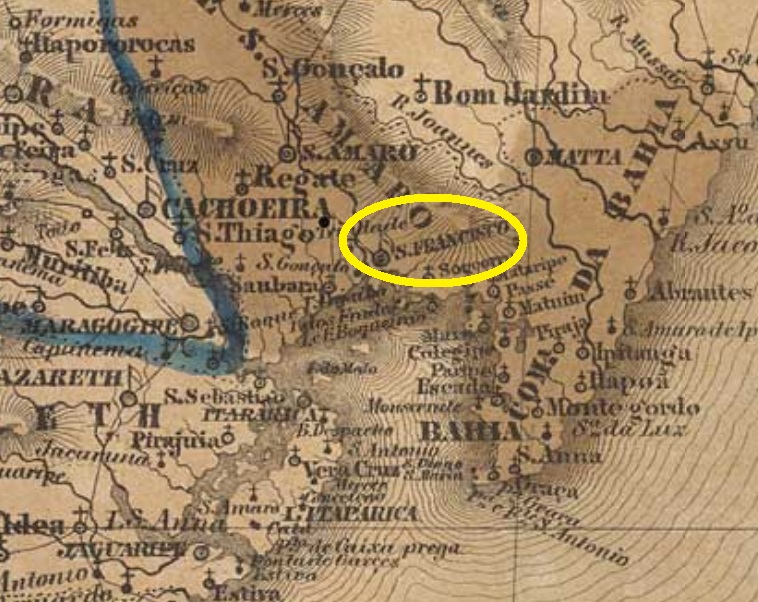
In November 1697 a villa was founded in Bahia, bearing the sonorous name of S. Francisco da Barra do Sergipe do Conde. It was in the north of All Saints’ Bay, less than 70 km northwest of the provincial capital Salvador. In June 1931, the place name was simplified to S. Francisco, to which an additional do Conde came in December 1943.

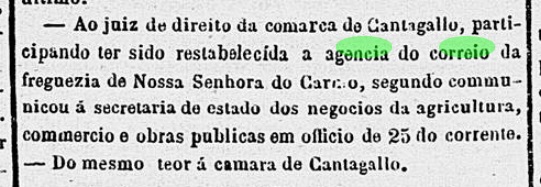
As can be read in the 1885 Imperial Mail Register (Tabella das Agencias do Correio do Imperio), there is a post office on place since 1872. This is confirmed by the provincial president’s report of March 1873:

Relatorio do Presidente da Provincia

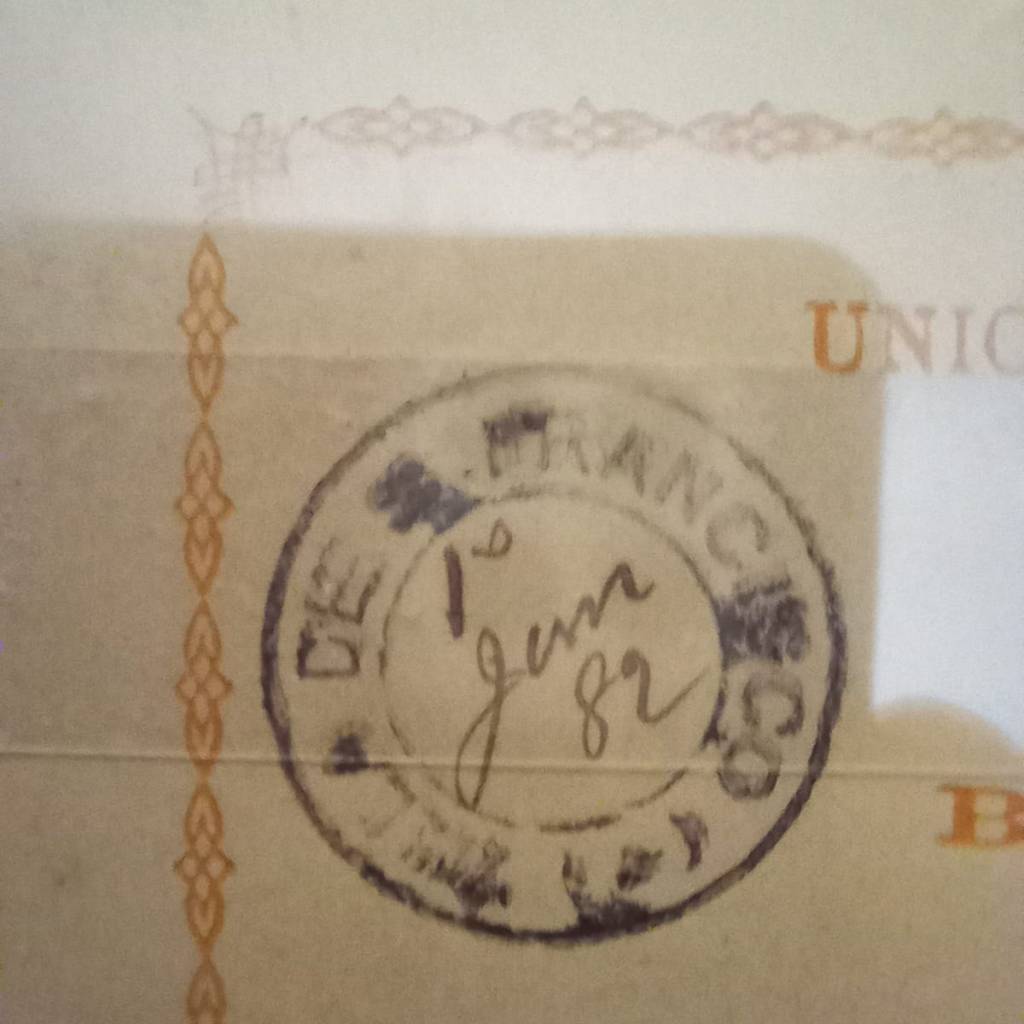
The only imperial postmark so far is the French-type SBA-0815a (Coll. Fuad Ferreira Fo.), which so far was found with postmarks between 1880 and 1901:

SBA-0815a (FF), 1880-1901
Villiers de l’Ile Adam: Carta (…) da Provinica da Bahia, 1848

Andere Namen: Villa de São Francisco da Barra do Sergipe do Conde, S. Francisco do Conde (1943)

In der Provinz Bahia wurde bereits im November 1697 eine Villa gegründet, die den sonoren Namen São Francisco da Barra do Sergipe do Conde trug. Sie lag im Norden der Allerheiligenbucht, knapp 70 km nordwestlich der Provinzhauptstadt Salvador entfernt. Im Juni 1931 wurde der Ortsnamen zu São Francisco vereinfacht, der aber seit Dezember 1943 wieder den Zusatz do Conde trägt.

Wie im Verzeichnis der kaiserlichen Postämter (Tabella das Agencias do Correio do Imperio) von 1885 zu lesen ist, gibt es dort eine Postagentur seit 1872. Dieses wird durch den Bericht des Provinzpräsidenten im März 1873 bestätigt:

Relatorio do Presidente da Provincia

Der bisher einzige kaiserliche Poststempel ist der französische Typ SBA-0815a (Samml. Fuad Ferreira Fo.), der bisher mit Daten zwischen 1880 und 1901 gefunden wurde:

SBA-0815a (FF), 1880-1901

Categories
Carimbologia T-Z

Villa de Patos, Paraíba (VPB-0285)

Atlas do Imperio do Brasil, 1868

See also Patos/PB (R. Koester: Carimbologia XXX)

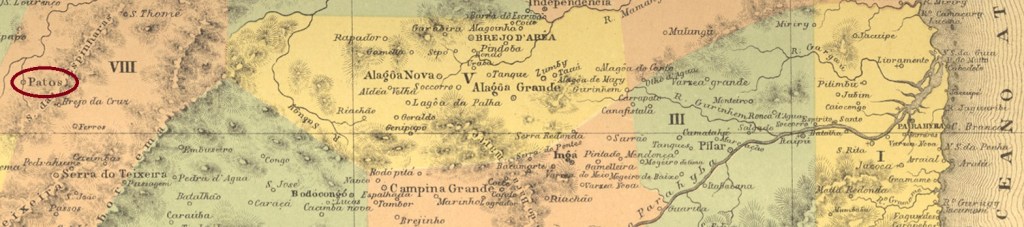
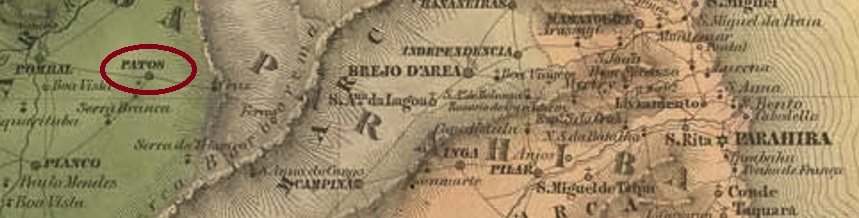
The freguesia of N. Sra. da Guia de Patos was founded in 1788 in the villa of Pombal and was situated on the west bank of the river Espinharas, 310 km west of the future provincial capital Parahyba do Norte (today: João Pessoa). The place was elevated to vila in December 1832 and to town in October 1903.

As Nova Monteiro writes in Administrações e Agencias Postaes do Brasil Imperio (in Brasil Filatelico/RJ, 1934-5; reprint SPP 1994-1999), the local post office was established as early as June 1833. Unfortunately, the only 19th century postmark so far is not the oldest. VPB-0285b (Coll. Dieter Kerkhoff) is a double circle with the inscription VILLA DE PATOS on top and an ornament in an oval below, open in four points. The dates in the centre are from the period 1891-1894 and were partly entered by hand.

Villiers de l’Ile Adam: Carta (…) das Provincias do Rio Grande do Norte e Parahiba, 1848

Siehe auch Patos/PB (R. Koester: Carimbologia XXX)

Die Freguesia von N. Sra. da Guia de Patos wurde 1788 in der Villa von Pombal gegründet und lag am Westufer des Flusses Espinharas, 310 km westlich der künftigen Provinzhauptstadt Parahyba do Norte (heute: João Pessoa) entfernt. Der Ort wurde im Dezember 1832 zur Vila und im Oktober 1903 zur Stadt erhoben.

Wie Nova Monteiro in Administrações e Agencias Postaes do Brasil Imperio (in Brasil Filatelico/RJ, 1934-5; Reprint SPP 1994-1999) schreibt, entstand das örtliche Postamt bereits im Juni 1833. Das bisher einzige Poststempel aus dem 19. Jahrhundert ist leider nicht der älteste. VPB-0285b (Samml. Dieter Kerkhoff) ist ein Doppelkreis mit der Inschrift VILLA DE PATOS oben und einem Ornament im Oval unten, das an vier Stellen offen ist. Die Daten in der Mitte entstammen dem Zeitraum 1891-1894 und wurden teilweise per Hand eingetragen.

Categories
Carimbologia T-Z

Villa de Pitangui, Minas Gerais (VMG-3785)

Atlas do Imperio do Brasil, 1868

See also Pitangui (R. Koester: Carimbologia XXXI)

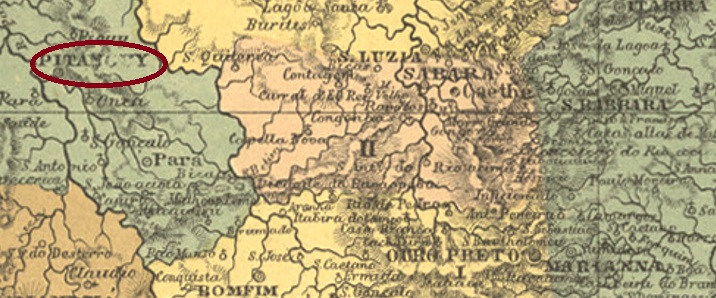
This settlement arose in the 17th century after gold miners found the precious metal at Descoberto Mountain, over 200 km northwest of the later provincial capital Ouro Preto. The village grew so rapidly that villa status was achieved in February 1715 as Villa Nova do Infante das Minas do Pitangui, nine years earlier than the designation as Freguesia of N. Sra. do Pilar de Pitangui. Pitangui has been a town since May 1855.

Two years of origin for the local post office could be found. First in March 1798, as Paula Sobrinho writes in História Postal de Minas Gerais (Belo Horizonte, 1997). Then again in March 1829, as R. Koester reports in Carimbologia XXXI. VMG-3785a is so far the oldest cancel; it also occurs in sepia, brown and green between 1836 and 1848 and was already presented by Paulo Ayres in Catálogo de Carimbos Brasil-Império (S. Paulo, 1937, 1942) under no. 1164 and also in the RHM catalogue under P-MG-46. Since the spelling erroneously shows a Y (instead of I), here are both images:

VMG-3785a (P.A. 1164 recte – RHM P-MG-46)

Later postmarks bear the place name Pitangui or Pitanguy, without mentioning Villa.

Villiers de l’Ile Adam: Carta (…) da Provincia de Minas Geraes, 1849

Siehe auch Pitangui (R. Koester: Carimbologia XXXI)

Diese Siedlung entstand im 17. Jahrhundert, nachdem Goldgräber das Edelmetall am Descoberto-Berg gefunden haben, über 200 km nordwestlich der späteren Provinzhauptstadt Ouro Preto entfernt. Die Ortschaft wuchs so rasch, dass der Villa-Status im Februar 1715 als Villa Nova do Infante das Minas das Minas do Pitangui erreicht wurde, neun Jahre früher als die Ernennung zur Freguesia von N. Sra. do Pilar de Pitangui. Seit Mai 1855 ist Pitangui eine Stadt.

Zwei Entstehungsjahre fürs örtliche Postamt waren zu finden. Erstmals im März 1798, wie Paula Sobrinho in História Postal de Minas Gerais (Belo Horizonte, 1997) schreibt. Dann im März 1829, wie R. Koester in Carimbologia XXXI berichtet. VMG-3785a ist bisher der älteste Stempel; er kommt auch in sepia, braun und grün zwischen 1836 und 1848 vor und wurde bereits von Paulo Ayres in Catálogo de Carimbos Brasil-Império (S. Paulo, 1937, 1942) unter Nr. 1164 und auch im RHM-Katalog unter P-MG-46 vorgestellt. Da die Schreibweise irrtümlich ein Y (statt I) zeigt, hier beide Abbildungen:

VMG-3785a (P.A. 1164 recte RHM P-MG-46)

Spätere Poststempel tragen die Ortsbezeichnung Pitangui oder Pitanguy, ohne Villa zu erwähnen.

Categories
Carimbologia T-Z

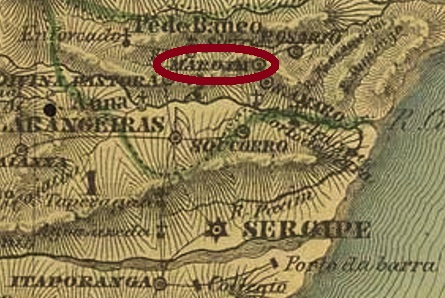
Villa de Maroim, Sergipe (VSE-0210)

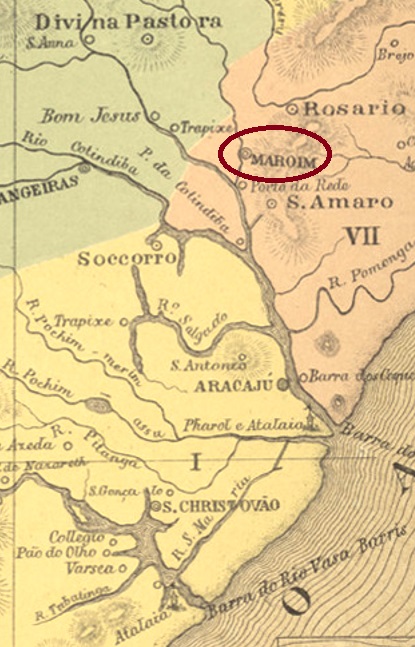
Villiers de l’Ile Adam: Carta (…) das Provincias de Pernambuco, Alagoas e Sergipe, 1848

Another name: Maruim

See also Maroim (R. Koester: Carimbologia XXVII)

Maruim is the indigenous name for many species of mosquitoes in Brazil. There were plenty of them on the north bank of the Sergipe River, so that the settlement received this name from about 1800. It was in the area of the Vila of Santo Amaro das Brotas, about 30 km north of the later provincial capital of Aracaju. The first years of settlement were marked by many disputes, some violent, among the political chiefs of the region, which did not come to an end even after Maroim was elevated to villa status in February 1835. It was not until May 1854, when Maroim was elevated to town, that peace returned.

Two years of origin for the local post office were found. First in December 1844, as Nova Monteiro writes in Administrações e Agencias Postaes do Brasil Imperio (Brasil Filatelico/RJ, 1934-5; Reprint SPP, 1994-1999). Then also in 1848, as can be seen from the Directory of Imperial Post Offices (Tabella das Agencias do Correio do Imperio, Rio de Janeiro, 1885). The earliest postmark is VSE-0210a, which was used from the 1844 numeral issue onwards, as can be read in Koester’s Carimbologia XXVII:

VSE-0210a (RK)

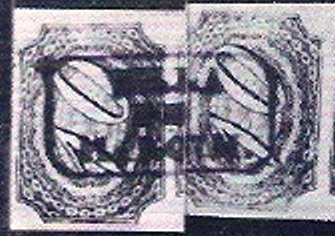
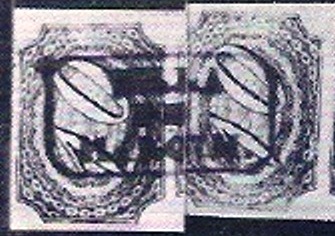
Another postmark is often assigned to this locality – also by the renowned RHM catalogue. However, this is a misinterpreted postmark from Mariana in Minas Gerais:

“Maroim” (RHM) – Mariana/MG (R. Koester: Carimbologia XXVII).

For later postmarks from Maroim (without Villa) see Carimbologia XXVII.

Atlas do Imperio do Brasil, 1868

Anderer Name: Maruim

Siehe auch Maroim (R. Koester: Carimbologia XXVII)

Maruim ist die indianische Bezeichnung für viele Stechmückenarten in Brasilien. Davon gab es reichlich am Nordufer des Sergipe-Flusses, so dass die Siedlung diesen Namen ab ca. 1800 erhielt. Sie lag im Gebiet der Vila von Santo Amaro das Brotas, ca. 30 km nördlich der späteren Provinzhauptstadt Aracaju entfernt. Die ersten Siedlungsjahre wurden von vielen, auch gewaltsamen Streitereien unter den politischen Häuptlingen der Region, die auch nach der Erhebung Maroims zur Villa im Februar 1835 kein Ende fanden. Erst um Mai 1854, bei der Vergabe des Stadtrechts an Maroim, kehrte der Frieden zurück.

Zwei Entstehungsjahre fürs örtliche Postamt wurden gefunden. Erstmals im Dezember 1844, wie Nova Monteiro in Administrações e Agencias Postaes do Brasil Imperio (Brasil Filatelico/RJ, 1934-5; Reprint SPP, 1994-1999) schreibt. Dann auch 1848, wie aus dem Verzeichnis der kaiserlichen Postämter (Tabella das Agencias do Correio do Imperio, Rio de Janeiro, 1885) zu entnehmen ist. Der früheste Poststempel ist VSE-0210a, der ab der Ziffernausgabe 1844 verwendet wurde, wie im Koesters Carimbologia XXVII zu lesen ist:

VSE-0210a (RK)

Ein weiterer Poststempel wird oftmals – auch im renommierten RHM-Katalog – dieser Ortschaft zugeordnet. Allerdings handelt es sich hier um einen falsch interpretierten Poststempel aus Mariana in Minas Gerais:

„Maroim“ (RHM) – Mariana/MG (R. Koester: Carimbologia XXVII

Für spätere Poststempel aus Maroim (ohne Villa) siehe Carimbologia XXVII.