Categories
Carimbologia T-Z

Villa de Patos, Paraíba (VPB-0285)

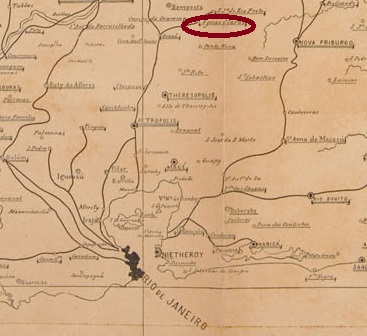
Atlas do Imperio do Brasil, 1868

See also Patos/PB (R. Koester: Carimbologia XXX)

The freguesia of N. Sra. da Guia de Patos was founded in 1788 in the villa of Pombal and was situated on the west bank of the river Espinharas, 310 km west of the future provincial capital Parahyba do Norte (today: João Pessoa). The place was elevated to vila in December 1832 and to town in October 1903.

As Nova Monteiro writes in Administrações e Agencias Postaes do Brasil Imperio (in Brasil Filatelico/RJ, 1934-5; reprint SPP 1994-1999), the local post office was established as early as June 1833. Unfortunately, the only 19th century postmark so far is not the oldest. VPB-0285b (Coll. Dieter Kerkhoff) is a double circle with the inscription VILLA DE PATOS on top and an ornament in an oval below, open in four points. The dates in the centre are from the period 1891-1894 and were partly entered by hand.

Villiers de l’Ile Adam: Carta (…) das Provincias do Rio Grande do Norte e Parahiba, 1848

Siehe auch Patos/PB (R. Koester: Carimbologia XXX)

Die Freguesia von N. Sra. da Guia de Patos wurde 1788 in der Villa von Pombal gegründet und lag am Westufer des Flusses Espinharas, 310 km westlich der künftigen Provinzhauptstadt Parahyba do Norte (heute: João Pessoa) entfernt. Der Ort wurde im Dezember 1832 zur Vila und im Oktober 1903 zur Stadt erhoben.

Wie Nova Monteiro in Administrações e Agencias Postaes do Brasil Imperio (in Brasil Filatelico/RJ, 1934-5; Reprint SPP 1994-1999) schreibt, entstand das örtliche Postamt bereits im Juni 1833. Das bisher einzige Poststempel aus dem 19. Jahrhundert ist leider nicht der älteste. VPB-0285b (Samml. Dieter Kerkhoff) ist ein Doppelkreis mit der Inschrift VILLA DE PATOS oben und einem Ornament im Oval unten, das an vier Stellen offen ist. Die Daten in der Mitte entstammen dem Zeitraum 1891-1894 und wurden teilweise per Hand eingetragen.

Categories
Carimbologia T-Z

Villa de Pitangui, Minas Gerais (VMG-3785)

Atlas do Imperio do Brasil, 1868

See also Pitangui (R. Koester: Carimbologia XXXI)

This settlement arose in the 17th century after gold miners found the precious metal at Descoberto Mountain, over 200 km northwest of the later provincial capital Ouro Preto. The village grew so rapidly that villa status was achieved in February 1715 as Villa Nova do Infante das Minas do Pitangui, nine years earlier than the designation as Freguesia of N. Sra. do Pilar de Pitangui. Pitangui has been a town since May 1855.

Two years of origin for the local post office could be found. First in March 1798, as Paula Sobrinho writes in História Postal de Minas Gerais (Belo Horizonte, 1997). Then again in March 1829, as R. Koester reports in Carimbologia XXXI. VMG-3785a is so far the oldest cancel; it also occurs in sepia, brown and green between 1836 and 1848 and was already presented by Paulo Ayres in Catálogo de Carimbos Brasil-Império (S. Paulo, 1937, 1942) under no. 1164 and also in the RHM catalogue under P-MG-46. Since the spelling erroneously shows a Y (instead of I), here are both images:

VMG-3785a (P.A. 1164 recte – RHM P-MG-46)

Later postmarks bear the place name Pitangui or Pitanguy, without mentioning Villa.

Villiers de l’Ile Adam: Carta (…) da Provincia de Minas Geraes, 1849

Siehe auch Pitangui (R. Koester: Carimbologia XXXI)

Diese Siedlung entstand im 17. Jahrhundert, nachdem Goldgräber das Edelmetall am Descoberto-Berg gefunden haben, über 200 km nordwestlich der späteren Provinzhauptstadt Ouro Preto entfernt. Die Ortschaft wuchs so rasch, dass der Villa-Status im Februar 1715 als Villa Nova do Infante das Minas das Minas do Pitangui erreicht wurde, neun Jahre früher als die Ernennung zur Freguesia von N. Sra. do Pilar de Pitangui. Seit Mai 1855 ist Pitangui eine Stadt.

Zwei Entstehungsjahre fürs örtliche Postamt waren zu finden. Erstmals im März 1798, wie Paula Sobrinho in História Postal de Minas Gerais (Belo Horizonte, 1997) schreibt. Dann im März 1829, wie R. Koester in Carimbologia XXXI berichtet. VMG-3785a ist bisher der älteste Stempel; er kommt auch in sepia, braun und grün zwischen 1836 und 1848 vor und wurde bereits von Paulo Ayres in Catálogo de Carimbos Brasil-Império (S. Paulo, 1937, 1942) unter Nr. 1164 und auch im RHM-Katalog unter P-MG-46 vorgestellt. Da die Schreibweise irrtümlich ein Y (statt I) zeigt, hier beide Abbildungen:

VMG-3785a (P.A. 1164 recte RHM P-MG-46)

Spätere Poststempel tragen die Ortsbezeichnung Pitangui oder Pitanguy, ohne Villa zu erwähnen.

Categories
Carimbologia T-Z

Villa de Maroim, Sergipe (VSE-0210)

Villiers de l’Ile Adam: Carta (…) das Provincias de Pernambuco, Alagoas e Sergipe, 1848

Another name: Maruim

See also Maroim (R. Koester: Carimbologia XXVII)

Maruim is the indigenous name for many species of mosquitoes in Brazil. There were plenty of them on the north bank of the Sergipe River, so that the settlement received this name from about 1800. It was in the area of the Vila of Santo Amaro das Brotas, about 30 km north of the later provincial capital of Aracaju. The first years of settlement were marked by many disputes, some violent, among the political chiefs of the region, which did not come to an end even after Maroim was elevated to villa status in February 1835. It was not until May 1854, when Maroim was elevated to town, that peace returned.

Two years of origin for the local post office were found. First in December 1844, as Nova Monteiro writes in Administrações e Agencias Postaes do Brasil Imperio (Brasil Filatelico/RJ, 1934-5; Reprint SPP, 1994-1999). Then also in 1848, as can be seen from the Directory of Imperial Post Offices (Tabella das Agencias do Correio do Imperio, Rio de Janeiro, 1885). The earliest postmark is VSE-0210a, which was used from the 1844 numeral issue onwards, as can be read in Koester’s Carimbologia XXVII:

VSE-0210a (RK)

Another postmark is often assigned to this locality – also by the renowned RHM catalogue. However, this is a misinterpreted postmark from Mariana in Minas Gerais:

“Maroim” (RHM) – Mariana/MG (R. Koester: Carimbologia XXVII).

For later postmarks from Maroim (without Villa) see Carimbologia XXVII.

Atlas do Imperio do Brasil, 1868

Anderer Name: Maruim

Siehe auch Maroim (R. Koester: Carimbologia XXVII)

Maruim ist die indianische Bezeichnung für viele Stechmückenarten in Brasilien. Davon gab es reichlich am Nordufer des Sergipe-Flusses, so dass die Siedlung diesen Namen ab ca. 1800 erhielt. Sie lag im Gebiet der Vila von Santo Amaro das Brotas, ca. 30 km nördlich der späteren Provinzhauptstadt Aracaju entfernt. Die ersten Siedlungsjahre wurden von vielen, auch gewaltsamen Streitereien unter den politischen Häuptlingen der Region, die auch nach der Erhebung Maroims zur Villa im Februar 1835 kein Ende fanden. Erst um Mai 1854, bei der Vergabe des Stadtrechts an Maroim, kehrte der Frieden zurück.

Zwei Entstehungsjahre fürs örtliche Postamt wurden gefunden. Erstmals im Dezember 1844, wie Nova Monteiro in Administrações e Agencias Postaes do Brasil Imperio (Brasil Filatelico/RJ, 1934-5; Reprint SPP, 1994-1999) schreibt. Dann auch 1848, wie aus dem Verzeichnis der kaiserlichen Postämter (Tabella das Agencias do Correio do Imperio, Rio de Janeiro, 1885) zu entnehmen ist. Der früheste Poststempel ist VSE-0210a, der ab der Ziffernausgabe 1844 verwendet wurde, wie im Koesters Carimbologia XXVII zu lesen ist:
VSE-0210a (RK)

Ein weiterer Poststempel wird oftmals – auch im renommierten RHM-Katalog – dieser Ortschaft zugeordnet. Allerdings handelt es sich hier um einen falsch interpretierten Poststempel aus Mariana in Minas Gerais:

„Maroim“ (RHM) – Mariana/MG (R. Koester: Carimbologia XXVII

Für spätere Poststempel aus Maroim (ohne Villa) siehe Carimbologia XXVII.

Categories
Carimbologia T-Z

Villa de Magé, Rio de Janeiro (VRJ-2360)

Atlas do Imperio do Brasil, 1868

See also Magé (R. Koester: Carimbologia XXVII)

The freguesia of N. Sra. da Piedade de Magé was created by royal decree (Alvará Regio) as early as January 1696 and was located at the vila of Sant’Anna do Macacu on the east bank of the Magé River close to Guanabara Bay, over 60 km north of the capital Rio de Janeiro. It became a vila in June 1789 and a town in October 1857.

The local post office was established in December 1829, as both Nova Monteiro in Administrações e Agencias Postaes do Brasil Imperio (Brasil Filatelico/RJ, 1934-5; Reprint SPP 1994-1999) and the Directory of Imperial Post Offices (Tabella das Agencias do Correio do Imperio, Rio de Janeiro, 1885) concur. The oldest postmark VRJ-2360a was in use at least in 1843 and was already presented in the RHM catalogue:

VRJ-2360a (RHM)

Later postmarks no longer bear the Villa designation and can be seen in R.Koester (Carimbologia XXVII).

Note: This blog will return after vacations on June 13, 2022

Villiers de l’Ile Adam. Carta (…) da Provincia do Rio de Janeiro, 1850

Siehe auch Magé (R. Koester: Carimbologia XXVII)

Die Freguesia von N. Sra. da Piedade de Magé entastand durch königliche Verfügung (Alvará Regio) bereits im Januar 1696 und lag bei der Vila von Sant’Anna do Macacu am Ostufer des Magé-Flusses nah an der Guanabara-Bucht, gut 60 km nördlich der Hauptstadt Rio de Janeiro entfernt. Im Juni 1789 wurde daraus eine Vila und im Oktober 1857 eine Stadt.

Das örtliche Postamt wurde im Dezember 1829 ins Leben gerufen, wie sowohl Nova Monteiro in Administrações e Agencias Postaes do Brasil Imperio (Brasil Filatelico/RJ, 1934-5; Reprint SPP 1994-1999) als auch das Verzeichnis der kaiserlichen Postämter (Tabella das Agencias do Correio do Imperio, Rio de Janeiro, 1885) übereinstimmend registrieren. Der älteste Poststempel VRJ-2360a war zumindest 1843 in Gebrauch und wurde bereits im RHM-Katalog vorgestellt:

VRJ-2360a (RHM)

Spätere Poststempel tragen die Bezeichnung Villa nicht mehr und sind bei R.Koester (Carimbologia XXVII) zu sehen.

Bitte beachten: Dieser Blog wird nach der Urlaubspause am 13. Juni 2022 fortgeführt.

Categories
Carimbologia T-Z

Villa de Lorena, São Paulo (VSP-1780, LSP-0775)

Atlas do Imperio do Brasil, 1868

Text update on June 17, 2022

See also Lorena (R. Koester: Carimbologia XXVI)

The original settlement of Guaiapacaré became the freguesia of N. Sra. da Piedade de Lorena in 1718, it belonged to the Vila de Guaratinguetá and was situated on the south bank of the river Paraíba do Sul, 180 km northeast of the later provincial capital São Paulo. In September 1788, it was elevated to the status of vila, and in April 1856, it became a town. The name comes from Bernardo José Maria de Lorena e Silveira (1756-1818), the Count of Sarzedas, who was Capitão-Mor of São Paulo from 1788 to 1797.

Both Nova Monteiro (Administrações e Agencias Postaes do Brasil Imperio, in Brasil Filatelico/RJ, 1934-5; Reprint SPP 1994-1999) and the Directory of Imperial Post Offices (Tabella das Agencias do Correio do Imperio, Rio de Janeiro, 1885) agree that there was a post office there from June 1842. However, there are postmarked letters from Lorena that show earlier dates. Apparently, Lorena was one of the towns in the Paraíba do Sul valley that had a functioning postal system before 1842 which was not subordinate to the central government in Rio. The first two postmarks are from this period of operation. LSP-0775a and LSP-0775b are very similar; the first postmark is chestnut in colour and was in circulation between 1831 and 1841, while the second – which probably also occurs in green – was found on letters and documents between 1839 and at least 1843. Both stamps were presented in the RHM catalogue under P-SP-18a and P-SP-19 respectively.

LSP-0775a (RHM P-SP-18a)
LSP-0775b (RHM P-SP-19)

Then there came VSP-1780a, which appeared from 1841 to 1856 and was already shown by Paulo Ayres in Catálogo de Carimbos Brasil-Império (S. Paulo, 1937, 1942) under no. 1578:

VSP-1780a (P.A. 1578, RHM P-SP-20)

This handwritten cancellation also dates from the first period of operation (Coll. José L. Fevereiro):

1830 (JLF)

Later postmarks bear the inscription Lorena (without villa) and can be seen in R. Koester’s Carimbologia XXVI.

Villiers de l’Ile Adam: Carta (…) da Provincia de São Paulo, 1847

Textaktualisierung am 17. Juni 2022

Siehe auch Lorena (R. Koester: Carimbologia XXVI)

Die ursprüngliche Siedlung von Guaiapacaré wurde 1718 die Freguesia von N. Sra. da Piedade de Lorena, sie gehörte der Vila de Guaratinguetá und lag am Südufer des Flusses Paraíba do Sul,, 180 km nordöstlich der späteren Provinzhauptstadt São Paulo entfernt. Im September 1788 wurde der Ort zur Vila erhoben und im April 1856 zur Stadt. Der Name kommt von Bernardo José Maria de Lorena e Silveira (1756-1818), dem Graf von Sarzedas, der von 1788 bis 1797 Capitão-Mor von São Paulo war.

Sowohl Nova Monteiro (Administrações e Agencias Postaes do Brasil Imperio, in Brasil Filatelico/RJ, 1934-5; Reprint SPP 1994-1999) als auch das Verzeichnis der kaiserlichen Postämter (Tabella das Agencias do Correio do Imperio, Rio de Janeiro, 1885) sind sich darüber einig, dass es dort ab Juni 1842 ein Postamt gab. Allerdings kennt man gestempelte Briefe aus Lorena, die frühere Daten aufweisen. Offenbar gehörte Lorena zu den Ortschaften im Paraíba do Sul-Tal, die vor 1842 ein funktionierendes Postwesen unterhielten, das nicht der Zentralregierung in Rio unterstellt war. Die ersten beiden Poststempel entstammen dieser Betriebsperiode. LSP-0775a und LSP-0775b  sind sich sehr ähnlich; der erste Poststempel ist kastanienfarbig und war zwischen 1831 und 1841 im Umlauf, während der zweite – der wohl auch in grün vorkommt – auf Briefen und Dokumenten zwischen 1839 und zumindest 1843 gefunden wurde. Beide Stempel wurden im RHM-Katalog unter P-SP-18a bzw. P-SP-19 vorgestellt.

LSP-0775a (RHM P-SP-18a)
LSP-0775b (RHM P-SP-19)

Danach kam VSP-1780a, der von 1841 bis 1856 erschien und bereits durch Paulo Ayres in Catálogo de Carimbos Brasil-Império (S. Paulo, 1937, 1942) unter Nr. 1578 gezeigt wurde:

VSP-1780a (P.A. 1578, RHM P-SP-20)

Aus der ersten Betriebsperiode stammt auch diese handschriftliche Entwertung (Samml. José L. Fevereiro):

1830 (JLF)

Spätere Poststempel tragen die Inschrift Lorena (ohne Villa) und sind in R. Koesters Carimbologia XXVI zu sehen.

Categories
Carimbologia T-Z

Villa de Lavras, Minas Gerais (VMG-3805, LMG-1490)

Atlas do Imperio do Brasil, 1868

Text updated on June 17, 2022

Another name: Lavras do Funil

See also Lavras (R. Koester: Carimbologia XXVI)

The parish of Sant’Anna de Lavras do Funil was established in July 1813 in the Município of Turvo, close to the south bank of the Rio Grande, about 250 km southwest of the former provincial capital of Ouro Preto. Funil means funnel, and this is still the name of a dam on the Rio Grande about 30 km away. The village rose to the status of Vila in October 1831 and has been a town since July 1868, when it was simply called Lavras.

Three years of origin have been found for the local post office. First in March 1829, as Nova Monteiro writes in Administrações e Agencias Postaes do Brasil Imperio (Brasil Filatelico/RJ, 1934-5; Reprint SPP 1994-1999). Then in October 1833, as can be read in both the Directory of Imperial Post Offices (Tabella das Agencias do Correio do Imperio, Rio de Janeiro, 1885) and the Postal Report (Relatorio Postal) for 1887. And finally in October 1853, as reported by Paula Sobrinho in História Postal de Minas Gerais (Belo Horizonte, 1997). However, this could be a transcription error.

The oldest postmark is LMG-1490a, supposedly used as early as 1835 and presented by the RHM catalogue under P-MG-33: 

LMG-1490a (RHM P-MG-33)

It was followed by VMG-3805a, which was in use between 1839 and at least 1866, also occurs in brown and green and is listed by Paulo Ayres in Catálogo de Carimbos Brasil-Império (S. Paulo, 1937, 1942) under no. 1529:

VMG-3805a (P.A. 1529, RHM P-MG-34)

For later postmarks (without Villa) see Koester: Carimbologia XXVI.

Villiers de l’Ile Adam: Carta (…) da Provincia de Minas Geraes, 1849

Textaktualisierung vom 17. Juni 2022

Anderer Name: Lavras do Funil

Siehe auch Lavras (R. Koester: Carimbologia XXVI)

Die Pfarrei von Sant’Anna de Lavras do Funil wurde im Juli 1813 im Município von Turvo errichtet und lag nah am Südufer des Rio Grande, ca. 250 km südwestlich der ehemaligen Provinzhauptstadt Ouro Preto entfernt. Funil bedeutet Trichter, und so heißt bis heute ein ca. 30 km entfernter Staudamm des Rio Grande. Der Ort stieg im Oktober 1831 zur Vila auf und ist seit Juli 1868 eine Stadt, die lediglich Lavras heißt.

Fürs örtliche Postamt wurden drei Entstehungsjahre gefunden. Zunächst im März 1829, wie Nova Monteiro in Administrações e Agencias Postaes do Brasil Imperio, in (Brasil Filatelico/RJ, 1934-5; Reprint SPP 1994-1999) schreibt. Dann im Oktober 1833, wie sowohl im Verzeichnis der kaiserlichen Postämter (Tabella das Agencias do Correio do Imperio, Rio de Janeiro, 1885) als auch im Postbericht (Relatorio Postal) für 1887 zu lesen ist. Und schließlich im Oktober 1853, wie Paula Sobrinho in História Postal de Minas Gerais (Belo Horizonte, 1997) berichtet. Allerdings könnte es sich hier um einen Abschreibfehler handeln.
Der älteste Poststempel ist LMG-1490a, der angeblich bereits 1835 verwendet und durch den RHM-Katalog unter P-MG-33 vorgestellt wurde: 

LMG-1490a (RHM P-MG-33)

Ihm folgte VMG-3805a, der zwischen 1839 und zumindest 1866 in Gebrauch war, auch in braun und grün vorkommt und durch Paulo Ayres in Catálogo de Carimbos Brasil-Império (S. Paulo, 1937, 1942) unter Nr. 1529 aufgelistet ist:

VMG-3805a (P.A. 1529, RHM P-MG-34)

Für spätere Poststempel (ohne Villa) siehe Koester: Carimbologia XXVI.

Categories
Carimbologia T-Z

Villa de Guaratinguitá, São Paulo (VSP-1775)

Villiers de l’Ile Adam: Carta (…) da Provincia de São Paulo, 1847

See also Guaratinguetá (R. Koester: Carimbologia XXI)

The freguesia of Santo Antonio de Guaratinguitá was mentioned in documents as early as 1630, belonged to the Vila of Taubaté and was situated on the south bank of the river Paraíba do Sul, 180 km northeast of the later provincial capital São Paulo. As early as 1657, the place was elevated to the status of a vila, but it was not until January 1844 that Guaratinguetá (as it is written today) was granted the status of a city. The name from the Tupi-guarani language means many white herons.

In the Directory of Imperial Post Offices (Tabella das Agencias do Correio do Imperio, Rio de Janeiro, 1885) we read that there had been a post office there since 1847. This cannot be the beginning of the first period of operation, because there are many cancelled letters from earlier years. As was the case in larger municipalities along the Paraíba-do-Sul valley, there was probably a postal system here before the establishment of the imperial post office, which was probably organised by the provincial government. Whatever, regular postal connections between Rio de Janeiro and Guaratinguetá already existed in January 1842:

Diario do Rio de Janeiro, 27.01.1842

The first postmarks were already presented by Paulo Ayres in Catálogo de Carimbos Brasil-Império (S. Paulo, 1937, 1942). However, they have the same spelling mistake, which is why they are shown here with the corrected version. VSP-1775a also occurs in red-brown, was in use from 1837 to at least 1844 and corresponds to Paulo Ayres’ No. 1527:

VSP-1775a (P.A.1527, RHM P-SP-12) – recte

The following VSP-1775b also exists in red, it was in use from about 1843 to at least 1852 and corresponds to P. Ayres’ No. 1528:

VSP-1775b (P.A. 1528-recte RHM)

For later postmarks with the inscription GUARATINGUETÁ see R. Koester, Carimbologia XXI.

Spix & Martius, 1823/1831

Siehe auch Guaratinguetá (R. Koester: Carimbologia XXI)

Die Freguesia von Santo Antonio de Guaratinguitá wurde bereits 1630 urkundlich erwähnt, gehörte der Vila von Taubaté und lag am Südufer des Flusses Paraíba do Sul, 180 km nordöstlich der späteren Provinzhauptstadt São Paulo entfernt. Bereits 1657 wurde der Ort zur Vila erhoben, aber erst im Januar 1844 erhielt Guaratinguetá (wie es heute geschrieben wird) den Status einer Stadt. Der Name aus der Tupi-guarani-Sprache bedeutet viele weiße Reiher.

Im Verzeichnis der kaiserlichen Postämter (Tabella das Agencias do Correio do Imperio, Rio de Janeiro, 1885) liest man, dass es dort seit 1847 ein Postamt gab. Das kann nicht der Anfang der ersten Betriebsperiode sein, denn es gibt viele gestempelten Postsendungen aus früheren Jahren. Wie es in größeren Gemeinden entlang des Paraíba-do-Sul-Tals der Fall war, gab es wohl auch hier ein Postwesen vor der Einrichtung des kaiserlichen Postamts, das vermutlich von der Provinzregierung organisiert wurde. Wie es dem auch sei, reguläre Postverbindungen zwischen Rio de Janeiro und Guaratinguetá gab es bereits im Januar 1842:

Diario do Rio de Janeiro, 27.01.1842

Die ersten Poststempel wurden bereits durch Paulo Ayres in Catálogo de Carimbos Brasil-Império (S. Paulo, 1937, 1942) vorgestellt. Allerdings haben sie den gleichen Schreibfehler, weswegen sie hier mit der jeweils korrigierten Version gezeigt werden. VSP-1775a kommt auch in Rotbraun vor, war von 1837 bis mindestens 1844 in Gebrauch und entspricht Paulo Ayres’ Nr. 1527:

VSP-1775a (P.A.1527, RHM P-SP-12) – recte

Den Nachfolgestempel VSP-1775b gibt es auch in Rot, er wurde von ca. 1843 bis mindestens 1852 verwendet und entspricht P. Ayres’ Nr. 1528:

VSP-1775b (P.A. 1528-recte RHM)

Für spätere Poststempel mit Inschrift GUARATINGUETÁ siehe R. Koester, Carimbologia XXI.

Categories
Carimbologia T-Z

Villa de Formigas, Minas Gerais (VMG-3870)

Villiers de l’Ile Adam: Carta (…) da Provincia de Minas Geraes, 1849

Other names: Montes Claros de Formigas, Montes Claros (1857)

See also Montes Claros (R. Koester: Carimbologia XXVII)

The chapel of N. Sra. da Conceição e São José de Montes Claros de Formigas was founded in June 1769 on the east bank of the Rio do Vieira, a tributary of the left bank of the Verde Grande in the district of Vila do Principe (now Serro), more than 500 km north of the future provincial capital Ouro Preto. The village grew rapidly and was elevated to vila status in October 1831 and to town status in July 1857. Montes Claros de Formigas means light anthills and refers to the calcareous hilltops without vegetation in the region.

The Brazilian statistical agency IBGE wrote in 1959 about the existence of “postal services” (Serviço de Correios) in the locality from December 1832. These must have taken the form of postal relay work, as the local post office did not come into existence until October 1833, as can be read both by Nova Monteiro in Administrações e Agencias Postaes do Brasil Imperio (Brasil Filatelico/RJ, 1934-5; Reprint SPP 1994-1999) and in the postal report (Relatorio Postal) for 1887. Paula Sobrinho reports in his História Postal de Minas Gerais (Belo Horizonte, 1997) an agency creation in June 1853; however, this may be a reopening.

The earliest postmarks bear the simple inscription V. DE FORMIGAS. VMG-3870a also occurs in red, yellow and brown between 1836 and at least 1850 and has already been presented by Paulo Ayres in Catálogo de Carimbos Brasil-Império (S. Paulo, 1937, 1942) under No. 1525 and also by the RHM catalogue:

VMG-3870a (P.A. 1525, RHM P-MG-27)

Parallel to it, the much rarer cancel variant VMG-3870b appeared, which was in circulation between 1841 and at least 1850 and was presented by Reinhold Koester in Carimbologia XXVII:

VMG-3870b (RK)

Later postmarks of this place bear the inscriptions MONTES CLAROS or M. CLAROS DE F. and have already been made known by R. Koester (op. cit.).

Atlas do Imperio do Brasil, 1868

Andere Namen: Montes Claros de Formigas, Montes Claros (1857)

Siehe auch Montes Claros (R. Koester: Carimbologia XXVII)

Die Kapelle von N. Sra. da Conceição e São José de Montes Claros de Formigas wurde im Juni 1769 am Ostufer vom Rio do Vieira, einem Zufluss der linken Seite des Verde Grande in der Gemarkung der Vila do Principe (heute Serro), über 500 km nördlich der späteren Provinzhauptstadt Ouro Preto entfernt. Der Ort wuchs schnell und wurde im Oktober 1831 zur Vila und im Juli 1857 zur Stadt erhoben. Montes Claros de Formigas bedeutet helle Ameisenhaufen und weist auf die kalkhaltigen Bergkuppen ohne Vegetation in der Region hin.

Die brasilianische Statistikbehörde IBGE schrieb 1959 über das Vorhandensein von „Postdiensten“ (Serviço de Corrreios) vor Ort ab Dezember 1832. Diese dürfen in Form von Poststafettenarbeit stattgefunden haben, denn das örtliche Postamt entstand erst im Oktober 1833, was sowohl bei Nova Monteiro in Administrações e Agencias Postaes do Brasil Imperio (Brasil Filatelico/RJ, 1934-5; Reprint SPP 1994-1999) als auch im Postbericht (Relatorio Postal) für 1887 zu lesen ist. Paula Sobrinho berichtet in seiner História Postal de Minas Gerais (Belo Horizonte, 1997) über eine Agenturentstehung im Juni 1853; dies mag aber eine Wiedereröffnung sein.

Die frühesten Poststempel tragen die einfache Inschrift V. DE FORMIGAS. VMG-3870a kommt auch in Rot, Gelb und Braun zwischen 1836 und mindestens 1850 vor und wurde bereits durch Paulo Ayres in Catálogo de Carimbos Brasil-Império (S. Paulo, 1937, 1942) unter der Nr. 1525 und auch durch den RHM-Katalog vorgestellt:

VMG-3870a (P.A. 1525, RHM P-MG-27)

Parallel dazu erschien auch die viel seltene Stempelvariante VMG-3870b, die zwischen 1841 und mindestens 1850 im Umlauf war und durch Reinhold Koester in Carimbologia XXVII präsentiert wurde:

VMG-3870b (RK)

Spätere Poststempel dieses Orts tragen die Inschriften MONTES CLAROS bzw. M. CLAROS DE F. und wurden bereits durch R. Koester (op. cit.) bekannt gemacht.

Categories
Carimbologia T-Z

Villa de Corumbá, Goiás (VGO-0051)

Atlas do Imperio do Brasil, 1868

Another name: Corumbá de Goiás (1943)

See also Corumbá/GO (R. Koester: Carimbologia XIV)

The district of Nossa Senhora da Penha de França de Corumbá was created in December 1840 in the Município of Meia Ponte (now Pirenópolis) and was located on the west bank of the Corumbá River, less than 200 km east of the former provincial capital of Goyaz (now Goiás Velho). In July 1849, the village was promoted to Vila, but lost its political independence in August 1863 and returned to Meia Ponte as a district. It was promoted again to Vila in June 1875, and since July 1902 it has had the status of a town, called Corumbá de Goiás since December 1943, probably to avoid confusion with the town of the same name in Mato Grosso.

Two dates of origin for the local post office were found. Firstly in August 1853, as Nova Monteiro writes in Administrações e Agencias Postaes do Brasil Imperio (Brasil Filatelico/RJ, 1934-5; Reprint SPP 1994-1999), which is confirmed by the report of the Imperial Ministry of that year:

Relatorio do Ministerio do Imperio, 1853

The second opening of the post office is said to have taken place in September 1854, as reported by Nova Monteiro (op. cit.) and R. Koester (Carimbologia XIV). The earliest postmark so far is VGO-0051a, used at least from about 1877 and already presented by Paulo Ayres in Catálogo de Carimbos Brasil-Império (S. Paulo, 1937, 1942) under no. 1599:

VGO-0051a (P.A. 1599)

Later postmarks of the locality probably bear the place name Corumbá, without mentioning the Vila.

Villiers de l’Ile Adam: Carta (…) da Provincia de Goyaz, 1849

Anderer Name: Corumbá de Goiás (1943)

Siehe auch Corumbá/GO (R. Koester: Carimbologia XIV)

Der Distrikt von Nossa Senhora da Penha de França de Corumbá entstand im Dezember 1840 im Município von Meia Ponte (heute Pirenópolis) und lag am Westufer des Corumbá-Flusses, unter 200 km östlich der ehemaligen Provinzhauptstadt Goyaz (heute Goiás Velho) entfernt. Im Juli 1849 wurde die Ortschaft zur Vila befördert, verlor aber im August 1863 ihre politische Selbständigkeit und kehrte als Distrikt zu Meia Ponte zurück. Der Wiederaufstieg zur Vila erfolgte im Juni 1875, und seit Juli 1902 hat der Ort den Status einer Stadt, die seit Dezember 1943 Corumbá de Goiás heißt, wohl um Verwechslungen mit der gleichnamigen Stadt in Mato Grosso zu vermeiden.

Zwei Entstehungsdaten fürs örtliche Postamt wurden gefunden. Erstmals im August 1853, wie Nova Monteiro in Administrações e Agencias Postaes do Brasil Imperio (Brasil Filatelico/RJ, 1934-5; Reprint SPP 1994-1999) schreibt und vom Bericht des Imperialministeriums d. J. bestätigt wird:

Relatorio do Ministerio do Imperio, 1853

Die zweite Postamteröffnung soll im September 1854 stattgefunden haben, wie Nova Monteiro (op. cit.) und R. Koester (Carimbologia XIV) berichten. Der bisher früheste Poststempel ist VGO-0051a, der zumindest ab ca. 1877 verwendet und bereits durch Paulo Ayres in Catálogo de Carimbos Brasil-Império (S. Paulo, 1937, 1942) unter Nr. 1599 vorgestellt wurde:
VGO-0051a (P.A. 1599)

Spätere Poststempel der Ortschaft tragen wohl die Ortsbezeichnung Corumbá, ohne eine Vila zu erwähnen.
Categories
Carimbologia T-Z

Villa de Carinhanha, Bahia (VBA-0261, CBA-0260)

Atlas do Imperio do Brasil, 1868

Text updated on June 17, 2022

Other names: Carunhanha, Carinhenha
Also Carinhanha (R. Koester: Carimbologia IX)
Three dates of foundation of the Freguesia of São José de Carinhanha have come to us: first in April 1779, in connection with the Archbishopric of Salvador; then in August 1806, as recorded in the archives of the Bishopric of Recife; finally in 1813, when the place was subordinated to the Municipality of Barra do Rio Grande. It is certain that at that time Carinhanha still belonged to the Capitania of Pernambuco and was located on the left bank of the Rio São Francisco north of the mouth of the Carinhanha River and the border with Minas Gerais, almost 800 km west of the later provincial capital Salvador da Bahia. In April 1832 – thus already assigned to the province of Bahia – the place rose to the status of a villa, and since August 1909 Carinhanha has been a town. The name from the Indian language means many toothed acaris. Acari is the general name for fish of the armoured catfish family Loricaridae:

Pterogoplichthys pardalis/Cascudo-abacaxi (Photo: Derek Ramsey, CC-BA-SA 3.0)

As Nova Monteiro writes in Administrações e Agencias Postaes do Brasil Imperio (Brasil Filatelico/RJ, 1934-5; Reprint SPP 1994-1999), there was a post office there since December 1836. The first postmark is probably CBA-0260a, used at least from 1843 and already made known by the RHM catalogue:

CBA-0260a (RHM)

The puzzling letters S.I. should mean Serviço Imperial (Imperial Service), as Paulo Novaes in http://agenciaspostais.com.br/?p=29268 makes credible. The following postmark VBA-0261a was found from about 1866 and was already presented by Paulo Ayres in Catálogo de Carimbos Brasil-Império (S. Paulo, 1937, 1942) under no. 1598:

VBA-0261a (P.A. 1598)

Later postmarks probably bear the local name Carinhanha.

Villiers de l’Ile Adam: Carta: (…) da Provincia da Bahia, 1848

Textaktualisierung am 17. Juni 2022

Andere Namen: Carunhanha, Carinhenha
Siehe auch Carinhanha (R. Koester: Carimbologia IX)

Von der Freguesia von São José de Carinhanha sind drei Gründungsdaten überliefert: erstmals im April 1779, in Verbindung mit dem Erzbistum von Salvador; dann im August 1806, wie in den Archiven des Bistums Recife registriert; schließlich 1813, als der Ort der Gemeinde von Barra do Rio Grande untergeordnet wurde. Sicher ist, dass Carinhanha damals noch der Capitania von Pernambuco angehörte und am linken Ufer des Rio São Francisco nördlich der Mündung des Carinhanha und der Grenze zu Minas Gerais lag, fast 800 km westlich der späteren Provinzhauptstadt Salvador da Bahia entfernt. Im April 1832 – also bereits der Provinz Bahia zugeordnet – stieg der Ort zur Villa auf, und seit August 1909 ist Carinhanha eine Stadt. Der Name aus der Indianersprache bedeutet viele gezähnte Acaris. Acari ist die allgemeine Bezeichnung für Fische der Panzerwels-Familie Loricaridae:

Pterogoplichthys pardalis/Cascudo-abacaxi (Foto: Derek Ramsey, CC-BA-SA 3.0)

Wie Nova Monteiro in Administrações e Agencias Postaes do Brasil Imperio (Brasil Filatelico/RJ, 1934-5; Reprint SPP 1994-1999) schreibt, gab es dort ein Postamt seit Dezember 1836. Der erste Poststempel ist wohl CBA-0260a, der zumindest ab 1843 verwendet und bereits durch den RHM-Katalog bekannt gemacht wurde:

CBA-0260a (RHM) 1843ff

Die rätselhaften Buchstaben S.I. sollen Serviço Imperial (kaiserlicher Dienst) bedeuten, wie Paulo Novaes in http://agenciaspostais.com.br/?p=29268 glaubhaft macht. Der folgende Poststempel VBA-0261a war ab ca. 1866 zu finden und wurde bereits durch Paulo Ayres in Catálogo de Carimbos Brasil-Império (S. Paulo, 1937, 1942) unter Nr. 1598 vorgestellt:

VBA-0261a (P.A. 1598)

Spätere Poststempel tragen vermutlich die Bezeichnung Carinhanha.