The parish of Nossa Senhora da Venda Nova (Our Lady of the New Store) was established in July 1868 in the Município of Sabará, just under 120 km northwest of the provincial capital of Ouro Preto. Since September 1923, Venda Nova has been a district of the current state capital Belo Horizonte.
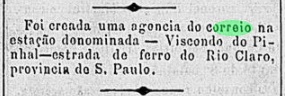
As Paula Sobrinho writes in História Postal de Minas Gerais (Belo Horizonte, 1997), there had been a post office there since November 1882, which is confirmed by the press from Rio de Janeiro:
Jornal do Commercio/RJ, 17.11.1882
The imperial postmark is the double circle VMG-3275a (Coll. José A. Junges), with the inscriptions VENDA NOVA above and (MINAS) below. The dates in the centre have so far been found for the period 1888-1889.
Google Maps
Die Pfarrei von Nossa Senhora da Venda Nova (Unsere Liebe Frau des Neuen Kaufladens) wurde im Juli 1868 im Município von Sabará errichtet und lag knapp 120 km nordwestlich der Provinzhauptstadt Ouro Preto entfernt. Seit September 1923 ist Venda Nova ein Distrikt der aktuellen Landeshauptstadt Belo Horizonte.
Wie Paula Sobrinho in História Postal de Minas Gerais (Belo Horizonte, 1997) schreibt, gab es dort ein Postamt seit November 1882, was durch die Presse aus Rio de Janeiro bestätigt wird:
Jornal do Commercio/RJ, 17.11.1882
Der kaiserliche Poststempel ist der Doppelkreis VMG-3275a (Samml. José A. Junges), mit den Inschriften VENDA NOVA oben und (MINAS) unten. Die Daten in der Mitte wurden bisher für den Zeitraum 1888-1889 gefunden.
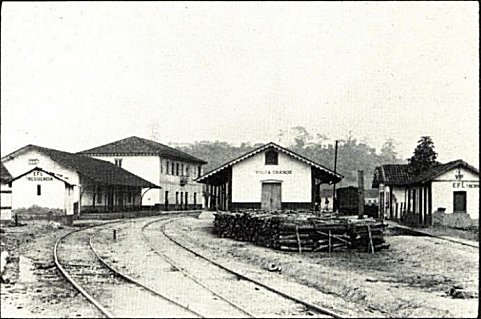
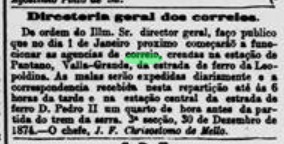
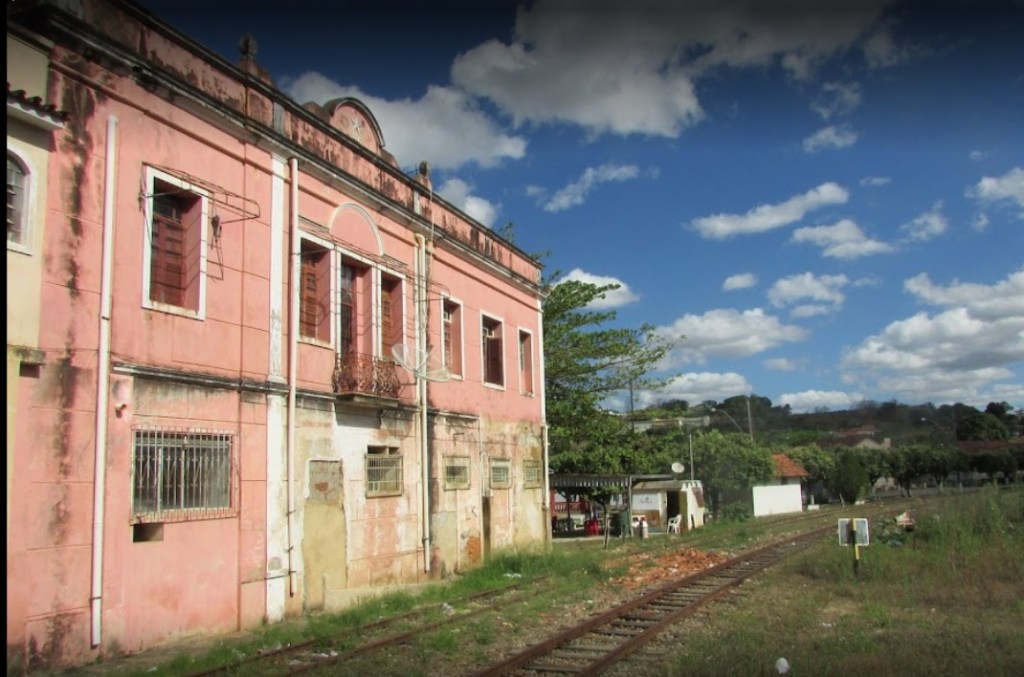
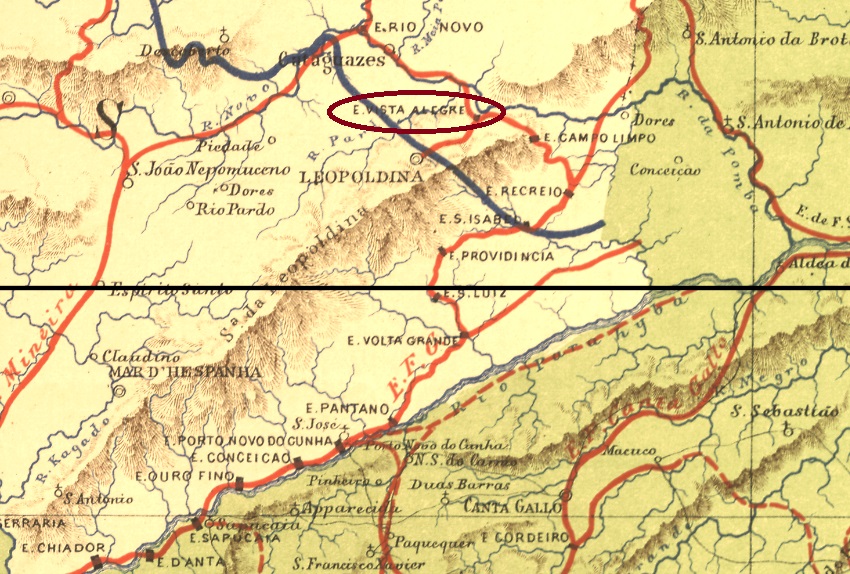
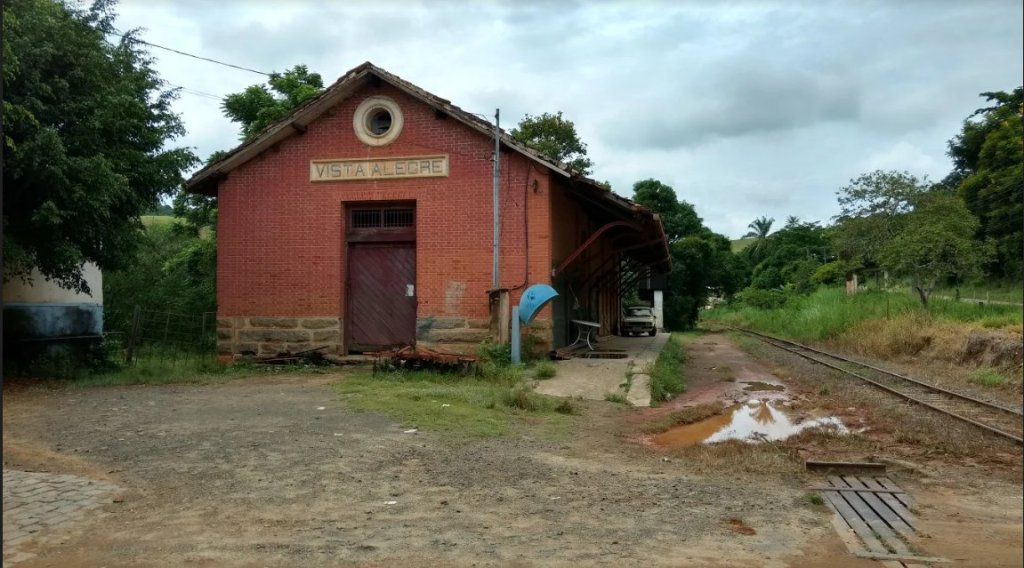
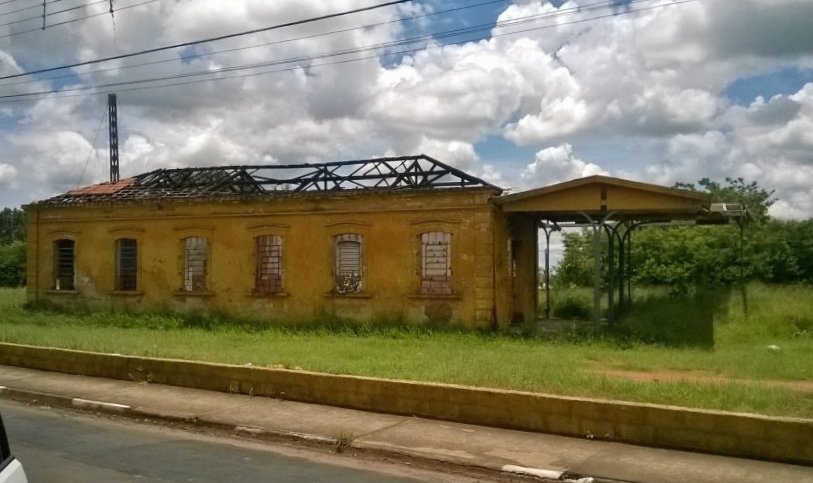
The station Venda das Pedras (shop near the rocks) was inaugurated in December 1874 by the Cia. Ferro-Carril Niteroiense (Coast Line) and was located north of Itaboraí, more than 50 km east of the capital Rio de Janeiro. In 1887 the railway line became the property of E.F. Leopoldina and from 1975 until its closure in 1996 it belonged to Rede Ferroviária Federal S. A. (estacoesferroviarias.com.br).
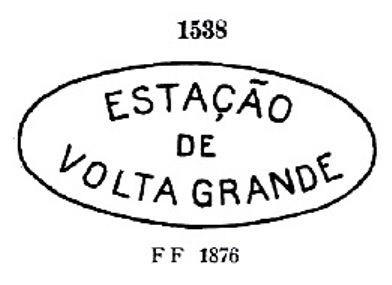
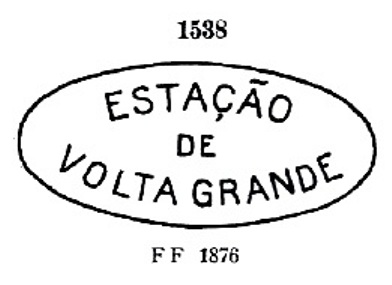
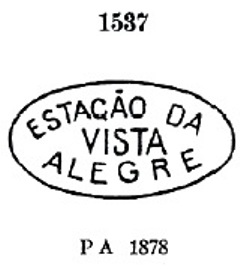
Paulo Novaes writes in agenciaspostais.com.br that there was a post office at the station from January 1875. The first station postmark, VRJ-1725a, remained in circulation until at least 1877 and was already presented by Paulo Ayres in Catálogo de Carimbos Brasil-Império (S. Paulo, 1937, 1942) under no. 1535:
VRJ-1725a (P.A. 1535)
It was followed by three postmarks as double circles. VRJ-1725b (Coll. José A. Junges) has only the inscription VENDA DAS PEDRAS at the top. Two copies found, dated 1881-2 in the centre. VRJ-1725c (Coll. José A. Junges) has the inscription V. DAS PEDRAS at the top. Again, only one example found, dated 1883 in the centre. And VRJ-1725d (Coll. José A. Junges) has the inscription EST. DA VENDA DAS PEDRAS, below you can see an ornament in lozenge, formed by four small lozenges. Dates in the middle from about 1885 to 1889.
Two mute cancellations have also appeared from Venda das Pedras, the first one used 1882 together with VRJ-1725b:
1882 (Coll. Alexandre Andrade)
The second one was used in 1883 in conjunction with VRJ-1725c:
1883 (Coll. José A. Junges)Estrada de Ferro Leopoldina
Textaktualisierung vom 15. Mai 2022
Der Bahnhof Venda das Pedras (Kaufladen an den Steinen) wurde im Dezember 1874 durch die Cia. Ferro-Carril Niteroiense (Küstenlinie) eingeweiht und lag bei Itaboraí, über 50 km östlich der Hauptstadt Rio de Janeiro entfernt. 1887 ging die Bahnlinie in Besitz der E.F. Leopoldina über und von 1975 bis zur Stilllegung 1996 gehörte sie der Rede Ferroviária Federal S. A. (estacoesferroviarias.com.br).
Paulo Novaes schreibt in agenciaspostais.com.br, dass am Bahnhof ab Januar 1875 ein Postamt gab. Der erste Bahnhofspoststempel, VRJ-1725a, blieb im Umlauf bis mindestens 1877 und wurde bereits durch Paulo Ayres in Catálogo de Carimbos Brasil-Império (S. Paulo, 1937, 1942) unter Nr. 1535 vorgestellt:
VRJ-1725a (P.A. 1535)
Ihm folgten drei Poststempel als Doppelkreise. VRJ-1725b (Samml. José A. Junges) hat lediglich oben die Inschrift VENDA DAS PEDRAS. Zwei Exemplare gefunden, datiert 1881-2 in der Mitte. VRJ-1725c (Samml. José A. Junges) hat oben die Inschrift V. DAS PEDRAS. Auch hier nur ein Exemplar vorhanden, datiert 1883 in der Mitte. Und VRJ-1725d (Samml. José A. Junges) hat oben die Inschrift EST. DA VENDA DAS PEDRAS, unten sieht man ein Ornament in Raute, das aus vier kleinen Rauten gebildet wird. Datiert in der Mitte von ca. 1885 bis 1889.
Aus Venda das Pedras sind auch zwei stumme Abstempelungen aufgetaucht; einmal auf einem Brief aus 1882:
1882 (Samml. Alexandre Andrade)
Die zweite wurde 1883 in Verbindung mit VRJ-1725c verwendet:
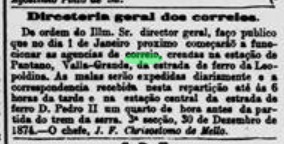
The beautiful old Portuguese word vau means river crossing point, by foot or on horseback. Assú (now spelled açu) is the Indian word for big. Vau-Assu was the name of the stream that gave the name to a fazenda in the Ponte Nova area, a good 90 km east of the provincial capital Ouro Preto. A station of the R.F. Leopoldina Railway Company (Main Line) was inaugurated there in February 1886. From 1975 until its closure in 1994, the railway line belonged to Rede Ferroviária Federal S.A. (estacoesferroviarias.com.br). Since December 1948, Vau-Açu has been a district in the Município of Ponte Nova.
Paula Sobrinho writes in História Postal de Minas Gerais (Belo Horizonte, 1997) that there was a post office at the station from June 1886. This is confirmed by the Rio press:
Gazeta de Noticias/RJ, 18/06/1886
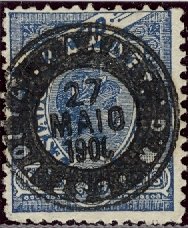
The oldest station postmark so far is VMG-3270a (image from the Internet): a double circle with the inscriptions VAU-ASSU above and (M. GERAES) below. The dates in the middle originate from the period 1897-1900.
Estrada de Ferro Leopoldina
Das schöne, alte portugiesische Wort Vau bedeutet Flussüberquerungspunkt, zu Fuß oder auf dem Pferd. Assú (heute açu geschrieben) ist ein indianisches Wort für groß. Vau-Assu hieß der Bach, der eine Fazenda im Gebiet von Ponte Nova den Namen gab und gut 90 km östlich der Provinzhauptstadt Ouro Preto entfernt lag. Dort wurde im Februar 1886 ein Bahnhof der R.F. Leopoldina Bahngesellschaft (Hauptlinie) eingeweiht. Die Bahnlinie gehörte von 1975 bis zur Stilllegung 1994 der Rede Ferroviária Federal S.A. (estacoesferroviarias.com.br). Seit Dezember 1948 ist Vau-Açu ein Distrikt im Município von Ponte Nova.
Paula Sobrinho schreibt in História Postal de Minas Gerais (Belo Horizonte, 1997), dass es dort am Bahnhof ab Juni 1886 ein Postamt gab. Dies wird durch die Presse aus Rio bestätigt:
Gazeta de Noticias/RJ, 18.06.1886
Der bisher älteste Bahnhofspoststempel ist VMG-3270a (Abb. aus dem Internet): ein Doppelkreis mit den Inschriften VAU-ASSU oben und (M. GERAES) unten. Die Daten in der Mitte entstammen dem Zeitraum 1897-1900.

The sesmaria (land area) of Vassouras and Rio Bonito was already mentioned in documents in 1782. It was located 120 km northwest of the future capital Rio de Janeiro and became Nossa Senhora da Conceição da Villa de Vassouras in January 1833. Vassouras has been a city since September 1857.
As Nova Monteiro writes in Administrações e Agencias Postaes do Brasil Imperio (Brasil Filatelico/RJ, 1934-5; Reprint SPP 1994-1999), there was a post office there since September 1832. The oldest postmark is probably VRJ-2355a, which was used from 1832 until at least 1843, also occurs in sepia and has already been presented by Paulo Ayres in Catálogo de Carimbos Brasil-Império (S. Paulo, 1937, 1942) under no. 1530 as well as by the RHM catalogue under P-RJ-46:
VRJ-2355a (P.A. 1530, RHM P-RJ-46)
It was followed by VRJ-0990a, which was also listed by Paulo Ayres (No. 1533) and could be found from about 1850:
VRJ-0990a (P.A. 1533) 1850ff
After that there were five stamps as double circles. VEJ-0990b (Coll. Fuad Ferreira Fo.) is a French type with the inscription VASSOURAS above and the star between brackets below. Dates in the centre from 1867 to 1874. VRJ-0990c (Coll. José A. Junges) has the same inscription at the top, but now reads ( C ) at the bottom, for Cidade. Dated from about 1877 to 1882 in the centre. VRJ-0990d (Coll. José A. Junges) has the inscription CID. DE VASSOURAS, below is an ornament in lozenge formed by four small lozenges. The inner dates were found for the period 1884-1887. VRJ-0990e (Coll. José A. Junges) has the inscription CIDE. DE VASSOURAS, below the ornament is now like a hashtag. Dated 1888-1889 in the middle. Finally there comes VRJ-0990f (Coll. José A. Junges): here the inscription above is simply VASSOURAS, below is a 12-pointed star, with internal dates from 1890 to 1893.
In June 1865, the train station was inaugurated there on the main line of the E.F. Dom Pedro II railway company. The line passed to the E.F. Central do Brasil in 1889, and from 1975 until its closure in 1996 it belonged to Rede Ferroviária Federal S.A. (estacoesferroviarias.com.br). The station was renamed Barão de Vassouras in May 1925. The Directory of Imperial Post Offices (Tabella das Agencias do Correio do Imperio, Rio de Janeiro, 1885) lists the station post office as originating in 1855. This will be a misprint, as much more plausible is the date of 31.12.1865, as recorded by Paulo Novaes in agenciaspostais.com.br.
Three station postmarks were found, starting with VRJ-0991a, which also occurs in blue, was in circulation from 1865 and has already been presented by Paulo Ayres (op.cit.) with no. 1534.
VRJ-0991a (P.A. 1534)
Two postmarks as double circles followed. VRJ-0991b (Coll. José A. Junges) has the inscription EST. DE VASSOURAS at the top, and an ornament in lozenge formed by four small lozenges at the bottom. The internal dates so far go from 1888 to 1890. VRJ-0991c has already been shown by Cicero A. Almeida in Carimbos Postais – século XIX (Rio de Janeiro, 1989) under the no. MPT 800:
VRJ-0991c (MPT 800)
Two mute cancellations from Vassouras have survived. The first one was seen in agenciaspostais.com.br:
1867 (PN)
The other one from the collection José A. Junges:
1882 (JJ)Villiers de l’Ile Adam: Carta (…) da Provincia do Rio de Janeiro, 1850
Die Sesmaria (Landfläche) von Vassouras und Rio Bonito war bereits 1782 urkundlich erwähnt. Sie lag 120 km nordwestlich der künftigen Hauptstadt Rio de Janeiro entfernt und wurde im Januar 1833 zu Nossa Senhora da Conceição da Villa de Vassouras. Seit September 1857 ist Vassouras eine Stadt.
Wie Nova Monteiro in Administrações e Agencias Postaes do Brasil Imperio (Brasil Filatelico/RJ, 1934-5; Reprint SPP 1994-1999) schreibt, gab es dort ein Postamt seit September 1832. Der älteste Poststempel ist wohl VRJ-2355a, der ab 1832 bis mindestens 1843 verwendet wurde, auch in sepia vorkommt und bereits sowohl durch Paulo Ayres in Catálogo de Carimbos Brasil-Império, (S. Paulo, 1937, 1942) unter Nr. 1530 als auch durch den RHM-Katalog unter P-RJ-46 vorgestellt wurde:
VRJ-2355a (P.A. 1530, RHM P-RJ-46)
Ihm folgte VRJ-0990a, der auch bei Paulo Ayres (Nr. 1533) aufgelistet und ab ca. 1850 zu finden war:
VRJ-0990a (P.A. 1533) 1850ff
Danach gab es fünf Stempel als Doppelkreise. VEJ-0990b (Samml. Fuad Ferreira Fo.) ist ein französischer Typus mit der Inschrift VASSOURAS oben und dem Stern zwischen Klammern untern. Daten in der Mitte von 1867 bis 1874. VRJ-0990c (Samml. José A. Junges) hat dieselbe Inschrift oben, unten ist nun ( C ) zu lesen, für Cidade. Datiert ab ca. 1877 bis 1882 in der Mitte. VRJ-0990d (Samml. José A. Junges) hat oben die Inschrift CID. DE VASSOURAS, unten ist ein Ornament in Raute, das aus vier kleinen Rauten gebildet wird. Die inneren Daten wurden für den Zeitraum 1884-1887 gefunden. VRJ-0990e (Samml. José A. Junges) hat oben die Inschrift CIDE. DE VASSOURAS, unten ist das Ornament nun wie ein Hashtag. Datiert 1888-1889 in der Mitte. Schließlich kommt VRJ-0990f (Samml. José A. Junges): hier lautet die obige Inschrift lediglich VASSOURAS, unten ist ein 12-zackiger Stern, mit inneren Daten von 1890 bis 1893.
Im Juni 1865 wurde dort der Bahnhof auf der Hauptslinie der E.F. Dom Pedro II Bahngesellschaft eingeweiht. Die Strecke ging 1889 zur E.F. Central do Brasil über, von 1975 bis zur Stilllegung 1996 gehörte sie der Rede Ferroviária Federal S.A. (estacoesferroviarias.com.br). Der Bahnhof wurde im Mai 1925 zu Barão de Vassouras umbenannt. Das Verzeichnis der kaiserlichen Postämter (Tabella das Agencias do Correio do Imperio, Rio de Janeiro, 1885) listet das Bahnhofspostamt mit Entstehungsjahr 1855 auf. Dies wird ein Druckfehler sein, denn viel plausibler ist das Datum vom 31.12.1865, wie durch Paulo Novaes in agenciaspostais.com.br ermittelt.
Drei Bahnhofspoststempel wurden gefunden, beginnend mit VRJ-0991a, der auch in blau vorkommt, von 1865 an im Umlauf war und durch Paulo Ayres (op.cit.) mit Nr.1534 bereits präsentiert wurde.
VRJ-0991a (P.A. 1534)
Es folgten zwei Poststempel als Doppelkreise. VRJ-0991b (Samml. José A. Junges) hat oben die Inschrift EST. DE VASSOURAS, unten ist ein Ornament in Raute zu sehen, das aus vier kleinen Rauten gebildet wird. Die inneren Daten gehen bisher von 1888 bis 1890.VRJ-0991c wurde bereits gezeigt von Cicero A. Almeida in Carimbos Postais – século XIX (Rio de Janeiro, 1989) unter der Nr. MPT 800:
VRJ-0991c (MPT 800)
Zwei Stumme Entwertungen aus Vassouras sind noch überliefert. Einmal in agenciaspostais.com.br zu sehen:
1867 (PN)
Und einmal wieder aus der Sammlung José A. Junges:
The district of Nossa Senhora do Rosário da Varzea was founded in November 1846 near Recife, more than 10 km west of the city centre. And so it has remained to this day, although since July 1960 the suburb has been part of the administrative zone (Zona Administrativa) in the município of Recife.
The local post office came into being in 1873, as the Directory of Imperial Post Offices (Tabella das Agencias do Correio do Imperio, Rio de Janeiro, 1885) and the Postal Report (Relatorio Postal) for 1887 concur. The oldest imperial postmark is VPE-0660b (Coll. José A. Junges): a plain double circle with the inscription VARZEA at the top. The dates in the middle were found for the period 1885ff-1894.
Carta Corographica da Provincia de Pernambuco, 1880
Der Distrikt von Nossa Senhora do Rosário da Varzea wurde im November 1846 bei Recife gegründet und lag über 10 km westlich der Stadtmitte entfernt. Und so ist es bis heute geblieben, wobei seit Juli 1960 der Vorort zur Verwaltungszone (Zona Administrativa) im Município von Recife gehört.
Das örtliche Postamt entstand 1873, wie das Verzeichnis der kaiserlichen Postämter (Tabella das Agencias do Correio do Imperio, Rio de Janeiro, 1885) und der Postbericht (Relatorio Postal) für 1887 übereinstimmend mitteilen. Der bisherige kaiserliche Poststempel ist VPE-0660b (Samml. José A. Junges): ein schlichter Doppelkreis mit der Inschrift VARZEA oben. Die Daten in der Mitte wurden für den Zeitraum 1885ff-1894 gefunden.
São Raymundo Nonato de Varzea Alegre (also called Vargem Alegre) was a district of Lavras from November 1863, 440 km south of the provincial capital, Fortaleza. In October 1870, it was promoted to vila status and remained so until May 1931, when it was downgraded as a district in the município of Cedro. It was then promoted again as a vila in its own município in December 1933.
There was a post office there since 1874, as can be read in the Directory of Imperial Post Offices (Tabella das Agencias do Correio do Imperio, Rio de Janeiro, 1885). So far, no imperial postmark could be assigned to this municipality with certainty.
Serviço Geologico e Mineralogico do Brasil, 1910
São Raymundo Nonato de Varzea Alegre (auch Vargem Alegre genannt) war ab November 1863 ein Distrikt von Lavras, der 440 km südlich der Provinzhauptstadt Fortaleza entfernt lag. Im Oktober 1870 stieg der Ort zur Vila auf, und so blieb es bis Mai 1931, als die Herabstufung als Distrikt im Município von Cedro stattfand. Der Wiederaufstieg als Vila im eigenen Município erfolgte dann im Dezember 1933.
Dort gab es ein eigenes Postamt seit 1874, wie im Verzeichnis der kaiserlichen Postämter (Tabella das Agencias do Correio do Imperio, Rio de Janeiro, 1885) zu lesen ist. Bisher konnte kein kaiserlicher Poststempel dieser Gemeinde mit Sicherheit zugeordnet werden.
The Freguesia of São Sebastião do Varre-Sahe (now spelled Varre-Sai) was created in November 1879 in the município of Itaperuna, 370 km northeast of the capital Rio de Janeiro. In June 1947, the village moved to the then newly established município of Natividade do Carangola. Varre-Sai has been an independent município since January 1991. The bizarre name of the village (“sweep and go”) originated around 1850, supposedly when overnight guests were gruffly asked by the landlady to clean their night’s lodging before moving on…
As Paulo Novaes notes in agenciaspostais.com.br, there was a post office there from April 1881. Two postmarks and a handwritten cancellation were found for the 19th century. The older cancel VRJ-1625a (Coll. Henrique B. Ferreira) is said to be a French type, but so far the typical star between brackets at the bottom was missing in the found copies. In this double circle we see only the inscription VARRE-SAHE at the top, with inner dates between 1882 and 1889. Its successor VRJ-1625b (image from the internet) has the above inscription VARRE SAHE between the circles (now without hyphen), at the bottom we have an ornament formed by a small circle between leaves on the right and left. Dates in the middle were for the period 1889 to 1941 (!).
The following handwritten cancellation comes from the Fuad Ferreira Fo. collection:
1894ff (FF)Mappa Geographico Postal, 1906
Die Freguesia von São Sebastião do Varre-Sahe (heute Varre-Sai geschrieben) entstand im November 1879 im Município von Itaperuna, 370 km nordöstlich der Hauptstadt Rio de Janeiro. Im Juni 1947 wechselte der Ort zum damals neu gegründeten Município von Natividade do Carangola. Seit Januar 1991 ist Varre-Sai ein eigenständiger Município. Der skurrile Ortsname („Kehre und Geh!“) entstand ca. 1850, angeblich als Übernachtungsgäste von der Wirtin unwirsch aufgefordert wurden, ihr Nachtquartier sauber zu machen, bevor sie weiter zogen…
Wie Paulo Novaes in agenciaspostais.com.br notiert, gab es dort ein Postamt seit April 1881. Zwei Poststempel und eine handschriftliche Entwertung wurden für das 19. Jahrhundert gefunden. Der ältere Stempel VRJ-1625a (Samml. Henrique B. Ferreira) soll angeblich ein französischer Typus sein, allerdings fehlte bisher in den vorhandenen Exemplaren der typische Stern zwischen Klammern unten. In diesem Doppelkreis sieht man lediglich die Inschrift VARRE-SAHE oben, mit inneren Daten zwischen 1882 und 1889. Sein Nachfolger VRJ-1625b (Abb. aus dem Internet) hat zwischen den Kreisen die obige Inschrift VARRE SAHE (nun ohne Bindestrich), unten haben wir ein Ornament, das aus einem kleinen Kreis zwischen Blättern rechts und links gebildet wird. Daten in der Mitte von 1889 bis 1941 (!).
Aus der Sammlung Fuad Ferreira Fo. kommt folgende handschriftliche Entwertung:
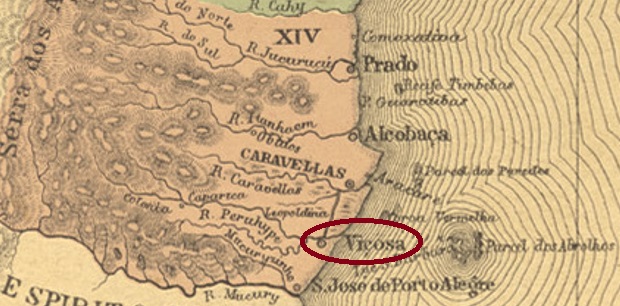
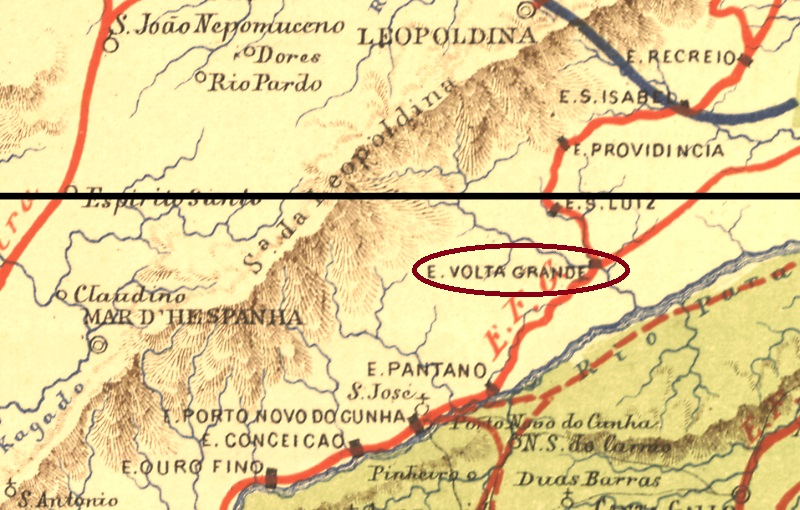
The district of Sant’Anna da Vargem Grande was created in September 1882 and was located in the Município of Juiz de Fora, 250 km south of the provincial capital of Ouro Preto. In December 1943, the district was renamed Ibitiguaia. The word from the Indian language means something like narrow valley. In December 1962, the district was promoted to Município of Belmiro Braga. The name commemorates Belmiro Ferrira Braga (1872-1937), a poet born there.
As Paula Sobrinho writes in História Postal de Minas Gerais (Belo Horizonte, 1997), there was a post office there from February 1882. The imperial postmark is VMG-3265a (Coll. José A. Junges): a double circle with the inscriptions VARGEM GRANDE above and (JUIZ DE FORA) below. The cancel also exists in turquoise, the dates in the middle are until now from the period 1885-1896.
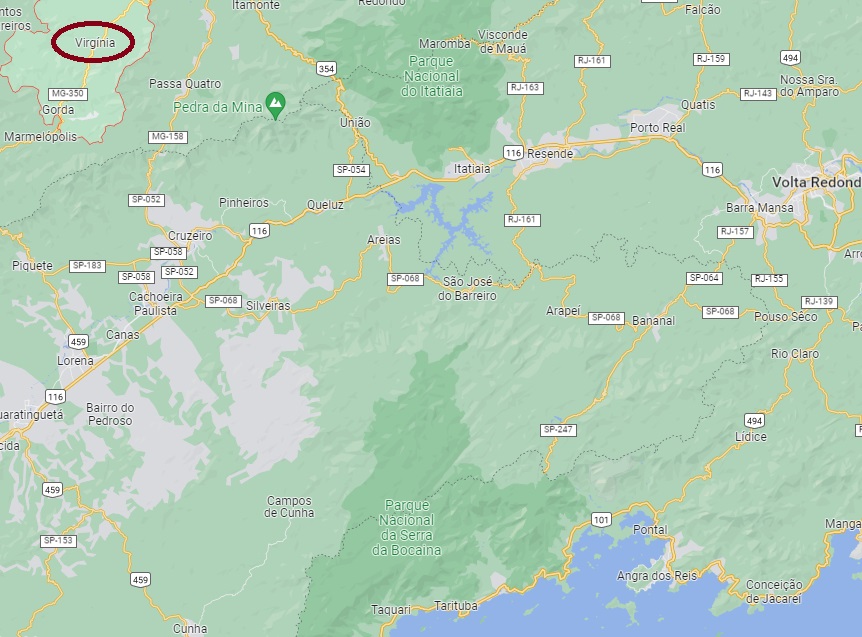
Google Maps
Andere Namen: Ibitiguaia, Belmiro Braga (1962)
Der Distrikt von Sant’Anna da Vargem Grande entstand im September 1882 und lag im Município von Juiz de Fora, 250 km südlich der Provinzhauptstadt Ouro Preto entfernt. Im Dezember 1943 wurde der Distrikt zu Ibitiguaia umbenannt. Das Wort aus der Indianersprache bedeutet etwa enges Tal. Im Dezember 1962 erfolgte nun der Aufstieg zum Município von Belmiro Braga. Der Name erinnert an Belmiro Ferrira Braga (1872-1937), einem dort geborenen Dichter.
Wie Paula Sobrinho in História Postal de Minas Gerais (Belo Horizonte, 1997) schreibt, gab es dort ein Postamt ab Februar 1882. Der kaiserliche Poststempel ist VMG-3265a (Samml. José A. Junges): ein Doppelkreis mit den Inschriften VARGEM GRANDE oben und (JUIZ DE FORA) unten. Den Stempel gibt es auch in türkis, die bisherigen Daten in der Mitte entstammen dem Zeitraum 1885-1896.
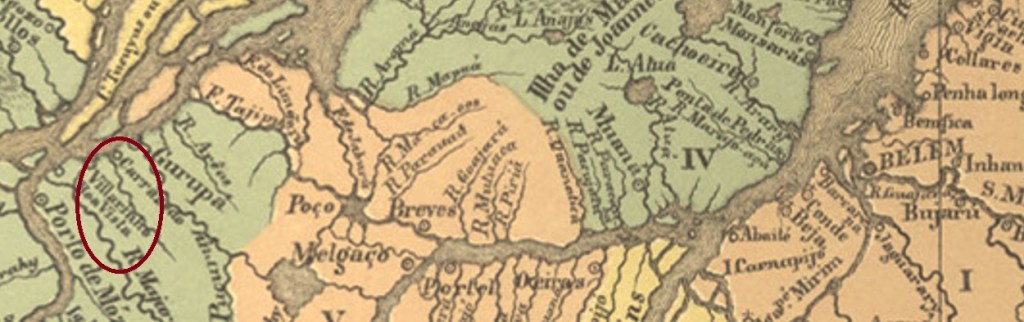
This village, old by Brazilian standards, was already a freguesia of the Vila of Itapecuru-Mirim in November 1817 and was located close to the west bank of the river Iguará, 180 km south of the future provincial capital of São Luís. In April 1833, the place rose to become a vila called São Sebastião da Manga de Iguará, but nine years later was given the name São Sebastião da Vargem Grande. Between December 1933 and June 1935, Vargem Grande was once again a district of Itapecuru-Mirim, then the Município was re-established.
Three dates of origin for the local post office have been found, all from 1856, the first being in January, according to the postal report (Relatorio Postal) of 1886. The other two dates are from June 1856, as Aureo G. Santos writes in Agências de Correio Criadas e Suprimidas 1851, 1855, 1856 e 1857 (Brasil Filatélico 181, Rio de Janeiro, 1977), and Nova Monteiro confirms in Administrações e Agencias Postaes do Brasil Imperio (Brasil Filatelico/RJ, 1934-5; Reprint SPP 1994-1999):
Aureo G. Santos (op.cit.)
So far, no imperial postmark from this locality has appeared.
Villiers de l’Ile Adam: Carta (…) da Provincia do Maranhão, 1850
Anderer Name: Manga de Iguará
Diese für brasilianische Verhältnisse alte Ortschaft war bereits im November 1817 eine Freguesia der Vila von Itapecuru-Mirim und lag nah am Westufer des Flusses Iguará, 180 km südlich der künftigen Provinzhauptstadt São Luís entfernt. Im April 1833 stieg der Ort zu einer Vila auf, die São Sebastião da Manga de Iguará hieß, aber neun Jahre später wurde der Vila den Namen São Sebastião da Vargem Grande verpasst. Zwischen Dezember 1933 und Juni 1935 war Vargem Grande nochmals ein Distrikt von Itapecuru-Mirim, dann wurde der Município wieder hergestellt.
Drei Entstehungsdaten fürs örtliche Postamt wurden gefunden, allesamt aus dem Jahr 1856. Erstmals im Januar, wie im Postbericht (Relatorio Postal) von 1886 zu lesen ist. Die beiden anderen Termine sind aus Juni des Jahres, wie sowohl Aureo G. Santos in Agências de Correio Criadas e Suprimidas 1851, 1855, 1856 e 1857 (Brasil Filatélico 181, Rio de Janeiro, 1977) als auch Nova Monteiro in Administrações e Agencias Postaes do Brasil Imperio (Brasil Filatelico/RJ, 1934-5; Reprint SPP 1994-1999) schreiben:
Aureo G. Santos (op.cit.)
Bisher ist kein kaiserlicher Poststempel aus dieser Ortschaft aufgetaucht.
Bellegard-Niemeyer: Carta Corographica da Provincia do Rio de Janeiro, 1867
This settlement originated as a large fazenda more than 40 km west of the capital Rio de Janeiro. It belonged to the freguesia of Guaratiba and was separated from this locality by the Serra do Bangu. Today, Vargem Grande is part of the district of Barra da Tijuca in the município of Rio de Janeiro.
Two dates of origin for the local post office have been found. First “ca. 1867”, as Paulo Novaes writes in agenciaspostais.com.br. Then 1879, as noted in the Directory of Imperial Post Offices (Tabella das Agencias do Correio do Imperio, Rio de Janeiro, 1885). However, from August 1853 onwards, there was both a postal relay service there and stamp sales on place, according to the Rio press:
Jornal do Commercio, 18.08.1853
So far, no Imperial postmark has been seen for this locality.
Mappa do Municipio Neutro, ca. 1880
Dese Siedlung entstand als eine große Fazenda, die über 40 km westlich von der Hauptstadt Rio de Janeiro entfernt lag. Sie gehörte der Freguesia von Guaratiba und war von dieser Ortschaft durch die Serra do Bangu getrennt. Heute ist Vargem Grande ein Ortsteil des Distrikts von Barra da Tijuca im Município von Rio de Janeiro.
Zwei Entstehungsdaten fürs örtliche Postamt wurden gefunden. Erstmals „ca. 1867“, wie Paulo Novaes in agenciaspostais.com.br schreibt. Dann 1879, wie imVerzeichnis der kaiserlichen Postämter (Tabella das Agencias do Correio do Imperio, Rio de Janeiro, 1885) vermerkt. Allerdings gab es ab August 1853 sowohl einen Poststafettendienst dorthin als auch Briefmarkenverkauf vor Ort, wie die Presse aus Rio mitteilte:
Jornal do Commercio, 18.08.1853
Bisher wurde kein Poststempel des Kaiserreichs für diese Ortschaft gesehen.