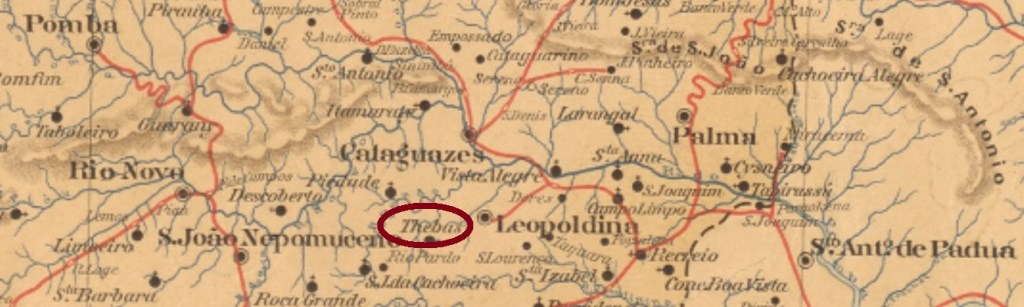
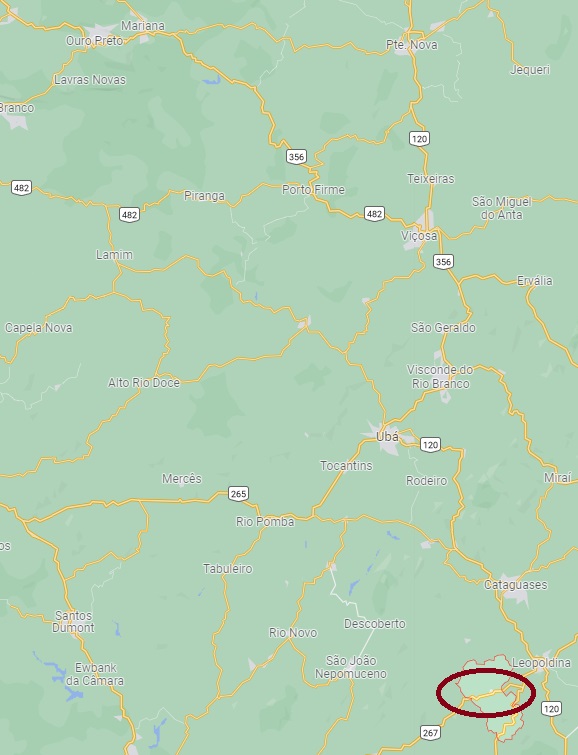
This village was a district of Leopoldina since October 1881, located below the Serra do Rio Pardo, almost 270 km southeast of the provincial capital Ouro Preto. And it has remained so until today, also in terms of population (about 2,000 inhabitants).
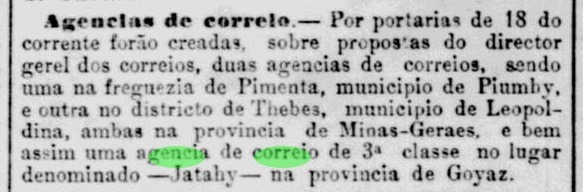
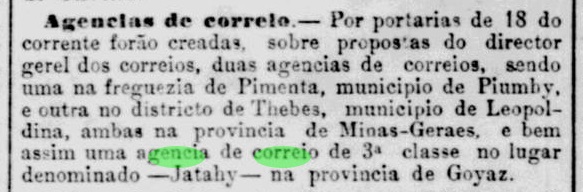
The local post office was established in August 1881, as Paula Sobrinho writes in História Postal de Mians Gerais (Belo Horizonte, 1997), which is also confirmed by the press from Rio de Janeiro.
Jornal do Commercio/RJ, 20 August 1881
The imperial postmark is TMG-3185a (Coll. José A. Junges): a double circle – which also exists in lilac – with the inscriptions THEBAS above and (MINAS) below. The dates in the middle were found for the period 1888-1901.
Google Maps
Anderer Name: Santo Antonio dos Thebas
Diese Ortschaft war seit Oktober 1881 ein Distrikt von Leopoldina, der unterhalb der Serra do Rio Pardo lag, knapp 270 km südöstlich der Provinzhauptstadt Ouro Preto entfernt. Und so ist es bis heute geblieben, auch was die Bevölkerungszahl betrifft (ca. 2.000 Einwohner).
Das örtliche Postamt entstand im August 1881, wie Paula Sobrinho in História Postal de Mians Gerais (Belo Horizonte, 1997) schreibt, was auch durch die Presse aus Rio de Janeiro bestätigt wird.
Jornal do Commercio/RJ, 20. August 1881
Der kaiserliche Poststempel ist TMG-3185a (Samml. José A. Junges): ein Doppelkreis – den es auch in lila gibt – mit den Inschriften THEBAS oben und (MINAS) unten. Die Daten in der Mitte wurde für den Zeitraum 1888-1901 gefunden.
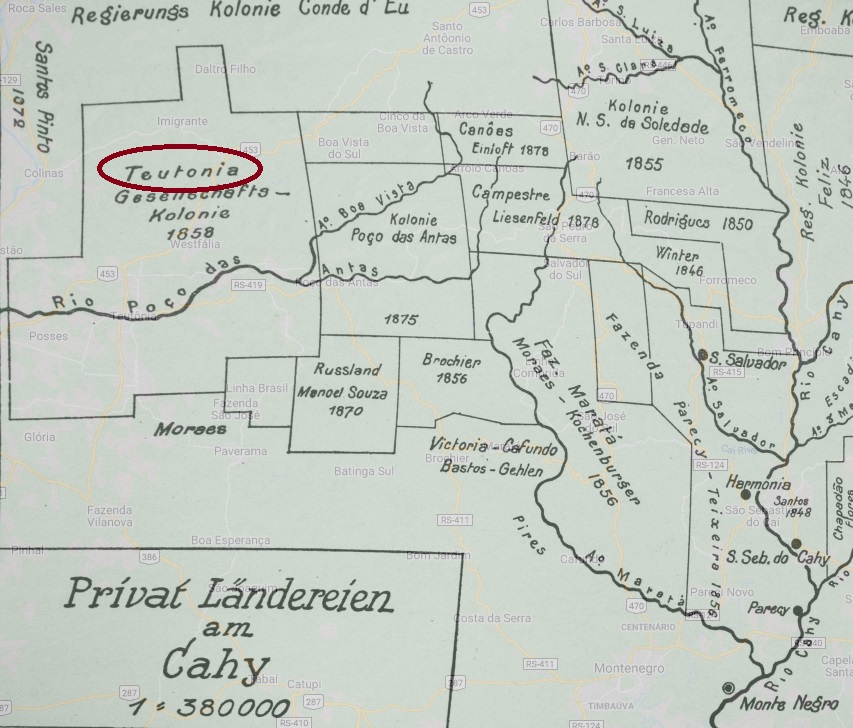
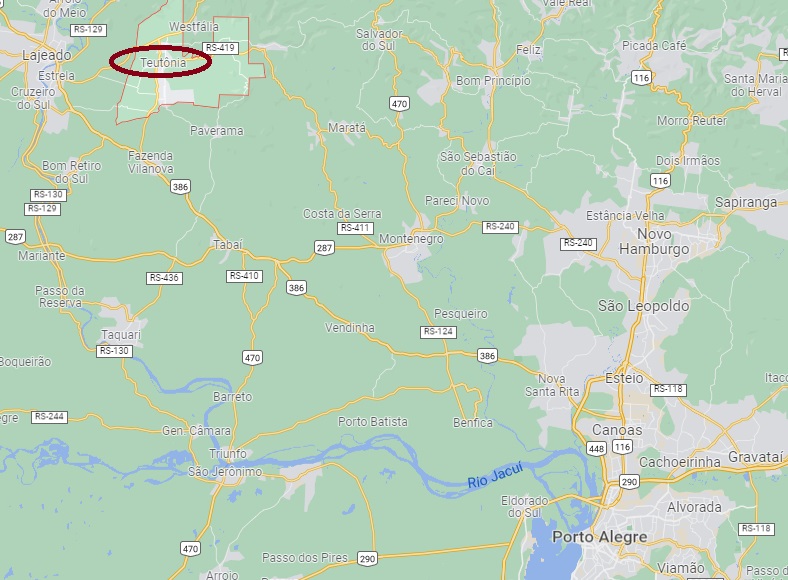
As the name suggests, Teutonia was from 1858 a German colony in the Município of Taquary, located just under 110 km northwest of the provincial capital Porto Alegre. In May 1876, the place changed to the newly founded municipality of Estrella, and since October 1981, Teutônia (now with ô) has been an independent Município.
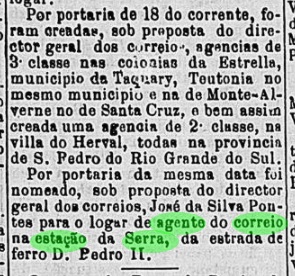
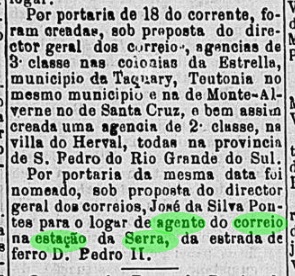
The local post office was established in October 1882, as reported by the Rio press:
Gazeta da Tarde/RJ, 19/10/1882
The imperial postmark is TRS-0450a (Coll. José A. Junges): a double circle with the inscription TEUTONIA above and an ornament in lozenge below, formed by four three-leaved branches. The cancel also occurs in violet and shows dates from 1884 to 1901 inside.
Google Maps
Wie der Name schon verrät, war Teutonia seit 1858 eine deutsche Kolonie im Município von Taquary, knapp 110 km nordwestlich der Provinzhauptstadt Porto Alegre gelegen. Im Mai 1876 wechselte der Ort zur neu gegründeten Gemeinde Estrella, und seit Oktober 1981 ist Teutônia – nun mit ô geschrieben – ein eigenständiger Município.
Das lokale Postamt entstand im Oktober 1882, wie die Presse aus Rio berichtete:
Gazeta da Tarde/RJ, 19.10.1882
Der kaiserliche Poststempel ist TRS-0450a (Samml. José A. Junges): ein Doppelkreis mit der Inschrift TEUTONIA oben und einem Ornament in Raute unten, das aus vier dreiblättrigen Zweigen gebildet wird. Der Stempel kommt auch in violett vor und zeigt im Inneren Daten von 1884 bis 1901.
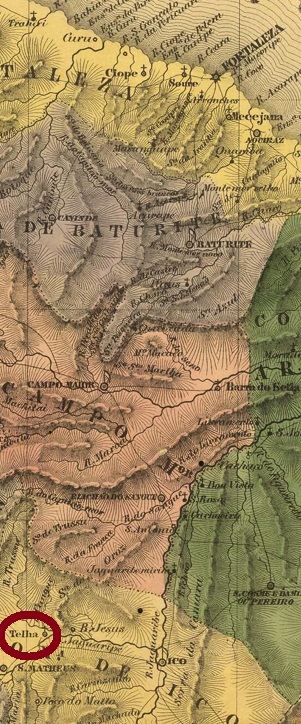
This locality was the district of N. Sa. Sant’Anna da Telha from October 1831, situated on the west bank of the Jaguaribe near Icó, 360 km south of the provincial capital Fortaleza. It became a vila in November 1851 and a town in August 1874 and has been called Iguatu since October 1883.
According to Nova Monteiro (Administrações e Agencias Postaes do Brasil Imperio, in Brasil Filatelico/RJ, 1934-5; Reprint SPP 1994-1999), there was a post office in Telha from August 1866. Unfortunately, no postmark has been seen under this name yet. For cancellations with IGUATU see R. Koester’s Carimbologia XXII.
Villiers de l’Ile Adam: Carta (…) da Provincia do Ceará, 1849
Siehe auch Iguatu (R. Koester: Carimbologia XXII)
Diese Ortschaft war seit Oktober 1831 der Distrikt von N. Sa. Sant’Anna da Telha, der am Westufer des Jaguaribe bei Icó lag, 360 km südlich der Provinzhauptstadt Fortaleza entfernt. Im November 1851 erfolgte der Aufstieg zur Vila und im August 1874 zu einer Stadt, die seit Oktober 1883 Iguatu heißt.
Laut Nova Monteiro (Administrações e Agencias Postaes do Brasil Imperio, in Brasil Filatelico/RJ, 1934-5; Reprint SPP 1994-1999) gab es in Telha ein Postamt ab August 1866. Leider war bisher kein Poststempel unter diesem Ortsnamen zu sehen. Für Entwertungen mit IGUATU siehe R. Koesters Carimbologia XXII.
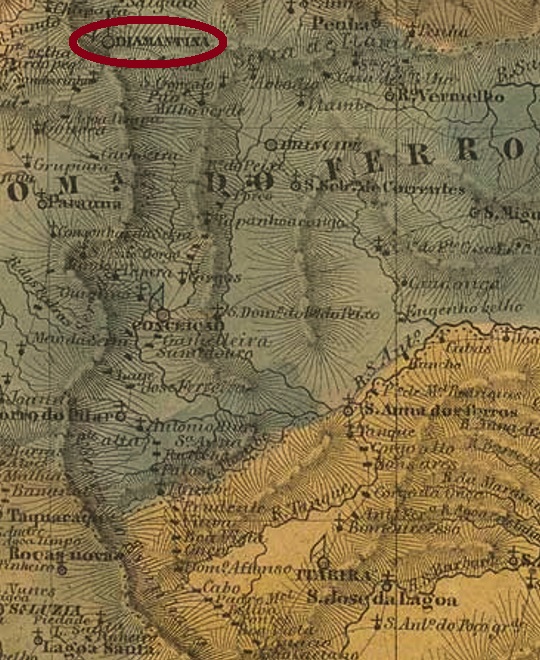
See also Diamantina (R. Koester: Carimbologia XVI)
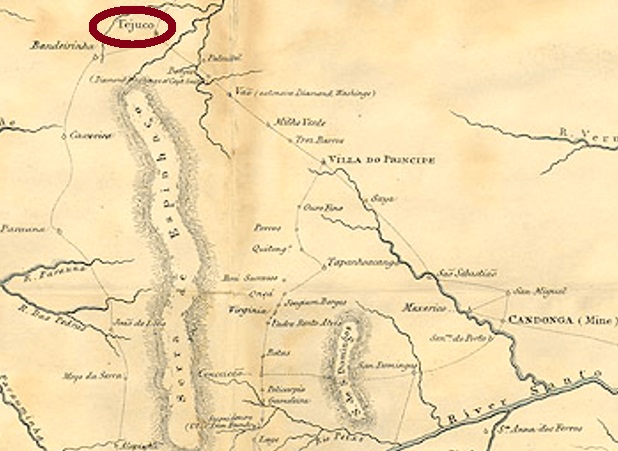
Arraial do Tejuco already existed from about 1729, it was a settlement of gold and diamond seekers located 380 km north of the future provincial capital of Ouro Preto. By royal decree (Alvará Régio), the place was promoted to freguesia in October 1819. In October 1831, already after Brazil’s independence, it became the Vila of Diamantina.
No less than four dates of creation of the local post office have been found, two of them by Paula Sobrinho in História Postal de Minas Gerais (Belo Horizonte, 1997): first in May 1809, then again in October 1833. Nova Monteiro in Administrações e Agencias Postaes do Brasil Imperio (Brasil Filatelico/RJ, 1934-5; reprint SPP 1994-1999) provided a date for the intermediate period, in March 1829. Finally, Reinhold Koester (Carimbologia XVI) writes October 1839, a sure indication of an eventful postal history of this place.
A single postmark from Tejuco was found and registered by the RHM catalogue under P-MG-64:
TMG-3740a (RHM P-MG-64) 1827-1834
Later town postmarks already bear the inscription DIAMANTINA and can be seen on R. Koester’s Carimbologia XVI.
Villiers de l’Ile Adam: Carta (…) da Provincia de Minas Geraes, 1849
Siehe auch Diamantina (R. Koester: Carimbologia XVI)
Den Arraial do Tejuco gab es bereits ab ca. 1729, er war eine Siedlung von Gold- und Diamantensuchern, die 380 km nördlich der künftigen Provinzhauptstadt Ouro Preto entfernt lag. Durch königliche Verfügung (Alvará Régio) stieg der Ort im Oktober 1819 zur Freguesia auf. Im Oktober 1831, also bereits nach Brasiliens Unabhängigkeit, wurde daraus die Vila von Diamantina.
Es wurden nicht weniger als vier Gründungsdaten fürs örtliche Postamt gefunden, zwei davon durch Paula Sobrinho in História Postal de Minas Gerais (Belo Horizonte, 1997) überliefert: erstmals im Mai 1809, dann wieder im Oktober 1833. Nova Monteiro lieferte im Administrações e Agencias Postaes do Brasil Imperio (in Brasil Filatelico/RJ, 1934-5; Reprint SPP 1994-1999) ein Datum für die Zwischenzeit, im März 1829. Und schließlich schreibt Reinhold Koester (Carimbologia XVI) noch den Oktober 1839. Ein sicheres Indiz für eine bewegte Postgeschichte dieses Orts.
Ein einziger Poststempel aus Tejuco wurde gefunden und durch den RHM-Katalog unter P-MG-64 registriert:
TMG-3740a (RHM P-MG-64) 1827-1834
Spätere Ortsstempel tragen bereits die Inschrift DIAMANTINA und sind unter R. Koesters Carimbologia XVI zu sehen.
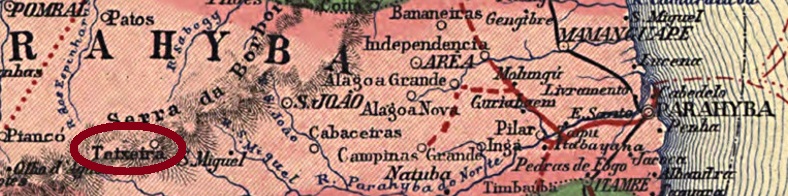
Carta da Republica dos Estados Unidos do Brazil, 1892
Another name: Serra do Teixeira
The district of Serra do Teixeira was created in October 1857 in the Município of Patos, 300 km west of the provincial capital of Parahyba do Norte (now João Pessoa). In August 1859, it became a vila, downgraded as a district of Patos in November 1871 and restored in September 1874.
There had been a post office there since January 1862, as Nova Monteiro writes in Administrações e Agencias Postaes do Brasil Imperio (in Brasil Filatelico/RJ, 1934-5; reprint SPP 1994-1999). This is confirmed by the provincial president’s report of May 1862:
Relatório do Presidente da Provincia, May 1862
Only one postmark of the imperial period was found, certainly not the oldest. TPB-0250b (Coll. José A. Junges) is a plain double circle with the inscription TEIXEIRA at the top. The only specimen bears a date from 1888 in the centre.
Atlas do Imperio do Brasil, 1868
Anderer Name: Serra do Teixeira
Der Distrikt von Serra do Teixeira entstand im Oktober 1857 im Município von Patos und lag 300 km westlich der Provinzhauptstadt Parahyba do Norte (heute João Pessoa) entfernt. Im August 1859 wurde daraus eine Vila, die im November 1871 als Distrikt von Patos herabgestuft und im September 1874 wiederhergestellt wurde.
Es gab dort ein Postamt seit Januar 1862, wie Nova Monteiro in Administrações e Agencias Postaes do Brasil Imperio (in Brasil Filatelico/RJ, 1934-5; Reprint SPP 1994-1999) schreibt. Das wird durch den Bericht des Provinzpräsidenten vom Mai 1862 bestätigt:
Relatório do Presidente da Provincia, Mai 1862
Nur ein Poststempel der Kaiserzeit wurde gefunden, sicher nicht der älteste. TPB-0250b (Samml. José A. Junges) ist ein schlichter Doppelkreis mit der Inschrift TEIXEIRA oben. Das einzige Exemplar trägt ein Datum aus 1888 in der Mitte.
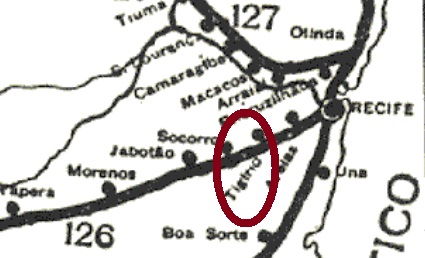
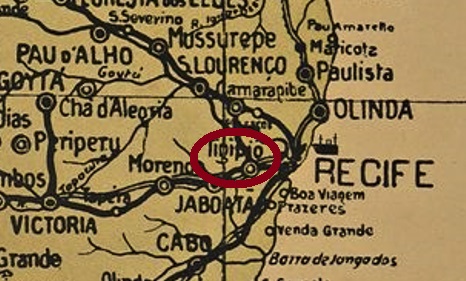
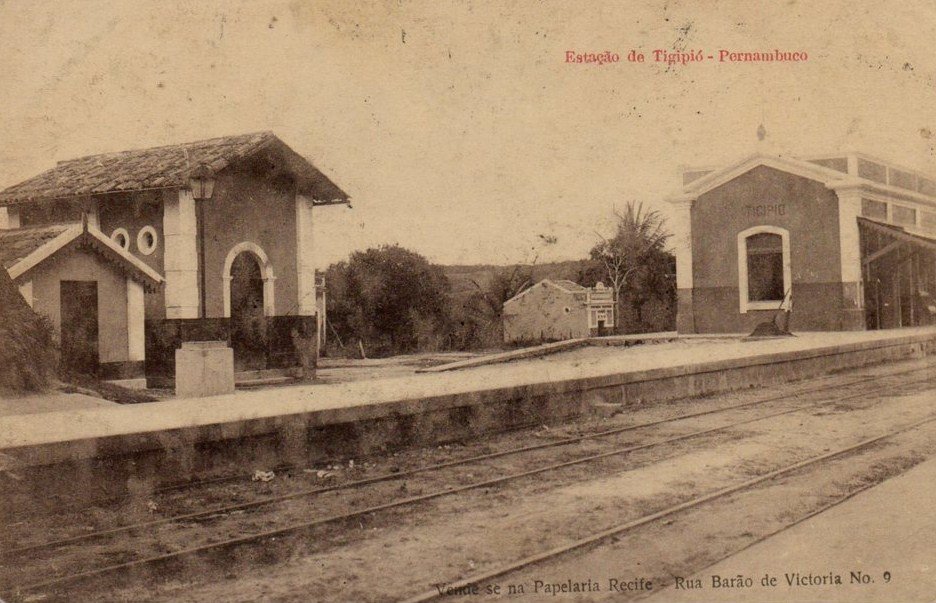
This station (now spelled Tejipió) was inaugurated in March 1885 by the E.F. Central de Pernambuco Railway Company, Central Line, in the município of Recife, and was located about 10 km west of the capital centre. The line belonged to the Great Western railway company from 1904, to Rede Ferroviária do Nordeste from 1950, and to Rede Ferroviária Federal S.A. from 1975 until its closure in 1996 (estacoesferroviarias.com.br).
ca. 1919 (estacoesferroviarias.com.br)
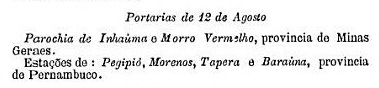
The station post office was established in August 1889 – three months before the republican coup – as shown in the postal report for the following month:
Boletim Postal No.5, Nov/89
Until now, no imperial postmark from this station could be found.
Arthur D. Ribeiro: Estado de Pernambuco, 1924
Dieser Bahnhof (nun Tejipió geschrieben) wurde im März 1885 durch die E.F. Central de Pernambuco Bahngesellschaft, Zentraler Linie, im Município von Recife eingeweiht und lag ca. 10 km westlich der Hauptstadtmitte. Die Linie gehörte ab 1904 der Great Western Bahngesellschaft, ab 1950 der Rede Ferroviária do Nordeste, und von 1975 bis zur Stilllegung 1996 der Rede Ferroviária Federal S.A. (estacoesferroviarias.com.br).
ca. 1919 (estacoesferroviarias.com.br)
Das Bahnhofspostamt entstand im August 1889 – also drei Monate vor dem Republikputsch – wie aus dem Postbericht für den folgenden Monat hervorgeht:
Boletim Postal Nr.5, Nov./89
Bisher war kein kaiserlicher Poststempel von diesem Bahnhof zu finden.
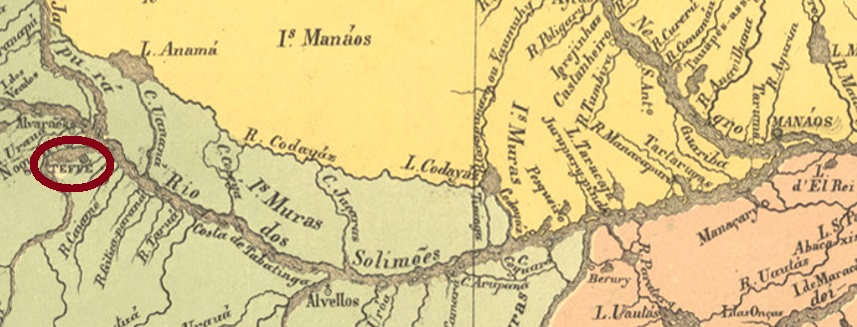
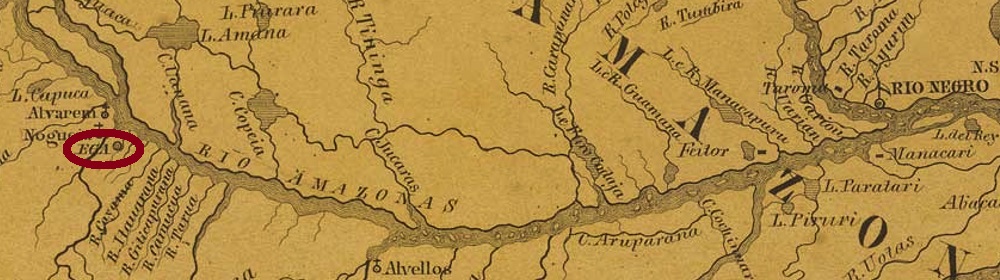
This village was a settlement on the south bank of the Rio Tefé, where it flows into the Amazon. The word comes from the nheegatu Indian language and means deep. In 1759, it became a vila called Egas (or also Ega), and since June 1859, the place has been the town of Teffé.
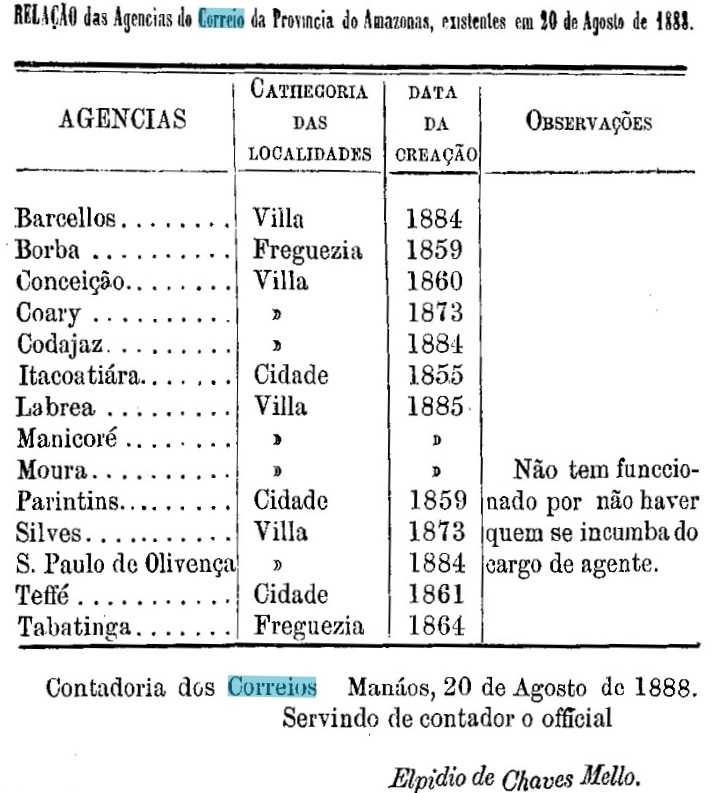
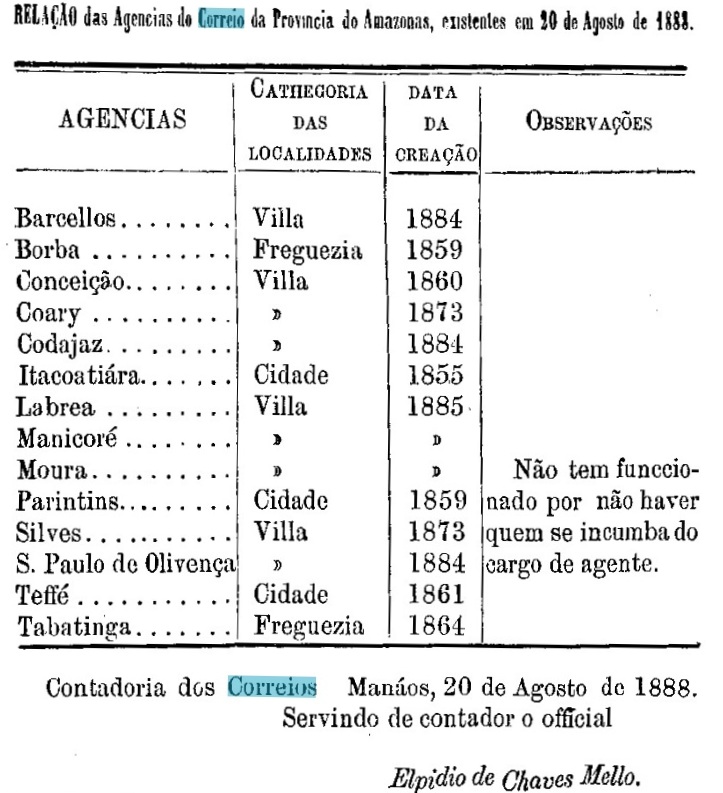
There were three years in which the local post office was founded. Nova Monteiro writes March 1829 for it in Administrações e Agencias Postaes do Brasil Imperio (in Brasil Filatelico/RJ, 1934-5; Reprint SPP 1994-1999). The Directory of Imperial Post Offices (Tabella das Agencias do Correio do Imperio, Rio de Janeiro, 1885) lists the postal agency from 1851. And in a list published in the Provincial President’s Report in August 1888, the Teffé post office is listed as created in 1861:
Relatório do Presidente da Província/AM, August 1888
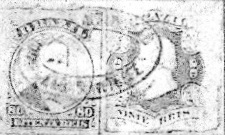
Also, three different postmarks were found for the 19th century. TAM-0100a is likely to have been in use between about 1851 and at least 1866 and was presented by Paulo Ayres in Catálogo de Carimbos Brasil-Império (S. Paulo, 1937, 1942) under No. 1513:
TAM-0100a (P.A. 1513) 1851ff-1866ff
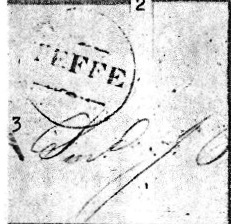
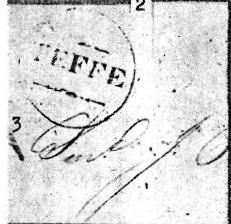
Two postmarks as double circles followed. TAM-0100b (Coll. José A. Junges) has only the inscription TEFFÉ on top. The inner date of the only specimen so far is from 1885. TAM-0100c (image from the internet) could already be republican, as the date inside is from 1891. Here one can also find the indication (AMAZONAS) at the bottom.
In Carimbologia XVII, R. Koester has shown two further imperial postmarks from Teffé, although he was not sure about the postal use of the first one:
TAM-0100d (RK)TAM-0100e (RK) 1876ffVilliers de l’Ile Adam: Carta (…) das Provincias do Grão Pará e Alto Amazonas, 1850
Textaktualisierung am 28. Mai 2024
Andere Namen: Ega, Egas
Diese Ortschaft war eine Siedlung am Südufer des Rio Tefé, wo dieser in den Amazonas mündet. Das Wort kommt aus der Nheegatu-Indianersprache und bedeutet tief. 1759 wurde daraus eine Vila, die Egas (oder auch Ega) hieß, und seit Juni 1859 ist der Ort die Stadt Teffé.
Drei Gründungsjahre fürs örtliche Postamt waren zu finden. Nova Monteiro schreibt dafür in Administrações e Agencias Postaes do Brasil Imperio (in Brasil Filatelico/RJ, 1934-5; Reprint SPP 1994-1999) den März 1829. DasVerzeichnis der kaiserlichen Postämter (Tabella das Agencias do Correio do Imperio, Rio de Janeiro, 1885) listet die Postagentur ab 1851 auf. Und in einer Liste, die im Bericht des Provinzpräsidenten im August 1888 veröffentlicht wurde, wird das Postamt Teffé mit Gründungsjahr 1861 geführt:
Relatorio do Presidente da Provincia/AM, August 1888
Ebenfalls drei verschiedene Poststempel wurden für den 19. Jahrhundert gefunden. TAM-0100a war nachweislich zwischen ca. 1851 und mindestens 1866 in Gebrauch und wurde durch Paulo Ayres in Catálogo de Carimbos Brasil-Império (S. Paulo, 1937, 1942) unter Nr. 1513 vorgestellt:
TAM-0100a (P.A. 1513) 1851ff-1866ff
Es folgten zwei Poststempel als Doppelkreise. TAM-0100b (Samml. José A. Junges) hat nur die Inschrift TEFFÉ oben. Das innere Datum des bisher einzigen Exemplars stammt aus dem Jahr 1885. TAM-0100c (Abb. aus dem Internet) könnte bereits republikanisch sein, da das Datum innen aus 1891 ist. Hier findet man zusätzlich die Angabe (AMAZONAS) unten.
R. Koester hat in Carimbologia XVII zwei weitere kaiserliche Poststempel aus Teffé gezeigt, wobei er sich bei dem ersten über die postalische Verwendung nicht sicher war:
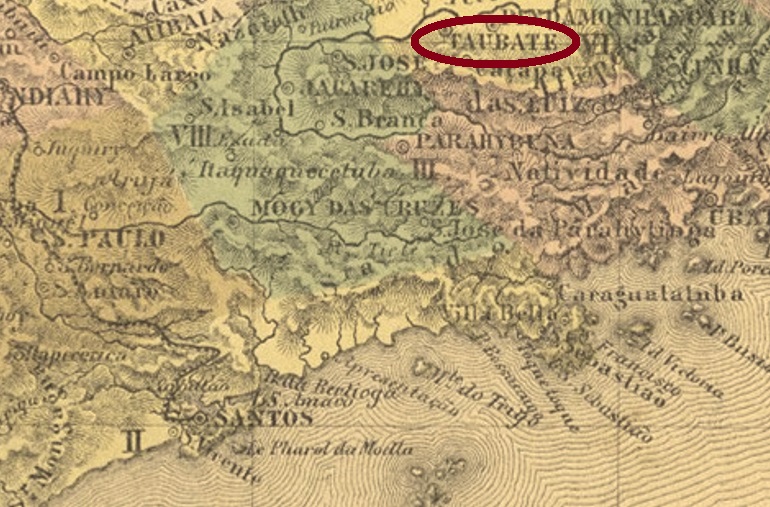
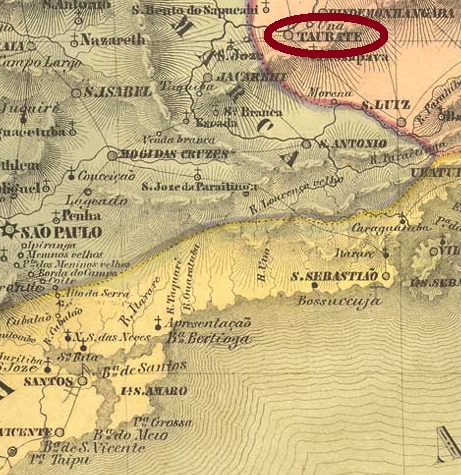
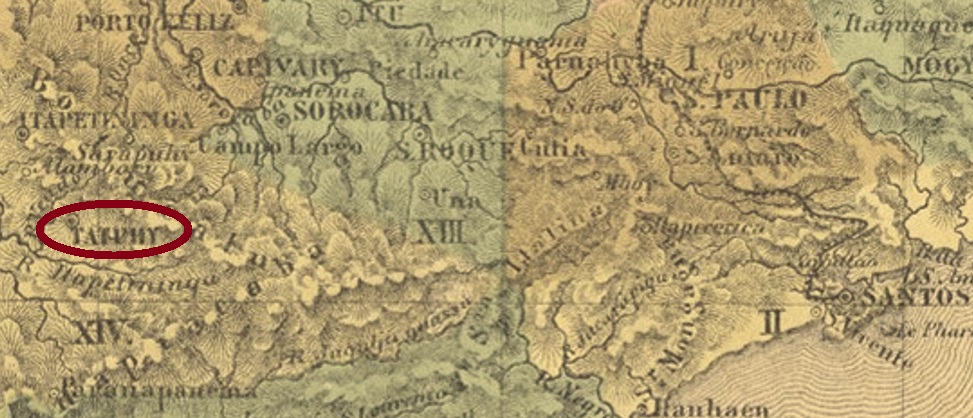
This old village was the freguesia of São Francisco das Chagas de Taubaté, appointed by royal decree (Provisão Real) in December 1645, located on the south bank of the river Parahyba do Sul, 130 km northeast of the future provincial capital of São Paulo. Allegedly, the ascent to the vila also took place in December 1645, which would be rather unusual. Taubaté has been a town since February 1842. The Indian name means village on the hill.
As Nova Monteiro writes in Administrações e Agencias Postaes do Brasil Imperio (in Brasil Filatelico/RJ, 1934-5; Reprint SPP 1994-1999), there was a post office there since May 1828. The pre-philatelic postmark from there is TSP-1420a, it was in use until about 1841 and was already presented in the RHM catalogue under P-SP-57. However, there are small discrepancies between the catalogue illustration and the actual postmark specimens:
TSP-1420a (RHM P-SP-57- recte), 1828-1841
Then came the seal-like TSP-1420b, presented by Paulo Ayres in Catálogo de Carimbos Brasil-Império (S. Paulo, 1937, 1942) under no. 30/1942 and used between 1842 and at least 1844:
TSP-1420b (P.A. 1942/30) 1842-1844ff
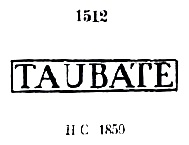
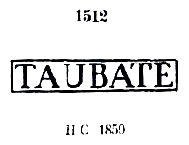
The following five place stamps were also seen in Paulo Ayres (op. cit.). TSP-1420c is P.A. 1512, it also exists in red, and was in use from about 1850 to at least 1876.
TSP-1420c (P.A. 1512), 1850ff-1876ff
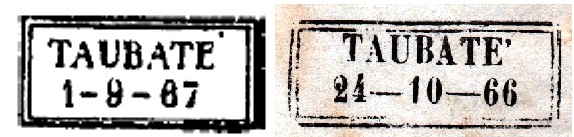
For TSP-1420d there are also small differences between the P. Ayres illustration no.1551 and the examples found:
TSP-1420d (P.A. 1551-recte) 1866-1867ff
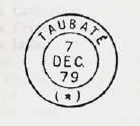
The French-type TSP-1420e is found on P. Ayres on p. 118 and also exists in red:
TSP-1420e (P.A. p. 118) 1877-1890
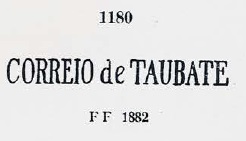
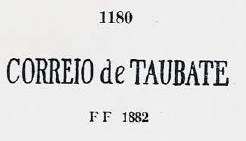
Around the same period, TSP-1420f was used, also in lilac, no. 1180 on P. Ayres:
TSP-1420f (P.A. 1180) 1866ff-1882ff
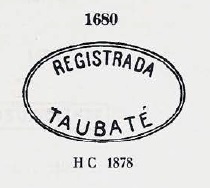
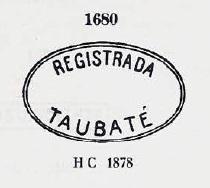
TSP-1420g (P.Ayres 1680) was used for registered mail:
TSP-1420g (P.A. 1680) 1878ff
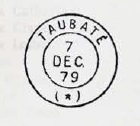
Then TSP-1420h (Coll. José A. Junges) was in use between 1880 and 1895: a plain double circle with the inscription TAUBATÉ on top.
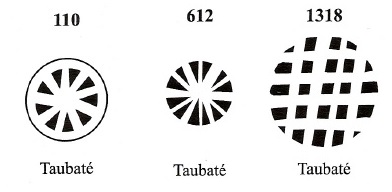
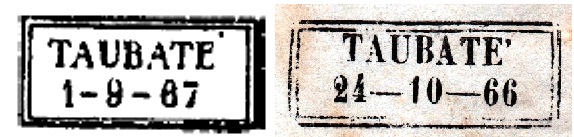
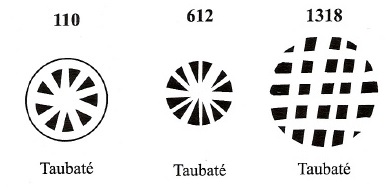
Three mute cancellations from Taubaté are shown in Mute Cancellations of the Brazil Empire/ Carimbos Mudos do Brasil Império (Brazil Philatelic Association, Rio de Janeiro, 2000) by J.A. Dingler and K.W. Lopes under nos. 110, 612 and 1318:
BPA 110, 612, 1318
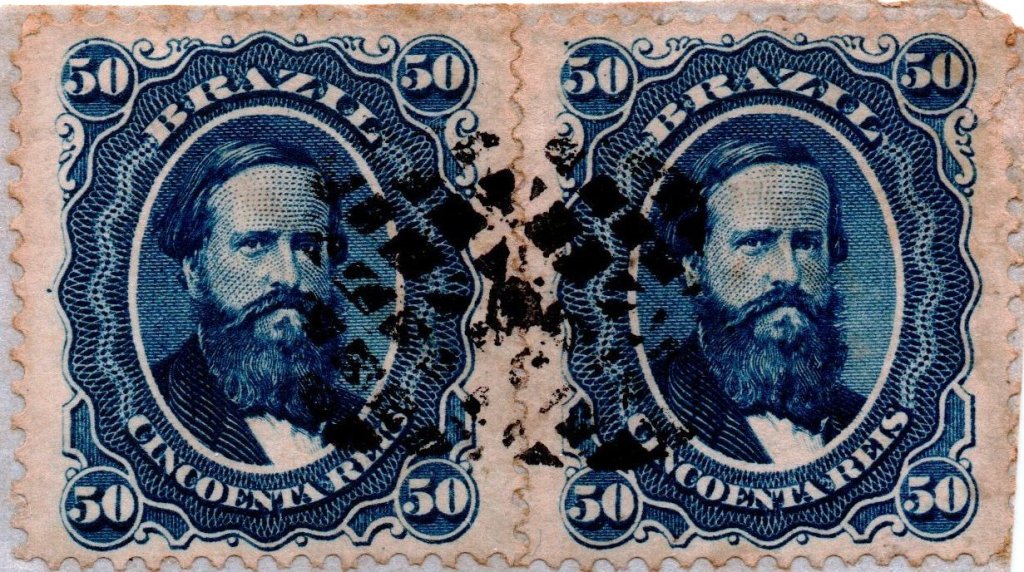
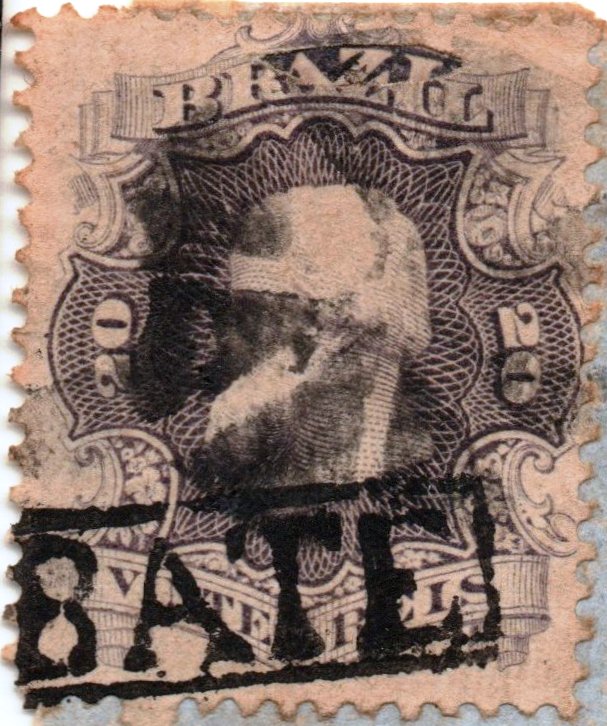
Two other mute cancels come from the José A. Junges collection, both on D. Pedro issues from 1866:
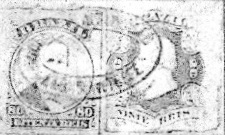
(JJ) 18661866ff (JJ) with TSP-1420cVilliers de l’Ile Adam: Carta (…) da Provincia de São Paulo, 1847
Diese alte Ortschaft war im Dezember 1645 die durch königliche Verfügung (Provisão Real) ernannte Freguesia von São Francisco das Chagas de Taubaté, die am Südufer des Flusses Parahyba do Sul lag, 130 km nordöstlich der künftigen Provinzhauptstadt São Paulo entfernt. Angeblich soll auch im Dezember 1645 der Aufstieg zur Vila stattgefunden haben, was eher ungewöhnlich wäre. Seit Februar 1842 ist Taubaté eine Stadt. Der indianische Name bedeutet Dorf auf der Anhöhe.
Wie Nova Monteiro in Administrações e Agencias Postaes do Brasil Imperio (in Brasil Filatelico/RJ, 1934-5; Reprint SPP 1994-1999) schreibt, gab es dort ein Postamt seit Mai 1828. Der Prephila-Poststempel von dort ist TSP-1420a, er war bis ca. 1841 in Gebrauch und wurde bereits im RHM-Katalog unter P-SP-57 vorgestellt. Allerdings gibt es kleine Abweichungen zwischen der Katalog-Abbildung und den tatsächlichen Stempelexemplaren:
Die folgenden fünf Ortsstempel waren auch in Paulo Ayres (op. cit.) zu sehen. TSP-1420c ist P.A. 1512. Ihn gibt es auch in Rot, und er war zwischen ca. 1850 bis mindestens 1876 in Gebrauch.
TSP-1420c (P.A. 1512) 1850ff-1876ff
Bei TSP-1420d gibt es ebenfalls kleine Unterschiede zwischen der P. Ayres Abbildung Nr.1551 und den gefundenen Beispielen:
TSP-1420d (P.A. 1551-recte) 1866-1867ff
Der französischer Typus TSP-1420e steht auf P. Ayres auf S. 118 und kommt auch in Rot vor:
TSP-1420e (P.A. S. 118) 1877-1890
Etwa im gleichen Zeitraum wurde TSP-1420f – auch in lila – verwendet, die Nr. 1180 bei P. Ayres:
TSP-1420f (P.A. 1180) 1866ff-1882ff
TSP-1420g (P.Ayres 1680) war für Einschreibsendungen bestimmt:
TSP-1420g (P.A. 1680) 1878ff
Dann war noch TSP-1420h (Samml. José A. Junges) zwischen 1880 und 1895 in Gebrauch: ein schlichter Doppelkreis mit der Inschrift TAUBATÉ oben.
Drei stumme Entwertungen aus Taubaté sind in Mute Cancellations of the Brazil Empire/ Carimbos Mudos do Brasil Império, (Brazil Philatelic Association, Rio de Janeiro, 2000) von J.A. Dingler und K.W. Lopes unter den Nr. 110, 612 und 1318 aufgelistet:
BPA 110, 612, 1318
Zwei weitere stumme Stempel kommen aus der Sammlung José A. Junges, beide auf D. Pedro-Briefmarken aus 1866:
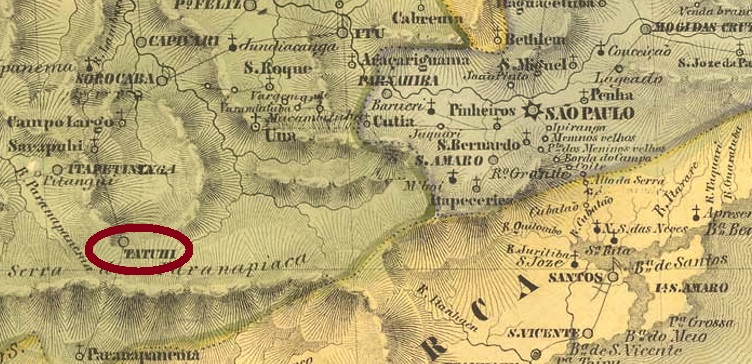
Tatuhy (also Tatuhi, now spelled Tatuí) was a freguesia of the Vila of Itapetininga from March 1822, located on the north bank of the Tatuí River (a tributary of the Sorocaba), 140 km west of the later provincial capital of São Paulo. It was elevated to the status of a vila in February 1844 and became a town in July 1861. The place name comes from the Tupi-guarani language and means river of armadillos.
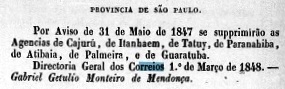
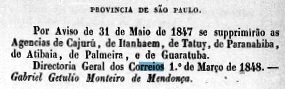
The local post office opened at least twice, although it has not yet been possible to date the first opening precisely. It is likely to have taken place around 1844. However, the agency closed in May 1847, according to an imperial ministerial report:
Relatório do Ministério do Império, 1848
The second opening, however, took place immediately in April of the following year, as Nova Monteiro writes in Administrações e Agencias Postaes do Brasil Imperio (in Brasil Filatelico/RJ, 1934-5; reprint SPP 1994-1999). The first local cancel TSP-1415a also occurs in light brown and was shown in the RHM catalogue:
TSP-1415a (RHM) ca. 1844
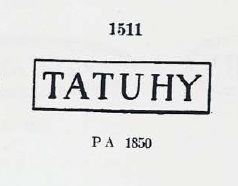
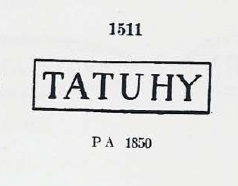
The next two postmarks have already been presented by Paulo Ayres in Catálogo de Carimbos Brasil-Império (S. Paulo, 1937, 1942). TSP-1415b corresponds to P. Ayres No. 1511 and was in use from about 1850 to 1867:
TSP-1415b (P.A. 1511)
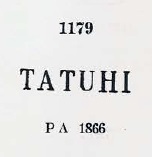
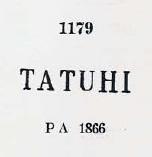
TSP-1415c is No. 1179 by Paulo Ayres, in use from about 1866:
TSP-1415c (P.A. 1179)
There followed four town stamps in double circle with the above inscription TATUHY. TSP-1415d (Coll. Mário Orsi Jr.) is a French type with the small star between brackets at the bottom, which also occurs in red. The dates inside have been found so far for the period 1776-1883. TSP-1415e (Coll. José A. Junges) is a plain double circle without decoration at the bottom, dated 1878-1880 in the centre. TSP-1415f (Coll. José A. Junges) has dates of 1884 and 1885 in the centre and an ornament at the bottom formed by four branches in lozenge. And TSP-1415g (Coll. José A. Junges) also appears in turquoise and blue and shows inner dates between 1886 and 1896. Here the lower ornament at the bottom is a cross-shaped circle with a smaller white circle in its centre.
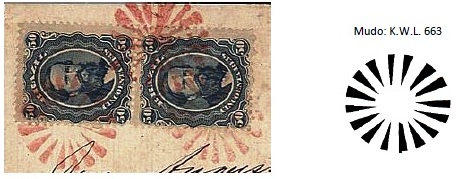
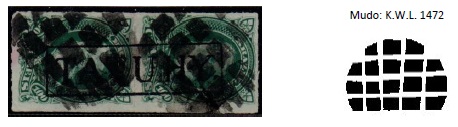
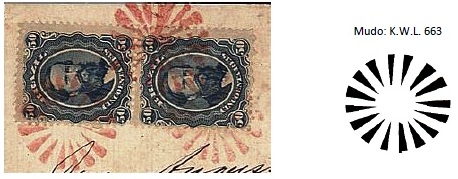
Philatelist Mario Celso Orsi Jr. was able to identify two mute cancels for Tatuhy listed in Mute Cancellations of the Brazil Empire / Carimbos Mudos do Brasil Império (Brazil Philatelic Association, Rio de Janeiro, 2000) by J.A. Dingler and K.W. Lopes. The cancel BPA 663 was found on a letter from 1876:
BPA 663 (MO) 1876
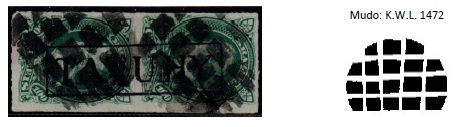
And cancel BPA 1472 was seen on a D. Pedro issue from 1877:
BPA 1472 (MO) 1877ffVilliers de l’Ile Adam: Carta (…) da Provincia de São Paulo, 1847
Tatuhy (auch Tatuhi, heute Tatuí geschrieben) war ab März 1822 eine Freguesia der Vila von Itapetininga, die am Nordufer des Flusses Tatuí (ein Nebenfluss des Sorocabas) lag, 140 km westlich der späteren Provinzhauptstadt São Paulo entfernt. Im Februar 1844 wurde der Ort zur Vila erhoben und ist seit Juli 1861 eine Stadt. Der Ortsname kommt aus der Tupi-guarani-Sprache und bedeutet Fluss der Gürteltiere.
Das örtliche Postamt eröffnete mindestens zweimal, wobei die erste Entstehung bisher nicht genau datiert werden konnte. Sie dürfte ca. 1844 stattgefunden haben. Die Agentur schloss aber im Mai 1847, wie aus einem kaiserlichen Ministerialbericht hervorgeht:
Relatório do Ministério do Império, 1848
Die zweite Eröffnung erfolgte aber gleich im April des folgenden Jahres, wie Nova Monteiro in Administrações e Agencias Postaes do Brasil Imperio (in Brasil Filatelico/RJ, 1934-5; Reprint SPP 1994-1999) schreibt. Der erste Ortsstempel TSP-1415a kommt auch in hellbraun vor und wurde im RHM-Katalog abgebildet:
TSP-1415a (RHM) ca. 1844
Die nächsten zwei Poststempel sind bereits durch Paulo Ayres in Catálogo de Carimbos Brasil-Império (S. Paulo, 1937, 1942) vorgestellt worden. TSP-1415b entspricht P. Ayres Nr. 1511 und war im Gebrauch von ca. 1850 bis 1867:
TSP-1415b (P.A. 1511)
TSP-1415c ist Nr. 1179 von Paulo Ayres, verwendet ab ca. 1866:
TSP-1415c (P.A. 1179)
Es folgten vier Ortsstempel in Doppelkreis mit der obigen Inschrift TATUHY. TSP-1415d (Samml. Mário Orsi Jr.) ist ein französischer Typus mit dem kleinen Stern zwischen Klammern unten, der auch in Rot vorkommt. Die Daten im Inneren wurden bisher für den Zeitraum 1776-1883 gefunden. TSP-1415e (Samml. José A. Junges) ist ein schlichter Doppelkreis ohne Verzierung unten, datiert 1878-1880 in der Mitte. TSP-1415f (Samml. José A. Junges) hat Daten von 1884 und 1885 in der Mitte und ein Ornament unten, das aus vier Zweigen in Raute gebildet wird. Und TSP-1415g (Samml. José A. Junges) kommt auch in türkis und blau vor und zeigt innere Daten zwischen 1886 und 1896. Hier ist die untere Verzierung unten ein kreuzförmiger Kreis mit einem kleineren weißen Kreis in der Mitte.
Der Philatelist Mario Celso Orsi Jr. konnte zwei stumme Stempel für Tatuhy identifizieren, die in Mute Cancellations of the Brazil Empire / Carimbos Mudos do Brasil Império (Brazil Philatelic Association, Rio de Janeiro, 2000) von J.A. Dingler und K.W. Lopes aufgelistet waren. Der Stempel BPA 663 wurde auf einem Brief aus 1876 gefunden:
BPA 663 (MO), 1876
Und der Stempel BPA 1472 war auf einer D. Pedro Marke aus dem Jahr 1877 zu sehen:
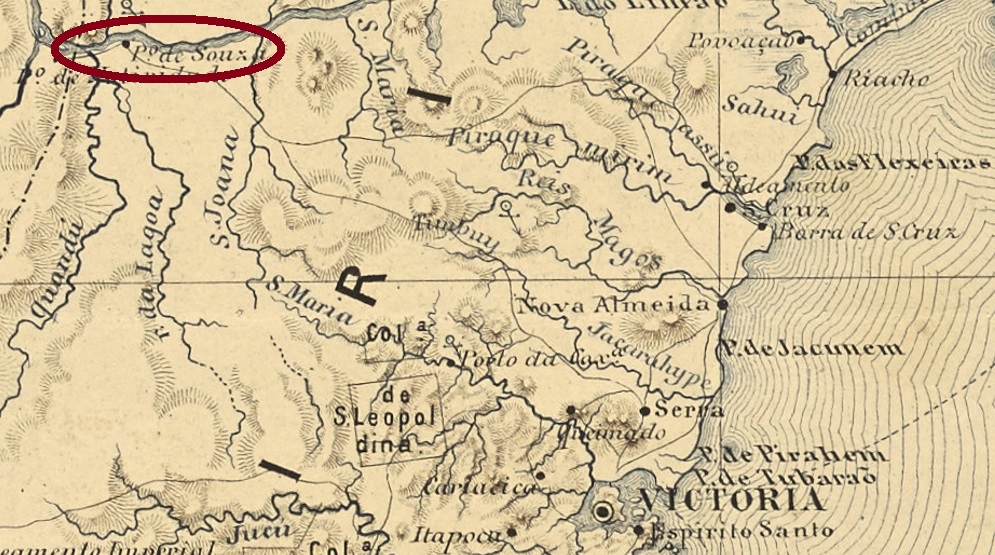
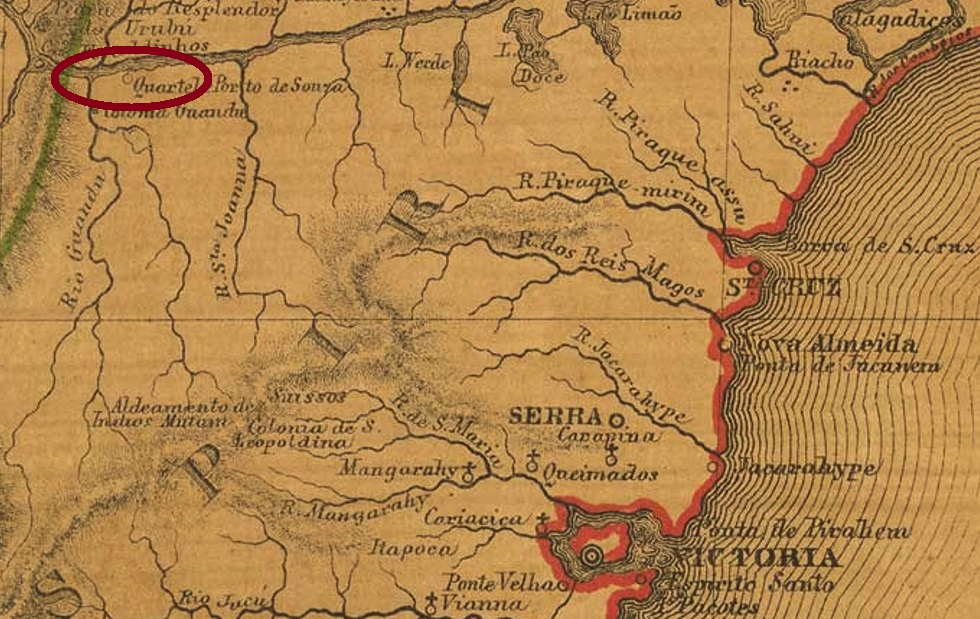
This village was not much more than a small port with a general shop (Empório) on the Rio Doce, located about 180 km from the provincial capital of Vitória. In February 1915, the village was incorporated into the newly created district of Baixo Guandu in the municipality of Linhares. Since April 1935 it has been a rural suburb of the Município of Baixo Guandu.
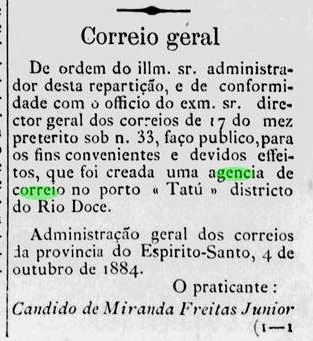
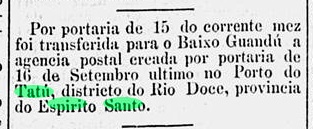
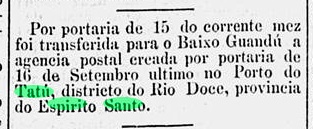
There was really a post office there, which was in operation for only three months, from September to December 1884:
A Provincia do Espirito Santo, 05.10.1884O Paiz/RJ, 16.12.1884
So far, no postmark of this locality has turned up. Must be a great rarity.
Provincia do Espirito Santo, 1873
Anderer Name: Porto do Tatú
Dieser Ortschaft war eigentlich ein kleiner Flusshafen mit einem Gemischtwarenladen (Empório) am Rio Doce, etwa 180 km der Provinzhauptstadt Vitória gelegen. Im Februar 1915 wurde der Ort dem neu gegründeten Distrikt von Baixo Guandu in der Gemeinde Linhares zugesprochen. Seit April 1935 ist es ein ländlicher Vorort des Município von Baixo Guandu.
Es gab dort tatsächlich ein Postamt, der lediglich drei Monate in Betrieb war, vom September bis Dezember 1884:
A Provincia do Espirito Santo, 05.10.1884O Paiz/RJ, 16.12.1884
Bisher ist kein Poststempel dieser Ortschaft aufgetaucht. Muss eine große Seltenheit sein.
















 Carimbologia