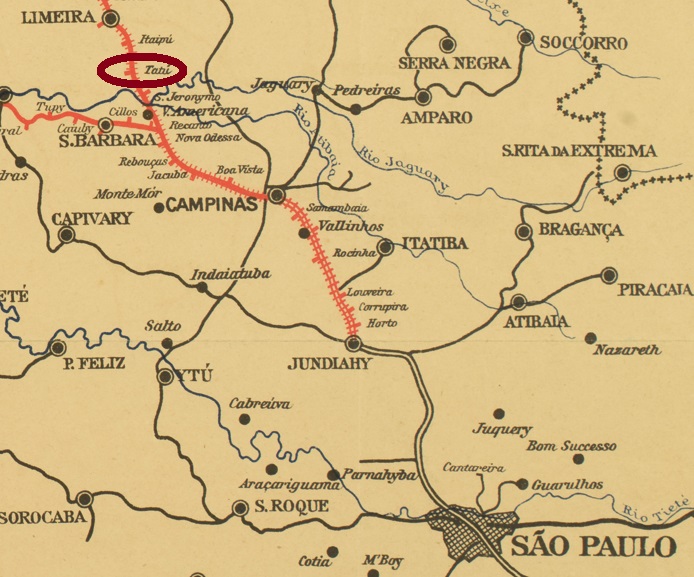
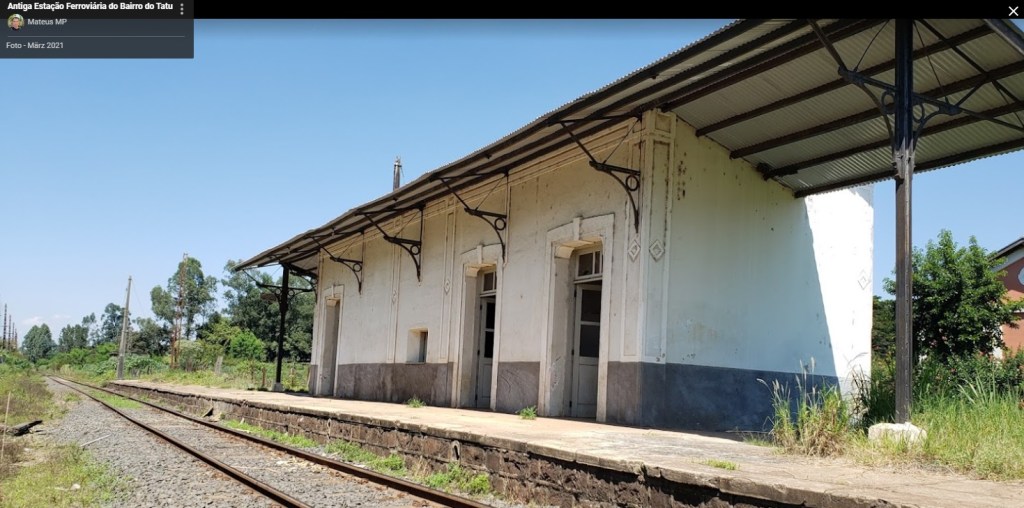
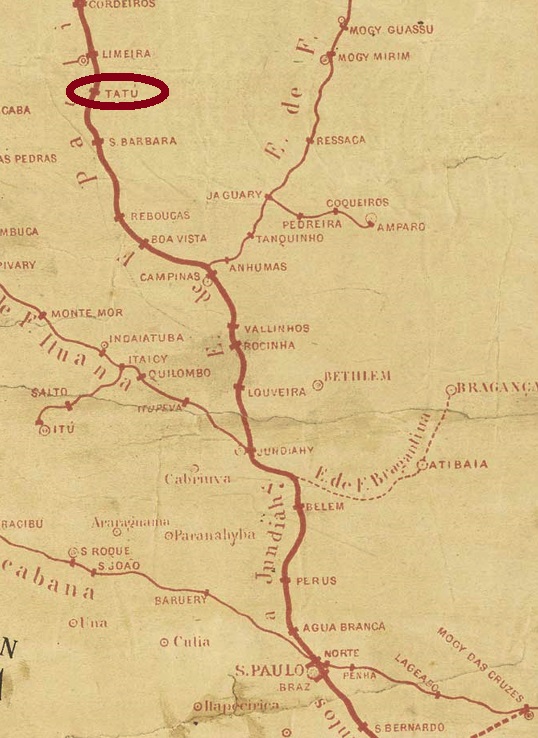
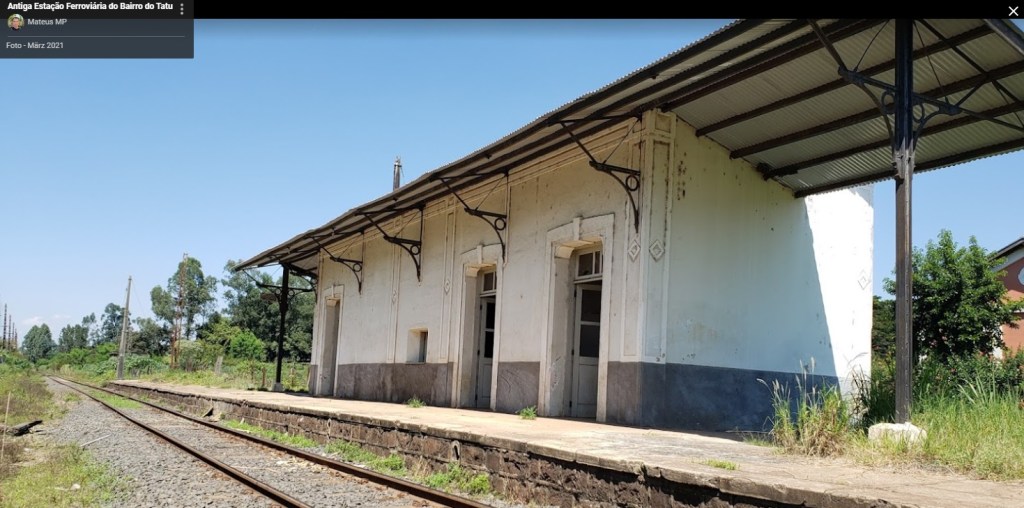
The Tatú (Armadillo) station was inaugurated in June 1876 by the Cia. Paulista Railway Company (main line) in the municipality of Limeira, located 140 km northwest of the provincial capital of São Paulo. The railway line was owned by FEPASA (estacoesferroviarias.com.br) from 1971 until its closure in 1998. A settlement grew up around the station, which was elevated as a district in November 1944, but since December 1953 it has been an outskirt of Limeira.
Photo: Mateus MP (CC-BY-SA)
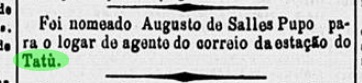
The station post office was created before May 1886, when probably the first postal clerk was nominated, according to the regional press:
Correio Paulistano, 30.05.1886
The imperial postmark is TSP-1410a (Coll. José A. Junges): a double circle with the inscription TATU above and an unfortunately illegible ornament below. The only specimen bears a date from 1887 in the centre.
Estações Ferroviarias do Rio de Janeiro, São Paulo e Minas Geraes, 1880
Der Bahnhof Tatú (Gürteltier) wurde im Juni 1876 durch die Cia. Paulista Eisenbahngesellschaft (Hauptlinie) in der Gemeinde Limeira eingeweiht und lag 140 km nordwestlich der Provinzhauptstadt São Paulo entfernt. Die Bahnlinie ging von 1971 bis zur Stilllegung 1998 in Besitz der FEPASA (estacoesferroviarias.com.br). Um den Bahnhof herum wuchs eine Siedlung, die im November 1944 als Distrikt erhoben wurde, seit Dezember 1953 aber ist sie ein Stadtteil von Limeira.
Foto: Mateus MP (CC-BY-SA)
Das Bahnhofspostamt entstand vor Mai 1886, als ein (erster?) Postangestellter ernannt wurde, wie aus der Regionalpresse hervorgeht:
Correio Paulistano, 30.05.1886
Der kaiserliche Poststempel ist TSP-1410a (Sammlung José A. Junges): ein Doppelkreis mit der Inschrift TATU oben und einem leider unleserlichen Ornament unten. Das einzige Exemplar trägt ein Datum aus 1887 in der Mitte.
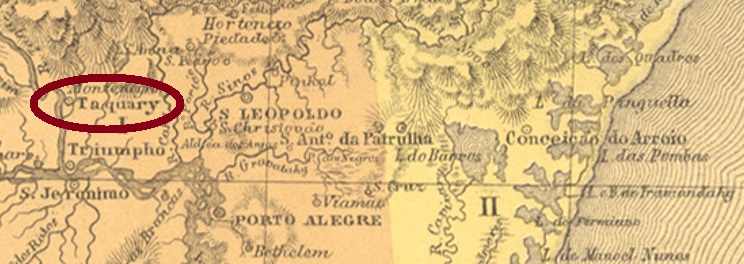
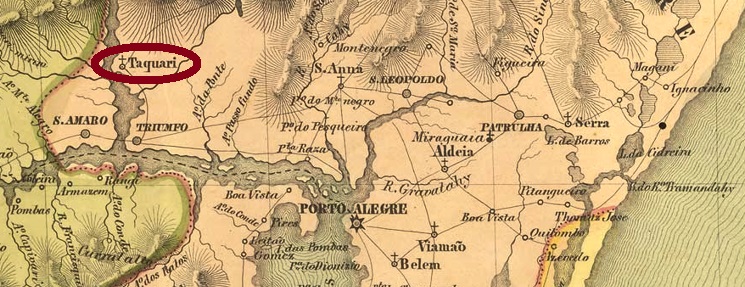
This locality is said to have been called the Chapel of São José do Tibiquary since May 1764, located about 100 km west of the future provincial capital of Porto Alegre. In 1831, it became a freguesia in the município of Triunfo, which was elevated to a vila in July 1849. Taquari has been a town since July 1891.
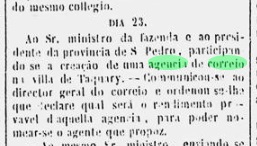
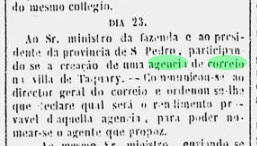
The local post office was established as early as January 1851, as noted by both Nova Monteiro in Administrações e Agencias Postaes do Brasil Imperio (in Brasil Filatelico/RJ, 1934-5; reprint SPP 1994-1999) and Aureo G. Santos in Agências de Correio Criadas e Suprimidas 1851, 1855, 1856 e 1857 (Brasil Filatélico 181, Rio de Janeiro, 1977). This is confirmed by the capital press:
Diario do Rio de Janeiro/01.02.1851
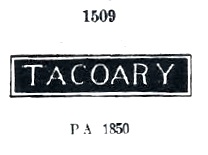
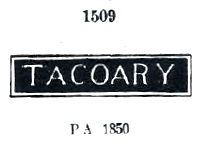
Three local stamps have been found so far for the 19th century. First came TRS-0445a, probably used from the beginning and already seen in Paulo Ayres’ Catálogo de Carimbos Brasil-Império (S. Paulo, 1937, 1942) under No. 1509:
TRS-0445a (P.A. 1509) 1851ff-1877ff
The following postmarks were double circles: TRS-0445b (Coll. José A. Junges) bears only the inscription TAQUARY at the top. The dates in the centre go from 1878 to 1885. TRS-0445c (Coll. José A. Junges) also appears in violet and has the same inscription at the top; there is now an ornament in X at the bottom. The internal dates are from 1890 to 1897.
In 1883, the Margem do Taquary (Taquary shore) station was inaugurated by the E.F. Porto Alegre a Uruguayana railway company. Around 1885, a station post office may also have gone into operation. The station stamp is TRS-0446a: a double ellipse with the inscription E.F. DE PORTO ALEGRE above and A URUGUAYANA below, plus TAQUARY in the centre.
Villiers de l’Ile Adam: Carta (…) da Provincia de São Pedro do Sul, 1847
Diese Ortschaft soll seit Mai 1764 die Kapelle von São José do Tibiquary geheißen haben, da ca. 100 km westlich der künftigen Provinzhauptstadt Posto Alegre entfernt lag. 1831 wurde daraus eine Freguesia im Município von Triunfo, die im Juli 1849 zur Vila erhoben wurde. Seit Juli 1891 ist Taquari eine Stadt.
Drei Ortsstempel wurden bisher für den 19. Jahrhundert gefunden. Zuerst kam TRS-0445a, der wohl von Beginn an verwendet wurde und bereits im Paulo Ayres‘ Catálogo de Carimbos Brasil-Império, (S. Paulo, 1937, 1942) unter Nr. 1509 zu sehen war:
TRS-0445a (P.A. 1509) 1851ff-1877ff
Die folgenden Poststempel waren Doppelkreise: TRS-0445b (Samml. José A. Junges) trägt lediglich die Inschrift TAQUARY oben. Die Daten in der Mitte gehen von 1878 bis 1885. TRS-0445c (Samml. José A. Junges) erscheint auch in violett und hat oben die gleiche Inschrift; unten ist nun ein Ornament in X zu sehen. Die inneren Daten sind von 1890 bis 1897.
1883 wurde der Bahnhof Margem do Taquary (Taquary-Ufer) durch die E.F. Porto Alegre a Uruguayana Bahngesellschaft eingeweiht. Um 1885 dürfte auch ein Bahnhofspostamt in Betrieb gegangen sein. Der Bahnhofsstempel ist TRS-0446a: eine Doppelellipse mit der Inschrift E.F. DE PORTO ALEGRE oben und A URUGUAYANA unten, dazu TAQUARY in der Mitte.
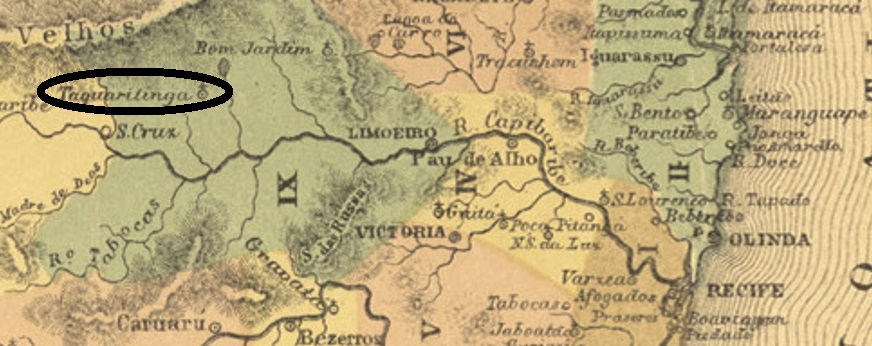
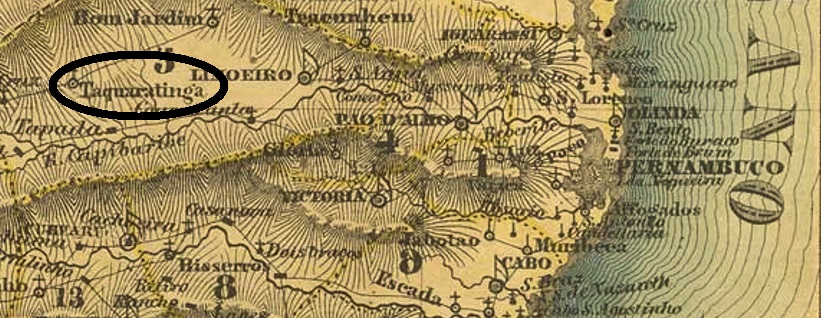
100 years ago, there were two places in Brazil with this name, but the Taquaretinga in São Paulo was not called so until 1907. Our locality in Pernambuco was the freguesia of Santo Amaro de Taquaretinga near Limoeiro from July 1811, located 160 km west of the future provincial capital Recife. In May 1877, it became a vila and 10 years later a town. Since December 1943, the município has been called Taquaritinga do Norte. The name probably comes from itacoaretetinga and means white stone with a large hole the Tupi-guarani language.
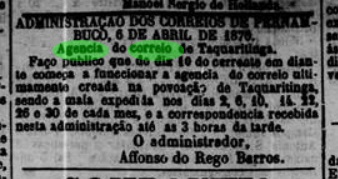
Two years of origin for the local post office have been found. The Directory of Imperial Post Offices (Tabella das Agencias do Correio do Imperio, Rio de Janeiro, 1885) gives the year 1873 for it. If the agency really went into operation, it was short-lived, as this post office was again announced in April 1876:
Diario de Pernambuco, 08.04.1876
Two 19th century postmarks were found. TPE-0625a (Coll. Fuad Ferreira Fo.) is a French type, with the inscription TAQUARETINGA above and the typical star between brackets below. The date on the only specimen so far (a numeral issue from 1885) is missing. TPE-0625b (Coll. José A. Junges) is a double circle with the inscription TAQUARETINGA at the top. The only specimen bears a date from 1898 in the centre.
Villiers de l’Ile Adam: Carta (…) das Provincias de Pernambuco, Alagoas e Sergipe, 1848
Andere Namen: Taquaritinga do Norte (1943)
Vor 100 Jahren gab es zwar in Brasilien zwei Ortschaften, die so hießen, aber die Taquaretinga in São Paulo hat diese Bezeichnung erst 1907 bekommen. Unsere Taquaretinga in Pernambuco war ab Juli 1811 die Freguesia von Santo Amaro de Taquaretinga bei Limoeiro und lag 160 km westlich von der künftigen Provinzhauptstadt Recife entfernt. Im Mai 1877 wurde daraus eine Vila und 10 Jahre später eine Stadt. Seit Dezember 1943 heißt der Município Taquaritinga do Norte. Der Name kommt wohl aus dem Begriff Itacoaretetinga, der Tupi-guarani-Sprache, und heißt weißer Stein mit einem großen Loch.
Zwei Entstehungsjahre fürs örtliche Postamt wurden gefunden. Das Verzeichnis der kaiserlichen Postämter (Tabella das Agencias do Correio do Imperio, Rio de Janeiro, 1885) schreibt dafür das Jahr 1873. Falls die Agentur tatsächlich in Betrieb ging, war sie von kurzer Dauer, denn im April 1876 sollte dieses Postamt nochmals entstanden sein:
Diario de Pernambuco, 08.04.1876
Zwei Poststempel aus dem 19. Jahrhundert wurden gefunden. TPE-0625a (Samml. Fuad Ferreira Fo.) ist ein französischer Typus, mit der Inschrift TAQUARETINGA oben und dem typischen Stern zwischen Klammern unten. Das Datum auf dem bisher einzigen Exemplar (eine Ziffer-Ausgabe aus 1885) fehlt. TPE-0625b (Samml. José A. Junges) ist ein Doppelkreis mit der Inschrift TAQUARETINGA oben. Das einzige Exemplar trägt ein Datum aus 1898 in der Mitte.
Other names: Taquarussu, Taquaraçu de Minas (1962)
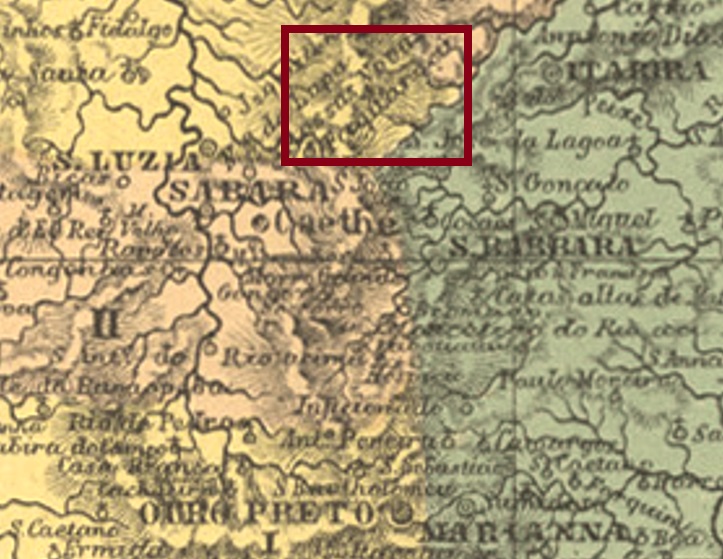
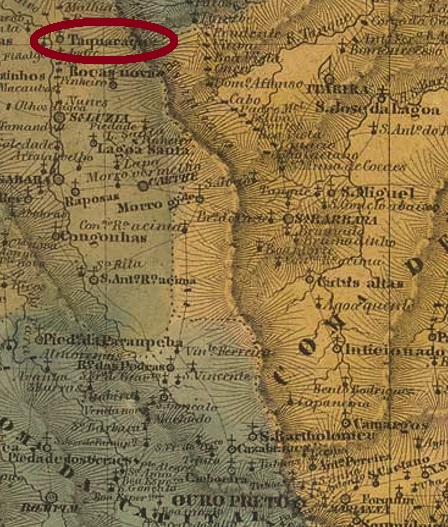
The Freguesia of Santíssimo Sacramento de Taquarassu was established in April 1841 in the Município of Caetés and was located on the south bank of the Rio Taquaraçu, 150 north of the provincial capital Ouro Preto. It was not until December 1962 that the locality gained administrative autonomy, when it became the Município of Taquaraçu de Minas.
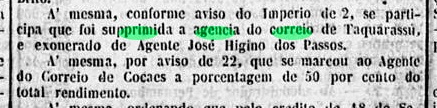
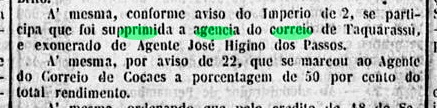
Two periods of operation were found for the local post office. First, from about 1845 to March 1847, as can be read in the Annuario for 1846 and in the Rio press:
Annuario 1846Gazeta Official/RJ, 30.03.1847
The second opening of the postal agency took place 35 years later, in August 1882, as Paula Sobrinho writes in História Postal de Minas Gerais (Belo Horizonte, 1997). From the second period of operation, the only postmark of this locality has survived. TMG-3175b (Coll. José A. Junges) is a double circle with the inscription TAQUARASSÚ above and an ornament in lozenge below, the four sides of which are open. The dates inside go from about 1882 to 1890.
Villiers de l’Ile Adam: Carta (…) da Provincia de Minas Geraes, 1849
Andere Namen: Taquarussu, Taquaraçu de Minas (1962)
Die Freguesia von Santíssimo Sacramento de Taquarassu wurde im April 1841 im Município von Caetés errichtet und lag and Südufer des Rio Taquaraçu, 150 nördlich der Provinzhauptstadt Ouro Preto entfernt. Erst im Dezember 1962 kam die Verwaltungsautonomie der Gemeinde zustande, als der Município von Taquaraçu de Minas.
Zwei Betriebsperioden wurden fürs örtliche Postamt gefunden. Erstens von ca. 1845 bis März 1847. Wie im Jahrbuch (Annuario) für 1846 bzw in der Presse aus Rio zu lesen ist:
Annuario 1846Gazeta Official/RJ, 30.03.1847
Die Zweiteröffnung der Postagentur erfolgte erst 35 Jahre später, im August 1882, wie Paula Sobrinho in História Postal de Minas Gerais (Belo Horizonte, 1997) schreibt. Aus der zweiten Betriebsperiode ist auch der bisher einzige Poststempel dieser Ortschaft überliefert. TMG-3175b (Samml. José A. Junges) ist ein Doppelkreis mit der Inschrift TAQUARASSÚ oben und einem Ornament in Raute unten, dessen vier Seiten offen sind. Die Daten in Inneren gehen von ca. 1882 bis 1890.
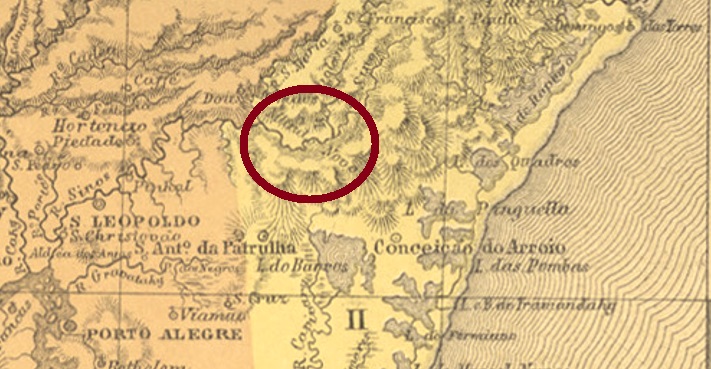
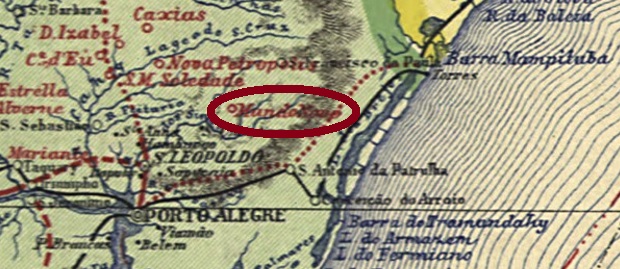
Senhor Bom Jesus da Taquara do Mundo Novo (Kind Lord Jesus of the New World Bamboo) was the name of the district settled mainly by German colonists, established in May 1882 in the Município of Santo Antonio da Patrulha, 80 km northeast of the provincial capital Porto Alegre. It became a vila as early as May 1886, and a city in December 1908.
In the Directory of Imperial Post Offices (Tabella das Agencias do Correio do Imperio, Rio de Janeiro, 1885), we read that there had been a post office there since 1881. The oldest postmark so far is TRS-0440a (Coll. José A. Junges) a double circle with the inscription TAQUARA above and an ornament in cross below formed by four arrowheads. The dates inside go from 1888 to 1907.
Carta da Republica dos Estados Unidos do Brazil, 1892
Anderer Name: Taquara do Mundo Novo
Senhor Bom Jesus da Taquara do Mundo Novo (Gütiger Herr Jesus des Neuen-Welt-Bambus) hieß der überwiegend durch deutsche Kolonisten besiedelte Distrikt, der im Mai 1882 im Município von Santo Antonio da Patrulha gegründet wurde, 80 km nordöstlich der Provinzhauptstadt Porto Alegre entfernt. Bereits im Mai 1886 wurde daraus eine Vila, und im Dezember 1908 eine Stadt.
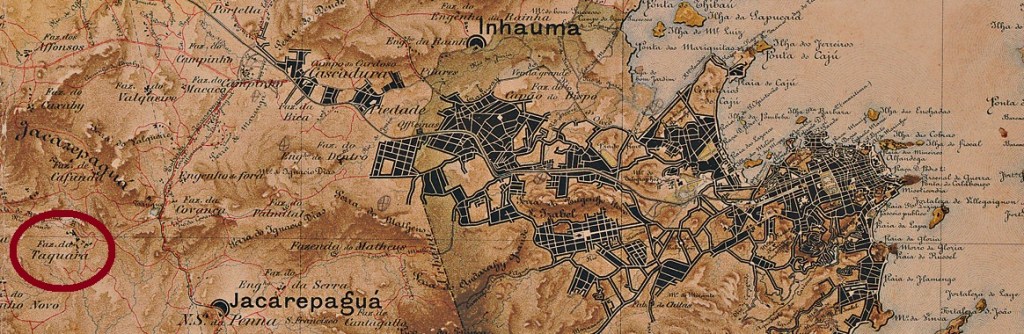
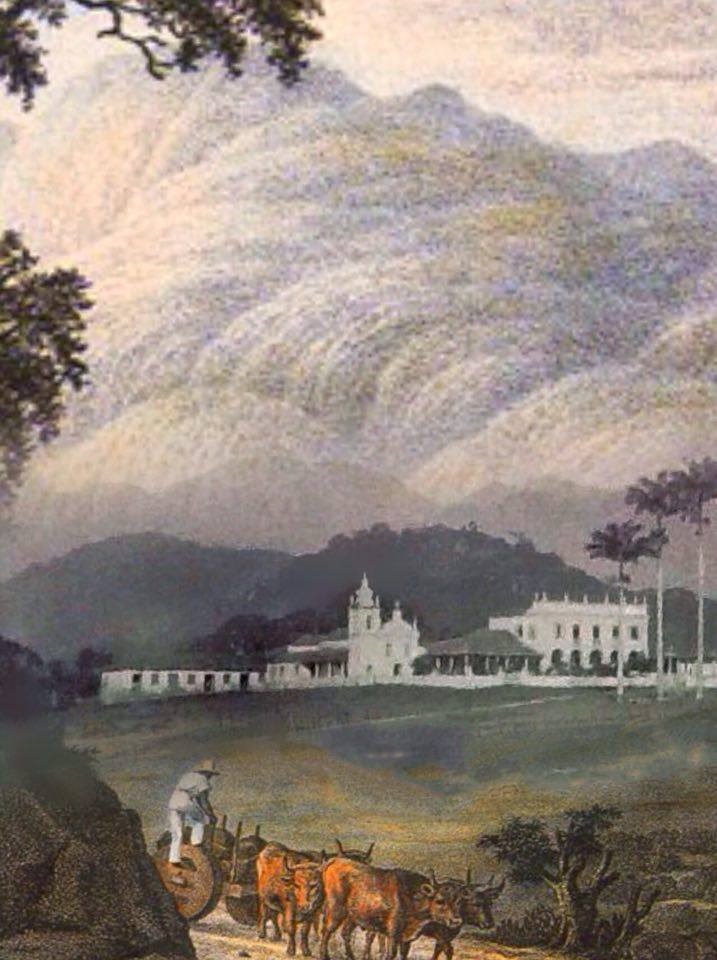
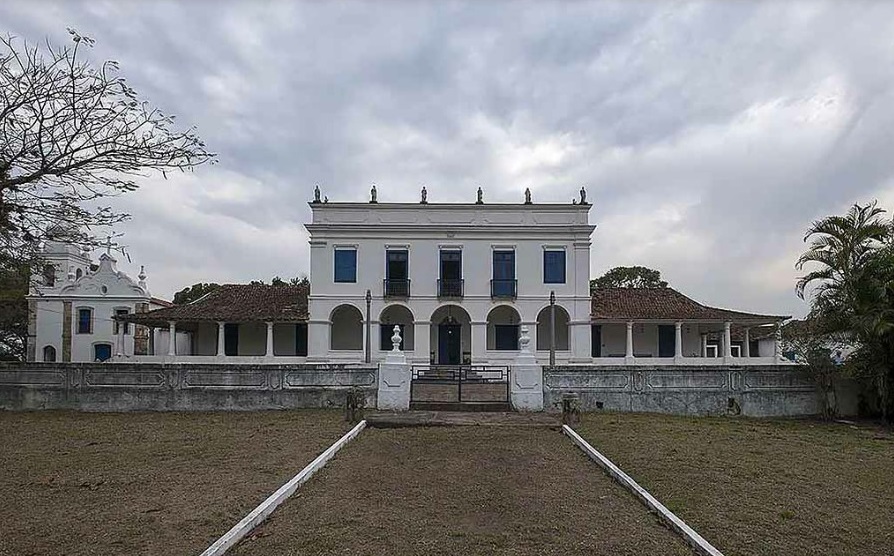
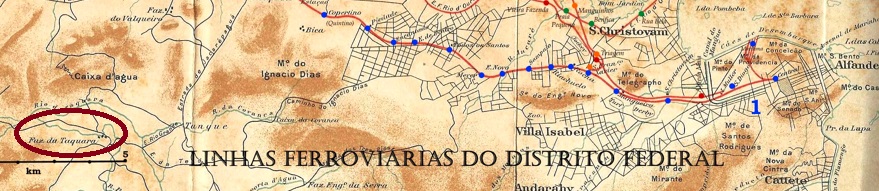
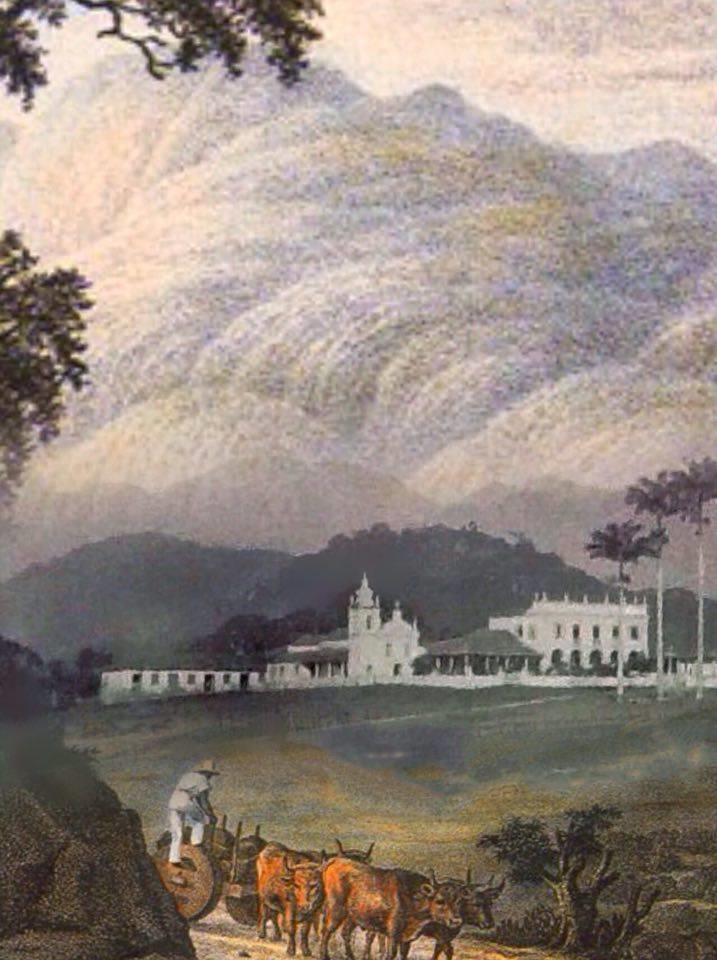
The history of this village began in 1757 with the establishment of the Fazenda da Taquara, 25 km west of the capital Rio de Janeiro. From then on, the estate shaped the social and economic development of the village and produced grapes, among other things, whose wine was allegedly also appreciated by Emperor D. Pedro II.
Instituto Historico e Geografico Itaborahyense
The growing settlement was subordinated to the Freguesia de Jacarepaguá during the 19th century. Today, Taquara is a district of Barra and Jacarepaguá, close to the Pedra Branca (White Stone) Regional Park.
Foto: Oscar H. Liberal (IPHAN)
There are two dates of foundation for the local post office. First in 1872, as listed in the Directory of Imperial Post Offices (Tabella das Agencias do Correio do Imperio, Rio de Janeiro, 1885). Then again in the early Republic, in April 1891, as shown in the postal report (Boletim Postal) of that year. So far, no local postmark from the 19th century has been found.
agenciaspostais.com.br
Die Geschichte dieser Ortschaft fing 1757 mit der Errichtung der Fazenda da Taquara an, die 25 km westlich der Hauptstadt Rio de Janeiro entfernt lag. Das Landgut prägte fortan die soziale und wirtschaftliche Entwicklung des Ortes und erzeugte u.a. Trauben, deren Wein angeblich auch vom Kaiser D. Pedro II geschätzt wurde.
Instituto Historico e Geografico Itaborahyense
Die wachsende Siedlung wurde im Lauf des 19. Jahrhunderts der Freguesia de Jacarepaguá untergeordnet. Heute ist Taquara ein Stadtteil des Distrikts von Barra und Jacarepaguá, der nah am Regionalpark der Pedra Branca (Weißer Stein) liegt.
Foto: Oscar H. Liberal (IPHAN)
Zwei Gründungsdaten fürs örtliche Postamt liegen vor. Erstmals 1872, wie im Verzeichnis der kaiserlichen Postämter (Tabella das Agencias do Correio do Imperio, Rio de Janeiro, 1885) aufgelistet. Dann wieder in der frühen Republik, im April 1891, wie aus dem Postbericht (Boletim Postal) des Jahres hervorgeht. Bisher wurde kein lokaler Poststempel aus dem 19. Jahrhundert gefunden.
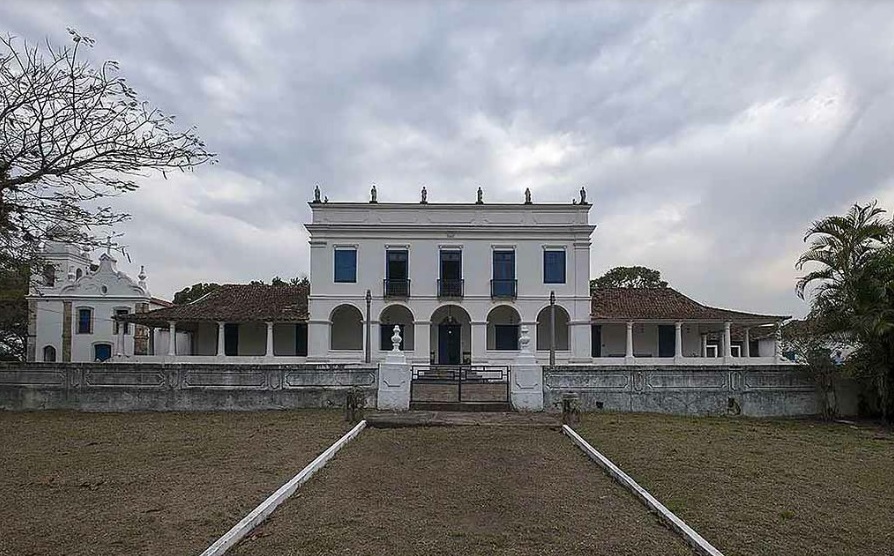
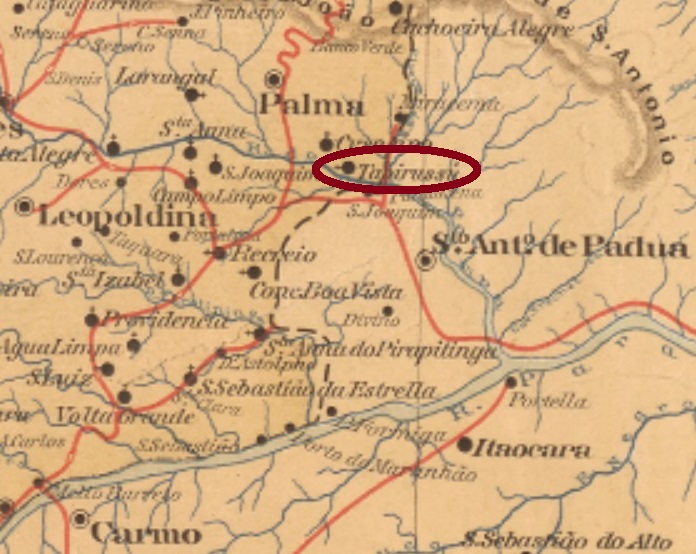
Tapirussu was a freguesia near São Francisco do Capivara in the Município of Cataguazes from October 1883, a good 270 km southeast of Outo Preto. In March 1891, the village was assigned to the newly created Município of Palmas. Since September 1923, this district has been called Itapiruçu. The word from the tupi-guarani language means big tapir.
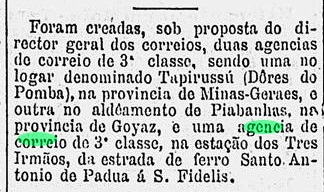
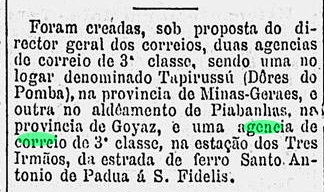
The local post office has existed since the beginning of September 1881, as reported by the Rio Press:
Gazeta de Noticias/RJ, 04.09.1881
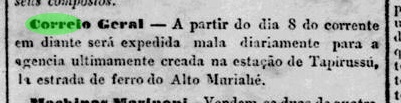
In April or May 1883, a station of the E.F. Leopoldina Railway Company was inaugurated there, on the so-called Paraoquena branch. From 1975 until its closure in 1996, the railway line belonged to Rede Ferroviária Federal S.A. (estacoesferroviarias.com.br). The station post office was built in 1884. Paula Sobrinho (História Postal de Minas Gerais, Belo Horizonte, 1997) writes 31 March for it. However, it must have taken a while for the post office to start operating, as can be read on the capital’s press:
Jornal do Commercio/RJ, 07.07.1884
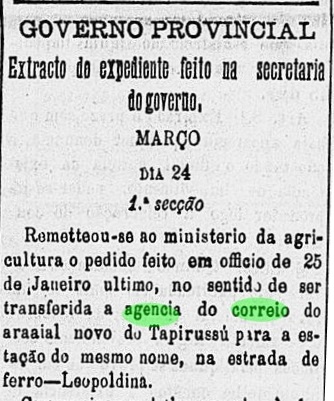
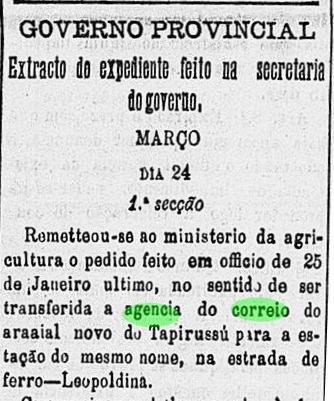
It is likely that the opening of the railway post office caused the old local agency to close. Anyway, the move of the post office to the railway station was already requested in January 1884:
Liberal Mineiro, 10.05.1884
This would mean that the old local postmark was also used later in the station agency. The town cancel is TGM-3170a (Coll. José A. Junges): a double circle with the inscription TAPIRUSSÚ above and an ornament in lozenge below. The dates in the centre are from 1885 to 1893. The station postmark is TMG-3171a (Coll. José A. Junges). Here, in addition to the place name at the top, there is the indication (ESTAÇÃO) at the bottom. Dates in the middle from 1886 to 1891.
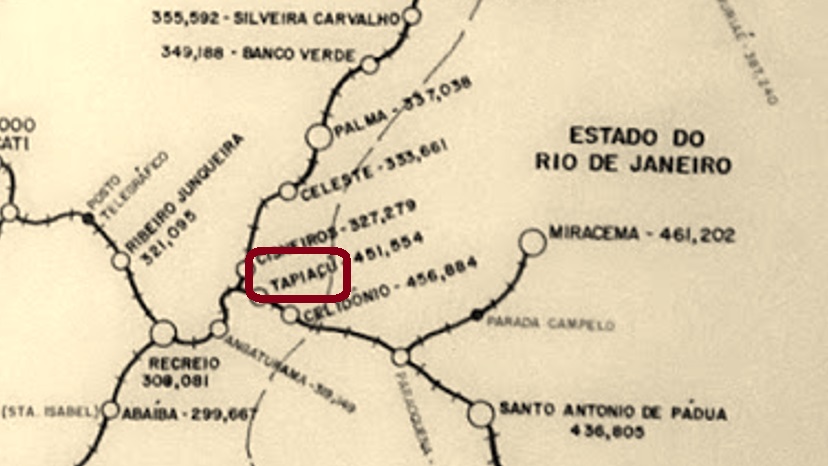
Estrada de Ferro Leopoldina (mit falschem Namen Tapiaçú)
Tapirussu war ab Oktober 1883 eine Freguesia bei São Francisco do Capivara im Município von Cataguazes, die gut 270 km südöstlich von Outo Preto entfernt lag. Im März 1891 wurde die Ortschaft dem neuentstandenen Município von Palmas zugeordnet. Seit September 1923 heißt dieser Distrikt Itapiruçu. Das Wort aus der Tupi-guarani-Sprache bedeutet großer Tapir.
Das örtliche Postamt gab es seit Anfang September 1881, wie die Rio-Presse berichtet:
Gazeta de Noticias/RJ, 04.09.1881
Im April oder Mai 1883 wurde dort ein Bahnhof der E.F. Leopoldina Eisenbahngesellschaft auf der sogenannten Paraoquena-Abzweigung eingeweiht. Von 1975 bis zur Stilllegung 1996 gehörte die Bahnstrecke der Rede Ferroviária Federal S.A. (estacoesferroviarias.com.br). Das Bahnhofpostamt entstand 1884. Paula Sobrinho (História Postal de Minas Gerais, Belo Horizonte, 1997) schreibt dafür den 31. März. Allerdings dürfte es eine Weile gedauert haben, bis der Postbetrieb aufgenommen wurde, wie aus der Hauptstadtpresse hervorgeht:
Jornal do Commercio/RJ, 07.07.1884
Es ist wahrscheinlich, dass durch die Eröffnung des Bahnpostamts die alte Agentur vor Ort zugemacht hat. Jedenfalls wurde der Umzug des Postamts in den Bahnhof bereits im Januar 1884 beantragt:
Liberal Mineiro, 10.05.1884
Das würde bedeuten, dass der alte Ortsstempel auch später in der Bahnhofsagentur Verwendung fand. Der Ortsstempel ist TGM-3170a (Samml. José A. Junges): ein Doppelkreis mit der Inschrift TAPIRUSSÚ oben und einem Ornament in Raute unten. Die Daten in der Mitte gehen von 1885 bis 1893. Der Bahnhofspoststempel ist TMG-3171a (Samml. José A. Junges): hier gibt es außer dem Ortsnamen oben die Angabe (ESTAÇÃO) unten. Daten in der Mitte von 1886 bis 1891.
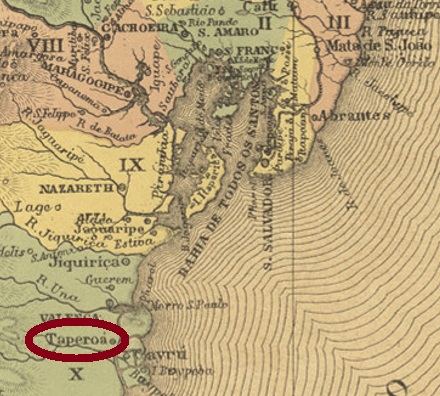
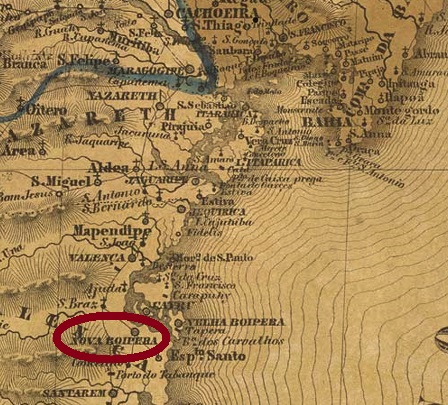
This village was originally an Indian settlement called São Miguel de Taperoguá, located between Valença and Cayru, 140 km southwest of the provincial capital Salvador da Bahia. At the beginning of the 19th century, it rose to become a freguesia called Nova Boipeba, but by May 1847 it had become the Vila of Taperoá. Since April 1906, Taperoá has been a town.
As Nova Monteiro writes in Administrações e Agencias Postaes do Brasil Imperio (Brasil Filatelico/RJ, 1934-5; Reprint SPP 1994-1999), there was a post office there since March 1863. Two postmarks have been found, but unfortunately not the very first one. TBA-0730b (Coll. José A. Junges) is a simple double circle with the inscription TAPEROÁ on top. The dates in the centre go from about 1878 to 1893. TBA-0730c (Coll. José A. Junges) should already be Republican. The inscription (BAHIA) now appears at the bottom of the double circle. There is a date from 1899 in the centre.
Villiers de l’Ile Adam: Carta (…) da Provincia da Bahia, 1848
Anderer Name: Nova Boipeba
Diese Ortschaft war ursprünglich ein Indianerdorf namens São Miguel de Taperoguá und lag zwischen Valença und Cayru, 140 km südwestlich der Provinzhauptstadt Salvador da Bahia entfernt. Am Anfang des 19. Jahrhunderts stieg sie zu einer Freguesia namens Nova Boipeba auf, aber schon im Mai 1847 wurde sie zur Vila von Taperoá. Seit April 1906 ist Taperoá eine Stadt.
Wie Nova Monteiro in Administrações e Agencias Postaes do Brasil Imperio (Brasil Filatelico/RJ, 1934-5; Reprint SPP 1994-1999) schreibt, gab es dort ein Postamt seit März 1863. Zwei Poststempel wurden zwar gefunden, leider noch nicht der allererste. TBA-0730b (Samml. José A. Junges) ist ein schlichter Doppelkreis mit der Inschrift TAPEROÁ oben. Die Daten in der Mitte gehen von ca. 1878 bis 1893. TBA-0730c (Samml. José A. Junges) dürfte bereits republikanisch sein. Im Doppelkreis erscheint nun unten die Inschrift (BAHIA) dazu. Datum in der Mitte aus 1899.
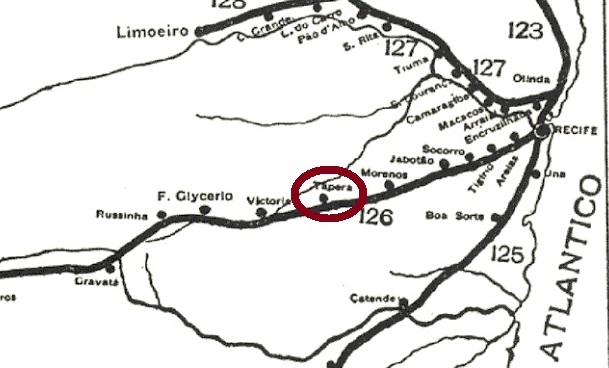
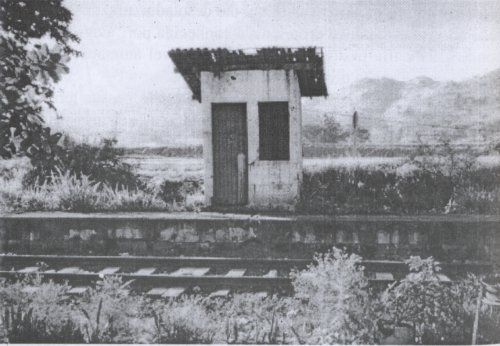
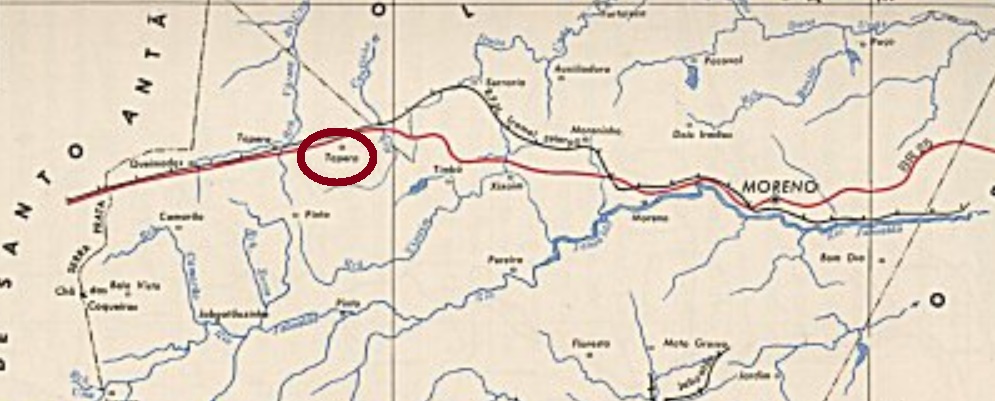
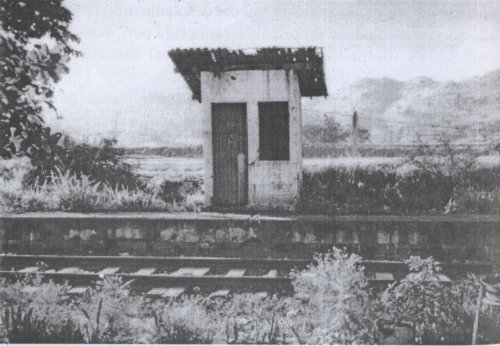
Tapera station was inaugurated in November 1888 by the E.F. Central de Pernambuco railway company (Central Line) in the Município of Jaboatão and was located about 40 km west of the provincial capital Recife. The line went to Great Western in 1904, to Rede Ferroviária do Nordeste in 1950 and to Rede Ferroviária Federal S.A. in 1975 until its closure in 1996. Since October 1928, the station has been in the Município of Moreno. Today, however, quite little remains of it (estacoesferroviarias.com.br):
Luiz Rubem Bonfim: E.F. Central de Pernambuco, 2002 (estacoesferroviarias.com.br)
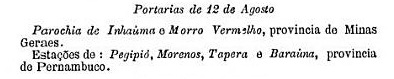
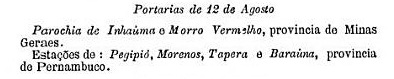
Hard to believe, but there was a post office there from August 1889, as shown in the postal report (Boletim Postal) of the following month:
Boletim Postal 5, Sep/89
The station postmark in the 19th century is TPE-0620a (Col. Ginaldo Bezerra da Silva): a double circle with the inscriptions E. DA TAPERA above and (PERNAMBUCO) below. The only specimen seen has a date of 1891 in the centre.
estacoesferroviarias.com.br
Der Bahnhof Tapera wurde im November 1888 durch die E.F. Central de Pernambuco Bahngesellschaft (Zentrumlinie) im Município von Jaboatão eingeweiht und lag ca. 40 km westlich der Provinzhauptstadt Recife entfernt. Die Linie ging 1904 zur Great Western, 1950 zur Rede Ferroviária do Nordeste und 1975 bis zur Stilllegung 1996 zur Rede Ferroviária Federal S.A. Seit Oktober 1928 befindet sich der Bahnhof im Município von Moreno. Heute ist allerdings nicht viel davon übriggeblieben (estacoesferroviarias.com.br):
Luiz Rubem Bonfim: E.F. Central de Pernambuco, 2002 (estacoesferroviarias.com.br)
Kaum zu glauben, aber dort gab es ab August 1889 ein Postamt, wie aus dem Postbericht (Boletim Postal) vom darauffolgenden Monat hervorgeht:
Boletim Postal 5, Sept./89
Der Bahnhofsstempel im 19. Jahrhundert ist TPE-0620a (Col. Ginaldo Bezerra da Silva): ein Doppelkreis mit den Inschriften E. DA TAPERA oben und (PERNAMBUCO) unten. Das einzige gesehene Exemplar trägt in der Mitte die Jahreszahl 1891.
Villiers de l’Ile Adam: Carta (…) da Provincia da Bahia, 1848
Another name: Santa Terezinha (1928)
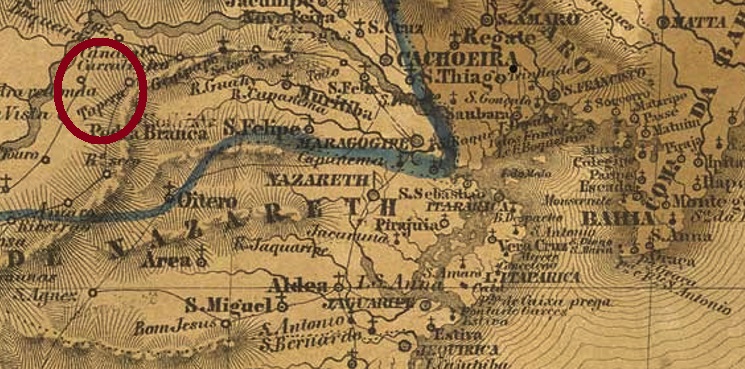
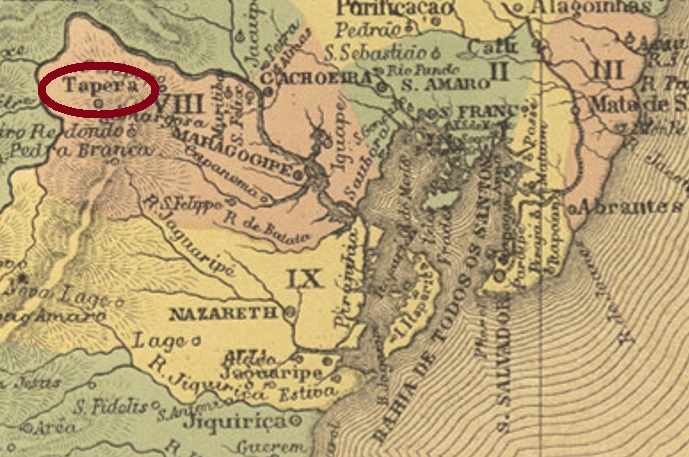
The Freguesia of Nossa Senhora da Conceição da Tapera was established in April 1843 in the Município of Cachoeira, 200 km west of the provincial capital of Salvador da Bahia. In October 1849, the village rose to the status of vila, but was demoted as a district of Amargosa in April 1877. It was promoted again as a município in May 1890, and since June 1928 the municipality has been called Santa Teresinha.
Two foundation dates for the local post office have been found. First, in September 1866, as stated in the Nova Monteiros Administrações e Agencias Postaes do Brasil Imperio (Brasil Filatelico/RJ, 1934-5; Reprint SPP 1994-1999). Then in 1868, as listed in the Directory of Imperial Post Offices (Tabella das Agencias do Correio do Imperio, Rio de Janeiro, 1885).
Three postmarks exist for the 19th century. First TBA-0725b (Coll. Fuad Ferreira Fo.): a double circle with the inscription TAPERA on top. The dates in the centre go from 1881 to 1889. Then TBA-0725c, as illustrated in Paulo Ayres’ Catálogo de Carimbos Brasil-Império (S. Paulo, 1937, 1942) under no. 1728:
TBA-0725c (P.A. 1728) 1885ff
Most recently TBA-0725d (Coll. José A. Junges). This double circle not only has the inscription TAPERA at the top, but also a five-pointed star as an ornament at the bottom. The inner dates go from 1889 to 1892.
Atlas do Imperio do Brasil, 1868
Andere Name: Santa Terezinha (1928)
Die Freguesia von Nossa Senhora da Conceição da Tapera wurde im April 1843 im Município von Cachoeira errichtet und lag 200 km westlich der Provinzhauptstadt Salvador da Bahia entfernt. Im Oktober 1849 stieg der Ort zur Vila auf, wurde aber im April 1877 als Distrikt von Amargosa degradiert. Der Wiederaufstieg als Município erfolgte im Mai 1890, und seit Juni 1928 heißt die Gemeinde Santa Teresinha.
Drei Poststempel sind für den 19. Jahrhundert überliefert. Zunächst TBA-0725b (Samml. Fuad Ferreira Fo.): ein Doppelkreis mit der Inschrift TAPERA oben. Die Daten in der Mitte gehen von 1881 bis 1889. Dann TBA-0725c, wie in Paulo Ayres‘ Catálogo de Carimbos Brasil-Império (S. Paulo, 1937, 1942) unter der Nr. 1728 abgebildet:
TBA-0725c (P.A. 1728) 1885ff
Zuletzt TBA-0725d (Samml. José A. Junges). Bei diesem Doppelkreis gibt es nicht nur die Inschrift TAPERA oben, sondern auch einen fünfzackigen Stern als Ornament unten. Die inneren Daten gehen von 1889 bis 1892.




 Carimbologia