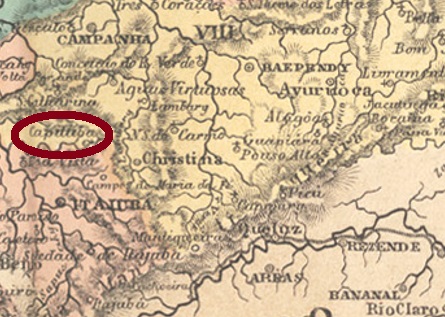
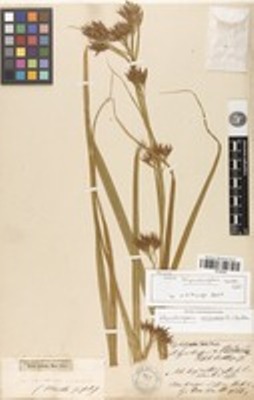
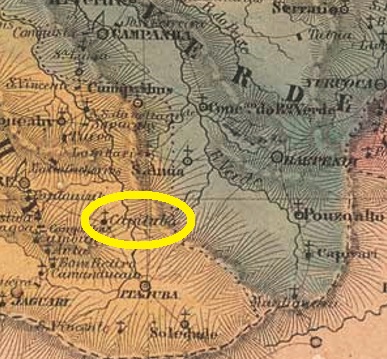
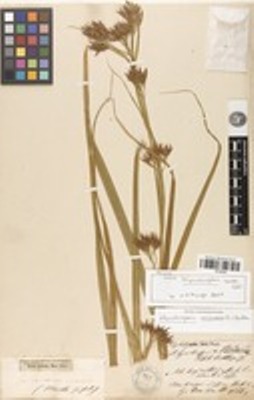
São Sebastião do Capituba was a freguesia of Christina from July 1832, situated 400 km southwest of the provincial capital Ouro Preto. Capituba is the name given in Brazil to an aquatic plant (Rynchospora aurea) of the Cyperaceae family:
Rynchospora aurea (plants.jstor.org)
In November 1880, the place rose to the status of a district under the name of São Sebastião da Pedra Branca (= of the white stone), which was elevated to the status of a villa in October 1884. After that, the place name changed twice: in September 1891 to Pedra Branca and in December 1943 to Pedralva.
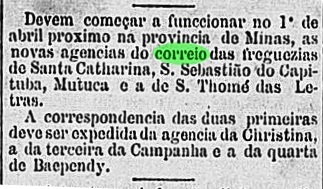
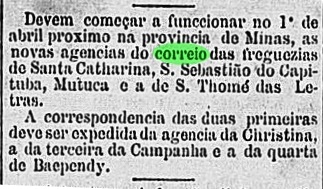
Paula Sobrinho writes in História Postal de Minas Gerais (Belo Horizonte, 1997) that the local post office was created in October 1877. However, it did not start operating until April of the following year, as noticed by the Rio press:
Gazeta de Noticias/RJ, 20/03/1878
Until now, no postmark with the complete original place name (S. Sebastião do Capituba) was seen. Prossibly it does not exist, as R. Koester in Carimbologia IX shows a postmark from 1887 with the legend CAPITUBA. SMG-2595b (Coll. Marcio Protzner) is a double circle with the inscription S. SEBAST. DA PEDRA BRANCA above and (MG) below. Interior dates found so far for 1895 and 1897.
Villiers de l’Ile Adam: Carta (…) da Provincia de Minas Geraes
Andere Namen: Pedra Branca, Pedralva (1943)
Siehe auch Capituba (R. Koester: Carimbologia IX)
São Sebastião do Capituba war ab Juli 1832 eine Freguesia von Christina, die 400 km südwestlich der Provinzhauptstadt Ouro Preto entfernt lag. Capituba nennt man in Brasilien eine Wasserpflanze (Rynchospora aurea) der Familie Cyperaceae:
Rynchospora aurea (plants.jstor.org)
Im November 1880 stieg der Ort zum Distrikt unter dem Namen São Sebastião da Pedra Branca (= vom weißen Stein) auf, der im Oktober 1884 zur Villa erhoben wurde. Danach wechselte der Ortsname zweimal: im September 1891 zu Pedra Branca und im Dezember 1943 zu Pedralva.
Paula Sobrinho schreibt in História Postal de Minas Gerais (Belo Horizonte, 1997), dass das örtliche Postamt im Oktober 1877 entstanden ist. Allerdings wurde der Betrieb erst im April des folgenden Jahres aufgenommen, wie die Presse aus Rio informiert:
Gazeta de Noticias/RJ, 20.03.1878
Bisher war kein Poststempel mit dem ursprünglichen Ortsnamen (S. Sebastião do Capituba) vollständig zu sehen. Vermutlich gibt es den gar nicht, da R. Koester in Carimbologia IX einen Stempel aus 1887 mit der Legende CAPITUBA zeigt. SMG-2595b (Samml. Marcio Protzner) ist ein Doppelkreis mit der Inschrift S. SEBAST. DA PEDRA BRANCA oben und (MG) unten. Die inneren Daten sind bisher für 1895 und 1897 gefunden.
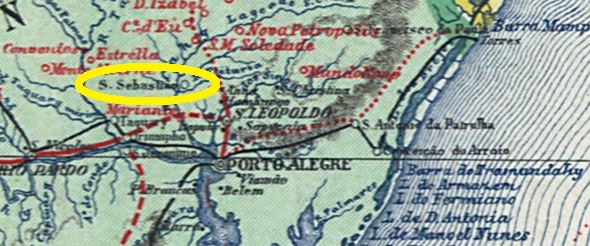
Carta da Republica dos Estados Unidos do Brazil, 1892
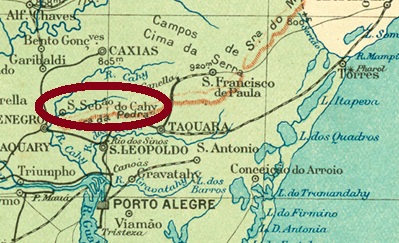
This locality was, from about 1850, a settlement called Porto do Guimarães, located on the east bank of the Caí River, about 70 km north of the provincial capital Porto Alegre. In 1873, the settlement became part of the Freguesia of São José do Hortêncio, which at that time belonged to São Leopoldo. Two years later, it became a villa.
The Imperial Mail Register (Tabella das Agencias do Correio do Imperio, Rio de Janeiro, 1885) lists this post office with foundation date 1879. Two postmarks as double circles were found for the 19th century. SRS-0370a (Coll. José A. Junges) also exists in blue, it has the inscription SAO SEBASTIAO DO CAHY at the top and the dates inside are from the period 1883-1889. SRS-0370b (Coll. José A. Junges) now has the inscription S. SEBASTIĀO DO CAHY at the top and there is an ornament in X at the bottom. Dates at the centre 1889 to 1890.
Estado do Rio Grande do Sul, 1923
Diese Ortschaft war ab ca. 1850 eine Siedlung namens Porto do Guimarães, die am Ostufer des Flusses Caí lag, rund 70 km nördlich der Provinzhauptstadt Porto Alegre entfernt. 1873 ging die Ortschaft zur Freguesia von São José do Hortêncio, die damals noch São Leopoldo angehörte. Zwei Jahre später wurde daraus eine Villa.
Das Verzeichnis der kaiserlichen Postämter (Tabella das Agencias do Correio do Imperio, Rio de Janeiro, 1885) listet dieses Postamt mit Gründungsdatum 1879 auf. Zwei Stempel als Doppelkreise waren für den 19. Jahrhundert zu finden. SRS-0370a (Samml. José A. Junges) gibt es auch in blau, er hat oben die Inschrift SAO SEBASTIAO DO CAHY, und die Daten im Inneren kommen vom Zeitraum 1883-1889. SRS-0370b (Samml. José A. Junges) hat nun die Inschrift S. SEBASTIĀO DO CAHY oben, unten ist ein Ornament in X zu sehen. Daten in der Mitte 1889 bis 1890.
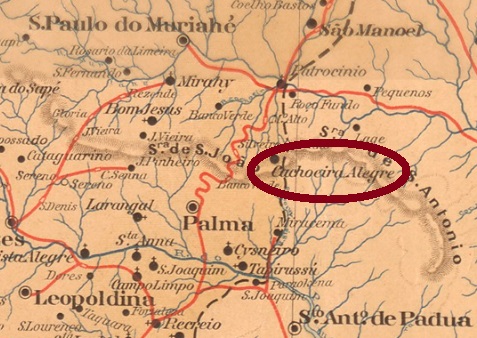
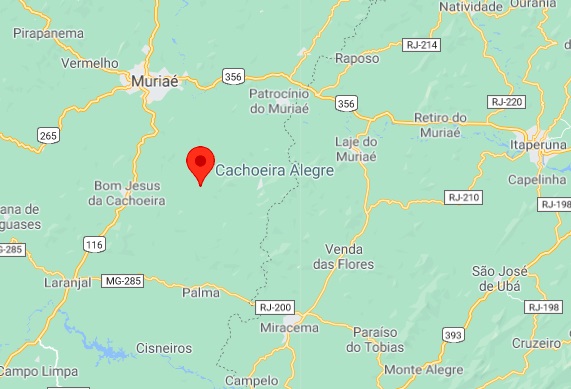
This locality was a district of S. Paulo do Muriahé from September 1870, close to the border with Rio de Janeiro, a good 240 km southeast of the provincial capital of Ouro Preto. In August 1911, the village changed to the newly created Municipio of Palma, now under the shortened name of Cachoeira Alegre, and since December 1962 it has been a district of Barão de Monte Alto.
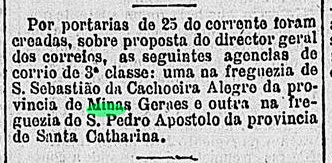
As Paula Sobrinho writes in História Postal de Minas Gerais (Belo Horizonte, 1997), there has been a post office there since April 1881. This is confirmed by the Rio press:
Gazeta de Noticias/RJ, 26 April 1881
Two postmarks as double circles were found for the 19th century. On SMG-2580a (Collected by José A. Junges) the inscription above is S. SEBASo. DA CACHOEIRA ALEGRE, below you can see an ornament in cross formed by four small diamonds. Dates in the centre from about 1883 to 1889. SMG-2580b (Collected by Márcio Protzner) could already be Republican, as the only copy so far has a date of 1898 inside. The inscription at the top now reads S. SEBAST. DA CACHA. ALEGRE, at the bottom it reads (MINAS).
Google Maps
Anderer Name: Cachoeira Alegre (1911)
Diese Ortschaft war ab September 1870 ein Distrikt von S. Paulo do Muriahé, der nah an der Grenze zu Rio de Janeiro lag, gut 240 km südöstlich der Provinzhauptstadt Ouro Preto entfernt. Im August 1911 wechselte der Ort zum neu gegründeten Municipio von Palma, nun unter dem gekürzten Namen Cachoeira Alegre, und seit Dezember 1962 ist er ein Distrikt von Barão de Monte Alto.
Wie Paula Sobrinho in História Postal de Minas Gerais (Belo Horizonte, 1997) schreibt, gibt es dort ein Postamt seit April 1881 Das wird durch die Rio-Presse bestätigt:
Gazeta de Noticias/RJ, 26. April 1881
Zwei Poststempel im Doppelkreis wurden für den 19. Jahrhundert gefunden. Bei SMG-2580a (Samml. José A. Junges) lautet die obige Inschrift S. SEBASo. DA CACHOEIRA ALEGRE, unten sieht man ein Ornament in Kreuz, das aus vier kleinen Rauten gebildet wird. Daten in der Mitte von ca. 1883 bis 1889. SMG-2580b (Samml. Márcio Protzner) könnte bereits republikanisch sein, da das bisher einzige Exemplar innen ein Datum von 1898 aufweist. Die Inschrift oben lautet nun S. SEBAST. DA CACHA. ALEGRE, unten steht (MINAS).
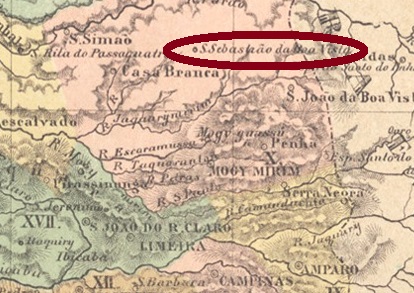
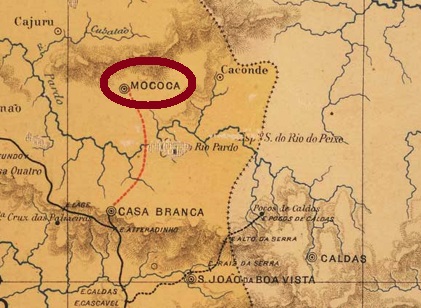
São Sebastião da Boa Vista had been a settlement of Casa Branca since December 1847, close to the border with Minas Gerais, about 260 km north of the provincial capital São Paulo. In April 1856, the place rose to a Freguesia and went as a district to Caconde for three years from April 1868, before returning to Casa Branca. Shortly afterwards it became a villa, and from April 1875 it has been a town called Mococa.
As can be read in the Imperial Mail Register (Tabella das Agencias do Correio do Imperio, Rio de Janeiro, 1885), there has been a post office there since 1870. Two imperial postmarks under this town name have been found. The first of these is certainly SSP-1860a (Coll. José A. Junges): a double ellipse with the inscriptions CORREIO above and DE S. SEBASTIÃO DA BOA VISTA below, separated by Maltese crosses on right and left. It was followed by SSP-1860b (Coll. Mario Celso Orsi Jr.): a double circle with the inscription S. S. DA BOA VISTA above. One copy, dated 1879 in the centre. From about 1886 onwards, all town stamps bore the inscription MOCOCA (for illustrations see R. Koester: Carimbologia XXVII).
J. M. Ribeiro Lisboa: Provincia de São Paulo, 1884
Siehe auch Mococa (R. Koester: Carimbologia XXVII)
São Sebastião da Boa Vista war seit Dezember 1847 eine Siedlung von Casa Branca, die nah an der Grenze zu Minas Gerais lag, ca. 260 km nördlich der Provinzhauptstadt São Paulo entfernt. Im April 1856 stieg der Ort zu Freguesia auf und ging ab April 1868 für drei Jahre als Distrikt von Caconde, bevor er wieder zu Casa Branca zurückkehrte. Kurz darauf wurde er eine Villa, und seit April 1875 ist es eine Stadt, die Mococa heißt.
Wie im Verzeichnis der kaiserlichen Postämter (Tabella das Agencias do Correio do Imperio, Rio de Janeiro, 1885) zu lesen ist, gibt es dort ein Postamt seit 1870. Zwei kaiserliche Stempel unter diesem Ortsnamen wurden gefunden. Der erste davon ist sicherlich SSP-1860a (Samml. José A. Junges): eine Doppelellipse mit den Inschriften CORREIO oben und DE S. SEBASTIÃO DA BOA VISTA unten, die durch Malteser Kreuze rechts und links getrennt sind. Danach kam SSP-1860b (Samml. Mario Celso Orsi Jr.): ein Doppelkreis mit der Inschrift S. S. DA BOA VISTA oben. Ein Exemplar, datiert 1879 in der Mitte. Ab ca. 1886 trugen alle Ortsstempel die Inschrift MOCOCA (Abb. siehe R. Koester: Carimbologia XXVII).
Carta da Republica dos Estados Unidos do Brasil, 1892
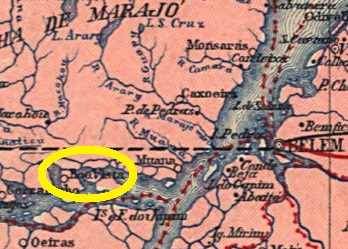
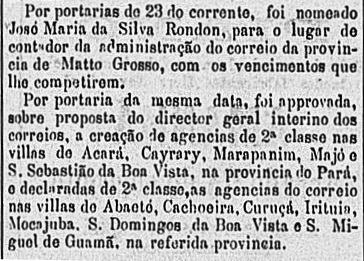
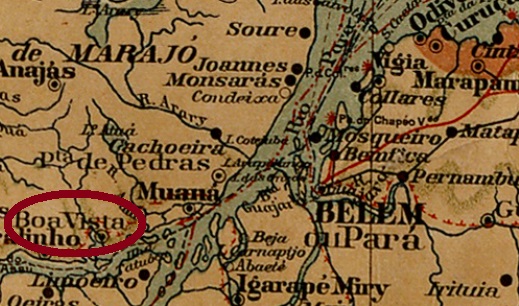
São Sebastião da Boa Vista was a freguesia of Muaná from October 1868, located on an island south of the famous Marajó Island, 120 km west of the provincial capital Belém do Pará. Thereafter, within 17 years, it was really promoted to villa status four times: in 1872, 1880, 1886 and 1889. Each promotion was followed by a relegation back to district status: in 1879, 1882, 1887 and finally in 1922, clearly reflecting the precarious situation of public administration in northern Brazil. It was not until December 1943 that the stable ascent as Município took place.
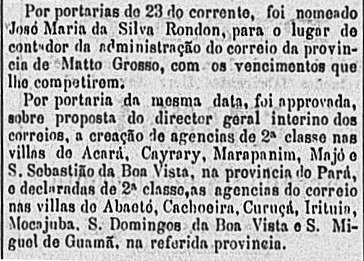
The local post office also had to be established at least twice. The first date of establishment could not be determined exactly, but took place by 1877, as the agency appears in a list of February 1881, which reports postal revenues locally in the 1877-1878 fiscal year. By 1881 the agency must have been closed, as a reopening in March 1882 was reported by the Rio press:
O Globo, 24 March 1882
So far, no imperial-era postmark from this locality has been found.
Mapa Geral do Brasil, 1911
São Sebastião da Boa Vista war ab Oktober 1868 eine Freguesia von Muaná, die auf einer Insel südlich der berühmten Marajó-Insel lag, 120 km Luftlinie westlich der Provinzhauptstadt Belém do Pará entfernt. Danach folgte binnen 17 Jahren tatsächlich viermal den Aufstieg zur Villa: 1872, 1880, 1886 und 1889. Jedem Aufstieg folgte ein Abstieg zurück zum Distrikt-Status: 1879, 1882, 1887 und zuletzt 1922, was die prekäre Situation der öffentlichen Verwaltung im Norden Brasiliens deutlich widerspiegelt. Erst im Dezember 1943 erfolgte der stabile Aufstieg als Município.
Auch das örtliche Postamt musste mindestens zweimal gegründet werden. Der erste Entstehungstermin konnte nicht exakt ermittelt werden, fand aber bis 1877 statt, da die Agentur in einer Liste vom Februar 1881 erscheint, die über Posteinnahmen vor Ort im Geschäftsjahr 1877-1878 berichtet. Um 1881 wurde die Agentur geschlossen, da eine Wiedereröffnung im März 1882 durch die Presse aus Rio publik wurde:
O Globo, 24. März 1882
Bisher konnte kein Poststempel der Kaiserzeit von dieser Ortschaft gefunden werden.
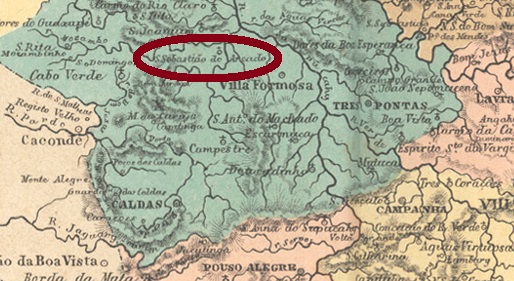
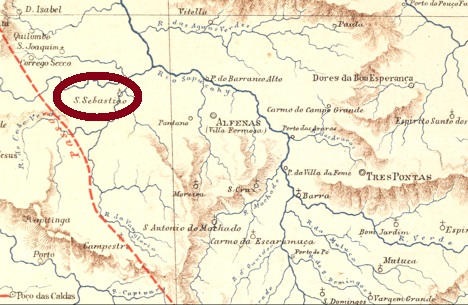
This São Sebastião “of the sandy soil” in the province of Minas Gerais was a district of Alfenas from September 1871, which at that time was located about 420 km west of the capital Ouro Preto. Today, the place is a holiday destination for tourists who want to visit the Furnas dam. In August 1911, the village rose to become a villa under the name Gomes – probably to pay homage to a prominent family in the region – but eight years later the old name (now shortened to Areado) returned.
Paula Sobrinho writes in História Postal de Minas Gerais (Belo Horizonte, 1997) that the local post office was created in September 1880. The only postmark of the imperial period so far is SMG-2620a (Coll. José A. Junges): a double circle with the inscription S. SEBASTIÃO DO AREADO above and an ornament in lozenge below, formed by four small diamonds. Dates inside from about 1880 to 1888.
Estrada de Ferro Central do Brasil, 1890
Andere Namen: Villa Gomes, Areado (1919)
Dieser São Sebastião “vom Sandboden” in der Provinz Minas Gerais war ab September 1871 ein Distrikt von Alfenas, der damals ca. 420 km westlich der Hauptstadt Ouro Preto entfernt lag. Heute ist der Ort ein Urlaubsziel für Touristen, die den Furnas-Staudamm besuchen möchten. Im August 1911 stieg der Ort zur Villa unter dem Namen Gomes – wohl um einer prominenten Familie der Region die Ehre zu erweisen – aber acht Jahre später kam der alte Name (nun verkürzt zu Areado) doch zurück.
Paula Sobrinho schreibt in História Postal de Minas Gerais (Belo Horizonte, 1997), dass das örtliche Postamt vom September 1880 ist. Der bisher einzige Poststempel der Kaiserzeit ist SMG-2620a (Samml. José A. Junges): ein Doppelkreis mit der Inschrift S. SEBASTIÃO DO AREADO oben und einem Ornament in Raute unten, das aus vier kleinen Rauten gebildet wird. Daten in Inneren von ca. 1880 bis 1888.
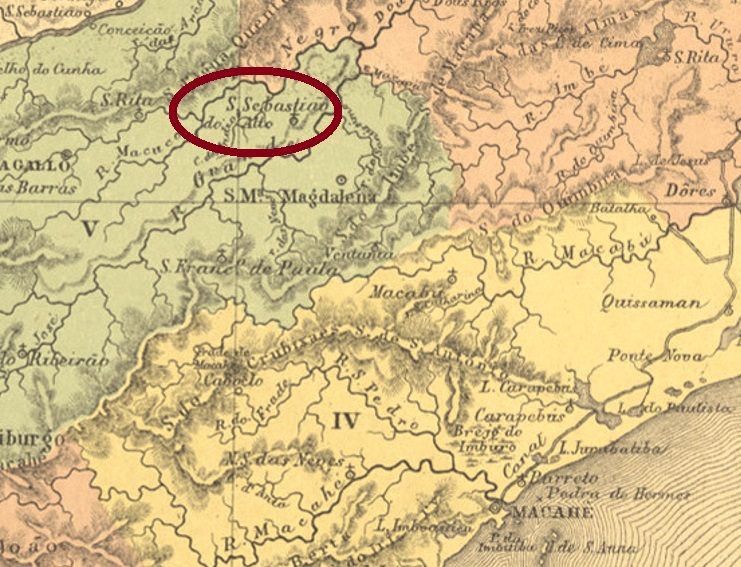
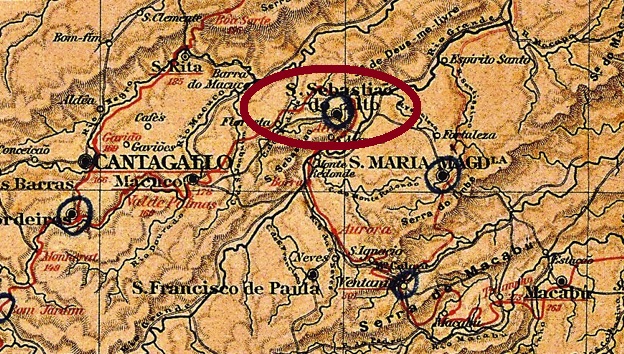
São Sebastião do Alto (= of the Heights) was a freguesia of S. Francisco de Paula from September 1855, located just under 220 km northeast of the capital Rio de Janeiro. In April 1891, the place rose to the status of a villa and became a town in December 1929.
Nova Monteiro writes in Administrações e Agencias Postaes do Brasil Imperio (in Brasil Filatelico/RJ, 1934-5; reprint SPP 1994-1999) that there has been a post office there since June 1855. However, Aureo G. Santos noted in Agências de Correio Criadas e Suprimidas 1851, 1855, 1856 e 1857, (in Brasil Filatélico 181, Rio de Janeiro, 1977) a date exactly one month later:
Aureo G. Santos (op. cit.)
Anyway, Paulo Novaes has found out that the post office closed in June 1861, only to reopen three months later (agenciaspostais.com.br).
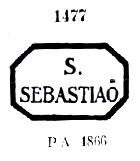
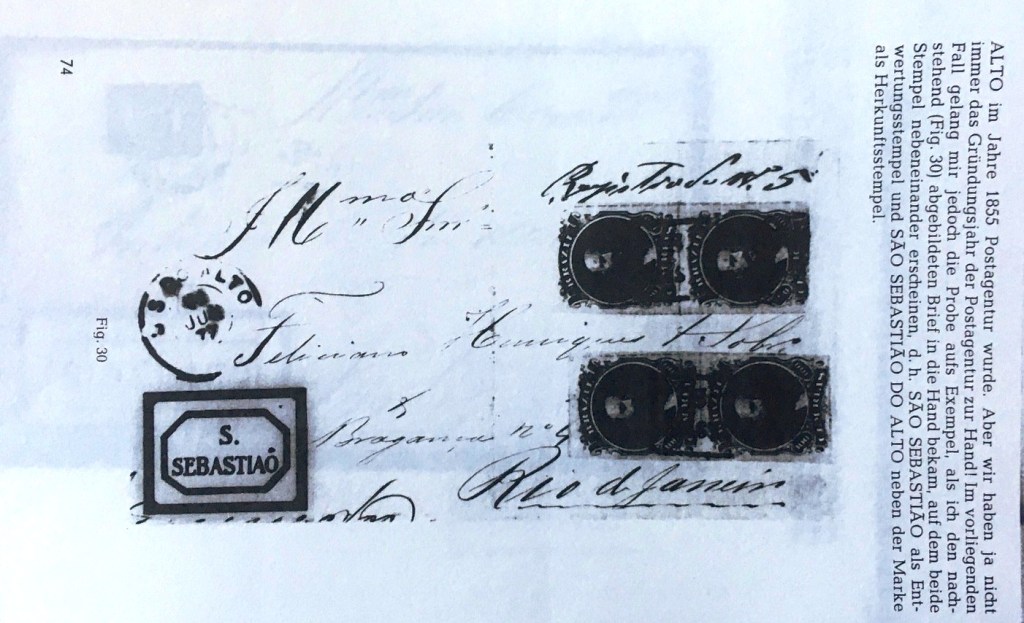
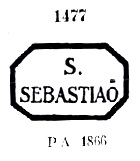
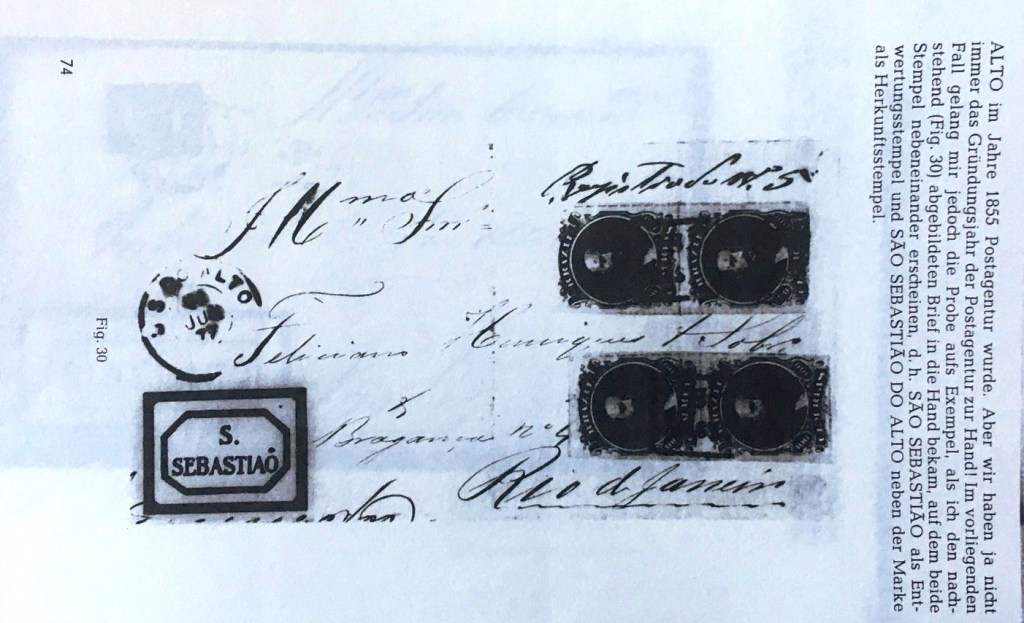
Three postmarks in double circle were found for the 19th century. But before them there was SRJ-0955a; this cancel was in circulation at least until 1877 and is usually assigned to São Sebastião in São Paulo, since the addition DO ALTO is missing here. It is listed in P. Ayres (Catálogo de Carimbos Brasil-Império, S. Paulo, 1937, 1942) under no. 1477 and could be identified beyond doubt by a cover from the R. Koester collection:
SRJ-0955a (P.A. 1477)Collection R. Koester
On SRJ-0955b (Coll. José A. Junges) the inscription at the top reads S. S. DO ALTO, the dates inside go from 1877 to 1884. This was followed by SRJ-0955c (coll. Karlheinz Wittig): the inscription at the top is now S. SEBASTIÃO DO ALTO, at the bottom one sees an ornament in lozenge formed by four small lozenges. The dates in the middle go from 1886 to 1890. SRJ-0955d (fig. from the internet) might be republican, as this stamp so far shows dates from 1890 onwards. The inscription at the top is now SEBASTIÃO DO ALTO (without SÃO), at the bottom the ornament is an X.
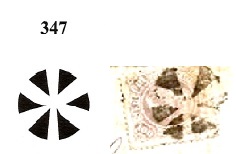
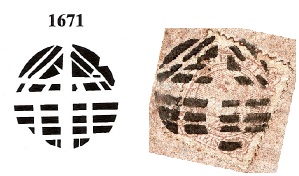
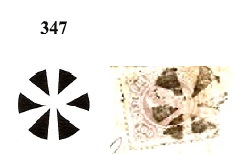
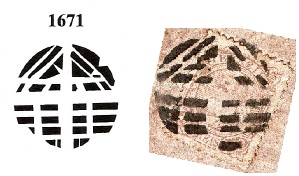
Two mute cancellations (both Coll. José A. Junges) were also found which could be assigned to Nos. 347 and 1671 in Mute Cancellations of the Brazil Empire/ Carimbos Mudos do Brasil Império (Brazil Philatelic Association, Rio de Janeiro, 2000) by J. Dingler and K. Lopes:
São Sebastião do Alto (= der Höhe) war ab September 1855 eine Freguesia von S. Francisco de Paula, die knapp 220 km nordöstlich der Hauptstadt Rio de Janeiro entfernt lag. Im April 1891 stieg der Ort zur Villa auf und wurde eine Stadt im Dezember 1929.
Nova Monteiro schreibt in Administrações e Agencias Postaes do Brasil Imperio (in Brasil Filatelico/RJ, 1934-5; Reprint SPP 1994-1999), dass es dort ein Postamt seit Juni 1855 gibt. Allerdings hat Aureo G. Santos in Agências de Correio Criadas e Suprimidas 1851, 1855, 1856 e 1857, (in Brasil Filatélico 181, Rio de Janeiro, 1977) ein Datum notiert, das exakt ein Monat später liegt:
Aureo G. Santos (op. cit.)
Wie es dem auch sei, Paulo Novaes fand heraus, dass das Postamt im Juni 1861 geschlossen wurde, um drei Monate später wieder zu öffnen (agenciaspostais.com.br).
Es wurden drei Poststempel im Doppelkreis für den 19. Jahrhundert gefunden. Davor aber kam SRJ-0955a; dieser Stempel war zumindest bis 1877 im Umlauf und wird meistens São Sebastião in São Paulo zugeordnet, da der Zusatz DO ALTO hier fehlt. Er wird im P. Ayres (Catálogo de Carimbos Brasil-Império, S. Paulo, 1937, 1942) unter Nr. 1477 aufgeführt und konnte durch einen Beleg aus der Sammlung R. Koester zweifelsfrei identifiziert werden:
SRJ-0955a (P.A. 1477)Sammlung R. Koester
Bei SRJ-0955b (Samml. José A. Junges) lautet die Inschrift oben S. S. DO ALTO, die Daten im Inneren gehen von 1877 bis 1884. Es folgte SRJ-0955c (Samml. Karlheinz Wittig): die Inschrift oben ist nun S. SEBASTIÃO DO ALTO, unten sieht man ein Ornament in Raute, das durch vier kleine Rauten gebildet wird. Daten in der Mitte von 1886 bis 1890. SRJ-0955d (Abb. aus dem Internet) dürfte evtl. republikanisch sein, da dieser Stempel bisher Daten ab 1890 aufweist. Die Inschrift oben ist nun SEBASTIÃO DO ALTO (Ohne SÃO), unten ist das Ornament ein X.
Zwei stumme Abstempelungen (beide Samml. José A. Junges) wurden darüber hinaus gefunden, die den Nr. 347 und 1671 in Mute Cancellations of the Brazil Empire/ Carimbos Mudos do Brasil Império (Brazil Philatelic Association, Rio de Janeiro, 2000) von J. Dingler und K. Lopes zugeordnet werden konnten:
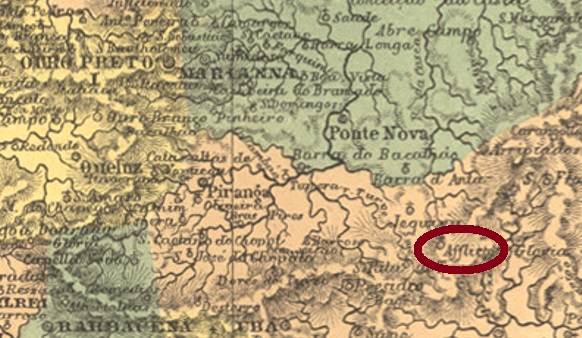
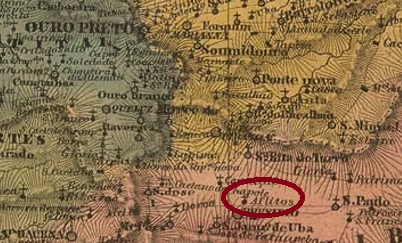
This São Sebastião in the province of Minas Gerais has also experienced several changes in place name. First, from April 1839, the place was a district of Ubá, under the name Capella Nova, which was about 160 km southeast of the provincial capital, Ouro Preto. In June 1853, the name changed to São Sebastião dos Aflictos (St. Sebastian of the Distressed), and in July 1886 to S. Sebastião do Herval (= of The Herb Meadow). During the Republic, the district’s name changes continued unabated: in September 1923 to Erval, which has been a Município since December 1938, and in December 1943 to Ervália, which is still current today.
As Paula Sobrinho writes in História Postal de Minas Gerais (Belo Horizonte, 1997), there has been a post office there since March 1881, and two Imperial postmarks have been found. On SMG-2657a (Coll. José A. Junges) one still reads S. SEBASTIÃO DOS AFLICTOS above, below is an ornament in lozenge formed by four small diamonds, the dates inside so far go from 1887 to 1888, i.e. from the time when the next place name was actually already valid. SMG-2635a (Coll. José A. Junges) duly reads S. SEBASTIÃO DO HERVAL above and (MINAS) below. Dated 1889-1900 at the centre.
Villiers de l’Ile Adam: Carta (…) da Provincia de Minas Geraes, 1849
Andere Namen: Capella Nova, Ervália (1943)
Auch dieser São Sebastião in der Provinz Minas Gerais hat mehrere Wechsel im Ortsnamen erlebt. Zunächst war der Ort ab April 1839 ein Distrikt von Ubá, unter dem Namen Capella Nova, der ca. 160 km südöstlich der Provinzhauptstadt Ouro Preto entfernt lag. Im Juni 1853 wechselte der Name zu São Sebastião dos Aflictos (Hl. Sebastian der Notleidende), und im Juli 1886 zu S. Sebastião do Herval (= Der Kräuterwiese). In der Republik ging der Namenwechsel des Distrikts munter weiter: im September 1923 zu Erval, der seit Dezember 1938 ein Município ist, und im Dezember 1943 zum heute noch aktuellen Ervália.
Wie Paula Sobrinho im História Postal de Minas Gerais (Belo Horizonte, 1997) schreibt, gibt es dort ein Postamt seit März 1881. Zwei Poststempel des Kaiserreichs wurden gefunden. Bei SMG-2657a (Samml. José A. Junges) liest man noch S. SEBASTIÃO DOS AFLICTOS oben, unten ist ein Ornament in Raute, das aus vier kleinen Rauten gebildet wird, die Daten im Inneren gehen bisher von 1887 bis 1888, also aus der Zeit, als der nächste Ortsname eigentlich schon gültig war. Bei SMG-2635a (Samml. José A. Junges) steht ordnungsgemäß S. SEBASTIÃO DO HERVAL oben und (MINAS) unten. Datiert 1889-1900 in der Mitte.
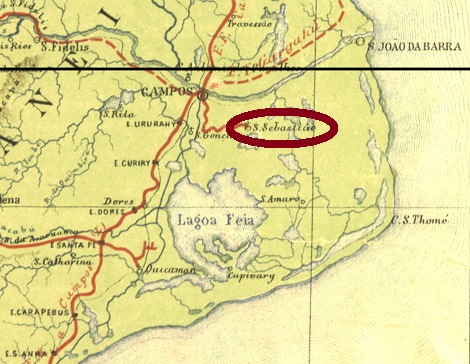
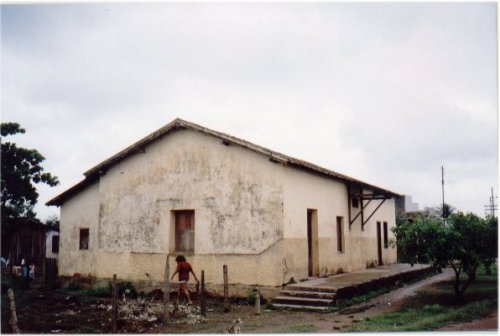
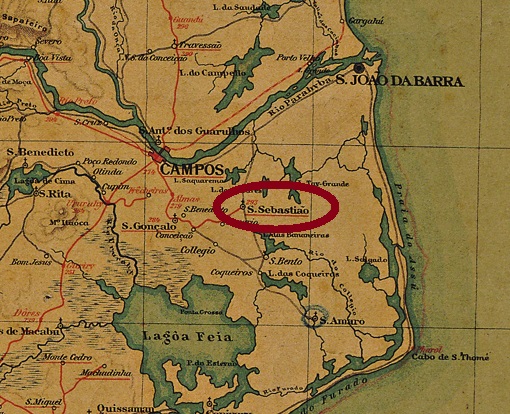
The São Sebastião railway station in the province of Rio was inaugurated in December 1873 by the Estrada de Ferro de Campos a São Sebastião railway company and was located near Campos, about 290 km northeast of the capital Rio de Janeiro. In 1889, the railway line changed to the Estrada de Ferro de Macahé a Campos company and about 10 years later to the E. F. Leopoldina. From 1975 until the end of operations in 1996, it belonged to Rede Ferroviária Federal. The station was renamed Mineiros around 1892, in the last period it is said to have been called José (or João) Amaro. Today the rails are gone, and there was only one picture of the station, which has since disappeared from the corresponding website estacoesferroviarias.com.br.
ex estacoesferroviarias.com.br
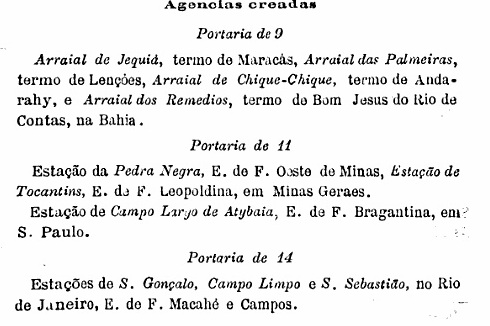
The station post office was created on November 14 November 1889, exactly the day before the military coup that ended the Brazilian Empire:
Boletim Postal, December 1889
It is very unlikely that a postmark date of 14 or 15 November will ever appear. SRJ-1485a (coll. R. Koester) is a double circle with the inscriptions EST. DE S. SEBASTIÃO above and (E.F.M. E CAMPOS) below. The only copy so far has a date of 1890 inside.
Almnak Laemmert, 1892
Andere Namen: Mineiros, José Amaro
Der Bahnhof São Sebastião in der Provinz Rio wurde im Dezember 1873 durch die Bahngesellschaft Estrada de Ferro de Campos a São Sebastião eingeweiht und lag bei Campos, ca. 290 km nordöstlich der Hauptstadt Rio de Janeiro entfernt. 1889 wechselte die Bahnhlinie zur Gesellschaft Estrada de Ferro de Macahé a Campos und ca. 10 Jahre später zur E. F. Leopoldina. Von 1975 bis zum Betriebsende 1996 gehörte sie der Rede Ferroviária Federal. Der Bahnhof wurde um 1892 zu Mineiros umbenannt, in der letzten Periode soll er José (oder João) Amaro geheißen haben. Heute sind die Schienen weg, und vom Bahnhof gab es nur ein Bild, das inzwischen von der entsprechenden Website estacoesferroviarias.com.br verschwunden ist.
ex estacoesferroviarias.com.br
Das Bahnhofspostamt entstand am 14.11.1889, genau am Tag vor dem Militärputsch, der das brasilianische Kaiserreich beendet hat:
Boletim Postal, Dezember 1889
Es ist sehr unwahrscheinlich, dass jemals ein Stempeldatum vom 14. oder 15. November erscheint. SRJ-1485a (Samml. R. Koester) ist ein Doppelkreis mit den Inschriften EST. DE S. SEBASTIÃO oben und (E.F.M. E CAMPOS) unten. Das bisher einzige Exemplar hat innen ein Datum aus 1890.
This station post office is a special case whose story still has blanks to fill in. It had four different names in less than 15 years – with corresponding postmarks – and two other place names followed. Furthermore, it is not yet clear when exactly the station was built, but apparently the post office started operations beforehand.
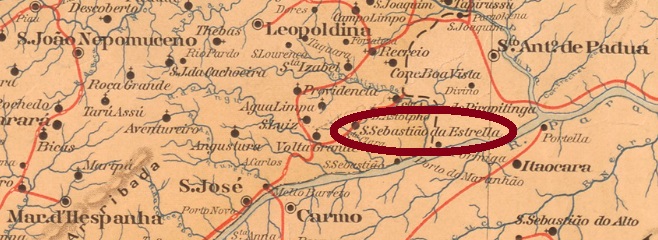
The railway line between Volta Grande and Sant’Anna de Pirapetinga in the province of Minas Geraes was planned in the late 1860s by the Companhia União e Industria. Although the client was the Estrada de Ferro do Pirapetinga railway company, this has operated the line for a very short time, if at all, because the E. F. Leopoldina already acted as a line owner at the end of 1879.
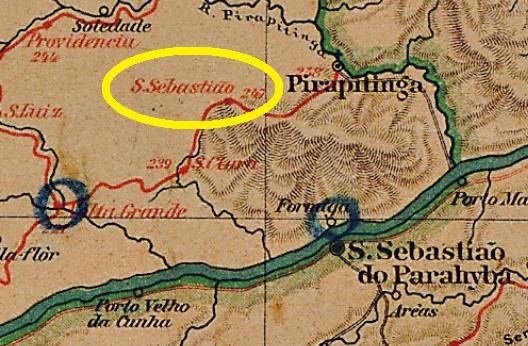
The station was in the municipality of Sao José d’Além Parahyba, about 320 km southeast of the provincial capital Ouro Preto, and was intended to serve the municipalities on both banks of the Parahyba River, especially São Sebastião do Parahyba in the province of Rio de Janeiro. Since the postal system was then managed from Rio, the station post office was given the name of São Sebastião. Three inauguration dates for the station have been found: first in October 1874 (Paula Sobrinho: História Postal de Minas Gerais, Belo Horizonte, 1997), then in December 1879 (A Actualidade, 21.01.1880) and finally in 1880 (estacoesferroviarias.com.br).
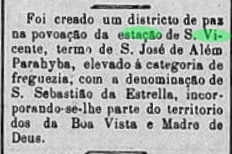
But this station had probably been given another name, São Vicente – now by the province of Minas Gerais. As a result, not only were two different postmarks in circulation at the post office, but the post office was also listed twice in the 1885 Imperial Mail Register (Tabella das Agencias do Correio do Imperio).
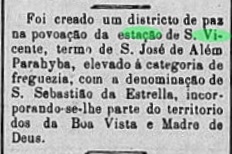
To defuse this confused situation in Solomon terms, in 1882 the provincial parliament in Ouro Preto decided by Provincial Law No. 2.988 to declare the village as a district and to call it henceforth São Sebastião da Estrella:
Pharol, 9 January 1883
However, it took a while for this place name to appear in the stamps; before that, the name of São Sebastião do Pirapetinga was added, apparently without any legal basis. A relatively quiet time followed. It was not until December 1938 that the district was renamed Estrella, and exactly five years later the district was given the name Estrela Dalva, which has been a municipality since December 1953.
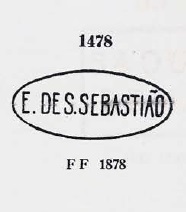
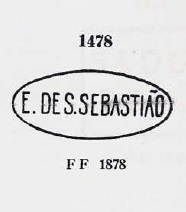
There are four creation dates for the station post office: 1872 (Tabella/1885), April 1877 (O Globo/RJ, 05.04.1877), December 1879 (O Apostolo, 31.12.1879) and July 1881 (Paula Sobrinho, op. cit.). The first postmark of this station is SMG-2575a, which was already shown by Paulo Ayres in Catalogo de Carimbos Brasil-Império (S. Paulo, 1937, 1942) under No. 1478:
SMG-2575a (P.A. 1478) 1872-1883ff
It was followed by four cancels with double circles. SMG-2575b (Coll. José A. Junges) is also available in blue and has above the inscription E. DE S. SEBASTIÃO, with dates inside from 1881 to 1883ff. SMG-2647a (Coll. Karlheinz Wittig) is also found in blue and has the inscriptions S. SEBASTIÃO DO PIRAPETA. above and (ESTAÇÃO) below. It is dated inside from 1884ff to 1890. SMG-2668a (Coll. José A. Junges) has the inscription S. VICENTE (ESTAÇÃO) above, with dates from 1883ff to 1889 inside. Finally, SMG-2586a (image from the Internet) is likely to be Republican, since the internal dates go from 1891 to 1903. Here are the inscriptions S. SEBASTIÃO DA ESTRELLA above and (M.G.) below.
Mappa de Minas Geraes, 1910
Andere Namen: Estrela (1938), Estrela Dalva (1943)
Dieses Bahnhofpostamt ist ein Sonderfall, dessen Geschichte noch lange nicht zu Ende erzählt wurde. Es hatte vier verschiedene Namen in weniger als 15 Jahren – mit entsprechenden Poststempeln – und weitere zwei Ortsnamen sind später dazu gekommen. Dann ist es noch nicht klar, wann genau der Bahnhof erbaut wurde, aber offenbar nahm das Postamt seinen Betrieb vorher auf.
Die Bahnlinie zwischen Volta Grande und Sant’Anna de Pirapetingain der Provinz Minas Geraes wurde ab Ende der 1860er Jahre von der Companhia União e Industria geplant und gebaut. Auftraggeber war zwar die Estrada de Ferro do Pirapetinga Bahngesellschaft, die aber – wenn überhaupt – sehr kurze Zeit die Linie betrieben hat, denn bereits Ende 1879 fungierte die E. F. Leopoldina als Linieninhaberin.
Der Bahnhof lag im Município von São José d’Além Parahyba, ca. 320 km südöstlich der Provinzhauptstadt Ouro Preto entfernt, und sollte die Gemeinden an beiden Ufern des Flusses Parahyba bedienen, besonders São Sebastião do Parahyba in der Provinz Rio de Janeiro. Da das Postwesen zunächst von Rio aus verwaltet wurde, bekam das Bahnhofspostamt zunächst den Namen São Sebastião. Drei Einweihungsdaten für den Bahnhof sind überliefert: erstmals im Oktober 1874 (Paula Sobrinho: História Postal de Minas Gerais, Belo Horizonte, 1997), dann im Dezember 1879 (A Actualidade, 21.01.1880), und zuletzt 1880 (estacoesferroviarias.com.br).
Nun aber hatte dieser Bahnhof einen anderen Namen – São Vicente – wohl von der Provinz Minas Gerais verpasst bekommen. Dies hatte zur Folge, dass nicht nur bald zwei unterschiedliche Poststempel an der Post im Umlauf waren, sondern auch das Postamt zweimal imVerzeichnis der kaiserlichen Postämter (Tabella das Agencias do Correio do Imperio, Rio de Janeiro, 1885) aufgelistet ist.
Um diese konfuse Lage salomonisch zu entzerren, entschied sich 1882 das Provinzparlament in Ouro Preto durch das Provinzialgesetz Nr. 2.988 dafür, die Ortschaft als Distrikt zu erklären und fortan São Sebastião da Estrella zu nennen:
Pharol, 9. Januar 1883
Es dauerte jedoch eine Weile, bis dieser Ortsname in den Stempeln erschien; dazwischen kam noch – scheinbar ganz ohne gesetzliche Grundlage – der Name São Sebastião do Pirapetinga. Es folgte eine relativ ruhige Zeit. Erst im Dezember 1938 kam die nächste Umbenennung als Distrikt von Estrella, und genau fünf Jahre später bekam der Distrikt den heute noch gültigen Namen Estrela Dalva, der seit Dezember 1953 ein Municipio ist.
Fürs Bahnhofspostamt gibt es vier Gründungsdaten: 1872 (Tabella/1885), April 1877 (O Globo/RJ, 05.04.1877), Dezember 1879 (O Apostolo, 31.12.1879) und auch den Juli 1881 (Paula Sobrinho, op.cit.). Der erste Poststempel dieses Bahnhofs ist SMG-2575a, der bereits durch Paulo Ayres in Catálogo de Carimbos Brasil-Império (S. Paulo, 1937, 1942) mit Nr. 1478 gezeigt wurde:
SMG-2575a (P.A. 1478) 1872-1883ff
Ihm folgten vier Stempel mit Doppelkreisen. SMG-2575b (Samml. José A. Junges) kommt auch in blau vor und hat oben die Inschrift E. DE S. SEBASTIÃO, mit Daten im Inneren von 1881 bis 1883ff. SMG-2647a (Samml. Karlheinz Wittig) kommt ebenfalls in blau vor und hat die Inschriften S. SEBASTIÃO DO PIRAPETA. oben und (ESTAÇÃO) unten. Daten 1884ff bis 1890 innen. SMG-2668a (Samml. José A. Junges) hat die Inschrift S. VICENTE (ESTAÇÃO) oben, mit Daten von 1883ff bis 1889 im Inneren. Und schließlich SMG-2586a (Abb. aus dem Internet) dürfte bereits republikanisch sein, da die inneren Daten von 1891 bis 1903 gehen. Hier lauten die Inschriften S. SEBASTIÃO DA ESTRELLA oben und (M.G.) unten.



 Carimbologia