Categories
Carimbologia S

São José do Paraopeba (Pomba, SMG-2470) – São José de Tocantins, Minas Gerais (SMG-2435)

Atlas do Imperio do Brasil, 1868

Print edition update, on November 12, 2021

In the imperial province of Minas Gerais there were two rivers called Paraopeba, and two localities named São José do Paraopeba! See also SMG-2469.

This S. José do Paraopeba was from July 1868 a freguesia of Pomba, located on the south bank of the smaller river Paraopeba (35 km long, a tributary to the Rio Pomba) in Minas Gerais, about 200 km southeast of the provincial capital Ouro Preto. In December 1878, the place name was changed to S. José de Tocantins, probably to avoid further confusion with the place of the same name near Ouro Preto. In September 1923, the district was simply called Tocantins and received its political emancipation as a municipality in December 1948.

According to Paula Sobrinho (História Postal de Minas Gerais, Belo Horizonte, 1997), there has been a post office there since August 1866. We have each found a stamp in the imperial era with each place name and a mute cancel. SMG-2470a (Coll. José A. Junges) has a double circle with the inscription S. J. DE PARAOPEBA above. The dates inside were found for the period 1878-1883, i.e. mainly from the time when the place was already renamed. However, the year is sometimes missing.

Meanwhile, an evidently older postmark has appeared: SMG-2470b (Col. Fuad Ferreira Fo.) on a D. Pedro issue of 1866. Since it is not listed in Carimbologia S2, it is presented here:

SMG-2470b (FF) 1866ff “ex-Nacinovic”

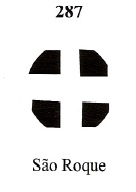
SMG-2435a (Coll. José A. Junges) has now the inscription S. JOSÉ DE TOCANTINS between circles above and below an ornament in cross, formed by four converging arrowheads. Dates inside: 1885-1895. The mute cancel was placed on a letter (Coll. José L. Fevereiro) from 1883, together with SMG-2470a. It is very similar to templates No. 262 by Paulo Ayres (Catalogo de Carimbos Brasil-Império, S. Paulo, 1937, 1942) and No. 1225 by James Dingler/Klerman W. Lopes (Mute Cancellations of the Brazil Empire/Carimbos Mudos do Brasil Império, Brazil Philatelic Association, Rio de Janeiro, 2000):
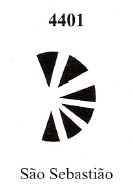
P.A. 262/BPA 1225, 1883 (Coll. José L. Fevereiro)

Provincia de Minas Geraes, 1873

Aktualisierung der Druckausgabe, am 12. November 2021

In der kaiserlichen Provinz Minas Gerais gab es zwei Flüsse namens Paraopeba und zwei verschiedene Orte mit dem Namen São José do Paraopeba! Siehe auch SMG-2469.

Dieser S. José do Paraopeba war ab Juli 1868 eine Freguesia von Pomba, die am Südufer des kleineren Flusses Paraopeba (35 km lang, ein Zufluss des Rio Pomba) in Minas Gerais lag, knapp 200 km südöstlich der Provinzhauptstadt OuroPreto entfernt. Im Dezember 1878 wurde der Ortsnamen zu S. José de Tocantins geändert, wohl um weitere Verwechslungen mit dem gleichnamigen Ort bei Ouro Preto zu vermeiden. Im September 1923 hieß der Distrikt einfach Tocantins und erhielt seine politische Emanzipation als Municipio im Dezember 1948.

Laut Paula Sobrinho (História Postal de Minas Gerais, Belo Horizonte, 1997) gibt es dort ein Postamt seit August 1866. Wir haben jeweils einen Stempel in der Kaiserzeit mit jedem Ortsnamen und eine stumme Entwertung gefunden. SMG-2470a (Samml. José A. Junges) hat einen Doppelkreis mit der Inschrift S. J. DE PARAOPEBA oben. Die Daten in der Mitte wurden für den Zeitraum 1878-1883 gefunden, also überwiegend aus der Zeit, als der Ort bereits anders hieß. Allerdings fehlt ab und zu die Jahresangabe.

Inzwischen wurde ein offensichtlich älterer Stempel gefunden: SMG-2470b (Col. Fuad Ferreira Fo.) erschien auf einer D. Pedro-Ausgabe von 1866. Da er nicht im Carimbologia S2 enthalten ist, wird er hier vorgestellt:

SMG-2470b (FF) 1866ff “ex-Nacinovic”

SMG-2435a (Samml. José A. Junges) hat im Doppelkreis nun die Inschrift S. JOSÉ DE TOCANTINS oben und unten ein Ornament in Kreuz, durch vier konvergierende Pfeilspitzen gebildet. Daten in der Mitte: 1885-1895. Der stumme Stempel wurde auf einem Brief (Samml. José L. Fevereiro) aus 1883 gefunden, zusammen mit SMG-2470a. Er ähnelt stark den Vorlagen Nr. 262 von Paulo Ayres (Catálogo de Carimbos Brasil-Império, S. Paulo, 1937, 1942) und Nr. 1225 von James Dingler/Klerman W. Lopes (Mute Cancellations of the Brazil Empire/Carimbos Mudos do Brasil Império, Brazil Philatelic Association, Rio de Janeiro, 2000):
P.A. 262/BPA 1225, 1883 (Samml. José L. Fevereiro)

Categories
Carimbologia S

São José do Paraopeba (Ouro Preto), Minas Gerais (SMG-2469)

Atlas do Imperio do Brasil, 1868

In the imperial province of Minas Gerais there were two rivers called Paraopeba, and two different localities named São José do Paraopeba! See also SMG-2470, today the municipality of Tocantins.

This village was since December 1873 a parish located on the east bank of the Paraopeba River, about 100 km west of the provincial capital Ouro Preto. After that, the place changed twice: in September 1923 to Itabirito and in December 1938 to Brumadinho, which is still the actual status.

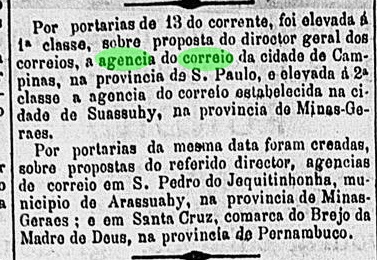
Paula Sobrinho writes in Historia Postal de Minas Gerais (Belo Horizonte, 1997) that the local post office was created in November 1881. This is ratified by the Rio press:

Gazeta de Noticias/RJ, 18 November 1881

SMG-2469a (Coll. José A. Junges) has a double circle with the inscription S. JOSÉ DO PARAOPEBA above and an ornament in cross below, which consists of four branches. The dates inside were found for the period 1890-1898.

Provincia de Minas Geraes, 1873

In der kaiserlichen Provinz Minas Gerais gab es zwei Flüsse namens Paraopeba und zwei verschiedene Orte mit dem Namen São José do Paraopeba! Siehe auch SMG-2470, heute Município von Tocantins.

Diese Ortschaft war seit Dezember 1873 eine Pfarrei am Ostufer des Flusses Paraopeba, die ca. 100 km westlich der Provinzhauptstadt Ouro Preto entfernt lag. Danach wechselte der Ort noch zweimal: im September 1923 zu Itabirito und im Dezember 1938 zu Brumadinho, was der aktuelle Stand noch ist.

Paula Sobrinho schreibt in seiner Historia Postal de Minas Gerais (Belo Horizonte, 1997) dass das örtliche Postamtim November 1881 entstanden ist. Das ist auch belegt durch eine Pressemeldung aus Rio:

Gazeta de Noticias/RJ, 18. November 1881

SMG-2469a (Samml. José A. Junges) hat einen Doppelkreis mit der Inschrift S. JOSÉ DO PARAOPEBA oben und einem Ornament in Kreuz unten, das aus vier Zweigen besteht. Daten in der Mitte: 1890 bis 1898.

Categories
Carimbologia S

São José do Paranapanema, São Paulo (SSP-1175)

J.M. Ribeiro Lisboa, Provincia de São Paulo, 1884

Other names: S. José, S. José de Guapiara, Guapiara (1905)

From April 1878, this village was a freguesia of Capão Bonito, about 260 km southwest of the provincial capital of São Paulo. In October 1902, it became a district called S. José do Guapiara, which three years later was renamed simply Guapiara. Since December 1948, Guapiara has been a town in own municipality. The tupi-guarani word means Valley Road.

The philatelist Mario Orsi writes that there has been a post office there since June 1887. This will probably be correct, for the first employee was announced shortly afterwards in the press from S. Paulo:

Correio Paulistano, 21 August 1887

The only early cancel found so far is SSP-1175a (Coll. José A. Junges): a double circle with the inscription AGIA DE S. JOSÉ DO PARANAPANEMA above and a dot between circles below. One copy seen, dated 1896 inside.

Provincia de São Paulo, 1886

Andere Namen: S. José, S. José de Guapiara, Guapiara (1905)

Diese Ortschaft war ab April 1878 eine Freguesia bei Capão Bonito, die ca. 260 km südwestlich der Provinzhauptstadt São Paulo entfernt lag. Im Oktober 1902 wurde daraus ein Distrikt namens S. José do Guapiara, der drei Jahre später lediglich Guapiara hieß. Seit Dezember 1948 ist Guapiara eine Stadt im eigenen Município. Das Wort aus der Tupi-Guarani-Sprache bedeutet Weg zum Tal.

Der Philatelist Mario Orsi schreibt, es gibt dort ein Postamt seit Juni 1887. Das wird wohl stimmen, den der erste Angestellte wurde kurz darauf in der Presse aus S. Paulo angekündigt:

Correio Paulistano, 21. August 1887

Der einzige bisher gefundene Stempel ist SSP-1175a (Samml. José A. Junges): ein Doppelkreis mit der Inschrift AGIA DE S. JOSÉ DO PARANAPANEMA oben und einem Punkt zwischen den Kreisen unten. Ein Exemplar vorhanden, datiert 1896 in der Mitte.

Categories
Carimbologia S

São José do Paraiso, Minas Gerais (SMG-2465)

Atlas do Imperio do Brasil, 1868

Other names: Campo do Lima (1826), São José da Ventania (1827), São José das Formigas (1831), Paraiso (1850), Paraisópolis (1914)

The history of this village began around 1826 with the settlement of Campo do Lima (Lima’s Field), which was located on the west bank of the Sapucahy-Mirim River, about 470 km southwest of the provincial capital Ouro Preto. There were several renamings: to São José da Ventania, São José das Formigas, and São José do Paraíso, as the parish in the municipality of Itajubá was called in 1850. In November 1867, the municipality was elevated to a villa, but less than a year later it was demoted to a district of Pouso Alegre. In July 1872, S. José do Paraíso became a villa in own municipality, which has been called Paraisópolis since September 1914.

As Paula Sobrinho reports in Historia Postal de Minas Gerais (Belo Horizonte, 1997), there has been a post office there since May 1872. Two postmarks in the Empire could be found. SMG-2465a (Coll. José A. Junges) is the first one: a frame cancel with the inscription S. JOSÉ/ DO /PARAISO, without date. Found on numeral editions from 1850, which means a rather late use of these stamps. It was followed by SMG-2465b (Coll. José A. Junges): a double circle with the inscriptions S. JOSÉ DO PARAIZO above and (MINAS) below. Dates inside between 1888 and 1891.

Provinica de Minas Geraes, 1873

Andere Namen: Campo do Lima (1826), São José da Ventania (1827), São José das Formigas (1831), Paraiso (1850), Paraisópolis (1914)

Die Geschichte dieser Ortschaft fing ca. 1826 mit der Siedlung Campo do Lima (Limas Feld) an, die am Westufer des Flusses Sapucahy-Mirim lag, ca. 470 km südwestlich der Provinzhauptstadt Ouro Preto entfernt. Danach gab es mehrere Umbenennungen: zu São José da Ventania, São José das Formigas und São José do Paraíso, wie die Pfarrei im Município von Itajubá 1850 hieß. Im November 1867 wurde die Gemeinde zur Villa erhoben, aber knapp ein Jahr später wieder zum Distrikt von Pouso Alegre degradiert. Im Juli 1872 wurde S.José do Paraíso wieder eine Villa im eigenen Município, die seit September 1914 Paraisópolis heißt.

Wie Paula Sobrinho in Historia Postal de Minas Gerais (Belo Horizonte, 1997) berichtet, gibt es dort ein Postamt seit Mai 1872. Zwei Poststempel im Kaiserreich konnten hierzu gefunden werden. SMG-2465a (Samml. José A. Junges) ist der erste: ein Rahmenstempel mit der Inschrift S. JOSÉ / DO /PARAISO, ohne Datum. Gefunden auf Ziffern-Ausgaben von 1850, was eine ziemlich späte Verwendung dieser Marken bedeutet. Ihm folgte SMG-2465b (Samml. José A. Junges): ein Doppelkreis mit den Inschriften S. JOSÉ DO PARAIZO oben und (MINAS) unten. Daten in der Mitte von 1888-1891.

Categories
Carimbologia S

São José do Parahytinga, São Paulo (SSP-1170)

Atlas do Imperio do Brasil, 1868

Another name: Salesópolis (1905)

From February 1838, this place was a freguesia of Mogy das Cruzes, which was located on the upper reaches of the Rio Tietê, about 100 km west of the provincial capital of São Paulo. In March 1857 it rose to a villa, which changed its name to Salesopolis in November 1905 and was elevated to a town the following year. The name is reminiscent of the lawyer Manuel Ferraz de Campos Sales (1841-1913), the Brazilian president from 1898 to 1902, who was born in Campinas.

As can be read in the Imperial Mail Register (Tabella das Agencias do Correio do Imperio) from 1885, there is a post office there since 1872. So far only one postmark of the imperial period has been found. SSP-1170a (Coll. José A. Junges) is a French-ype: a double circle with the inscription S. J. DO PARAHYTINGA above and the typical star between brackets below. The date inside shows the year 1888.

Villiers de l’Ile Adam: Carta (…) da Provincia de São Paulo, 1847

Anderer Name: Salesópolis (1905)

Dieser Ort war ab Februar 1838 eine Freguesia von Mogy das Cruzes, die am Oberlauf des Rio Tietê, gut 100 km westlich der Provinzhauptstadt São Paulo lag. Im März 1857 stieg er zu einer Villa auf, die im November 1905 den Namen zu Salesópolis wechselte und im darauffolgenden Jahr zur Stadt erhoben wurde. Der Name erinnert an den Juristen Manuel Ferraz de Campos Sales (1841-1913), den in Campinas geborenen brasilianischen Präsidenten von 1898 bis 1902.

Wie im Verzeichnis der kaiserlichen Postämter (Tabella das Agencias do Correio do Imperio) aus 1885 zu lesen ist, gibt es dort ein Postamt seit 1872. Bisher wurde nur ein Poststempel der Kaiserzeit gefunden. SSP-1170a (Samml. José A. Junges) ist ein Französischer-Typ: ein Doppelkreis mit der Inschrift S. J. DO PARAHYTINGA oben und dem typischen Stern zwischen Klammern unten. Das Datum in der Mitte zeigt das Jahr 1888.

Categories
Carimbologia S

São José do Norte, Rio Grande do Sul (SRS-0335)

Atlas do Imperio do Brasil, 1868

Another name: Norte

From April 1820, this village was a freguesia of Rio Grande, which was elevated to a villa in October 1831 and was located about 330 km south of the provincial capital Porto Alegre. The name do Norte (“from the north”) refers either to the location north of the mouth of the Lagoa dos Patos, or perhaps in contrast to another place of the same name, which was further south.

Here, too, two dates of origin for the local post office were found: once before, once after the Farroupilha Revolution (1835-1845). It follows that the postal service was temporarily paralyzed during the uprising. According to Nova Monteiro, the post office was first created in October 1831. The Imperial Mail Register (Tabella das Agencias do Correio do Imperio) from 1885 lists the agency from 1847, but this is probably the installing year, since the official creation to open was announced a year earlier:

Annuario Politico, Historico e Estatistico do Brazil, 1846

The oldest cancel is SRS-0335a, which was thought to be from Porto Alegre, for post towards north (Norte). Reinhold Koester nevertheless wrote in Porto Alegre and its cancels until the end of the imperial period (in Brazil, 140 years of postage stamps, ArGe Brazil, 1983) that it was also used on mail from north to Porto Alegre, and thus would be a transit cancel of São José do Norte. The cancel was used until about 1835 and is presented in the RHM catalogue under P-RS-06:

SRS-0335a (RHM P-RS-06)

It was followed by SRS-0335b, which is also found in red and brown. Sometimes the year is missing, and this cancel is also shown by RHM:

SRS-0335b (RHM P-RS-05), 1841-1844ff

The last cancel, SRS-0335c (Coll. José A. Junges) is a double circle with the inscription S. JOSÉ DO NORTE above. It also appears in blue and its dates in the middle were found for the period 1876-1886.

Between SRS-0335b and -0335c manuscript cancellations were also common, as this image from a letter of 1873 shows:

1873 (Coll. José A. Junges)

Villiers de l’Ile Adam: Carta (…) da Provincia de São Pedro do Sul, 1847

Anderer Name: Norte

Diese Ortschaft war ab April 1820 eine Freguesia von Rio Grande, die bereits im Oktober 1831 zur Villa erhoben wurde, und ca. 330 km südlich der Provinzhauptstadt Porto Alegre lag. Der Name do Norte („aus dem Norden“) bezieht sich entweder aus der Lage nördlich der Mündung der Lagoa dos Patos, oder vielleicht auch in Unterschied zu einem anderen Ort gleichen Namens, der weiter südlich lag.

Auch hier wurden zwei Entstehungsdaten fürs örtliche Postamt gefunden: einmal vor, einmal nach der Farroupilha-Revolution (1835-1845). Daraus folgt, dass der Postbetrieb zeitweise während des Aufstands lahmgelegt wurde. Laut Nova Monteiro entstand das Postamt erstmals im Oktober 1831. Das Verzeichnis der kaiserlichen Postämter (Tabella das Agencias do Correio do Imperio) aus 1885 listet die Agentur ab 1847, das dürfte aber der Zeitpunkt der Inbetriebnahme sein, da die offizielle Anweisung zur Eröffnung ein Jahr zuvor veröffentlicht wurde:

Annuario Politico, Historico e Estatistico do Brazil, 1846

Der älteste Stempel ist SRS-0335a, von dem man dachte, er wäre aus Porto Alegre und für Post nach Norden (Norte) bestimmt. Reinhold Koester schrieb dennoch in Porto Alegre und seine Stempel bis zum Ende der Kaiserzeit (in Brasilien, 140 Jahre Briefmarken, ArGe Brasilien, 1983), dass der Stempel auch auf Post aus Norden nach Porto Alegre verwendet wurde, und dadurch ein Transitstempel von São José do Norte wäre. Der Stempel wurde bis ca. 1835 gebraucht und wird im RHM-Katalog unter P-RS-06 vorgestellt:

SRS-0335a (RHM P-RS-06)

Ihm folgte SRS-0335b, der auch in rot und braun vorkommt und manchmal die Jahresangabe nicht bringt. Ebenfalls im RHM abgebildet:

SRS-0335b (RHM P-RS-05), 1841-1844ff

Der letzte Stempel, SRS-0335c (Samml. José A. Junges) ist ein Doppelkreis mit der Inschrift S. JOSÉ DO NORTE oben. Er kommt auch in blau vor und seine Daten in der Mitte wurden für den Zeitraum 1876-1886 gefunden.

Zwischen SRS-0335b und -0335c wurde offenbar auch per Hand entwertet, wie diese Abbildung aus einem Brief aus 1873 zeigt:

1873 (Samml. José A. Junges)

Categories
Carimbologia S

São José do Morro Agudo, São Paulo (SSP-1165)

Arthur D. RIbeiro: Mappa do Estado de São Paulo, 1924

Another name: Morro Agudo

São José do Morro Agudo was a district of Espirito Santo de Batataes, located about 380 km north of the provincial capital São Paulo. In March 1885 it became a freguesia, then from December 1896 it became a district of Nuporanga – as Espirito Santo de Batataes was called from then on. In November 1909, it changed to the new municipality of Orlandia and received the political emancipation in August 1934.

Two origins of the local post office have been identified. First in July 1884, as can be read in the Rio press:

Gazeta de Noticias/RJ, 17 July 1884

Sometime after that, the agency was closed, as its reopening in November 1888 was announced in the press from S. Paulo:

Correio Paulistano, 30 November 1888

An early cancel was found: SSP-1165a (Coll. José A. Junges) has a double circle with the inscription S. J.M. AGUDO above and an ornament in diamond form below, the four sides of which are open. Dates at the centre: 1890-1896.

Google Maps

Anderer Name: Morro Agudo

São José do Morro Agudo war ein Distrikt von Espirito Santo de Batataes, der gut 380 km nördlich der Provinzhauptstadt São Paulo entfernt lag. Im März 1885 stieg er zur Freguesia, dann wurde er ab Dezember 1896 ein Distrikt von Nuporanga – wie Espirito Santo de Batataes fortan hieß. Im November 1909 wechselte er als Distrikt zum Município von Orlandia und erhielt seine politische Emanzipation im August 1934.

Zwei Entstehungen des örtlichen Postamts wurden ermittelt. Erstmals im Juli 1884, wie aus der Presse in Rio hervorgeht:

Gazeta de Noticias/RJ, 17. Juli 1884

Irgendwann danach war die Agentur geschlossen, da ihre Wiedereröffnung im November 1888 in der Presse aus S. Paulo angekündigt wurde:

Correio Paulistano, 30. November 1888

Ein früher Stempel wurde gefunden: SSP-1165a (Samml. José A. Junges) hat einen Doppelkreis mit der Inschrift S. J. M. AGUDO oben und einem Ornament in Raute unten, dessen vier Seiten offen sind. Daten in der Mitte: 1890-1896.

Categories
Carimbologia S

São José de Mipibú, Rio Grande do Norte (SRN-0215)

Atlas do Imperio do Brasil, 1868

Other names: São José, São José do Rio Grande do Norte, Mipibu

This place is said to have been a villa called S. José do Rio Grande do Norte in 1762, which was located about 40 km south of the future provincial capital Natal. In October 1845, the villa rose to the town of Mipibu, which ten years later was given the full name S. José de Mipibu again. Mipibu is a river named after the Tupi language, that means to appear suddenly. Allegedly, this refers to Indian arrows…

Two different creation dates were found for the local post office. According to Nova Monteiro (Administrações e Agencias Postaes do Brasil Imperio, in Brasil Filatelico/RJ, 1934-5; Reprint SPP 1994-1999) it took place in April 1818, while in the Imperial Mail (Tabella das Agencias do Correio do Imperio) of 1885 the year 1876 is reported. So, we can assume that the agency was closed sometime after 1830 – the date of the last mention in the press. A postmark of the second operating period was found. SRN-0215b (Coll. José A. Junges) has a double circle with the inscription S. J. DE MIPIBU above. The dates at the centre were seen for the period 1883-1885ff.

Villiers de l’Ile Adam: Carta (…) da Provincia do Rio Grande do Norte, 1848

Andere Namen: São José, São José do Rio Grande do Norte, Mipibu

Dieser Ort soll bereits 1762 eine Villa namens S. José do Rio Grande do Norte gewesen sein, die knapp 40 km südlich der künftigen Provinzhauptstadt Natal lag. Im Oktober stieg die Villa zur Stadt von Mipibu auf und erhielt zehn Jahre später den vollständigen Namen S. José de Mipibu wieder. Mipibu heißt der Fluss der Umgebung. Das Wort der Tupi-Sprache soll plötzlich erscheinend bedeuten. Angeblich bezieht sich das auf Indianerpfeile…

Zwei verschiedene Gründungsdaten wurden fürs örtliche Postamt gefunden. Laut Nova Monteiro (Administrações e Agencias Postaes do Brasil Imperio, in Brasil Filatelico/RJ, 1934-5; Reprint SPP 1994-1999) ist es der April 1818, während im Verzeichnis der kaiserlichen Postämter (Tabella das Agencias do Correio do Imperio) von 1885 liest man das Jahr 1876. Also können wir davon ausgehen, dass die Agentur irgendwann nach 1830 – Datum der bisher letzten Erwähnung in der Presse – mal geschlossen wurde. Ein Poststempel der zweiten Betriebsperiode wurde gefunden. SRN-0215b (Samml. José A. Junges) hat einen Doppelkreis mit der Inschrift S. J. DE MIPIBU oben. Die Daten in der Mitte wurden für den Zeitraum 1883-1885ff gesehen.

Categories
Carimbologia S

São José dos Mattões, Maranhão (SMA-0240)

Atlas do Imperio do Brasil, 1868

Other names: Sao José, Matões (1943)

See also Mattões (Koester: Carimbologia XXVII)

According to Reinhold Koester (Carimbologia XXVII), this village became a villa as early as April 1833, which on the one hand seems a little premature, on the other hand would justify the existence of a post office. The Brazilian Statistics Institute (IBGE) is also somewhat confused here, but one can only assume that the Villa status did not come into force until May 1835. After a rapid economic decline, the village descended to a district of Caxias in 1855, only to re-enter as villa in July 1863. From 1864 to 1870, the headquarters of the municipality were moved to S. José das Cajazeiras (see SMA-0235), but finally returned for good. Since December 1943, this municipality has been simply called Matões. It is located close to the border with Piauí, more than 460 km southeast of the then provincial capital, São Luís. 

The local post office was established at least twice. The first founding date has not yet been found, but it is known that the agency was closed around 1846, as can be seen from the official annual report (Annuario Politico, Historico e Estatistico do Brazil) for 1847:

Annuario Politico, Historico e Estatistico, 1847

The second opening of the post office did not take place until February 1875, as can be read in the Post Report (Relatorio Postal) for 1887. So far, no cancel of the imperial period has been found for this village.

Villiers de l’Ile Adam: Carta (…) da Provincia do Maranhão

Andere Namen: São José, Matões (1943)

Siehe auch Mattões (Koester: Carimbologia XXVII)

Laut Reinhold Koester (Carimbologia XXVII) wurde diese Ortschaft bereits im April 1833 eine Villa, was einerseits etwas verfrüht erscheint, andererseits die Existenz eines Postamts rechtfertigen würde. Auch die brasilianische Statistikbehörde (IBGE) bringt hier etwas durcheinander, aber man darf letztendlich annehmen, dass der Villa-Status erst im Mai 1835 in Kraft trat. Nach einem raschen wirtschaftlichen Niedergang stieg 1855 der Ort zum Distrikt von Caxias ab, um im Juli 1863 wieder als Villa aufzusteigen. Von 1864 bis 1870 wurde der Hauptsitz des Município nach S. José das Cajazeiras (siehe SMA-0235) verlegt, kehrte aber danach endgültig zurück. Seit Dezember 1943 heißt dieser Município einfach Matões. Er liegt nah an der Grenze zu Piauí, über 460 km südöstlich der damaligen Provinzhauptstadt São Luís entfernt.  

Das örtliche Postamt wurde mindestens zweimal gegründet. Das erste Gründungsdatum wurde noch nicht gefunden, aber man weiß immerhin, dass die die Agentur um 1846 geschlossen wurde, wie aus dem amtlichen Jahresbericht (Annuario Politico, Historico e Estatistico do Brazil) für 1847 hervorgeht:

Annuario Politico, Historico e Estatistico, 1847

Die zweite Postamtseröffnung fand erst im Februar 1875 statt, wie im Postbericht (Relatorio Postal) für 1887 zu lesen ist. Bisher wurde kein Stempel der Kaiserzeit für diese Ortschaft gefunden.

Categories
Carimbologia S

São José de Maricá, Rio de Janeiro (SRJ-1453)

Atlas do Imperio do Brasil, 1868

Another name: S. José do Imbassahy

This village already existed in 1675, when the small chapel of S. José do Imbassahy was built on the west end of the lagoon of Maricá, about 50 km east of the later imperial capital Rio de Janeiro. Since May 1814, it was part of the villa of Maricá, since December 1889 it has been a rural suburb of the town of Maricá and since 1890 it has been called again S. José do Imbassahy (also written Imbassaí or Imbaçaí). The word from the tupi language means river way.

The local post office was established in 1880, as can be read in the Imperial Mail Register (Tabella das Agencias do Correio do Imperio) of 1885. So far, no postmark of the imperial era has been found.

Almanak Laemmert, 1892

Anderer Name: S. José do Imbassahy

Diese Ortschaft existierte bereits 1675, als die kleine Kapelle von S. José do Imbassahy am Westufer der Lagune von Maricá erbaut wurde, ca. 50 km östlich der späteren kaiserlichen Hauptstadt Rio de Janeiro entfernt. Der Ort gehörte ab Mai 1814 zur Villa von Maricá, ist seit Dezember 1889 ein ländlicher Vorort der Stadt Maricá und heißt seit 1890 wieder S. José do Imbassahy (heute Imbassaí oder Imbaçaí geschrieben). Das Wort aus der Tupi-Sprache bedeutet Weg zum Fluss.

Das örtliche Postamt entstand 1880, wie aus dem Verzeichnis der kaiserlichen Postämter (Tabella das Agencias do Correio do Imperio) von 1885 hervorgeht. Bisher wurde kein Poststempel der Kaiserzeit gefunden.