See also Ibiapina (R. Koester: Carimbologia XXII).
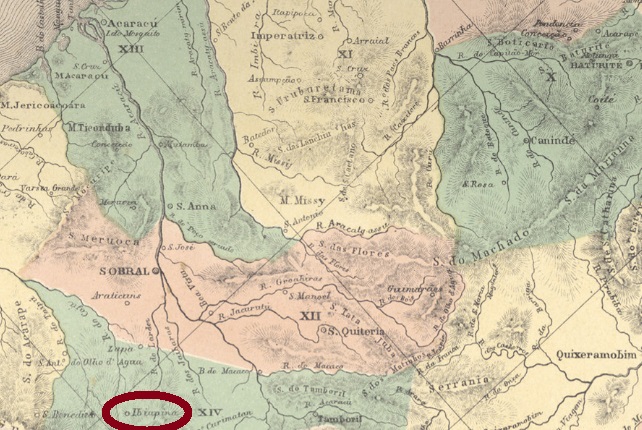
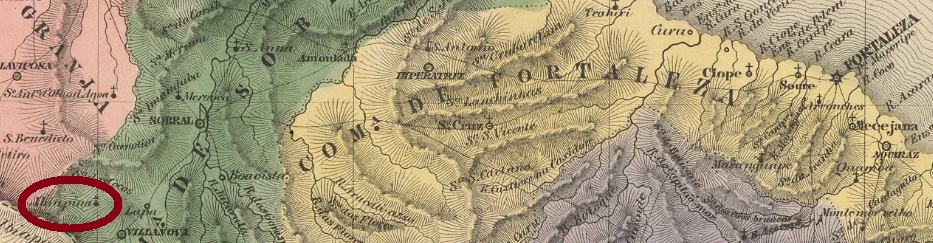
This locality was a district of São Benedicto from March 1842, situated 300 km west of the provincial capital, Fortaleza. Although it was promoted to a villa in November 1878, it lost this status in May 1931 and returned to São Benedicto as a district. Two years later the place became a villa again, and another five years after that a town, which has since then been called simply Ibiapina.
We know through Reinhold Koester that the local post office was established in March 1879. Unfortunately, no imperial postmark has yet appeared under this name. For a cancel featuring only Ibiapina, see Koesters Carimbologia XXII.
Villiers de l’Ile Adam: Carta (…)da Provincia do Ceara, 1849
Siehe auch Ibiapina (R. Koester: Carimbologia XXII)
Diese Ortschaft war ab März 1842 ein Distrikt von São Benedicto, der 300 km westlich der Provinzhauptstadt Fortaleza entfernt lag. Sie stieg zwar im November 1878 zu einer Villa auf, verlor diesen Status jedoch im Mai 1931 und kehrte als Distrikt zu São Benedicto zurück. Zwei Jahre später wurde der Ort wieder eine Villa, und weitere fünf Jahre danach eine Stadt, die seitdem einfach Ibiapina heißt.
Von Reinhold Koester wissen wir, dass das örtliche Postamt im März 1879 entstanden ist. Leider ist bisher kein Poststempel im Kaiserreich mit dem vollständigen Ortsnamen aufgetaucht. Ein Siegelstempel mit IBIAPINA ist bei Koesters Carimbologia XXII zu sehen.
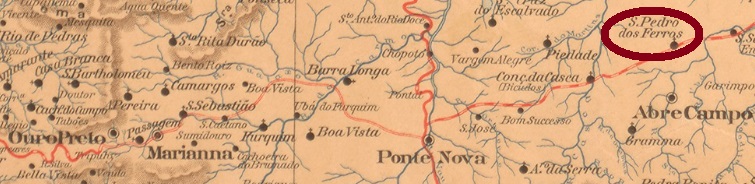
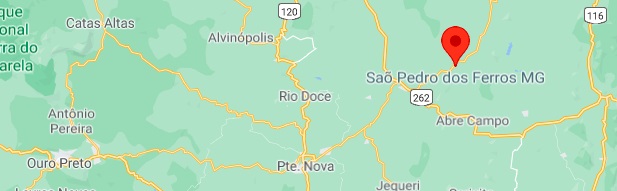
São Pedro dos Ferros was a district in the municipality of Ponte Nova from January 1880, located over 140 km east of the provincial capital Ouro Preto. In January 1911, the place passed as a district to Rio Casca, and since December 1943, S. Pedro dos Ferros has been an independent municipality.
As Paula Sobrinho writes in História Postal de Minas Gerais (Belo Horizonte, 1997), there has been a post office there since May 1882. The imperial-era postmark is SMG-2560a (Coll. José A. Junges), which also appears in purple: a double circle with the inscription S. PEDRO DOS FERROS at the top and an ornament in diamond at the bottom; its four sides are open. Dates in the centre between 1885 and 1904.
Google Maps
São Pedro dos Ferros war ab Januar 1880 ein Distrikt im Município von Ponte Nova, der gut 140 km östlich der Provinzhauptstadt Ouro Preto entfernt lag. Im Januar 1911 ging der Ort als Distrikt zu Rio Casca über, und seit Dezember 1943 ist S. Pedro dos Ferros eine selbständige Gemeinde.
Wie Paula Sobrinho in História Postal de Minas Gerais (Belo Horizonte, 1997) schreibt, gibt es dort ein Postamt seit Mai 1882. Der Poststempel aus der Kaiserzeit ist SMG-2560a (Samml. José A. Junges), der auch in violett vorkommt: ein Doppelkreis mit der Inschrift S. PEDRO DOS FERROS oben und einem Ornament in Raute unten, dessen vier Seiten offen sind. Daten in der Mitte zwischen 1885 und 1904.
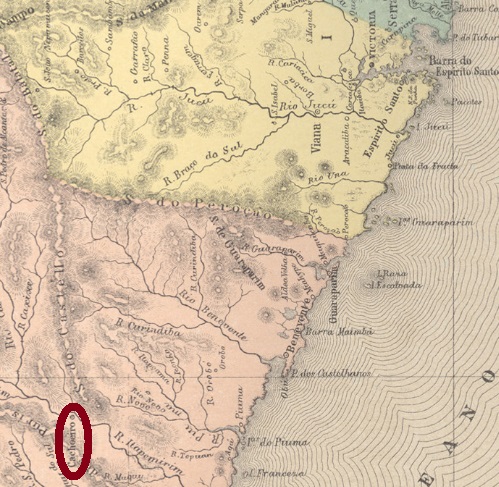
Other names: Caxoeiro, Cachoeira, Cachoeiro do Itapemirim.
See also Cachoeira do Itapemirim (R. Koester: Carimbologia VII)
From July 1856, São Pedro da Cachoeira was a district in the Município of Itapemirim, located on the south bank of the river Itapemirim, a good 130 km southwest of the provincial capital Vitória. In November 1864, the place rose to become a villa and in December 1889, to a town.
Two periods of origin – but only one exact date – for the local post office have been found. The first was in July 1859, as R. Koester writes in Carimbologia VII. However, the agency was closed again in about 1861, as it is no longer listed in the 1863 directory (R. Koester). The second opening took place around 1878, as Paulo Novaes writes (agenciaspostais.com.br).
A postmark from the second period of operation has appeared. SES-0210b (Coll. José A. Junges) is a simple double circle with the inscription S.P. DA CACHOEIRA at the top. The dates in the middle are from the period 1884-1888.
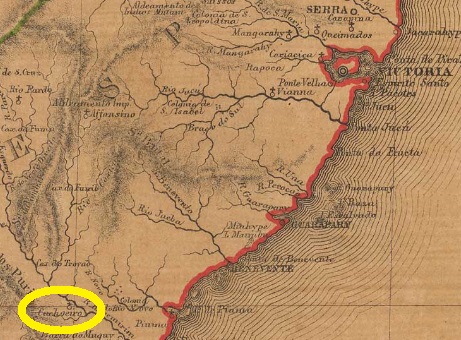
Provincia do Espirito Santo, 1873
Andere Namen: Caxoeiro, Cachoeira, Cachoeiro do Itapemirim
Siehe auch Cachoeira do Itapemirim (R. Koester: CarimbologiaVII)
São Pedro da Cachoeira war ab Juli 1856 ein Distrikt im Município von Itapemirim, der am Südufer des Flusses Itapemirim lag, gut 130 km südwestlich der Provinzhauptstadt Vitória. Im November 1864 stieg der Ort zu einer Villa und im Dezember 1889 zur Stadtauf.
Zwei Entstehungsperioden– doch nur ein genaues Datum – fürs örtliche Postamt wurden gefunden. Erstmals im Juli 1859, wie R. Koester in Carimbologia VII schreibt. Allerdings wurde die Agentur ca. 1861 wieder geschlossen, da sie nicht mehr im 1863 Verzeichnis aufgelistet wird (R. Koester). Die zweite Eröffnung fand ca. 1878 statt, wie Paulo Novaes schreibt (agenciaspostais.com.br).
Ein Poststempel aus der zweiten Betriebsperiode ist überliefert. SES-0210b (Samml. José A. Junges) ist ein schlichter Doppelkreis mit der Inschrift S.P. DA CACHOEIRA oben. Die Daten in der Mitte entstammen dem Zeitraum 1884-1888.
Other names: São Pedro Apóstolo do Gaspar, Gaspar (1934)
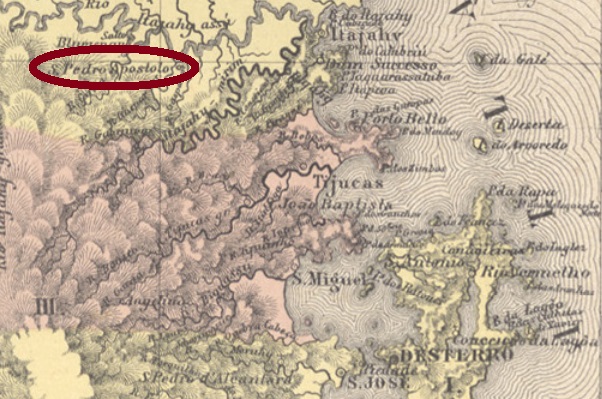
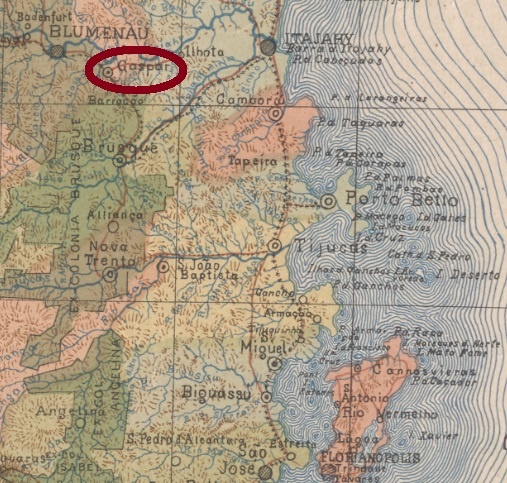
São Pedro Apóstolo do Gaspar (=Gaspar’s Apostle Peter) was the name of a freguesia near Itajahy from April 1861, situated on the south bank of the Itajaí-Açu River, barely 140 km north of the provincial capital Desterro (now Florianópolis). Gaspar was the small affluent which had its mouth on place. In February 1880, the municipality transferred as a district to the Município of Blumenau, and in February 1934 it received its political autonomy as an independent Município.
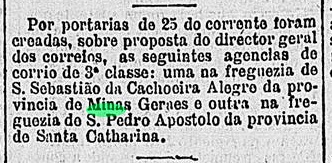
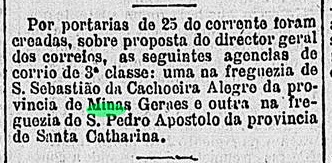
The post office there was established in April 1881, as shown in the Rio Press:
Gazeta de Noticias/RJ, 26 April 1881
The imperial postmark is SSC-0235a (Coll. Karlheinz Wittig): a double circle with the inscription S. PEDRO APOSTOLO above and an ornament in diamond below, formed by four small diamonds. Dates in the centre from 1883 to 1885.
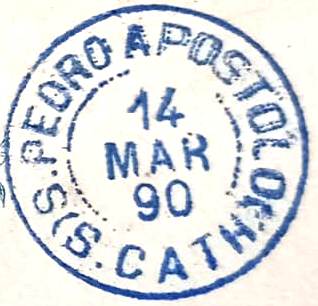
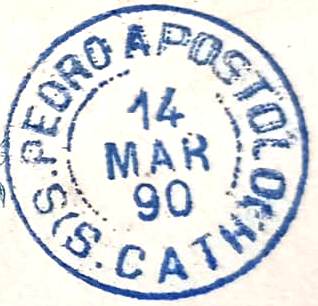
Furthermore, another 19th century postmark has appeared after the printing of Carimbologia S2, SSC-0235b (Coll. Fuad Ferreira Fo.):
SSC-0236b (FF) 1890-1906Carta do Estado de Santa Catharina, 1907
Aktualisierung der Printausgabe, am 11. Januar 2022
Andere Namen: São Pedro Apóstolo do Gaspar, Gaspar (1934)
São Pedro Apóstolo do Gaspar (=Gaspars Apostel Petrus) hieß ab April 1861 eine Freguesia bei Itajahy, die am Südufer des Flusses Itajaí-Açu lag, knapp 140 km nördlich der Provinzhauptstadt Desterro (heute Florianópolis) entfernt. Gaspar hieß der kleine Zufluss, der dort mündete. Im Februar 1880 wechselte die Gemeinde als Distrikt zum Município von Blumenau, und im Februar 1934 erhielt sie ihre politische Autonomie als selbständiger Município.
Das dortige Postamt entstand im April 1881, wie aus der Rio-Presse hervorging:
Gazeta de Noticias/RJ, 26. April 1881
Der kaiserliche Poststempel ist SSC-0235a (Samml. Karlheinz Wittig): ein Doppelkreis mit der Inschrift S. PEDRO APOSTOLO oben und einem Ornament in Raute unten, das aus vier kleinen Rauten gebildet wird. Daten in der Mitte von 1883 bis 1885.
Es ist aber ein weiterer Poststempel des 19. Jahrhunderts nach dem Druck der Carimbologia S2 aufgetaucht, SSC-0235b (Samml. Fuad Ferreira Fo.):
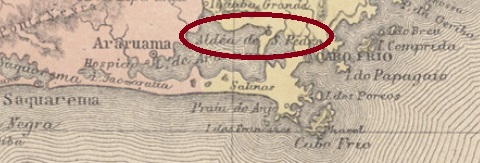
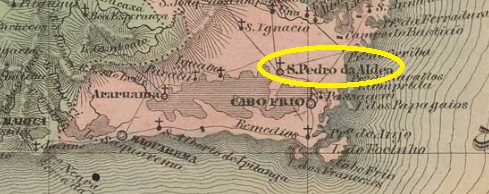
The history of this settlement, which is very old by Brazilian standards, began as early as May 1617, when the Aldeia de São Pedro was founded on the north-eastern shore of Lake Araruama near Cabo Frio, about 140 east of the future capital Rio de Janeiro. In December 1795, it became a freguesia, which rose to become a villa called Sapiatiba in September 1890. However, the Tupi word meaning rich in clay did not find favour, and a good two years later the old place name returned. São Pedro da Aldeia has been a town since December 1929.
Again, there are two dates for the origin of the local post office. The Imperial Mail Register (Tabella das Agencias do Correio do Imperio) of 1885 gives the year 1820 for it, while Nova Monteiro (Administrações e Agencias Postaes do Brasil Imperio, in Brasil Filatelico/RJ, 1934-5; Reprint SPP 1994-1999) lists the agency from June 1829.
Both postmarks of the imperial period found so far bear the place name Aldeia de S. Pedro and should rather be discussed under letter A. Since Reinhold Koester did not do so, they are presented here. SRJ-0200a also occurs in blue, was in use from about 1829 to 1884 and was already presented by Paulo Ayres (Catálogo de Carimbos Brasil-Império, S. Paulo, 1937, 1942) under no. 1193:
SRJ-0200a (P. A. 1193)
SRJ-0200b (agenciaspostais.com.br) is a simple double circle with the inscription A. DE S. PEDRO at the top. The only known copy is dated 1884 in the centre.
Villiers de l’Ile Adam: Carta (…) da Provincia do Rio de Janeiro, 1850
Andere Namen: Aldeia de São Pedro, Sapiatiba
Die Geschichte dieser für brasilianische Verhältnisse sehr alten Siedlung fing bereits im Mai 1617 an, als die Aldeia de São Pedro am Nordostufer des Araruama-Sees bei Cabo Frio gegründet wurde, ca. 140 östlich der künftigen Hauptstadt Rio de Janeiro entfernt. Im Dezember 1795 wurde daraus eine Freguesia, die im September 1890 zu einer Villa namens Sapiatiba aufstieg. Das Tupi-Wort, das reich an Lehm bedeutet, fand jedoch kein Gefallen, und gut zwei Jahre später kam der alte Ortsname zurück. Seit Dezember 1929 ist São Pedro da Aldeia eine Stadt.
Auch hier gibt es zwei Jahresangaben für die Entstehung des örtlichen Postamts. Das Verzeichnis der kaiserlichen Postämter (Tabella das Agencias do Correio do Imperio) von 1885 nennt dafür das Jahr 1820, während Nova Monteiro (Administrações e Agencias Postaes do Brasil Imperio, in Brasil Filatelico/RJ, 1934-5; Reprint SPP 1994-1999) die Agentur ab dem Juni 1829 auflistet.
Beide bisher gefundenen Poststempel der Kaiserzeit tragen den Ortsnamen Aldeia de S. Pedro und sollten eigentlich unter Buchstabe A besprochen werden. Da Reinhold Koester dies nicht gemacht hat, werden sie hier vorgestellt. SRJ-0200a kommt auch in blau vor, war von ca. 1829 bis 1884 in Gebrauch und wurde bereits durch Paulo Ayres (Catálogo de Carimbos Brasil-Império, S. Paulo, 1937, 1942) unter Nr. 1193 vorgestellt:
SRJ-0200a (P. A. 1193)
SRJ-0200b (agenciaspostais.com.br) ist ein einfacher Doppelkreis mit der Inschrift A. DE S. PEDRO oben. Das einzige Exemplar ist 1884 in der Mitte datiert.
Other names: S. Pedro de Alcantara do Itabapoanna, Monjardim, S. Pedro do Itabapoanna.
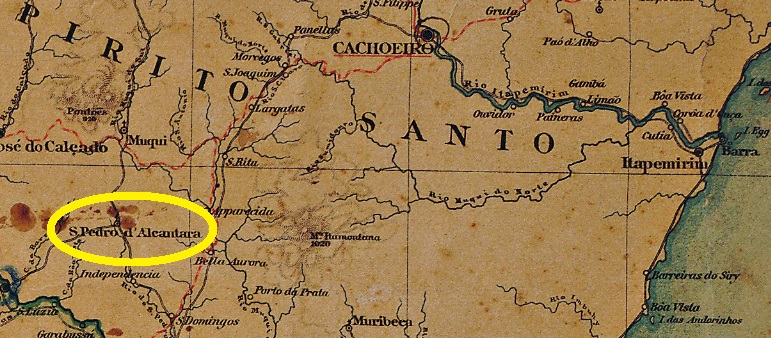
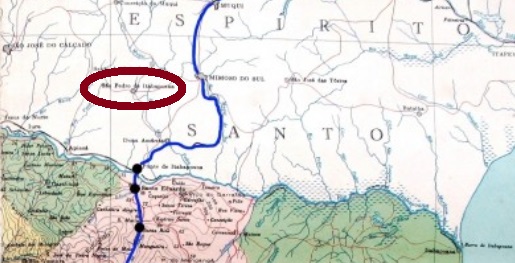
This village was a district of Cachoeiro do Itapemirim from November 1863, located about 200 km southwest of the provincial capital Vitória. Since its elevation to the villa of S. Pedro de Itabapoanna in July 1887, the village changed its name twice: in June 1890 to Monjardim and in March 1892 back to S. Pedro do Itabapoanna. However, things did not go as expected economically and politically, and the village became a district of Mimoso do Sul in January 1930, which is still valid today.
Two years of foundation for the local post office were found. According to the provincial president’s report in October 1878, the agency first came into being in May of that year.
Relatorio do Presidente da Provincia, October 1878
Paulo Novaes (agenciaspostais.com.br), on the other hand, write a creation date in September 1881 for it. Accordingly, the post office was closed in the meantime. The only postmark of the imperial period so far is SES-0160a (Coll. José A. Junges). A double circle with the inscription S. PEDRO DE ALCANTARA on top and an ornament in diamond below consisting of four small diamonds. The dates in the centre go from 1885 to 1891.
agenciaspostais.com.br
Andere Namen: S. Pedro de Alcantara do Itabapoanna, Monjardim, S. Pedro do Itabapoanna
Diese Ortschaft war ab November 1863 ein Distrikt von Cachoeiro do Itapemirim, der ca. 200 km südwestlich der Provinzhauptstadt Vitória entfernt lag. Seit dem Aufstieg zur Villa von S. Pedro de Itabapoanna im Juli 1887 wechselte der Ort noch zweimal den Namen: im Juni 1890 zu Monjardim und im März 1892 zurück zu S. Pedro do Itabapoanna. Allerdings ging es wirtschaftlich und politisch nicht so wie erwartet, und der Ort stieg im Januar 1930 zum Distrikt von Mimoso do Sul, was heute noch gültig ist.
Zwei Gründungsjahre fürs örtliche Postamt wurden gefunden. Laut dem Bericht des Provinzpräsidenten im Oktober 1878 entstand die Agentur erstmals im Mai des Jahres:
Relatorio do Presidente da Provincia, Oktober 1878
Dafür schreibt Paulo Novaes (agenciaspostais.com.br) den September 1881 für diese Entstehung. Demnach war das Postamt zwischendurch geschlossen. Der bisher einzige Poststempel der Kaiserzeit ist SES-0160a (Samml. José A. Junges). Ein Doppelkreis mit der Inschrift S. PEDRO DE ALCANTARA oben und ein Ornament in Raute unten, das aus vier kleinen Rauten besteht. Die Daten in der Mitte gehen von 1885 bis 1891.
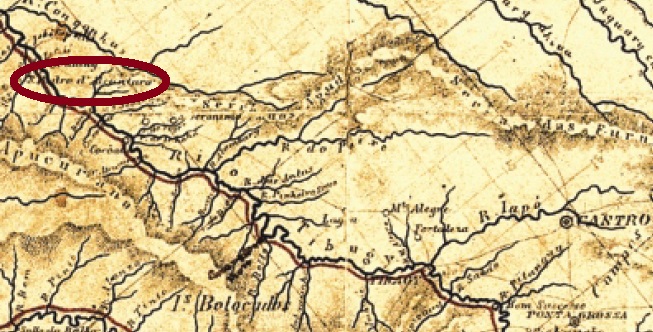
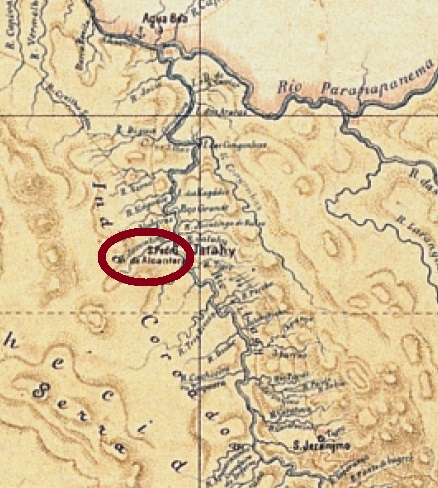
This is another locality that has disappeared from the map today. Its history began in 1855, when an Indian settlement was founded on the west bank of the Tibagy River near Castro, more than 400 km northwest of the provincial capital of Curitiba. When the villa of Tibagy was built in 1872, the place went to the Freguesia of Conceição do Jatahy, which belonged to it. The settlement project ended in 1895 and it is not known what became of the Indians. The village grew very slowly and in October 1938 it became part of the newly created Município of Sertanópolis as the district of Ibiporã. Since October 1947, it has been a suburb of the town of Ibiporã. The word from the Tupi-Guarani language means Beautiful Land.
The earliest mention of a local post office was found in the provincial president’s report for February 1868:
Relatório do Presidente da Provincia/PR, February 1868.
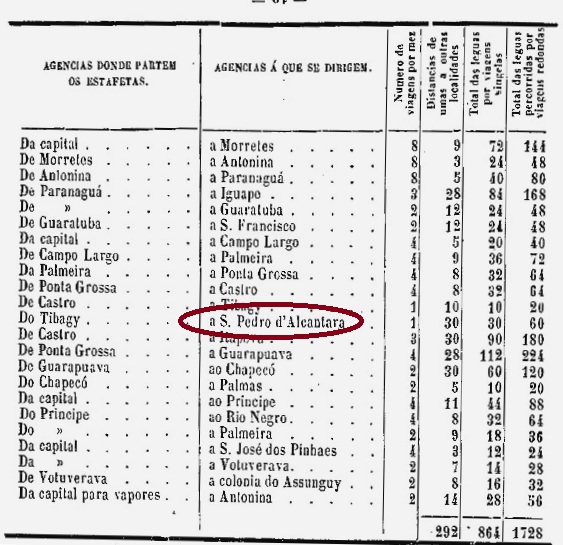
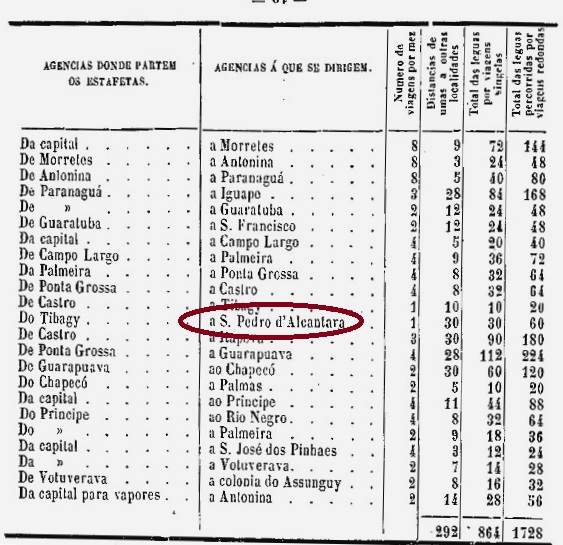
Since a postal route from Tibagy to S. Pedro d’Alcantara had already been active a year earlier (Dezenove de Dezembro, 7 August 1867), one may assume that the post office had been established shortly before. However, the 1880 Imperial Postal Guide (Guia Postal do Império) does not list the agency. It is likely that a chickenpox epidemic in 1878 caused the cessation of postal operations. No postmark has yet been found from there. With a population of 294 (1879), this postmark must be very rare.
Mappa do Estado do Paraná, 1896
Diese ist wieder eine Ortschaft, die heute von der Landkarte verschwunden ist. Ihre Geschichte fing 1855 an, als eine Indianersiedlung am Westufer des Flusses Tibagy bei Castro gegründet wurde, über 400 km nordwestlich der Provinzhauptstadt Curitiba entfernt. Als 1872 die Villa von Tibagy entstanden ist, ging der Ort zur dazu gehörenden Freguesia von Conceição do Jatahy. Das Siedlungsprojekt wurde 1895 beendet, und man weiß nicht, was aus den Indianern wurde. Die Ortschaft wuchs sehr langsam und ging im Oktober 1938 als Distrikt von Ibiporã zum neu gegründeten Município von Sertanópolis. Seit Oktober 1947 ist es ein Vorort des Städtchens Ibiporã. Das Wort aus der Tupi-Guarani-Sprache bedeutet Schönes Land.
Die früheste Erwähnung eines Postamtes vor Ort findet man im Bericht des Provinzpräsidenten für Februar 1868:
Relatório do Presidente da Provincia/PR, Februar 1868
Da schon ein Jahr zuvor eine Postroute von Tibagy zu S. Pedro d’Alcantara aktiv war (Dezenove de Dezembro, 7. August 1867), darf man annehmen, dass das Postamt kurz davor entstanden war. Im kaiserlichen Postführer (Guia Postal do Império) von 1880 wird die Agentur allerdings nicht aufgelistet. Wahrscheinlich hat eine Windpockenepidemie 1878 die Einstellung des Postbetriebs verursacht. Kein Poststempel wurde bisher von dort gefunden. Bei einer Bevölkerungszahl von 294 (1879) muss dieser Stempel sehr selten sein.
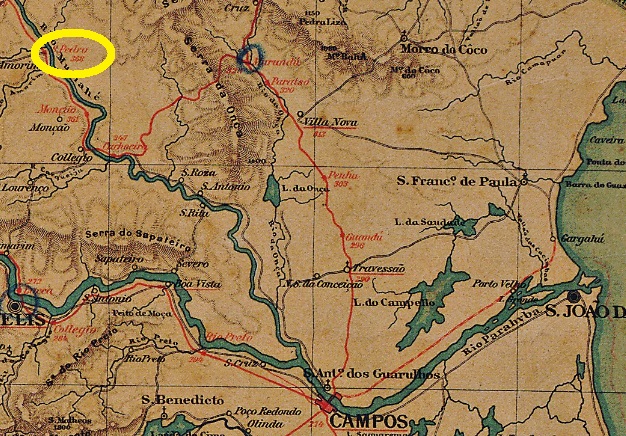
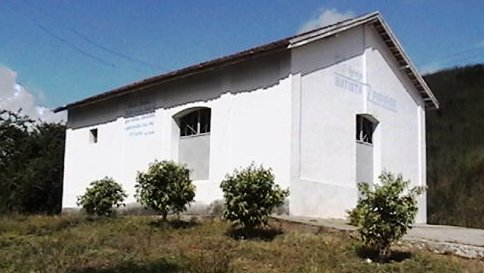
This station was inaugurated in June 1880 by the E. F. Carangola Railway Company in the municipality of Campos dos Goytacazes and was located on the north bank of the Muriaé River, about 320 km northeast of the capital Rio de Janeiro. The railway line changed hands three times: in 1890 to the Cia. Barão de Araruama and then to the Estrada de Ferro Leopoldina, in 1975 to the Rede Ferroviária Federal. The railway ceased to operate in 1977, the rails have since disappeared, and the station building was last used as a Baptist church hall (estacoesferroviarias.com.br).
In 2006 (Photo: Lucio Fernandes, in estacoesferroviarias.com.br)
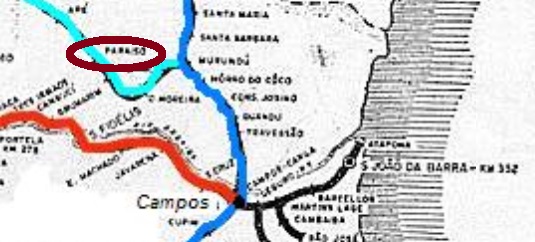
The station was renamed Paraiso in 1892; around it grew a settlement, now the district of Paraíso, in the Município of Italva. This municipality first became a município in 1983. Nevertheless, due to a formal error, this administrative autonomy was soon revoked and only restored in 1986.
According to the Imperial Mail Register (Tabella das Agencias do Correio do Imperio, 1885), there was a station post office since 1880. Two postmarks in double circle were found. SRJ-1893a (Coll. José A. Junges) has the inscription E. DE S. PEDRO; the only existing specimen bears a date from 1883 in the centre. SRJ-1893b (coll. Klerman W. Lopes) now has the inscription EST. DE S. PEDRO at the top and E.F. DO CARANGOLA at the bottom. Two copies dated 1889 at the centre.
E.F. Leopoldina
Dieser Bahnhof wurde im Juni 1880 durch die E. F. Carangola Bahngesellschaft im Município von Campos dos Goytacazes eingeweiht und lag am Nordufer des Flusses Muriaé, gut 320 km nordöstlich der Hauptstadt Rio de Janeiro entfernt. Die Bahnlinie wechselte den Besitzer dreimal: 1890 zu der Cia. Barão de Araruama und gleich danach zur Estrada de Ferro Leopoldina, und 1975 zur Rede Ferroviária Federal. Der Bahnbetrieb wurde 1977 eingestellt, die Schienen sind inzwischen weg, und das Bahnhofsgebäude diente zuletzt als Kirchraum der Baptisten (estacoesferroviarias.com.br).
2006 (Foto: Lucio Fernandes, in estacoesferroviarias.com.br)
Der Bahnhof wurde 1892 zu Paraiso umbenannt; um ihn herum wuchs eine Siedlung, die heute der Distrikt von Paraíso ist, im Município von Italva. Diese Gemeinde wurde erstmals 1983 ein Município. Durch einen Formfehler wurde dennoch diese Verwaltungsautonomie bald aufgehoben und erst 1986 wiederhergestellt.
Laut Verzeichnis der kaiserlichen Postämter (Tabella das Agencias do Correio do Imperio, 1885) gab es ein Bahnhofspostamt seit 1880. Zwei Poststempel in Doppelkreis wurden gefunden. SRJ-1893a (Samml. José A. Junges) hat die Inschrift E. DE S. PEDRO; das einzige vorhandene Exemplar trägt ein Datum aus 1883 in der Mitte. SRJ-1893b (Samml. Klerman W. Lopes) hat nun oben die Inschrift EST. DE S. PEDRO und unten E.F. DO CARANGOLA. Zwei Exemplare, datiert 1889 in der Mitte.
Mappa das Estações de São Paulo, Rio de Janeiro e Minas Geraes, 1880
Another name: Pequery (Estação).
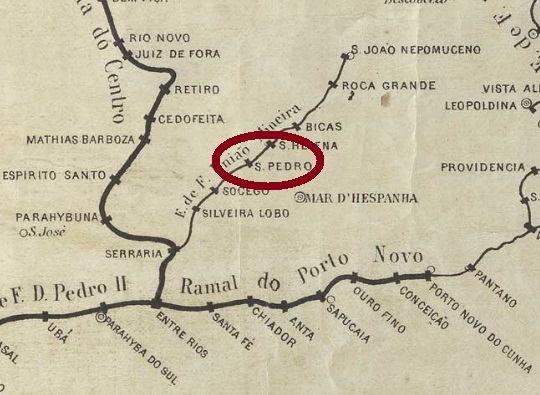
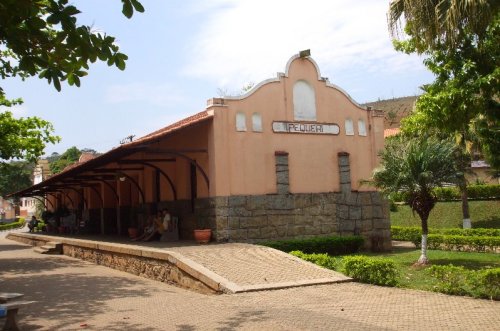
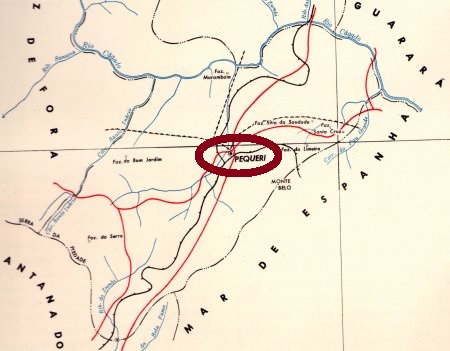
This station was inaugurated in July 1879 by the E.F. União Mineira railway company and was located on the Caratinga Line near Juiz de Fora, just under 280 km south of the provincial capital Ouro Preto. In 1884, the railway line was transferred to the Estrada de Ferro Leopoldina, and from 1975 until the end of operations in 1994, it belonged to Rede Ferroviária Federal. In the 1940s, the name changed to Pequeri, a word in the Tupi language that is said to mean River of the Little Fish. Now the rails have been torn out and the station building has become a small bistro.
In 2008 (Photo: Jorge A. Ferreira, from estacoesferroviarias.com.br)
Paula Sobrinho writes in História Postal de Minas Gerais (Belo Horizonte, 1997) that there has been a station post office since July 1877. This is probably a typo, as this date is two years before the inauguration of the station. Two 19th century double-circle postmarks were found. SMG-2545a (coll. Karlheinz Wittig) has the inscription S. PEDRO (ESTAÇÃO) at the top, dated inside from 1883 to 1889. SMG-2545b (coll. José A. Junges) now has EST. DE S. PEDRO above and at the bottom it reads (MINAS). Dates in the middle: 1890-1899.
IBGE (apud estacoesferroviarias.com.br)
Anderer Name: Pequery (Estação)
Dieser Bahnhof wurde im Juli1879 durch die E.F. União Mineira Bahngesellschaft eingeweiht und lag auf der Caratinga-Linie bei Juiz de Fora, knapp 280 km südlich der Provinzhauptstadt Ouro Preto entfernt. 1884 ging die Bahnlinie zur Estrada de Ferro Leopoldina über, und von 1975 bis Betreibsende 1994 gehörte sie der Rede Ferroviária Federal. In den 40er Jahren wechselte der Name zu Pequeri, ein Wort der Tupi-Sprache, das Fluss der Fischlein bedeuten soll. Nun sind die Schienen ausgerissen, aus dem Bahnhofsgebäude wurde ein kleines Bistro.
In 2008 (Foto: Jorge A. Ferreira, aus estacoesferroviarias.com.br)
Paula Sobrinho schreibt in História Postal de Minas Gerais (Belo Horizonte, 1997), dass es dort seit Juli 1877 ein Postamt gibt. Das dürfte ein Tippfehler sein, denn dieses Datum liegt zwei Jahre vor der Bahnhofseinweihung. Zwei Poststempel im Doppelkreis aus dem 19. Jahrhundert wurden gefunden. SMG-2545a (Samml. Karlheinz Wittig) hat die Inschrift S. PEDRO (ESTAÇÃO) oben, datiert im Inneren von 1883 bis 1889. Bei SMG-2545b (Samml. José A. Junges) heißt es nun oben EST. DE S. PEDRO und unten liest man (MINAS). Daten in der Mitte: 1890-1899.
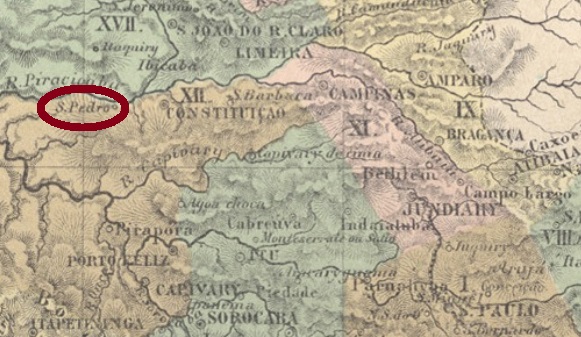
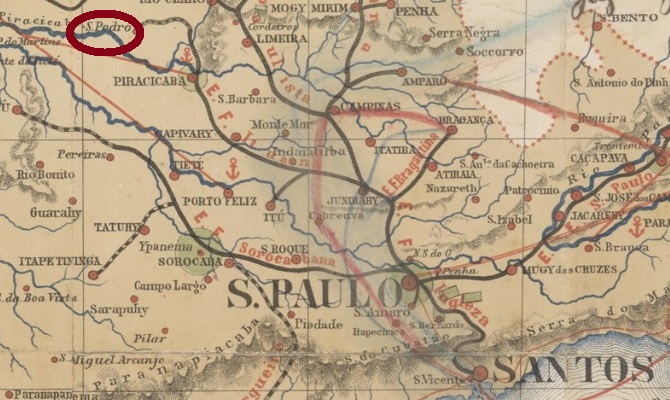
This locality was a district near Piracicaba from April 1864, located close to the north bank of the Piracicaba River, barely 200 km northwest of the provincial capital of São Paulo. It rose to the status of a villa in February 1881 and to a town in October 1903.
The local post office was established in April 1874, as can be read in the regional press:
Correio Paulistano, 21 April 1874
So far, only SSP-1215a (Klerman Lopes Collection) could be found as an imperial postmark: a “French type”, with the inscription SÃO PEDRO above and the star between brackets below. It is said to occur in black and blue, the only seen specimen has a date from the beginning of the 1980s.
Provincia de São Paulo, 1886
Diese Ortschaft war ab April 1864 ein Distrikt bei Piracicaba, der nah am Nordufer des Flusses Piracicaba lag, knapp 200 km nordwestlich der Provinzhauptstadt São Paulo entfernt. Im Februar 1881 steig sie zur Villa und im Oktober 1903 zur Stadt auf.
Das örtliche Postamt entstand im April 1874, wie man in der Regionalpresse lesen kann:
Correio Paulistano, 21. April 1874
Bisher konnte nur SSP-1215a (Samml. Klerman Lopes) als kaiserlicher Poststempel gefunden werden: ein „Französischer Typus“, mit der Inschrift SÃO PEDRO oben und dem Stern zwischen Klammern unten. Er soll in schwarz und blau vorkommen, das einzige Exemplar hat ein Datum vom Anfang der 80er Jahre.








 Carimbologia