Categories
Carimbologia S

São José d’El-Rei, Rio de Janeiro (SRJ-1427)

Real Archivo Militar de Lisboa, 1823 (agenciaspostais.com.br)

Other names: São Bernabé, Villa Nova de Itamby, Itambi

See also São Bernabé (SRJ-0913)

This post office was discovered through the Carimbologia project: a locality which disappeared almost 200 years ago, i.e. still in the pre-philatelic period, and belonged to a municipality that no longer exists, either. It began in November 1759, with the foundation of the freguesia of Nossa Senhora do Desterro de Itamby, which took part of the now extinct municipality of Santo Antonio de Sá, located under 50 km northeast of the imperial capital. In 1772 it became a villa called São José del Rei, that after a short decadence went in 1833 as the freguesia of São Bernabé to the municipality of São João de Itaborahy. This status remained until 1840, when São Bernabé merged with other localities into the Villa Nova de Itamby, which is now Itambi, in the outskirts of the town of Itaboraí. We don’t know the causes of such a turbulent history, whether they are political, economic, or ecological nature, or even a combination among them.

No creation date for the local post office has been found until now, but it was closed by June 1835, according to official reports:

Correio Official, 30 de junho de 1835

No postal cancel from this locality has been found so far.

Carta Corographica do Rio de Janeiro, 1867

Andere Namen: São Bernabé, Villa Nova de Itamby, Itambi

Siehe auch São Bernabé (SRJ-0913)

Dieses Postamt wurde durch die Carimbologia-Recherchen entdeckt: eine vor fast 200 Jahren verschwundene Ortschaft – also noch in der Vorphila-Ära – die einer Gemeide angehörte, die inzwischen auch nicht mehr existiert. Die Geschichte begann im November 1759 mit der Gründung der Freguesia von Nossa Senhora do Desterro de Itamby im inzwischen ausgelöschten Município von Santo Antonio de Sá, knapp 50 km nordöstlich der kaiserlichen Hauptstadt Rio de Janeiro gelegen. 1772 wurde daraus die Villa von São José del Rei, die nach einem raschen Verfall im Jahr 1833 zur Freguesia von São Bernabé im Município von São João de Itaborahy abstieg. Dieser Status hielt bis 1840, als São Bernabé mit anderen Ortschaften zur Villa Nova de Itamby (heute Itambi) wurde, heute ein Vorort der Stadt Itaboraí. Wir wissen nicht die Gründe für eine solch turbulente Geschichte, ob sie politischer, wirtschaftlicher oder ökologischer Natur sind, oder auch eine Mischung davon.

Kein Gründungsdatum fürs örtliche Postamt wurde bisher gefunden, lediglich für dessen Schließung (bis Juni 1835), wie aus dem offiziellen Mittelungsblatt hervorgeht:

Correio Official, 30. Juni 1835

Bisher wurde kein Poststempel von dieser Ortschaft gefunden.

Categories
Carimbologia S

São José do Egypto, Pernambuco (SPE-0560)

Arthur D. Ribeiro: Mappa de Pernambuco, 1924

Other names: São José das Queimadas, São José da Ingazeira

From 1865, this village was called São José das Queimadas, located in the municipality of Ingazeira, about 350 km west of the provincial capital Recife. In May 1872, it ascended to a district called São José da Ingazeira and was granted political autonomy as a municipality five years later. The villa was given the current name São José do Egypto (now Egito) in April 1881.

The local post office was established in 1879, as can be read both in the Imperial Mail Register (Tabella das Agencias do Correio do Imperio, Rio de Janeiro, 1885) and in the Postal Report for 1887. It follows that the first postmark would still have to bear the name São José da Ingazeira. So far, however, only SPE-0560a (Coll. José A. Junges) was found: a double circle with the inscriptions S. JO DO EGYPTO above and (PERNAMO.) below. Two copies are available, both with a date from 1892 in the middle. 

Google Maps

Andere Namen: São José das Queimadas, São José da Ingazeira

Diese Ortschaft hieß ab 1865 S. José das Queimadas und lag im Município von Ingazeira, gut 350 km westlich der Provinzhauptstadt Recife. Im Mai 1872 stieg er zum Distrikt von S. José da Ingazeira und erhielt seine politische Autonomie als Município fünf Jahre später. Die dann entstandene Villa erhielt im April 1881 den bis heute aktuellen Namen S. José do Egypto (heute Egito geschrieben).

Das örtliche Postamt entstand 1879, wie sowohl im Imperial Mail Register / Verzeichnis der kaiserlichen Postämter (Tabella das Agencias do Correio do Imperio, Rio de Janeiro, 1885) als auch im Postbericht für 1887 zu lesen ist. Daraus folgt, dass der erste Poststempel noch den Namen S. José da Ingazeira tragen müsste. Bisher wurde aber lediglich SPE-0560a (Samml. José A. Junges) gefunden: ein Doppelkreis mit den Inschriften S. JOSÉ DO EGYPTO oben und (PERNAMO.) unten. Zwei Exemplare vorhanden, beide mit einem Datum aus 1892 in der Mitte.  

Categories
Carimbologia S

São José da Coroa Grande, Pernambuco (SPE-0550)

Villiers de l’Ile Adam: Carta (…) das Provincias de Pernambuco, Alagoas e Sergipe, 1848

Other names: Coroa Grande, Puirassu

This village was originally a freguesia of Barreiros, located on the beach on the provincial border with Alagoas, about 120 km south of the provincial capital Recife. Later, the place name changed three times: in 1901 to Coroa Grande (= Big Crown), in 1938 to Puirassu (Big Crown in the Tupi language) and in 1958 back to the old Sao José da Coroa Grande, which has been an own municipality since December 1958.

As reported by the regional press, there was a post office there since July 1882:

Diario de Pernambuco, 26 July 1882

So far, no local postmark of the Empire has been found.

Atlas do Imperio do Brasil, 1868

Andere Namen: Coroa Grande, Puirassu

Diese Ortschaft war ursprünglich eine Freguesia von Barreiros, die am Strand an der Provinzgrenze zu Alagoas lag, knapp 120 km südlich der Provinzhauptstadt Recife. Später wechselte der Ortsname – nun als Distrikt – dreimal: 1901 zu Coroa Grande (= Große Krone), 1938 zu Puirassu (Große Krone in der Tupi-Sprache) und 1958 zum alten São José da Coroa Grande zurück, der seit Dezember 1958 ein eigener Município ist.

Wie man in der Regionalpresse lesen kann, gab es dort ein Postamt seit Juli 1882:

Diario de Pernambuco, 26. Juli 1882

Bisher wurde kein Poststempel des Kaiserreichs von dort gesichtet.

Categories
Carimbologia S

São José do Chopotó, Minas Gerais (SMG-2455)

Atlas do Imperio do Brasil, 1868

Another name: Alto Rio Doce (1890)

From July 1832, this was a freguesia of Barbacena, located on the west bank of the River Chopotó (today written Xopotó), about 110 km south of the provincial capital Ouro Preto. In July 1868, the village passed as a freguesia to the municipality of Piranga and became a villa in its own municipality under the name Alto Rio Doce in March 1890. Since May 1892, Alto Rio Doce has been a town.

Two dates for the creation of the local post office were found. The Imperial Mail Register (Tabella das Agencias do Correio do Imperio) of 1885 indicates the year 1877, while Paula Sobrinho writes October 1887 in his História Postal de Minas Gerais (Belo Horizonte, 1997), which could be a copy error or a reopening date, because there are previous local cancels. SMG 2455a (Coll. José A. Junges) has a double circle with the inscription S. JOSÉ DO CHOPOTÓ above and an ornament in cross below. The dates at the centre are from 1885 to 1886. SMG-2455b (Coll. José A. Junges) came after that: here are the inscriptions in the double circle S. JE. DO CHOPOTÓ above and (MINAS) below, the only copy so far bearing a date from 1889 in the centre.

Villiers de l’Ile Adam: Carta (…) da Provincia de Minas Geraes, 1849

Anderer Name: Alto Rio Doce (1890)

São José do Chopotó war ab Juli 1832 eine Freguesia von Barbacena, die am Westufer des Flusses Chopotó (heute Xopotó geschrieben), ca. 110 km südlich der Provinzhauptstadt Ouro Preto lag. Im Juli 1868 ging der Ort als Freguesia zum Município von Piranga über, und wurde eine Villa im eigenen Município unter dem Namen Alto Rio Doce im März 1890. Seit Mai 1892 ist Alto Rio Doce eine Stadt.

Es wurden zwei Jahre für die Gründung des örtlichen Postamtes gefunden. Das Verzeichnis der kaiserlichen Postämter (Tabella das Agencias do Correio do Imperio) von 1885 gibt das Jahr 1877 an, während Paula Sobrinho den Oktober 1887 in seiner História Postal de Minas Gerais (Belo Horizonte, 1997) schreibt, was ein Kopierfehler oder ein Wiedereröffnungsdatum sein dürfte, da es frühere lokale Stempel gibt. SMG 2455a (Samml. José A. Junges) hat einen Doppelkreis mit der Inschrift S. JOSÉ DO CHOPOTÓ oben und einem Ornament in Kreuz unten. Die Daten in der Mitte gehen von 1885 bis 1886. SMG-2455b (Samml. José A. Junges) kam danach: hier lauten die Inschriften im Doppelkreis S. JE. DO CHOPOTÓ oben und (MINAS) unten, Das bisher einzige Exemplar trägt ein Datum aus 1889 in der Mitte.

Categories
Carimbologia S

São José do Carrapicho, Minas Gerais (SMG-2450)

Mappa de Minas Geraes, 1910

Other names: Carrapicho, Joselândia (1953)

This locality with the strange name (Carrapicho is a plant of the Asteraceae family) became in October 1881 a parish in the Municipality of Queluz, which was located on the west bank of the river Piranga, about 60 km south of the provincial capital Ouro Preto. In December 1953, the place name was changed to Joselândia, and since December 1962 Joselândia is a district in the municipality of Santana dos Montes.

Acanthospermum australe (Photo: Forrest & Kim Starr)

According to Paula Sobrinho (História Postal de Minas Gerais, Belo Horizonte, 1997), the local post office was established in June 1887.  The only postmark of the 19th century was sighted with earliest date from 1895. SMG-2450a (Coll. José A. Junges) has a double circle with the inscriptions S. JE DO CARRAPICHO above and (MINAS) below, with date at the centre.

Google Maps

Andere Namen:  Carrapicho, Joselândia (1953)

Diese Gemeinde mit dem merkwürdigen Namen (Carrapicho ist eine Pflanze der Familie Asteraceae) wurde im Oktober 1881 eine Pfarrei im Município von Queluz, die am Westufer des Flusses Piranga,  gut 60 km südlich der Provinzhauptstadt Ouro Preto entfernt lag. Im Dezember 1953 wurde der Ortsname zu Joselândia geändert, und seit Dezember 1962 ist Joselândia ein Distrikt im Município von Santana dos Montes.

Acanthospermum australe (Foto: Forrest & Kim Starr)

Laut Paula Sobrinho (História Postal de Minas Gerais, Belo Horizonte, 1997) entstand das örtliche Postamt im Juni 1887.  Der bisher einzige Poststempel des 19. Jahrhunderts wurde mit frühestem Datum aus 1895 gesichtet. SMG-2450a (Samml. José A. Junges) hat einen Doppelkreis mit den Inschriften S. JE DO CARRAPICHO oben und (MINAS) unten, dazu Datum in der Mitte.

Categories
Carimbologia S

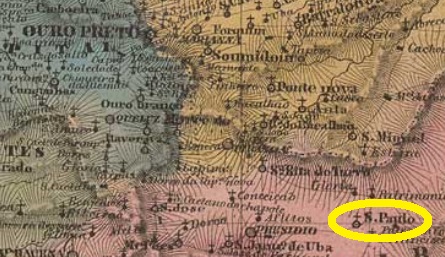
São José dos Campos (SSP-1190) – São Jozé, São Paulo (SSP-1855)

Atlas do Imperio do Brasil, 1868

Other names: São José do Parahyba, S. José do Norte

There were apparently two neighbouring villages, which later merged. Since July 1767, there was a villa called S. José do Parahyba, which was located on the river of the same name, about 90 km northeast of the later provincial capital of São Paulo. Just over a year later, a freguesia of São José dos Campos was founded in the neighbourhood, still within the municipality of Jacarehy. In April 1864, the village of São José da Parahyba became a town through merging with S. José dos Campos and had been bearing the latter name since April 1871.

There are still many questions about the postal history of this village. Nova Monteiro writes in Administrações e Agencias Postaes do Brasil Imperio (Brasil Filatelico/RJ, 1934-5; Reprint SPP 1994-1999) that the local post office was only established in October 1849, although the presence of Bull’s Eyes issued in 1843 with this local cancel would speak for an earlier date. The philatelist Mario Celso R. Orsi Jr. reports an agency creation exactly with same day and month, but in 1834 and without naming his source. SSP-1855a is also found in brown colour and has already been introduced by Henrique B. Ferreira in his Catalogo ilustrado dos carimbos sobre os olhos-de-boi (Porto Alegre, 2017):

SSP-1855a (HBF S17) 1843ff-1858ff

Given that the next cancel was only registered after about 20 years, one wonders whether there would exist an unknown cancel, the agency was closed for a while, or both. SSP-1190a (Coll. José A. Junges) is also available in blue and sepia, and it has a double circle with the inscription S. J. DOS CAMPOS above. The internal dates originate from the period 1879-1886.  SSP-1190b (Coll. FM) is a “French type”: a double circle with the inscription S. J. DOS CAMPOS above and the typical star in brackets below. Dates inside: 1884-1893.

The next question relates to the local station. It was inaugurated in August 1876, and in the Imperial Postal Guide (Guia Postal do Imperio) for 1880 a station post office S. José dos Campos is listed under no. 402. Accordingly, there was still a previously unknown station cancel, or maybe this would be SSP-1190a… The same guide also lists under No. 1027 another post office in São Paulo, which is called S. José do Norte. Since S. José do Norte was also a name for S. José dos Campos, this could mean that there were two post offices there, which would be quite unlikely. There are still many issues for researching.

Villiers de l’Ile Adam: Carta (…) da Provincia de São Paulo, 1847

Andere Namen: São José do Parahyba, S. José do Norte

Hier handelt es sich scheinbar um zwei benachbarte Ortschaften, die später fusionierten. Es gab seit Juli 1767 eine Villa namens S. José do Parahyba, die am gleichnamigen Fluss, ca. 90 km nordöstlich der späteren Provinzhauptstadt São Paulo lag. Gut ein Jahr später wurde die Freguesia von São José dos Campos in der Nachbarschaft gegründet, doch noch der Gemeinde Jacarehy zugeordnet war. Im April 1864 wurde aus São José da Parahyba eine Stadt, die mit S. José dos Campos zusammen kam und seit April 1871 letzteren Namen trägt.

Über das Postwesen dieser Ortschaft gibt es auch viele Fragen. Nova Monteiro schreibt in Administrações e Agencias Postaes do Brasil Imperio (Brasil Filatelico/RJ, 1934-5; Reprint SPP 1994-1999), dass das örtliche Postamt erst im Oktober 1849 entstanden ist, obwohl das Vorhandensein von in 1843 ausgegebenen Ochsenaugen mit diesem Ortsstempel für ein früheres Datum sprechen würde. Der Philatelist Mario Celso R. Orsi Jr. nennt ohne Quellenangabe ein Datem mit exakt denselben Tag und Monat, aber in 1834, was ein Abschreibfehler sein könnte. SSP-1855a kommt auch in Braun vor und wurde bereits durch Henrique B. Ferreira in seinem Catálogo ilustrado dos carimbos sobre os olhos-de-boi (Porto Alegre, 2017) vorgestellt:

SSP-1855a (HBF S17) 1843ff-1858ff

Weil der nächste Stempel erst nach ca. 20 Jahren registriert wurde, fragt man sich, ob es noch einen unbekannten Stempel gibt, die Agentur für eine Weile geschlossen wurde, oder beides. SSP-1190a (Samml. José A. Junges) gibt es auch in Blau und Sepia, und er hat einen Doppelkreis mit der Inschrift S. J. DOS CAMPOS oben. Die inneren Daten entstammen dem Zeitraum 1879-1886.  SSP-1190b (Samml. FM) ist ein „französischen Typus“: ein Doppelkreis mit der Inschrift S. J. DOS CAMPOS oben und dem typischen Stern in Klammern unten. Daten im Inneren: 1884-1893.

Die nächste Frage bezieht sich auf den Bahnhof vor Ort. Er wurde im August 1876 eingeweiht, und im kaiserlichen Postführer (Guia Postal do Imperio) für 1880 wird ein Bahnhofspostamt S. José dos Campos unter Nr. 402 aufgelistet. Demnach gab es noch einen bisher unbekannten Bahnhofsstempel, oder wäre es SSP-1190a… Derselbe Führer listet außerdem unter der Nr. 1027 ein weiteres Postamt in São Paulo, der S. José do Norte heißt. Da S. José do Norte auch ein Name für S. José dos Campos war, könnte es bedeuten, dass es dort zwei Postämter gab, was ziemlich unwahrscheinlich wäre. Hier besteht noch viel Klärungsbedarf.

Categories
Carimbologia S

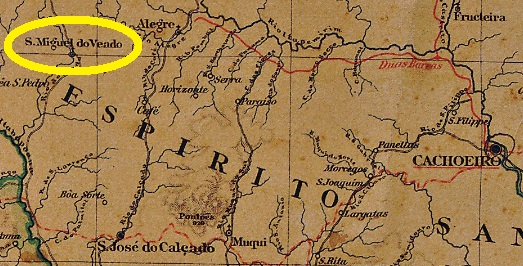
São José do Calçado, Espírito Santo (SES-0145)

Almanak Laemmert, 1892

This village, with a strange name related to shoes (calçado), was a district of S. Pedro do Itabapoanna, located about 240 km southwest of the provincial capital Vitória, on the border with the province of Rio de Janeiro. In November 1890, the village became a municipality. Since the footwear of the name has no plausible explanation, sometime later a legend with a religious background was invented.

According to Paulo Novaes (agenciaspostais.com.br) there has been a post office there since May 1881. Two early postmarks in double circle were found. SES-0145a (Coll. José A. Junges) also occurs in turquoise and carmine; it has on top the inscription S. JOSÉ DO CALÇADO and below an ornament in diamond, which consists of four small diamonds. Dates at the centre from 1883 until 1889. SES-0145b (Coll. José A. Junges) now has the inscription above S. JE. DO CALÇADO and below (ESP. SANTO). The dates inside go from 1890 to 1902.

agenciaspostais.com.br

Diese Ortschaft mit dem merkwürdigen Namen do Calçado (etwa: vom Schuhwerk) war ab November 1871 ein Distrikt von S. Pedro do Itabapoanna, der ca. 240 km südwestlich der Provinzhauptstadt Vitória entfernt lag, an der Grenze zur Provinz Rio de Janeiro. Im November 1890 stieg der Ort zum Município auf. Das Schuhwerk vom Namen hat bisher keine plausible Erklärung, also wurde irgendwann später eine Legende mit religiösem Hintergrund erfunden.

Laut Paulo Novaes (agenciaspostais.com.br) gibt es dort ein Postamt seit Mai 1881. Zwei frühe Poststempel in Doppelkreis wurden gefunden. SES-0145a (Samml. José A. Junges) kommt auch in türkisblau und karmin vor und hat oben die Inschrift S. JOSÉ DO CALÇADO und unten ein Ornament in Raute, das aus vier kleinen Rauten besteht. Daten in der Mitte: 1883-1889. SES-0145b (Samml. José A. Junges) hat oben nun die Inschrift S. JE. DO CALÇADO und unten (ESP. SANTO). Die Daten im Inneren gehen von 1890 bis 1902.

Categories
Carimbologia S

São José das Cajazeiras, Maranhão (SMA-0235)

Atlas do Imperio do Brasil, 1868

Other names: São José do Parnahyba, Flores (1890), Timon (1943)

In the first half of the 19th century, São José das Cajazeiras (also spelled Cajaseiras) was a freguesia of S. José dos Matões, located directly on the west bank of the Parnaiba River, on the opposite bank to Teresina, capital of Piauí – more than 400 km southeast of the capital, São Luís do Maranhão. Cajazeira is the yellow mombin plum (Spondias mombin, Linné 1753), a genus of the sumach family (Anacardiaceae):

Photo: Marco Schmidt (CC BY-SA 2.5)

São José das Cajazeiras was the headquarters of the municipality for a short time (1864-1870) but did not rise to the Villa of Flores until December 1890, and in April 1924 became a city called Timon since December 1943. The last name comes from Timon of Athens, a misanthrope of Greek antiquity, whose legendary vita inspired several works of world literature, including Lukian, Shakespeare and Moliére.

The local post office was established in September 1881, as can be seen from the regional press:

O Paiz, 15 October 1881

So far, no postmark of the imperial era could be found from this place.

Carta da Republica dos Estados Unidos do Brazil, 1892

Andere Namen: São José do Parnahyba, Flores (1890), Timon (1943)

São José das Cajazeiras (auch Cajaseiras geschrieben) war in der ersten Hälfte des 19. Jahrhunderts eine Freguesia von S. José dos Matões, die am Westufer des Flusses Parnaiba lag – und auch direkt gegenüber Teresina, der Hauptstadt von Piauí – über 400 km südöstlich der Hauptstadt São Luís do Maranhão entfernt. Cajazeira ist die Gelbe Mombinpflaume (Spondias mombin, Linné 1753), eine Gattung der Sumachgewächse (Anacardiaceae):

Foto: Marco Schmidt (CC BY-SA 2.5)

São José das Cajazeiras war kurzzeitig (1864-1870) Hauptsitz der Gemeinde, stieg aber erst im Dezember 1890 zur Villa von Flores auf, und wurde im April 1924 eine Stadt, die seit Dezember 1943 Timon heißt. Der letzte Name kommt von Timon von Athen, einem Misanthropen der griechischen Antike, dessen legendäre Vita mehrere Werke der Weltliteratur inspirierte, u.a. von Lukian, Shakespeare und Molière.

Das örtliche Postamt entstand im September 1881, wie aus der Regionalpresse hervorgeht:

O Paiz, 15. Oktober 1881

Bisher konnte kein Poststempel der Kaiserzeit aus diesem Ort gefunden werden.

Categories
Carimbologia S

São José dos Botelhos, Minas Gerais (SMG-2405)

Mappa de Minas Geraes, 1910

Another name: Botelhos (1923)

São José dos Botelhos was from October 1866 a district of Cabo Verde, located almost 500 km southwest of the provincial capital Ouro Preto. It changed the municipality twice: in December 1873 to Caldas and in November 1878 back to Cabo Verde. Since August 1911, the village has had its own municipality, whose name was simplified to Botelhos in September 1923, which has the town status since September 1925. Botelho was the name of the first settler family in the area.

As Paula Sobrinho reports in his Historia Postal de Minas Gerais (Belo Horizonte, 1997), there has been a post office there since November 1874. Two early postmarks in double circle from there were found, but probably not the oldest of them, since all the dates are Republican. SMG-2405b (image from the Internet) bears the inscription S. JE. DOS BOTELHOS above and (MINAS) below; it was found with inner dates between 1896 and 1904. At SMG-2405c (Coll. José A. Junges) is the upper inscription, on the other hand, S. JOSÉ DOS BOTELHOS. The only copy so far is dated 1906 inside.

Google Maps

Anderer Name: Botelhos (1923)

São José dos Botelhos war ab Oktober 1866 ein Distrikt von Cabo Verde, der fast 500 km südwestlich der Provinzhauptstadt Ouro Preto entfernt lag. Er wechselte danach zweimal die Zuständigkeit: im Dezember 1873 zu Caldas und im November 1878 zurück nach Cabo Verde. Seit August 1911 hat die Ortschaft einen eigenen Município, dessen Name im September 1923 zu Botelhos vereinfacht wurde, und Botelhos nennt sich auch seit September 1925 eine Stadt. Botelho hieß die erste Siedlerfamilie der Gegend.

Wie Paula Sobrinho in seiner Historia Postal de Minas Gerais (Belo Horizonte, 1997) berichtet, gibt es dort seit November 1874 ein Postamt. Zwei frühe Poststempel im Doppelkreis von dort wurden gefunden, aber wahrscheinlich nicht der älteste davon, da alle Daten republikanisch sind. SMG-2405b (Abb. aus dem Internet) trägt oben die Inschrift S. JE. DOS BOTELHOS und unten (MINAS); er wurde mit Daten im Inneren zwischen 1896 und 1904 gefunden. Bei SMG-2405c (Samml. José A. Junges) lautet die Inschrift oben dagegen S. JOSÉ DOS BOTELHOS. Das einzige Exemplar ist 1906 in der Mitte datiert.

Categories
Carimbologia S

São José do Bom Jardim (SRJ-1440) – São Jozé da Cacaria, Rio de Janeiro (SRJ-0950)

Atlas do Imperio do Brasil, 1868

Another name: Monumento (1938)

This village was called originally São Jozé da Cacaria, a freguesia of São João do Principe (see SRJ-0945), which was located about 80 km northwest of the imperial capital Rio de Janeiro. In 1875 the toponym changed to the better sounding S. José do Bom Jardim. In December 1890, following the social, political, and economic downfall of S. João do Principe, S. José do Bom Jardim passed as a district to the municipality of Pirahy. And this status remained to this day, although the district has been called Monumento since December 1938.

The postal agency of São José da Cacaria was created in August 1856, according to Nova Monteiro in Administrações e Agencias Postaes do Brasil Imperio (Brasil Filatelico/RJ, 1934-5; Reprint SPP 1994-1999). This can be ratified by Aureo G. Santos in Agências de Correio Criadas e Suprimidas 1851,  1855, 1856 e 1857 (Brasil Filatélico 181, Rio de Janeiro, 1977):

Aureo G. Santos (op. cit.)

The oldest cancel there, SRJ-0950a, which also occurs in violet, was used at least until 1875 and has already been presented by Paulo Ayres in Catálogo de Carimbos Brasil-Império (S. Paulo, 1937, 1942), under # 1463:

SRJ-0950a (P. Ayres 1463, MPT 379) 1856-1875ff

We can assume that the post office of S. José da Cacaria has continued to operate from 1875 under the new toponym S. José do Bom Jardim, since this year can be read as the year of its creation in the Imperial Mail Register (Tabella das Agencias do Correio do Imperio, Rio de Janeiro, 1885). Two imperial postmarks in double circle were to be found. SRJ-1440a (Coll. José A. Junges) simply bears the inscription S. J. DO BOM JARDIM above. The only seen copy is dated 1884 in the centre. SRJ-1440b (Coll. Paulo Novaes) now has the inscription S. JOSÉ DO BOM-JARDIM above and a hollow-cross ornament below. Dates inside: 1889 and 1890.

Villiers de l’Ile Adam: Carta (…) da Provincia do Rio de Janeiro, 1850

Anderer Name: Monumento (1938)

São José da Cacaria war eine Freguesia von São João do Príncipe (siehe SRJ-0945), die ca. 80 km nordwestlich der kaiserlichen Hauptstadt Rio de Janeiro entfernt lag. Dieser Name klingt sehr merkwürdig auf Portugiesisch (ein Caco ist eine Scherbe), daher wundert es nicht, dass er 1875 zu S. José do Bom Jardim geändert wurde. Mit dem sozialen, politischen und wirtschaftlichen Untergang von S. João do Principe ging S. José do Bom Jardim im Dezember 1890 als Distrikt zum Município von Pirahy über. Und so blieb es bis heute, wenngleich der Distrikt seit Dezember 1938 Monumento heißt.

Die Postagentur von São José da Cacaria wurde im August 1856 gegründet, laut Nova Monteiro in Administrações e Agencias Postaes do Brasil Imperio (Brasil Filatelico/RJ, 1934-5; Nachdruck SPP 1994-1999). Dieses wird durch Aureo G. Santos in Agências de Correio Criadas e Suprimidas 1851,  1855, 1856 e 1857 (Brasil Filatélico 181, Rio de Janeiro, 1977):

Aureo G. Santos (op. cit.)

Die älteste Abstempelung dort, SRJ-0950a, verwendet bis mindestens 1875, kommt auch in violett vor und wurde uns bereits von Paulo Ayres in Catálogo de Carimbos Brasil-Império (S. Paulo, 1937, 1942) unter Nummer 1463 präsentiert:

SRJ-0950a (P. Ayres 1463, MPT 379) 1856-1875ff

Wir dürfen annehmen, dass das seit August 1856 bestehende Postamt von S. José da Cacaria ab 1875 unter dem neuen Ortsnamen S. José do Bom Jardim weiter geführt wurde, da diese Jahresangabe als Entstehungsjahr dieser Agentur im Verzeichnis der kaiserlichen Postämter (Tabella das Agencias do Correio do Imperio, Rio de Janeiro, 1885) zu lesen ist. Zwei imperiale Poststempel in Doppelkreis waren zu finden. SRJ-1440a (Samml. José A. Junges) trägt einfach die Inschrift S. J. DO BOM JARDIM oben. Das einzig vorhandene Exemplar ist mit 1884 in der Mitte datiert. SRJ-1440b (Samml. Paulo Novaes) hat nun die Inschrift S. JOSÉ DO BOM-JARDIM oben und ein ausgehöhltes Ornament in Kreuz unten. Daten in der Mitte: 1889 und 1890.