Categories
Carimbologia S

São Francisco, Santa Catarina (SSC-0210)

Atlas do Imperio do Brasil, 1868

Other name: São Francisco do Sul (1943)

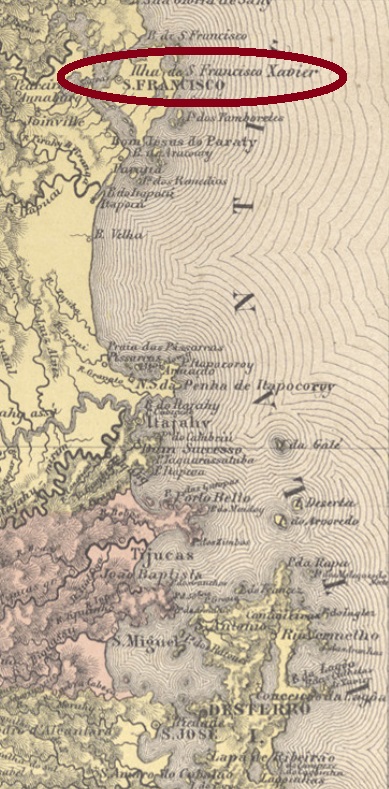
This São Francisco in the province of Santa Catarina was already in 1660 a villa with the beautiful name Nossa Senhora da Graça do Rio São Francisco. On old maps one will search in vain for a river that was called so. Rather, São Francisco Xavier was the name of the island on which this historic port town was built, about 180 km north of the later provincial capital Desterro (now Florianópolis). In April 1847, the villa ascended to a town, and the current name of São Francisco do Sul was first given to it for six months in 1938, before finally returning in December 1943.

Nova Monteiro (Administrações e Agencias Postaes do Brasil Imperio, in Brasil Filatelico/RJ, 1934-5; Reprint SPP 1994-1999) writes that the local postal agency was created in June 1860. This date, however, would be a re-establishment, because already in 1849 the local postal system was reported on in the regional press, when two soldiers were transferred to postal services:
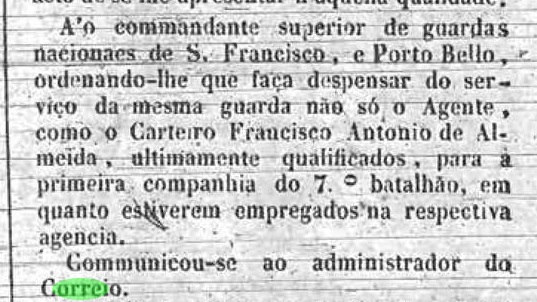
Conciliador Catharinense, July 7, 1849

On the other hand, the Imperial Mail Register (Tabella das Agencias do Correio do Imperio) of 1885 lists the agency with creation year 1848. This is more plausible, because the first postmark, SSC-2010a, was already found on Bull’s-Eye issues from 1843 and was in use until at least 1866. Paulo Ayres provides the illustration in his Catalogo de Carimbos Brasil-Império (S. Paulo, 1937, 1942):
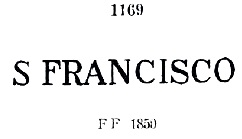
SSC-2010a (P.Ayres 1169)

The next cancel did not appear until about 1888, possibly there is an undiscovered postmark from the meantime. SSC-2010c (Coll. José A. Junges) is also available in blue and was used until about 1898: a double circle with the inscriptions S. FRANCISCO above and (SA. CATHARINA) below, with date at the centre.
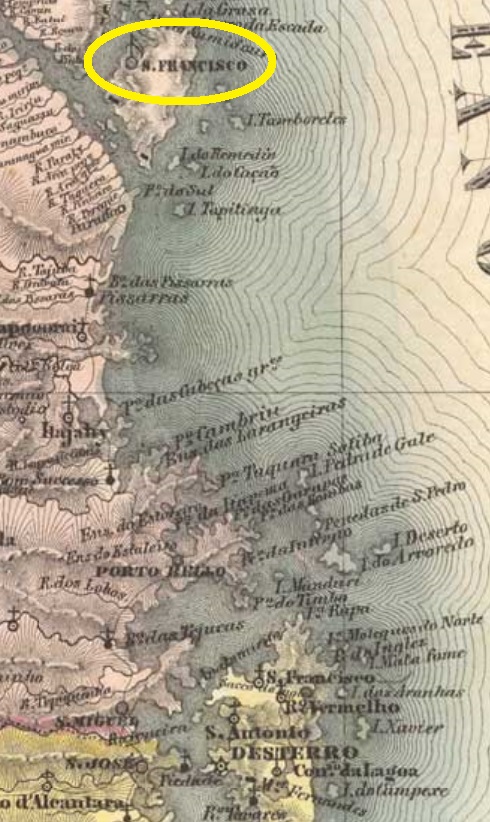
Villiers de l’Ile Adam: Carta (…) da Provincia de Santa Catharina, 1848

Anderer Name: São Francisco do Sul (1943)

Dieser São Francisco in der Provinz Santa Catarina war bereits 1660 eine Villa mit dem schönen Namen Nossa Senhora da Graça do Rio São Francisco. Wobei man auf alten Karten vergeblich nach einem Fluss suchen wird, der so hieß. Vielmehr war São Francisco Xavier der Name der Insel, auf der dieses historische Hafenstädtchen gebaut wurde, ca. 180 km nördlich der späteren Provinzhauptstadt Desterro (heute Florianópolis). Im April 1847 stieg die Villa zur Stadt auf, und der aktuelle Name São Francisco do Sul wurde ihr 1938 erstmals für sechs Monate vergeben, bevor er im Dezember 1943 endgültig zurückkehrte.

Nova Monteiro (Administrações e Agencias Postaes do Brasil Imperio, in Brasil Filatelico/RJ, 1934-5; Reprint SPP 1994-1999) schreibt, die örtliche Postagentur wurde im Juni 1860 ins Leben gerufen. Dieses Datum wird allerdings einer Wiedererrichtung entsprechen, denn bereits 1849 wurde über das Postwesen vor Ort in der der Regionalpresse berichtet, als zwei Soldaten zum Postdienst abkommandiert wurden:
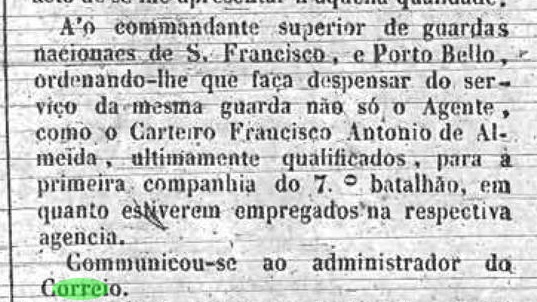
Conciliador Catharinense, 7. Juli 1849

Das Verzeichnis der kaiserlichen Postämter (Tabella das Agencias do Correio do Imperio) von 1885 listet die Agentur mit Entstehungsjahr 1848. Dieses Jahr ist plausibler, denn der erste Poststempel, SSC-2010a, wurde schon auf Ochsenaugen-Ausgaben von 1843 gefunden und war bis mindestens 1866 in Gebrauch. Paulo Ayres liefert davon die Abbildung in seinem Catálogo de Carimbos Brasil-Império (S. Paulo, 1937, 1942):

SSC-2010a (P.Ayres 1169)

Der nächste Stempel tauchte erst ca. 1888 auf, möglicherweise ist aus der Zwischenzeit noch was zu entdecken. SSC-2010c (Samml. José A. Junges) gibt es auch in blau und wurde bis ca. 1898 verwendet: ein Doppelkreis mit den Inschriften S. FRANCISCO oben und (SA. CATHARINA) unten, dazu Datum in der Mitte.
Categories
Carimbologia S

São Francisco, Minas Gerais (SMG-2255)

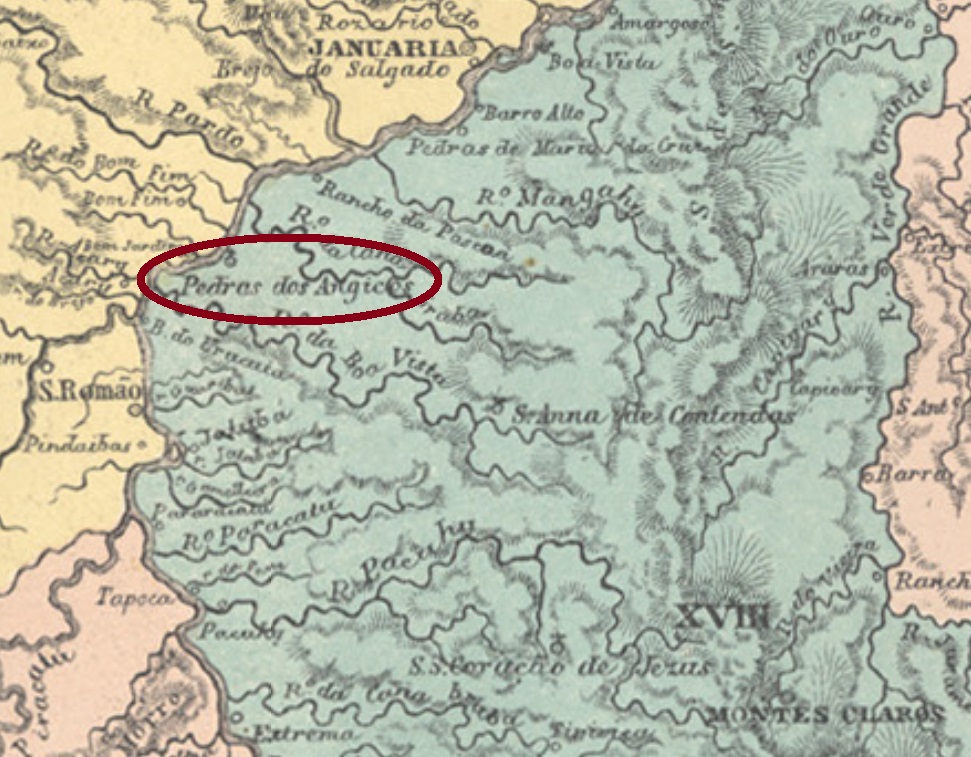
Atlas do Imperio do Brasil, 1868

See also Pedra dos Angicos (R. Koester: Carimbologia XXX)

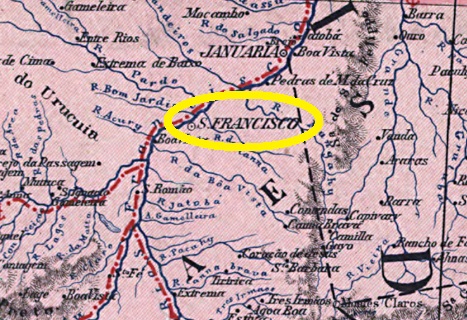
As the name suggests, this place is located on the east bank of the legendary São Francisco River, more than 600 km north of the former provincial capital Ouro Preto. In November 1866, it became the district of São José da Pedra dos Angicos in the municipality of São Romão. In August 1870, when a yellow fever epidemic caused the rapid demise of the upstream municipal headquarters of Villa Risonha de São Romão, Pedra dos Angicos became the new headquarters as a villa that has been called the town of São Francisco since November 1877.

As Paula Sobrinho writes in Historia Postal de Minas Gerais (Belo Horizonte, 1997), there has been a post office there since August 1874, i.e. when the place was still called Pedra (or Pedras) dos Angicos. Reinhold Koester (Carimbologia XXX) had not yet found a stamp with this name. We were luckier with the next toponym: SMG-2255b (Coll. Klerman W. Lopes) consists of a double circle with the inscription CI.DE DE S. FRANCISCO above and (MINAS) below. The only known copy bears a date from 1889 at the centre.

Carta da Republica dos Estados Unidos do Brazil, 1892

Siehe auch Pedra dos Angicos (R. Koester: Carimbologia XXX)

Wie der Name schon verrät, liegt dieser Ort am Ostufer des legendären São Francisco-Flusses, über 600 km nördlich der ehemaligen Provinzhauptstadt Ouro Preto entfernt. Im November 1866 wurde daraus der Distrikt von São José da Pedra dos Angicos im Municipio von São Romão. Als eine Gelbfieber-Epidemie den raschen Untergang des flussaufwärts gelegenen Gemeinde-Hauptsitzes Villa Risonha de São Romão verursachte, wurde Pedra dos Angicos im August 1870 der neue Hauptsitz als eine Villa, die sich seit November 1877 die Stadt São Francisco nennen darf.

Wie Paula Sobrinho in História Postal de Minas Gerais (Belo Horizonte, 1997) schreibt, gibt es dort ein Postamt seit August 1874, d.h. als der Ort noch Pedra (oder Pedras) dos Angicos hieß. Reinhold Koester (Carimbologia XXX) hatte zwar noch keinen Stempel mit dieser Bezeichnung gefunden. Da hatten wir mit dem nächsten Namen mehr Glück: SMG-2255b (Samml. Klerman W. Lopes) besteht aus einem Doppelkreis mit der Inschrift CI.DE DE S. FRANCISCO oben und (MINAS) unten. Das einzige bekannte Exemplar trägt ein Datum aus 1889 in der Mitte.

Categories
Carimbologia S

São Francisco, Maranhão (SMA-0230)

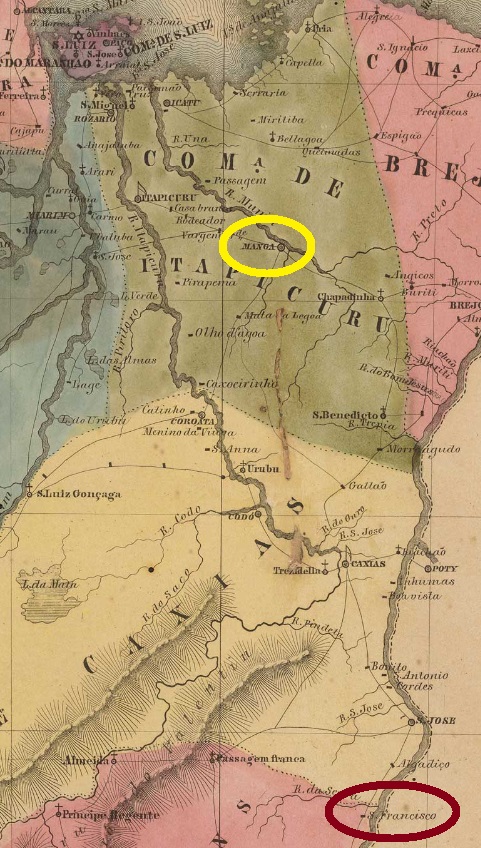
Villiers de l’Ile Adam: Carta (…) da Provincia do Maranhão, 1850

Other names: Manga do Iguará, Iguaratinga, São Francisco do Maranhão (1948)

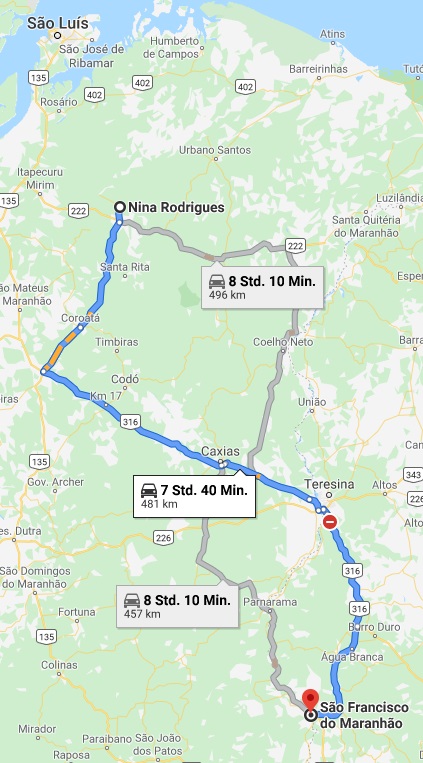
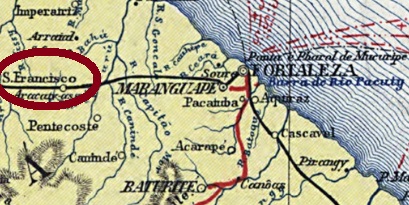
This village in the province of Maranhão also has a remarkable history. It was called Vila da Manga do Iguará from April 1835 on and was located on the south bank of the river Munim, close to the mouth of the Iguará, 150 km south of the provincial capital São Luiz. The location did not please the authorities very much, and the whole villa was moved over 450 km towards southeast by provincial law of 14 July 1870. On the west bank of the Parnahiba River, the villa of São Francisco was established, which was renamed Iguaratinga in December 1943, and since December 1849 has been called São Francisco do Maranhão (see map above).

The old Villa da Manga was extinguished at the occasion, but recovered later again, and has been the municipality of Nina Rodrigues since December 1961, with about 15 thousand inhabitants (map below). The name reminds about Raimundo Nina Rodrigues (1862-1906), a son of the region who, as a physician, writer, anthropologist, and ethnologist, was a proponent of eugenics, and whose overtly racist ideas would be completely unacceptable today. But this is another story.

The post office of São Francisco was established in July 1874 (Postal Report 1886). Unfortunately, no postmark from the imperial era could be surely assigned to this place so far.

Google Maps

Andere Namen: Manga do Iguará, Iguaratinga, São Francisco do Maranhão (1948)

Diese Ortschaft in der Provinz Maranhão hat auch eine bemerkenswerte Geschichte hinter sich. Sie hieß ab April 1835 Vila da Manga do Iguará und lag am Südufer des Flusses Munim, nah an der Einmündung des Iguará, 150 km südlich der Provinzhauptstadt São Luiz. Die Lage gefiel der Obrigkeit nicht besonders, und die ganze Villa wurde per Provinzialgesetz des 14. Juli 1870 über 450 km nach Südosten versetzt. Am Westufer des Parnahiba-Flusses errichtete man die Villa von São Francisco, die im Dezember 1943 zu Iguaratinga umbenannt wurde, und seit Dezember 1849 São Francisco do Maranhão heißt (siehe Karte ganz oben).

Die alte Villa da Manga wurde beim Umzug ausgelöscht, rappelte sich später wieder auf, und ist seit Dezember 1961 der Município von Nina Rodrigues, mit ca. 15 tausend Einwohnern (untere Karte). Der Name erinnert an Raimundo Nina Rodrigues (1862-1906), einen Sohn der Gegend, der als Arzt, Schriftsteller, Anthropologe und Ethnologe ein Verfechter der Eugenik war, und dessen offen rassistische Ansichten heute absolut inakzeptabel wären. Aber das ist eine andere Geschichte.

Das Postamt von São Francisco wurde laut Postbericht aus 1886 im Juli 1874 errichtet. Leider konnte bisher kein Poststempel aus der Kaiserzeit diesem Ort mit Sicherheit zugeordnet werden.

Categories
Carimbologia S

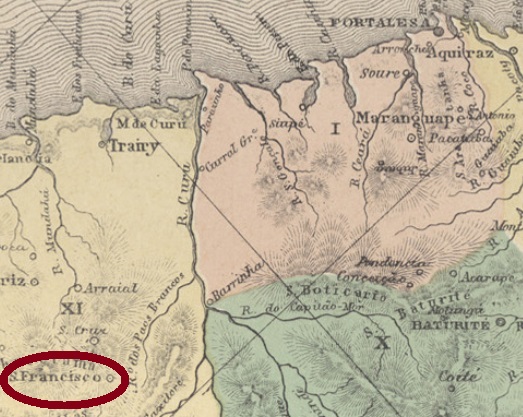
São Francisco, Ceará (SCE-0285)

Atlas do Imperio do Brasil, 1868

Book text update of February 7, 2021

Other names: Sao Francisco da Uruburetama, Itapagé (1943)

The villa of Sao Francisco da Uruburetama was founded in July 1859 by merging several small villages and was located about 125 km west of the provincial capital Fortaleza. The name was shortened to S. Francisco in 1893, and the town was degraded to a district of Arraial (now Uruburetama) for two years from 1931. After regaining independence, the place name changed to Itapagé in 1943, which has been written Itapajé since 1989.

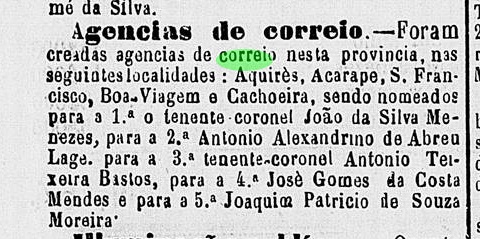
The local post office was established in 1872, as can be read on the regional press:

Cearense, 4 July 1872

Unfortunately, no postmark from the imperial era could be surely assigned to this place so far.

Carta da Republica dos Estados Unidos do Brazil, 1892

Buchtext-Aktualisierung vom 7. Februar 2021

Andere Namen: São Francisco da Uruburetama, Itapagé (1943)

Die Villa von São Francisco da Uruburetama wurde im Juli 1859 durch Zusammenlegung mehrerer kleinen Ortschaften gegründet und lag ca. 125 km westlich der Provinzhauptstadt Fortaleza entfernt. Der Name wurde 1893 offiziell zu São Francisco gekürzt, und der Ort war ab 1931 zwei Jahre lang als Distrikt von Arraial (heute Uruburetama) degradiert. Nach Wiedererlangen der Eigenständigkeit wechselte der Ortsnamen 1943 zu Itapagé, das seit 1989 Itapajé geschrieben wird.

Das örtliche Postamt entstand 1872, wie aus der Regionalpresse hervorgeht:

Cearense, 4. Juli 1872

Leider konnte bisher kein Poststempel aus der Kaiserzeit diesem Ort mit Sicherheit zugeordnet werden.

Categories
Carimbologia S

São Francisco (train station/Bahnhof), Rio de Janeiro (SRJ-0928)

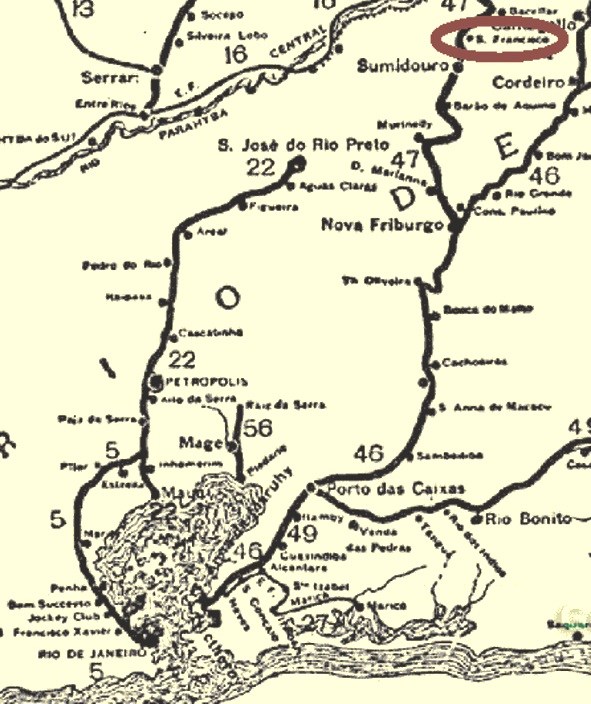
E. F. Leopoldina, 1898

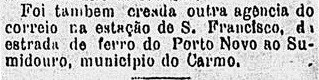
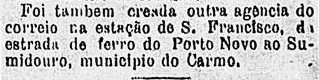
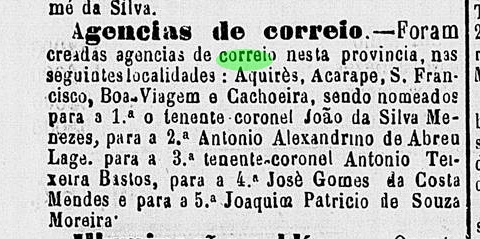
The station of S. Francisco was inaugurated in October 1885 by the E.F. Leopoldina Railway Company and was located in the so-called Sumidouro junction (Ramal) in the municipality of Carmo, more than 150 km north of Rio de Janeiro. This station was soon called Barra de Sao Francisco because it was located at the mouth (Barra) of the river of the same name into the Paquequer River. Today, Barra de Sao Francisco is a district of Carmo, and rail operations ceased in October 1967. 

The station post office was established in January 1886, as announced in the Rio press:

Gazeta de Noticias, January 13, 1886

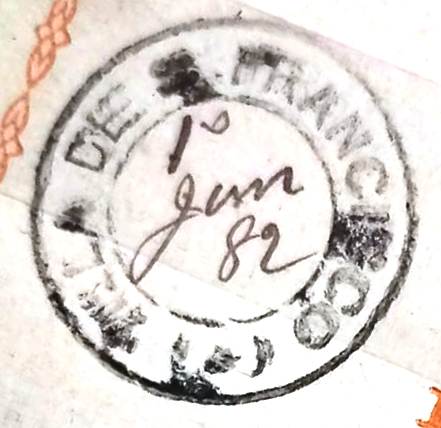
6 copies of the only station cancel of the Empire were found, all from 1886. SRJ-0928a (Coll. Karlheinz Wittig) consists of a double circle with the inscriptions EST DE S. FRAN.o above and RAMAL DE SUMIDOURO below, with date at the centre.

Almanak Laemmert, 1892

Der Bahnhof São Francisco wurde im Oktober 1885 durch die E.F. Leopoldina Bahngesellschaft eingeweiht und lag in der so genannten Sumidouro-Abzweigung (Ramal) in der Gemeinde Carmo, über 150 km nördlich von Rio de Janeiro entfernt. Dieser Bahnhof wurde bald Barra de São Francisco genannt, da er an der Mündung (Barra) des gleichnamigen Flusses in den Paquequer-Fluss lag. Heute ist Barra de São Francisco ein Ortsteil von Carmo, und der Bahnbetrieb wurde im Oktober 1967 eingestellt.  

Das Bahnhofspostamt wurde im Januar 1886 ins Leben gerufen, wie in der Rio-Presse bekannt gegeben:

Gazeta de Noticias, 13. Januar 1886

Vom einzigen Bahnhofsstempel im Kaiserreich wurden 6 Exemplare gefunden, allesamt aus 1886. SRJ-0928a (Samml. Karlheinz Wittig) besteht aus einem Doppelkreis mit den Inschriften EST DE S. FRAN.o oben und RAMAL DE SUMIDOURO unten, dazu Datum in der Mitte.
Categories
Carimbologia S

São Francisco, Bahia (SBA-0815)

Atlas do Imperio do Brasil, 1868

Print edition update, on October 19, 2021

Other names: Villa de Sao Francisco da Barra do Sergipe do Conde, S. Francisco do Conde (1943)

The series of villages dedicated to St. Francis in the Brazilian Empire begins in the province of Bahia, where a villa was founded in November 1697, bearing the sonorous name of S. Francisco da Barra do Sergipe do Conde. It was located in the north of All Saints’ Bay, less than 70 km northwest of the provincial capital Salvador. In June 1931, the place name was simplified to S. Francisco, to which an additional do Conde came in December 1943.

As can be read in the 1885 Imperial Mail Register (Tabella das Agencias do Correio do Imperio), there is a post office on place since 1872. This is confirmed by the provincial president’s report of March 1873:

Relatorio do Presidente da Provincia, pg 37

The only imperial postmark so far is the French type SBA-0815a (Coll. Fuad Ferreira Fo.). As it was not shown in Carimbologia S1, it is presented here:

SBA-0815a (FF), 1882-1901

Please note: in Carimbologia S1 (pg 161) there is a post office in the Bahian railway station of São Francisco (SBA-0817). This station was inaugurated in February 1880 by the E.F. from Bahia to São Francisco. Further research revealed that the cancel registered there comes rather from the train station of S. Francisco Xavier, in the Municipio Neutro (SMN-2185). The agency of the Bahia station, therefore, possibly never existed.

Villiers de l’Ile Adam: Carta (…) da Provincia da Bahia, 1848

Buchtext-Aktualisierung vom 19. Oktober 2021

Andere Namen: Villa de São Francisco da Barra do Sergipe do Conde, S. Francisco do Conde (1943)

Die Reihe der dem Hl. Franz gewidmeten Ortschaften im Kaiserreich Brasilien beginnt in der Provinz Bahia, wo bereits im November 1697 eine Villa gegründet wurde, die den sonoren Namen São Francisco da Barra do Sergipe do Conde trug. Sie lag im Norden der Allerheiligenbucht, knapp 70 km nordwestlich der Provinzhauptstadt Salvador entfernt. Im Juni 1931 wurde der Ortsnamen zu São Francisco vereinfacht, der aber seit Dezember 1943 wieder den Zusatz do Conde trägt.

Wie im Verzeichnis der kaiserlichen Postämter (Tabella das Agencias do Correio do Imperio) von 1885 zu lesen ist, gibt es dort eine Postagentur seit 1872. Dieses wird durch den Bericht des Provinzpräsidenten im März 1873 bestätigt:

Relatorio do Presidente da Provincia, S. 37

Der bisher einzige kaiserliche Poststempel ist der Französischer Typ SBA-0815a (Samml. Fuad Ferreira Fo.). Da er nicht in Carimbologia S1 abgebildet wurde, wird er hier präsentiert:

SBA-0815a (FF), 1882-1901

Bitte beachten: In Carimbologia S1 (S. 161) wird ein Postamt im Bahia-Bahnhof von São Francisco (SBA-0817) vorgestellt. Letzter wurde im Februar 1880 von der E.F. von Bahia nach São Francisco eingeweiht. Weitere Untersuchungen ergaben, dass der dort abgebildete Stempel eher vom Bahnhof S. Francisco Xavier im Municipio Neutro (SMN-2185) stammen soll. Die Agentur im Bahia-Bahnhofs gab es daher möglicherweise nie.

Categories
Carimbologia S

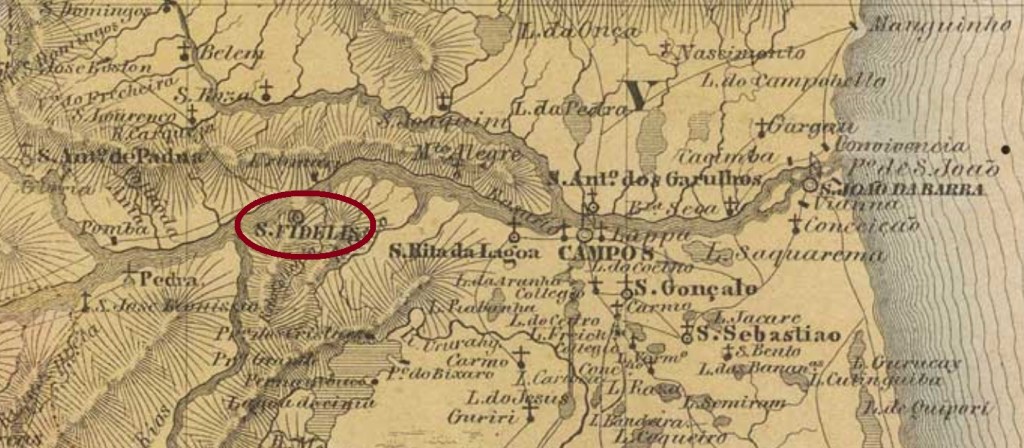
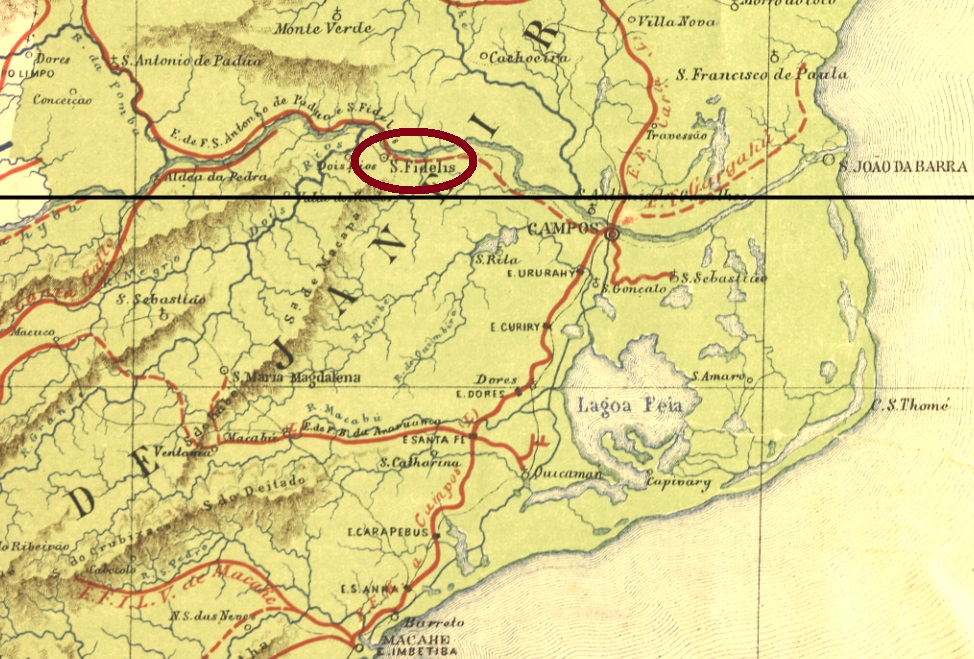
São Fidelis, Rio de Janeiro (SRJ-0925) – São Fidelis (train station/Bahnhof), Rio de Janeiro (SRJ-0926)

Villiers de l’Ile Adam: Carta (…) da Provincia do Rio de Janeiro, 1850

Printed version update from February 4, 2021

Another name : São Fidelis de Sigmaringa

Saint Fidelis of Sigmaringen (1578-1622), philosopher, jurist, religious priest and martyr, also had his admirers in colonial Brazil. The parish of Sao Fidelis de Sigmaringa was founded in 1812 on the south bank of the Parahyba do Sul river near Campos, 300 km northeast of Rio de Janeiro. In April 1840 it was elevated to a freguesia and exactly 10 years later to a villa. Since December 1870, it has been a town.

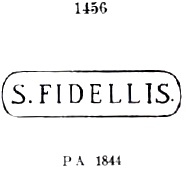
As Nova Monteiro in Administrações e Agencias Postaes do Brasil Imperio (Brasil Filatelico/RJ, 1934-5; Reprint SPP 1994-1999) reports, there is a post office there since November 1833. So you can find many imperial cancels here, starting with SRJ-0925a, which was used from the beginning until at least 1868 and was already presented by Paulo Ayres (Catalogo de Carimbos Brasil-Império, S. Paulo, 1937, 1942) under No. 1456:

SRJ-0925a (P. Ayres 1456, RHM P-RJ-42)

There followed SRJ-0925b (Coll. José A. Junges): a simple double circle with inscription S. FIDELIS above and the date at the centre, period of use ca. 1878-1886. SRJ-0925c (Coll. Dieter Kerkhoff) is similar to his predecessor, but has an additional diamond-shaped ornament at the bottom of the circles, which consists of four small diamonds. Copies were found for the period 1884-1889. At SRJ-0925d (image from the internet) the lower ornament consists of three ellipses in series, the middle one standing, the others lying. 1889 to 1892. Finally, SRJ-0925e (Coll. Karlheinz Wittig) may already be Republican, since its dates at the centre go from 1894 until 1899: here too we have a double circle with S. FIDELIS above, the ornament below is now an X.

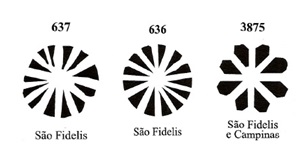
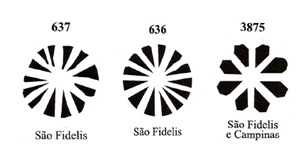
Four mute cancels could be assigned to this place, three of which were identified by A. Dingler and K. Lopes (Mute Cancellations of the Brazil Empire / Carimbos Mudos do Brasil Império, Brazil Philatelic Association, Rio de Janeiro, 2000):

Dingles/Lopes (op. cit.)

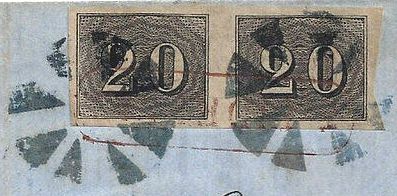
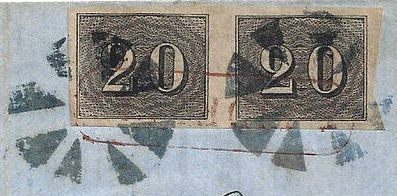
The fourth mute cancel was found on an envelope from 1868 (image from the internet):

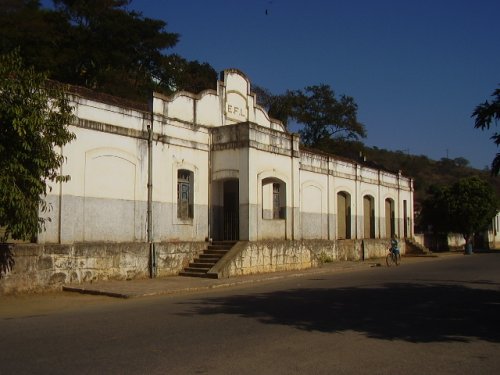
In January 1880, a railway station of the E.F. Santo Antonio de Padua Railway Company was inaugurated in Sao Fidelis. In 1884, the line ownership went to E.F. Macahe a Campos, in 1887 to E. F. Leopoldina, and from 1975 to the end of the company’s operation in 1996, to the Rede Ferroviária Federal S.A. Now the building seems unused (estacoesferroviarias.com.br):

In 2008 (Photo: Ricardo Q. Mattos, apud estacoesferroviarias.com.br)

As Paulo Novaes (agenciaspostais.com.br) reports, there was also a train station post office from 1880 on, which had a short service life. Two station cancels were found: SRJ-0926a (Coll. José A. Junges) is the oldest of them, the only copy, in turquoise, was used in 1883: a double circle with inscriptions EST. CENTRAL above and E.F.S.F. below, with date at the centre. It was followed by SRJ-0926b (agenciaspostais.com.br). Here the inscriptions are more detailed: EST CENTRAL above and E.F. DE S. FIDELIS below. Used 1884-1890.

Estrada de Ferro Central do Brasil, 1890

Buchtext-Aktualisierung vom 4. Februar 2021

Anderer Name : São Fidelis de Sigmaringa

Auch der Heilige Fidelis von Sigmaringen (1578-1622), Philosoph, Jurist, Ordenspriester und Märtyrer, hatte seine Verehrer im kolonialen Brasilien. So wurde 1812 die Pfarrei São Fidelis de Sigmaringa am Südufer des Flusses Parahyba do Sul bei Campos, 300 km nordöstlich von Rio de Janeiro errichtet. Im April 1840 wurde sie zur Freguesia und exakt 10 Jahre später zur Villa erhoben. Seit Dezember 1870 ist São Fidelis eine Stadt.

Wie Nova Monteiro in Administrações e Agencias Postaes do Brasil Imperio (Brasil Filatelico/RJ, 1934-5; Reprint SPP 1994-1999) berichtet, gibt es dort ein Postamt seit November 1833. Also kann man hier viele imperiale Stempel vorfinden, beginnend mit SRJ-0925a, der vom Betriebsbeginn bis mindestens 1868 verwendet und bereits durch Paulo Ayres (Catálogo de Carimbos Brasil-Império, S. Paulo, 1937, 1942) unter Nr. 1456 vorgestellt wurde:

SRJ-0925a (P. Ayres 1456, RHM P-RJ-42)

Es folgte SRJ-0925b (Samml. José A. Junges): ein schlichter Doppelkreis mit Inschrift S. FIDELIS oben und dem Datum in der Mitte, Verwendungsperiode ca. 1878-1886. SRJ-0925c (Samml. Dieter Kerkhoff) ist ähnlich wie sein Vorgänger, hat aber ein zusätzliches Ornament in Rautenform unten zwischen den Kreisen, das aus vier kleinen Rauten besteht. Exemplare für den Zeitraum 1884-1889 gefunden. Bei SRJ-0925d (Abb. aus dem Internet) besteht das untere Ornament aus drei Ellipsen in Reihe, die Mittlere davon stehend, die anderen liegend. Von 1889 bis 1892. Schließlich könnte SRJ-0925e (Samml. Karlheinz Wittig) bereits republikanisch sein, da seine bisherigen Daten in der Mitte zwischen 1894 und 1899 liegen: auch hier haben wir einen Doppelkreis mit S. FIDELIS oben, das Ornament unten ist nun ein X.

Vier stumme Stempel konnten diesem Ort zugeordnet werden, drei davon haben A. Dingler und K. Lopes (Mute Cancellations of the Brazil Empire / Carimbos Mudos do Brasil Império, Brazil Philatelic Association, Rio de Janeiro, 2000) identifiziert:

Dingles/Lopes, op. cit.)

Der vierte Stempel wurde auf einem Umschlag aus 1868 vorgefunden (Abb. aus dem Internet):

Im Januar 1880 wurde in São Fidelis ein Bahnhof der E.F. Santo Antonio de Padua Eisenbahngesellschaft eingeweiht. 1884 ging der Linienbesitz zur E.F. Macahe a Campos, 1887 zur E. F. Leopoldina, und von 1975 bis Betriebsende 1996, zur Rede Ferroviária Federal S.A. Nun steht das Gebäude anscheinend ohne Benutzung da (estacoesferroviarias.com.br):

In 2008 (Foto: Ricardo Q. Mattos, apud estacoesferroviarias.com.br)

Wie Paulo Novaes (agenciaspostais.com.br) berichtet, gab es auch ab 1880 ein Bahnhofspostamt, das allerdings von kurzer Betriebsdauer war. Zwei Bahnhofsstempel sind da: SRJ-0926a (Samml. José A. Junges) ist davon der Älteste, das einzige Exemplar wurde 1883 in türkis verwendet: ein Doppelkreis mit Inschriften EST. CENTRAL oben und E.F.S.F. unten, dazu Datum in der Mitte. Ihm folgte SRJ-0926b (agenciaspostais.com.br). Hier sind die Inschriften etwas ausführlicher: EST CENTRAL oben und E.F. DE S. FIDELIS unten. Benutzt 1884-1890.
Categories
Carimbologia S

São Felix, Goiás (SGO-0182)

Atlas do Imperio do Brasil, 1868

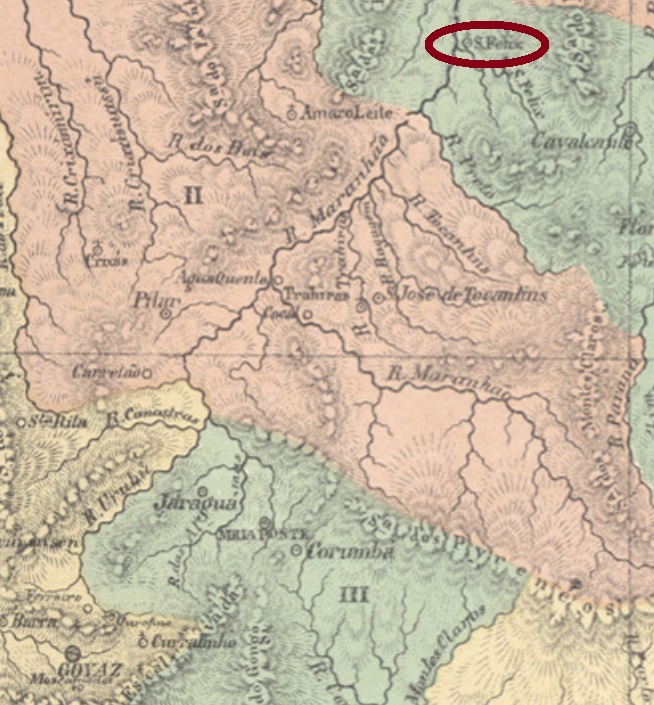
This was a small settlement in the municipality of Cavalcante, more than 500 km northeast of the provincial capital Goyaz (today Goiás Velho). The village became an arraial in November 1831 and experienced a fast development through the discovery of gold deposits. These were soon exhausted, however, and S. Felix was then abandoned by the gold diggers. Today, the place has disappeared from the map, and remains only through its beautiful waterfalls in the memory of its visitors.

According to Nova Monteiro (Administrações e Agencias Postaes do Brasil Imperio, in Brasil Filatelico/RJ, 1934-5; Reprint SPP 1994-1999) there was a post office there as early as March 1829, but it was closed again in January 1851, as Aureo G. Santos reports in Agências de Correio Criadas e Suprimidas 1851, 1855, 1856 e 1857 (Brasil Filatélico 181, 1977):

Aureo G. Santos (op. cit.)

No imperial post cancel from this S. Felix could be found so far.

Villiers del’Ile Adam: Carta (…) da Provincia de Goyaz, 1849

São Felix war eine kleine Siedlung im Município von Cavalcante, die über 500 km nordöstlich der Provinzhauptstadt Goyaz (heute Goiás Velho) entfernt lag. Die Ortschaft wurde im November 1831 ein Arraial und erfuhr einen raschen Aufschwung durch die Entdeckung von Goldvorkommen. Dieses wurde aber bald ausgeschöpft, und São Felix wurde anschließend von den Goldgräbern verlassen. Heute ist ist der Ort von der Karte verschwunden, und bleibt nur durch seine schönen Wasserfälle in der Erinnerung seiner Besucher.

Laut Nova Monteiro (Administrações e Agencias Postaes do Brasil Imperio, in Brasil Filatelico/RJ, 1934-5; Reprint SPP 1994-1999) gab es dort ein Postamt bereits im März 1829, das allerdings im Januar 1851 wieder geschlossen wurde, wie Aureo G. Santos zu berichten weiß (Agências de Correio Criadas e Suprimidas 1851, 1855, 1856 e 1857, in Brasil Filatélico 181, 1977):

              Aureo G. Santos (op. cit.)

Kein Stempel der Kaiserzeit aus diesem S. Felix konnte bisher gefunden werden.

Categories
Carimbologia S

São Felix, Bahia (SBA-0810)

Atlas do Imperio do Brasil, 1868

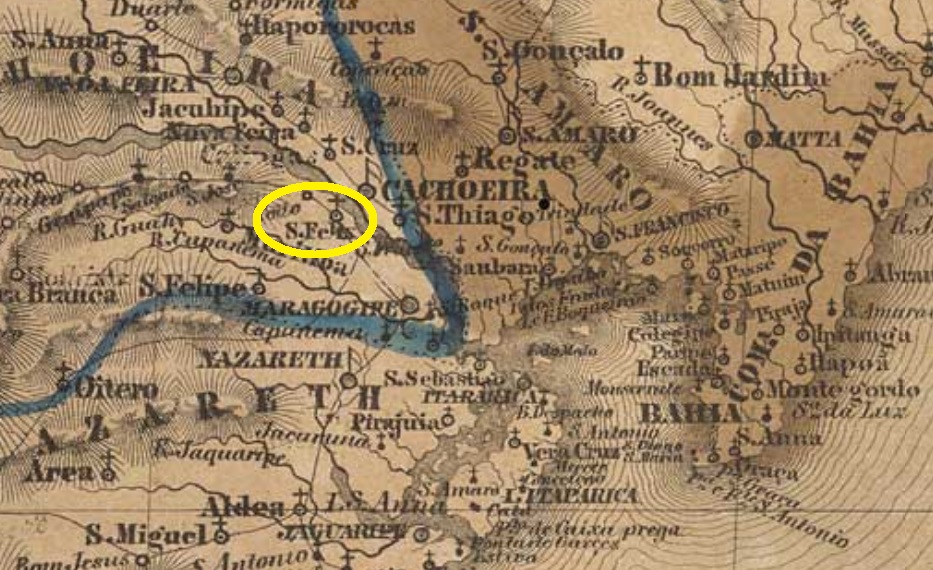
From October 1857 on, São Felix was a district in the municipality of Cachoeira, located on the west bank of the Paraguassu River, about 120 km northwest of the provincial capital Salvador da Bahia. In December 1889 the village was elevated to a villa and is a town since October 1890.

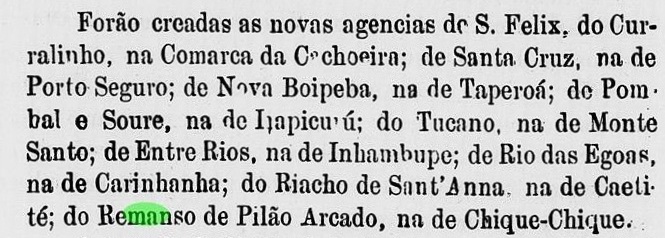
The local post office was probably built between the end of 1875 and the beginning of 1876, as its creation is listed in the provincial government’s report of May 1876:

Relatorio do Presidente da Provincia, May 1876

Two early cancellations were found, both with republican dates. SBA-0810a (image from the internet) has a double circle with the inscription S. FELIX above. The dates at the centre are from 1890 to 1895. SBA-0810b (Coll. Fuad Ferreira Fo.) is a handwritten cancel used on an issue from 1893. One reads S. Feli(x) and a date 16-9-(…)

Villiers de l’Ile Adam: Carta (…) da Provincia da Bahia, 1848

São Felix war ab Oktober 1857 ein Distrikt im Município von Cachoeira, der am Westufer des Flusses Paraguassu lag, ca. 120 km nordwestlich der Provinzhauptstadt Salvador da Bahia. Im Dezember 1889 wurde der Ort zur Villa erhoben, und ist eine Stadt seit Oktober 1890.

Das örtliche Postamt wurde wohl zwischen Ende 1875 und Anfang 1876 errichtet, da seine Entstehung im Bericht der Provinzregierung vom Mai 1876 angepriesen wird:

Relatorio do Presidente da Provincia, Mai 1876

Zwei frühe Entwertungen waren zu finden, beide mit Daten aus der Republik. SBA-0810a (Abb. aus dem Internet) hat einen Doppelkreis mit der Inschrift S. FELIX oben. Die Daten in der Mitte gehen von 1890 bis 1895. SBA-0810b (Samml. Fuad Ferreira Fo.) ist eine handgeschriebene Entwertung, die auf einer Ausgabe aus 1893 verwendet wurde. Man liest S. Feli(x), dazu ein Datum 16-9-(…).  

Categories
Carimbologia S

São Felippe, Bahia (SBA-0610)

Atlas do Imperio do Brasil, 1868

In the province of Bahia, São Felippe (also written Philippe or Felipe) was formerly a freguesia in the municipality of Maragogipe, which is located almost 90 km west of the provincial capital Salvador and was elevated to villa in May 1880. Since March 1938, the locality has been a town.

As can be read in the Imperial Mail Register (Tabella das Agencias do Correio do Imperio) of 1885, there is a post office there since 1881, which is also confirmed by the annual report of the provincial president for 1882:

Relatório do Presidente da Provincia, January 1882

An early postmark was found: SBA-0610a (Coll. José A. Junges) consists of a double circle with inscription S. FELIPPE above. The only copy has a date of 1893 at the centre.

Villiers de l’Ile Adam: Carta (…) da Provincia da Bahia, 1848

São Felippe (auch Philippe oder Felipe geschrieben) in der Provinz Bahia war früher eine Freguesia im Município von Maragogipe, die knapp 90 km Luftlinie westlich der Provinzhauptstadt Salvador liegt und im Mai 1880 zur Villa erhoben wurde. Seit März 1938 ist die Ortschaft eine Stadt.

Wie man im Verzeichnis der kaiserlichen Postämter (Tabella das Agencias do Correio do Imperio) von 1885 nachlesen kann, gibt es dort ein Postamt seit 1881, was auch durch den Jahresbericht des Provinzpräsidenten für 1882 bestätigt wird:

Relatório do Presidente da Provincia, Januar 1882

Ein früher Poststempel wurde gefunden: SBA-0610a (Samml. José A. Junges) besteht aus einem Doppelkreis mit Inschrift S. FELIPPE oben. Das einzige Exemplar trägt ein Datum aus 1893 in der Mitte.