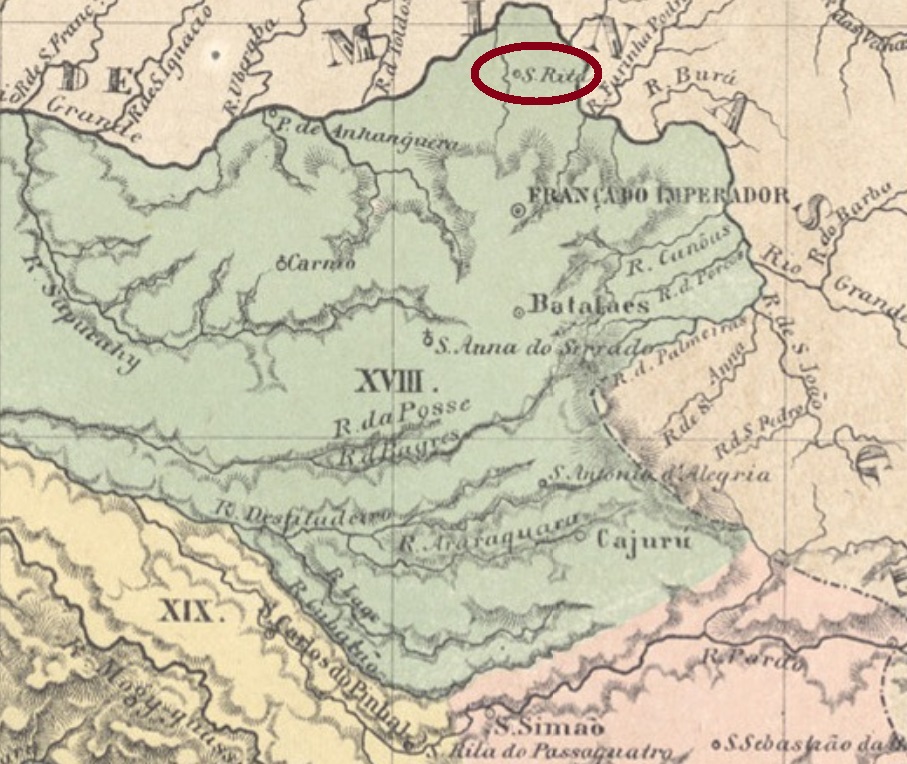
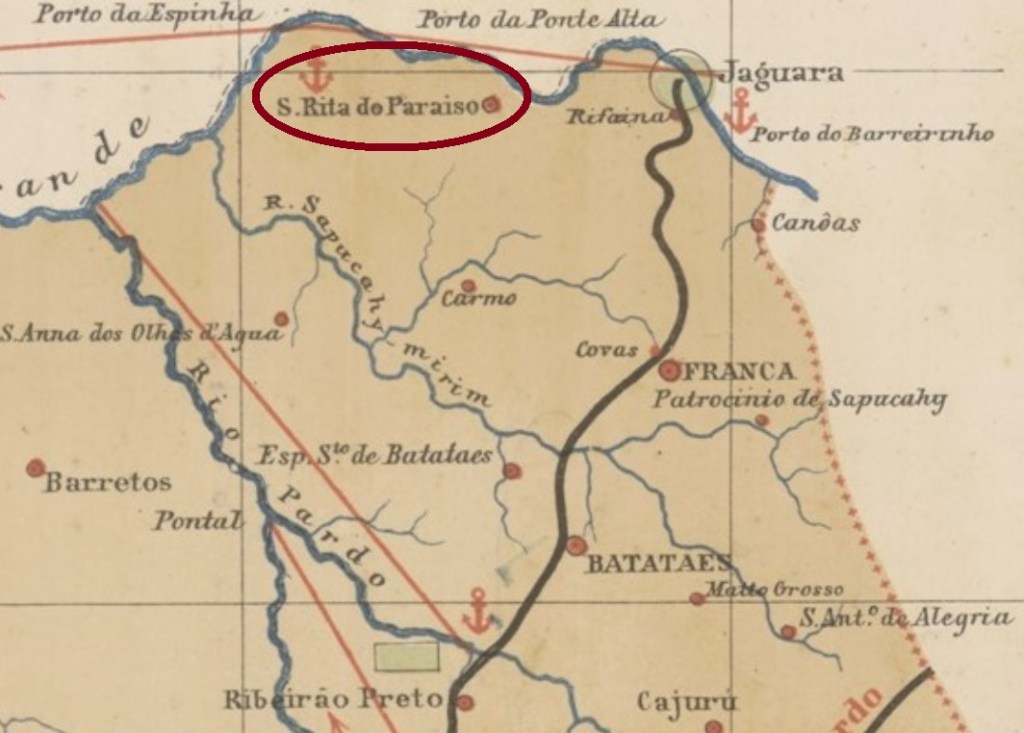
Santa Rita do Paraizo was since April 1851 a freguesia of the municipality of Franca, situated on the south bank of the Rio Grande on the northern edge of the São Paulo province, ca. 450 km away from the capital. In April 1873 it was elevated to a villa, which became a town in December 1906. Since November 1907 it is the municipality of Igarapava, a tupi-guarani word that means canoe harbor.
It was followed by SSP-1305b (image from the internet), which is a French-type: small double circle, with the inscription S. RITA DO PARAISO above and a star within brackets below. Dates in the centre found for the period 1889-1897.
Mappa da Provincia de São Paulo, 1886
Anderer Name: Igarapava (1907)
Santa Rita do Paraizo war seit April 1851 eine Freguesia im Município von Franca und lag am Südufer des Rio Grande am Nordrand der Provinz São Paulo, ca. 450 km von der Hauptstadt entfernt. Im April 1873 stieg sie zur Villa auf, die im Dezember 1906 eine Stadt wurde. Seit November 1907 ist es der Município von Igarapava, ein Begriff der tupi-guarani Sprache, der Kanuhafen bedeutet.
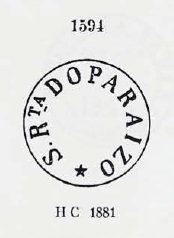
Laut Nova Monteiro (Administrações e Agencias Postaes do Brasil Imperio, in Brasil Filatelico/RJ, 1934-5; Reprint SPP 1994-1999) gibt es dort ein Postamt seit Juni 1857. Zwei Poststempel der Kaiserzeit sind überliefert. SSP-1305a hat Daten zwischen 1877 und 1888 und wurde bereits durch Paulo Ayres (Catálogo de Carimbos Brasil-Império, S. Paulo, 1937, 1942) mit Nr. 1594 vorgestellt:
SSP-1305a – P. Ayres 1594
Ihm folgte SSP-1305b (Abb. aus dem Internet): ein französischer-Typ mit kleinem Doppelkreis, dazu Inschrift S. RITA DO PARAISO oben und ein Stern zwischen Klammern unten. Die Daten in der Mitte wurden für den Zeitraum 1889-1897 gefunden.
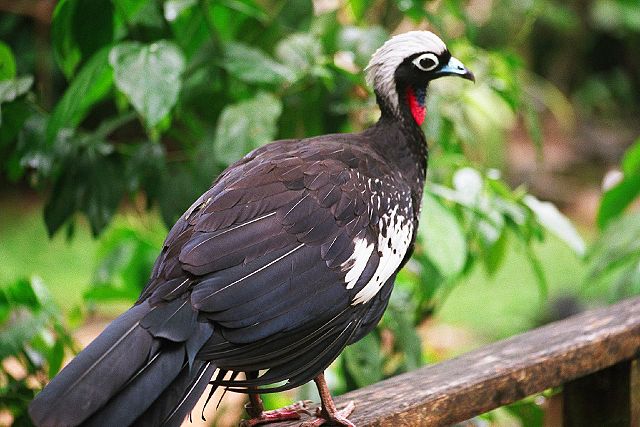
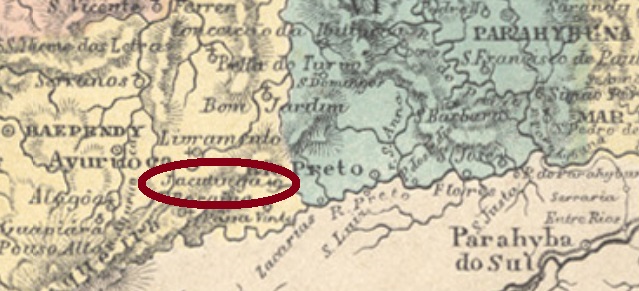
Jacutinga (white jacu, in tupi) is a bird (Pipile jacutinga, Spix, 1825) of the Cracidae family, that can reach 75 cm lenght, but it is meanwhile also endangered. Santa Rita do Jacutinga (also written Jacotinga) was since June 1859 a district of the municipality of Rio Preto, situated over 300 km south of the ancient province capital Ouro Preto. In December 1943 it emancipated politically.
According to Paula Sobrinho (História Postal de Minas Gerais, Belo Horizonte, 1997), the local post office was created in December 1873. Two early cancels are known. SMG-2915a (Coll. José A. Junges) has a double circle with the inscription S. RITA DO JACUTINGA above and a diamond ornament below, which consists of four small twigs. The dates in the centre were found for the period 1884-1886. The following SMG-2915b (Coll. José A. Junges), is similar to its predecessor, but here the inscriptions are (…) RITA DE JACOTINGA above and (MINAS) below. Dates in the centre between 1888 and 1890.
Atlas do Imperio do Brasil, 1868
Ein jacutinga (weißer Jacu, in tupi) ist ein Vogel (Pipile jacutinga, Spix, 1825) der Cracidae-Familie, der bis 75 cm lang werden kann, aber inzwischen auch gefährdet ist. Santa Rita do Jacutinga (auch mal Jacotinga geschrieben) war seit Juni 1859 ein Distrikt des Município von Rio Preto, der über 300 km südlich der alten Provinzhauptstadt Ouro Preto entfernt lag. Im Dezember 1943 stieg der Ort zum eigenen Município auf.
Laut Paula Sobrinho (História Postal de Minas Gerais, Belo Horizonte, 1997) gibt es dort ein Postamt seit Dezember 1873. Zwei frühe Poststempel sind bekannt. SMG-2915a (Samml. José A. Junges) hat einen Doppelkreis mit der Inschrift S. RITA DO JACUTINGA oben und einem rautenförmigen Ornament unten, das aus vier kleinen Zweigen besteht. Die Daten in der Mitte stammen aus dem Zeitraum 1884-1886. Der darauf folgende SMG-2915b (Samml. José A. Junges) ist dem Vorgänger ähnlich, nur hier lauten die Inschriften (…) RITA DE JACOTINGA oben und (MINAS) unten. Daten in der Mitte zwischen 1888 und 1890.
The tupi word ibitipoca means bursting mountains and may be related to thunder echoes during storms in this mountain region. Santa Rita de Ibitipoca was since July 1832 a district in the municipality of Barbacena, situated round 200 km south of the province capital Ouro Preto. In December 1938 it changed as a district to the newly founded municipality of Bias Fortes and received its administrative emancipation in December 1962.
Nova Monteiro (Administrações e Agencias Postaes do Brasil Imperio, in Brasil Filatelico/RJ, 1934-5; Reprint SPP 1994-1999) writes a creation date of September 1866 for the post office, which is confirmed by Paula Sobrinho (História Postal de Minas Gerais, Belo Horizonte, 1997).
In 1872 the agency was closed, as reported by the regional press:
O Noticiador, May 1st, 1872
It must have reopened by 1879, for it is listed in the Postal Guide (Guia Postal do Império) of 1880. Two imperial cancels were found: SMG-2910a (Coll. José A. Junges) has a double circle with the inscription S.R. DE IBITIPOCA above and a circular ornament below, cut in both diagonals. A sole example is known, dated 1886 in the centre. SMG-2910b (Coll. José A. Junges) has also the double circle, but here the inscription is S. RITA DA IBITIPOCA, and the ornament below is a cross with wide diamond wings. Dates found for the period 1889-1904.
Villiers de l’Ile Adam: Carta (…) da Provincia de Minas Geraes, 1849
Anderer Name: Ibitipoca (1938-1962)
Das Tupi-Indianerwort ibitipoca bedeutet platzende Berge und soll angeblich den Donnerkrach beschreiben, den die Gewitter der Gebirgsregion verursachen. Santa Rita de Ibitipoca war seit Juli 1832 ein Distrikt des Município von Barbacena und lag ca. 200 km südlich der ehemaligen Provinzhauptstadt Ouro Preto entfernt. Im Dezember 1938 wechselte er zum neu gegründeten Município von Bias Fortes, emanzipierte sich aber im Dezember 1962 als eigenständige Gemeinde.
Nova Monteiro (Administrações e Agencias Postaes do Brasil Imperio, in Brasil Filatelico/RJ, 1934-5; Reprint SPP 1994-1999) schreibt den September 1866 als Entstehungsdatum für das örtliche Postamt, was durch Paula Sobrinho (História Postal de Minas Gerais, Belo Horizonte, 1997) bestätigt wird. 1872 wurde die Agentur geschlossen, wie die Regionalpresse berichtet:
O Noticiador, 1. Mai 1872
Sie muss aber bis 1879 wieder geöffnet haben, da sie im Postführer (Guia Postal do Império) von 1880 aufgelistet ist. Zwei Poststempel der Kaiserzeit sind vorhanden: SMG-2910a (Samml. José A. Junges) hat einen Doppelkreis mit der Inschrift S.R. DE IBITIPOCA oben und einem kreisförmigen Ornament unten, das an beiden Diagonalen geschnitten ist. Ein einziges Exemplar ist bekannt, datiert 1886 in der Mitte. SMG-2910b (Samml. José A. Junges) hat auch einen Doppelkreis, hier aber lautet die Inschrift S. RITA DA IBITIPOCA, und das untere Ornament ist ein Kreuz mit breiten Flügeln in Rautenform. Die Daten weisen auf den Zeitraum 1889-1904 hin.
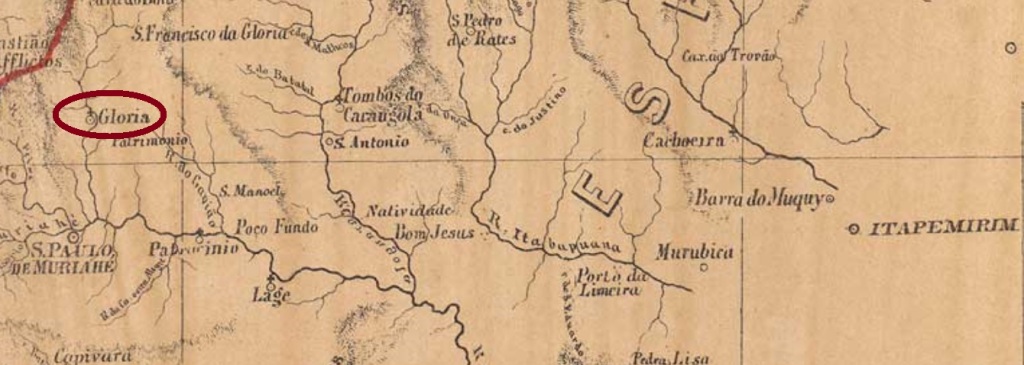
This Santa Rita on the Gloria River was since December 1867 a district of the municipality of São Paulo de Muriahé, situated over 200 km east of the old province capital Ouro Preto. In December 1938 it ascended to a town named Glória, which five years later changed its toponym to the actual Miradouro.
According to Paula Sobrinho (História Postal de Minas Gerais, Belo Horizonte, 1997) the local post office was created in September 1889. This can be confirmed by the regional press:
A Provincia de Minas Geraes, October 12, 1889
Consequently, cancels with empire dates (until November 15) must be very rare. A single later example was found: SMG-2925a (Coll. Márcio Protzner) has a double circle with the inscriptions S. RITA DO GLORIA above and (MINAS) below, dated 1900 in the centre.
Mappa de Minas Geraes e Espirito Santo, 1873
Andere Namen: Glória, Miradouro (1943)
Diese Santa Rita am Fluss Gloria war seit Dezember 1867 ein Distrikt im Município von São Paulo de Muriahé und lag über 200 km östlich der alten Provinzhauptstadt Ouro Preto. Im Dezember 1938 wurde daraus die Stadt Glória, die fünf Jahre später den Ortsnamen zum heutigen Miradouro gewechselt hat.
Laut Paula Sobrinho (História Postal de Minas Gerais, Belo Horizonte, 1997) gibt es dort ein Postamt seit September 1889. Das bestätigt die Regionalpresse:
A Provincia de Minas Geraes, 12. Oktober 1889
Folglich müssen Poststempel der späten Kaiserzeit (bis 15. November) sehr selten sein. Ein einziges, späteres Exemplar war anzutreffen: SMG-2925a (Samml. Márcio Protzner) hat einen Doppelkreis mit den Inschriften S. RITA DO GLORIA oben und (MINAS) unten, datiert 1900 in der Mitte.
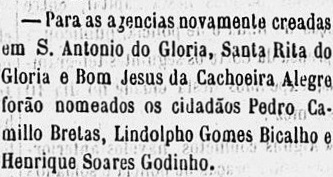
Santa Rita da Floresta was the other locality devoted to this catholic saint in the municipality of Cantagallo, else than Santa Rita do Rio Negro (see SRJ-0885/ SRJ-1545). It was elevated to a district in September 1890, which changed the name to Floresta in December 1938, but the old denomination Santa Rita da Floresta returned in December 1943, remaining until now.
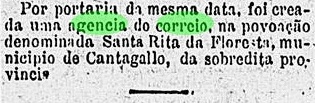
According to Paulo Novaes (agenciaspostais.com.br), the local post office was created in July 1882, as reported by the Rio press:
Gazeta de Noticias, July 25, 1882
We have found two postal cancellations in the 19th century. SRJ-2295a (Coll. Klerman Lopes) has a double circle with the inscription STA. RITA DA FLORESTA above and a diamond ornament below, whose four sides are open. Dates in the centre are between 1885-1889. SRJ-2295b (Coll. Paulo Novaes) is similar to the former, here the inscription is S. RITA DA FLORESTA, and the ornament below resembles an X. Dates found for the period 1897-1901.
Google Maps
Santa Rita da Floresta war nach Santa Rita do Rio Negro (siehe SRJ-0885/ SRJ-1545) die andere dieser Heilige gewidmeten Ortschaft im Município von Cantagallo. Sie steig im September 1890 zum Distrikt auf, der im Dezember 1938 zu Floresta umbennant wurde, dennoch kehrte der alte Orsname fünf Jahre später wieder zurück, und bieb es bis heute.
Laut Paulo Novaes (agenciaspostais.com.br) entstand das örtliche Postamt im Juli 1882, was durch die Presse aus Rio bestätigt wird:
Gazeta de Noticias, 25. Juli 1882
Wir haben zwei Poststempel aus dem 19. Jahrhundert gefunden: SRJ-2295a (Samml. Klerman Lopes) hat einen Doppelkreis mit der Inschrift STA. RITA DA FLORESTA oben und einem rautenförmigen Ornament unten, dessen vier Seiten offen sind. Die Daten in der Mitte kommen aus dem Zeitraum 1885-1889. SRJ-2295b (Samml. Paulo Novaes) ist ähnlich wie vor, hier lautet die Inschrift S. RITA DA FLORESTA, und das untere Ornament hat eine X-Form. Die Daten sind bereits republikanisch: 1897-1901.
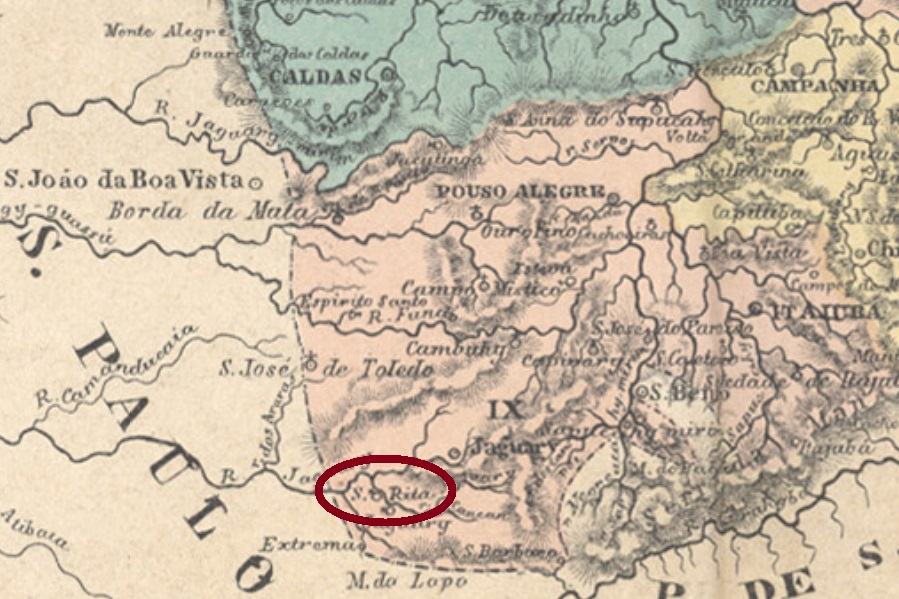
The former Santa Rita district of the municipality of Bom Jardim changed as Santa Rita da Extrema in October 1871 to Jaguary, and was situated over 500 km southwest of the old province capital Ouro Preto. In September 1901 it was elevated to a municipality, which simplified the name to Extrema in September 1915.
According to Paula Sobrinho (História Postal de Minas Gerais, Belo Horizonte, 1997), the local post office was created in June 1881. One cancel from the Empire was found: SMG-2900a (Coll. José A. Junges) has a double circle with the inscription S. RITA DA EXTREMA above and a diamond ornament below, whose four sides are open. The dates in the centre were found between 1886 and at least 1890.
Villiers de l’Ile Adam: Carta (…) da Provincia de Minas Geraes, 1849
Anderer Name: Extrema (1915)
Der ehemalige Distrikt von Santa Rita im Município von Bom Jardim wechselte im Oktober 1871 als Santa Rita da Extrema zur Gemeide Jaguary und lag über 500 km südwestlich der ehemaligen Hauptstadt Ouro Preto entfernt. Im September 1901 stieg er zum Município auf, der im September 1915 den vereinfachten Ortsnamen Extrema bekam.
Laut Paula Sobrinho (História Postal de Minas Gerais, Belo Horizonte, 1997) entstand das örtliche Postamt im Juni 1881. Ein einziger Poststempel aus dem Kaiserreich wurde gefunden: SMG-2900a (Samml. José A. Junges) hat einen Doppelkreis mit der Inschrift S. RITA DA EXTREMA oben und einem rautenförmigen Ornament unten, dessen vier Seiten offen sind. Die Daten in der Mitte wurden für den Zeitraum 1886-1890ff ermittelt.
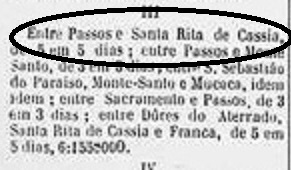
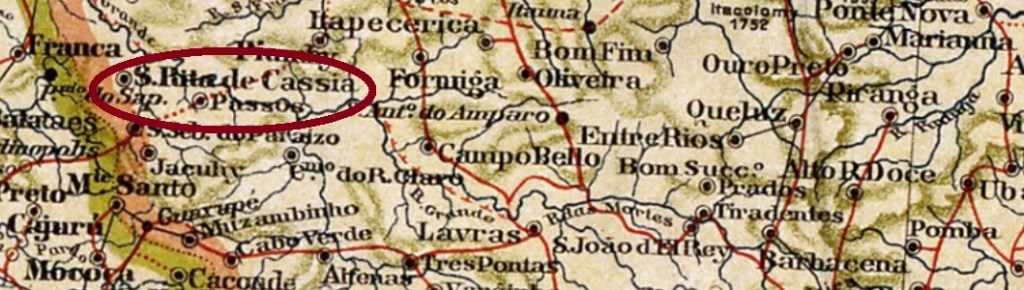
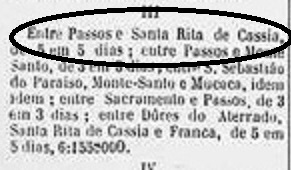
According to the Postal Guide (Guia Postal do Imperio) of 1880, there were two localities named Santa Rita de Cassia in Minas Gerais. The bigger one (ca. 2.4 thousand inhabitants) was Santa Rita de Cássia do Rio Claro near Caldas, the smaller (less than 2 thousand people), near Passos. It seems that the post office was created in the small Santa Rita, as this mail route reveals:
A Provincia de Minas, September 12, 1887
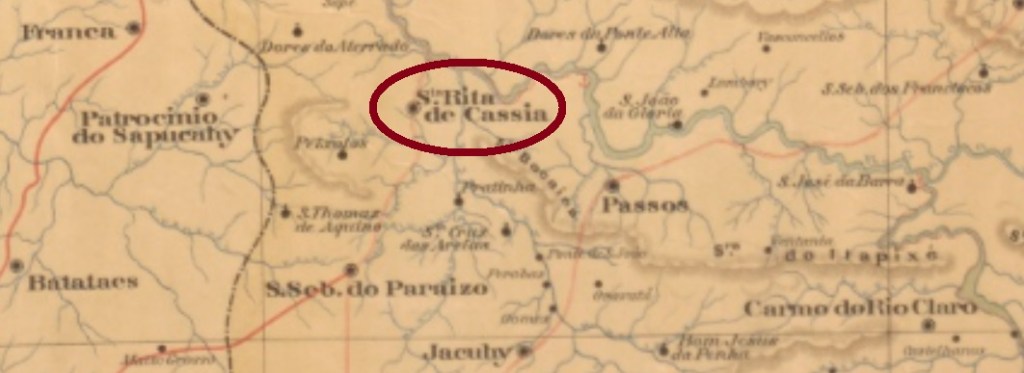
This Santa Rita de Cassia was since May 1855 a district of the municipality of Passos, which passed in January 1866 to Jacuhy. In 1890 it was elevated to a villa, and two years later, to a town, which simplified its toponym to Cássia in 1919.
Paula Sobrinho (História Postal de Minas Gerais, Belo Horizonte, 1997) tells us that the post office was created in July 1881. One imperial cancel is known: SMG-2905a (Coll. José A. Junges) features a double circle with the inscription S. RITA DE CASSIA above and a diamond ornament below, whose four sides are open. The dates in the centre come from the period 1881ff-1894.
Mapa de Minas Geraes, 1911
Anderer Name: Cássia (1919)
Laut dem Postführer (Guia Postal do Imperio) vom 1880 gab es zwei Ortschaften in Minas Gerais, die Santa Rita de Cássia hießen. Die größte davon (ca. 2,4 tausend Einwohner) war Santa Rita de Cássia do Rio Claro bei Caldas, die andere (knapp 2 tausend Seelen) lag bei Passos. Es scheint, dass das gesuchte Postamt in der kleineren Santa Rita de Cássia errichtet wurde, wie diese Postroute uns zeigt:
A Provincia de Minas, 12. September 1887
Diese Santa Rita de Cassia war seit Mai 1855 ein Distrikt im Município von Passos, der 1866 zu Jacuhy wechselte. 1890 wurde daraus eine Villa, und zwei Jahre später eine Stadt, die 1919 den Ortsnamen auf Cássia vereinfachte.
Paula Sobrinho (História Postal de Minas Gerais, Belo Horizonte, 1997) sagt uns, dass das Postamt im Juli 1881 entstand. Eine Abstempelung des Kaiserreichs ist überliefert: SMG-2905a (Samml. José A. Junges) zeigt einen Doppelkreis mit der Inschrift S. RITA DE CASSIA oben und einem rautenförmigen Ornament unten, dessen vier Seiten offen sind. Die Daten in der Mitte stammen aus dem Zeitraum 1881ff-1894.
Other names: Trahiry, Santa Cruz da Ribeira do Trahiry
See also: Santa Cruz (SRN-0220)
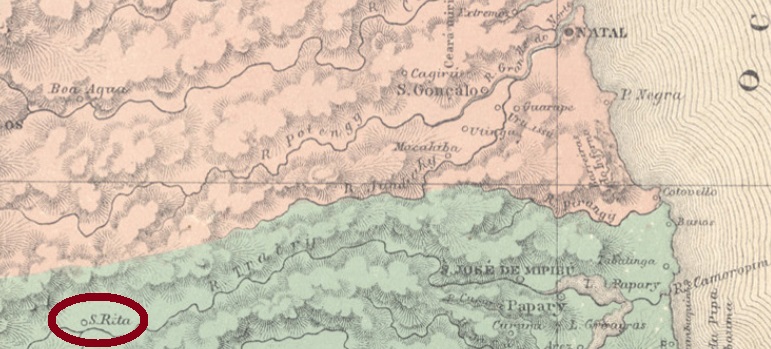
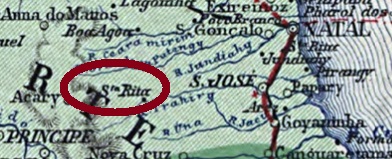
Santa Rita da Cachoeira was since March 1835 a freguesia, situated over 130 km southwest of the province capital Natal. In 1864 it changed as a district of São José de Mipibu and became the Villa of Trahiry in own municipality in December 1876. Since November 1914 it is the municipality of Santa Cruz.
Carta da Republica dos Estados Unidos do Brazil, 1892
Andere Namen: Trahiry, Santa Cruz da Ribeira do Trahiry
See also: Santa Cruz (SRN-0220)
Santa Rita da Cachoeira war seit März 1835 eine Freguesia und lag über 130 km südwestlich der Provinzhauptstadt Natal entfernt. 1864 wechselte sie als ein Distrikt zum Município von São José de Mipibu und wurde im Dezember 1876 die Villa von Trahiry. Seit November 1914 ist es der Município von Santa Cruz.
Im Verzeichnis der kaiserlichen Postämter (Tabella das Agencias do Correio do Imperio) von 1885 wird das örtliche Postamt mit Entstehungsjahr 1874 bereits unter dem Namen Santa Cruz aufgelistet. Kein Poststempel aus der Kaiserzeit ist bisher erschienen.
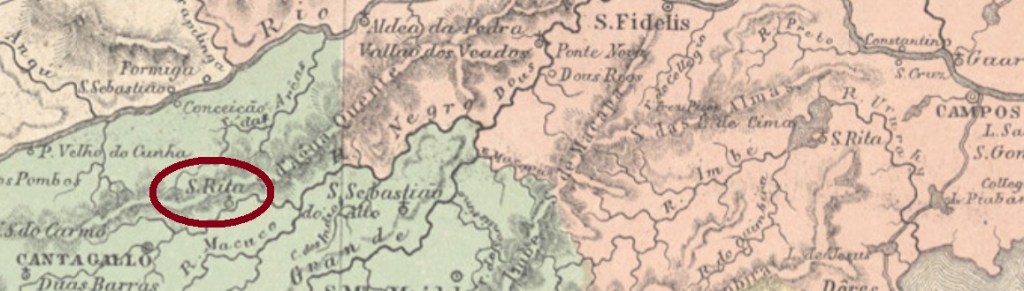
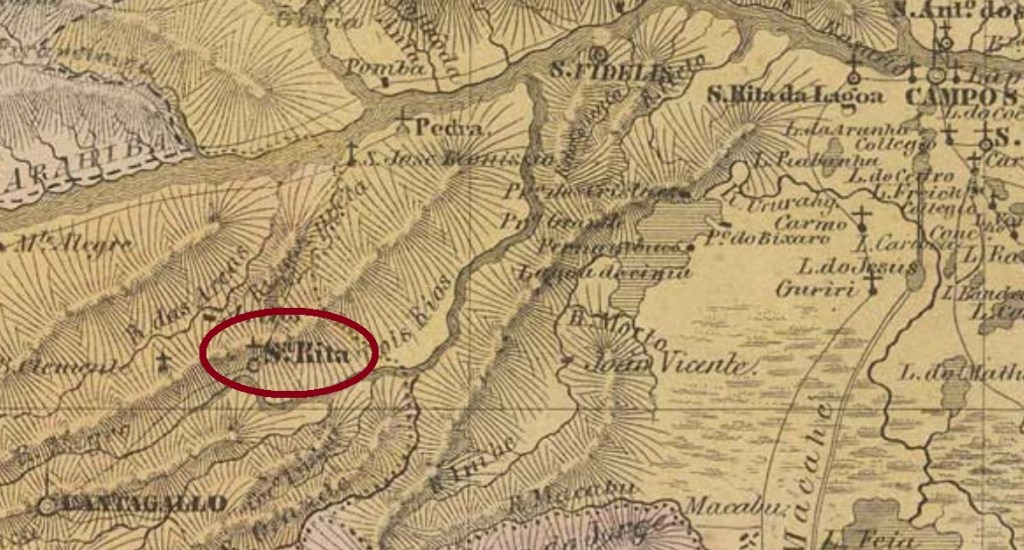
Santa Rita (also written Ritta) was since May 1842 a district of the municipality of Cantagallo, situated on the north bank of the Rio Negro, an affluent to the Rio Grande, over 200 km northeast of the imperial capital Rio de Janeiro. In December 1938 the toponym changed to Rio Negro, but only five years later it changed again, to the actual Euclidelândia. This name is a tribute to the prominent Brazilian writer and engineer Euclides da Cunha (1866-1909), who was born in the region.
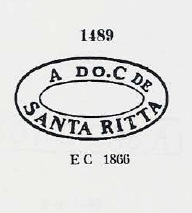
The earliest Santa Rita cancel originates from the first period. SRJ-0885a was already presented by Henrique B. Ferreira (Catálogo ilustrado dos carimbos sobre os olhos-de-boi, 4a. ed, Porto Alegre, 2017) and was used from the beginning until at least 1843:
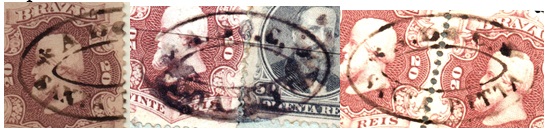
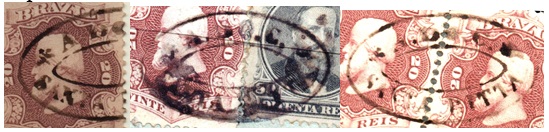
In the real cancel images (Coll. José A. Junges) there is no DE above right. Instead, there are twigs on both upper sides between ovals. Furthermore, there are missing dots after A and C, as shown below:
SRJ-0885b (Coll. José A. Junges)
It was followed by SRJ-0885c (Coll. José A. Junges): a double circle with the inscription SANTA RITA above and date in the centre. The examples were found for the period 1877-1885.
From ca. 1886 on the cancels show a complementary DO RIO NEGRO, possibly because there was another locality called Santa Rita in Cantagallo, which was growing fast and had already its own post office, awaiting for the district status, under the toponym Santa Rita da Floresta (SRJ-2295). So the last imperial cancel for the original Santa Rita, SRJ-1545a (agenciaspostais.com.br), has a double circle with the inscription S. RITA DO RIO NEGRO above and the date in the centre. Found with dates between 1886 and 1892.
Villiers de l’Ile Adam: Carta (…) da Provincia do Rio de Janeiro, 1850
Textaktualisierung vom 1. September 2020
Andere Namen: Rio Negro, Euclidelândia (1943)
Santa Rita (auch Ritta geschrieben) war ab Mai 1842 ein Distrikt im Município von Cantagallo und lag am Nordufer des Rio Negro, ein Zufluss des Rio Grande, über 200 km nordöstlich der kaiserlichen Hauptstadt Rio de Janeiro entfernt. Im Dezember 1938 wechselte der Ortsname zu Rio Negro, doch nur fünf Jahre später wechselte er wieder, diesmal zum aktuellen Euclidelândia. Der Name soll an Euclides da Cunha (1866-1909) erinnern, einen prominenten Sohn der Region, der als Literat und Ingenieur eine wichtige Rolle in der Landesgeschichte spielte.
Laut Nova Monteiro (Administrações e Agencias Postaes do Brasil Imperio, in Brasil Filatelico/RJ, 1934-5; Reprint SPP 1994-1999) entstand das örtliche Postamt im November 1833, Paulo Novaes (agenciaspostais.com.br) schreibt dennoch ein Gründungsdatum am 1. Januar 1862. Da diese Agentur noch im Postbericht (Relatorio Postal) für 1860 aufgelistet war, wurde sie wahrscheinlich zwischen beiden Jahren geschlossen.
Der früheste Santa Rita-Stempel stammt noch aus der ersten Betriebsperiode. SRJ-0885a wurde bereits durch Henrique B. Ferreira (Catálogo ilustrado dos carimbos sobre os olhos-de-boi, 4a. ed, Porto Alegre, 2017) vorgestellt und wurde wohl vom Beginn an bis mindestens 1843 gebraucht:
SRJ-0885a (HBF)
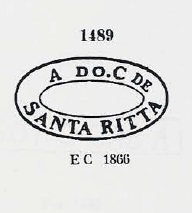
Leider ist die durch Paulo Ayres (unter Nr. 1489 im Catálogo de Carimbos Brasil-Império, S. Paulo, 1937, 1942) überlieferte Abbildung für SRJ-0885b erheblich fehlerhaft:
P. Ayres (op. cit.) Nr. 1489
Tatsächlich zeigen die echten Stempelbilder (Samml. José A. Junges) kein DE oben rechts. Stattdessen sieht man Zweige oben auf beiden Seiten. Außerdem fehlen noch Punkte nach den Buchstaben A und C, wie unten abgebildet:
SRJ-0885b (Samml. José A. Junges)
Dieser Stempel war zwischen 1862 und 1866ff in Gebrauch. Ihm folgte SRJ-0885c (Samml. José A. Junges): ein Doppelkreis mit der Inschrift SANTA RITA oben und das Datum in der Mitte. Die gefundenen Exemplare kommen aus dem Zeitraum 1877-1885.
Ab ca. 1886 zeigen die Abstempelungen den Zusatz DO RIO NEGRO, womöglich weil eine andere Ortschaft gleichen Namens im Município von Cantagallo schnell wuchs und schon ein eigenes Postamt unter Santa Rita da Floresta (SRJ-2295) besaß. So hat der letzte kaiserliche Stempel für die ursprüngliche Santa Rita, SRJ-1545a (agenciaspostais.com.br), einen Doppelkreis mit der Inschrift S. RITA DO RIO NEGRO oben, dazu Datum in der Mitte. Die vorhandenen Exemplare wurden 1886-1892 gebraucht.
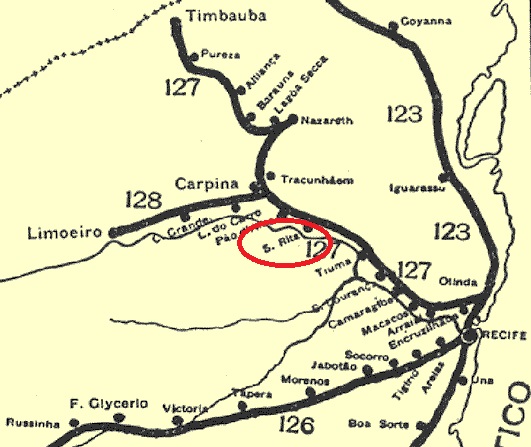
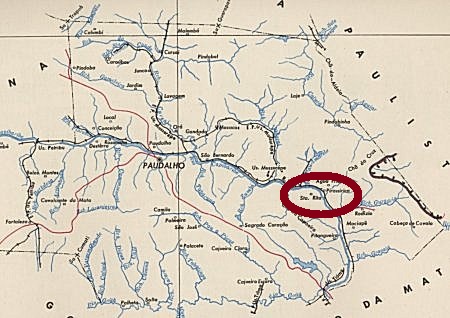
The Santa Rita train station was built in october 1881 by the Estrada de Ferro do Recife ao Limoeiro (Great Western do Brazil), North Line, in the municipality of Pau d’Alho, round 35 km northwest of the province capital Recife. Early in 20th century the station was renamed Pirassirica. In 1950 the railway passed to the Rede Ferroviária do Nordeste, and from 1975 until operation end in 1996, to the Rede Ferroviária Federal SA. Now the station is demolished, but the tracks are still there, in a militar area (estacoesferroviarias.com.br).
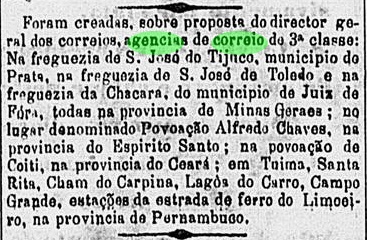
The station post office was created in October 1882, as reported by the Rio press:
O Globo, Rio de Janeiro, October 28, 1882
One early cancel is known: SPE-0585a (Coll. José A. Junges) has a double circle with the inscriptions SANTA RITA above and PERNAMO. below. The date of the only found copy (on a Southern Cross issue of 1890) shows SET for September.
IBGE (estacoesferroviarias.com.br)
Anderer Name: Pirassirica
Der Bahnhof Santa Rita train station wurde im Oktober 1881 durch die Estrada de Ferro do Recife ao Limoeiro (Great Western do Brazil), Linie Nord, gebaut und lag im Município von Pau d’Alho, rund 35 km nordwestlich der Provinzhauptstadt Recife entfernt. Im frühen 20. Jahrhundert wurde die Station auf Pirassirica umbenannt. 1950 ging die Bahnklinie in Besitz der Rede Ferroviária do Nordeste über, und von 1975 bis zum Betriebsende 1996 gehörte sie der Rede Ferroviária Federal SA. Nun ist das Gebäude abgerissen, aber die Schiene liegen noch, in einem Militärgebiet (estacoesferroviarias.com.br).
Das Bahnhofspostamt entstand im Oktober 1882, wie die Presse aus Rio berichtet:
O Globo, Rio de Janeiro, 28. Oktober 1882
Ein früher Stempel ist überliefert: SPE-0585a (Samml. José A. Junges) hat einen Doppelkreis mit den Inschriften SANTA RITA oben und PERNAMO. unten. Das einzige vorhandene Exemplar (auf einer Kreuz-des-Südens-Ausgabe von 1890) zeigt in der Mitte SET, für September.








 Carimbologia