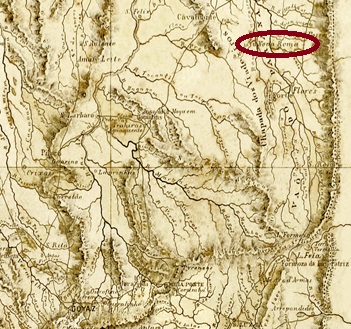
The settlement was originally called São Theodoro. It was located near the west bank of the Paranã River, 600 kilometres northeast of the provincial capital Goyaz (today: Goiás Velho). In July 1858, it became Freguesia do Divino Espírito Santo de Nova Roma, which belonged to Vila de Cavalcante. In December 1943, the place name was changed to Guataçaba. The term comes from the Guarani language and means ‘hiding place of the maned wolves’.
Maned wolf (Photo: Aguará, CC BY-SA 3.0)
In November 1949, however, the old place name Nova Roma was restored. As such, it became part of the Município de Veadeiros in October 1953. Nova Roma has been an independent municipality since November 1958.
According to reports in the Rio de Janeiro press, a decision was made in May 1885 to establish a post office there.
Jornal do Commercio/RJ, 06.05.1885
However, no imperial postmark from Nova Roma has been found to date.
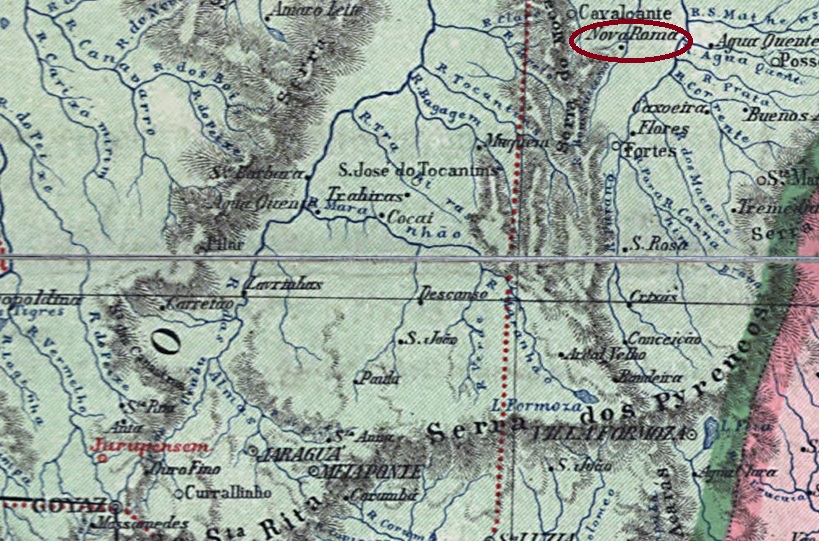
Carta da Republica dos Estados Unidos do Brazil, 1892
Outros nomes: São Teodoro, Guataçaba
O povoado se chamava originalmente São Teodoro. Ficava próximo à margem oeste do rio Paranã, 600 quilômetros a nordeste da capital do estado, Goiás (hoje Goiás Velho). Em julho de 1858, tornou-se a Freguesia do Divino Espírito Santo de Nova Roma e pertencia à Vila de Cavalcante. Em dezembro de 1943, o nome do local foi alterado para Guataçaba. O termo vem da língua guarani e significa “esconderijo dos lobos-guará”.
Lobo-guará (Foto: Aguará, CC BY-SA 3.0)
Em novembro de 1949, porém, o antigo nome Nova Roma foi restaurado. Com esse nome, em outubro de 1953, passou a fazer parte do município de Veadeiros. Desde novembro de 1958, Nova Roma é um município independente.
Conforme noticiado pela imprensa do Rio de Janeiro, em maio de 1885 foi decidido estabelecer uma agência dos correios no local.
Jornal do Comércio/RJ, 06/05/1885
Até o momento, porém, nenhum carimbo postal imperial de Nova Roma foi encontrado.
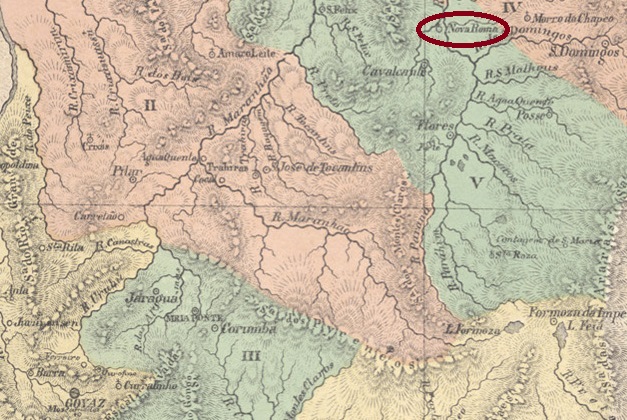
Carta da Provncia de Goyaz, 1874
Andere Namen: São Theodoro, Guataçaba
Die Siedlung hieß ursprünglich São Theodoro. Sie lag in der Nähe des Westufers des Flusses Paranã, 600 Kilometer nordöstlich der Provinzhauptstadt Goyaz (heute: Goiás Velho). Im Juli 1858 wurde sie zur Freguesia do Divino Espírito Santo de Nova Roma und gehörte zur Vila de Cavalcante. Im Dezember 1943 wurde der Ortsname in Guataçaba geändert. Der Begriff stammt aus der Guarani-Sprache und bedeutet „Versteck der Mähnenwölfe”.
Mähnenwolf (Foto: Aguará, CC BY-SA 3.0)
Im November 1949 kehrte der alte Ortsname Nova Roma jedoch zurück. Als solcher wechselte er im Oktober 1953 zum Município de Veadeiros. Seit November 1958 ist Nova Roma ein eigenständiger Município.
Wie die Presse aus Rio de Janeiro mitteilte, wurde im Mai 1885 beschlossen, dort ein Postamt einzurichten.
Jornal do Commercio/RJ, 06.05.1885
Bisher wurde jedoch kein kaiserlicher Poststempel aus Nova Roma gefunden.
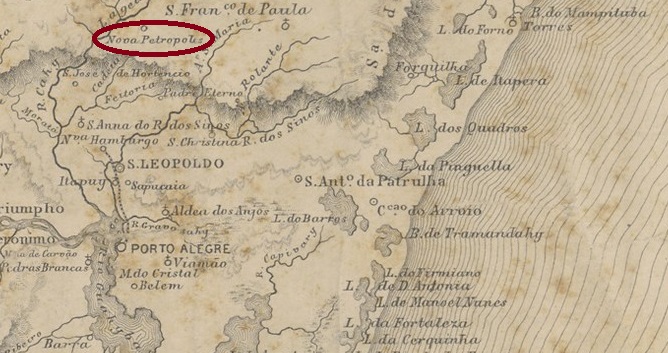
The colony of Nova Petrópolis was founded in September 1858. It belonged to Vila de São Leopoldo, was located near the eastern bank of the Caí River and 90 km north of the provincial capital Porto Alegre. In June 1889, it became Freguesia da Vila de São Sebastião do Cahy and has been an independent município since December 1954.
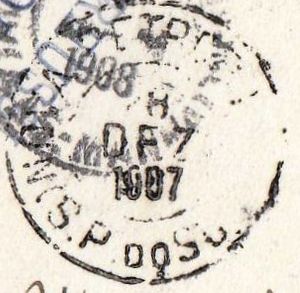
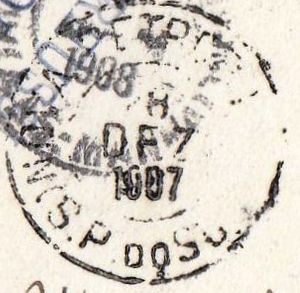
According to the Postal Bulletin (Boletim Postal), a post office in Nova Petrópolis was created in October 1889. It is very unlikely that there are postmarks with imperial dates (until 15 November 1889). The oldest cancel to date is NRS-0635a (image from the internet):
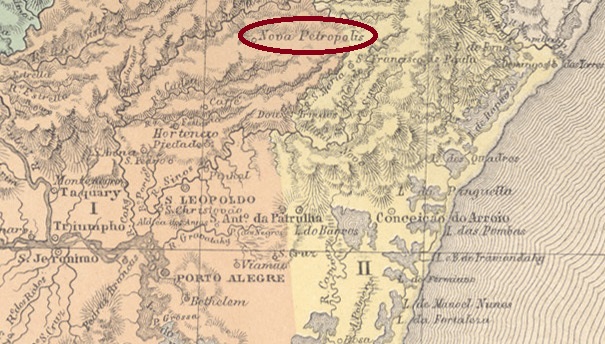
NRS-0635a (EB) 1907Provincia de São Pedro do Sul, 1877
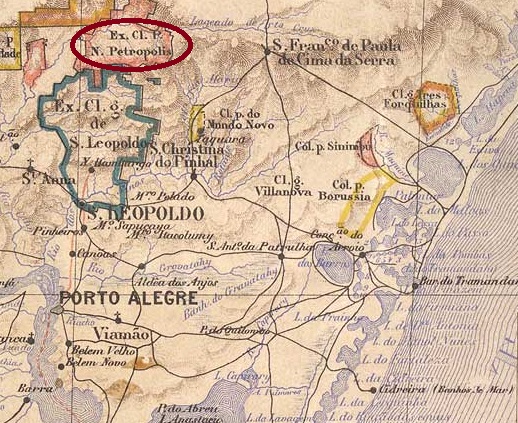
A colônia de Nova Petrópolis foi fundada em setembro de 1858. Pertencia à Vila de São Leopoldo, ficava próxima à margem leste do rio Caí e a 90 km ao norte da capital do estado, Porto Alegre. Em junho de 1889, tornou-se a Freguesia da Vila de São Sebastião do Cahy e, desde dezembro de 1954, é um município independente.
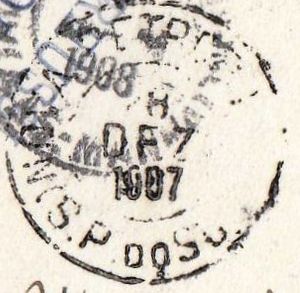
Conforme consta no Boletim Postal, a agência dos correios em Nova Petrópolis foi criada em outubro de 1889. É muito improvável que existam carimbos postais com datas imperiais (até 15 de novembro de 1889). O carimbo mais antigo encontrado até agora é o NRS-0635a (figura da Internet):
NRS-0635a (EB) 1907Estado do Rio Grande do Sul, 1891
Die Kolonie Nova Petrópolis wurde im September 1858 gegründet. Sie gehörte zur Vila de São Leopoldo, lag nah am Ostufer des Caí und 90 km nördlich der Provinzhauptstadt Porto Alegre. Im Juni 1889 wurde sie zur Freguesia da Vila de São Sebastião do Cahy und ist seit Dezember 1954 ein eigenständiger Município.
Wie dem Postbulletin (Boletim Postal) zu entnehmen ist, wurde die Einrichtung eines Postamts in Nova Petrópolis im Oktober 1889 beschlossen. Es ist sehr unwahrscheinlich, dass es Poststempel mit kaiserlichen Daten (bis zum 15. November 1889) gibt. Der bisher älteste Stempel ist NRS-0635a (Abb. aus dem Internet):
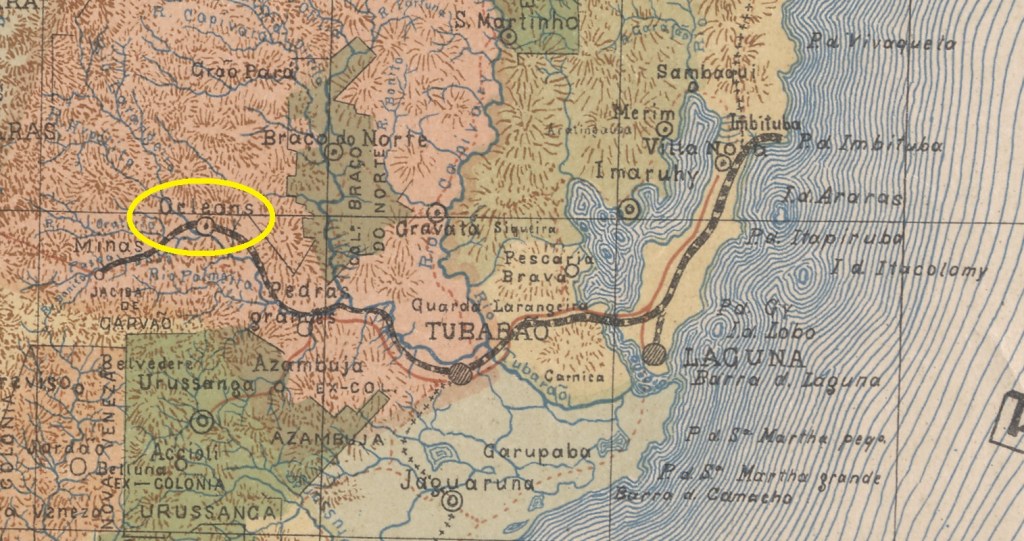
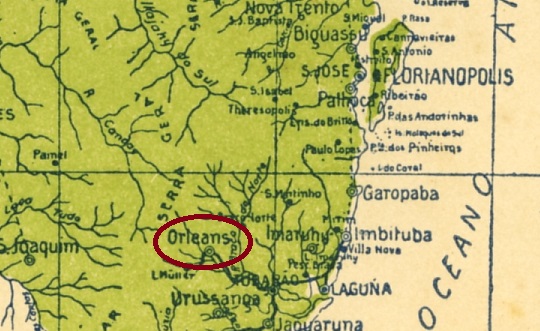
This settlement was founded in 1883 as part of the Grão Pará colony and was located on the north bank of the Hipólito, which further became the Rio Tubarão. It was located 180 km southwest of the provincial capital Desterro (now Florianópolis). In October 1888, it became Freguesia de Orleans do Sul, which belonged to Vila de Tubarão. In August 1913, it became a municipality, which was spelled Orleães from December 1943 onwards, before reverting to the old spelling in 1970.
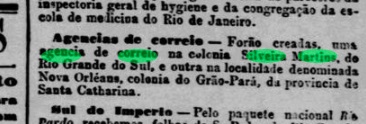
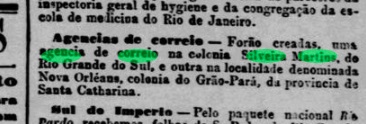
According to reports in the Rio de Janeiro press, there had been a post office there since August 1888.
Jornal do Commercio/RJ, 20 August 1888
In it, the place is still referred to as Nova Orleans.
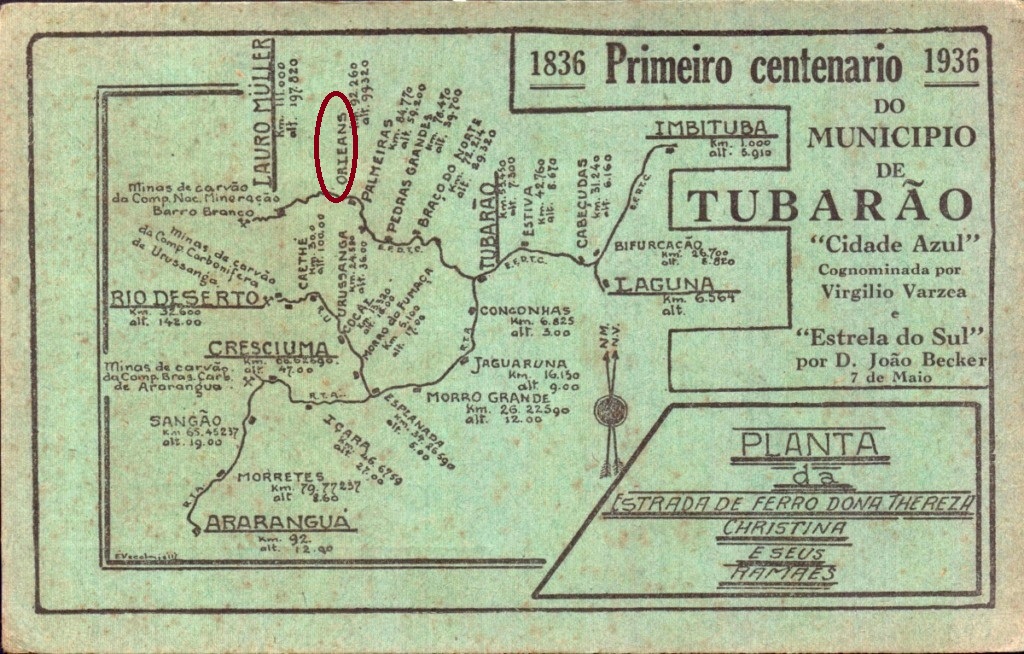
In January 1886, the railway company E. F. Teresa Cristina (main line) opened a station there. Even though the post office is not mentioned anywhere as a station post office, it is directly connected to the station. To date, no imperial postmark from Nova Orleans, Orleans do Sul or Orleans station has been seen.
Arthur D. RIbeiro: Estado de Santa Catharina, 1923
Outros nomes: Orleans do Sul, Orleães, Orleans
Este povoado foi fundado em 1883 como parte da colônia Grão Pará e ficava na margem norte do Hipólito, que mais adiante se tornou o Rio Tubarão. Localizava-se 180 km a sudoeste da capital provincial Desterro (hoje Florianópolis). Em outubro de 1888, tornou-se a Freguesia de Orleans do Sul, pertencente à Vila de Tubarão. Em agosto de 1913, tornou-se município, que a partir de dezembro de 1943 passou a ser escrito Orleães, antes de retornar à grafia antiga em 1970.
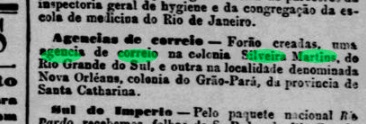
Segundo a imprensa do Rio de Janeiro, havia uma agência dos correios no local desde agosto de 1888.
Jornal do Commercio/RJ, 20/08/1888
Nele, o local ainda é mencionado como Nova Orleans.
Em janeiro de 1886, a E. F. Teresa Cristina (Linha Tronco) inaugurou uma estação ferroviária no local. Embora a agência dos correios não seja mencionada em nenhum lugar como agência da estação, ela está diretamente relacionada à ferrovia. Até o momento, não foi encontrado nenhum carimbo postal imperial de Nova Orleans, Orleans do Sul ou da estação ferroviária de Orleans.
E.F. Thereza Christina, 1936
Andere Namen: Orleans do Sul, Orleães, Orleans
Diese Siedlung wurde 1883 als Teil der Kolonie Grão Pará gegründet und lag am Nordufer des Hipólito, der im Unterlauf zum Rio Tubarão wurde. Sie befand sich 180 km südwestlich der Provinzhauptstadt Desterro (heute Florianópolis). Im Oktober 1888 wurde sie zur Freguesia de Orleans do Sul, die zur Vila de Tubarão gehörte. Im August 1913 wurde sie zum Município, der ab Dezember 1943 Orleães geschrieben wurde, bevor 1970 die alte Schreibweise zurückkehrte.
Ein Postamt soll es dort seit August 1888 geben, wie die Presse aus Rio de Janeiro mitteilte.
Jornal do Commercio/RJ, 20.08.1888
Darin wird der Ort noch als Nova Orleans erwähnt.
Im Januar 1886 hatte die Eisenbahngesellschaft E. F. Teresa Cristina (Hauptlinie) dort einen Bahnhof eröffnet. Auch wenn das Postamt nirgends als Bahnhofspostamt erwähnt wird, steht es doch in unmittelbarem Zusammenhang mit dem Bahnhof. Bisher wurde jedenfalls kein kaiserlicher Poststempel aus Nova Orleans, Orleans do Sul oder vom Bahnhof Orleans gesehen.
Other names: Conceição do Cariri, Lage/Laje (1905)
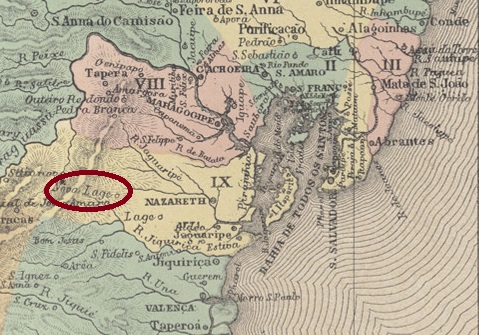
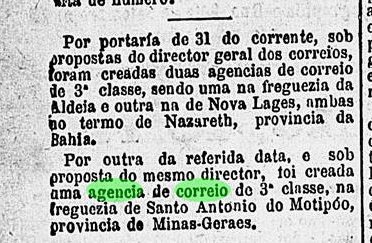
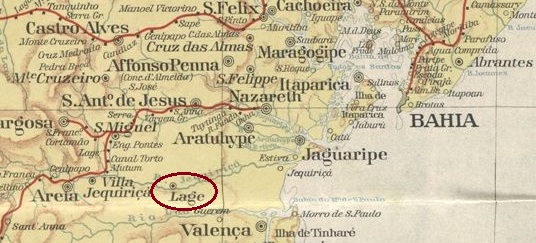
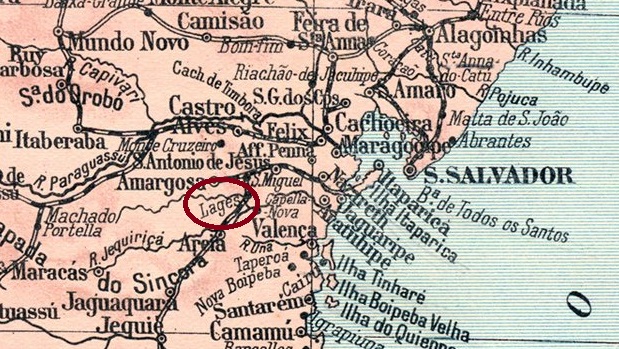
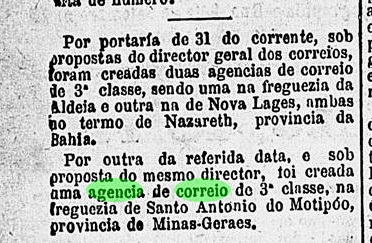
The Freguesia de Nossa Senhora das Dores de Nova Lage existed since May 1864. It belonged to the Vila de Nazaré and was located on the north bank of the Jequiriçá, 150 kilometres west of the provincial capital Salvador da Bahia. In April 1870, it became a district of the Freguesia de Nossa Senhora da Conceição do Cariri and in 1884 the Freguesia de Nossa Senhora da Conceição do Cariri de Nova Lage. In this form, Nova Lage moved to the Município de Aratuípe in February 1890. Since July 1905, Laje has been an independent município.
According to the Rio press, there had been a post office there since July 1882:
Gazeta de Noticias/RJ, 03.08.1882
No imperial postmark from Nova Lage has been seen to date.
Estado da Bahia, 1913
Outros nomes: Conceição do Cariri, Lage/Laje (1905)
A Freguesia de Nossa Senhora das Dores de Nova Lage existia desde maio de 1864. Pertencia à Vila de Nazaré e ficava na margem norte do Jequiriçá, 150 quilômetros a oeste da capital do estado, Salvador da Bahia. Em abril de 1870, tornou-se um distrito da Freguesia de Nossa Senhora da Conceição do Cariri e, em 1884, a Freguesia de Nossa Senhora da Conceição do Cariri de Nova Lage. Nessa forma, Nova Lage passou para o Município de Aratuípe em fevereiro de 1890. Desde julho de 1905, Laje é um município independente.
Segundo a imprensa do Rio, havia uma agência dos correios no local desde julho de 1882:
Gazeta de Notícias/RJ, 03.08.1882
Até o momento, não foi encontrado nenhum carimbo postal imperial de Nova Lage.
Monteiro e Oliveira: EStado da Bahia, 1927
Andere Namen: Conceição do Cariri, Lage/Laje (1905)
Die Freguesia de Nossa Senhora das Dores de Nova Lage bestand seit Mai 1864. Sie gehörte zur Vila de Nazaré und lag am Nordufer des Jequiriçá, 150 Kilometer westlich der Provinzhauptstadt Salvador da Bahia. Im April 1870 wurde sie ein Distrikt der Freguesia de Nossa Senhora da Conceição do Cariri und im Jahr 1884 die Freguesia de Nossa Senhora da Conceição do Cariri de Nova Lage. In dieser Form wechselte Nova Lage im Februar 1890 zum Município de Aratuípe. Seit Juli 1905 ist Laje ein eigenständiger Município.
Wie aus der Presse in Rio hervorgeht, gab es dort seit Juli 1882 ein Postamt:
Gazeta de Noticias/RJ, 03.08.1882
Bisher wurde kein kaiserlicher Poststempel aus Nova Lage gesehen.
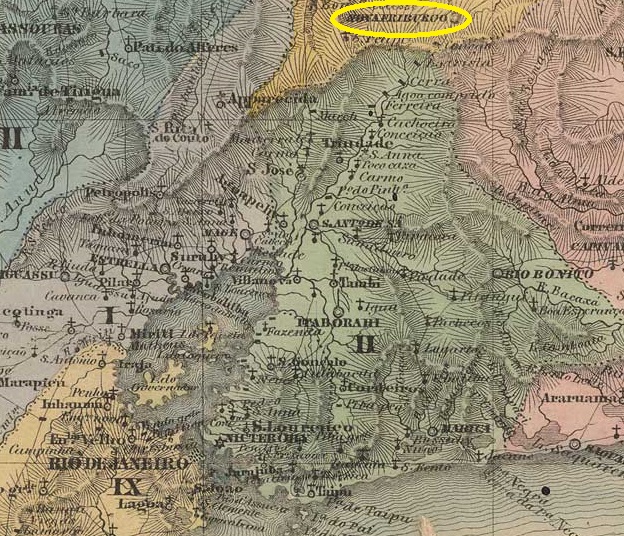
Villiers de l’Ile Adam: Carta (…) da Provincia do Rio de Janeiro, 1850
Other names: Morro Queimado
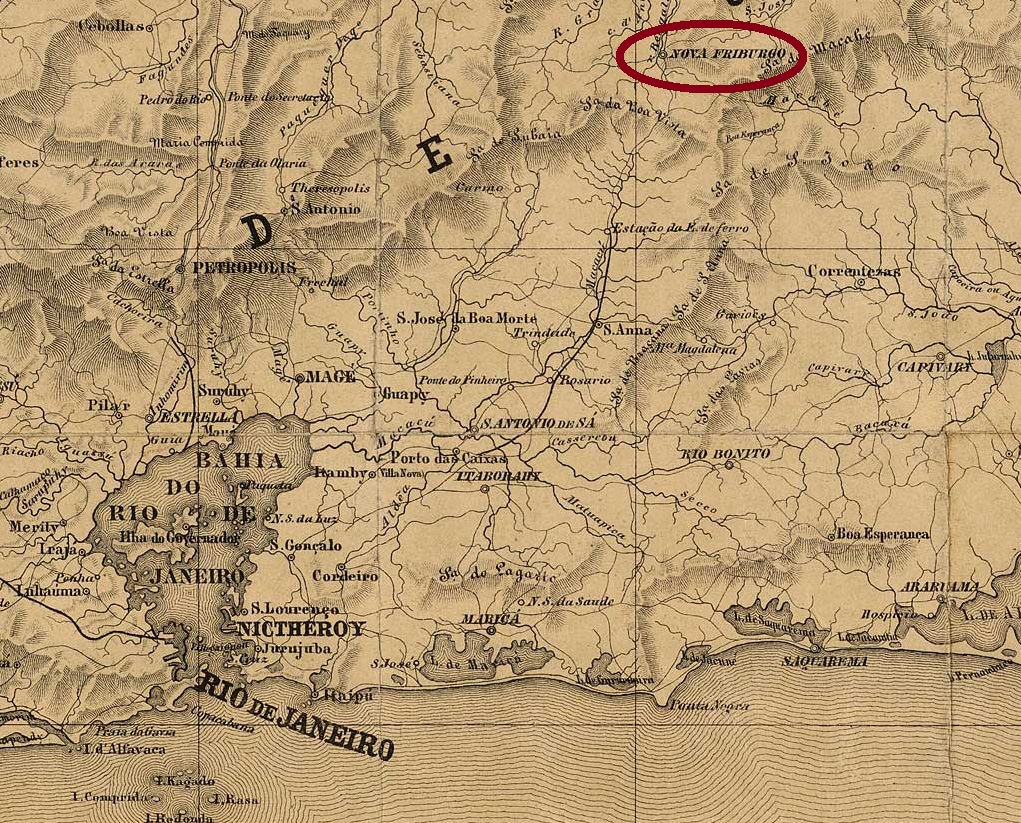
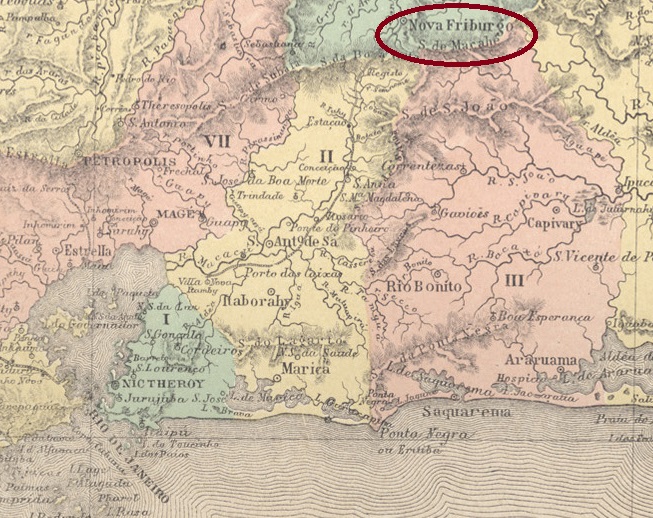
The settlement was originally called Morro Queimado (Burnt Mountain) and was located 140 kilometres northeast of the capital Rio de Janeiro. It still belonged to Vila de Cantagalo. In 1819, at the end of the colonial era, it became a colony to receive immigrants from the Swiss canton of Fribourg. In January 1820, it became a Vila and the following year, the Freguesia de São João Baptista de Nova Friburgo. Nova Friburgo has been a city since January 1890.
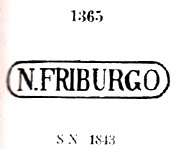
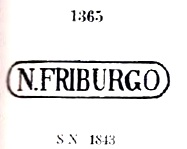
As Nova Monteiro writes in Administrações e Agencias Postaes do Brasil Imperio (Brasil Filatelico/RJ, 1934–1935; reprinted by SPP 1994–1999), there has been a post office there since January 1820. The oldest postmark to date is NRJ-0735a. This was given the number 1365 by Paulo Ayres (Catálogo de Carimbos Brasil-Império, São Paulo, 1937, 1942) and also appears in red and orange.
NRJ-0735a (P. A. 1365, RHM P-RJ-21 – EB) 1843–1873
This was followed by the French type NRJ-0735b, also listed in P. Ayres (op. cit.).
NRJ-0735b (P. A., p. 117) 1873–1876
Then came NRJ-0735c. It also exists in blue and is also recorded in P. Ayres:
NRJ-0735c (P. A., p. 122) 1877–1883
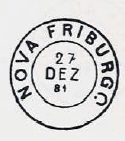
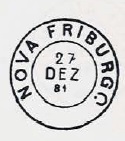
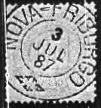
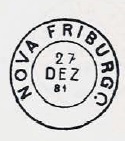
At the end of the Empire, two postmarks with double circles and similar ornaments at the bottom also appeared, starting with NRJ-0735d (illustration by R. Koester in Carimbologia XXVII).
NRJ-0735d (RK) 1883-1886
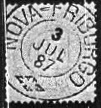
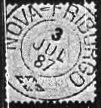
The image of the other postmark NRJ-0735e (which is also available in blue) also comes from Koester.
NRJ-0735e (RK) 1887-1895
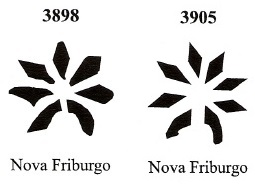
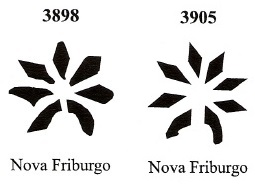
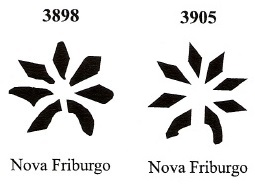
James Dingler and Klerman W. Lopes also presented two mute postmarks from Nova Friburgo in Mute Cancellations of the Brazil Empire / Carimbos Mudos do Brasil Império (Brazil Philatelic Association, Rio de Janeiro, 2000):
BPA 3898 (P.A. 612, 1878ff) – 3905 (1882ff, also in violet)Laemmert: Provincia do Rio de Janeiro, 1866
Outros nomes: Morro Queimado
O povoado se chamava originalmente Morro Queimado e ficava a 140 quilômetros a nordeste da capital Rio de Janeiro. Ainda pertencia à Vila de Cantagalo. Em 1819, no final do período colonial, tornou-se uma colônia destinada a receber imigrantes do cantão suíço de Friburgo. Em janeiro de 1820, tornou-se vila e, no ano seguinte, freguesia de São João Baptista de Nova Friburgo. Desde janeiro de 1890, Nova Friburgo é uma cidade.
Como escreve Nova Monteiro em Administrações e Agências Postais do Brasil Império (Brasil Filatélico/RJ, 1934-1935; reimpressão SPP 1994-1999), havia uma agência dos correios lá desde janeiro de 1820. O carimbo postal mais antigo até agora é o NRJ-0735a. Este recebeu o número 1365 em Paulo Ayres (Catálogo de Carimbos Brasil-Império, São Paulo, 1937, 1942) e também existe nas cores vermelho e laranja.
NRJ-0735a (P. A. 1365, RHM P-RJ-21 – EB) 1843–1873
Seguiu-se o tipo francês NRJ-0735b, também listado em P. Ayres (op. cit.).
NRJ-0735b (P. A., p. 117) 1873–1876
Depois veio o NRJ-0735c. Ele também existe em azul e está registrado em P. Ayres:
NRJ-0735c (P. A., p. 122) 1877–1883
No final do Império, surgiram mais dois carimbos postais circulares, agora com ornamentos semelhantes na parte inferior, começando com o NRJ-0735d (ilustração em R. Koester em Carimbologia XXVII).
NRJ-0735d (RK, EB) 1883-1886
A imagem do outro carimbo NRJ-0735e (que também existe em azul) também é de Koester.
NRJ-0735e (RK) 1887-1895
James Dingler e Klerman W. Lopes também apresentaram dois carimbos postais mudos de Nova Friburgo em Mute Cancellations of the Brazil Empire / Carimbos Mudos do Brasil Império (Clube Filatélico do Brasil, Rio de Janeiro, 2000):
BPA 3898 (P.A. 612, 1878ff) – 3905 (1882ff, também em violeta)Atlas do Imperio do Brasil, 1868
Andere Namen: Morro Queimado
Die Siedlung hieß ursprünglich Morro Queimado (Verbrannter Berg) und lag 140 Kilometer nordöstlich der Hauptstadt Rio de Janeiro. Sie gehörte noch zur Vila de Cantagalo. 1819, am Ende der Kolonialzeit, wurde sie zu einer Kolonie, die Einwanderer aus dem schweizerischen Kanton Freiburg empfangen sollte. Im Januar 1820 wurde sie zur Vila und im folgenden Jahr zur Freguesia de São João Baptista de Nova Friburgo. Seit Januar 1890 ist Nova Friburgo eine Stadt.
Wie Nova Monteiro in Administrações e Agencias Postaes do Brasil Imperio (Brasil Filatelico/RJ, 1934–1935; Nachdruck SPP 1994–1999) schreibt, gab es dort seit Januar 1820 ein Postamt. Der bisher älteste Poststempel ist NRJ-0735a. Dieser erhielt bei Paulo Ayres (Catálogo de Carimbos Brasil-Império, São Paulo, 1937, 1942) die Nr. 1365 und kommt auch in den Farben Rot und Orange vor.
NRJ-0735a (P. A. 1365, RHM P-RJ-21 – EB) 1843–1873
Es folgte der französische Typ NRJ-0735b, ebenfalls in P. Ayres (op. cit.) aufgeführt.
NRJ-0735b (P. A., S. 117) 1873–1876
Danach kam NRJ-0735c. Es gibt ihn auch in Blau und er ist ebenfalls in P. Ayres erfasst:
NRJ-0735c (P. A., S. 122) 1877–1883
Am Ende des Kaiserreichs erschienen auch zwei Poststempel im Doppelkreis mit ähnlichen Ornamenten unten, beginnend mit NRJ-0735d (Abbildung bei R. Koester in Carimbologia XXVII).
NRJ-0735d (RK, EB) 1883-1886
Auch das Bild des anderen Stempels NRJ-0735e (den es auch in Blau gibt) stammt von Koester.
NRJ-0735e (RK) 1887-1895
James Dingler und Klerman W. Lopes haben auch zwei stumme Poststempel aus Nova Friburgo in Mute Cancellations of the Brazil Empire / Carimbos Mudos do Brasil Império (Brazil Philatelic Association, Rio de Janeiro, 2000) vorgestellt:
BPA 3898 (P.A. 612, 1878ff) – 3905 (1882ff, auch in Violett)
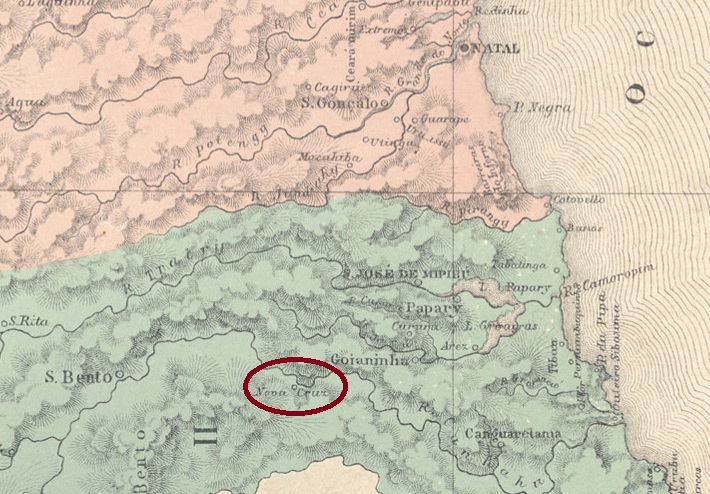
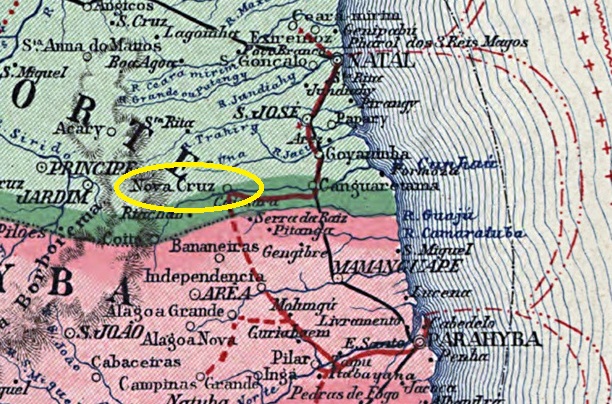
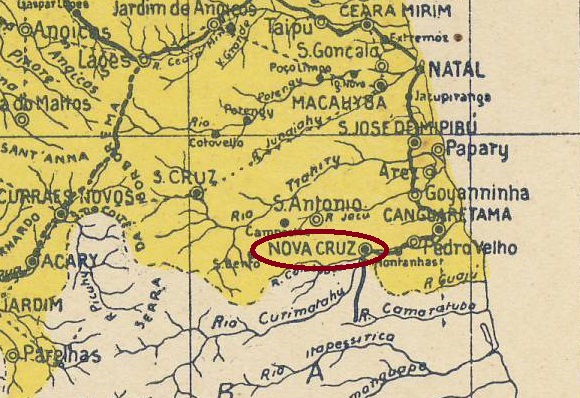
The village was originally called Urtigal (Nettle Field) and Anta Esfolada (Skinned Tapir) before it was given the name Freguesia de Nossa Senhora da Conceição de Nova Cruz. It belonged to Vila de São Bento and was located on the south bank of the Curimataú, 110 kilometres south of the provincial capital Natal. On old maps, Nova Cruz was further away from the provincial border with Paraíba, but today the town is located directly on this border.
In March 1852, Nova Cruz became the municipal seat of Vila de S. Bento. Sixteen years later, in December 1919, Nova Cruz was elevated to city status.
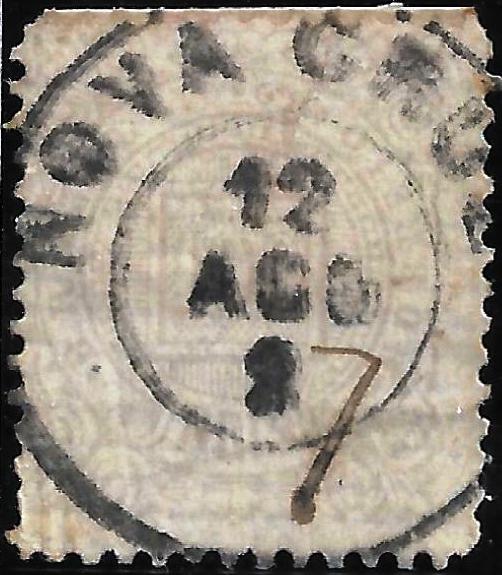
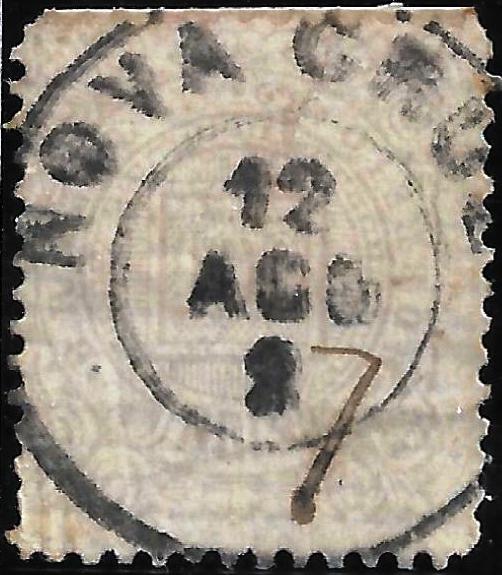
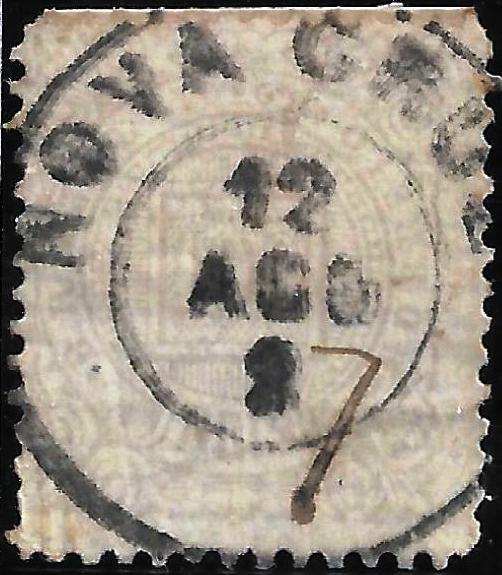
As R. Koester wrote in Carimbologia XXVIII, there had been a post office there since June 1869. The only imperial postmark with this place name to date is NRN-0120b (image from the Internet):
NRN-0120b (EB) 1883-1892
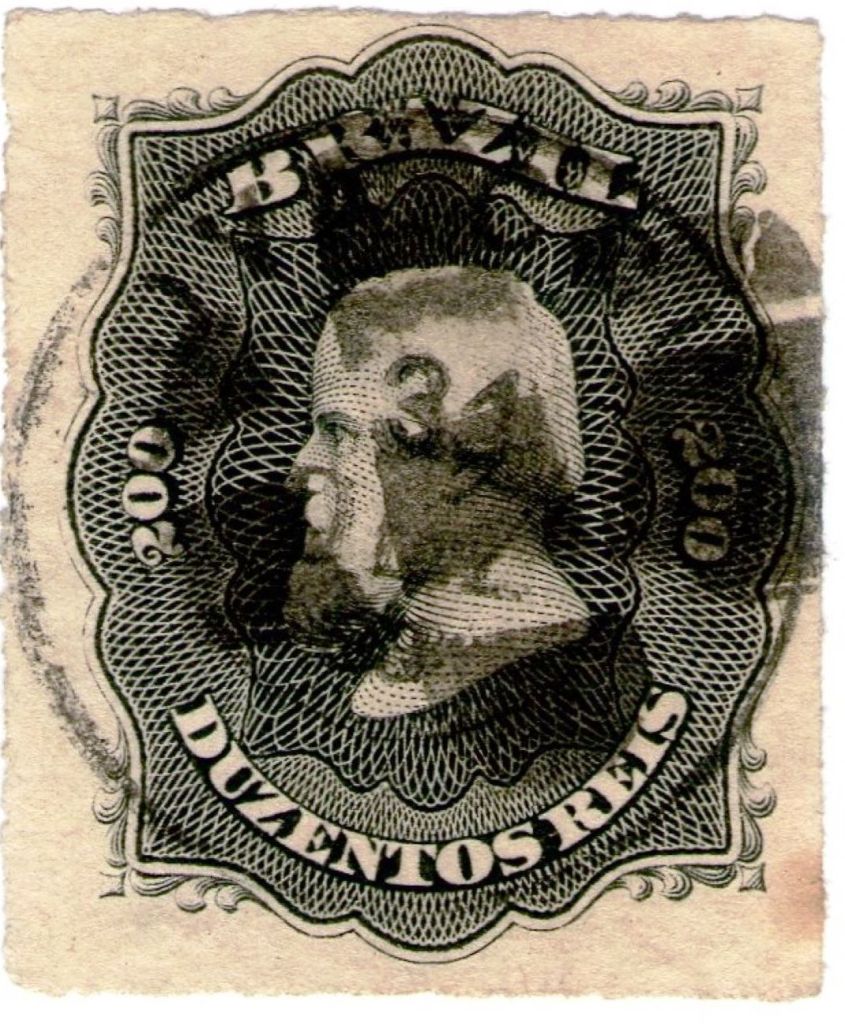
Philatelist Claudio Coelho has also shown a mute postmark from Nova Cruz:
1883 (CC)
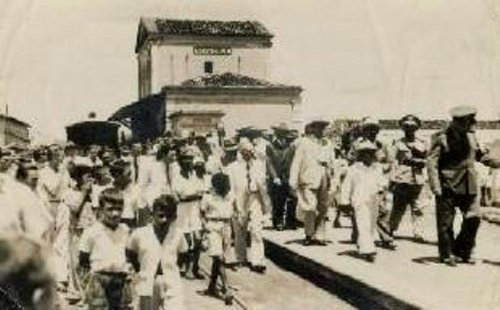
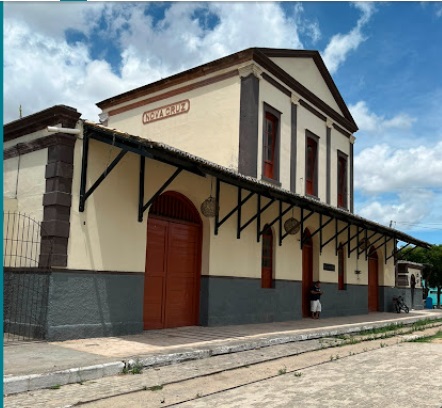
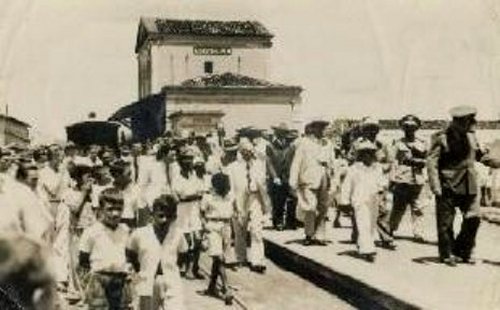
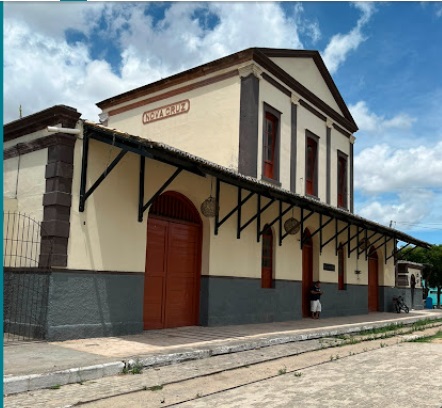
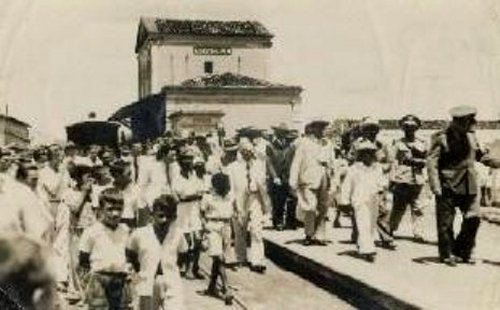
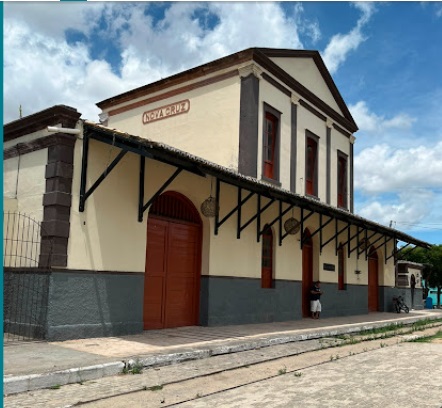
In April 1883, a railway station belonging to the E. F. de Natal a Nova Cruz railway company (main line) was opened in Nova Cruz. The line was transferred to Great Western in 1902, to E.F. Sampaio Correia in 1939, to Rede Ferroviária do Nordeste in 1957, and belonged to Rede Ferroviária Federal S.A. from 1975 until its closure in 1996 (estacoesferroviarias.com.br). Today, the tracks are still in place and the restored station building serves as a cultural centre for the community of Nova Cruz.
Around 1940 (estacoesferroviarias.com.br)In January 2023 (photo: Larissa Galvão, on Google Maps)
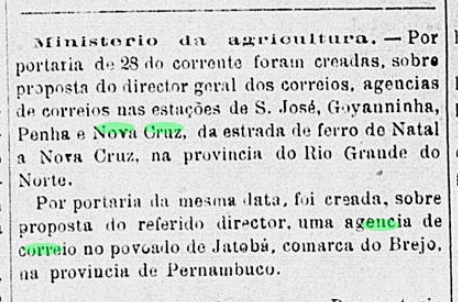
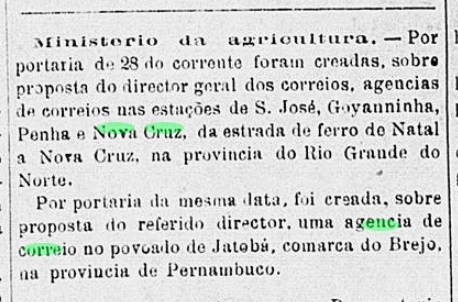
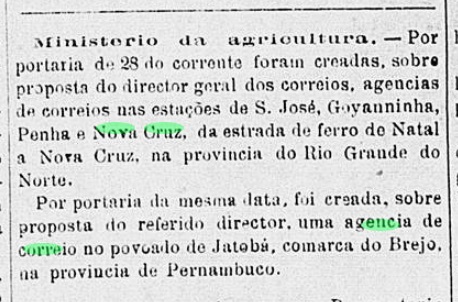
According to reports in the Rio press, a post office was established at the station in July 1883.
Brazil/RJ, 29 July 1883
Even though the village was not large at the time, both post offices (at the station and in the village) were still listed in the directory of imperial post offices (Tabella das Agencias do Correio do Imperio, Rio de Janeiro, 1885). However, one of them was probably closed soon afterwards.
Carta da Republica dos Estados Unidos do Brazil, 1892
Outros nomes: Urtigal, Anta Esfolada
A localidade chamava-se originalmente Urtigal e Anta Esfolada, antes de receber o nome de Freguesia de Nossa Senhora da Conceição de Nova Cruz. Pertencia à Vila de São Bento e ficava na margem sul do Curimataú, 110 quilômetros ao sul da capital da provincia, Natal. Em mapas antigos, Nova Cruz ficava mais distante da fronteira com o estado da Paraíba, mas hoje a localidade fica nessa fronteira.
Em março de 1852, Nova Cruz tornou-se sede da Vila de S. Bento. Dezesseis anos depois, em dezembro de 1919, Nova Cruz foi elevada à categoria de cidade.
Como escreveu R. Koester em Carimbologia XXVIII, havia uma agência dos correios no local desde junho de 1869. O único carimbo postal imperial com esse nome até hoje é o NRN-0120b (figura da internet):
NRN-0120b (EB) 1883-1892
O filatelista Claudio Coelho também mostrou um carimbo postal mudo de Nova Cruz:
1883 (CC)
Em abril de 1883, foi inaugurada em Nova Cruz uma estação ferroviária da E. F. de Natal a Nova Cruz (Linha Tronco). A linha passou para a Great Western em 1902, para a E.F. Sampaio Correia em 1939, para a Rede Ferroviária do Nordeste em 1957 e pertenceu à Rede Ferroviária Federal S.A. de 1975 até ao seu encerramento em 1996 (estacoesferroviarias.com.br). Hoje, os trilhos ainda existem e o prédio restaurado da estação serve como centro cultural do município de Nova Cruz.
Em torno de 1940 (estacoesferroviarias.com.br)Em janeiro de 2023 (Foto: Larissa Galvão, no Google Maps)
Conforme noticiado pela imprensa do Rio, em julho de 1883 foi criada uma agência dos correios na estação.
Brasil/RJ, 29/07/1883
Embora a vila não fosse grande na época, ambas as agências dos correios (na estação ferroviária e na vila) ainda constavam na Tabella das Agencias do Correio do Imperio (Rio de Janeiro, 1885). No entanto, provavelmente uma delas foi fechada logo em seguida.
Arthur D. Ribeiro: Estado do Rio Grande do Norte, 1923
Andere Namen: Urtigal, Anta Esfolada
Die Ortschaft hieß ursprünglich Urtigal (Brennnesselfeld) und Anta Esfolada (Enthäuteter Tapir), bevor sie den Namen Freguesia de Nossa Senhora da Conceição de Nova Cruz erhielt. Sie gehörte zur Vila de São Bento und lag am Südufer des Curimataú, 110 Kilometer südlich der Provinzhauptstadt Natal. Auf alten Karten lag Nova Cruz weiter von der Provinzgrenze zu Paraíba entfernt, doch heute liegt der Ort unmittelbar an dieser Grenze.
Im März 1852 wurde Nova Cruz zum Gemeindesitz der Vila de S. Bento. 16 Jahre später, im Dezember 1919, wurde Nova Cruz zur Stadt erhoben.
Wie R. Koester in Carimbologia XXVIII schrieb, gab es dort seit Juni 1869 ein Postamt. Der bisher einzige kaiserliche Poststempel mit diesem Ortsnamen ist NRN-0120b (Abb. aus dem Internet):
NRN-0120b (EB) 1883-1892
Der Philatelist Claudio Coelho zeigte auch einen stummen Poststempel aus Nova Cruz:
1883 (CC)
Im April 1883 wurde in Nova Cruz ein Bahnhof der Eisenbahngesellschaft E. F. de Natal a Nova Cruz (Hauptlinie) eröffnet. Die Linie ging 1902 an die Great Western, 1939 an die E.F. Sampaio Correia, 1957 an die Rede Ferroviária do Nordeste und gehörte von 1975 bis zur Stilllegung im Jahr 1996 zur Rede Ferroviária Federal S.A. (estacoesferroviarias.com.br). Heute sind die Gleise noch vorhanden und das restaurierte Bahnhofsgebäude dient als Kulturzentrum der Gemeinde Nova Cruz.
Ca. 1940 (estacoesferroviarias.com.br)Im Januar 2023 (Foto: Larissa Galvão, auf Google Maps)
Wie die Presse aus Rio berichtete, entstand im Juli 1883 ein Postamt am Bahnhof.
Brazil/RJ, 29.07.1883
Auch wenn die Vila damals nicht groß war, waren beide Postämter (am Bahnhof und im Ort) noch im Verzeichnis der kaiserlichen Postämter (Tabella das Agencias do Correio do Imperio, Rio de Janeiro, 1885) aufgeführt. Doch vermutlich wurde eines davon bald geschlossen.
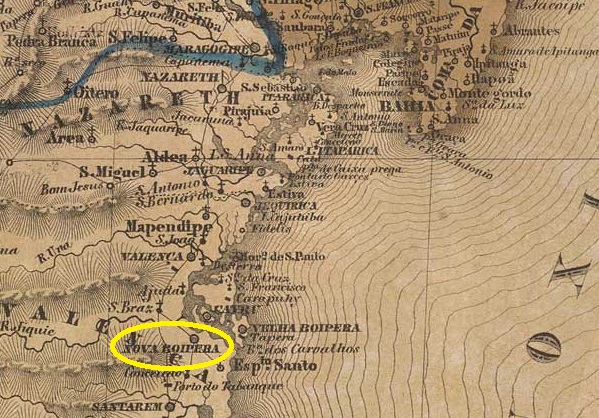
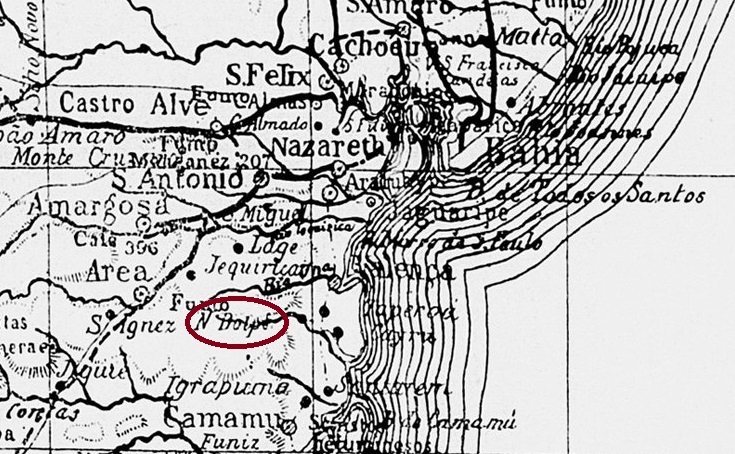
Villiers de l’Ile Adam: Carta (…) da Provincia da Bahia, 1848
Other names: Jequié, Nilo Peçanha (1930)
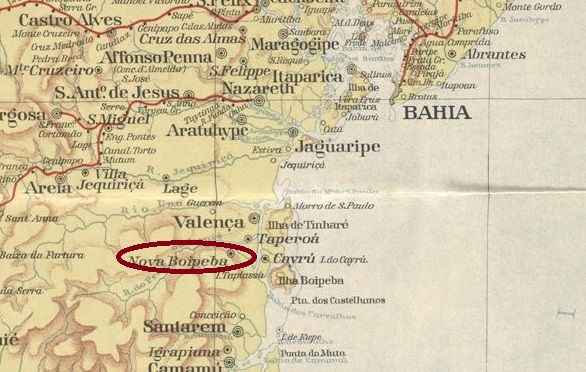
The settlement was originally called Povoação de Jequié, belonged to Vila de Boipeba and was located on the south bank of the Rio das Almas, 150 kilometres south of the colonial capital Salvador da Bahia. In December 1810, it was elevated to Vila de Nova Boipeba, as the old Vila de Boipeba had to be abandoned due to Indian attacks. In June 1838, it was named Freguesia de Senhor do Bomfim de Nova Boipeba, but in May 1847, it was downgraded to Freguesia da Vila de Taperoá. In April 1873, it regained its villa status. Since December 1930, the town has been called Município de Nilo Peçanha in honour of the former Brazilian president.
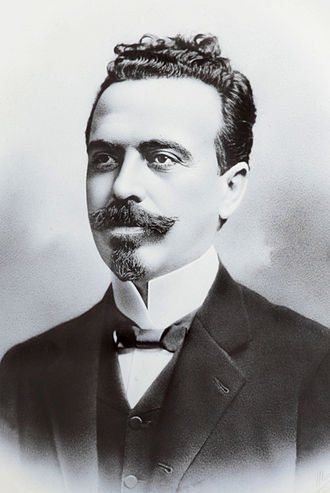
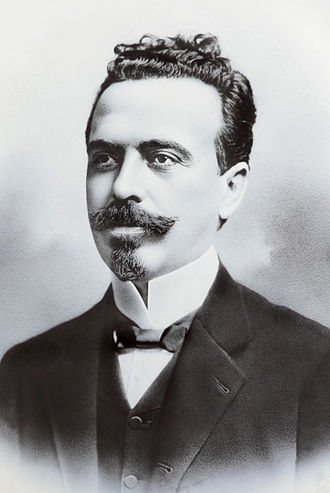
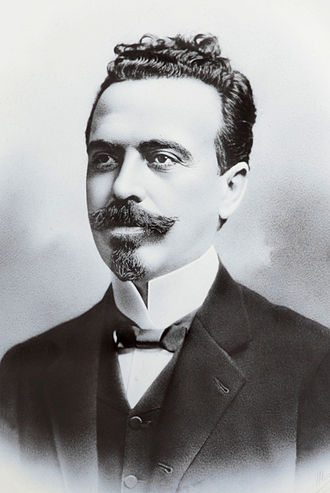
Nilo Peçanha (1867-1924, image from Wikipedia)
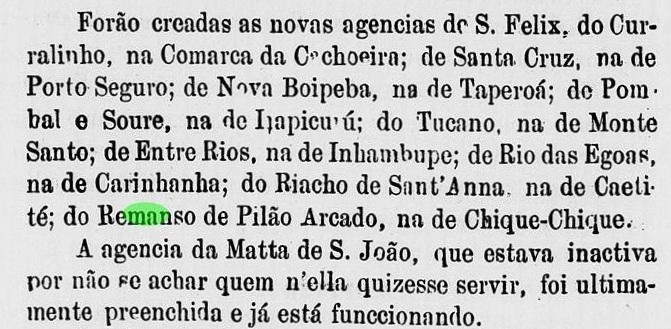
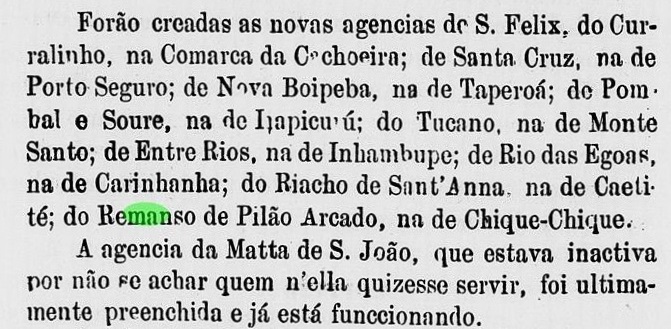
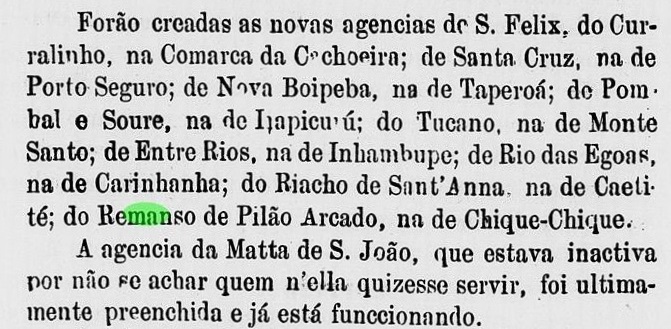
Two dates have been found for the creation of the local post office. R. Koester writes October 1876 in Carimbologia XXVIII, but 1874 is probably more correct. This is what can be read in the directory of imperial post offices (Tabella das Agencias do Correio do Imperio, Rio de Janeiro, 1885). A post office in Nova Almeida was officially mentioned as early as May 1876.
Relatorio do Conselho Interino do Governo da Bahia, May 1876
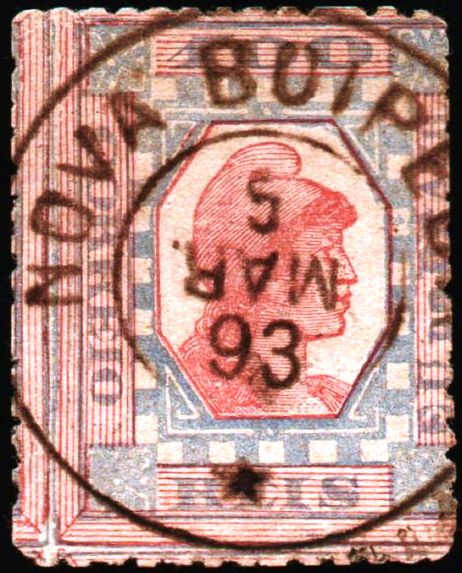
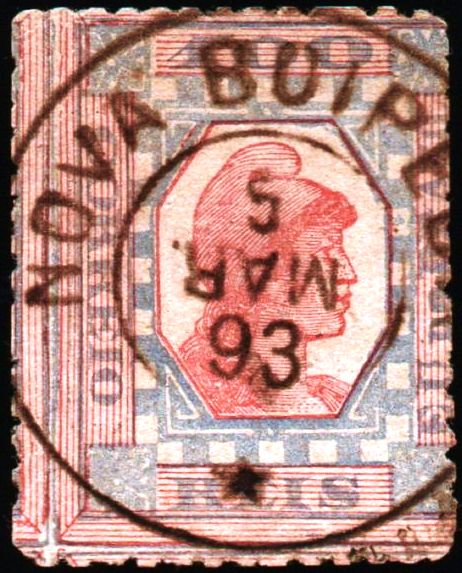
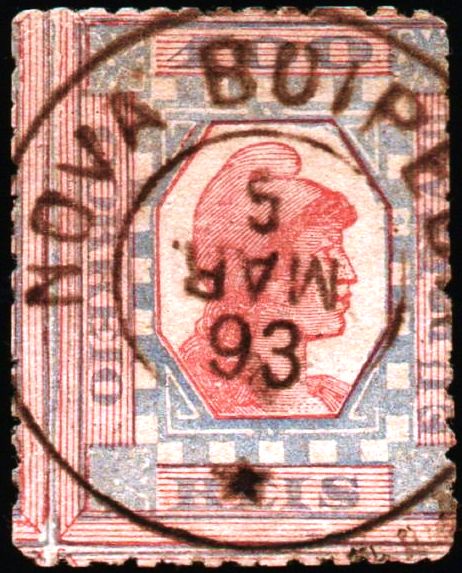
The oldest postmark to date is NBA-0510a (Fig. Claudio Coelho):
NBA-0510a (CC) 1893Estado da Bahia, 1913
Outros nomes: Jequié, Nilo Peçanha (1930)
A localidade se chamava originalmente Povoação de Jequié, pertencia à Vila de Boipeba e ficava na margem sul do Rio das Almas, 150 quilômetros ao sul da capital colonial Salvador da Bahia. Em dezembro de 1810, foi elevada à categoria de Vila de Nova Boipeba, pois a antiga Vila de Boipeba teve que fugir dos ataques indígenas. Em junho de 1838, foi nomeada Freguesia de Senhor do Bomfim de Nova Boipeba, mas já em maio de 1847 foi rebaixada a Freguesia da Vila de Taperoá. Em abril de 1873, ela recuperou o status de vila. Desde dezembro de 1930, o local leva o nome de Município de Nilo Peçanha, em homenagem ao ex-presidente brasileiro.
Nilo Peçanha (1867-1924, imagem: Wikipedia)
Foram encontradas duas datas para a criação da agência postal local. R. Koester escreve em Carimbologia XXVIII outubro de 1876, mas o ano de 1874 é provavelmente mais correto. É o que se lê na Tabella das Agencias do Correio do Imperio (Rio de Janeiro, 1885). Já em maio de 1876, uma agência dos correios em Nova Almeida fora mencionada oficialmente.
Relatório do Conselho Interino do Governo da Bahia, maio de 1876
O carimbo postal mais antigo até agora é o NBA-0510a (fig. Claudio Coelho):
NBA-0510a (CC) 1893Laemmert: Estado da Bahia, 1913
Andere Namen: Jequié, Nilo Peçanha (1930)
Die Siedlung hieß ursprünglich Povoação de Jequié, gehörte zur Vila de Boipeba und lag am Südufer des Rio das Almas, 150 Kilometer südlich der Kolonialhauptstadt Salvador da Bahia. Im Dezember 1810 wurde sie zur Vila de Nova Boipeba erhoben, da die alte Vila de Boipeba den Indianerangriffen ausweichen musste. Im Juni 1838 erfolgte die Ernennung zur Freguesia de Senhor do Bomfim de Nova Boipeba, doch schon im Mai 1847 wurde sie zur Freguesia da Vila de Taperoá degradiert. Im April 1873 erlangte sie erneut den Villa-Status. Seit Dezember 1930 trägt der Ort den Namen Município de Nilo Peçanha zu Ehren des ehemaligen brasilianischen Präsidenten.
Nilo Peçanha (1867-1924, Abb. aus Wikipedia)
Für die Entstehung des örtlichen Postamtes wurden zwei Daten gefunden. R. Koester schreibt in Carimbologia XXVIII den Oktober 1876, doch das Jahr 1874 ist vermutlich korrekter. So ist im Verzeichnis der kaiserlichen Postämter (Tabella das Agencias do Correio do Imperio, Rio de Janeiro, 1885) zu lesen. Bereits im Mai 1876 wurde ein Postamt in Nova Almeida amtlich erwähnt.
Relatorio do Conselho Interino do Governo da Bahia, Mai 1876
Der bisher älteste Poststempel ist NBA-0510a (Abb. Claudio Coelho):
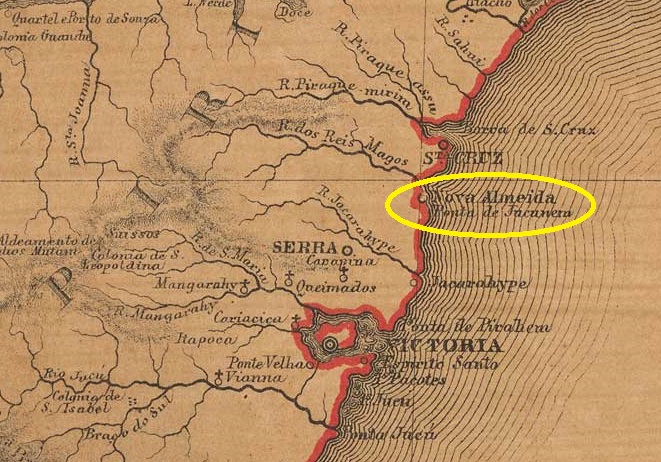
Villiers de l’Ile Adam: Carta (…) da Provincia do Espirito Santo, 1850
Other names: Aldeia dos Reis Magos
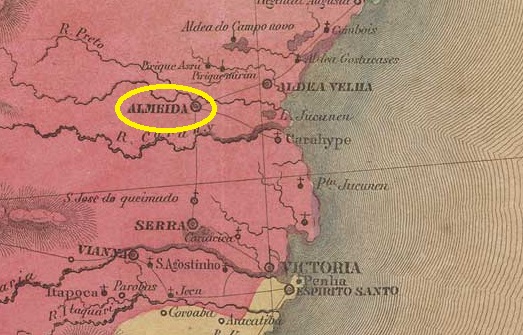
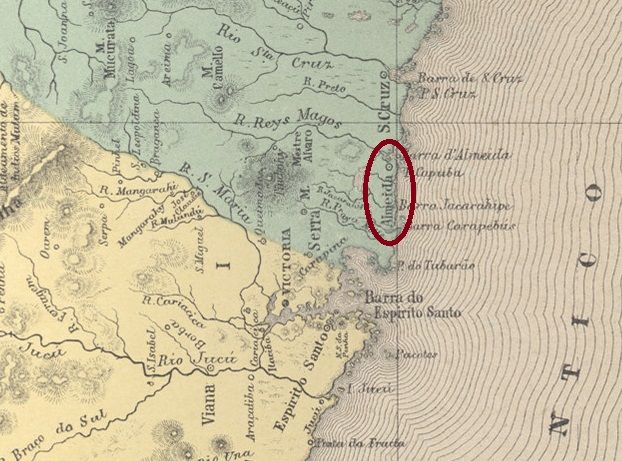
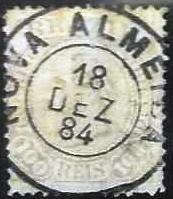
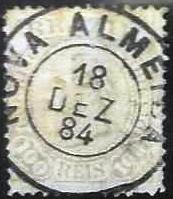
Around 1556, this place was known as Aldeia dos Reis Magos and was located on the west bank of the Fundão River, close to the sea, 40 kilometres north of what would later become the provincial capital of Vitória. In November 1757, it was elevated to the status of Freguesia de Santos Reis Magos de Nova Almeida and in January 1759 to that of Vila. The 20th century saw economic decline, and in October 1915, Nova Almeida was downgraded to a district of the municipality of Timbuí. In July 1923, the town changed status to become part of the municipality of Fundão. Since November 1938, Nova Almeida has been a district of the municipality of Serra.
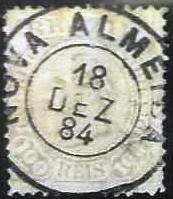
According to Nova Monteiro in Administrações e Agencias Postaes do Brasil Imperio (Brasil Filatelico/RJ, 1934–1935; reprinted by SPP 1994–1999), there has been a post office there since October 1831. The only imperial postmark from Nova Almeida to date is NES-0115b (fig. agenciaspostais.com.br):
NES-0115b (PN) 1884Atlas do Imperio do Brasil, 1868
Outros nomes: Aldeia dos Reis Magos
Esta localidade era conhecida por volta de 1556 como Aldeia dos Reis Magos e ficava na margem oeste do rio Fundão, perto do mar, 40 quilômetros ao norte da futura capital provincial, Vitória. Em novembro de 1757, foi elevada à categoria de Freguesia de Santos Reis Magos de Nova Almeida e, em janeiro de 1759, à de Vila. No século XX, seguiu-se uma decadência econômica e Nova Almeida foi rebaixada a distrito do município de Timbuí em outubro de 1915. Com esse status, a localidade passou a fazer parte do município de Fundão em julho de 1923. Desde novembro de 1938, Nova Almeida é um distrito do município de Serra.
Como escreve Nova Monteiro em Administrações e Agencias Postais do Brasil Império (Brasil Filatélico/RJ, 1934–1935; reimpressão SPP 1994–1999), havia uma agência dos correios no local desde outubro de 1831. O único carimbo postal imperial de Nova Almeida até o momento é o NES-0115b (fig. agenciaspostais.com.br):
NES-0115b (PN) 1884Provincia do Espirito Santo, 1873
Andere Namen: Aldeia dos Reis Magos
Diese Ortschaft war um 1556 als Aldeia dos Reis Magos bekannt und lag am Westufer des Fundão, nah am Meer, 40 Kilometer nördlich der späteren Provinzhauptstadt Vitória. Im November 1757 wurde sie zur Freguesia de Santos Reis Magos de Nova Almeida erhoben und im Januar 1759 zur Vila. Im 20. Jahrhundert folgte eine wirtschaftliche Dekadenz und Nova Almeida wurde im Oktober 1915 zum Distrikt des Munizips Timbuí degradiert. In diesem Status wechselte der Ort im Juli 1923 zum Município de Fundão. Seit November 1938 ist Nova Almeida ein Distrikt des Município de Serra.
Wie Nova Monteiro in Administrações e Agencias Postaes do Brasil Imperio (Brasil Filatelico/RJ, 1934–1935; Nachdruck SPP 1994–1999) schreibt, gab es dort seit Oktober 1831 ein Postamt. Der bisher einzige kaiserliche Poststempel aus Nova Almeida ist NES-0115b (Abb. agenciaspostais.com.br):
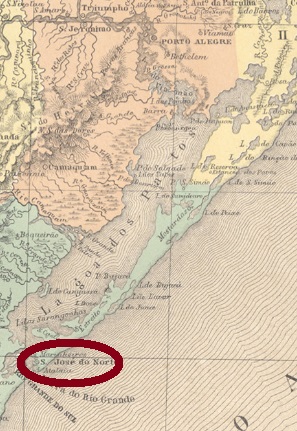
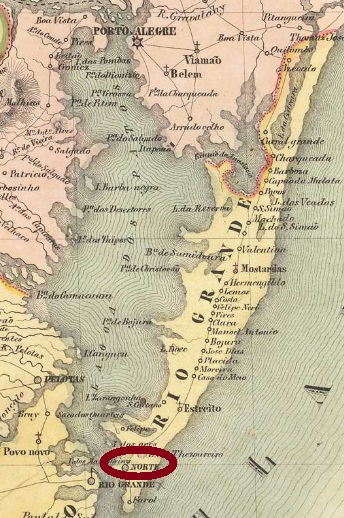
From April 1820, this village was a freguesia of Rio Grande, which was elevated to a villa in October 1831 and located about 330 km south of the provincial capital Porto Alegre. The name do Norte (“from the north”) refers either to the location north of the mouth of the Lagoa dos Patos, or perhaps in contrast to another place of the same name, which was further south.
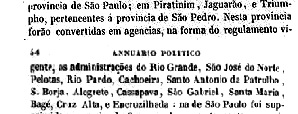
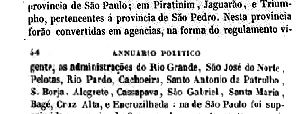
Here, too, two dates of origin for the local post office were found: once before, once after the Farroupilha Revolution (1835-1845). It follows that the postal service was temporarily paralyzed during the uprising. According to Nova Monteiro, the post office was first created in October 1831. The Imperial Mail Register (Tabella das Agencias do Correio do Imperio) from 1885 lists the agency from 1847, but this is probably the installing year, since the official creation to open was announced a year earlier:
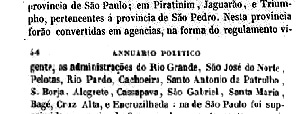
Annuario Politico, Historico e Estatistico do Brazil, 1846
The oldest cancel is NRS-0335a, which was thought to be from Porto Alegre, for post towards north (Norte). Reinhold Koester nevertheless wrote in Porto Alegre and its cancels until the end of the imperial period (in Brazil, 140 years of postage stamps, ArGe Brazil, 1983) that it was also used on mail from north to Porto Alegre, and thus would be a transit cancel of São José do Norte. The cancel was used until about 1835 and is presented in the RHM catalogue under P-RS-06:
NRS-0335a (RHM P-RS-06) 1825-1835
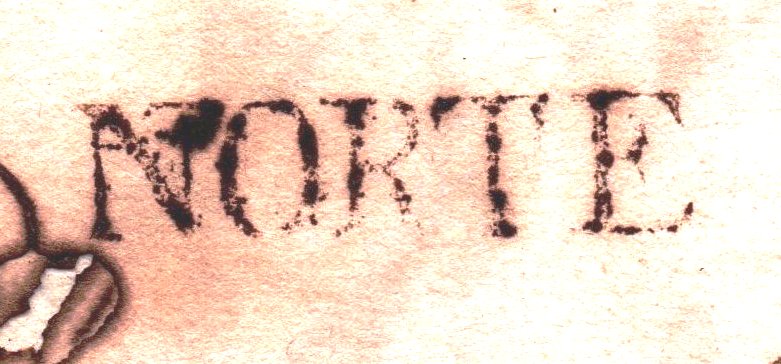
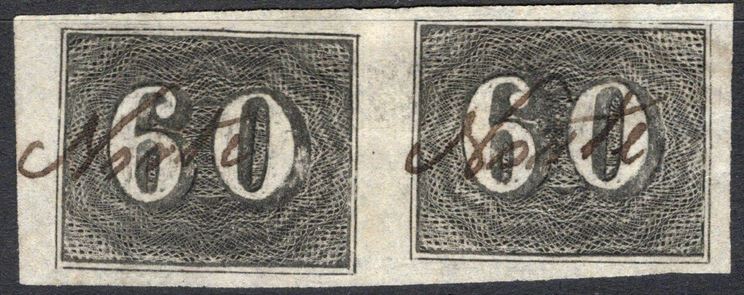
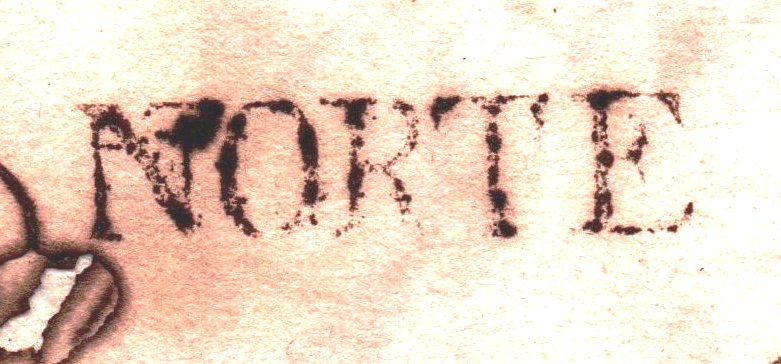
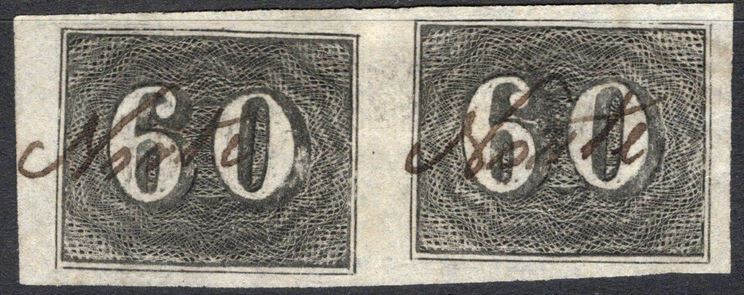
From around 1850 onwards, handwritten cancellations with Norte are also known (here an image from the internet), which presumably originate from this town.
1850ff (EB)Atlas do Imperio do Brasil, 1868
For postmarks with São José do Norte see SRS-0335.
A partir de abril de 1820, esta localidade era uma freguesia de Rio Grande, que foi elevada a vila em outubro de 1831 e estava localizada a cerca de 330 km ao sul da capital da província, Porto Alegre. O nome do Norte refere-se à localização ao norte da barra da Lagoa dos Patos, ou talvez para diferenciar de algum outro lugar de mesmo nome, que ficava mais ao sul.
Aqui, também, foram encontradas duas datas de origem para os correios locais: uma vez antes, uma vez após a Revolução Farroupilha (1835-1845). Conclui-se que o serviço postal foi temporariamente paralisado durante a revolta. Segundo Nova Monteiro, a agência postal local foi criada pela primeira vez em outubro de 1831. A Tabella das Agências do Correio do Imperio de 1885 lista a agência a partir de 1847, mas este é provavelmente o ano de instalação da mesma, uma vez que a reabertura foi notificada um ano antes:
Annuario Politico, Historico e Estatistico do Brasil, 1846
O carimbo mais antigo é NRS-0335a, que se pensava ser de Porto Alegre e aplicado em objetos postais a serem enviados ao norte. Reinhold Koester, no entanto, escreveu em Porto Alegre e seus carimbos até o final do período imperial (in Brasil, 140 anos de selos postais, ArGe Brasilien, 1983) que ele também foi usado no correio originário do norte para Porto Alegre, e assim seria anes um carimbo de trânsito de São José do Norte. O carimbo foi usado até cerca de 1835 e é apresentado no catálogo RHM sob P-RS-06:
NRS-0335a (RHM P-RS-06) 1825-1835
A partir de aproximadamente 1850, também são conhecidas obliterações manuscritas com Norte (aqui, imagem da Internet), que provavelmente provêm desta vila.
1850ff (EB)
Para carimbos com São José do Norte veja SRS-0335.
Villiers de l’Ile Adam: Carta (…) da Provincia de São Pedro do Sul, 1847
Diese Ortschaft war ab April 1820 eine Freguesia von Rio Grande, die bereits im Oktober 1831 zur Villa erhoben wurde, und ca. 330 km südlich der Provinzhauptstadt Porto Alegre lag. Der Name do Norte („aus dem Norden“) bezieht sich entweder aus der Lage nördlich der Mündung der Lagoa dos Patos, oder vielleicht auch in Unterschied zu einem anderen Ort gleichen Namens, der weiter südlich lag.
Auch hier wurden zwei Entstehungsdaten fürs örtliche Postamt gefunden: einmal vor, einmal nach der Farroupilha-Revolution (1835-1845). Daraus folgt, dass der Postbetrieb zeitweise während des Aufstands lahm gelegt wurde. Laut Nova Monteiro entstand das Postamt erstmals im Oktober 1831. Das Verzeichnis der kaiserlichen Postämter (Tabella das Agencias do Correio do Imperio) aus 1885 listet die Agentur ab 1847, das dürfte aber der Zeitpunkt der Inbetriebnahme sein, da die offizielle Anweisung zur Eröffnung ein Jahr zuvor bekannt wurde:
Annuario Politico, Historico e Estatistico do Brazil, 1846
Der älteste Stempel ist NRS-0335a, woüber man dachte, er wäre aus Porto Alegre und für Post nach Norden (Norte) bestimmt. Reinhold Koester schrieb dennoch in Porto Alegre und seine Stempel bis zum Ende der Kaiserzeit (in Brasilien, 140 Jahre Briefmarken, ArGe Brasilien, 1983), dass er auch auf Post aus Norden nach Porto Alegre verwendet wurde, und dadurch ein Transitstempel von São José do Norte wäre. Der Stempel wurde bis ca. 1835 gebraucht und wird im RHM-Katalog unter P-RS-06 vorgestellt:
NRS-0335a (RHM P-RS-06) 1825-1835
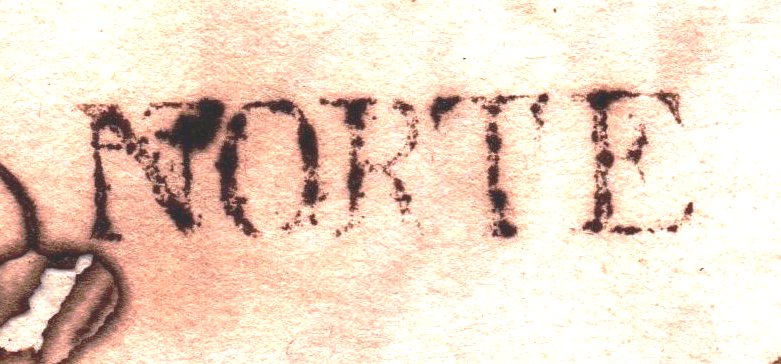
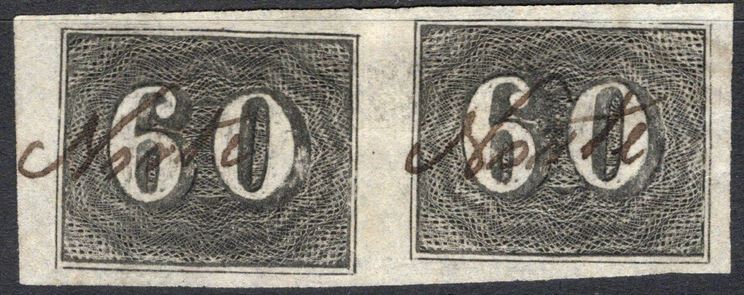
Ab ca. 1850 sind auch handschriftliche Entwertungen mit Norte bekannt (hier Abb. aus dem Internet), die vermutlich aus dieser Vila stammen.
1850ff (EB)
Für Poststempel mit São José do Norte siehe SRS-0335.
Villiers de l’Ile Adam: Carta (…) das Provincias de Pernambuco, Alagoas e Sergipe, 1848
Other names: Alagoa do Norte, Villa do Norte
See also Santa Luzia do Norte (SAL-0240)
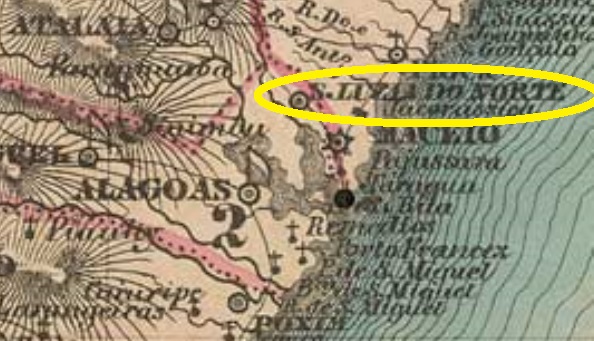
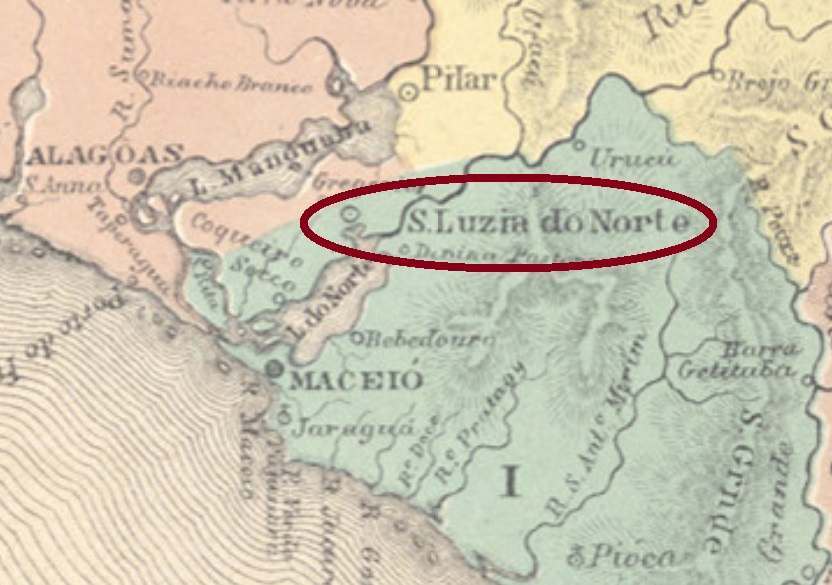
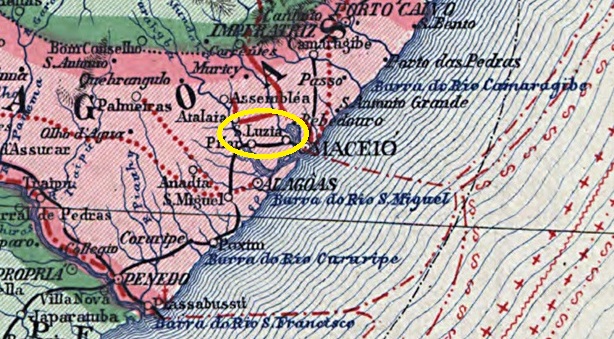
Santa Luzia do Norte was originally a district of the former province capital Alagoas (today: Marechal Deodoro), situated ca. 40 km north, near the Mundaú Lagoon. In December 1830 it was elevated to a Villa in own municipality, which became a town in July 1915. In March 1938 it lost the town status, to remain as a district of Rio Largo, ascending again as a município in August 1962.
According to Nova Monteiro (Administrações e Agencias Postaes do Brasil Imperio, in Brasil Filatelico/RJ, 1934-5; Reprint SPP 1994-1999), the local post office was created in September 1855, but the Imperial Mail Register (Tabella das Agencias do Correio do Imperio) of 1885 list this agency from 1860 on. Aldo Cardoso (Contribuição para a História dos Correios de Alagoas, Maceió, 1969), on the other hand, writes that as early as 1834 the local collector served as a post officer, even though no agency had been established.
No imperial postmark with Norte has been sighted to date. For postmarks with Santa Luzia do Norte, see SAL-0240.
Atlas do Imperio do Brasil, 1868
Outros nomes: Alagoa do Norte, Villa do Norte
Veja também Santa Luzia do Norte (SAL-0240)
Santa Luzia do Norte era originalmente um distrito do município de Alagoas (hoje Marechal Deodoro), situado a cerca de 40 km ao norte dessa antiga capital provincial, próximo à Lagoa do Mundaú. Em dezembro de 1830 foi elevado a vila em município próprio, tornando-se uma cidade em julho de 1915. Em março de 1938 foi rebaixado a distrito de Rio Largo, mas recuperou o status de município em agosto de 1962.
Segundo Nova Monteiro (Administrações e Agencias Postaes do Brasil Imperio, in Brasil Filatelico/RJ, 1934-5; Reprint SPP 1994-1999), a agência postal local foi criada em setembro de 1855, mas a Tabella das Agencias do Correio do Imperio de 1885 lista esta agência a partir de 1860. Aldo Cardoso (Contribuição para a História dos Correios de Alagoas, Maceió, 1969), por outro lado, escreve que já em 1834 o encarregado da coletoria local trabalhava como agente postal, mesmo ser haver agência estabelecida.
Até o momento, não foi encontrado nenhum carimbo postal imperial com Norte. Para carimbos com Santa Luzia do Norte, consulte SAL-0240.
Carta da Republica dos Estados Unidos do Brazil, 1892
Andere Namen: Alagoa do Norte, Villa do Norte
Siehe auch Santa Luzia do Norte (SAL-0240)
Santa Luzia do Norte war ursprünglich ein Distrikt der ehemaligen Provinzhauptstadt Alagoas (heute: Marechal Deodoro) und lag 40 km weiter nördlich, nah am Mundaúsee. Im Dezember 1830 wurde daraus eine Villa im eigenen Município, die im Juli 1915 den Stadtstatus erhielt. Dieser ging allerdings im März 1938 verloren, Santa Luzia do Norte wurde ein Distrikt von Rio Largo und erlangte erst im August 1962 den höheren Status wieder.
Laut Nova Monteiro (Administrações e Agencias Postaes do Brasil Imperio, in Brasil Filatelico/RJ, 1934-5; Reprint SPP 1994-1999) eröffnete das örtliche Postamt im September 1855, obwohl das Verzeichnis der kaiserlichen Postämter (Tabella das Agencias do Correio do Imperio) von 1885 das Jahr 1860 dafür angibt. Auf der anderen Seite schreibt Aldo Cardoso Cardoso (Contribuição para a História dos Correios de Alagoas, Maceió, 1969), dass bereits 1834 der Steuereinnehmer des Orts als Postbeamter fungierte, obwohl damals keine Postagentur vorhanden war.
Bisher wurde kein kaiserlicher Poststempel mit Norte gesichtet. Für Stempel mit Santa Luzia do Norte siehe SAL-0240.