Categories
Carimbologia E-G

Granito, Pernambuco (GPE-0295)

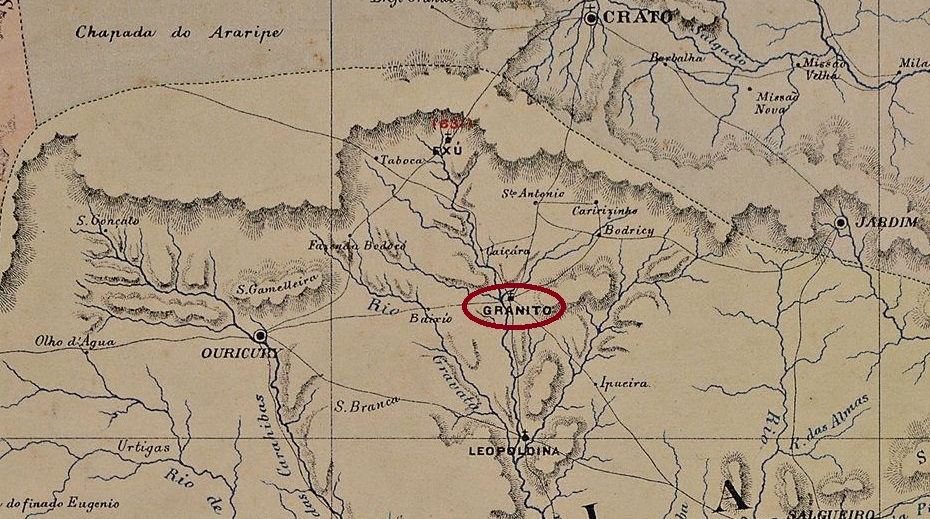
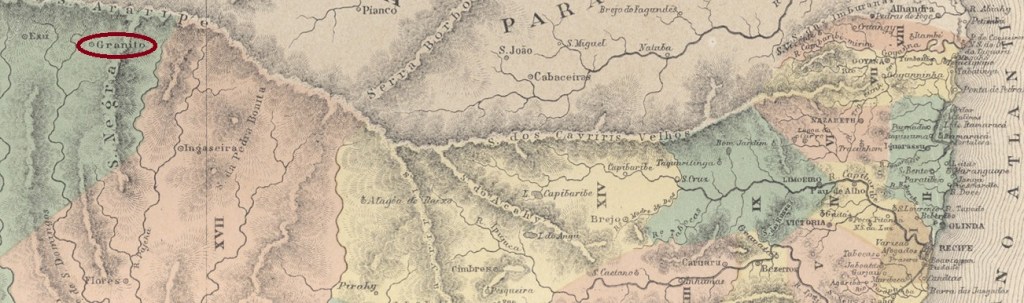
Carta Corographica da Provincia de Pernambuco, 1880

The chapel N. Sra. do Bom Conselho de Granito, built in 1859, belonged to the Vila de Exú and was located on the west bank of the Riacho da Brígida, 590 kilometres west of the provincial capital Recife. In April 1863 Granito became a Vila and in July 1909 a town. In March 1938, Granito was downgraded to a district of the Município de Bodocó, but regained the status of a Município in December 1963.

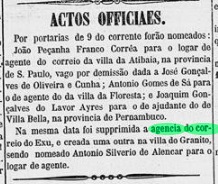
As Nova Monteiro writes in Administrações e Agencias Postaes do Brasil Imperio (Brasil Filatelico/RJ, 1934-5; reprint SPP 1994-1999), there had been a post office there since June 1865, a statement confirmed by the press in Rio with the comment that it was the transfer of the post office from Exu to Granito at that time:
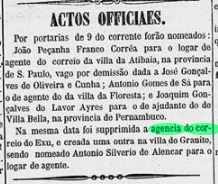
Correio Mercantil/RJ, 11/06/1865

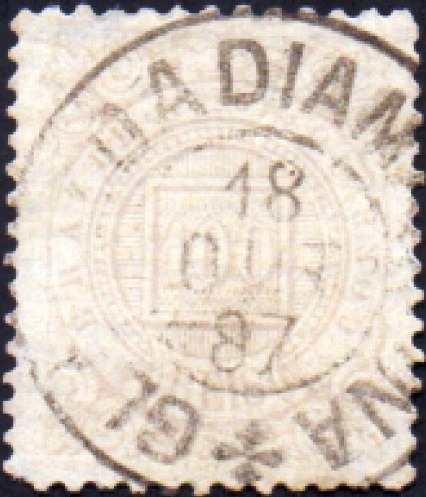
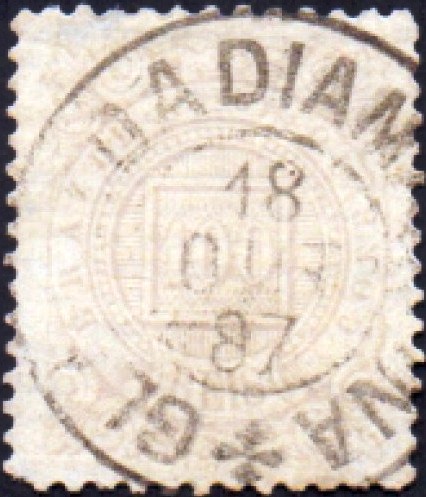
The oldest postmark to date is probably not the first: GPE-0295b (fig. Roberto Assef Jr.) was first found on D. Pedro of 1883:
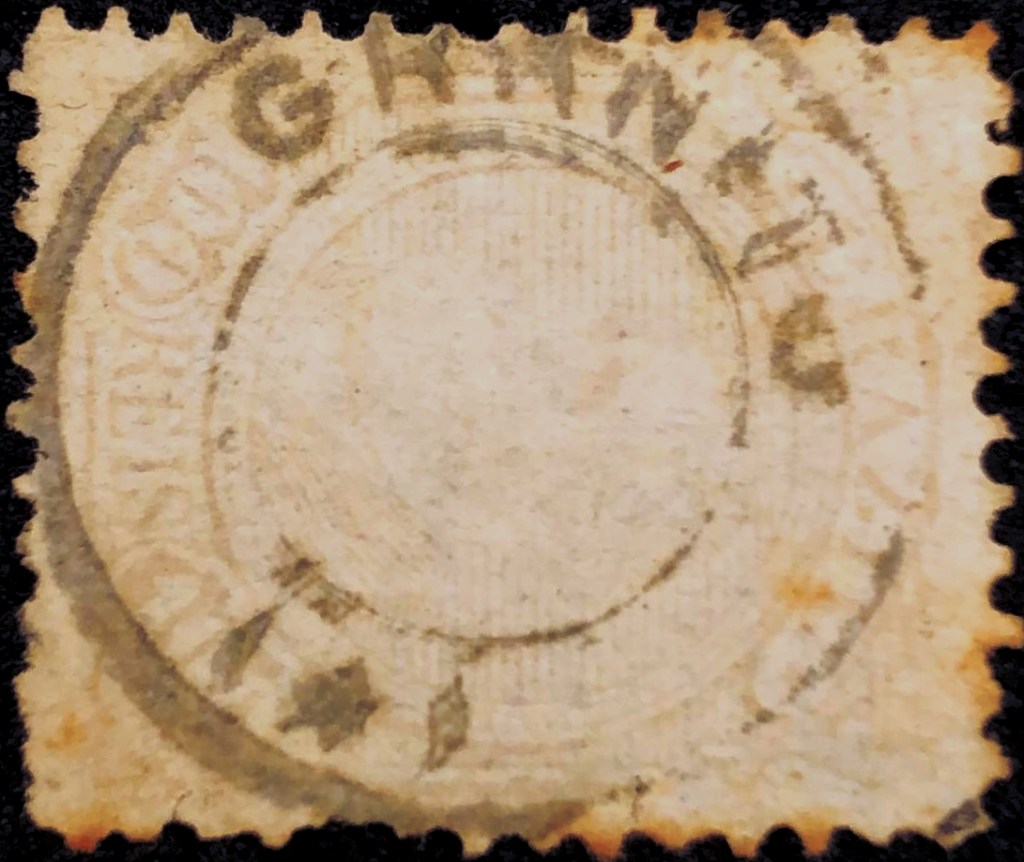
GPE-0295b (RA) 1883ff-1897ff
Atlas do Imperio do Brasil, 1868

Die 1859 erbaute Kapelle N. Sra. do Bom Conselho de Granito gehörte zur Vila de Exú und lag am Westufer des Riacho da Brígida, 590 km westlich der Provinzhauptstadt Recife. Im April 1863 wurde Granito zur Vila und im Juli 1909 zur Stadt erhoben. Im März 1938 wurde Granito zum Distrikt des Município de Bodocó herabgestuft, erhielt aber im Dezember 1963 wieder den Status eines Município.

Wie Nova Monteiro in Administrações e Agencias Postaes do Brasil Imperio (Brasil Filatelico/RJ, 1934-5; Reprint SPP 1994-1999) schreibt, gab es dort seit Juni 1865 ein Postamt, eine Angabe, die von der Presse in Rio mit dem Hinweis bestätigt wird, dass es sich damals um die Verlegung des Postamtes von Exu nach Granito handelte:
Correio Mercantil/RJ, 11.06.1865

Der bisher älteste Stempel ist wahrscheinlich nicht der erste: GPE-0295b (Abb. Roberto Assef Jr.) wurde erst auf D. Pedro von 1883 gefunden:
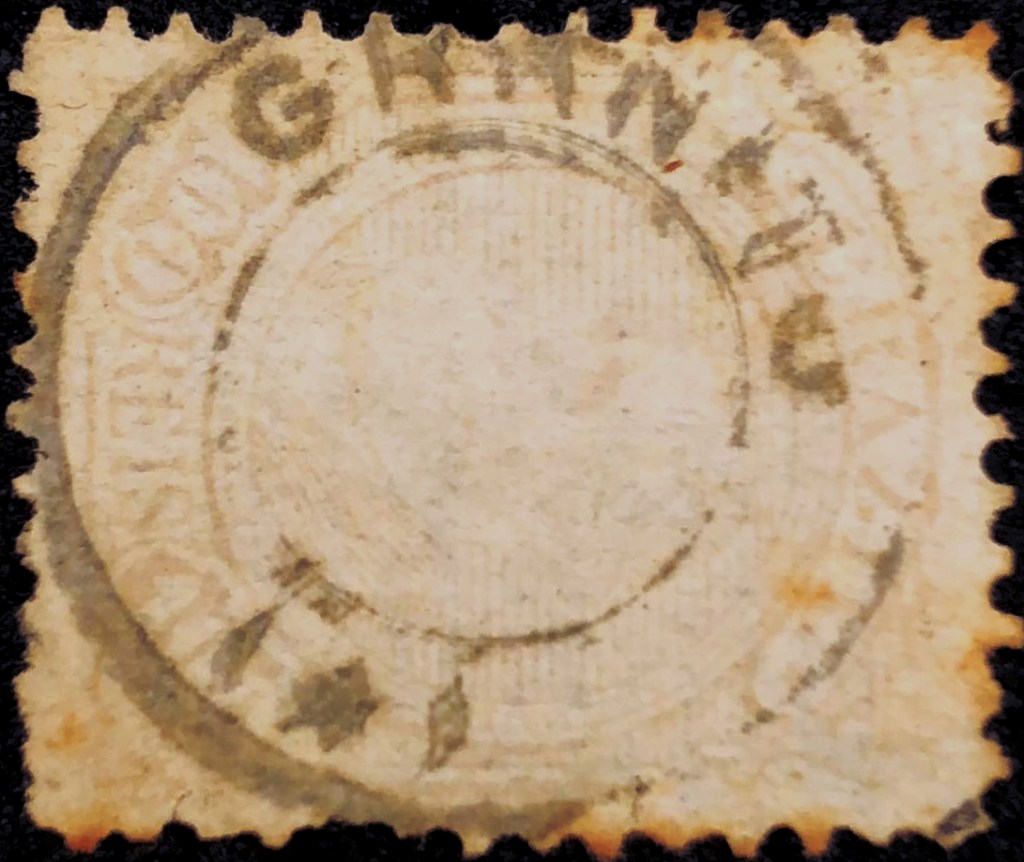
GPE-0295b (RA) 1883ff-1897ff
Categories
Carimbologia E-G

Gramma, Minas Gerais (GMG-1260)

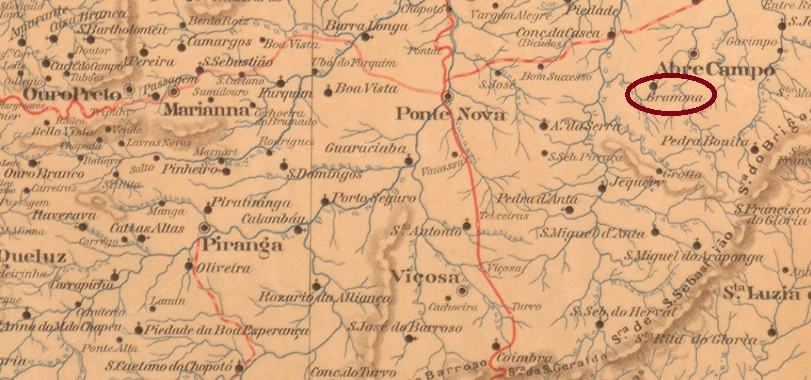
Estado de Minas Geraes, 1910

Other names: Santo Antonio do Grama

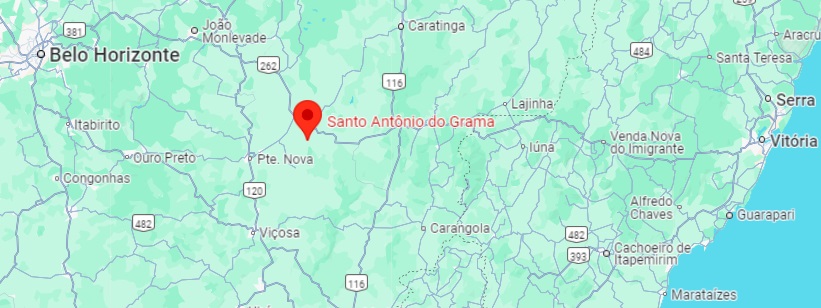
Santo Antonio do Gramma had been a distrito of the Vila de Ponte Nova, 130 kilometres east of the provincial capital Ouro Preto, since July 1868. In July 1889, the village was incorporated into the Vila de Abre Campo as a freguesia and in September 1923 it became a distrito of the Município de Rio Casca. Since December 1953, Santo Antonio do Grama (as it is written today) has been an independent município.

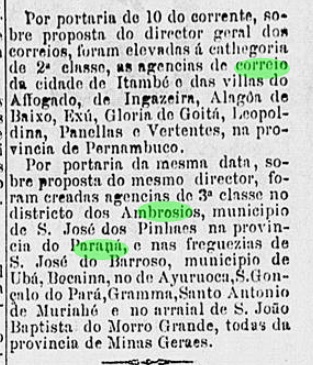
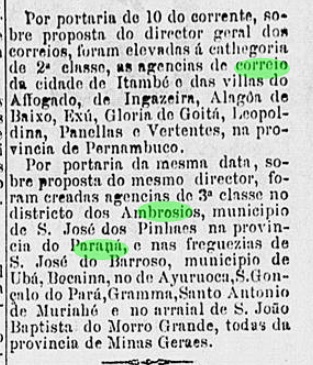
R. Koester (Carimbologia XX) and Paula Sobrinho (História Postal de Minas Gerais, Belo Horizonte, 1997) unanimously report that there had been a post office there since October 1881. This is confirmed by the press in Rio:

Gazeta da Tarde/RJ, 11/10/1881

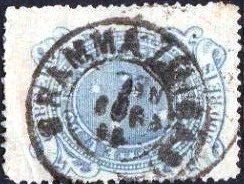
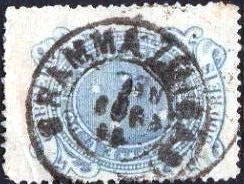
The oldest postmark to date is GMG-1260a (image from the Internet):

GMG-1260a (EB) 1885-1890ff

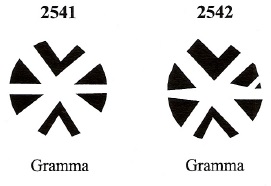
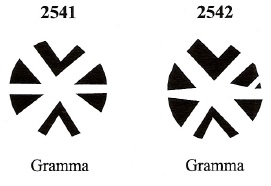
Two similar looking mute cancellations from Gramma were registered by James Dingler and Klerman W. Lopes in Mute Cancellations of the Brazil Empire/Carimbos Mudos do Brasil Império (Brazil Philatelic Association, Rio de Janeiro, 2000):

BPA 2541 (1881ff) – 2542
Google Maps

Andere Namen: Santo Antonio do Grama

Santo Antonio do Gramma war seit Juli 1868 ein Distrito der Vila de Ponte Nova, 130 km östlich der Provinzhauptstadt Ouro Preto gelegen. Im Juli 1889 wurde der Ort als Freguesia in die Vila de Abre Campo eingegliedert und im September 1923 ein Distrito des Município de Rio Casca. Seit Dezember 1953 ist Santo Antonio do Grama (wie es heute geschrieben wird) ein eigenständiges Município.

R. Koester (Carimbologia XX) und Paula Sobrinho (História Postal de Minas Gerais, Belo Horizonte, 1997) berichten übereinstimmend, dass es dort seit Oktober 1881 ein Postamt gab. Dies wird von der Presse in Rio bestätigt:

Gazeta da Tarde/RJ, 11.10.1881

Der bisher älteste Poststempel ist GMG-1260a (Abbildung aus dem Internet):

GMG-1260a (EB) 1885-1890ff

Zwei ähnlich aussehende stumme Stempel aus Gramma wurden von James Dingler und Klerman W. Lopes in Mute Cancellations of the Brazil Empire /Carimbos Mudos do Brasil Império (Brazil Philatelic Association, Rio de Janeiro, 2000) registriert:

BPA 2541 (1881ff) – 2542
Categories
Carimbologia E-G

Goyo-En, Rio Grande do Sul (GRS-0175)

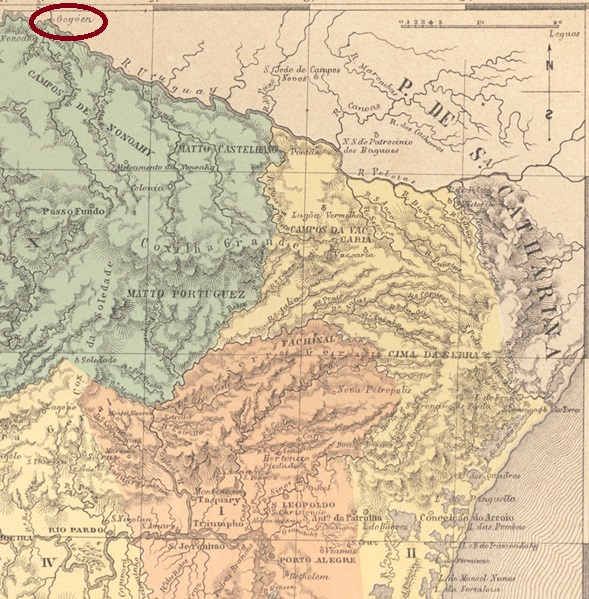
Estado do Rio Grande do Sul, 1891

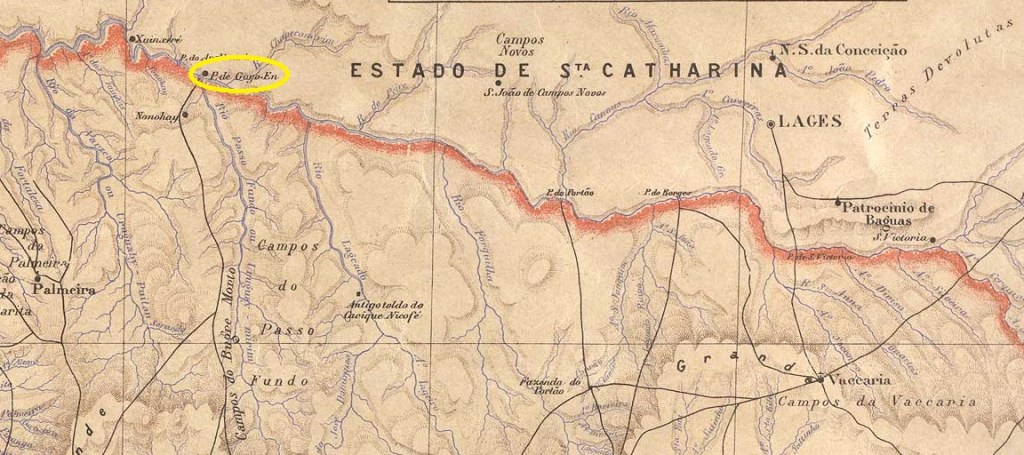
Goyo-En is a word from the Guarani language and means large body of water. Since January 1857, it has also been a settlement of the Vila de Passo Fundo on the south bank of the Uruguay, 440 kilometres northwest of the provincial capital Porto Alegre. Strangely enough, old maps show Goyo-En on the north bank of the river – and thus in the province of Santa Catarina. And in fact, Gôyo-En has also been a district of the Município Chapecó in this state since around 1960. This means that there are settlements of the same name on both banks of the Uruguay.

Goyo-En in Rio Grande do Sul was assigned to the then newly founded Município de Erechim in April 1918, but has been part of the Município de Erval Grande since February 1959, as a district since March 1967.

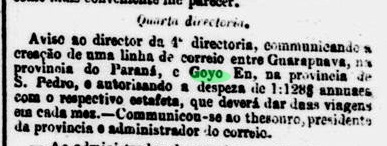
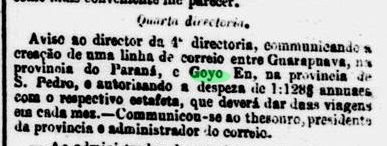
Two creation dates have been found for the local post office. Once in January 1858, according to Nova Monteiro in Administrações e Agencias Postaes do Brasil Imperio (Brasil Filatelico/RJ, 1934-5; reprint SPP 1994-1999). Then again around 1862, as can be seen from R. Koester’s Carimbologia XX. A postal line between Guarapuava in the province of Paraná and Goyo-En was established in April 1862, as reported by the press in Rio:

Jornal do Commercio/RJ, 23/05/1862, (Report of April 30)

As the agency is neither mentioned in the postal guide (Guia Postal do Império do Brazil, Rio de Janeiro, 1880) nor in the list of imperial post offices (Tabella das Agencias do Correio do Imperio, Rio de Janeiro, 1885), it can be assumed that it was only of short duration. No imperial postmarks from Goyo-En are known to date.

Atlas do Imperio do Brasil, 1868

Goyo-En ist ein Wort aus der Sprache der Guarani und bedeutet großes Gewässer. Seit Januar 1857 ist es auch eine Siedlung der Vila de Passo Fundo am Südufer des Uruguay, 440 km nordwestlich der Provinzhauptstadt Porto Alegre. Merkwürdigerweise zeigen alte Karten Goyo-En am Nordufer des Flusses – und damit in der Provinz Santa Catarina. Und tatsächlich ist Gôyo-En seit etwa 1960 auch ein Bezirk des Município Chapecó in diesem Bundesstaat. Somit gibt es an beiden Ufern des Uruguay gleichnamige Siedlungen.

Goyo-En in Rio Grande do Sul wurde im April 1918 dem damals neu gegründeten Município de Erechim zugeteilt, gehört aber seit Februar 1959 zum Município de Erval Grande, seit März 1967 als Distrikt.

Für das örtliche Postamt wurden zwei Gründungsdaten gefunden. Einmal im Januar 1858, so Nova Monteiro in Administrações e Agencias Postaes do Brasil Imperio (Brasil Filatelico/RJ, 1934-5; Nachdruck SPP 1994-1999). Dann wieder um 1862, wie aus R. Koesters Carimbologia XX hervorgeht. Eine Postlinie zwischen Guarapuava in der Provinz Paraná und Goyo-En wurde im April 1862 eingerichtet, wie die Presse in Rio berichtete:

Jornal do Commercio/RJ, 23.05.1862 (Protokoll v. 30.04.)

Da die Agentur weder im Postführer (Guia Postal do Império do Brazil, Rio de Janeiro, 1880) noch im Verzeichnis der kaiserlichen Postämter (Tabella das Agencias do Correio do Imperio, Rio de Janeiro, 1885) erwähnt wird, ist davon auszugehen, dass sie nur von kurzer Dauer war. Bisher sind keine kaiserlichen Poststempel aus Goyo-En bekannt.

Categories
Carimbologia E-G

Goyanna, Pernambuco (GPE-0290)

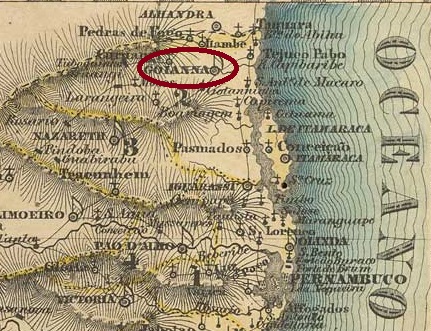
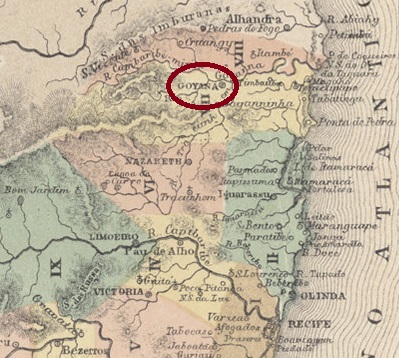
Villiers de l’Ile Adam: Carta (…) das Provincias de Pernambuco, Alagoas e Sergipe, 1848

The Freguesia de N. Sra. do Rosário de Goyanna on the north bank of the Tracunhaém, 70 kilometres north of the later provincial capital of Recife, already existed in 1568. The village was subsequently elevated to the status of a vila twice, in January 1685 and October 1742, and Goiana (as it is now spelt) became a town in May 1840.

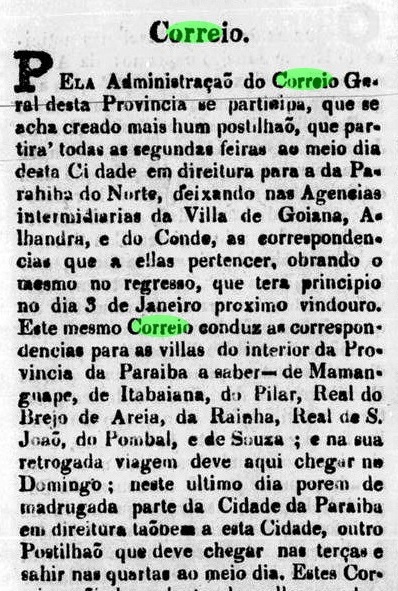
Two foundation dates for the local post office have been found. Firstly in March 1829, as Nova Monteiro writes in Administrações e Agencias Postaes do Brasil Imperio (Brasil Filatelico/RJ, 1934-5; reprint SPP 1994-1999). Then again in 1835, as noted in the Directory of Imperial Post Offices (Tabella das Agencias do Correio do Imperio, Rio de Janeiro, 1885). We do not know when the agency was closed in between, but it was active in December 1830, as can be seen from the regional press:

Diario de Pernambuco, 23/12/1830

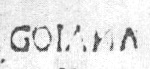
The oldest postmark to date is GPE-0290a, of which R. Koester (Carimbologia XX) writes that it dates from the pre-philatelic period:

GPE-0290a (RK) ca. 1840

Later the French type GPE-0290c followed (fig. Koester, op.cit.):

GPE-0290c (RK) 1878ff-1890ff

GPE-0290d (fig. Koester) also appeared towards the end of the Empire:

GPE-0290d (RK) 1887-1889
Atlas do Imperio do Brasil, 1868

Die Freguesia de N. Sra. do Rosário de Goyanna am Nordufer des Tracunhaém, 70 Kilometer nördlich der späteren Provinzhauptstadt Recife, bestand bereits 1568. Das Dorf wurde in der Folge zweimal, im Januar 1685 und im Oktober 1742, zur Vila erhoben, und Goiana (wie es heute geschrieben wird) wurde im Mai 1840 zur Stadt.

Es wurden zwei Gründungsdaten für das örtliche Postamt gefunden. Erstens im März 1829, wie Nova Monteiro in Administrações e Agencias Postaes do Brasil Imperio (Brasil Filatelico/RJ, 1934-5; Nachdruck SPP 1994-1999) schreibt. Dann wieder im Jahr 1835, wie im Verzeichnis der kaiserlichen Postämter (Tabella das Agencias do Correio do Imperio, Rio de Janeiro, 1885) vermerkt. Wir wissen nicht, wann die Agentur dazwischen geschlossen wurde, aber sie war im Dezember 1830 aktiv, wie aus der regionalen Presse hervorgeht:

Diario de Pernambuco, 23/12/1830

Der bisher älteste Stempel ist GPE-0290a, von dem R. Koester (Carimbologia XX) schreibt, dass er aus der präphilatelistischen Zeit stammt:

GPE-0290a (RK) ca. 1840

Später folgte der französische Typ GPE-0290c (Abb. Koester, op.cit.):

GPE-0290c (RK) 1878ff-1890ff

GPE-0290d (Abb. Koester) erschien ebenfalls gegen Ende des Kaiserreichs:

GPE-0290d (RK) 1887-1889
Categories
Carimbologia E-G

Goyaninha (GRN-0075) – Goyaninha (train station/Bahnhof), Rio Grande do Norte (GRN-0076)

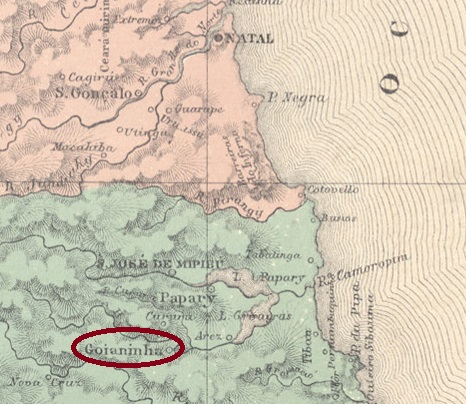
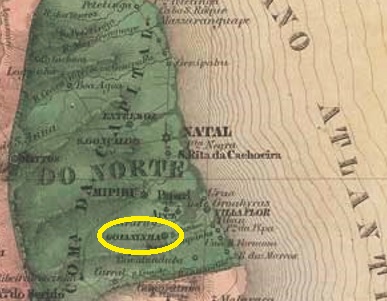
Atlas do Imperio do Brasil, 1868

Text update of December 26, 2024

The Freguesia de N. Sra dos Prazeres de Goyaninha was founded in August 1821 on the south bank of the Brandão, 60 kilometres south of the later provincial capital of Natal. In April 1833, it was promoted to a vila and in November 1928 to a town. The place name is said to have come from settlers from Goiana in Pernambuco.

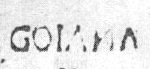
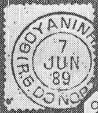
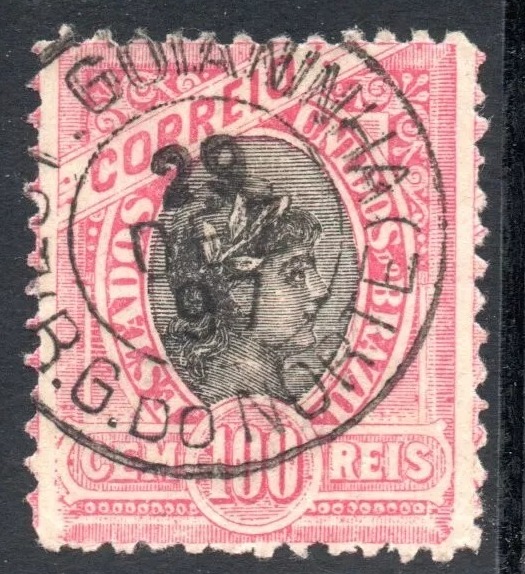
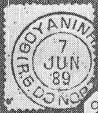
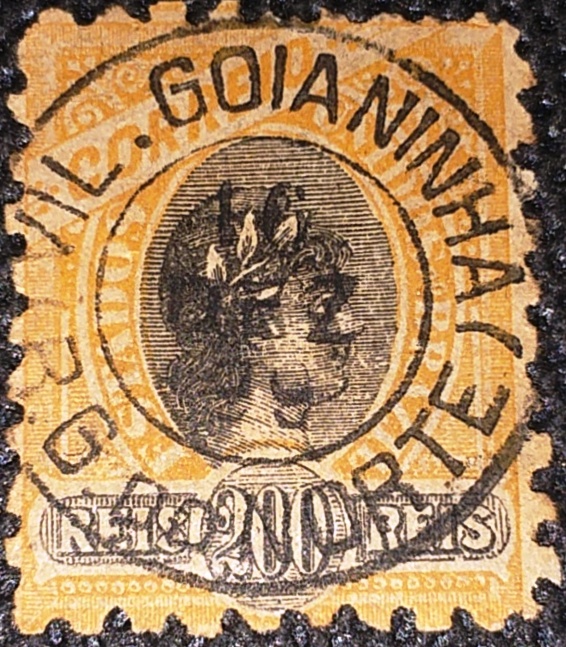
As Nova Monteiro writes in Administrações e Agencias Postaes do Brasil Imperio (Brasil Filatelico/RJ, 1934-5; reprint SPP 1994-1999), there was a local post office since April 1818. The oldest postmark from this town so far is GRN-0075b (fig. R. Koester, in Carimbologia XX):

GRN-0075b (RK) 1889-1890

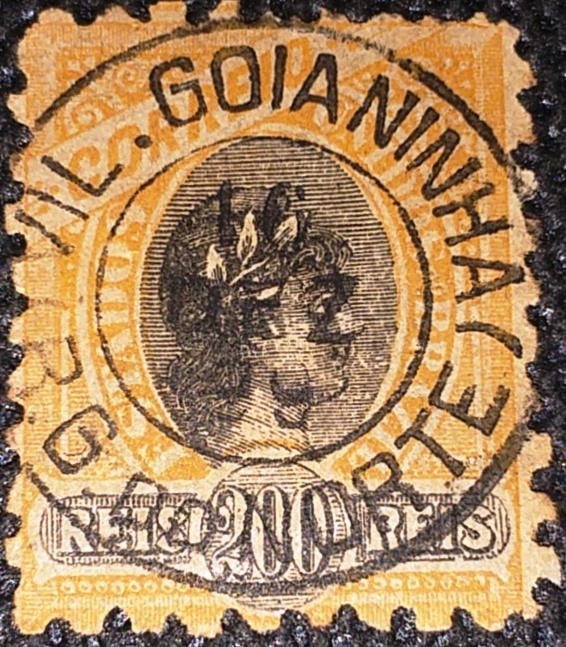
This was followed by GRN-0075c (fig. Luiz C. Fritzen), which bears the inscription VIL. for Villa:

GRN-0075c (LCF) 1899

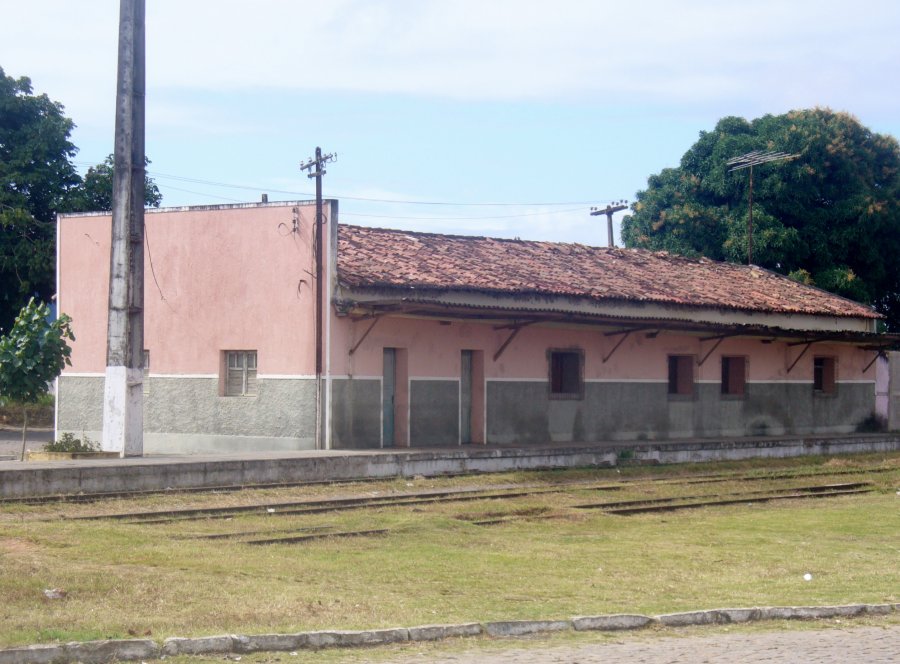
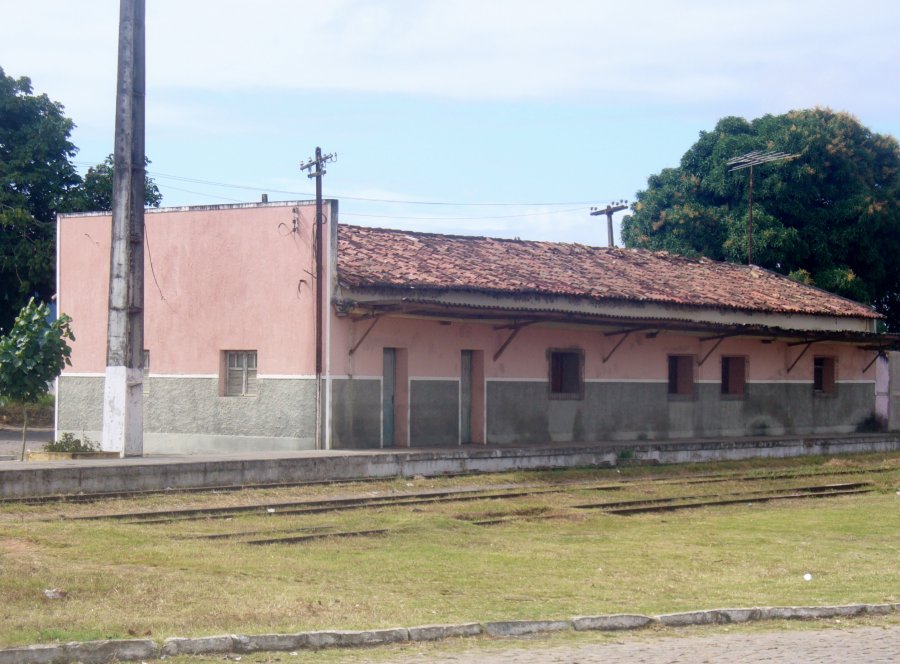
In October 1882, a railway station of the E.F. Natal a Nova Cruz (Northern Line) railway company was opened there. The railway line changed hands three times: in 1902 to Great Western, in 1939 to Rede Ferroviaria do Nordeste and from 1975 until its closure in 1997 it belonged to Rede Ferroviária Federal S.A. (estacoesferroviarias.com.br). Today, the tracks and the station building are still there:

In July 2015 (Photo: Luiz Antonio F. Coutinho, on estacoesferroviarias.com.br)

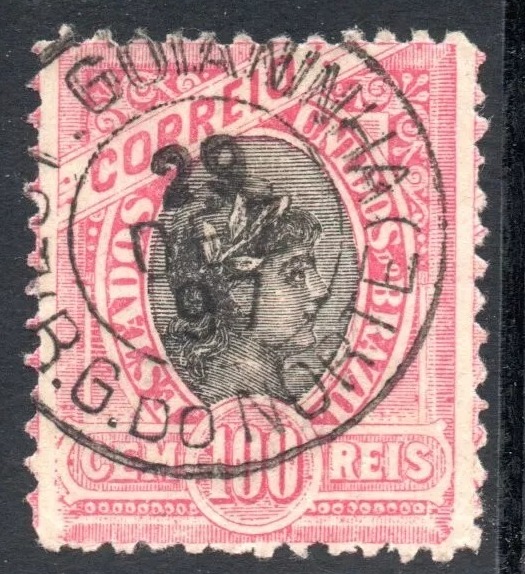
As shown in the Directory of Imperial Post Offices (Tabella das Agencias do Correio do Imperio, Rio de Janeiro, 1885), there was a railway station post office since 1883. The oldest postmark of the railway station to date is GRN-0076a (Fig. Felipe Piccinini):

GRN-0076a (FP) 1897
Villiers de l’Ile Adam: Carta (…) das Provincias do Rio Grande do Norte e Parahiba, 1848

Textaktualisierung am 26.12.2024

Die Freguesia de N. Sra dos Prazeres de Goyaninha wurde im August 1821 gegründet und befand sich am Südufer des Brandão, 60 Kilometer südlich der späteren Provinzhauptstadt Natal. Im April 1833 wurde sie zu einer Vila und im November 1928 zur Stadt erhoben. Der Ortsname soll von Siedlern stammen, die aus Goiana in Pernambuco kamen.

Wie Nova Monteiro in Administrações e Agencias Postaes do Brasil Imperio (Brasil Filatelico/RJ, 1934-5; Nachdruck SPP 1994-1999) schreibt, gab es seit April 1818 ein örtliches Postamt. Der bisher älteste Poststempel aus dieser Stadt ist GRN-0075b (Abb. R. Koester, in Carimbologia XX):

GRN-0075b (RK) 1889-1890

Danach kam GRN-0075c (Abb. Luiz C. Fritzen), dieser trägt die Inschrift VIL. für Villa:

GRN-0075c (LCF) 1899

Im Oktober 1882 wurde hier ein Bahnhof der Eisenbahngesellschaft E.F. Natal a Nova Cruz (Nordlinie) eröffnet. Die Bahnlinie wechselte dreimal den Besitzer: 1902 an Great Western, 1939 an Rede Ferroviaria do Nordeste und von 1975 bis zu ihrer Schließung 1997 gehörte sie Rede Ferroviária Federal S.A. (estacoesferroviarias.com.br). Heute sind die Gleise und das Bahnhofsgebäude noch vorhanden:

Im Juli 2015 (Foto: Luiz Antonio F. Coutinho, auf estacoesferroviarias.com.br)

Wie aus dem Verzeichnis der kaiserlichen Postämter (Tabella das Agencias do Correio do Imperio, Rio de Janeiro, 1885) hervorgeht, gab es seit 1883 ein Bahnhofspostamt. Der bisher älteste Poststempel des Bahnhofs ist GRN-0076a (Abb. Felipe Piccinini):

GRN-0076a (FP) 1897

Categories
Carimbologia E-G

Gouvêa, Minas Gerais (GMG-1255)

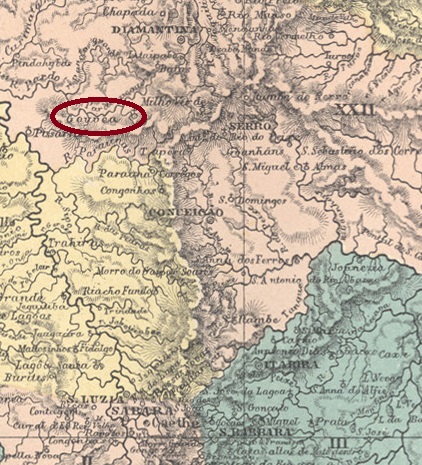
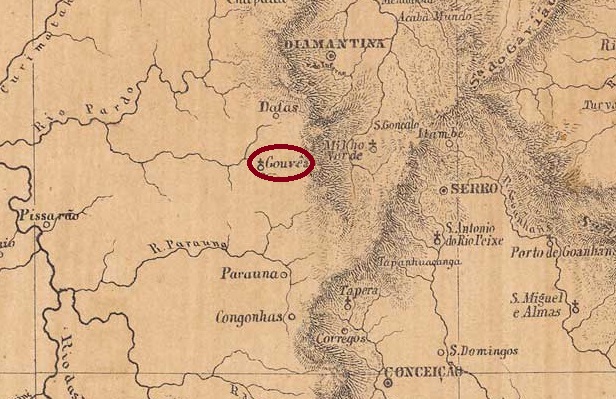
Atlas do Imperio do Brasil, 1868

Sto. Antonio de Gouvêa had been a district of the Vila de Diamantina since April 1841, located between the Ribeirão do Chiqueiro and the Córrego Lava-Pés, 350 kilometres north of the provincial capital Ouro Preto. In November 1873, the locality was a vila for a day before it was given the status of a district again. Gouveia (as it is spelt today) has only been a município again since December 1953.

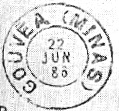
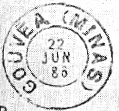
Paula Sobrinho (História Postal de Minas Gerais, Belo Horizonte, 1997) and R. Koester (Carimbologia XX) agree that there has been a post office there since November 1881. The oldest postmark to date is GMG-1255a (fig. R. Koester):

GMG-1255a (RK) 1881ff

It was followed by GMG-1255b (Ill. R. Koester, op. cit.):

GMG-1255b (RK) 1885-1887
Provincia de Minas Geraes, 1873

Sto. Antonio de Gouvêa war seit April 1841 ein Distrikt der Vila de Diamantina und lag zwischen dem Ribeirão do Chiqueiro und dem Córrego Lava-Pés, 350 km nördlich der Provinzhauptstadt Ouro Preto. Im November 1873 war der Ort für einen Tag eine Vila, bevor er wieder den Status eines Distrikts erhielt. Erst seit Dezember 1953 ist Gouveia (wie es heute geschrieben wird) wieder ein Município.

Paula Sobrinho (História Postal de Minas Gerais, Belo Horizonte, 1997) und R. Koester (Carimbologia XX) sind sich einig, dass es dort seit November 1881 ein Postamt gab. Der bisher älteste Stempel ist GMG-1255a (Abb. R. Koester):

GMG-1255a (RK) 1881ff

Es folgte GMG-1255b (Abb. R. Koester, op. cit.):

GMG-1255b (RK) 1885-1887
Categories
Carimbologia E-G

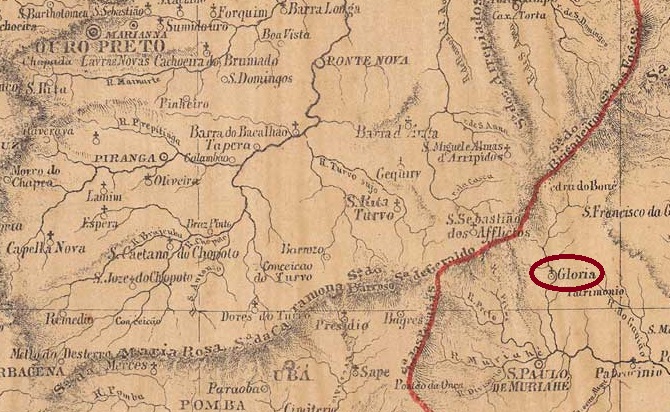
Gloria do Muriahe, Minas Gerais (GMG-1235)

Provincia de Minas Geraes, 1873

Other names: Itamuri (1927)

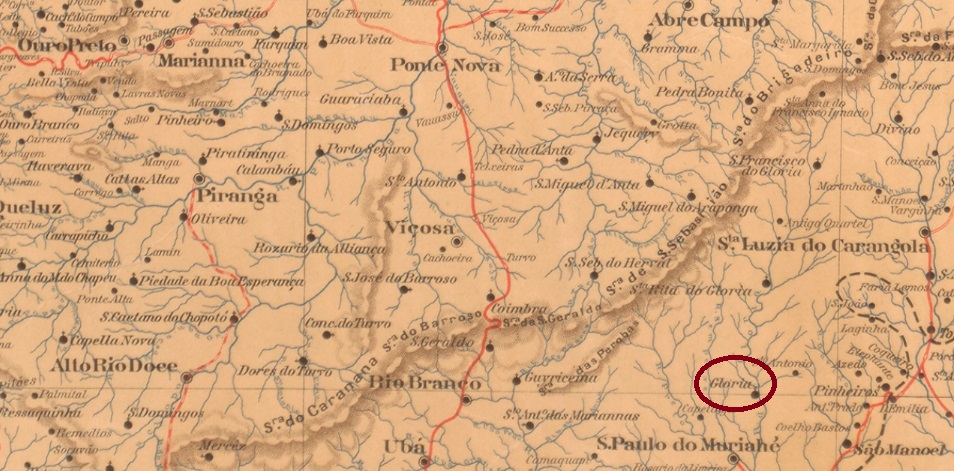
The Freguesia de N. Sra. do Glória was founded in July 1843, belonged to the Vila de Rio Branco and was located on the west bank of the Glória, 230 km south-east of the provincial capital Ouro Preto. In May 1855, the freguesia changed to the Município de S. Paulo de Muriaé and since September 1927, the place has been called Distrito de Itamuri. The name comes from the Tupi-Guarani and means mosquito stone.

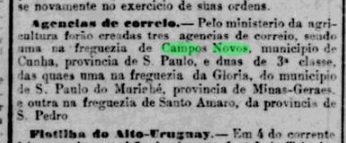
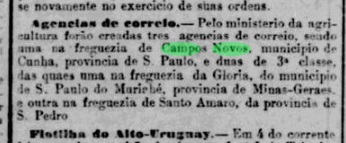
Both Paula Sobrinho (História Postal de Minas Gerais, Belo Horizonte, 1997) and R. Koester (Carimbologia XX) write that there has been a post office there since May 1881. This is confirmed by the press in Rio:

Jornal do Commercio/RJ, 07/05/1881

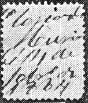
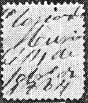
Initially, the stamps were cancelled by hand, as R. Koester (op. cit.) shows:

1884-1885 (RK)

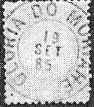
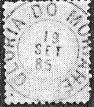
The oldest cancellation to date is GMG-1235a (fig. R. Koester):

GMG-1235a (RK) 1885-1887
Estado de Minas Geraes, 1910

Andere Namen: Itamuri (1927)
Die Freguesia de N. Sra. do Glória wurde im Juli 1843 gegründet, gehörte zur Vila de Rio Branco und lag am Westufer des Glória, 230 km südöstlich der Provinzhauptstadt Ouro Preto. Im Mai 1855 wechselte die Freguesia zum Município de S. Paulo de Muriaé und seit September 1927 heißt der Ort Distrito de Itamuri. Der Name stammt aus dem Tupi-Guarani und bedeutet Mückenstein.

Sowohl Paula Sobrinho (História Postal de Minas Gerais, Belo Horizonte, 1997) als auch R. Koester (Carimbologia XX) schreiben, dass es dort seit Mai 1881 ein Postamt gab. Dies wird von der Presse in Rio bestätigt:

Jornal do Commercio/RJ, 07.05.1881

Anfangs wurden die Marken wohl von Hand entwertet, wie R. Koester (op. cit.) zeigt:

1884-1885 (RK)

Der bisher älteste Stempel ist GMG-1235a (Abb. R. Koester):

GMG-1235a (RK) 1885-1887
Categories
Carimbologia E-G

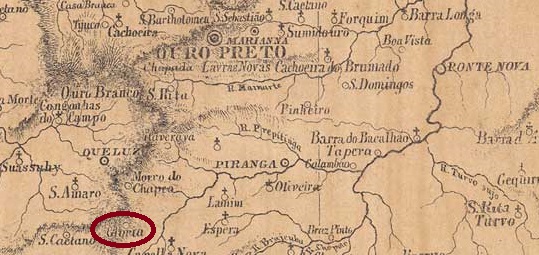
Glória de Queluz, Minas Gerais (GMG-1240)

Estado de Minas Geraes, 1910

Text update of October 8, 2024

Other names: Caranaíba (1918)

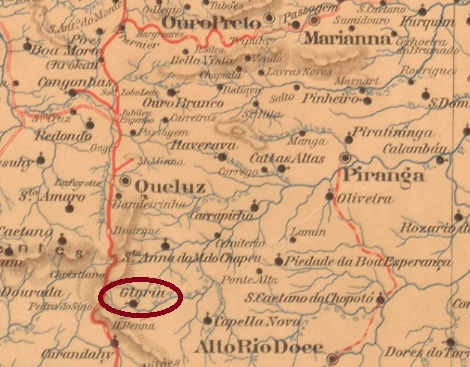
In September 1882, the Freguesia de N. Sra. da Glória was founded, which belonged to the Vila de Queluz and was located 80 kilometres south of the provincial capital Ouro Preto. In September 1918, the place name was changed to Caranaíba and five years later the district passed to the Município de Carandaí. Caranaíba has been an independent município since December 1962.

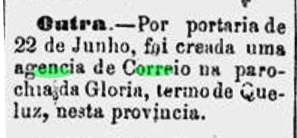
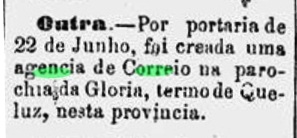
According to the regional press, there had been a post office on place since June 1887.

A União, 04.07.1887

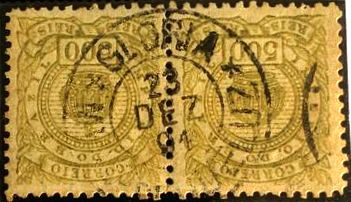
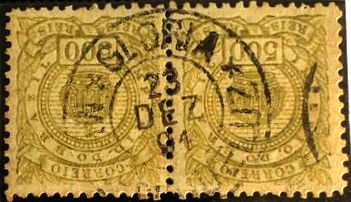
The oldest postmark to date is GMG-1240a (Coll. Alexandre Andrade):

GMG-1240a (AA) 1891
Provincia de Minas Geraes, 1873

Textaktualisierung am 8. Oktober 2024

Andere Namen: Caranaíba (1918)

Im September 1882 wurde die Freguesia de N. Sra. da Glória gegründet, die zur Vila de Queluz gehörte und 80 km südlich der Provinzhauptstadt Ouro Preto lag. Im September 1918 wurde der Ortsname in Caranaíba geändert und fünf Jahre später ging der Distrito zum Município de Carandaí über. Seit Dezember 1962 ist Caranaíba ein unabhängiges Município.

Wie die regionale Presse berichtet, gab es dort seit Juni 1887 ein Postamt.

A União, 04.07.1887

Der bisher älteste Poststempel ist GMG-1240a (Samml. Alexandre Andrade):
GMG-1240a (AA) 1891
Categories
Carimbologia E-G

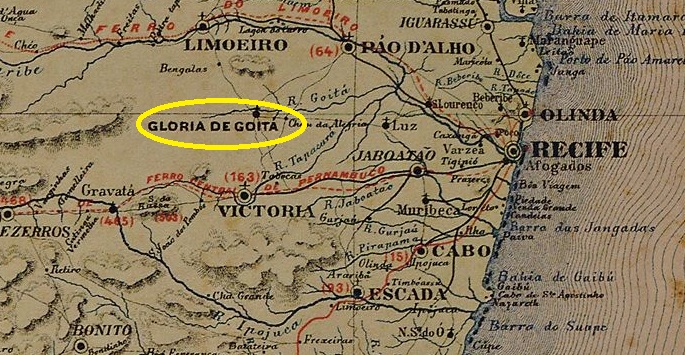
Gloria de Goytá, Pernambuco (GPE-0285)

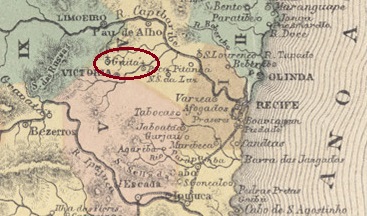
Carta Corographica da Provincia de Pernambuco, 1880

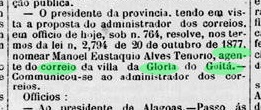
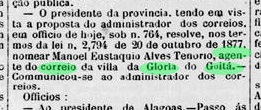
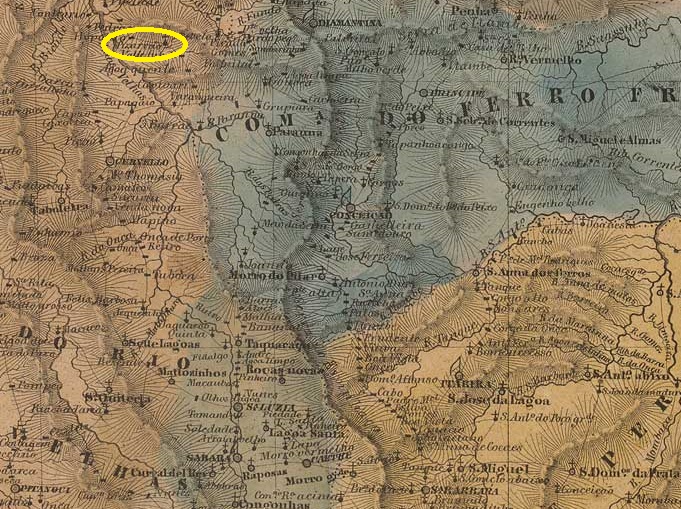
The Freguesia de N. Sra. da Glória de Goytá was founded in May 1837 and belonged to the Vila de Pau d’Alho on the south bank of the Goitá, 60 kilometres west of the provincial capital Recife. It became a vila in July 1877 and a town in June 1884, now written Glória do Goitá.

According to the regional press, there had been a local post office agent since November 1878:

Diario de Pernambuco, 08/11/1878

No imperial postmark from Gloria de Goytá has yet been sighted.

Atlas do Imperio do Brasil, 1868

Die Freguesia de N. Sra. da Glória de Goytá wurde im Mai 1837 gegründet und gehörte zur Vila de Pau d’Alho am Südufer des Goitá, 60 km westlich der Provinzhauptstadt Recife. Der Ort wurde im Juli 1877 zur Vila und im Juni 1884 zur Stadt erhoben, nun Glória do Goitá geschrieben.

Wie die regionale Presse berichtet, gab es seit November 1878 einen Postagent vor Ort:

Diario de Pernambuco, 08.11.1878

Bisher wurde kein kaiserlicher Poststempel aus Gloria de Goytá gesichtet.

Categories
Carimbologia E-G

Gloria da Diamantina, Minas Gerais (GMG-1230)

Villiers de l’Ile Adam: Carta (…) da Provincia de Minas Geraes, 1849

Other names: Piçarrão, N. Sra. da Glória, Senhora da Glória

The original settlement of N. Sra. da Glória do Piçarrão became the Distrito de N. Sra. da Glória in October 1875, which belonged to the Freguesia de Curimatahy and was located in the Vila de Diamantina area on the east bank of the Rio das Velhas, 300 kilometres north of the provincial capital of Ouro Preto. In September 1923 the district became part of the newly founded Município de Corinto and since December 1962 Senhora da Glória has been a district of the Município de Sto. Hipólito.

R. Koester (Carimbologia XX) and Paula Sobrinho (História Postal de Minas Gerais, Belo Horizonte, 1997) agree that the local post office was created in April 1882.

The imperial postmark is GMG-1230a (fig. Felipe Piccinini):

GMG-1230a (FP) 1885-1887
Atlas do Imperio do Brasil, 1868

Andere Namen: Piçarrão, N. Sra. da Glória, Senhora da Glória

Die ursprüngliche Siedlung N. Sra. da Glória do Piçarrão wurde im Oktober 1875 zum Distrito de N. Sra. da Glória, der zur Freguesia de Curimatahy gehörte und im Gebiet der Vila de Diamantina am Ostufer des Rio das Velhas lag, 300 km nördlich der Provinzhauptstadt Ouro Preto. Im September 1923 kam der Distrikt zum neu gegründeten Município de Corinto und seit Dezember 1962 ist Senhora da Glória ein Distrito des Município de Sto. Hipólito.

R. Koester (Carimbologia XX) und Paula Sobrinho (História Postal de Minas Gerais, Belo Horizonte, 1997) sind sich einig, dass das lokale Postamt im April 1882 gegründet wurde.

Der kaiserliche Poststempel ist GMG-1230a (Abb. Felipe Piccinini):

GMG-1230a (FP) 1885-1887