Categories
Carimbologia E-G

Espirito Santo da Varginha, Minas Gerais (EMG-1135)

Provincia de Minas Geraes, 1873

Other names: Espirito Santo das Catanduvas, Varginha (1923)

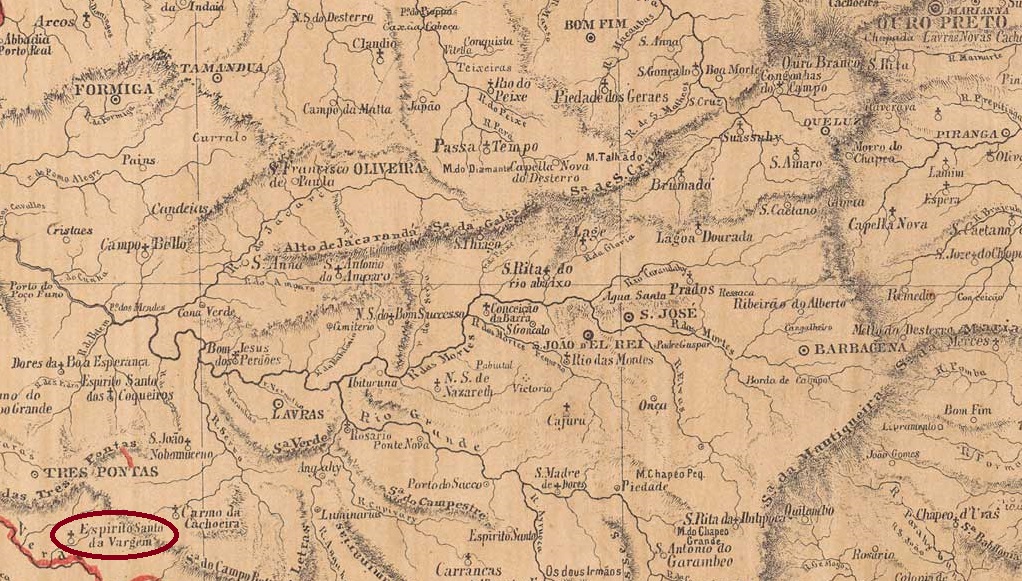
The Arraial do Espirito Santo das Catanduvas was established around 1800 on the north bank of the Rio Verde, 360 km south-west of the provincial capital Ouro Preto. In June 1850, it was elevated to the Freguesia do Espirito Santo da Varginha, which belonged to the Vila de Três Pontas. It was elevated to a Vila in July 1881 and to a town in October 1882. The abbreviated name Município de Varginha has been used since September 1923.

Three foundation dates have been found for the local post office. Once in June 1859, as Paula Sobrinho (História Postal de Minas Gerais, Belo Horizonte, 1997) writes, although he himself was not convinced of this. Then again in July 1864, as Nova Monteiro and R. Koester (Carimbologia XVIII) report. And finally in June 1879, as can be read in the postal report (Relatorio dos Correios) for the year 1887.

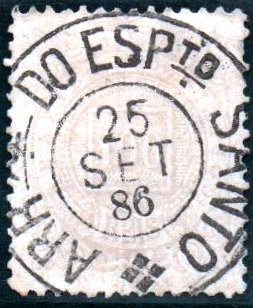
Seen in this light, the oldest postmark to date, EMG-1135b (fig. R. Koester, op. cit.), is probably not the very first:
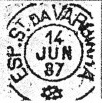
EMG-1135b (RK) 1887-1900
Atlas do Imperio do Brasil, 1868

Andere Namen: Espirito Santo das Catanduvas, Varginha (1923)

Der Arraial do Espirito Santo das Catanduvas entstand um 1800 am Nordufer des Rio Verde, 360 km südwestlich der Provinzhauptstadt Ouro Preto. Im Juni 1850 wurde es zur Freguesia do Espirito Santo da Varginha erhoben, die zur Vila de Três Pontas gehörte. Die Erhebung zur Vila erfolgte im Juli 1881, die zur Stadt im Oktober 1882. Seit September 1923 wird der abgekürzte Name Município de Varginha verwendet.

Für das örtliche Postamt wurden drei Gründungsdaten gefunden. Einmal im Juni 1859, wie Paula Sobrinho (História Postal de Minas Gerais, Belo Horizonte, 1997) schreibt, obwohl er selbst davon nicht überzeugt war. Dann wieder im Juli 1864, wie Nova Monteiro und R. Koester (Carimbologia XVIII) berichten. Und schließlich im Juni 1879, wie im Postbericht (Relatorio dos Correios) für das Jahr 1887 zu lesen ist.

So gesehen dürfte der bisher älteste Poststempel EMG-1135b (Abb. R. Koester, op. cit.) nicht der allererste sein:
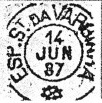
EMG-1135b (RK) 1887-1900
Categories
Carimbologia E-G

Espirito Santo da Fortaleza, São Paulo (ESP-0475)

Provincia de São Paulo, 1886

Text updated on July 21, 2024

Other names: Bauru (1896)

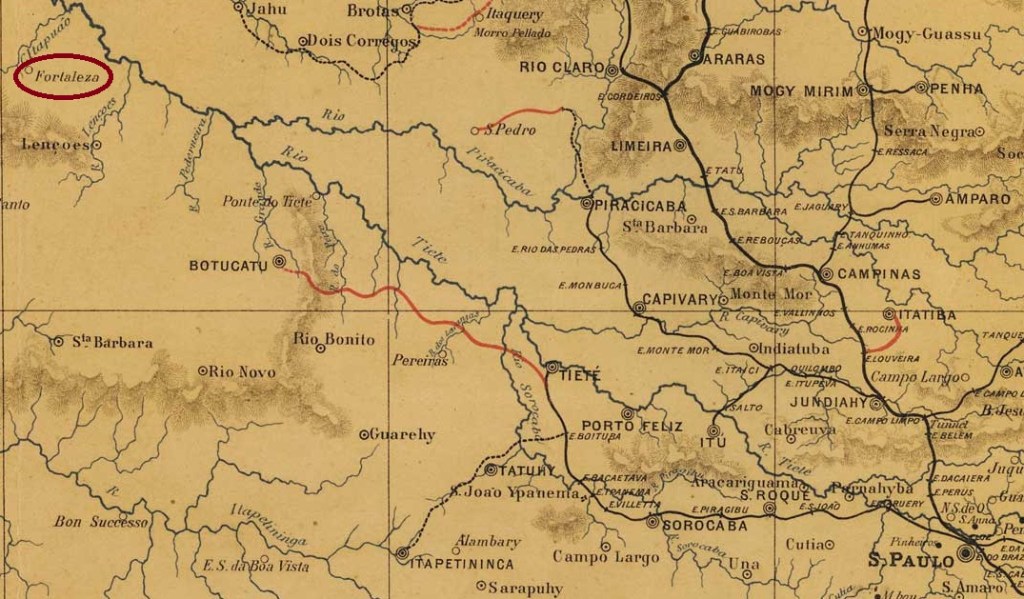
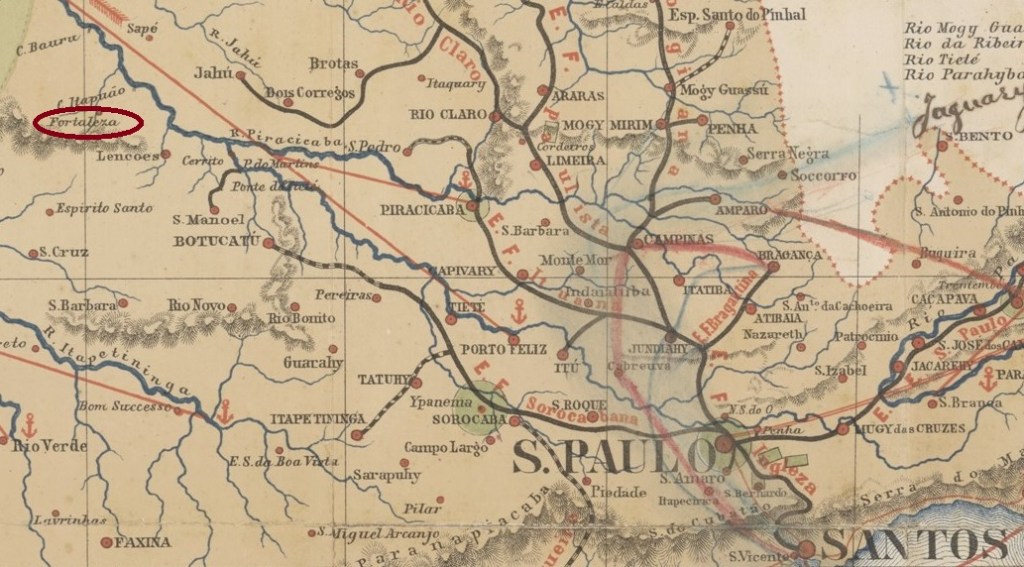
From April 1880, Espírito Santo da Fortaleza was a freguesia of the Vila de Lençóis on the south bank of the river Itapuão, 330 kilometres northwest of the provincial capital São Paulo. The village was elevated to a Vila in April 1887 and renamed Bauru in August 1896. Bauru has been a city since December 1906.  The name from the Tupi-Guarani language can mean both wild waters and fruit basket (which seems less likely here).

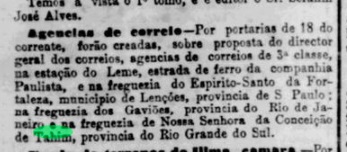
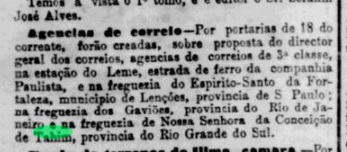
As the press in Rio reported, there had been a post office there since June 1883:

Jornal do Commercio/RJ, 19/06/1883

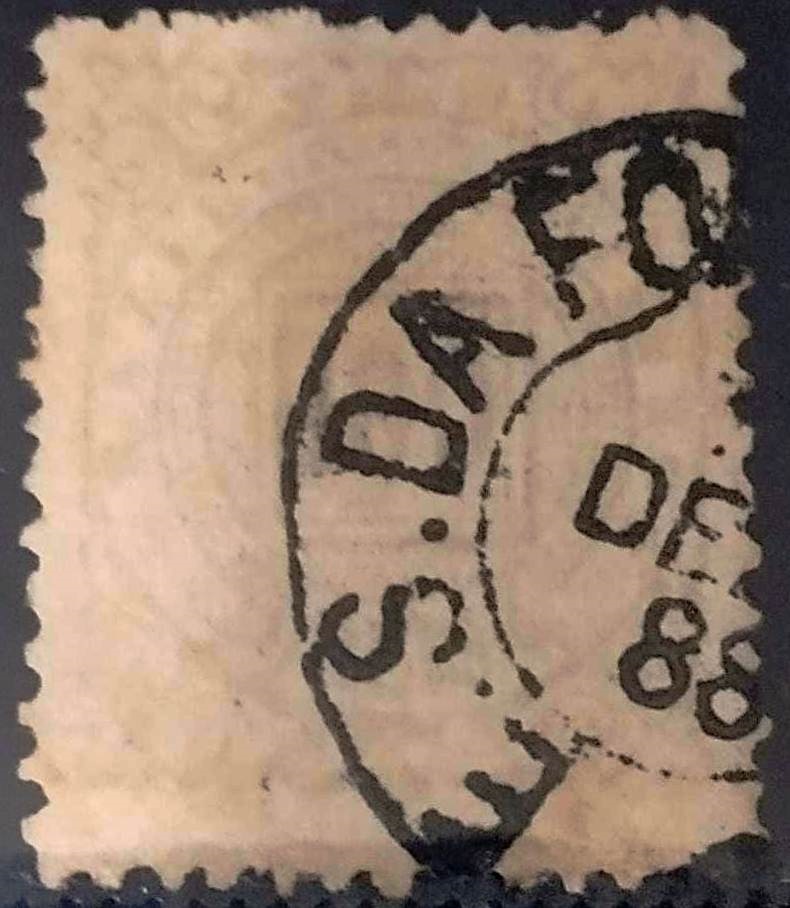
R. Koester writes in Carimbologia XVIII that the agency was closed in June 1900 and replaced by the nearby Borebi railway station post office. This is unlikely, as the Borebi railway station was only opened in 1917 by the E.F. Sorocabana railway company. The imperial postmark is ESP-0475a (illus. Carlos Aldir):

ESP-0475a (CAL) 1888
J. M. Ribeiro Lisboa: Provincia de São Paulo, 1884

Andere Namen: Bauru (1896)
Seit April 1880 war Espírito Santo da Fortaleza eine Freguesia der Vila de Lençóis am Südufer des Flusses Itapuão, 330 km nordwestlich der Provinzhauptstadt São Paulo. Der Ort wurde im April 1887 zur Vila erhoben und im August 1896 in Bauru umbenannt. Seit Dezember 1906 ist Bauru eine Stadt.  Der Name aus der Tupi-Guarani-Sprache kann sowohl wilde Gewässer als auch Fruchtkorb bedeuten (was hier weniger wahrscheinlich erscheint).

Wie die Presse in Rio berichtete, gab es dort seit Juni 1883 ein Postamt:
Jornal do Commercio/RJ, 19.06.1883

R. Koester schreibt in Carimbologia XVIII, dass die Agentur im Juni 1900 geschlossen und durch das nahe gelegene Bahnhofspostamt Borebi ersetzt wurde. Dies ist unwahrscheinlich, da der Bahnhof Borebi erst 1917 von der Eisenbahngesellschaft E.F. Sorocabana eingeweiht wurde. Der kaiserliche Poststempel ist ESP-0475a (Abb. Carlos Aldir):

ESP-0475a (CAL) 1888
Categories
Carimbologia E-G

Espirito Santo da Boa Vista, São Paulo (ESP-0470)

Provincia de São Paulo, 1879

Other Names: Ribeirão Grande do Palmital, Angatuba (1908)

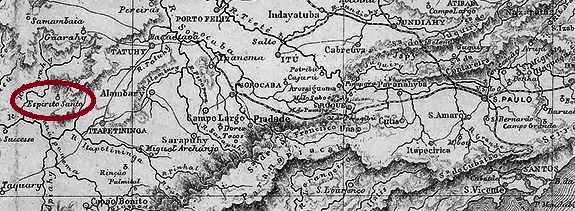
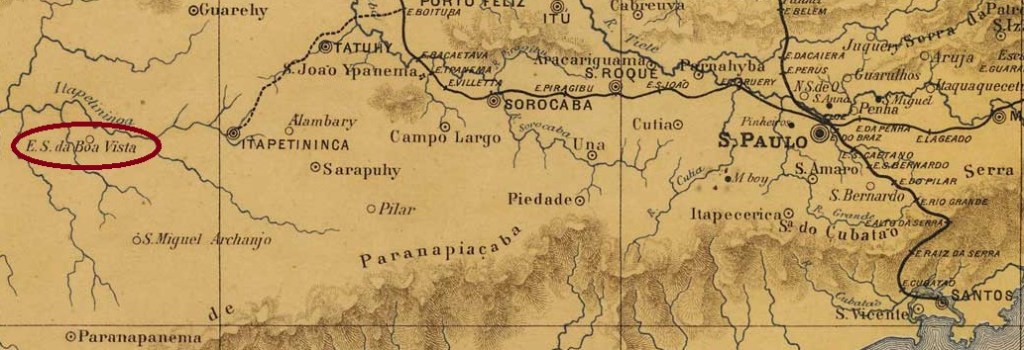
From March 1872, Espirito Santo da Boa Vista was a freguesia of the Vila de Itapetininga, 210 kilometres west of the provincial capital of São Paulo. It became a vila in March 1885 and a town in December 1906, which was renamed Angatuba two years later. The word from the Tupi-Guarani language is said to mean the abode of spirits.

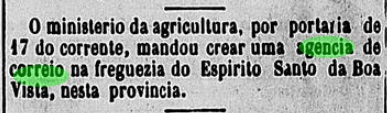
There had been a post office there since November 1880, as reported in the regional press:

Jornal da Tarde, 20/11/1880

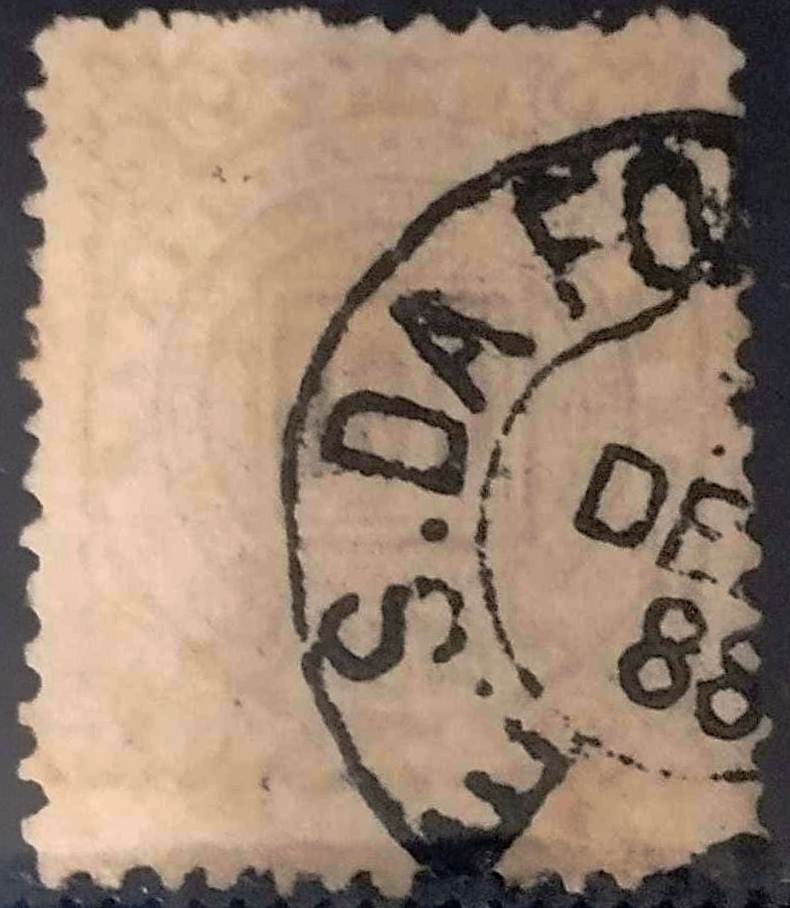
The imperial postmark is the French type ESP-0470a (illustration by Mário Celso Orsi Jr.):

ESP-0470a (MO) 1885-1889
J. Mo. Ribeiro Lisboa: Provincia de São Paulo, 1884

Andere Namen: Ribeirão Grande do Palmital, Angatuba (1908)

Seit März 1872 war Espirito Santo da Boa Vista eine Freguesia der Vila de Itapetininga, 210 km westlich der Provinzhauptstadt São Paulo. Sie wurde im März 1885 zur Vila und im Dezember 1906 zur Stadt, die zwei Jahre später in Angatuba umbenannt wurde. Das Wort aus der Sprache der Tupi-Guarani soll Wohnort der Geister bedeuten.

Seit November 1880 gab es dort ein Postamt, wie die regionale Presse berichtete:

Jornal da Tarde, 20.11.1880

Der kaiserliche Poststempel ist der französische Typ ESP-0470a (Abb. Mário Celso Orsi Jr.):

ESP-0470a (MO) 1885-1889
Categories
Carimbologia E-G

Espirito Santo da Barra Mansa, Rio de Janeiro (ERJ-0485)

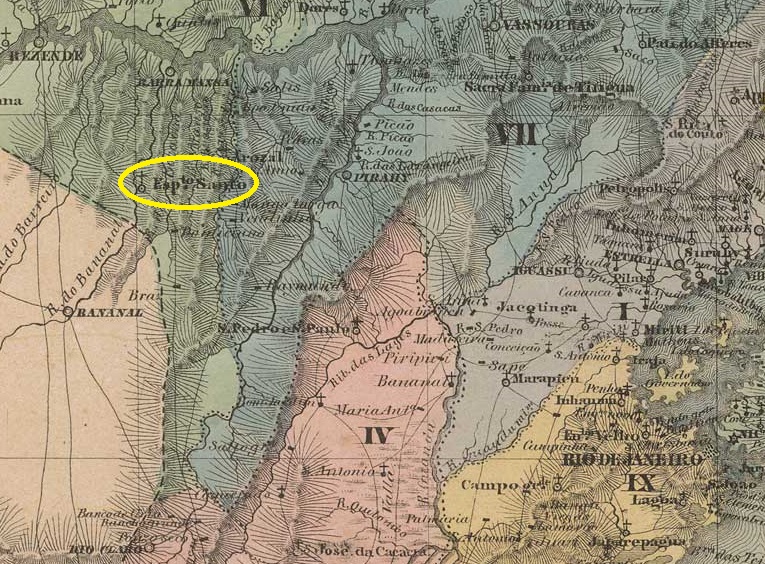
Villiers de l’Ile Adam: Carta (…) da Provincia do Rio de Janeiro, 1850

Other names: Rialto (1943)

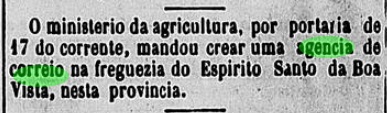
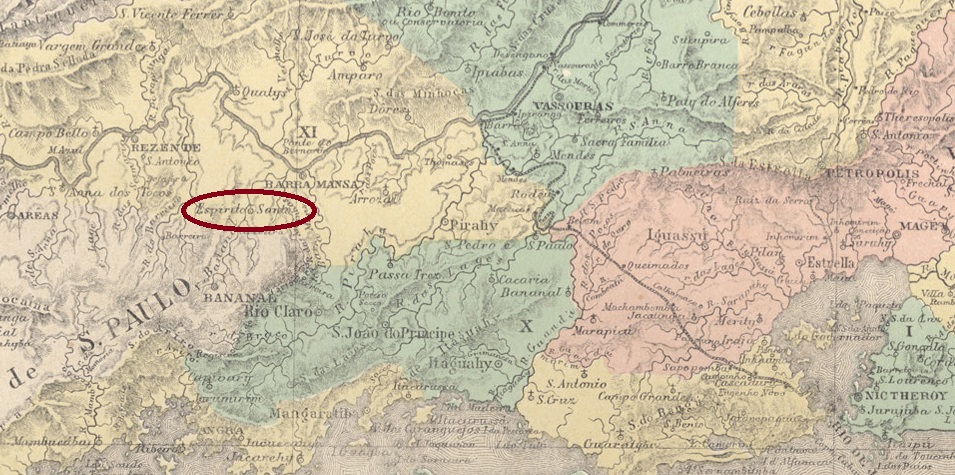
This Freguesia do Espirito Santo, founded in March 1884, belonged to the Vila de Barra Mansa and was located on the east bank of the Bananal, 150 kilometres northwest of the capital Rio de Janeiro. In March 1890, it was downgraded to a distrito, which has borne the name of the nearby Rialto railway station since December 1943.

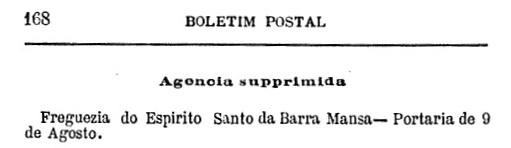
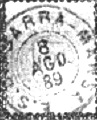
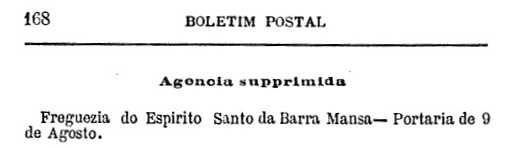
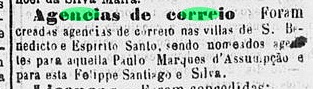
R. Koester writes in Carimbologia XVIII that there had been a post office there since December 1866. However, this was closed in August 1889, as can be seen from the postal bulletin (Boletim Postal) of the following month:

Boletim Postal No. 5 (September 1889)

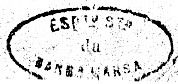
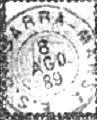
After that, mail to and from this locality was probably handled by the Realto railway station post office (RRJ-1670). The oldest postmark of Espirito Santo da Barra Mansa to date is the rare ERJ-0485a (fig. R. Koester, op. cit.):

ERJ-0485a (RK) 1866ff

This was followed by the double circle ERJ-0485b (Fig. R. Koester, op. cit.), here with the date of the penultimate day of operation:

ERJ-0485b (RK) 1880-1889

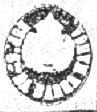
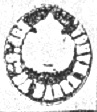
Koester also showed the stamp with the imperial seal ERJ-0485c:

ERJ-0485c (RK) 1880
Atlas do Imperio do Brasil, 1868

Andere Namen: Rialto (1943)

Die im März 1884 gegründete Freguesia do Espirito Santo gehörte zur Vila de Barra Mansa und lag am Ostufer des Bananal, 150 km nordwestlich der Hauptstadt Rio de Janeiro. Im März 1890 wurde sie zu einem Distrito herabgestuft, der seit Dezember 1943 den Namen des nahe gelegenen Bahnhofs Rialto trägt.

R. Koester schreibt in Carimbologia XVIII, dass es dort seit Dezember 1866 ein Postamt gab. Dieses wurde jedoch im August 1889 geschlossen, wie aus dem Postbulletin (Boletim Postal) des folgenden Monats hervorgeht:

Boletim Postal Nr. 5 (September 1889)

Danach wurde die Post von und nach diesem Ort wahrscheinlich über das Bahnhofspostamt Realto (RRJ-1670) abgewickelt. Der bisher älteste Poststempel von Espirito Santo da Barra Mansa ist der seltene ERJ-0485a (Abb. R. Koester, op. cit.):

ERJ-0485a (RK) 1866ff

Es folgte der Doppelkreis ERJ-0485b (Abb. R. Koester, op. cit.), hier mit dem Datum des vorletzten Betriebstages:

ERJ-0485b (RK) 1880-1889

Koester zeigte auch den Stempel mit dem kaiserlichen Siegel ERJ-0485c:

ERJ-0485c (RK) 1880
Categories
Carimbologia E-G

Espirito Santo, Ceará (ECE-0130)

Atlas do Imperio do Brasil, 1868

Other names: Anauá (1943)

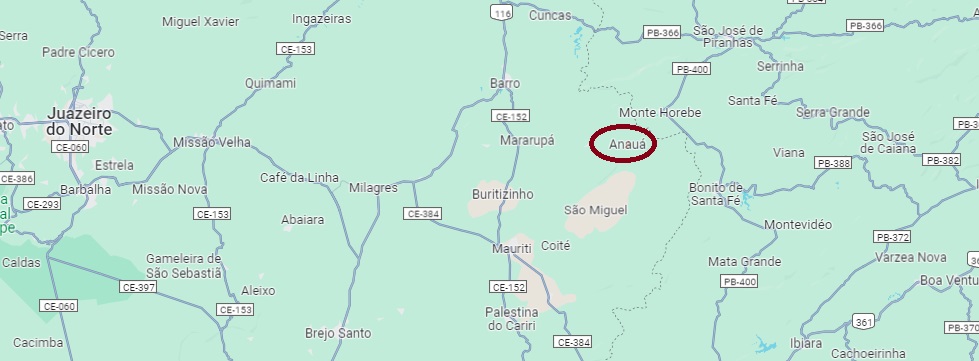
The Freguesia do Espírito Santo in the province of Ceará was founded in September 1873 and belonged to the Vila de Milagres, 490 kilometres south of the capital Fortaleza. In August 1882 it was elevated to the status of a Vila but lost this status in August 1890 and became an Arraial of the Município de Mauriti. In December 1933, it was modestly upgraded to a distrito, which was renamed Anauá ten years later. The beautiful word from the Tupi-Guarani language means blossoming tree.

R. Koester writes in Carimbologia XVIII that there had been a post office there since the end of May 1877, but the regional press had already reported on it in April:

Cearense, 15/04/1877

The only imperial postmark to date is ECE-0130a (fig. R. Koester, op.cit.)

ECE-0130a (RK)
Google Maps

Andere Namen: Anauá (1943)

Die Freguesia do Espírito Santo in der Provinz Ceará wurde im September 1873 gegründet und gehörte zur Vila de Milagres, 490 km südlich der Hauptstadt Fortaleza. Im August 1882 wurde sie zur Vila erhoben, verlor diesen Status aber im August 1890 und wurde ein Arraial des Município de Mauriti. Im Dezember 1933 erfolgte eine bescheidene Aufwertung zum Distrito, der zehn Jahre später in Anauá umbenannt wurde. Das schöne Wort aus der Sprache der Tupi-Guarani bedeutet blühender Baum.

R. Koester schreibt in Carimbologia XVIII, dass es dort seit Ende Mai 1877 ein Postamt gab, aber die regionale Presse berichtete bereits im April darüber:

Cearense, 15.04.1877

Der bisher einzige kaiserliche Poststempel ist ECE-0130a (Abb. R. Koester, op.cit.)

ECE-0130a (RK)
Categories
Carimbologia E-G

Espirito Santo (Arraial), Espirito Santo (EES-0220)

Briguiet: Estado do Espirito Santo, 1923

Other names: Espirito Santo do Rio Pardo, Muniz Freire (1896)

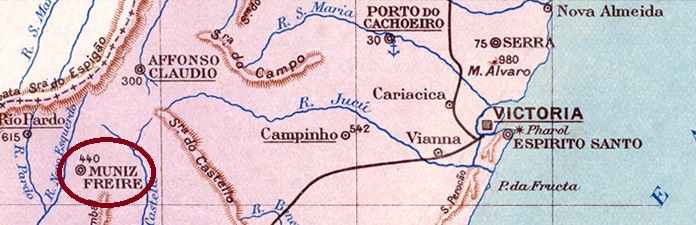
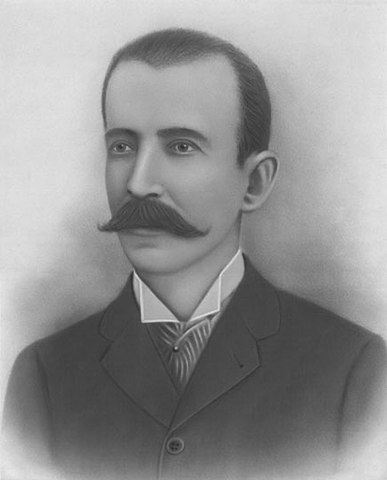
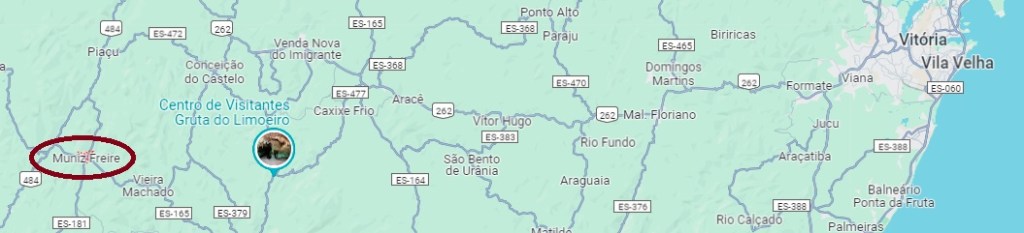
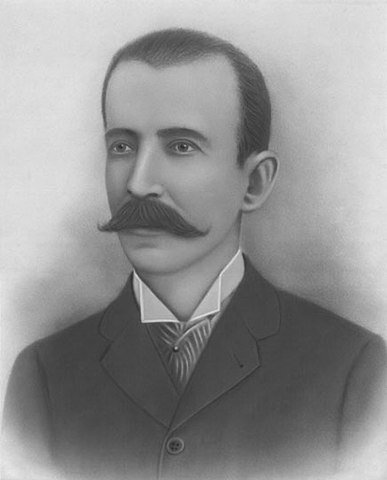
The Arraial do Espirito Santo belonged to the Vila de Cachoeiro do Itapemirim and was located near the Rio Pardo, 170 kilometres west of the provincial capital Vitória. In April 1890 it was elevated to freguesia status and seven months later to Vila do Espírito Santo do Rio Pardo. Since November 1896, the município has borne the name Muniz Freire, in memory of the lawyer, journalist and politician (1861-1918), who was governor of the state of Espírito Santo for two terms.

Wikipedia (CC BY-SA 4.0)

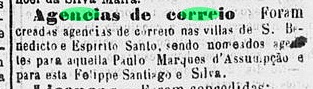
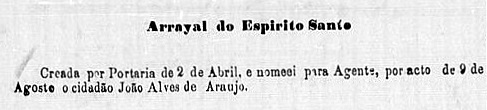
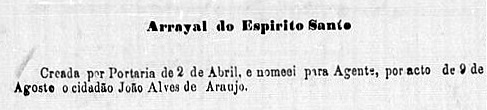
The local post office was created in April 1881, as reported in the regional press:

O Horizonte, 12/05/1882

The imperial postmark is EES-0220a (coll. José A. Junges):

EES-0220a (JJ) 1884-1896
Google Maps

Andere Namen: Espirito Santo do Rio Pardo, Muniz Freire (1896)

Der Arraial do Espirito Santo gehörte zur Vila de Cachoeiro do Itapemirim und lag in der Nähe des Rio Pardo, 170 km westlich der Provinzhauptstadt Vitória. Im April 1890 erfolgte die Erhebung zur Freguesia und sieben Monate später zur Vila do Espírito Santo do Rio Pardo. Seit November 1896 trägt der Município den Namen Muniz Freire, in Erinnerung an den Juristen, Journalisten und Politiker (1861-1918), der zwei Amtszeiten lang Gouverneur des Staates Espírito Santo war.

Wikipedia (CC BY-SA 4.0)

Das örtliche Postamt wurde im April 1881 gegründet, wie die regionale Presse berichtete:

O Horizonte, 12.05.1882

Der kaiserliche Poststempel ist EES-0220a (Samml. José A. Junges):

EES-0220a (JJ) 1884-1896
Categories
Carimbologia E-G

Esperança, Paraíba (EPB-0130)

Sociedade Geológica e Mineralógica, 1910

Other names: Boa Esperança, Esperança (1908)

See also Banabuyé (BPB-0044)

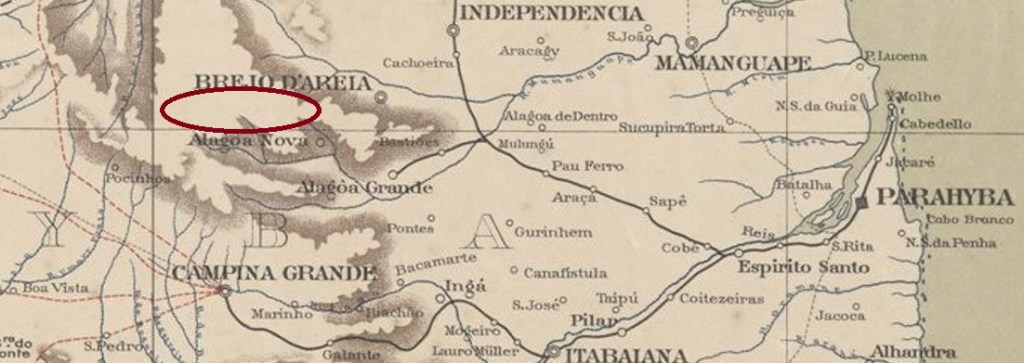
The beautiful Tupi word banabuyé means swamp of butterflies. The chapel of N. Sra. do Bom Conselho de Banabuyé was built in 1862 in the Município of Alagoa Nova, located 130 km west of the provincial capital Parahyba do Norte (today: João Pessoa). In 1872, it became a district called Boa Esperança and in May 1908 a freguesia, which was then simply called Esperança. Since December 1925, Esperança has been an independent município.

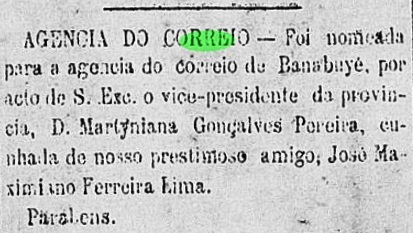
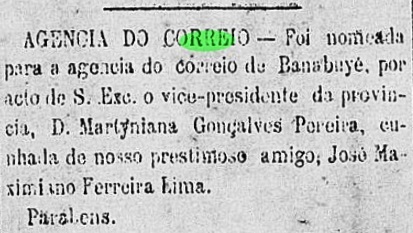
Three dates have been found for the creation of the local post office. First in June 1884, as stated in the postal report (Relatorio Postal) for 1887. Then in 1885, as reported in historiaesperancense.blogspot.com. Finally in May 1887, as Reinhold Koester (Carimbologia XVII) writes. However, the simultaneous existence of 2-3 place names seems to become a problem here. Even in 1889, when the place had long since been called Boa Esperança, it was still called Banabuyé by the regional press:

Gazeta do Sertão, 12.07.1889

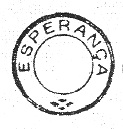
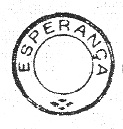
So far, no imperial postmark has been seen from Banabuyé. Koester (op.cit.) shows a cancellation with Esperança, unfortunately without dates:

 EPB-0130a (RK)
Atlas do Imperio do Brasil, 1868

Andere Namen: Boa Esperança, Esperança (1908)

Siehe auch Banabuyé (BPB-0044)

Das schöne Tupi-Wort banabuyé bedeutet Sumpf der Schmetterlinge. Die Kapelle von N. Sra. do Bom Conselho de Banabuyé wurde 1862 im Município von Alagoa Nova errichtet, 130 km westlich der Provinzhauptstadt Parahyba do Norte (heute: João Pessoa) gelegen. 1872 wurde daraus ein Distrikt namens Boa Esperança und im Mai 1908 eine Freguesia, die dann nur Esperança hieß. Seit Dezember 1925 ist Esperança ein eigenständiger Município.

Für die Entstehung des örtlichen Postamts wurden drei Zeitpunkte gefunden. Erstmals im Juni 1884, wie im Postbericht (Relatorio Postal) für 1887 zu lesen ist. Dann 1885, wie im historiaesperancense.blogspot.com berichtet wird. Schließlich im Mai 1887, wie Reinhold Koester (Carimbologia XVII) schreibt. Allerdings scheint hier das gleichzeitige Vorhandensein von 2-3 Ortsnamen ein Problem zu werden. Noch 1889, als der Ort längst Boa Esperança hieß, wurde er immer wieder von der Regionalpresse Banabuyé genannt:

Gazeta do Sertão, 12.07.1889

Bisher wurde kein kaiserlicher Poststempel von Banabuyé gesehen. Koester (op.cit.) zeigt eine Entwertung mit Esperança, leider ohne Datumsangaben:

 EPB-0130a (RK)
Categories
Carimbologia E-G

Espera, Minas Gerais (EMG-1910)

Provincia de Minas Geraes, 1873

Other names: N. Sra. da Piedade da Boa Esperança, Rio Espera (1911)

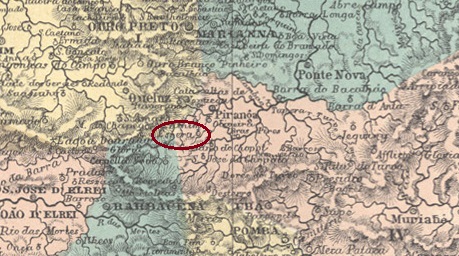
This village was formerly a curato called N. Sra. da Piedade da Espera, belonged to the Freguesia de S. José do Chopotó in the Vila de Barbacena area and was located at the source of the Rio Espera, 75 kilometres south of the provincial capital Ouro Preto. In June 1850, it became a freguesia of the Vila de Piranga, which was renamed N. Sra. da Piedade da Boa Esperança in November 1866. Since August 1911 it has been the municipality of Rio Espera.

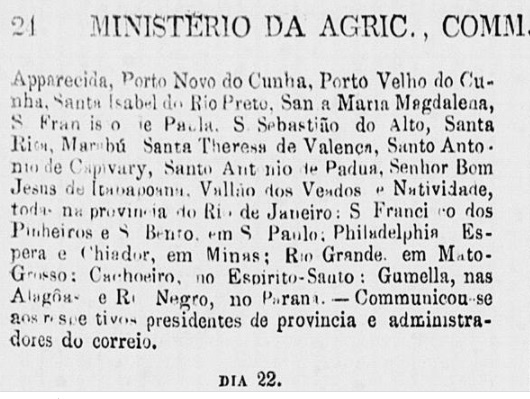
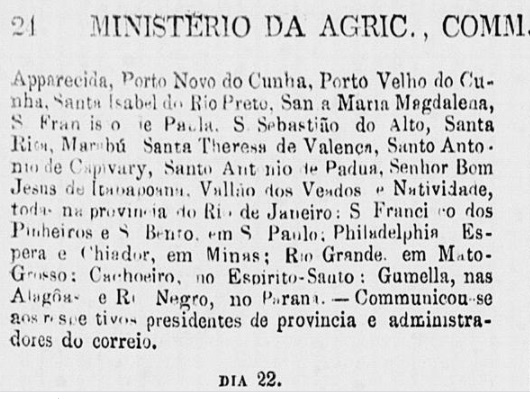
The local post office was opened at least twice. The date of the first opening has not yet been determined and in June 1861 the closure of the post office was announced:

Expediente do Ministerio da Agricultura, 21/06/1861

Paula Sobrinho (História Postal de Minas Gerais, Belo Horizonte, 1997) and R. Koester (Carimbologia XXXI) give September 1876 as the date of reopening. At this time, the place had long been called Piedade da Boa Esperança, with corresponding postmarks, although the old place name Piedade da Espera was still mentioned in the press until 1884.

It is likely that imperial postmarks with Espera (or Piedade da Espera) date from the first postal period. Unfortunately, we have not yet been able to see them.

Atlas do Imperio do Brasil, 1868

Andere Namen: N. Sra. da Piedade da Boa Esperança, Rio Espera (1911)

Diese Ortschaft war früher ein Curato namens N. Sra. da Piedade da Espera, gehörte zur Freguesia de S. José do Chopotó im Gebiet der Vila de Barbacena und lag an der Quelle des Rio Espera, 75 km südlich der Provinzhauptstadt Ouro Preto. Im Juni 1850 wurde es eine Freguesia der Vila de Piranga, die im November 1866 in N. Sra. da Piedade da Boa Esperança umbenannt wurde. Seit August 1911 ist es Munizip Rio Espera.

Das örtliche Postamt wurde mindestens zweimal eröffnet. Das Datum der ersten Eröffnung konnte bisher nicht ermittelt werden und im Juni 1861 wurde die Schließung des Postamtes bekannt gegeben:

Expediente do Ministerio da Agricultura, 21.06.1861

Paula Sobrinho (História Postal de Minas Gerais, Belo Horizonte, 1997) und R. Koester (Carimbologia XXXI) geben den September 1876 als Datum der Wiedereröffnung an. Zu diesem Zeitpunkt hieß der Ort schon lange Piedade da Boa Esperança, mit entsprechenden Poststempeln, obwohl der alte Ortsname Piedade da Espera noch bis 1884 in der Presse erwähnt wurde.

Es ist wahrscheinlich, dass kaiserliche Poststempel mit Espera (oder Piedade da Espera) aus der ersten Postperiode stammen. Leider konnten wir diese bisher nicht sehen.

Categories
Carimbologia E-G

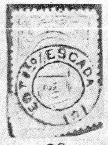
Escada (EPE-0235); Escada (train station/Bahnhof), Pernambuco (EPE-0740)

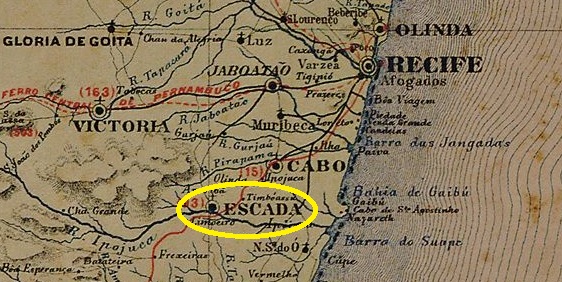
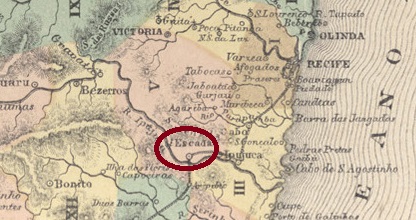
Carta Corographica da Provincia de Pernambuco, 1880

The Freguesia de N. Sra. da Apresentação de Escada was founded in April 1786, belonged to the Vila do Cabo and was located on the north bank of the Ipojuca, 60 kilometres southwest of the later provincial capital Recife. In April 1854 it became a Vila and in May 1873 a town.

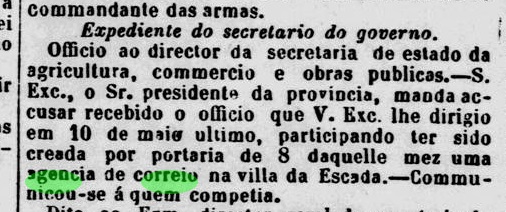
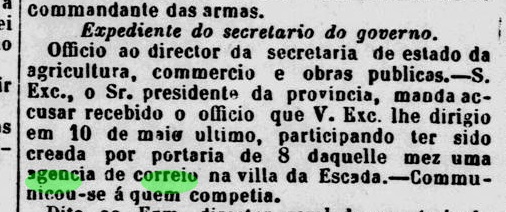
The local post office was created in May 1861, as reported in the regional press:

Diario de Pernambuco, 06/06/1861

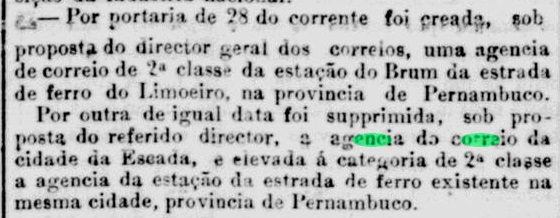
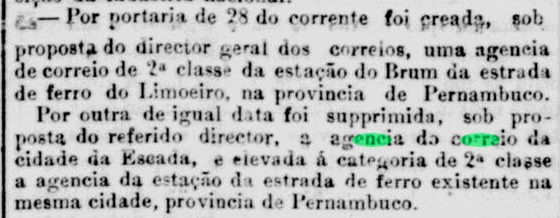
However, it was closed in September 1881 and replaced by the railway station post office:

Jornal do Commercio/RJ, 30/09/1881

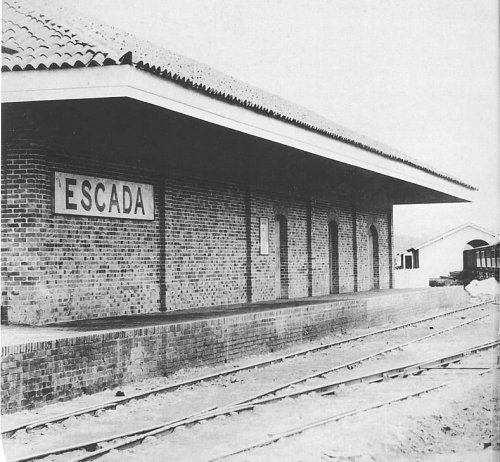
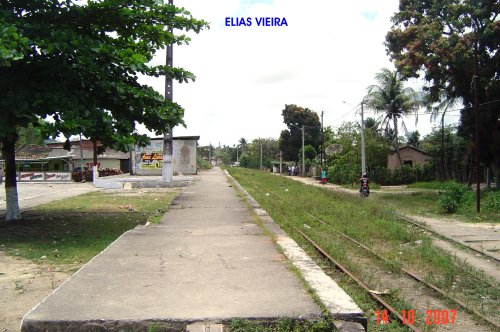
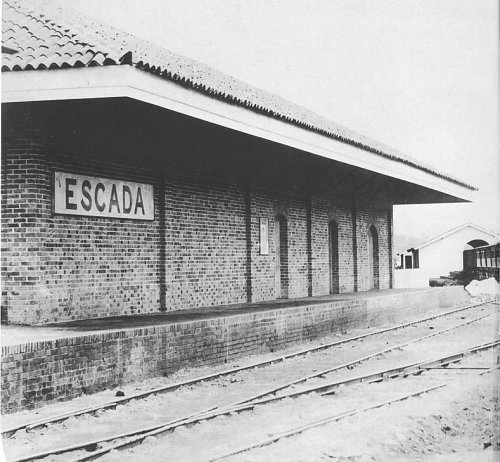
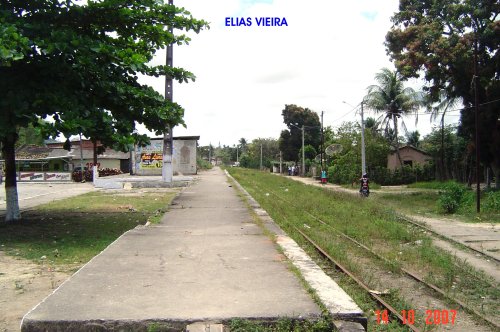
The station was opened in November 1860 by the railway company E.F. do Recife ao S. Francisco (South Line) and was located on the south bank of the Ipojuca. The railway line was transferred to Great Western in 1901, to Rede Ferroviária do Nordeste in 1950 and belonged to Rede Ferroviária Federal S.A. (estacoesferroviarias.com.br) from 1975 until it was closed in 1996. The tracks still exist today, the station building was demolished.

End of the 19th century (Foto: Augusto Stahl, on estacoesferroviarias.com.br)
In October 1997 (Photo: Elias Vieira, on estacoesferroviarias.com.br)

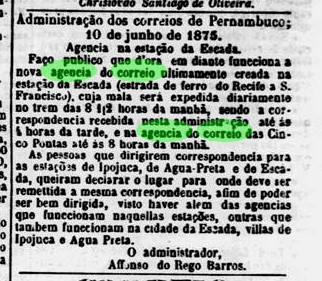
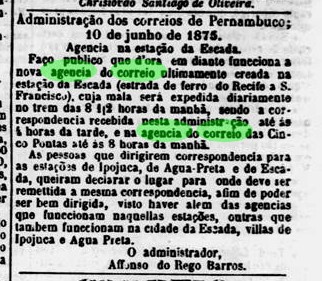
The station post office was in operation from 1875, as reported in the regional press:

Diario de Pernambuco, 14/06/1875

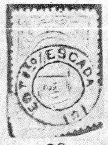
A station postmark and a mute postmark are known from Escada. EPE-0740a (fig. R. Koester, in Carimbologia XVII) is a French type:

EPE-0740a (RK) 1885-1887

The mute cancellation also originates from the station and has already been assigned the no. 979 by James Dingler and Klerman W. Lopes (Mute Cancellations of the Brazil Empire / Carimbos Mudos do Brasil Império, Brazil Philatelic Association, Rio de Janeiro, 2000):

BPA 979
Atlas do Imperio do Brasil, 1868

Die Freguesia de N. Sra. da Apresentação de Escada wurde bereits im April 1786 gegründet, gehörte zur Vila do Cabo und lag am Nordufer des Ipojuca, 60 km südwestlich der späteren Provinzhauptstadt Recife. Im April 1854 wurde es zur Vila und im Mai 1873 zur Stadt erhoben.

Das örtliche Postamt wurde im Mai 1861 eröffnet, wie die regionale Presse berichtete:

Diario de Pernambuco, 06.06.1861

Es wurde jedoch im September 1881 geschlossen und durch das Bahnhofspostamt ersetzt:

Jornal do Commercio/RJ, 30.09.1881

Der Bahnhof wurde im November 1860 von der Eisenbahngesellschaft E.F. do Recife ao S. Francisco (Südlinie) eröffnet und lag am Südufer des Ipojuca. Die Bahnlinie ging 1901 an die Great Western, 1950 an die Rede Ferroviária do Nordeste und gehörte von 1975 bis zu ihrer Stilllegung 1996 der Rede Ferroviária Federal S.A. (estacoesferroviarias.com.br). Die Gleise sind heute noch vorhanden, das Bahnhofsgebäude wurde abgerissen.

Ende des 19. Jahrhunderts (Foto: Augusto Stahl, auf estacoesferroviarias.com.br)
Im Oktober 1997 (Foto: Elias Vieira, auf estacoesferroviarias.com.br)

Das Bahnhofspostamt wurde ab 1875 betrieben, wie die regionale Presse berichtete:

Diario de Pernambuco, 14.06.1875

Aus Escada sind ein Bahnhofspoststempel und ein stummer Stempel bekannt. EPE-0740a (Abb. R. Koester, in Carimbologia XVII) ist ein französischer Typ:

EPE-0740a (RK) 1885-1887

Der stumme Stempel stammt ebenfalls von der Station und wurde bereits von James Dingler und Klerman W. Lopes (Mute Cancellations of the Brazil Empire / Carimbos Mudos do Brasil Império, Brazil Philatelic Association, Rio de Janeiro, 2000) mit der Nr. 979 versehen:

BPA 979
Categories
Carimbologia E-G

Escada, São Paulo (ESP-0460)

Villiers de l’Ile Adam: Carta (…) da Provincia de São Paulo, 1847

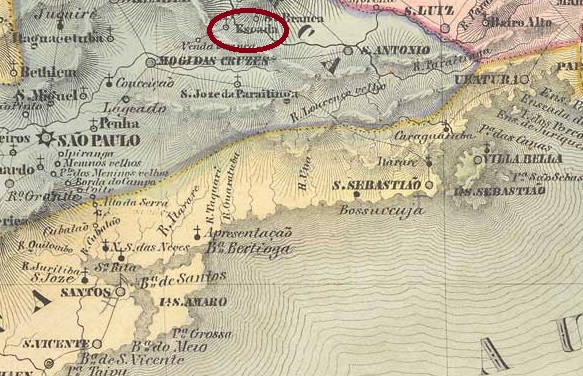
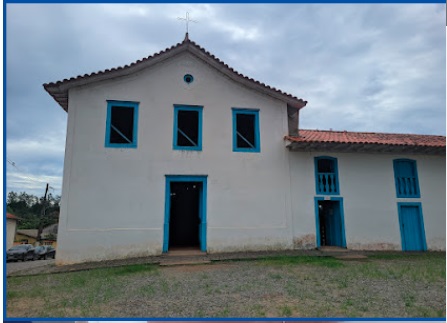
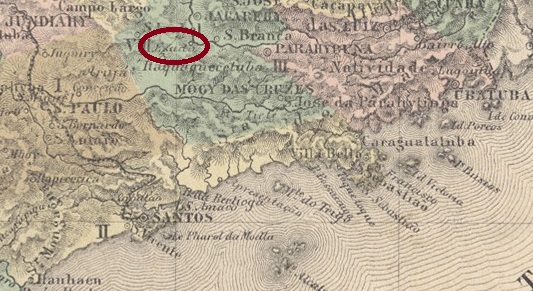
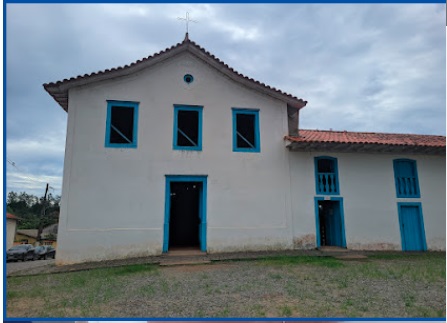
The Freguesia de N. Sra. da Escada, founded in February 1846, belonged to the Vila de Mogi das Cruzes and was located on the west bank of the Paraiba do Sul, 80 kilometres north-east of the provincial capital of São Paulo. In January 1890, the village was downgraded to an arraial of the Freguesia de Guararema and in June 1898 to a district of the Vila de Guararema.

Church N. Sra. das Dores de Escada in 2023 (Photo: Denis Sato, in Google Maps)

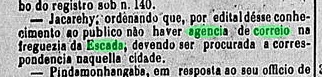
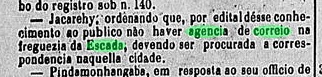
Two dates have been found for the foundation of the local post office. According to R. Koester (Carimbologia XVIII), Helmut Ponge is said to have determined the year 1861, but this could be a confusion with the town of the same name in the province of Pernambuco. Nova Monteiro gave a later date of July 1868 in Administrações e Agencias Postaes do Brasil Imperio (Brasil Filatelico/RJ, 1934-5; reprint SPP 1994-1999). However, it is questionable whether the agency was put into operation immediately, as the regional press reported no postal traffic to and from Escada in June 1876.

Correio Paulistano, 10 June 1876

So far we have not been able to see an imperial postmark of Escada in São Paulo.

Atlas do Imperio do Brasil, 1868

Die im Februar 1846 gegründete Freguesia de N. Sra. da Escada gehörte zur Vila de Mogi das Cruzes und lag am Westufer des Paraiba do Sul, 80 km nordöstlich der Provinzhauptstadt São Paulo. Im Januar 1890 wurde der Ort zu einem Arraial der Freguesia de Guararema herabgestuft und im Juni 1898 zu einem Ortsteil der Vila de Guararema.

Kirche N. Sra. das Dores de Escada, 2023 (Foto: Denis Sato, in Google Maps)

Für die Gründung des örtlichen Postamtes wurden zwei Daten gefunden. Lt. R. Koester (Carimbologia XVIII) soll Helmut Ponge das Jahr 1861 ermittelt haben, es könnte sich aber um eine Verwechslung mit dem gleichnamigen Ort in der Provinz Pernambuco handeln. Nova Monteiro gab in Administrações e Agencias Postaes do Brasil Imperio (Brasil Filatelico/RJ, 1934-5; Reprint SPP 1994-1999) ein späteres Datum im Juli 1868 an. Es ist jedoch fraglich, ob die Agentur sofort in Betrieb genommen wurde, da die regionale Presse im Juni 1876 keinen Postverkehr von und nach Escada vermeldete.

Correio Paulistano, 10.06.1876

Bisher konnten wir keinen kaiserlichen Poststempel von Escada in São Paulo sehen.