Other names: Parada do Barão, Est. Boa Vista, Avellar, Vieira Cortez (1924)
See also Avellar (train station, ARJ-0095)
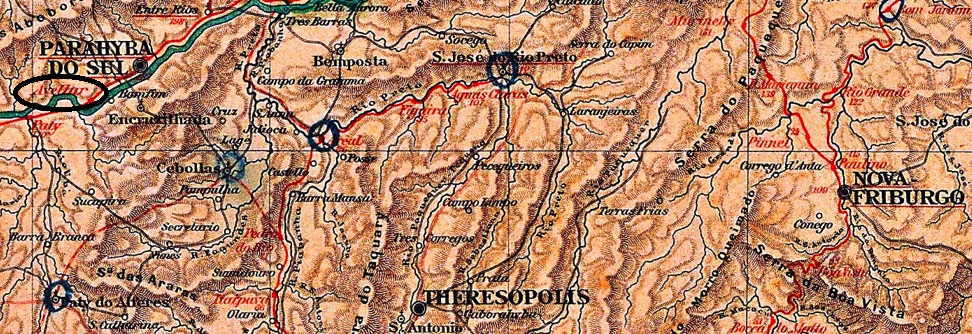
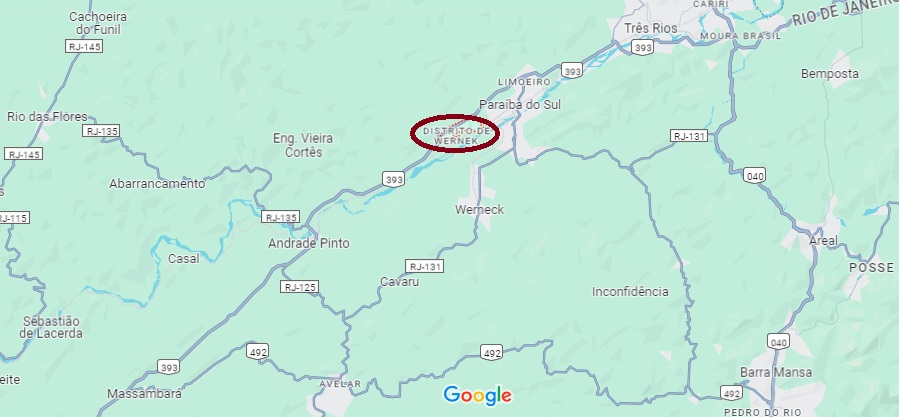
A desvio can be a diversion, or simply a bend. This desvio was located directly at the Fazenda da Boa Vista, Freguesia of S. Pedro and S. Paulo in the Município of Parahyba do Sul on the north bank of the river of the same name, 140 kilometres north of the capital Rio de Janeiro. In 1924 the town was renamed Vieira Cortez, and since December 1951 Vieira Cortez has belonged to the Distrito de Werneck.
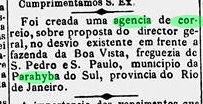
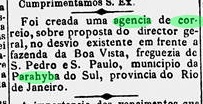
The post office was established in September 1884, according to the Rio press:
Gazeta da Tarde, 13/09/1884
The imperial postmark is DRJ-0430a, which was already shown in P. Ayres’ (Catálogo de Carimbos Brasil-Império, S. Paulo, 1937, 1942):
DRJ-0430a (P.A. p. 121) 1885-1888
After the Avellar railway station opened in 1885, the old postmarks continued to be used. For postmarks with Avellar (from 1889) see ARJ-0095.
Google Maps
Andere Namen: Parada do Barão, Est. Boa Vista, Avellar, Vieira Cortez (1924)
Siehe auch Avellar (Bahnhof, ARJ-0095)
Ein Desvio kann ein Umweg, eine Umleitung oder auch einfach eine Kurve sein. Dieser Desvio lag direkt an der Fazenda da Boa Vista, Freguesia von S. Pedro und S. Paulo im Município von Parahyba do Sul am Nordufer des gleichnamigen Flusses, 140 km nördlich der Hauptstadt Rio de Janeiro. 1924 wurde der Ort zu Vieira Cortez umbenannt, seit Dezember 1951 gehört Vieira Cortez dem Distrito de Werneck.
Das Postamt wurde im September 1884 ins Leben gerufen, wie die Presse aus Rio mitteilte:
Gazeta da Tarde, 13.09.1884
Der kaiserliche Poststempel ist DRJ-0430a, der bereits in P. Ayres‘ (Catálogo de Carimbos Brasil-Império, S. Paulo, 1937, 1942) zu sehen war:
DRJ-0430a (P.A. S. 121) 1885-1888
Nach Inbetriebnahme der Bahnhofs Avellar 1885 wurden die alten Poststempel zunächst weiterverwendet. Für Poststempel mit Avellar (ab 1889) siehe ARJ-0095.
See also Vila Nova de Itambi (VRJ-1000); Itambi (R. Koester: Carimbologia XXIII); São Bernabé (SRJ-0913); São José d’El Rei (SRJ-1427)
In November 1759 the freguesia of Nossa Senhora do Desterro de Itamby was founded in the now extinct municipality of Santo Antonio de Sá, located under 50 km northeast of the imperial capital. In 1772 it became a villa called São José del Rei, that after a short decadence went in 1833 as the freguesia of São Bernabé to the municipality of São João de Itaborahy. This status remained until 1840, when São Bernabé merged with other localities into the Villa Nova de Itamby, which is now Itambi, in the outskirts of the town of Itaboraí. We don’t know the causes of such a turbulent history, whether they are political, economic, or ecological nature, or even a combination among them.
After the closure of the post offices of São José d’El Rei (1835) and São Bernabé (around 1842), the town remained without a postal agency for around 20 years. Nova Monteiro writes in Administrações e Agencias Postaes do Brasil Imperio (Brasil Filatelico/RJ, 1934-5; reprint SPP 1994-1999) that a postal agency was created in Desterro de “Ibambi” in October 1862.
R. Koester shows in Carimbologia XXIII a postmark and a handwritten cancellation, both bearing only the place name Itamby:
IRJ-1070a (RK) 1866ff1885 (RK)
The railway station of Villa Nova do Itamby was opened in November 1866 by the Estrada de Ferro do Cantagallo railway company. The station post office was established in 1873 or 1874, and it can be assumed that the old Itamby postmarks were still in use there until the end of the Empire.
For postmarks with Vila Nova de Itambi see VRJ-1000.
Almanak Laemmert, 1892
Andere Namen: Vila Nova de Itambi, Itambi
Siehe auch Vila Nova de Itambi (VRJ-1000); Itambi (R. Koester: Carimbologia XXIII); São Bernabé (SRJ-0913); São José d’El Rei (SRJ-1427)
Die Geschichte dieser Ortschaft begann im November 1759 mit der Gründung der Freguesia von Nossa Senhora do Desterro de Itamby im inzwischen ausgelöschten Município von Santo Antonio de Sá, knapp 50 km nordöstlich der kaiserlichen Hauptstadt Rio de Janeiro gelegen. 1772 wurde daraus die Villa von São José del Rei, die nach einem raschen Verfall im Jahr 1833 zur Freguesia von São Bernabé im Município von São João de Itaborahy abstieg. Dieser Status hielt bis 1840, als São Bernabé mit anderen Ortschaften zur Villa Nova de Itamby (heute Itambi) wurde, heute ein Vorort der Stadt Itaboraí. Wir wissen nicht die Gründe für eine solch turbulente Geschichte, ob sie politischer, wirtschaftlicher oder ökologischer Natur sind, oder auch eine Mischung davon.
Nach der Schließung der Postämter von São José d’El Rei (1835) und São Bernabé (ca. 1842) blieb der Ort etwa 20 Jahre ohne Postagentur. Nova Monteiro schreibt in Administrações e Agencias Postaes do Brasil Imperio (Brasil Filatelico/RJ, 1934-5; Reprint SPP 1994-1999), dass im Oktober 1862 eine Postagentur in Desterro de „Ibambi“ gegründet wurde.
R. Koester zeigt in Carimbologia XXIII einen Poststempel und eine handschriftliche Entwertung, die beide nur den Ortsnamen Itamby tragen:
IRJ-1070a (RK) 1866ff1885 (RK)
Der Bahnhof von Villa Nova do Itamby wurde im November 1866 von der Eisenbahngesellschaft Estrada de Ferro do Cantagallo eröffnet. Das Bahnhofspostamt wurde 1873 oder 1874 eingerichtet, und es ist anzunehmen, dass die alten Itamby-Poststempel noch bis zum Ende des Kaiserreichs dort weiterverwendet wurden.
Für Poststempel mit Vila Nova de Itambi siehe VRJ-1000.
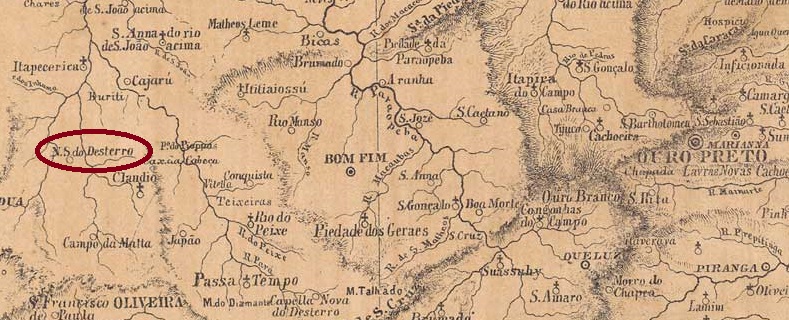
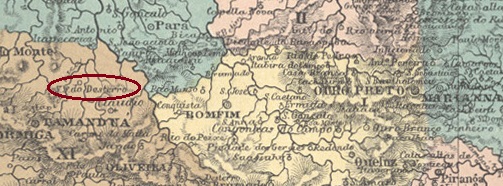
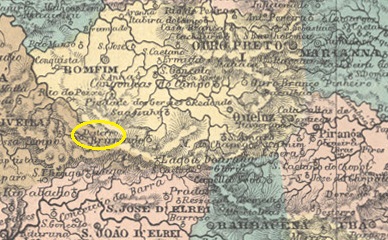
The Freguesia de N. Sra. do Desterro was founded in September 1870, it belonged to the Vila de S. Bento de Tamanduá and was located on the west bank of the Ribeirão Boa Vista, 230 km west of the provincial capital Ouro Preto. In October 1882, the freguesia became part of the Vila de Itapecerica and has been the Distrito de Marilândia since February 1935.
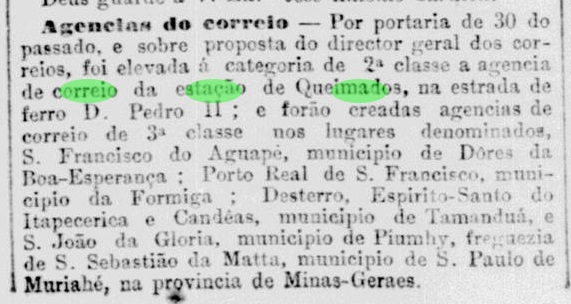
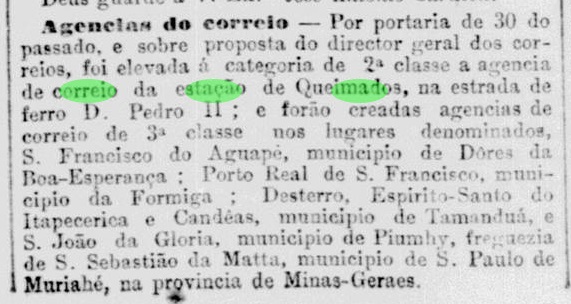
As Paula Sobrinho writes in História Postal de Minas Gerais (Belo Horizonte, 1997), there has been a post office there since November 1881. This is confirmed by the press in Rio:
Jornal do Commercio/RJ, 02/12/1881
No imperial postmark from N. Sra. do Desterro has yet been found.
Atlas do Imperio do Brasil, 1868
Andere Namen: Marilândia (1935)
Die Freguesia de N. Sra. do Desterro wurde im September 1870 gegründet, sie gehörte zur Vila de S. Bento de Tamanduá und lag am Westufer des Ribeirão Boa Vista, 230 km westlich der Provinzhauptstadt Ouro Preto. Im Oktober 1882 ging die Freguesia in die Vila de Itapecerica über und ist seit Februar 1935 der Distrito de Marilândia.
Wie Paula Sobrinho in História Postal de Minas Gerais (Belo Horizonte, 1997) schreibt, gab es dort seit November 1881 ein Postamt. Dies wird von der Presse in Rio bestätigt:
Jornal do Commercio/RJ, 02.12.1881
Bisher wurde noch kein kaiserlicher Poststempel aus N. Sra. do Desterro gefunden.
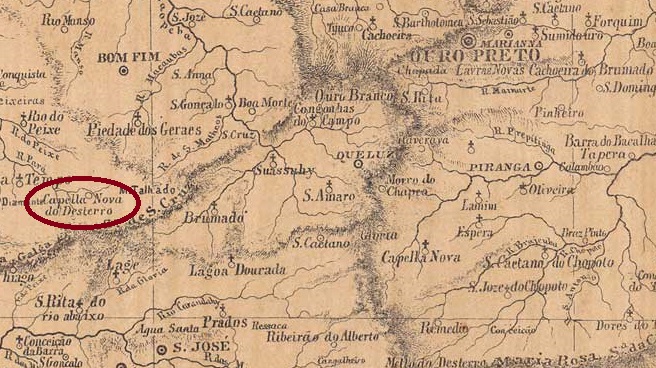
In the imperial province of Minas Gerais there were three places with a post office called Desterro (exile): The Freguesias N. Sra. do Desterro near Itapecerica (today Marilândia) and Mello de Desterro near Barbacena are discussed under DMG-0985 and MMG-1595 respectively. The third place discussed here is only 100 km away from Desterro de Itapecerica and is therefore often confused with it. Capella Nova do Desterro was a district of the Vila de Entre Rios, near the east bank of the Pará River, 120 km south-west of the provincial capital Ouro Preto. It became the Freguesia de N. Sra. do Desterro de Entre Rios in October 1882 and the Município de Desterro de Entre Rios in December 1953.
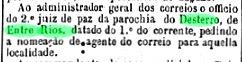
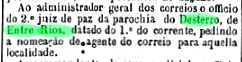
Paula Sobrinho writes in História Postal de Minas Gerais (Belo Horizonte, 1997) that there had been a post office since August 1891. This was a reopening, as a postal worker was already being sought for the local agency in July 1886, as reported in the regional press:
A União, 11/09/1886
No imperial postmark from Desterro de Entre Rios has yet been found.
Atlas do Imperio do Brasil, 1868
Andere Namen: Capella Nova do Desterro, Desterro
In der kaiserlichen Provinz Minas Gerais gab es drei Orte mit einem Postamt namens Desterro (Verbannung): Die Freguesias N. Sra. do Desterro bei Itapecerica (heute Marilândia) und Mello de Desterro bei Barbacena werden unter DMG-0985 bzw. MMG-1595 besprochen. Der dritte Ort, um den es hier geht, liegt nur 100 km von Desterro de Itapecerica entfernt und wird daher oft mit diesem verwechselt. Capella Nova do Desterro war ein Bezirk der Vila de Entre Rios, nahe dem Ostufer des Flusses Pará, 120 km südwestlich der Provinzhauptstadt Ouro Preto. Es wurde im Oktober 1882 zur Freguesia de N. Sra. do Desterro de Entre Rios und im Dezember 1953 zum Município de Desterro de Entre Rios.
Paula Sobrinho schreibt in História Postal de Minas Gerais (Belo Horizonte, 1997), dass es seit August 1891 ein Postamt gab. Es handelt sich um eine Wiedereröffnung, da bereits im Juli 1886 ein Postangestellter für die örtliche Agentur gesucht wurde, wie die regionale Presse berichtet:
A União, 11.09.1886
Bisher wurde kein kaiserlicher Poststempel aus Desterro de Entre Rios gefunden.
Other names: Juparanã, Barão de Juparanã (ca. 1952)
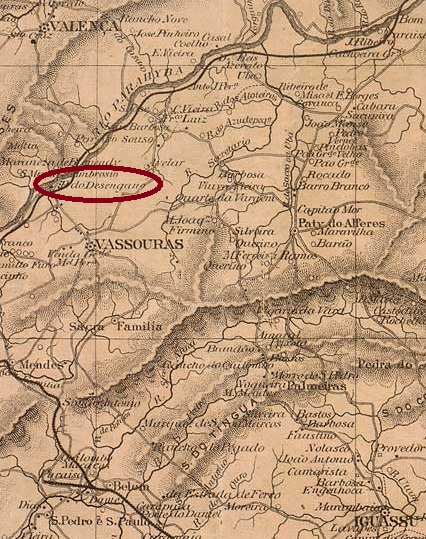
Desengano (also written Dezengano) was a settlement on the west bank of the river Paraíba do Sul, near the bridge Desengano Feliz (Happy Disappointment) around Vila de Valença, 150 kilometres northwest of the capital Rio de Janeiro. In May 1892, it was elevated to the status of a district, which was renamed Juparanã in December 1949 and shortly afterwards received the name Barão de Juparanã. The name commemorates Manuel Jacinto Carneiro Nogueira da Costa e Gama (Rio de Janeiro, 4 April 1830, Valença, 2 June 1876), landowner and regional politician.
As Nova Monteiro writes in Administrações e Agencias Postaes do Brasil Imperio (Brasil Filatelico/RJ, 1934-5; reprint SPP 1994-1999), there had been a post office there since August 1857, and when a luxurious railway station of the E.F.D. Pedro II (Central Line) was built in December 1865, the postal agency moved into the station building, as the station keeper was also the postal clerk.
Desengano Station, ca. 1881 (E.F. D. Pedro II, on estacoesferroviarias.com.br)
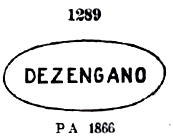
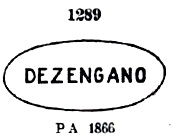
The oldest postmark to date is DRJ-0420a, which also existed in red and was already assigned the no. 1289 by P. Ayres in the Catálogo de Carimbos Brasil-Império (S. Paulo, 1937, 1942):
DRJ-0420a (P.A. 1289) 1866ff-1876ff
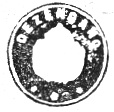
It was followed by DRJ-0420b (illustration from the Internet), which also occurs in dark violet:
DRJ-0420b (EB) 1876ff-1889
DRJ-0420c (illustration from the Internet) was also used in the late imperial period:
DRJ-0420c (EB) 1889-1891
R. Koester still shows the seal cancel DRJ-0420d in Carimbologia XVI, without further details:
DRJ-0420d (RK)
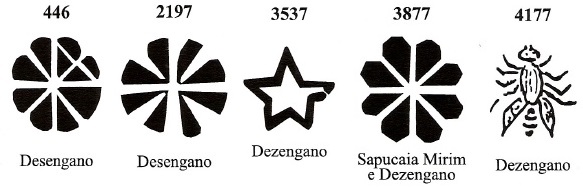
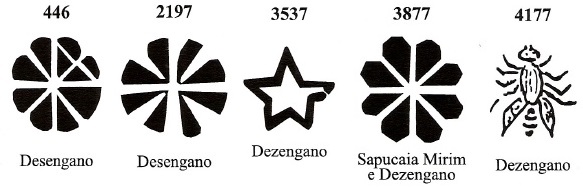
James Dingler and Klerman W. Lopes have shown in Mute Cancellations of the Brazil Empire / Carimbos Mudos do Brasil Império (Brazil Philatelic Association, Rio de Janeiro, 2000) no less than five mute cancellations from Desengano:
And from the Fuad Ferreira Fo. collection comes this handwritten cancellation:
1866ff (FF)Villiers de l’Ile Adam: Carta (…) da Provinica do Rio de Janeiro, 1850
Andere Namen: Juparanã, Barão de Juparanã (ca. 1952)
Desengano (auch Dezengano geschrieben) war eine Siedlung am Westufer des Flusses Paraíba do Sul, in der Nähe der Brücke Desengano Feliz (Glückliche Enttäuschung) im Gebiet von Vila de Valença, 150 km nordwestlich der Hauptstadt Rio de Janeiro. Im Mai 1892 wurde es zum Distrikt erhoben, der im Dezember 1949 in Juparanã umbenannt wurde und kurze Zeit später den Namen Barão de Juparanã erhielt.
Der Name erinnert an Manuel Jacinto Carneiro Nogueira da Costa e Gama (Rio de Janeiro, 4.4.1830, Valença, 2.6.1876), Großgrundbesitzer und Regionalpolitiker.
Wie Nova Monteiro in Administrações e Agencias Postaes do Brasil Imperio (Brasil Filatelico/RJ, 1934-5; Reprint SPP 1994-1999) schreibt, gab es dort seit August 1857 ein Postamt, und als im Dezember 1865 ein luxuriöser Bahnhof der E.F.D. Pedro II (Hauptlinie) gebaut wurde, zog die Postagentur in das Bahnhofsgebäude um, da der Bahnhofswärter auch der Postbeamte war.
Bahnhof Desengano, ca. 1881 (E.F. D. Pedro II, auf estacoesferroviarias.com.br)
Der bisher älteste Poststempel ist DRJ-0420a, den es auch in rot gab und der bereits von P. Ayres im Catálogo de Carimbos Brasil-Império (S. Paulo, 1937, 1942) mit der Nr. 1289 versehen wurde:
DRJ-0420a (P.A. 1289) 1866ff-1876ff
Ihm folgte DRJ-0420b (Abb. aus dem Internet), der auch in dunkelviolett vorkommt:
DRJ-0420b (EB) 1876ff-1889
In der späten Kaiserzeit wurde auch DRJ-0420c (Abb. aus dem Internet) verwendet:
DRJ-0420c (EB) 1889-1891
R. Koester zeigt in Carimbologia XVI noch den Siegelstempel DRJ-0420d, ohne weitere Angaben:
DRJ-0420d (RK)
James Dingler und Klerman W. Lopes haben in Mute Cancellations of the Brazil Empire / Carimbos Mudos do Brasil Império (Brazil Philatelic Association, Rio de Janeiro, 2000) nicht weniger als fünf stumme Stempel aus Desengano gezeigt:
Villiers de l’Ile Adam: Carta (…) da Provinica de Minas Gerais, 1849
Other names: Desterro do Descoberto
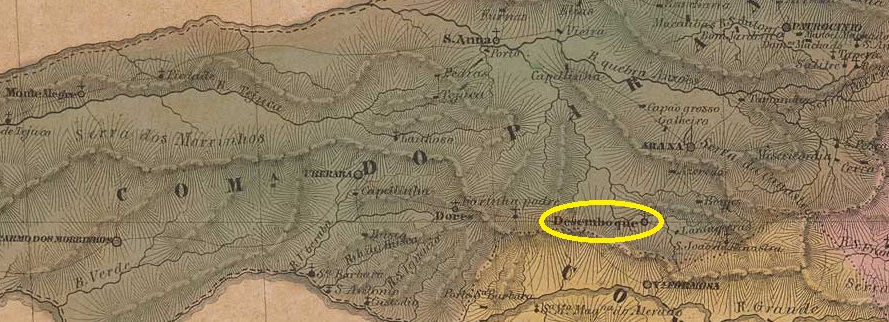
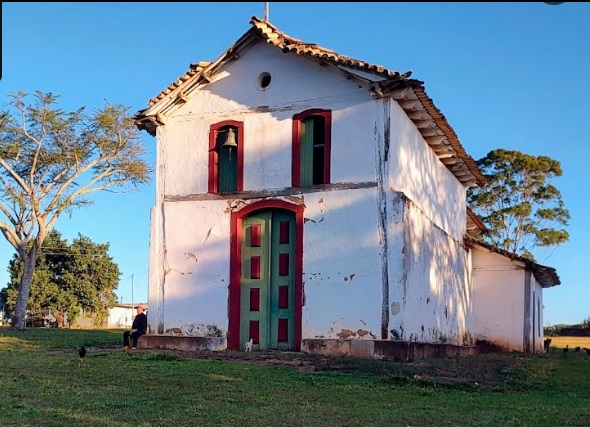
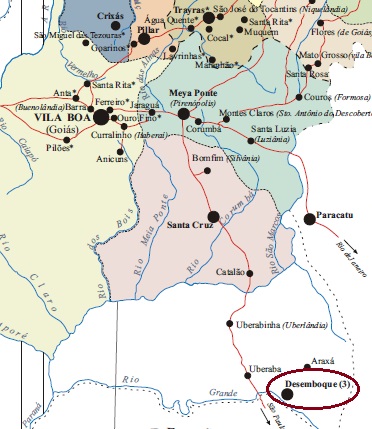
Another forgotten place with a fascinating history. The settlement of Desterro do Descoberto was founded as early as 1743, at that time still in the Capitania de Goiás, on the south bank of the Araguari (formerly Rio das Velhas), 500 kilometres west of the later provincial capital of Ouro Preto. In April 1816, Arraial do Desemboque was assigned to the Vila de Paracatu and thus to the Capitania de Minas Gerais. In May 1850, it was elevated to Vila de N. Sra. do Desterro do Desemboque, but this was short-lived: in September 1870, Desemboque was demoted to the freguesia of the Vila de Santissimo Sacramento. The once proud village on the trade route had almost 4,000 inhabitants at the end of the empire; today there are just under 30.
The village church (Photo: Tiago Giorgiani, Google Maps)
As Nova Monteiro writes in Administrações e Agencias Postaes do Brasil Imperio (Brasil Filatelico/RJ, 1934-5; reprint SPP 1994-1999), there had been a post office in Desemboque since September 1852, which was closed again around 1860 as it no longer appeared in the lists of imperial post offices. It was reopened in July 1892, as Paula Sobrinho (História Postal de Minas Gerais, Belo Horizonte, 1997) writes and the postal bulletin (Boletim Postal) of the following month confirms.
No imperial postmark of Desemboque has yet been seen.
Teixeira Neto, apud Silva e Souza: Capitania de Goiás, 1809
Andere Namen: Desterro do Descoberto
Ein weiterer vergessener Ort mit einer faszinierenden Geschichte. Die Siedlung Desterro do Descoberto entstand bereits 1743, damals noch in der Capitania de Goiás, am Südufer des Araguari (früher Rio das Velhas), 500 km westlich der späteren Provinzhauptstadt Ouro Preto. Im April 1816 wurde der Arraial do Desemboque der Vila de Paracatu und damit der Capitania de Minas Gerais zugeordnet. Im Mai 1850 erfolgte die Erhebung zur Vila de N. Sra. do Desterro do Desemboque, die jedoch nur von kurzer Dauer war: Im September 1870 wurde Desemboque zur Freguesia der Vila de Santissimo Sacramento degradiert. Der einst stolze Ort an der Handelsstraße zählte am Ende des Kaiserreichs fast 4.000 Einwohner, heute sind es noch knapp 30.
Die Dorfkirche (Foto: Tiago Giorgiani, Google Maps)
Wie Nova Monteiro in Administrações e Agencias Postaes do Brasil Imperio (Brasil Filatelico/RJ, 1934-5; Reprint SPP 1994-1999) schreibt, gab es in Desemboque seit September 1852 ein Postamt, das um 1860 wieder geschlossen wurde, da es nicht mehr in den Verzeichnissen der kaiserlichen Postämter auftauchte. Im Juli 1892 wurde es wieder eröffnet, wie Paula Sobrinho (História Postal de Minas Gerais, Belo Horizonte, 1997) schreibt und das Postbulletin (Boletim Postal) des folgenden Monats bestätigt.
Bisher wurde kein kaiserlicher Poststempel von Desemboque gesehen.
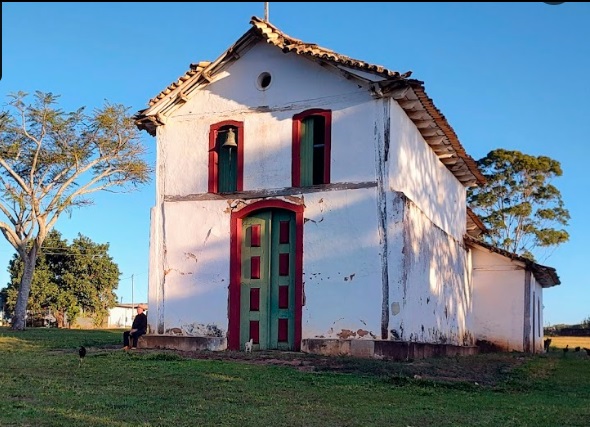
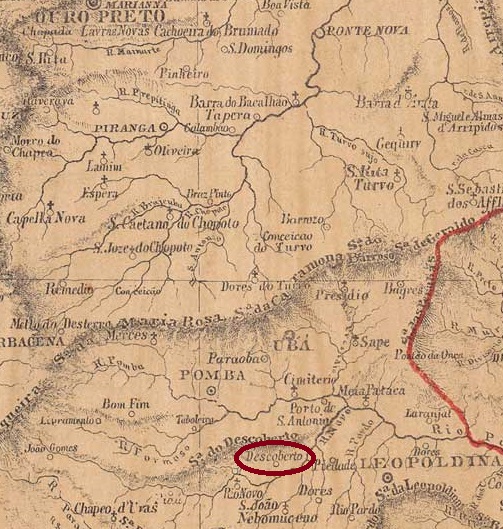
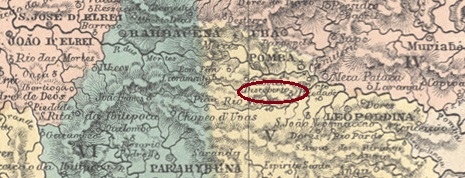
The chapel of Descoberto was built in June 1824. It belonged to the Freguesia do Rio Novo and was located on the southern slope of the Serra do Descoberto, 220 kilometres south-east of the provincial capital of Ouro Preto. In December 1865, the municipality was attached as a district to the Freguesia de S. João Nepomuceno, but returned to the Vila de Rio Novo as Freguesia da Santissima Trindade do Descoberto in December 1874, before being reattached to S. João Nepomuceno in November 1880. Descoberto has been a município since December 1953.
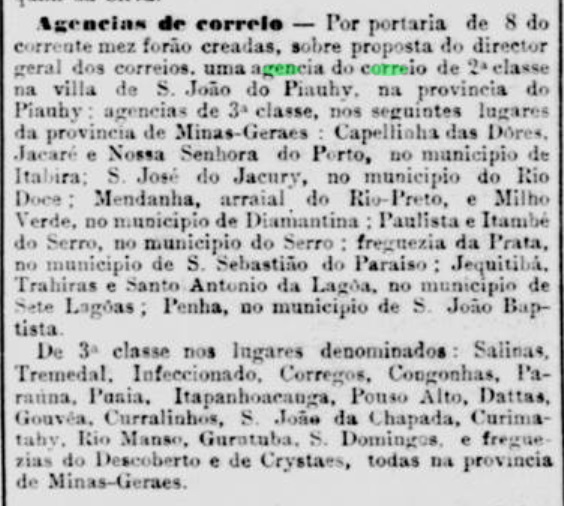
R. Koester (Carimbologia XVI) and Paula Sobrinho (História Postal de Minas Gerais, Belo Horizonte, 1997) also agree that the local post office was founded in November 1881. This is confirmed by the press in Rio:
Jornal do Commercio/RJ, 12/11/1881
The oldest postmark to date is DMG-0965a (fig. R. Koester, op. cit.):
DMG-0965a (RK) 1887-1890
Towards the end of the 19th century, the peculiar DMG-0965b also appeared (ill. from the Internet):
DMG-0965b (EB) 1891ffAtlas do Imperio do Brasil, 1868
Die Kapelle von Descoberto wurde im Juni 1824 errichtet. Sie gehörte zur Freguesia do Rio Novo und lag am Südhang der Serra do Descoberto, 220 km südöstlich der Provinzhauptstadt Ouro Preto. Im Dezember 1865 wurde die Gemeinde als Distrikt an die Freguesia de S. João Nepomuceno angeschlossen, kehrte aber im Dezember 1874 als Freguesia da Santissima Trindade do Descoberto zur Vila de Rio Novo zurück, bevor sie im November 1880 wieder an S. João Nepomuceno angeschlossen wurde. Seit Dezember 1953 ist Descoberto ein Município.
R. Koester (Carimbologia XVI) und Paula Sobrinho (História Postal de Minas Gerais, Belo Horizonte, 1997) sind sich auch hier einig, dass das lokale Postamt im November 1881 gegründet wurde. Dies wird von der Presse in Rio bestätigt:
Jornal do Commercio/RJ, 12.11.1881
Der bisher älteste Poststempel ist DMG-0965a (Abb. R. Koester, op. cit.):
DMG-0965a (RK) 1887-1890
Gegen Ende des 19. Jahrhunderts erschien auch der eigentümliche DMG-0965b (Abb. aus dem Internet):
Villiers de l’Ile Adam: Carta (…) da Provincia de São Paulo, 1847
See also Belém do Descalvado (BSP-0145)
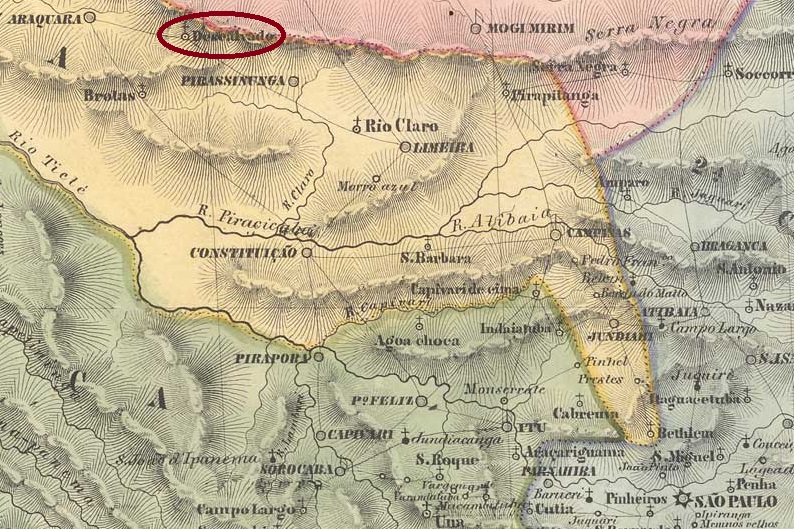
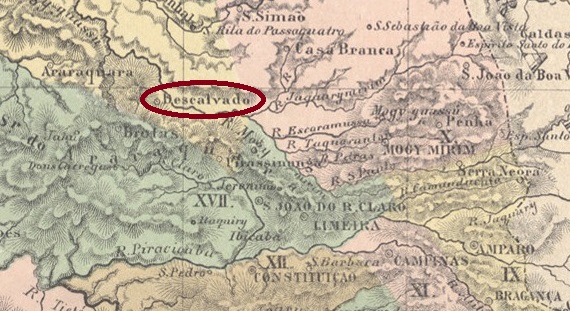
The chapel of N. Sra. de Belém was built in 1832 and was located on the west bank of the Bonito River at the Vila of Araraquara, 240 km north of the provincial capital of São Paulo. The village was elevated to Freguesia in February 1844 and passed to the Município of Rio Claro the following year. In April 1864, it was promoted to Vila in its own Município, and in April 1889, it became a town, simply called Descalvado since December 1908.
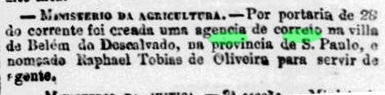
In June 1865 came the official decree for a post office on site, as reported in the capital press:
Jornal do Commercio/RJ, 30/06/1865
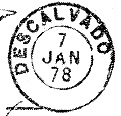
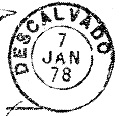
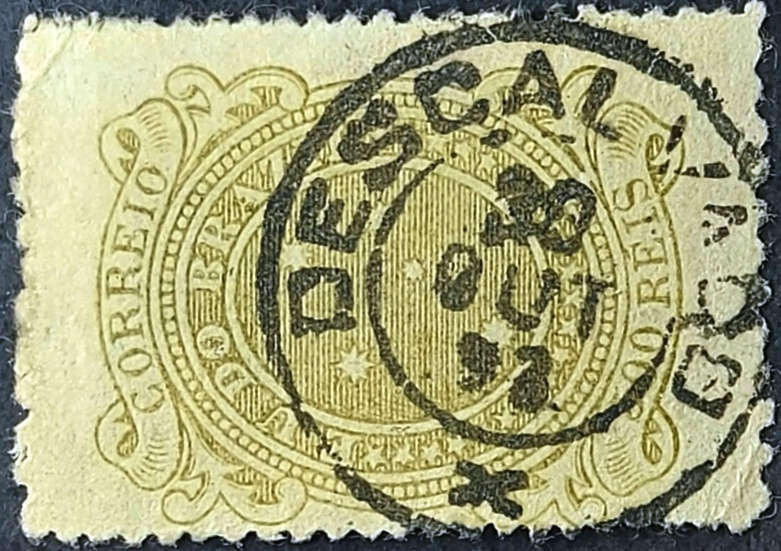
Until about 1878 the postmarks bore the place name BELEM DO DESCALVADO (see BSP-0145). Then came DSP-0435a (fig. R. Koester, in Carimbologia IV):
DSP-0435a (RK) 1878-1881
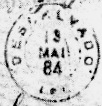
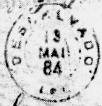
It was followed by the French type DSP-0435b (fig. R. Koester, op.cit.):
DSP-0435b (RK) 1878ff-1885
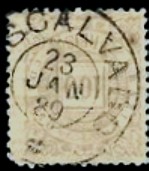
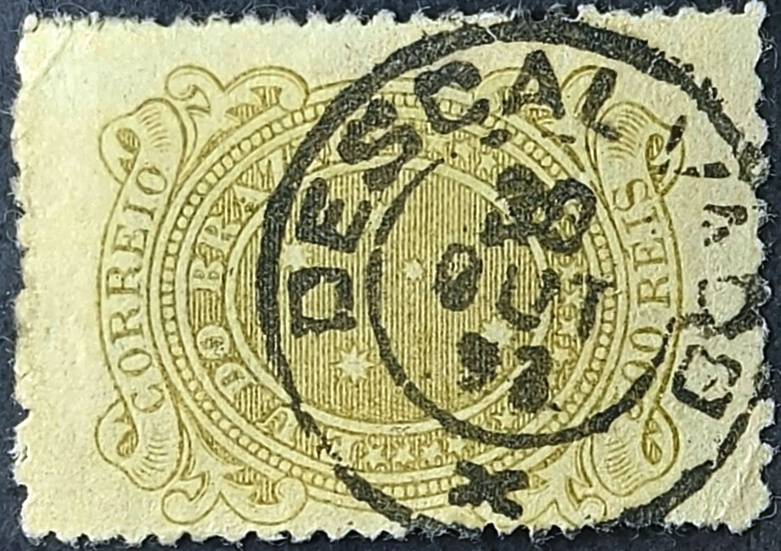
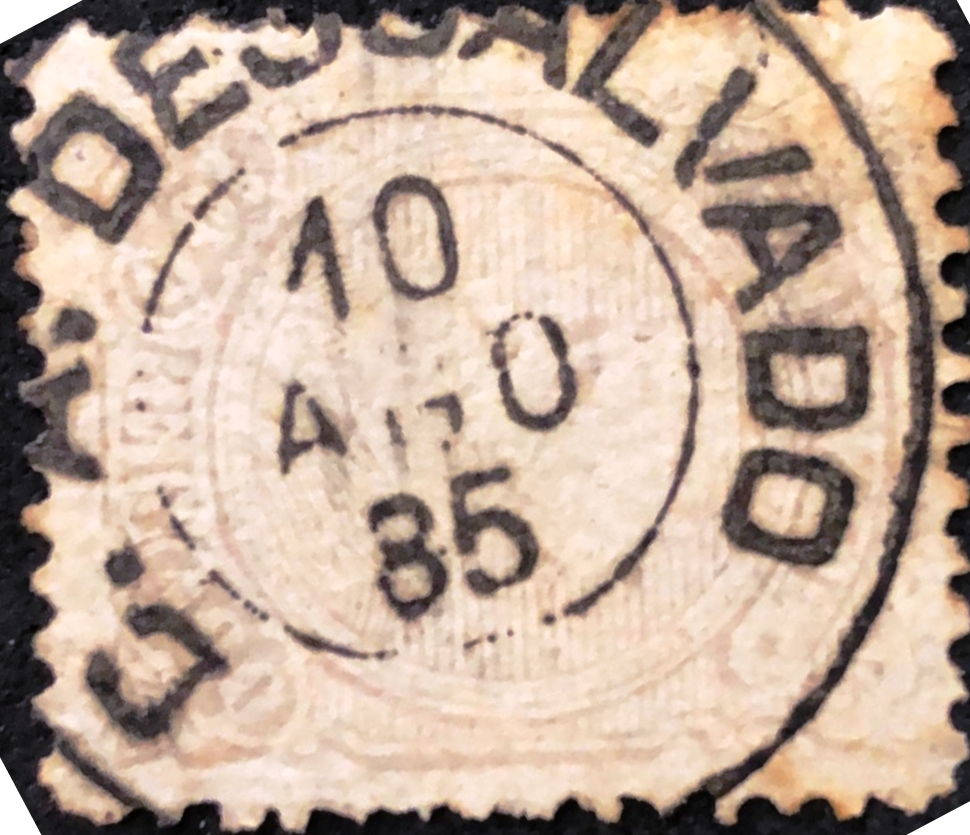
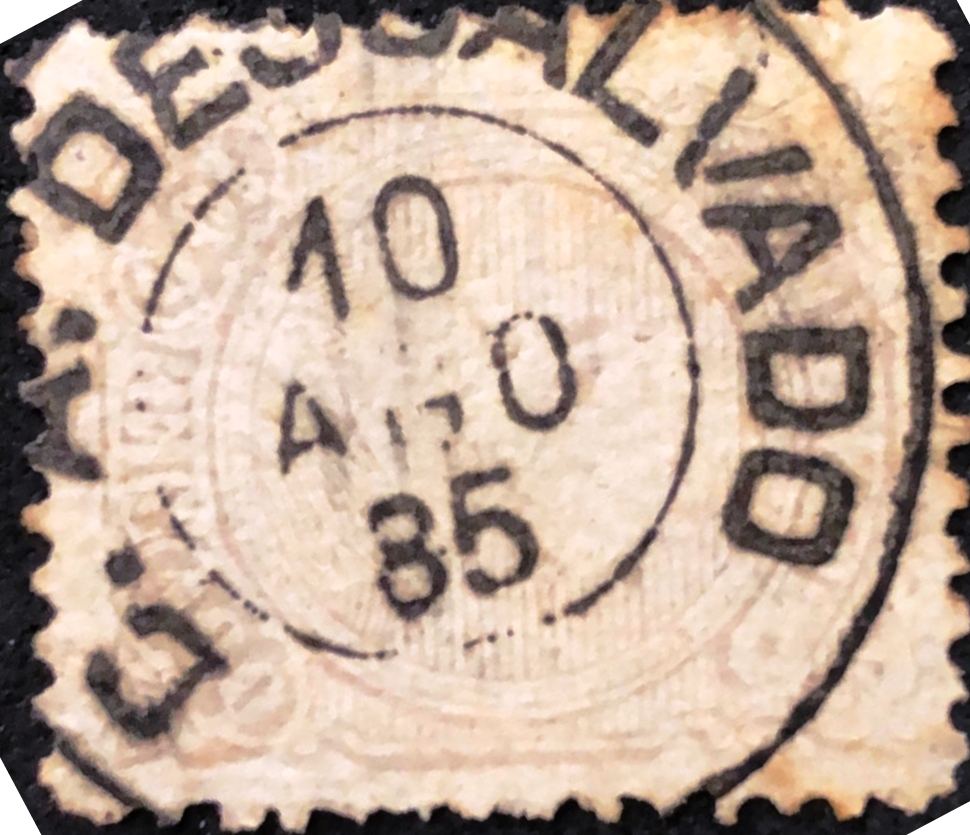
Then came DSP-0435c, which was already presented by P. Ayres in Catálogo de Carimbos Brasil-Império (S. Paulo, 1937, 1942) with no. 1726:
DSP-0435c (P.A. 1726-EB) 1883ff-1887ff
DSP-0435d also appeared at the end of the Empire (ill. Claudio Neumann):
DSP-0435d (CN) 1887-1889
And probably at the beginning of the Republic came DSP-0435e (ill. Luíz C. Fritzen):
DSP-0435e (LCF) 1893
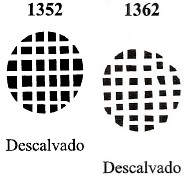
Three mute cancellations are known from Descalvado. R. Koester showed the first one in Carimbologia IV:
1878 (RK)
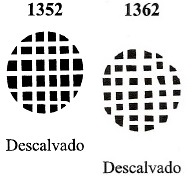
James Dingler and Klerman W. Lopes have added two more in Mute Cancellations of the Brazil Empire / Carimbos Mudos do Brasil Império (Brazil Philatelic Association, Rio de Janeiro, 2000) with nos. 1352 and 1362:
BPA 1352 (P.A. 319) – 1362
In November 1881, a Cia. Paulista railway station was built in Descalvado, albeit without its own post office. On the other hand, the railway line’s ambulant postmark is known: DSP-0436a (fig. R. Assef Jr.):
DSP-0436a (RA) 1885-1891Atlas do Imperio do Brasil, 1868
Siehe auch Belém do Descalvado (BSP-0145)
Die Kapelle von N. Sra. de Belém wurde 1832 erbaut und liegt am Westufer des Flusses Bonito in der Nähe der Stadt Araraquara, 240 km nördlich der Provinzhauptstadt São Paulo. Die Stadt wurde im Februar 1844 zur Freguesia erhoben und im folgenden Jahr in das Município Rio Claro eingegliedert. Im April 1864 erfolgte die Erhebung zur Vila im eigenen Município und im April 1889 die Ernennung zur Stadt, die seit Dezember 1908 einfach Descalvado genannt wird.
Im Juni 1865 kam die behördliche Anordnung, ein Postamt vor Ort einzurichten, wie die Hauptstadtpresse berichtete:
Jornal do Commercio/RJ, 30.06.1865
Bis etwa 1878 trugen die Poststempel die Ortsbezeichnung BELEM DO DESCALVADO (siehe BSP-0145). Dann kam DSP-0435a (Abb. R. Koester, in Carimbologia IV):
DSP-0435a (RK) 1878-1881
Ihm folgte der französischer Typ DSP-0435b (Abb. R. Koester, op.cit.):
Am Ende des Kaiserreichs erschien auch DSP-0435d (Abb. Claudio Neumann):
DSP-0435d (CN) 1887-1889
Und wohl zu Beginn der Republik kam DSP-0435e (Abb. Luíz C. Fritzen):
DSP-0435e (LCF) 1893
Aus Descalvado sind drei stumme Abstempelungen bekannt. R. Koester zeigte die erste in Carimbologia IV:
1878 (RK)
James Dingler und Klerman W. Lopes haben zwei weitere in Mute Cancellations of the Brazil Empire / Carimbos Mudos do Brasil Império (Brazil Philatelic Association, Rio de Janeiro, 2000) mit Nr. 1352 und 1362 versehen:
BPA 1352 (P.A. 319) – 1362
Im November 1881 wurde in Descalvado ein Bahnhof der Cia. Paulista gebaut, allerdings ohne eigenes Postamt. Bekannt ist dagegen der ambulante Poststempel der Bahnlinie: DSP-0436a (Abb. R. Assef Jr.):
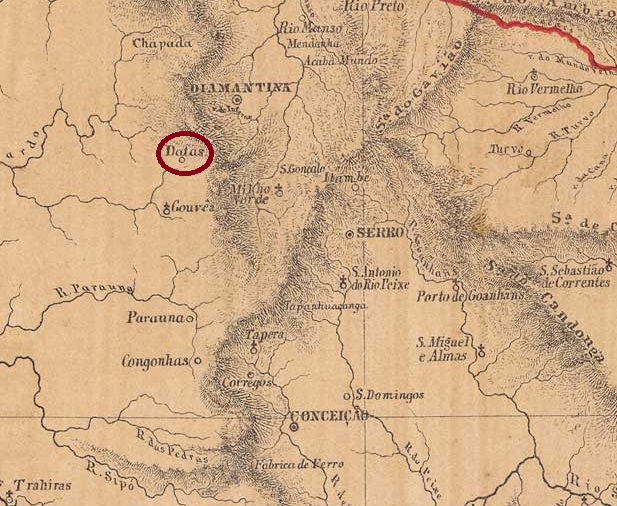
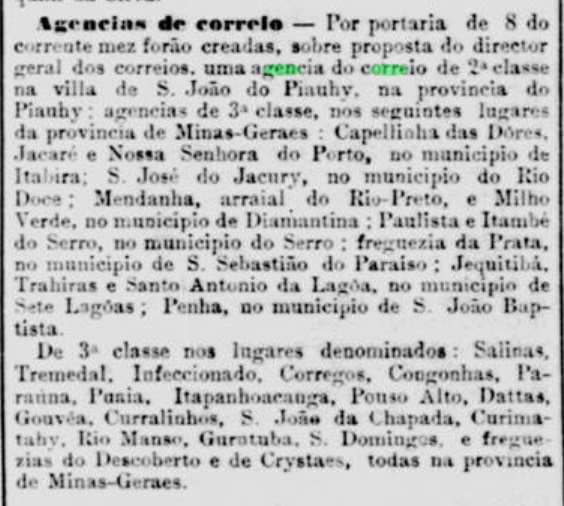
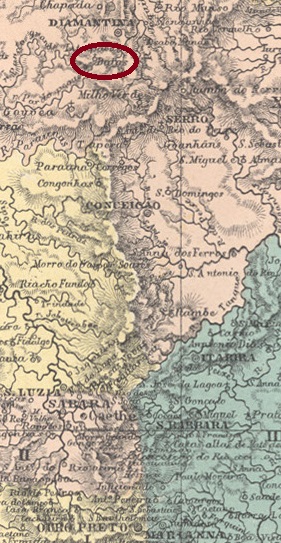
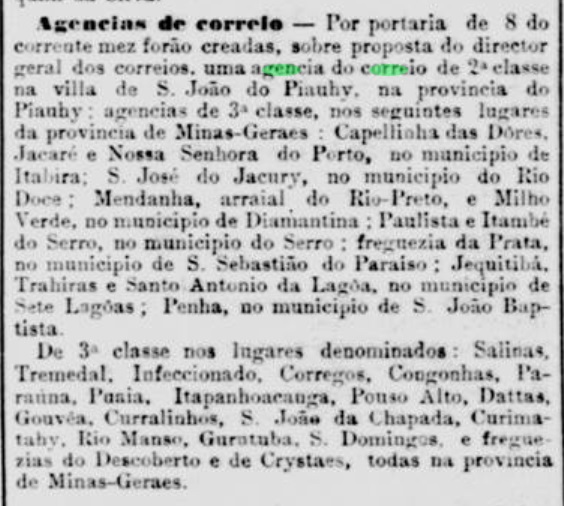
The Freguesia de Espírito Santo das Dattas was founded in November 1866 and belonged to the Vila de Diamantina, 360 kilometres north of the provincial capital Ouro Preto. It was not until December 1962 that it was elevated to the status of Município de Datas (as it is written today).
Both R. Koester (Carimbologia XVI) and Paula Sobrinho (História Postal de Minas Gerais, Belo Horizonte, 1997) agree that there was a post office there from November 1881. This is confirmed by the press in Rio:
Jornal do Commercio/RJ, 12/11/1881
Initially, the stamps were cancelled by hand, as R. Koester (op. cit.) shows:
1884 (RK)
Then came the simple round cancellation DMG-0960a, which Koester mentions (unfortunately without illustration) with a date of 1887.
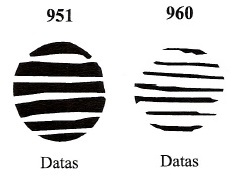
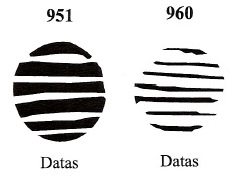
James Dingles and Klerman W. Lopes in Mute Cancellations of the Brazil Empire / Carimbos Mudos do Brasil Império (Brazil Philatelic Association, Rio de Janeiro, 2000) have registered two mute cancels from Dattas with nos. 951 and 960:
BPA 951 (1883) and 960Atlas do Imperio do Brasil, 1868
Anderer Name: Ribeirão das Dattas
Die Freguesia de Espírito Santo das Dattas wurde im November 1866 gegründet und gehörte zur Vila de Diamantina, 360 km nördlich der Provinzhauptstadt Ouro Preto. Erst im Dezember 1962 erfolgte die Erhebung zum Município de Datas (wie es heute geschrieben wird).
Sowohl R. Koester (Carimbologia XVI) als auch Paula Sobrinho (História Postal de Minas Gerais, Belo Horizonte, 1997) sind sich einig, dass es dort ab November 1881 ein Postamt gab. Dies wird von der Presse in Rio bestätigt:
Jornal do Commercio/RJ, 12.11.1881
Anfangs wurden die Marken von Hand entwertet, wie R. Koester (op. cit.) zeigt:
1884 (RK)
Dann kam der einfache Rundstempel DMG-0960a, den Koester (leider ohne Abbildung) mit einem Datum aus 1887 erwähnt.
James Dingles und Klerman W. Lopes haben in Mute Cancellations of the Brazil Empire / Carimbos Mudos do Brasil Império (Brazil Philatelic Association, Rio de Janeiro, 2000) auch zwei stumme Stempel aus Dattas mit Nr. 951 und 960 registriert:
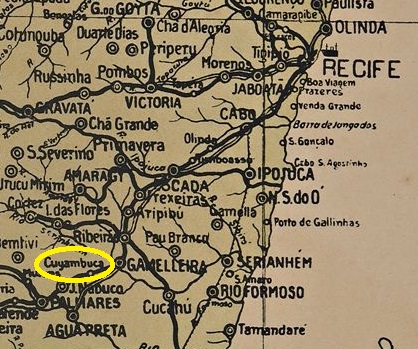
Carta Corogaphica da Provincia de Pernambuco, 1880
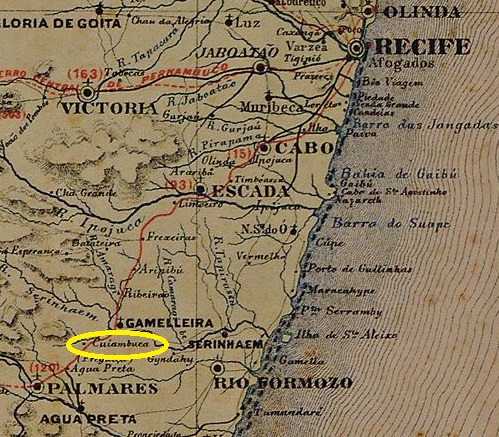
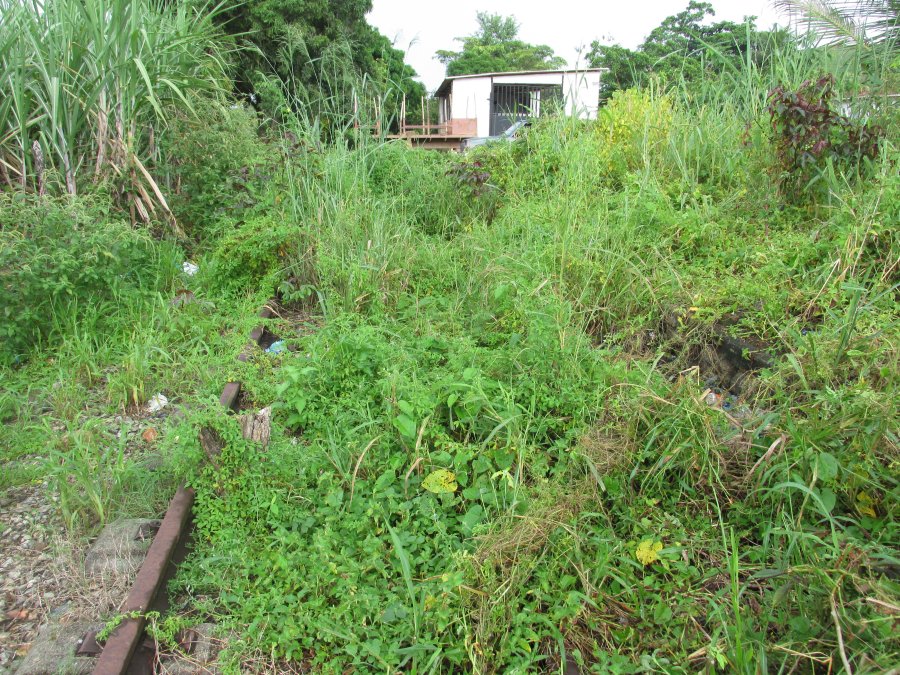
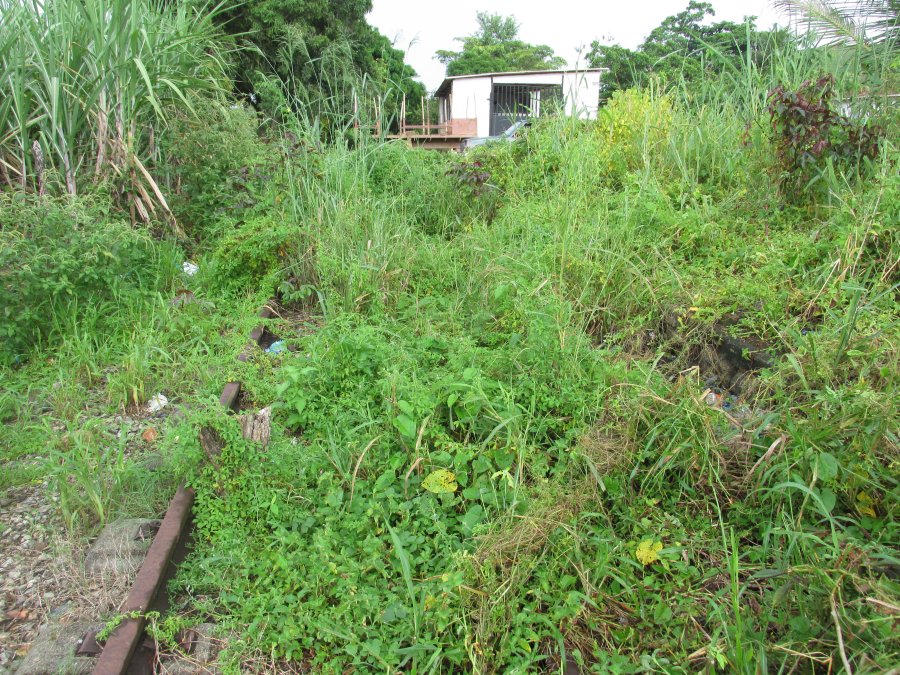
Cuyambuca station was opened in June 1862 by the railway company E.F. do Recife ao São Francisco (Southern Line) in the Município de Serinhaem, 100 km south-west of the provincial capital Recife. The line then changed hands three times: in 1901 it went to Great Western, in 1950 to Rede Ferroviária do Nordeste and from 1975 until its closure in 1996 it belonged to Rede Ferroviária Federal S.A. (estacoesferroviarias.com.br). The tracks are still there today, but the station building has long since been demolished.
In November 2019 (Photo: Sydney Correa, on estacoesferroviarias.com.br)
The area around the railway station was added to the newly founded Município de Gameleira in June 1872 and has been a district since January 1931.
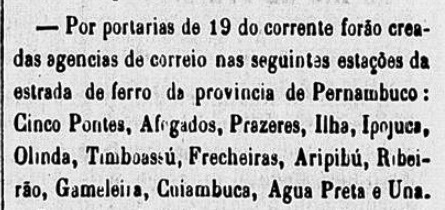
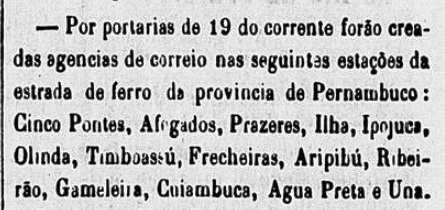
As reported in the Rio press, there had been a post office there since December 1864:
Constitucional/RJ, 24/12/1864
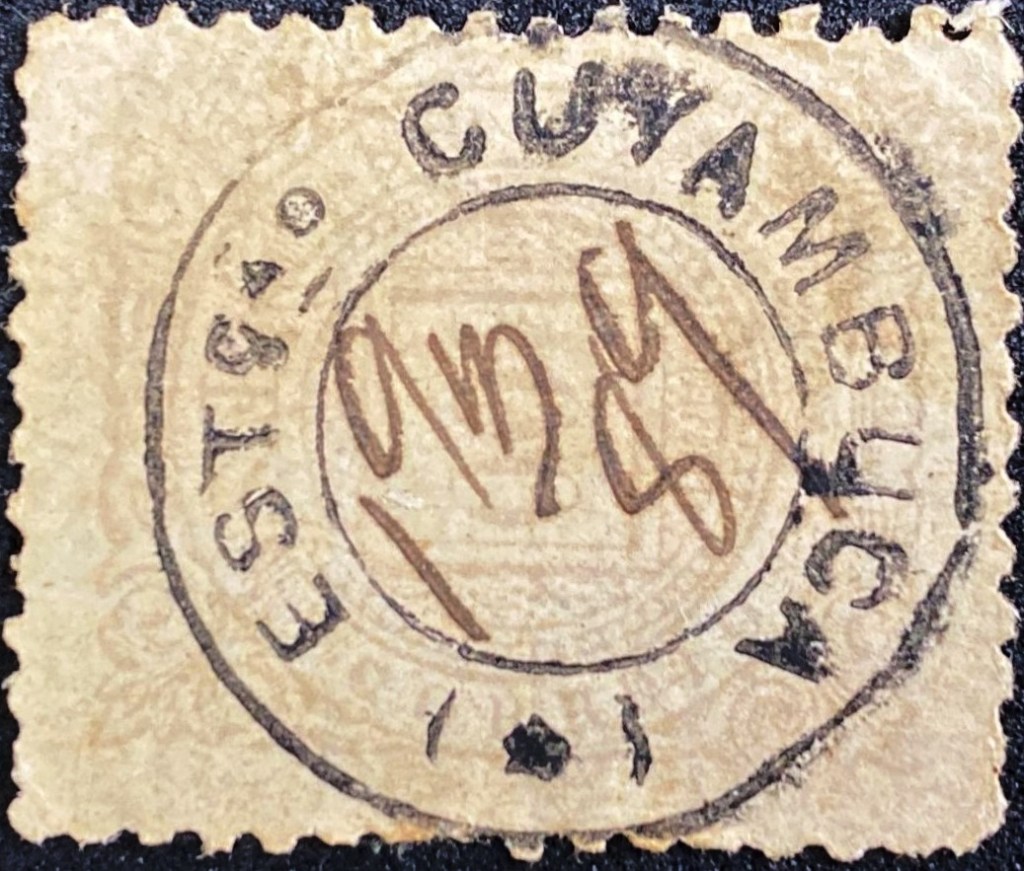
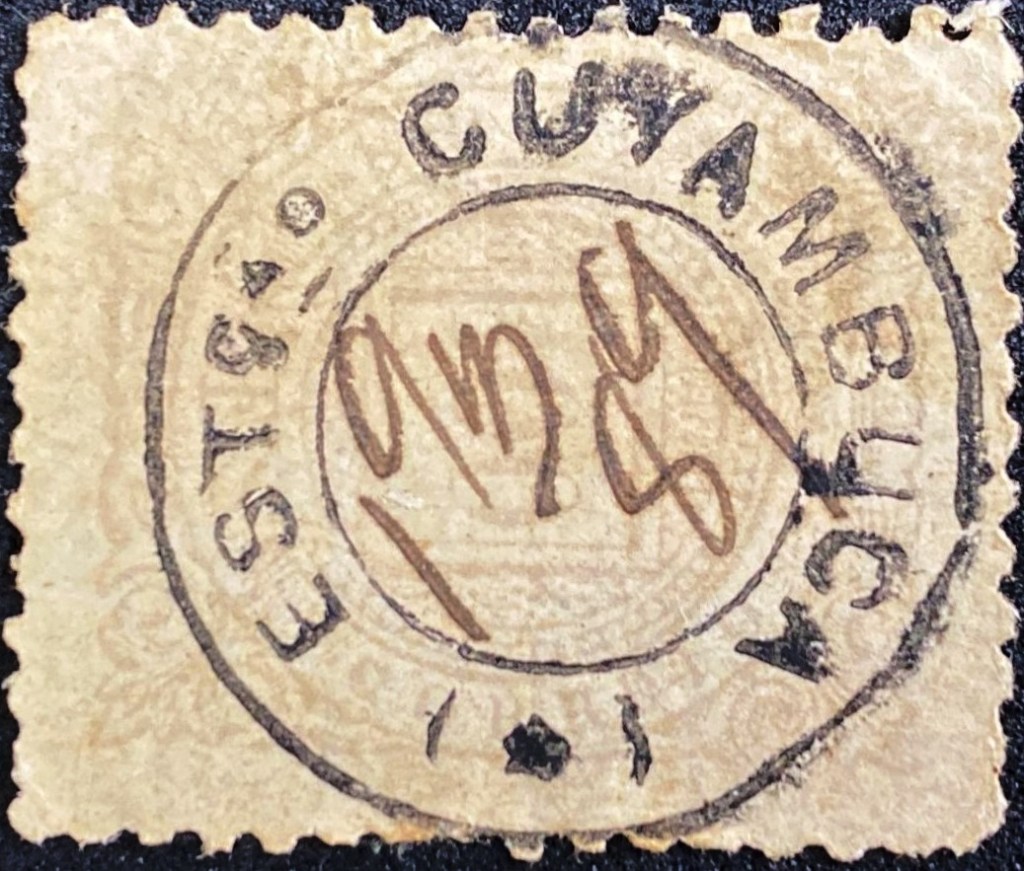
The only postmark in the Empire to date is CPE-0225b (Fig. Felipe Piccinini):
CPE-0225b (FP) 1885-1890Arthur D. Ribeiro: Estado de Pernambuco, 1924
Der Bahnhof Cuyambuca wurde im Juni 1862 von der Eisenbahngesellschaft E.F. do Recife ao São Francisco (Südlinie) eröffnet und lag im Município de Serinhaem, 100 km südwestlich der Provinzhauptstadt Recife. Danach wechselte die Strecke dreimal den Besitzer: 1901 ging sie an die Great Western, 1950 an die Rede Ferroviária do Nordeste und von 1975 bis zu ihrer Stilllegung 1996 gehörte sie der Rede Ferroviária Federal S.A. (estacoesferroviarias.com.br). Heute sind die Gleise noch vorhanden, das Bahnhofsgebäude ist längst abgerissen.
Im November 2019 (Foto: Sydney Correa, auf estacoesferroviarias.com.br)
Das Gebiet um den Bahnhof wurde im Juni 1872 dem neu gegründeten Município de Gameleira zugeschlagen und ist seit Januar 1931 ein Distrikt.
Wie in der Presse von Rio berichtet, gab es dort seit Dezember 1864 ein Postamt:
Constitucional/RJ, 24.12.1864
Der bisher einzige Poststempel im Kaiserreich ist CPE-0225b (Abb. Felipe Piccinini):


























 Carimbologia