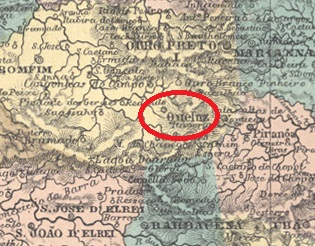
Text update of December 26, 2025
Other names: Arraial dos Carijós, Conselheiro Lafaiete (1934)
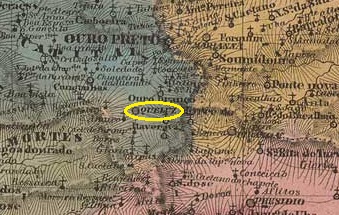
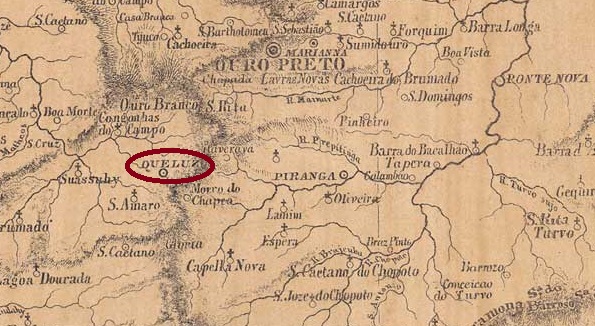
As early as 1683 there was a settlement called Arraial dos Carijós in the region whose capital was São João del Rey. In 1752 it was named the district of Queluz, which became a Villa in 1791 and a town in 1866. According to Nova Monteiro, a post office was installed on March 5, 1829. Since 1934 it is called Conselheiro Lafaiete, a homage to Lafayette Rodrigues Pereira (1834-1917), lawyer, journalist and politician, a most prominent son of Queluz.
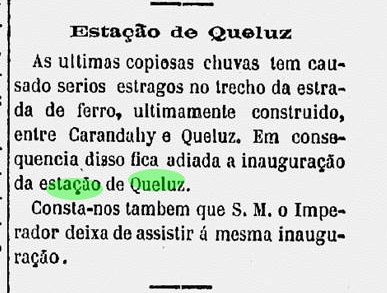
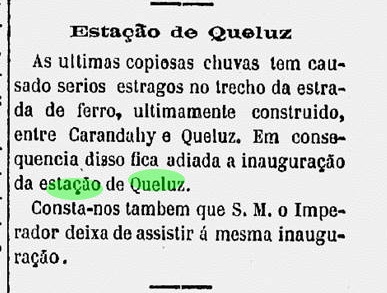
Both Ralph Giesbrecht (estacoesferroviarias.com.br) and Paula Sobrinho (História Postal de Minas Gerais, Belo Horizonte, 1997) claim the railroad station, which was soon called Lafayette (to avoid confusion with the train station Queluz in São Paulo), was installed there on December 15, 1883. But according to the local press, this date had to be postponed due to bad weather:
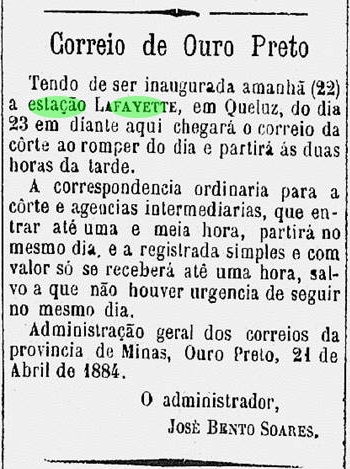
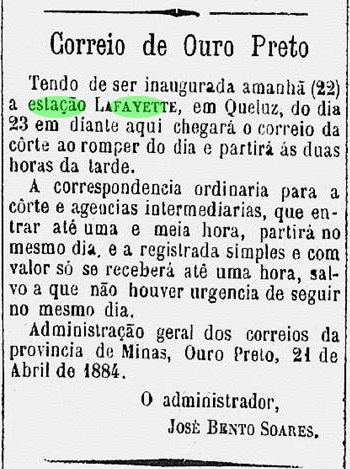
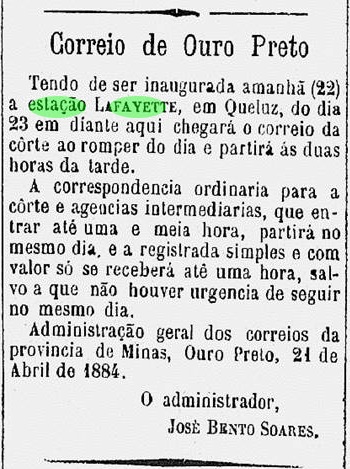
The definitive inauguration date for the train station is April 22, 1884 (s. below), and from that time post was carried by rail. From June on, according to Paula Sobrinho, there was an additional post office at the station.
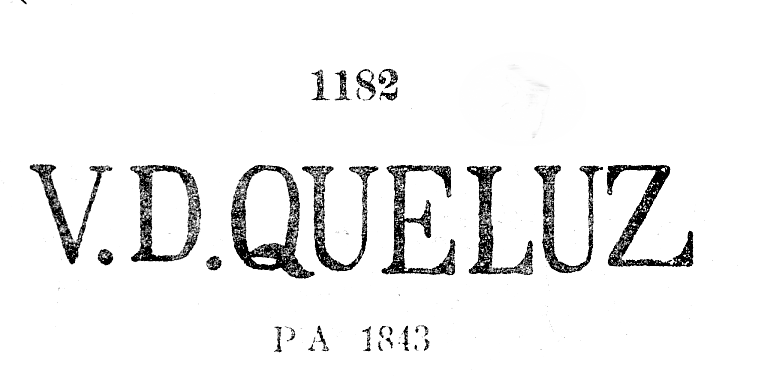
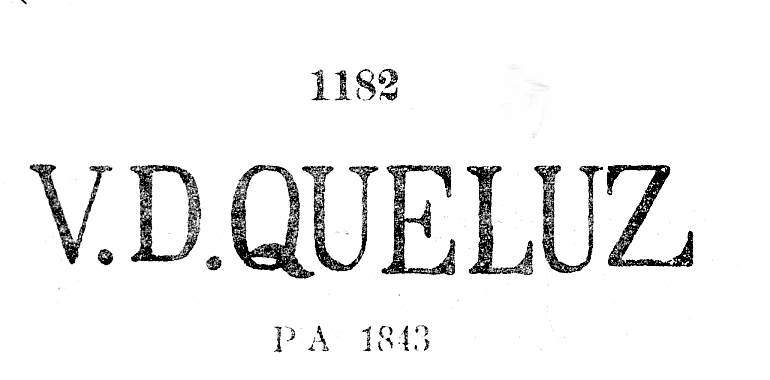
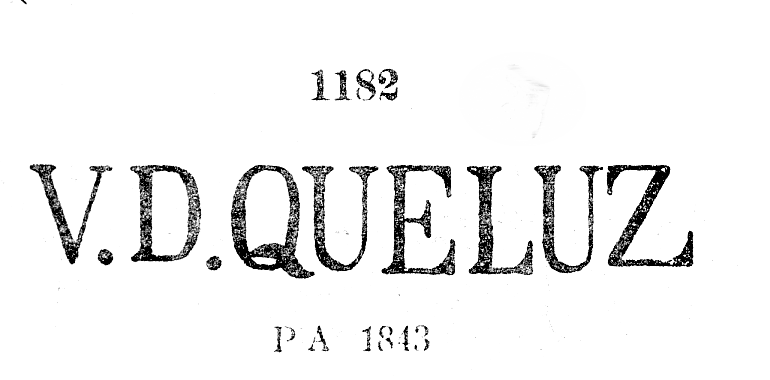
QMG-2075a (Coll. José A. Junges) is the famous cancel V. (i.e. Villa) DE QUELUZ (Paulo Ayres #1182), which circulated at least between 1835 and 1860. One can find often a horizontal pen stroke underneath, and this cancel occurs in black, red, brown and dark blue.
QMG-2075b (Coll. José A. Junges) is a wonderful manuscript cancel, easily recognisable through the embellished final Z. It was found between 1861 and 1876.
QMG-2075c (Coll. Marco Morel) is another manuscript cancel, which can be identified as from Minas Gerais, for it clearly shows Queluz/Minas below. Marco Morel wrote a very interesting article about manuscript cancels from Queluz/MG (Die handschriftlichen Entwertungen aus Queluz, in Forschungsbericht 86, ArGe Brasilien, 2019)
QMG-2075d (Coll. José A. Junges) has the typical double circle with QUELUZ above, (MINAS) below and the date (between 1886 and 1892) within the inner circle.
QMG-2075e (Coll. José A. Junges) was previously thought to be a postmark from the town of the same name in São Paulo, until philatelist Claudio Coelho discovered that it belonged here. In this double circle (also in blue) we have the inscription QUELUZ above, below is an ornament in lozenge formed by four small lozenges. Dates in the middle: 1882-1888.
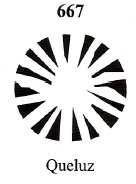
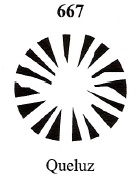
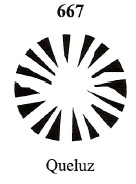
Then we have a mute cancel from Queluz, which probably originates from this province and was assigned the number 667 in Mute Cancellations of the Brazil Empire / Carimbos Mudos do Brasil Império (Brazil Philatelic Association, Rio de Janeiro, 2000) by J. Dingler and Klerman W. Lopes.
Texto atualizado em 26 de dezembro de 2025
Outros nomes: Arraial dos Carijós, Conselheiro Lafaiete (1934)
Já em 1683 houve uma povoação chamada Arraial dos Carijós, na região administrada por São João d’El Rey. Em 1752 foi ali fundado o distrito de Queluz, que se tornou vila em 1791 e cidade em 1866. Segundo Nova Monteiro, a agência do correio local foi instalada em março de 1829. Desde 1934 é o município de Conselheiro Lafaiete, uma homenagem a Lafayette Rodrigues Pereira (1834-1917), advogado, jornalista e político, o mais famoso filho de Queluz.
Tanto Ralph Giesbrecht (estacoesferroviarias.com) quanto Paula Sobrinho (História Postal de Minas Gerais, Belo Horizonte, 1997) indicam 12 de dezembro de 1883 como data da inauguração da estação de Lafayette – que foi assim chamada para evitar confusão com a estação paulista de Queluz, esta inaugurada já em 1874. No entanto, a inauguração da estação mineira foi adiada devido ao mau tempo (ver A Provincia de Minas, 4 de janeiro de 1884), realizando-se somente em 22 de abril do ano seguinte:
Segundo Paula Sobrinho (op.cit.), já em junho de 1884 houve uma agência postal também na estação ferroviária de Queluz, mas até agora não foi possível diferenciar os carimbos entre as agências locais.
QMG-2075a (Col. José A. Junges) é o já famoso carimbo listado por Paulo Ayres (Carimbos Postais –Brasil Império, S. Paulo, 1937) sob No.1182, que circulou pelo menos de 1835 a 1860. Encontra-se com frequência uma linha horizontal manuscrita na parte inferior. O carimbo ocorre em preto, vermelho, marrom e azul escuro:
QMG-2075b (Col. José A. Junges) é uma bela obliteração manuscrita, facilmente reconhecível pelas curvas da letra final Z. Os exemplares conhecidos vão de 1861 a 1876.
QMG-2075c (Col. Marco Morel) é outro manuscrito, claramente mineiro por apresentar Queluz/Minas nap arte inferior.
QMG-2075d (Col. José A. Junges) apresenta o típico círculo duplo, a mostrar acima a inscrição QUELUZ, abaixo (MINAS) e a data dentro do círculo interior.
QMG-2075e (Col. José A. Junges) era anteriormente considerado um carimbo postal da cidade do mesmo nome em São Paulo, até que o filatelista Claudio Coelho descobriu que ele era daqui. Neste círculo duplo temos a inscrição QUELUZ acima, abaixo está um ornamento em losango formado por quatro pequenos losangos. Datas no meio: 1882-1888.
Sobre as obliterações manuscritas de Queluz (MG e SP) Marco Morel escreveu um artigo publicado no Boletim de Pesquisas No. 86 da ArGe-Brasilien alemã (dezembro de 2019).
Temos ainda um carimbo mudo de Queluz, que provavelmente é originário dessa província e recebeu o número 667 em Mute Cancellations of the Brazil Empire / Carimbos Mudos do Brasil Império (Clube Filatélico do Brasil, Rio de Janeiro, 2000), de J. Dingler e Klerman W. Lopes.
Textaktualisierung vom 26. Dezember 2025
Schon in 1683 gab es seine Siedlung in der Gegend von São João del-Rey, genannt Arraial dos Carijós. In 1752 wurde aus der Siedlung der Distrikt von Queluz, ab 1791 als Villa und ab 1866 als Stadt. Laut Nova Monteiro wurde dort bereits am 5.3.1829 ein Postamt errichtet. Seit 1934 heißt der Ort Conselheiro Lafaiete, eine Hommage an Lafayette Rodrigues Pereira (1834-1917), Jurist, Journalist und Politiker, den berühmtesten Sohn von Queluz.
Sowohl Rolf Giesbrecht (estacoesferroviarias.com.br) als auch Paula Sobrinho (História Postal de Minas Gerais, Belo Horizonte, 1977) behaupten, der Bahnhof dort (der bald Estação Lafayette genannt wurde, um Verwechslungen mit dem Queluz-Bahnhof aus S. Paulo zu vermeiden) wurde am 15.12.1883 eingeweiht. Dieses geplante Datum musste aber, laut Presseberichten, verschoben werden:
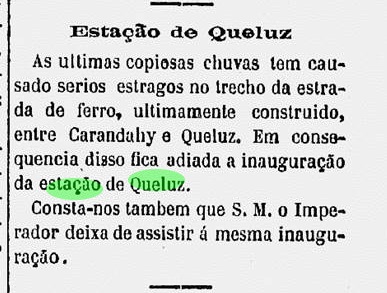
Das korrigierte Einweihungsdatum für diesen Bahnhof soll 22.04.1884 heißen (s. Bild). Von nun an war die Post per Bahn befördert, und laut Paula Sobrinho wurde schon in Juni 1884 ein zusätzliches Postamt, diesmal für die Bahnstation, errichtet:
QMG-2075a (Samml. José A. Junges) ist der berühmte Stempel V. (für Villa) DE QUELUZ (P. A. Nr. 1182), einzutreffen mindestens zwischen 1835 und 1860. Oft hat er einen waagerechten Federstrich unterhalb der Schrift. Diese Abstempelung kommt in schwarz, rot, braun und dunkelblau vor.
QMG-2075b (Samml. José A. Junges) ist eine wunderbare Handentwertung, leicht zu erkennen durch the Verzierung am Buchstaben Z am Ende. Bisher gefunden zwischen 1861 und 1876.
QMG-2075c (Samml. Marco Morel) ist eine weitere Manuskriptentwertung, leicht erkennbar als aus Minas, da es klar Queluz/Minas unten zeigt. Marco Morel schrieb einen sehr interessanten Text darüber (Die handschriftlichen Entwertungen aus Queluz, in Forschungsbericht 86, ArGe Brasilien, 2019)
QMG-2075d (Samml. José A. Junges) hat den typischen Doppelkreis, mit QUELUZ oben, (MINAS) unten, dazu das Datum innerhalb des Innenkreises: 1886-1892.
QMG-2075e (Samml. José A. Junges) galt bislang als ein Poststempel aus dem gleichnamigen Ort in São Paulo, bis der Philatelist Claudio Coelho herausfand, dass er hierhergehört. In diesem Doppelkreis haben wir die Inschrift QUELUZ oben, unten ist ein Ornament in Raute, das von vier kleinen Rauten gebildet wird. Daten in der Mitte: 1882-1888.
Dann haben wir noch einen stummen Stempel aus Queluz, der vermutlich aus dieser Provinz stammt und die Nr. 667 in Mute Cancellations of the Brazil Empire / Carimbos Mudos do Brasil Império (Brazil Philatelic Association, Rio de Janeiro, 2000) von J. Dingler und Klerman W. Lopes erhielt.

 Carimbologia