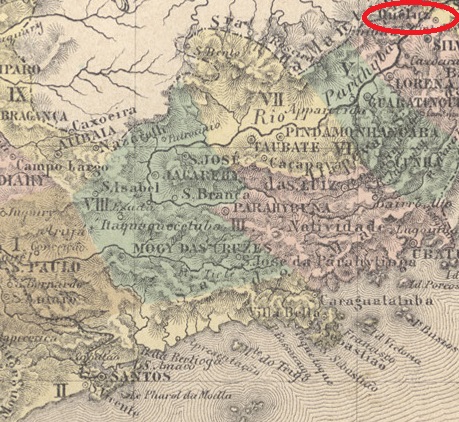
Text update of December 26, 2025
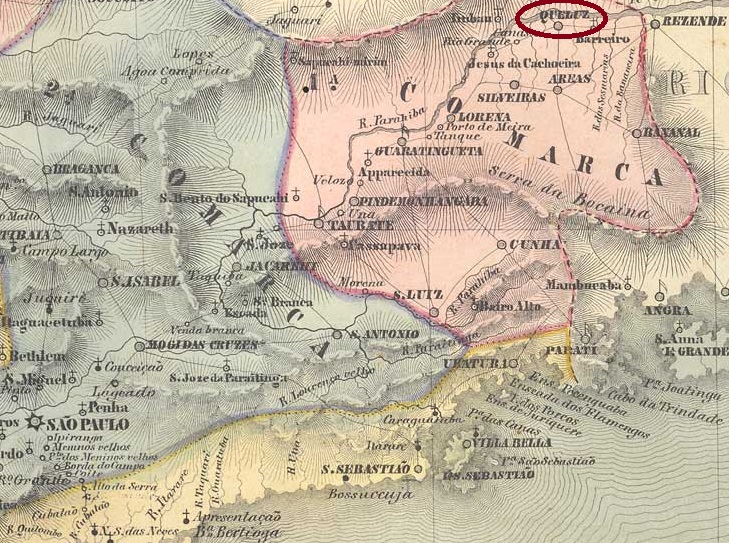
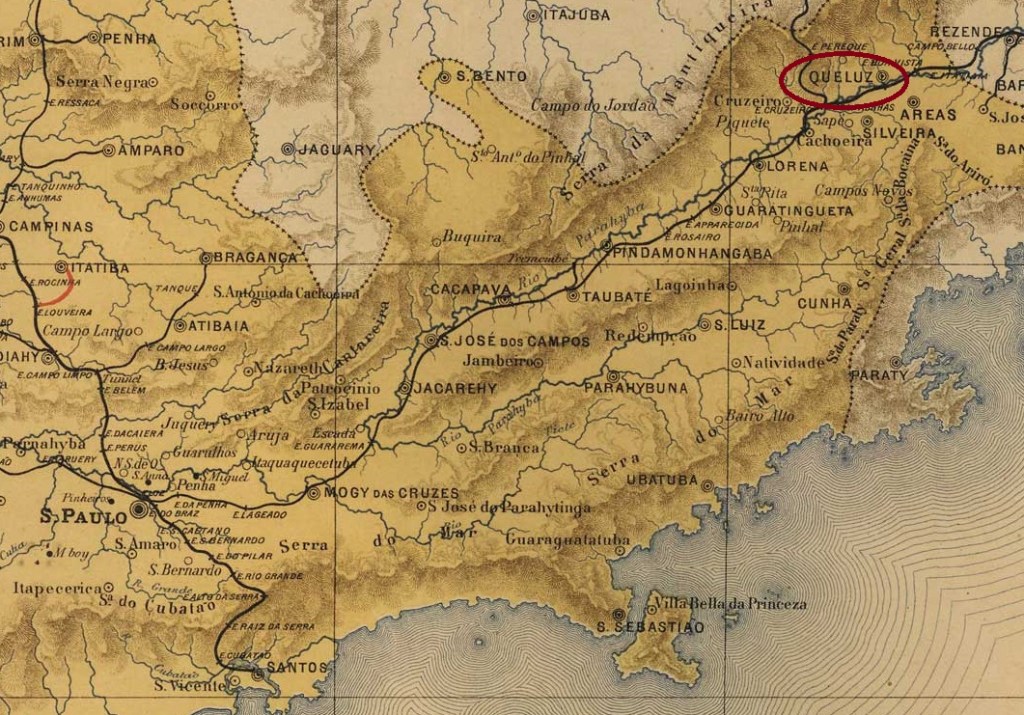
The parish of São João Baptista de Queluz was established near the Paraíba River in the municipality of Lorena at the edge of the São Paulo province in 1803. The post office was installed in 1840 (see Nova Monteiro: Administrações e Agências Postais do Brasil Império 1798-1869, Brasil Filatélico 1834-5, reprint SPP, 1994-99), two years before Queluz was made a Villa. A period of economic stagnation followed, until the arrival of the Estrada de Ferro D. Pedro II railway, in 1874.
Although there was another important town with the same name in imperial Minas Gerais (QMG-2075), the paulista Queluz has at least five slightly different cancels within its early period, which were probably handmade, all of them in black, featuring the locality name in a small rectangle.
QSP-1040a depicts “S.J. DE QUELUS”; QSP-1040b has the inscription “S.J.DEQUELLUS” and was used in 1840; QSP-1040c shows “V. DE S. J DEQUELLUZ” and is known for 1842; QSP-1040d follows with “V.D.S.J.D.QUELLUZ” with examples from 1843 and 1844; and QSP-1040e finishes with “V.S.J.DEQUELLUZ”.
The four last cancels were discovered by Karlheinz Wittig during the BRASILIANA 83 philatelic exhibition in Rio de Janeiro. Having found some Queluz letters in the National Museum, Wittig reported to Rolf H. Meyer who, after observing all cancels himself, asked his son Peter to take pictures of them. The Museu Nacional burned out in September 2019, with all original letters and their Queluz cancels.
QSP-1040f was already registered by Paulo Ayres (#1589). Used from ca. 1850 until ca. 1870:

The old QSP-1040g turned out to be a stamp of the city of the same name in Minas Gerais, as the philatelist Claudio Coelho from S. Paulo was able to prove. It has now been replaced by the new QSP-1040g (image from the Internet):
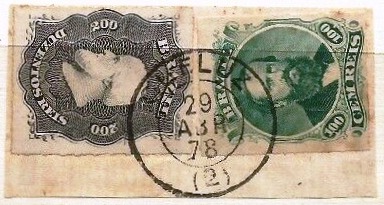
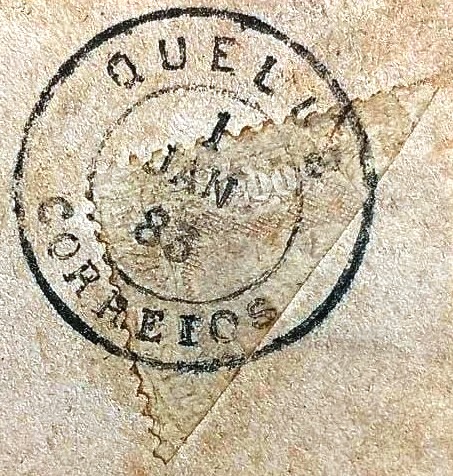
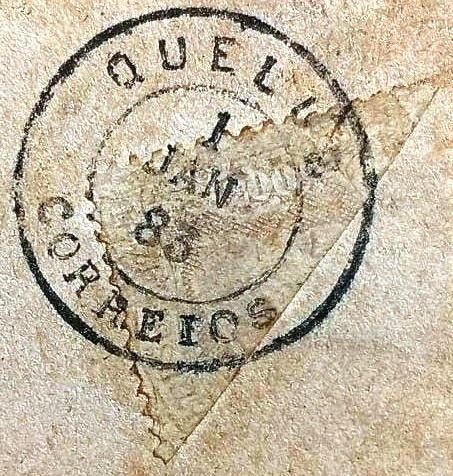
QSP-1040h is a French-type cancel, a small single circle with a small star between parentheses below. Dates found for 1883 until 1893.
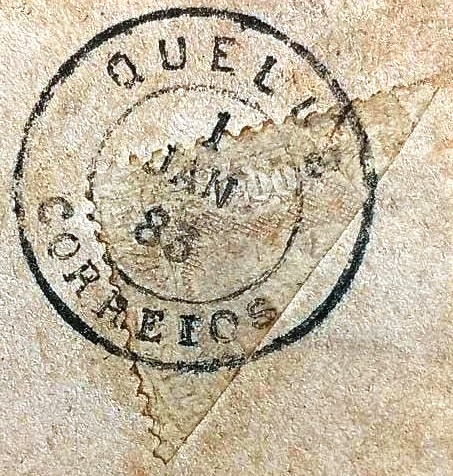
After Carimbologia Q-R went to press in 2019, the postmark QSP-1040i (illustration by Felipe Piccinini) was discovered:
Texto atualizado em 26 de dezembro de 2025
A paróquia de São João Baptista de Queluz foi instalada em 1803 às margens do Paraíba, no município de Lorena, confins da província de São Paulo. A agência postal veio em 1840, dois anos antes de Queluz tornar-se vila, segundo Nova Monteiro (Administrações e Agências Postais do Brasil Império 1798-1869, Brasil Filatélico, 1934-5, reimpressão SPP, 1994-99). Seguiu-se um período de estagnação econômica, após os disturbios da Revolta Liberal de 1842, que só terminou com o advento da linha ferroviária da E.F. D. Pedro II, em 1874.
Paralelamente à sua homônima mineira, a Queluz paulista tem, no início de sua atividade postal, pelo menos cinco carimbos primitivos, provavelmente feitos a mão. Todos eles em preto, a apresentar o topônimo detro de um retângulo estreito.
QSP-1040a mostra “S.J. DE QUELUS”; QSP-1040b tem a inscrição “S.J.DEQUELLUS” e foi utilizado em 1840; QSP-1040c apresenta “V. DE S. J DEQUELLUZ” e foi usado em 1842; QSP-1040d segue com “V.D.S.J.D.QUELLUZ” , onde há exemplos de 1843 e 1844; e QSP-1040e conclui com “V.S.J.DEQUELLUZ”.
Os carimbos de QSP-1040b a QSP-1040e foram descobertos pelo filatelista alemão Karlheinz Wittig durante a exposição filatélica BRASILIANA 83 no Rio de Janeiro. Após haver encontrados algumas cartas antigas da Queluz paulista expostas no Museu Nacional, Wittig relatou sua descoberta a Rolf H. Meyer. Este, após verificar os dados pessoalmente in loco, mandou seu filho Peter para que este fotografasse as cartas no museu. Desde então, as imagens desses carimbos precursores da Queluz paulista encontram-se nos catálogos RHM. O Museu Nacional queimou quase totalmente em setembro de 2019, e com ele, todas as cartas originais com os únicos exemplos conhecidos daqueles carimbos da Queluz paulista.
QSP-1040f é o carimbo listado por Paulo Ayres sob No. 1589. Encontrado de ca. 1850 até ca. 1870 :

O antigo QSP-1040g revelou ser um carimbo da cidade mineira homônima, como comprovou o filatelista Claudio Coelho, de S. Paulo. Ele foi substituído pelo novo QSP-1040g (imagem da Internet):
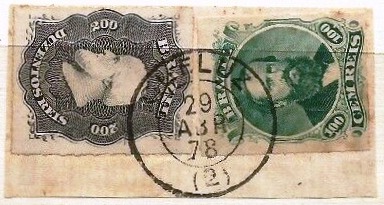
QSP-1040h é um carimbo tipo francês, pequeno com a típica estrelinha entre parênteses, abaixo. Datas encontradas entre 1883 e 1893.
Após a impressão da Carimbologia Q-R em 2019, foi descoberto o carimbo postal QSP-1040i (ilustração de Felipe Piccinini):
Textaktualisierung v. 26 Dezember 2025
Die Pfarrei São João Baptista de Queluz wurde 1803 am Ufer des Paraíba-Flusses im Bezirk Lorena am Rande der Provinz São Paulo errichtet. Das Postamt (laut Nova Monteiro: Administrações e Agências Postais do Brasil Império 1798-1869, Brasil Filatélico 1834-5, Nachdruck SPP, 1994-99) ist aus dem Jahr 1840, zwei Jahre bevor aus Queluz eine Villa wurde. Es folgte eine Periode der wirtschaftlichen Stagnation, bis 1874 der Bahnbetrieb der Estrada de Ferro D. Pedro II nach Queluz anfing.
Obwohl es eine zweite wichtige Queluz in der kaiserlichen Provinz Minas Gerais gab, hatte die paulista Queluz mindestens fünf leicht verschiedene Abstempelungen in ihrer frühen Postzeit, alle in schwarz. Diese Stempel wurden wohl per Hand angefertigt und zeigen den Ortsnamen innerhalb eines schmalen Vierecks.
In QSP-1040a heißt es lediglich “S.J. DE QUELUS”; QSP-1040b hat dagegen “S.J.DEQUELLUS” und wurde in 1840 verwendet; QSP-1040c zeigt “V. DE S. J DEQUELLUZ” und kann für 1842 nachgewiesen werden; es folgt QSP-1040d mit “V.D.S.J.D.QUELLUZ”, gefunden in 1843 und 1844; und zuletzt QSP-1040e bringt noch eine Variante mit “V.S.J.DEQUELLUZ”.
Die vier letzten Abstempelungen wurden von Karlheinz Wittig während der BRASILIANA 83-Philatelieausstellung in Rio de Janeiro entdeckt. Bei einem Besuch im Museu Nacional fielen ihm die Stempel auf Briefen aus Queluz auf. Wittig berichtete dem brasilianischen Händler und Katalogverleger Rolf H. Meyer darüber. Dieser, nachdem er sich die Exponate angeschaut hatte, wies seinen Sohn Peter an, die Stempel abzuzeichnen. Das Museu Nacional brannte in September 2019 aus, und mit ihm auch die Queluz-Originalbriefe.
QSP-1040f wurde bereits durch Paulo Ayres (Nr. 1589) erfasst. Er wurde von ca. 1850 bis ca. 1870 benutzt.

Der alte QSP-1040g entpuppte sich als ein Stempel der gleichnamigen Stadt in Minas Gerais, wie der Philatelist Claudio Coelho aus S. Paulo nachweisen konnte. Er wurde nun durch den neuen QSP-1040g (Abb. aus dem Internet):
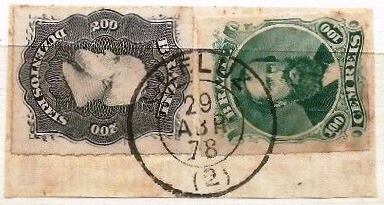
QSP-1040h ist ein Stempel “französischer Art” , also mit einem kleinen Kreis und dem typischen Stern (in Klammern) unten. Nachgewiesen zwischen 1883 und 1893.
Nach der Drucklegung der Carimbologia Q-R im Jahr 2019 wurde der Poststempel QSP-1040i (Abb. Felipe Piccinini) entdeckt:

 Carimbologia