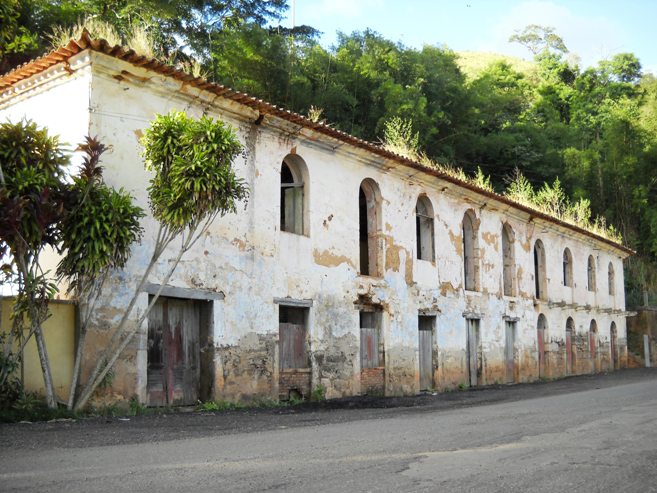
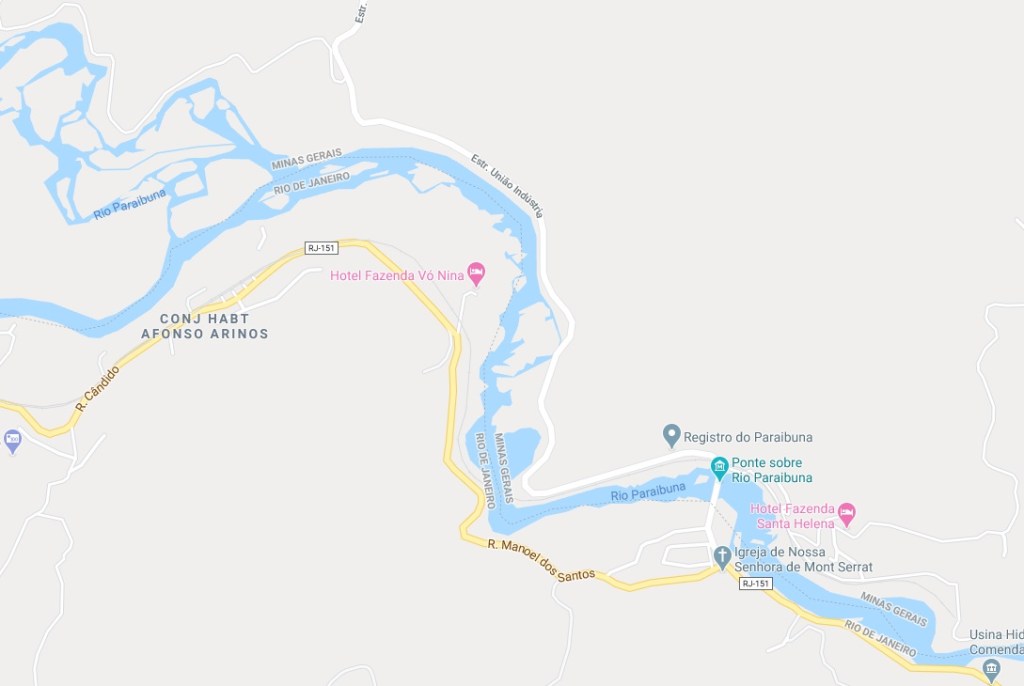
The Parahybuna (now written Paraibuna) River flows from the mountains of the Zona da Mata region in Minas Gerais towards south, where it meets the Rio Preto at the border to the state of Rio de Janeiro. Then it turns east along the same border until the confluence into the Parahyba River (now Paraíba do Sul), near Tres Rios. The Registro do Parahybuna was built in 1723 at the beginning of this borderline on the north side of the river, i.e. in Minas Gerais, but all sources state it was administrated by the Rio province. This construction – together with a bridge from the 19th century which exists still today – has made possible a new commercial road (Caminho Novo) between Minas Gerais and Rio de Janeiro.
But there is another Paraibuna River in the state of São Paulo. This one emerges near Cunha and goes west until it meets the Paraitinga River in the municipality of Paraibuna. Both rivers merge into the Paraíba do Sul River. Shortly after, near Jacareí, the bigger river turns spectacularly towards east, to cross the border to the state of Rio de Janeiro, where it meets the Paraibuna River from Minas described above.
This odd situation contributed to a pretty confusion among the researchers who looked for its post offices. The Guia do Correio do Brasil of 1856 has a Parahibuna agency in Rio de Janeiro and other one in São Paulo. The Guia Postal do Imperio (1880) lists only a Parahybuna post office in São Paulo. Nova Monteiro names a Parahibuna in the Rio Province (agency created on March 26, 1840) and another one in São Paulo. Paula Sobrinho reports a Paraibuna train station of the E.F. Dom Pedro II in Minas Gerais (installed in 1874), which is confirmed by Ralph Giesbrecht. Reinhold Koester tells us about a Parahybuna post office in São Paulo (established 1844), a second one in Rio de Janeiro (which he supposed to be that one listed in 1856) and a third one at the train station in Minas Gerais. Besides, he also mentions an office called Ponte do Paraibuna, which would be identical to Registro do Paraibuna in Rio de Janeiro. Paulo Novaes (agenciaspostais.com.br) presents three post offices almost on the same spot: Registro do Paraibuna (from 1840 until ca. 1867, closed between 1846 and 1847), Paraibuna train station (which followed from 1875 till 1886), and Monte Serrat, created 1886 on the other side of the river to substitute the former. And finally, Wittig & Wittig list three Parahybunas (in MG, RJ and SP), an additional Parahibuna in RJ (identical to a former one) and Ponte do Parahybuna, also in RJ.
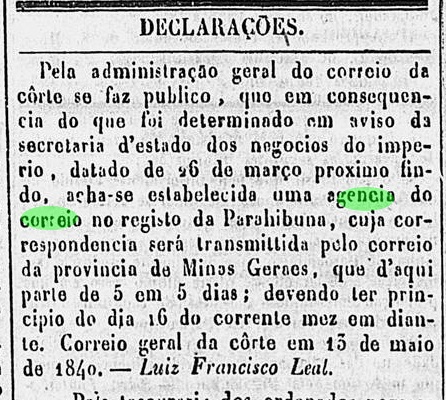
An extensive research in the local press brought us some hints to elucidate this issue. First of all, we could confirm the earliest date of the creation of a postal agency in the Registro building:
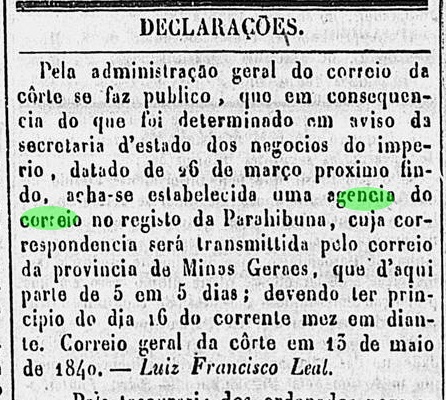
Diario do Rio de Janeiro, May 14, 1840
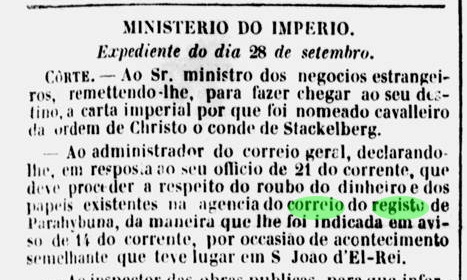
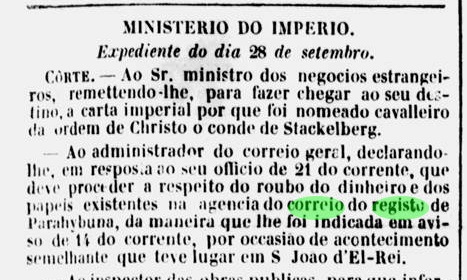
But two years later, the bridge was set in fire in the turmoil of the Liberal Revolution, and robbers stole money and documents from the post office:
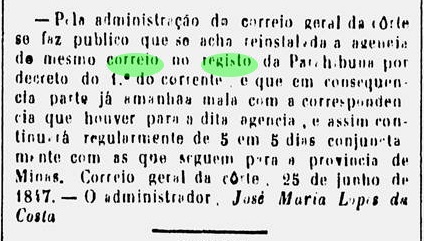
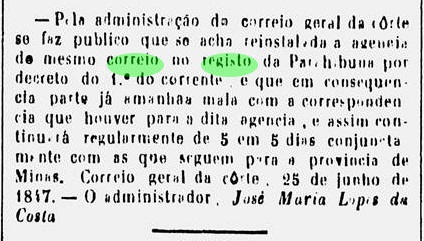
It took certainly long to rebuild the bridge, and eventually the agency had to close, for it was reopened in 1847:
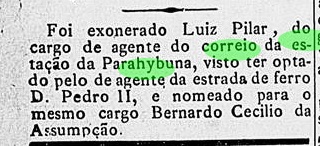
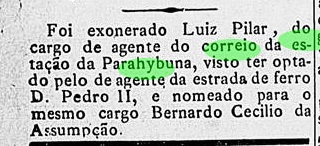
The opening of the train station just beside the Registro in 1874 eventually caused an opening of an additional post office at the station, or the Registro agency has simply moved to the station. Although Paulo Novaes claims that this office has opened already in 1875, the earliest press notice about a station post agency was found only in 1883:
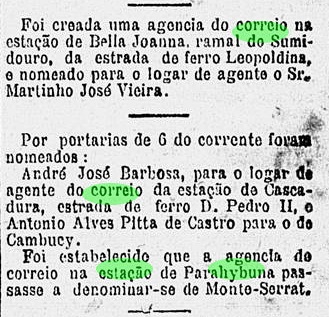
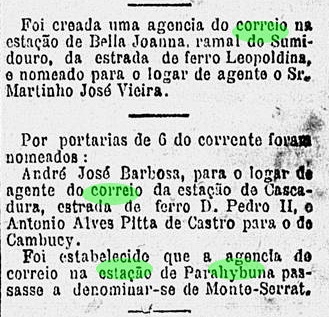
In 1886, the station post office was renamed as Monte Serrat, as stated by Novaes:
However, it is still now uncertain whether the post office at the Registro has closed due to the other station office nearby, or – oddly enough – both offices kept on working side by side for a while, since the Registro office has been referred even after the train station was built:

And the only known cancellation from there (RRJ-3930a, Corinphila auctions, Switzerland) also brings a mystery to unravel:
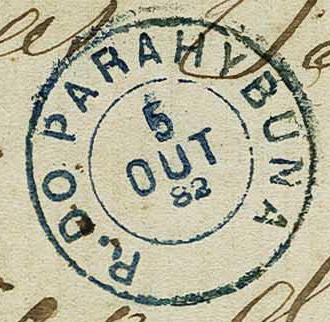
Is the first letter a real R, or just a P which was turned to an R by hand? And the date of 1882 clearly contradicts Novaes, who indicates the closing of the Registro post office around 1867.
Der Parahybuna (heute Paraibuna geschrieben) ist ein Fluss, der aus dem Gebirge der Zona da Mata in Minas Gerais entspringt. Von dort fließt er in Richtung Süden, bis zur Grenze zu Rio de Janeiro, wo er den Rio Preto empfängt. Dann fließt er weiter entlang der Grenze, bis zu seiner Einmündung in den Fluss Parahyba do Sul (heute: Paraíba), nahe der Stadt Três Rios.
Der Registro do Parahybuna wurde 1723 am Anfang dieser Grenzstrecke am Nordufer, also in Minas Gerais, gebaut, aber alle Quellen behaupten, dass der Registro von Rio aus verwaltet wurde. Wie es dem auch sei, dieser Bau – zusammen mit einer im 19. Jahrhundert entstandenen Brücke, die bis heute existiert – hat einen neuen Handelsweg (Caminho Novo) zwischen Minas Gerais und Rio de Janeiro ermöglicht.
Doch gibt es einen zweiten Paraibuna-Fluss im Staat São Paulo. Dieser entspringt nah am Städtchen Cunha, fließt dann westwärts, bis er den Paraitinga-Fluss im Gebiet des heutigen Paraibuna-Município trifft. Nach dieser Mündung heißt der Fluss Paraíba do Sul, und kurz darauf, bei Jacareí, macht dieser groß gewordener Fluss eine spektakuläre Kurve nach Osten, um die Grenze zu Rio zu überqueren, wo er danach den anderen, oben beschriebenen Paraibuna-Fluss empfängt.
Diese etwas vertrackte Lage verursachte eine schöne Konfusion unter den Forschern auf deren Suche nach Postämtern. Der Guia do Correio do Brasil von 1856 hat ein Parahibuna-Postamt in Rio de Janeiro und ein anderes in São Paulo. Der Guia Postal do Imperio (1880) nennt lediglich ein Parahybuna-Postamt in São Paulo. Nova Monteiro listete einmal Parahibuna in der Rio Provinz (Postamt am 26. März 1840 entstanden) und einmal in São Paulo. Paula Sobrinho berichtet über einen Bahnhof Paraibuna der E.F. Dom Pedro II in Minas Gerais (in 1874 eingeweiht), was durch Ralph Giesbrecht bestätigt wird. Reinhold Koester erzählt uns über ein Parahybuna-Postamt in São Paulo (entstanden in 1844), ein weiteres in Rio de Janeiro (das er glaubt, identisch zu sein mit dem im GCB/1856 erwähnt) und ein drittes an einem Bahnhof in Minas Gerais. Dazu gab er eine Agentur zur Protokoll, die Ponte do Paraibuna hieß, und identisch mit Registro do Paraibuna in Rio de Janeiro sein sollte. Paulo Novaes (agenciaspostais.com.br) stellt gleich drei Postämter fast im gleichen Ort: Registro do Paraibuna (von 1840 bis ca. 1867, aber zwischen 1846 und 1847 geschlossen), Bahnhof Paraibuna (als Nachfolge-Postamt,von 1875 bis 1886), und Monte Serrat, in 1886 auf der Südseite des Flusses gegründet, um das Bahnhofspostamt zu ersetzen. Zu guter Letzt, Wittig & Wittig listen drei Parahybunas (in MG, RJ und SP), ein zusätzliches Parahibuna in RJ (das identisch mit dem Rio-Parahybuna sein soll) und Ponte do Parahybuna, auch in RJ.
Nach einer langen Recherche in der lokalen Presse kamen einige Daten zu Tage, die zur Klärung des Falls beitragen können. Zunächst können wir das früheste Datum zur Postamtentstehung im Registro-Gebäude bestätigen:
Schon zwei Jahre später wurde die Brücke im Aufruhr der Liberalen Revolution in Brand gesetzt, und Diebe haben Geld und Dokumente aus dem Postamt gestohlen:
Der Wiederaufbau der Brücke hat sicherlich lange gebraucht. Zwischendurch war das Postamt geschlossen, denn eine Wiedereröffnung fand in 1847 statt:
Der Bau der Eisenbahnstation gleich neben dem Registro in 1874 hat wahrscheinlich ein weiteres Postamt verursacht. Auch wenn Paulo Novaes das Eröffnungsjahr 1875 nennt, die bisher früheste Pressenotiz darüber stammt aus dem Jahr 1883:
In 1886 wurde dieses Bahnpostamt in Monte Serrat umbenannt, wie Novaes angegeben hatte:
Dennoch ist es bisher unklar, ob die Agentur im Registro wegen des neuen Bahnhofspostamtes geschlossen wurde (und, wenn ja, wann genau?), oder ob beide Büros für eine Übergangszeit parallel in Betrieb waren. Denn auch einige Jahre nach der Ankunft des Bahnhof wurde der Registro als Postadresse erwähnt:

Und auch der einzige überlieferte Registro-Stempel (RRJ-3930a, Corinphila, Zürich) bringt gleich einen Rätsel mit:
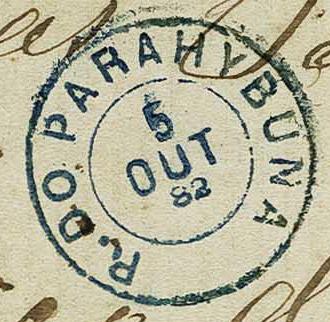
Ist der erste Buchstabe wirklich ein R, oder einfach ein P, der per Hand zu R umgeschreiben wurde? Und das Datum (1882) steht in direkter Widerspruch zu Novaes, der „ca.1867“ für die Schliessung des Registro-Postamts angibt.

 Carimbologia