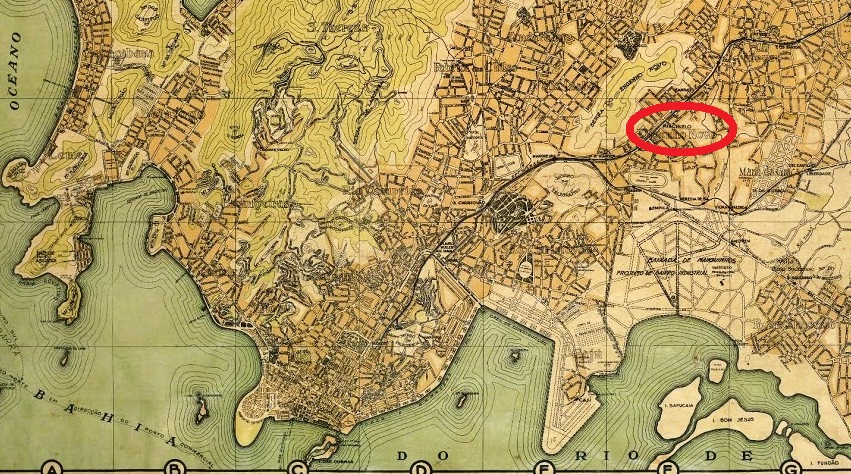
The Município Neutro (= Neutral Municipality) “was an administrative unit created in the Empire of Brazil, that existed in the territory corresponding to the current location of the municipality of Rio de Janeiro between August 12, 1834 (when it was proclaimed the Additional Act to the Constitution of 1824) and November 15, 1889, when was proclaimed the republic in Brazil. But it only officially ceased to exist with the promulgation of the 1891 Constitution. By the republican constitution, this administrative unit became the Federal District in 1891, whose political situation changed again when it became the state of Guanabara in 1960, and later, with the fusion of this with the state of Rio de Janeiro in 1975.” (Wikipedia)
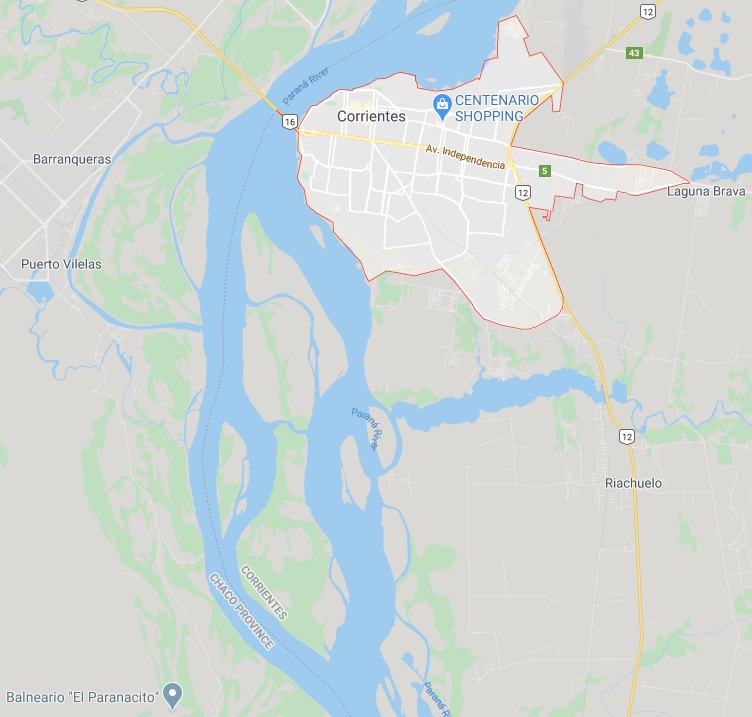
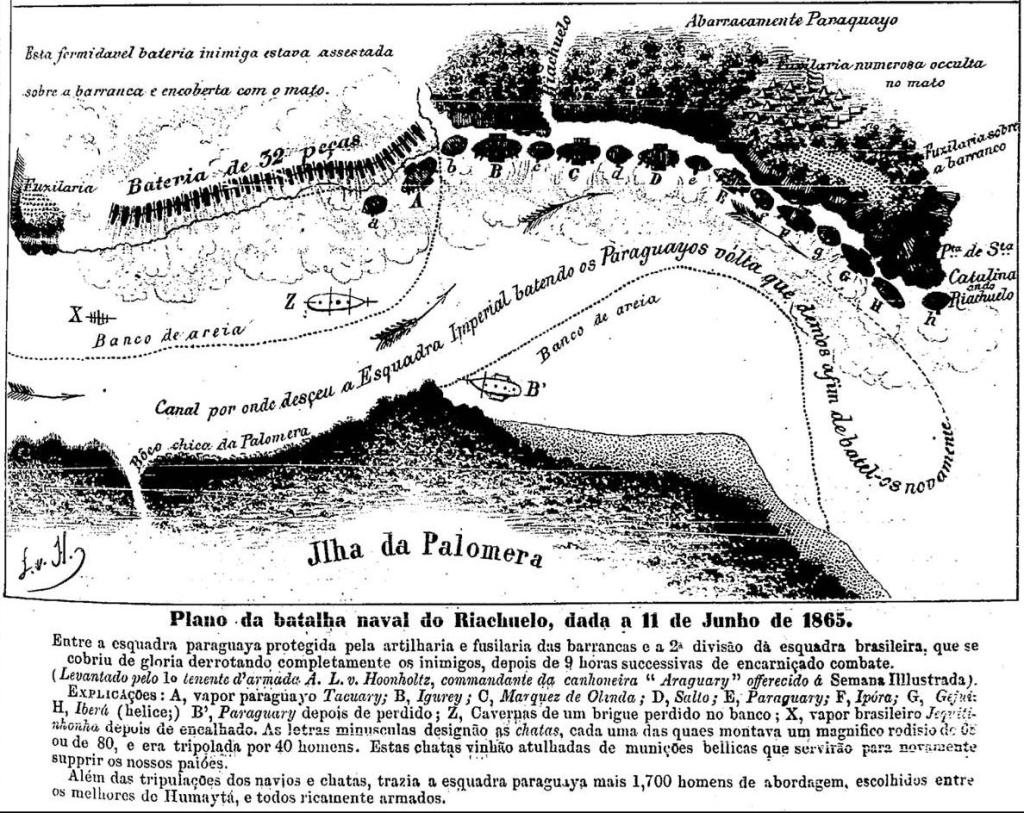
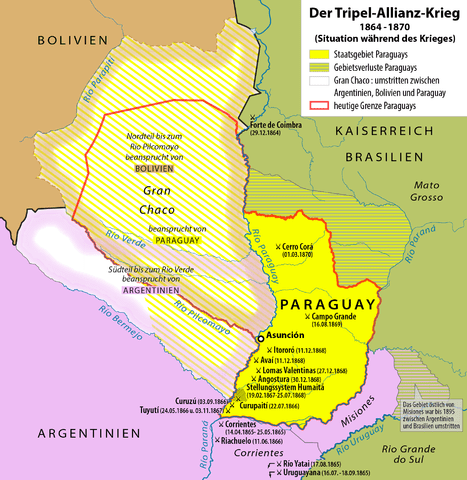
According to Ralph Giesbrecht (estacoesferroviarias.com.br), the Riachuelo station of the Estrada de Ferro D. Pedro II was installed in 1869, ca. 7 km away from the Central Line start. The name celebrates the famous naval battle of June 1865 around the Riachuelo brook in Argentina, in which the Brazilian fleet defeated the Paraguay forces, a turning point in the War of the Triple Alliance (1864-1870):
see also https://en.wikipedia.org/wiki/Battle_of_the_Riachuelo
Paulo Novaes (agenciaspostais.com.br) asserts that the local post office was created on November 12, 1870, shortly after the end of the war. To date we have found three different imperial cancels; possibly, there may also be an earlier one. RMN-2035a (Coll. Paulo Novaes) presents a double circle with inscriptions RIACHUELO (above) and EST (below), separated by asterisks, and the date in the inner circle. Used 1887-1888. RMN-2035b (Coll. José A. Junges) has a double circle with the inscription EST. DE RIACHUELO above and the date in the inner circle. One single copy was found, with date 1887. RMN-2035c (Coll. José A. Junges) is similar to RMN-2035a, but now the inscription below shows (EST.), and the asterisks disappeared. Copies found for 1893-4, but possibly also used in the Empire.
Der Município Neutro (= Neutraler Stadtbezirk) war ein kaiserliches Verwaltungsgebiet in Brasilien, der dem heutigen Município von Rio de Janeiro entspricht. Er existierte vom August 1834 bis zum Ende des Kaiserreichs im November 1889. Offiziell aber wurde die Bezeichnung erst mit dem Inkrafttreten der ersten republikanischen Verfassung in 1891 in Distrito Federal geändert, und der nächsten Wechsel erfolgte in 1960, als das Gebiet zum Bundesstaat Guanabara erklärt wurde. In 1975 fusionierten schließlich die Staaten Guanabara und Rio de Janeiro.
Laut Ralph Giesbrecht (estacoesferroviarias.com.br) wurde der Bahnhof Riachuelo der Estrada de Ferro D. Pedro II in 1869 in Betrieb genommen; er liegt ca. 7 km vom Startbahnhof der Linha do Centro (= Zentrale Linie) entfernt. Der Name Riachuelo soll an die berühmte Schlacht des Tripel-Allianz-Krieges um den gleichnamigen Fluss bei Corrientes in Argentinien im Juni 1865 erinnern, bei der die brasilianische Flotte die Gegner aus Paraguay geschlagen hat und damit einen Wendepunkt im Krieg einleitete:
siehe auch https://de.wikipedia.org/wiki/Schlacht_auf_dem_Riachuelo_(1865)
Paulo Novaes (agenciaspostais.com.br) schreibt, dass das Bahnhofspostamt am 12. November 1870 entstanden ist, also kurz nach Ende des Kriegs. Bisher wurden drei verschiedene Stempel des Kaiserreichs gefunden, vermutlich gab es auch einen vierten, der in der Frühzeit des Postbetriebs verwendet wurde. RMN-2035a (Samml. Paulo Novaes) zeigt einen Doppelkreis mit den Inschriften RIACHUELO (oben) und EST (unten), von Asterisken getrennt, dazu das Datum im Innenkreis. Benutzt 1887-1888. RMN-2035b (Samml. José A. Junges) hat einen Doppelkreis mit der Inschrift EST. DE RIACHUELO oben und dem Datum, im Innenkreis. Nur ein Exemplar aus dem Jahr 1887 gefunden. RMN-2035c (Samml. José A. Junges) ähnelt RMN-2035a, nun aber sieht man hier die Inschrift in Klammern (EST.) unten, und die Asterisken sind verschwunden.

 Carimbologia