See also: Presídio, S. João Batista do (Koester: Carimbologia XXXII, 1992)
Other names: Presídio, Presídio de Ubá, São João Baptista do Presídio, Villa do Prezidio, Visconde do Rio Branco
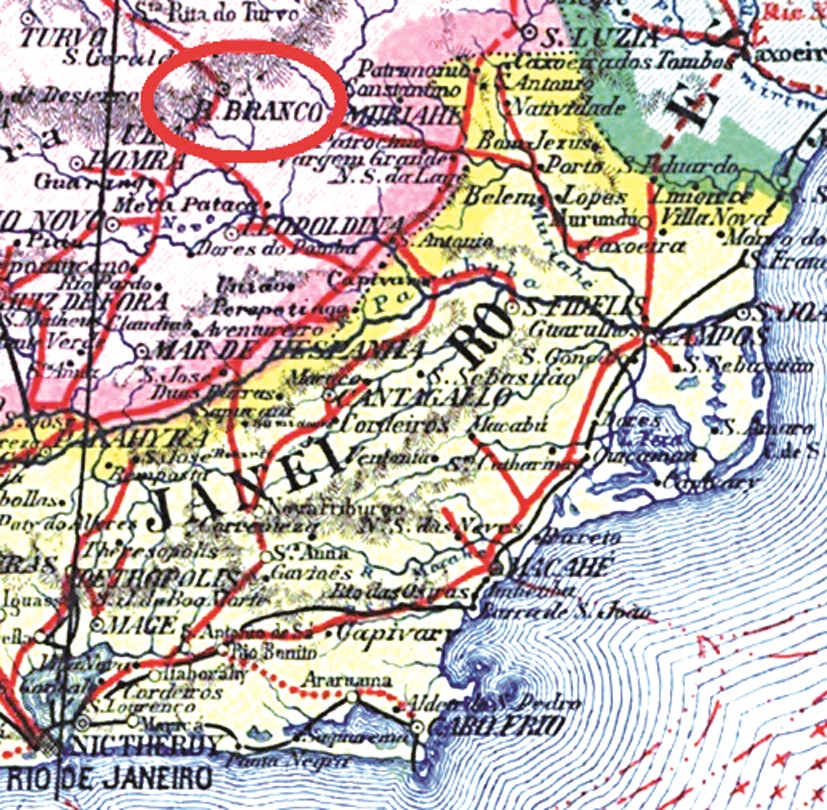
The long rivalry between the neighbour towns of Visconde do Rio Branco and Ubá in southeast of Minas Gerais has historical roots. The former was originally a district of the municipality of Pomba in 1810, with the sonorous name Distrito de São João Baptista dos Índios Coropós. Eventually after that, the locality became an open prison, surrounded by woods and called S. João Baptista do Presídio, which was made a Villa in February or March 1839. Sometime later there must have been an economic decay, for in 1853 it was degraded to a district of the municipality of Ubá and therefore called Presídio de Ubá (= Ubá Prison). It recovered the old name and Villa status only in 1881, and in the following year was elevated to a town named Visconde do Rio Branco. Such measures show understandingly a wish to leave behind both names of prison and Ubá, even though José Maria da Silva Paranhos, the Viscount of Rio Branco (1819-1880), father of the famous Baron of Rio Branco, probably never visited Minas Gerais.
According to Nova Monteiro (Administrações e Agências Postaes do Brasil-Império 1798-1869), a post office was created in December 1839, but seems to have been closed by 1856, for it is absent in Guia do Correio do Brazil of 1857. A famous postal cancel from this early period was used on Bull’s Eyes and already presented by Paulo Ayres (1937) under #1601:
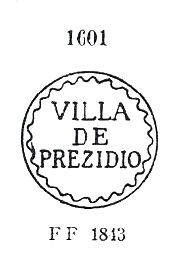
However, Ayres writes erroneously Villa DE Prezidio, while further research has already confirmed the correct spelling Villa DO Prezidio (see H. B. Ferreira, Catálogo Ilustrado dos Carimbos sobre os Olhos-de-Boi, 4th ed., 2017).
Apparently the post office reopened only in September 1870 (Paula Sobrinho: História Postal de Minas Gerais, Belo Horizonte, 1997). The postmarks from this period were already shown by R. Koester under Presídio (Carimbologia XXXII, Rio, 1992).
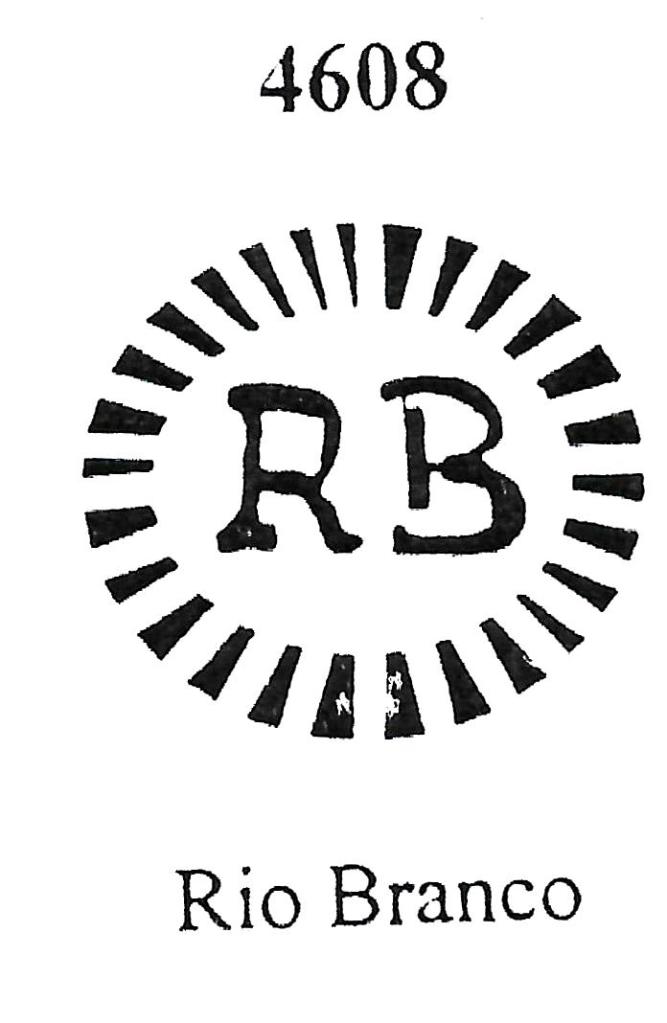
There are to date four different cancels known for Rio Branco from the late imperial period (1882-1889). RMG-2110a corresponds to Paulo Ayres’ #1110, and was used between 1882 and 1883, probably as a stopgap. This cancel was also catalogued by J.A. Dingler and K.W. Lopes (Mute Cancellations of the Brazil Empire, 1865-1889, Rio de Janeiro, 2000) under # 4608. Both images have significant differences, making their comparison interesting:


RMG-2110b (Coll. Karlheinz Wittig) is a gorgeous shell-shaped cancel, absent in Paulo Ayres: there is a bowed inscription CORREIO DO RIO BRANCO above, MINAS GERAES below, and the date in the middle. Found between 1884 and 1886 in black, blue, violet and lilac. RMG-2110c (Coll. José A. Junges) has a double circle with the inscriptions RIO BRANCO above, MINAS below, and the date in the inner circle. Found in violet and lilac from 1885 to 1886. Finally, RMG-2110d (Coll. José A. Junges) shows a double circle with bigger letters than the former. The inscriptions are RIO=BRANCO above, (MINAS) below, and date in the inner circle. Found in black and lilac from 1887 until 1892.
Siehe auch: Presídio, S. João Batista do (Koester, Carimbologia XXXII, 1992)
Andere Namen: Presídio, Presídio de Ubá, São João Baptista do Presídio, Villa do Prezidio, Visconde do Rio Branco
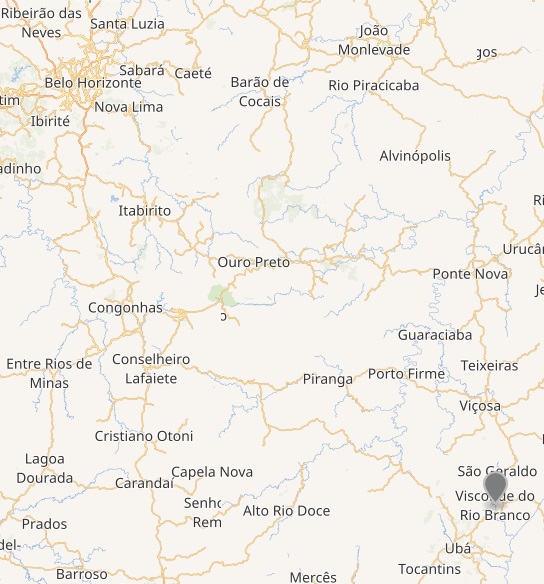
Die lange Rivalität zwischen den Nachbarstädtchen Visconde do Rio Branco und Ubá im Südosten von Minas Gerais hat eine ebenso lange Vorgeschichte. Erstes war ursprünglich (ab 1810) ein Distrikt im Município von Pomba, mit dem wohlklingenden Namen Distrito de São João Baptista dos Índios Coropós. Irgendwann danach wurde aus der Ortschaft ein offenes Gefängnis mitten im Urwald, das sich S. João Baptista do Presídio nannte, das im Februar oder März 1839 als Villa aufgewertet wurde. Aber später soll es wirtschaftlich so weit bergab gegangen sein, dass die Villa in 1853 zum Distrikt vom Nachbar Ubá degradiert wurde, unter dem – zugegeben nicht sehr schmeichelhaften – Namen Presídio de Ubá (= Ubás Gefängnis). Der Status einer Villa mit eigener Verwaltungsautonomie wurde erst in 1881 wieder erlangt, und ein Jahr später war der Ort zur Stadt Visconde do Rio Branco umbenannt. Die letzten Verwaltungsakte zeigen unmissverständlich den Wunsch, die Bezeichnungen Presídio und Ubá loszuwerden, auch wenn José Maria das Silva Paranhos (1819-1880), der Vicomte von Rio Branco und Vater des berühmten Baron von Rio Branco, womöglich niemals in Minas Gerais unterwegs war.
Laut Nova Monteiro (Administrações e Agências Postaes do Brasil-Império 1798-1869) wurde ein Postamt bereits im Dezember 1839 errichtet, das gleichwohl schon vor 1856 wieder geschlossen war, da es nicht im Guia do Correio do Brazil von 1857 aufgelistet wurde. Von dieser Frühzeit ist ein einziger Stempel überliefert, der auf Ochsenaugen zu finden ist und von Paulo Ayres (1937) unter Nr. 1601 registriert wurde:
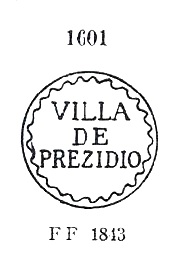
Ayres schreibt dennoch fälschlicherweise Villa DE Prezidio, aber die spätere Forschung hat den Fehler behoben und die Schreibweise auf Villa DO Prezidio korrigiert (siehe H. B. Ferreira, Catálogo Ilustrado dos Carimbos sobre os Olhos-de-Boi, 4.. Aufl., 2017).
Das Postamt wurde wahrscheinlich erst im September 1870 (Paula Sobrinho: História Postal de Minas Gerais, Belo Horizonte, 1997) wieder eröffnet. Die Stempel aus dieser Zeit wurden bereits von R. Koester unter Presídio (Carimbologia XXXII, Rio, 1992) vorgestellt.
Es sind vier verschiedene Abstempelungen für Rio Branco aus der späteren kaiserlichen Zeit (1882-1889) bekannt. RMG-2110a entspricht Paulo Ayres’ Nr.1110, und wurde in 1882 und 1883 benutzt, wohl als Provisorium. Dieser Stempel wurde auch von J.A. Dingler and K.W. Lopes (Mute Cancellations of the Brazil Empire, 1865-1889, Rio de Janeiro, 2000) unter Nr. 4608 katalogisiert. Die Abbildungen zeigen aber wesentliche Unterschiede, so dass ein Vergleich hier interessant wird:

RMG-2110b (Samml. Karlheinz Wittig) ist ein wunderbarer Stempel in Muschelform, nicht in Paulo Ayres enthalten: da sehen wir eine gebogene Inschrift CORREIO DO RIO BRANCO oben, MINAS GERAES unten, und das Datum in der Mitte. Einzutreffen zwischen 1884 und 1886 in den Farben schwarz, blau, violett und lila. RMG-2110c (Samml. José A. Junges) hat einen Doppelkreis mit der Inschrift RIO BRANCO oben, MINAS unten und das Datum im Innenkreis. Einzutreffen in den Farben violett und lila von 1885 bis 1886. Schließlich RMG-2110d (Samml. José A. Junges) zeigt einen Doppelkreis mit etwas größere Buchstaben als vorher. Die Inschriften sind RIO=BRANCO oben und (MINAS) unten, mit Datum im Innenkreis. Einzutreffen in schwarz und lila von 1887 bis 1892.

 Carimbologia