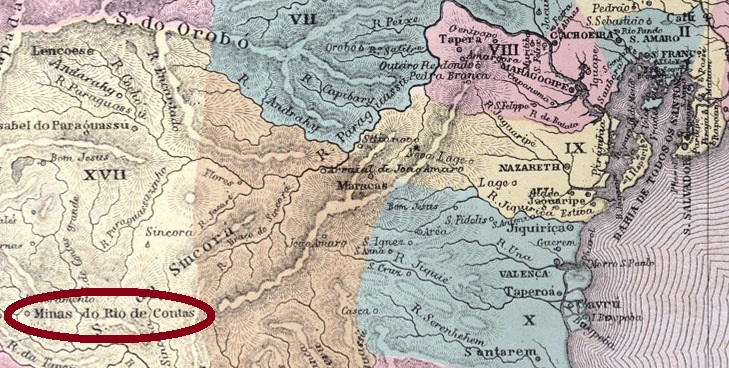
Other names: Santo Antônio do Mato Grosso, Minas do Rio de Contas
This historical town, splendidly situated in the Chapada Diamantina in Bahia, has newly experienced a revival for its tourist attractions. At the beginning, some time in 17th century, it was called Pouso dos Crioulos, a hideout for fugitive slaves on the miners’ trail between Mato Grosso and Salvador. The discovery of gold mines in the region around 1710 drew many seekers from Brazil and abroad, and from then on population has rapidly increased. In 1715 the chapel of Nossa Senhora do Livramento (actually Livramento de Nossa Senhora) was built 12 km south. Three years later, Pouso dos Crioulos was renamed Santo Antonio do Mato Grosso, and in November 1723, both settlements were united into the Villa de Nossa Senhora do Livramento das Minas do Rio de Contas. A main connecting road to Jacobina and Salvador was built in 1725, and one year later a gold smeltery was installed.
The prosperity period ended around 1800, when mines were exhausted and miners had to decide between go further and stay in the village, changing their livelihood. In 1840, the toponym was simplified to Villa de Minas do Rio de Contas, which was elevated to a town in 1885. Finally, in June 1931 the municipality was renamed Rio de Contas.
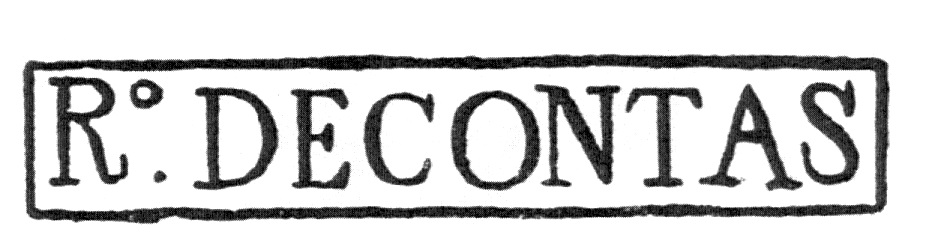
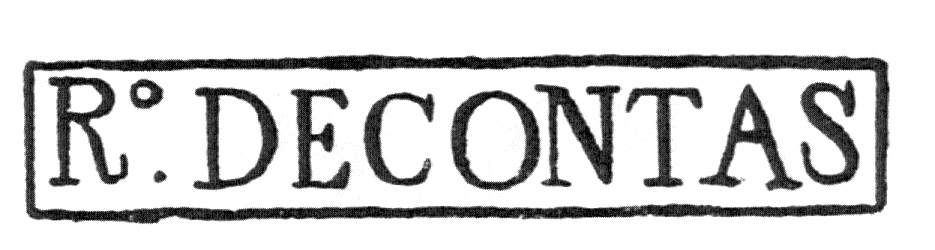
According to Nova Monteiro, the post office was created in May 1832. The first cancel, RBA-0805a, was presented by Paulo Ayres in his supplement of 1942, but since that image was not correct, this source originates from Henrique B. Ferreira (Catálogo Ilustrado dos carimbos sobre os olhos-de-boi, 4a. ed., Porto Alegre, 2017), under Nr. R5. It occurs in black, brown and red-brown, with dates probably between 1832 and 1844:
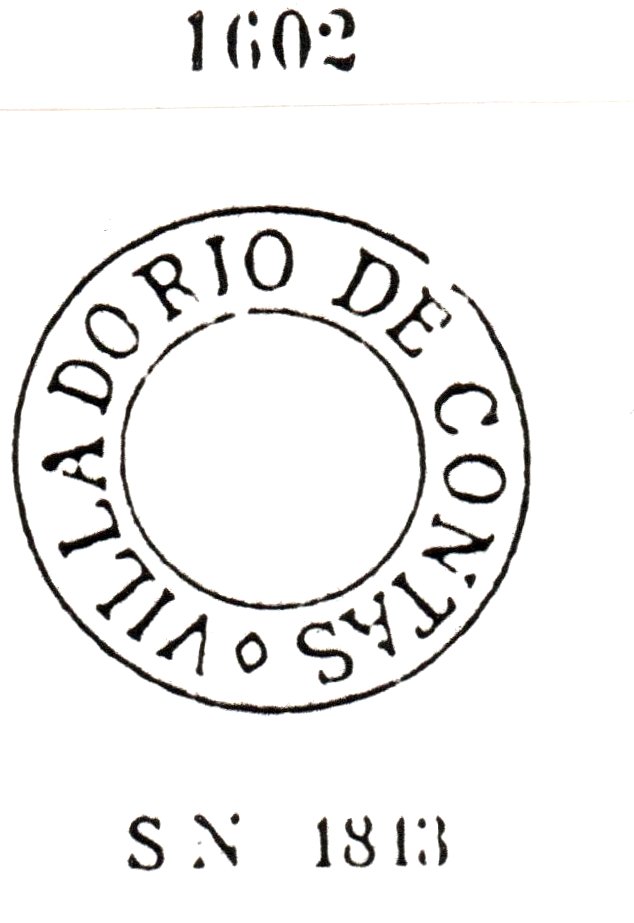
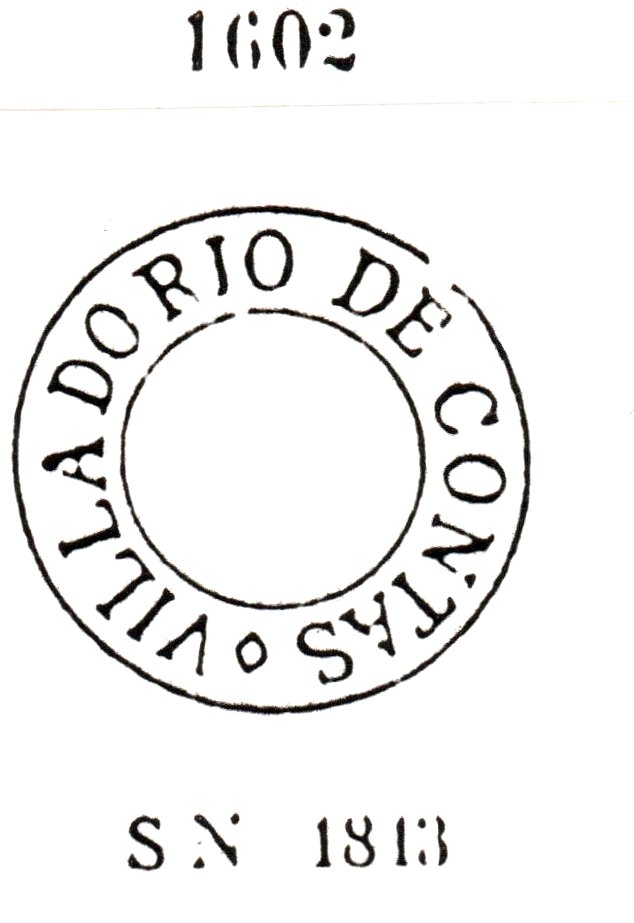
The following cancel, RBA-0805b, was presented by Paulo Ayres (1937) under #1602. However, Henrique B. Ferreira (op.cit., #R6) notes a missing dot in the diamond between CONTAS and MINAS below. It has dates between ca. 1843 and ca.1876, occurring in black, brown, red and green:
Finally, RBA-0805c (Coll. Karlheinz Wittig) has a double circle with inscription RIO DE CONTAS above and the date in the inner circle. Exemplars found with postmarks between 1876 and 1888.
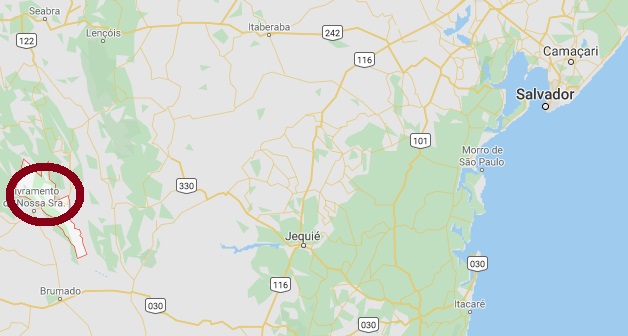
Andere Namen: Santo Antônio do Mato Grosso, Minas do Rio de Contas
Dieser historische Ort, reizvoll in der Chapada Diamantina im Bundesstaat Bahia gelegen, wurde in letzter Zeit wieder durch seine touristischen Vorzüge bekannt. Am Anfang, irgendwann im 17. Jahrhundert, hieß er Pouso dos Crioulos und war nicht viel mehr als ein Versteck für geflüchtete Sklaven auf der Strecke zwischen Mato Grosso und Salvador, von Goldsuchern und anderer Abenteurern als Übernachtungsort benutzt.
Die Entdeckung von Goldvorkommen um 1710 änderte die Geschichte des Orts radikal. Aus dem In- und Ausland kamen Goldssucher, die Bevölkerungszahl stieg schnell an, und schon in 1715 wurde 12 km südlich die Kapelle Nossa Senhora do Livramento (heute Livramento de Nossa Senhora) errichtet. Drei Jahre später wurde Pouso dos Crioulos in Santo Antonio do Mato Grosso umbenannt, und im November 1723 wurden beide Siedlungen vereint, unter der feierlichen Bezeichnung Villa de Nossa Senhora do Livramento das Minas do Rio de Contas. Dazu kamen eine Hauptstrasse nach Salvador über Jacobina in 1725 und ein Jahr später die Hütte für den Goldschmelz.
Ab 1800 ging es mit dem Wohlstand der Gemeinde bergab. Die Goldvorkommen waren praktisch ausgeschöpft und die Sucher mussten entscheiden, ob sie weiter ziehen oder im Ort bleiben sollten, dann aber in anderen Berufen. In 1840 wurde der Ortsname als Villa de Minas do Rio de Contas vereinfacht, und in 1885 bekam der Ort den Stadtstatus. Schließlich hieß der Município ab 1931 Rio de Contas.
Das Postamt wurde laut Nova Monteiro im Mai 1832 errichtet. Der erste Stempel, RBA-0805a, wurde durch Paulo Ayres in seinem Supplement von 1942 vorgestellt. Da aber diese Abbildung fehlerhaft ist, zeigen wir hier das von Henrique B. Ferreira (Catálogo Ilustrado dos carimbos sobre os olhos-de-boi, 4a. ed., Porto Alegre, 2017) veröffentlichte Bild, unter Nr. R5. Den Stempel gibt es in schwarz, braun und rotbraun, mit vermuteten Daten zwischen 1832 und 1844:
Der nächste Stempel, RBA-0805b, wurde von Paulo Ayres (1937) unter Nr. 1602 gezeigt. Dennoch hat Henrique B. Ferreira (op.cit., Nr. R6) einen fehlenden Punkt in der Raute zwischen CONTAS und MINAS (unten) festgestellt. Er hat Daten zwischen ca. 1843 und ca.1876 und kommt in schwarz, braun, rot und grün vor:
Der dritte Stempel, RBA-0805c (Samml. Karlheinz Wittig) hat einen Doppelkreis mit der Inschrift RIO DE CONTAS oben und dem Datum im Innenkreis. Die gefundenen Exemplare haben Stempeldaten zwischen 1876 und 1888.

 Carimbologia