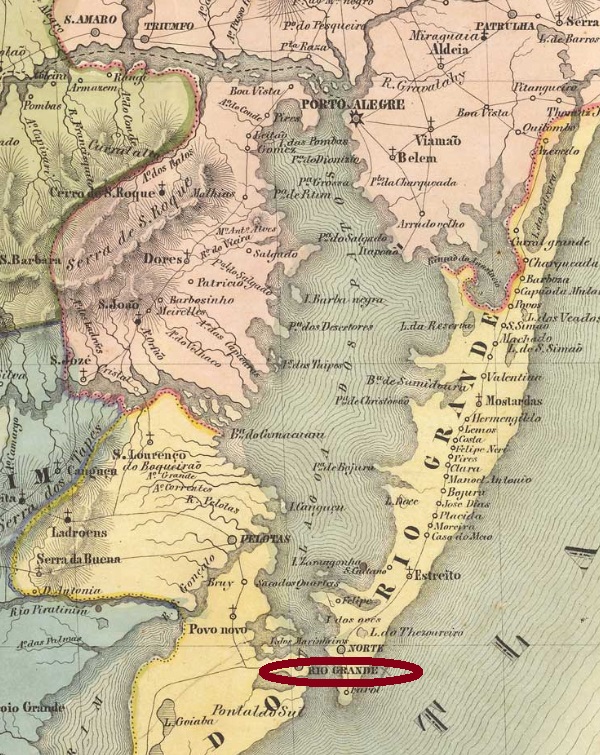
Rio Grande is the oldest settlement and the first capital in the southern province of São Pedro, now the Brazilian state of Rio Grande do Sul. It was founded in August 1736; in July 1751 it was elevated to a Villa, and in June 1836 it was declared a town.
There are two important misunderstandings about this locality. The first one refers to a supposed big river (Rio Grande), which is actually the lagoon called Lagoa dos Patos. (A similar confusion occurred in Rio de Janeiro, where the Guanabara Bay was also taken for a big river by the Portuguese). The second mistake confounds quite often the town of Rio Grande not only with the whole province, but also with the later capital Porto Alegre. This confusion is originated from the fact that capital and post administration in the province of São Pedro changed from Rio Grande to Porto Alegre in different times. So was Porto Alegre made capital already in 1773, whereas the postal service control remained in Rio Grande until ca. 1845.
Another controversy is related to the creation of the post office. Nova Monteiro asserts it took place on October 12, 1831, and the Imperial Mail Register (Tabella das Agencias do Correio do Império) of 1885 lists the year 1848. But as early as September 24, 1817, a royal document (Carta Régia) signed by D. João VI ordered a regular mail service between the provinces of S. Paulo and S. Pedro, beginning in the capital São Paulo and passing through Santos, Rio Grande and Porto Alegre until the arrival in Rio Pardo. This mail line would hardly be possible without establishing post offices on the main itinerary stops. The Carta Régia in original Portuguese can be read here:
Besides, the existence of pre-philatelic cancels dated before 1831 in Rio Grande would be another evidence of an earlier date for the creation of the local post office. Since there are no cancels found so far with dates between 1838 and 1841, possibly the agency was temporarily closed during the Farroupilha Revolution in that province (1835-1845).
The first four Rio Grande cancels are pre-philatelic:

P-RS-14, Used 1814(?)-1837

P-RS-15, Used 1821(?)-1837
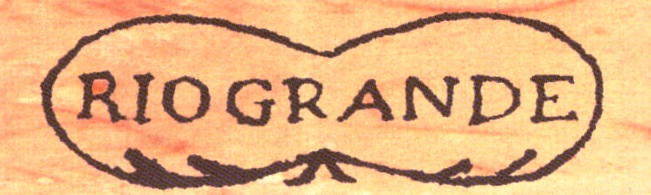
P-RS-16, Used 1832-1835

P-RS-17, Used in 1837
RRS-0285e corresponds to Paulo Ayres #1620. It exists in black and red; known exemplars used between 1842 and 1852:

Paulo Ayres #1620
RRS-0285f corresponds to Paulo Ayres #1621. Found on stamps with years 1858-1876.

Paulo Ayres #1621
RRS-0285g (Coll. José A. Junges) is a French-Type: double circle, inscription RIO GRANDE above and star between parentheses below, date in the centre. Used 1867-1884.
RRS-0285h (image from the internet) has a double circle with inscription RIO GRANDE above and (I) below, date in the centre. Some exemplars have no date at all, others have a missing year indication. Used 1878-1886.
RRS-0285i (Coll. José A. Junges) has a double circle with RIO GRANDE above and a foliated ornament below consisting of four leaves, each one with three leaflets. Later exemplars are quite smudgy and show just a black square standing on a corner. Used 1883-1891.
RRS-0285j (Coll. Karlheinz Wittig) has a double circle with RIO GRANDE above and nothing below. Late exemplars may have no date at all (acc. to image by Marcio Monteiro), others with missing year. Used 1878-1887.
RRS-0285k (Coll. José A. Junges) has a double circle with RIO GRANDE above and a foliated ornament below consisting of four leaves, each one with three leaflets. Compared to RRS-0285i it is here diamond-shaped (rhombus). Used 1883-1892.
RRS-0285l (Coll. José A. Junges) has a double circle with RIO GRANDE above and a foliated ornament below consisting of four leaves, each one with three leaflets. Compared to RRS-0285i and RRS-0285k it has here a square form with a white cross in the centre. Used in black and blue in 1889.
RRS-0285m (Coll. José A. Junges) has a double circle with RIO GRANDE above and (S.PEDRO DO SUL) below, with date in the centre. Used 1892-1894, so it is possibly republican.
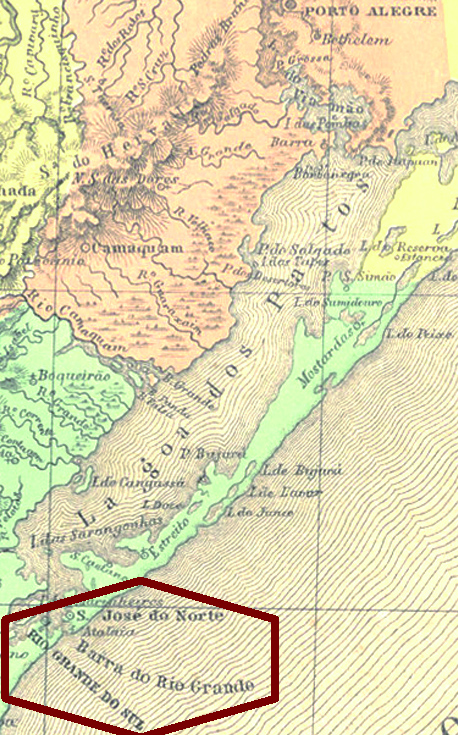
Rio Grande ist die älteste Siedlung und die erste Hauptstadt der südlichsten brasilianischen Provinz, die früher Rio Grande de São Pedro hieß und heute der stolze Bundesstaat Rio Grande do Sul ist. Die Ortschaft wurde im August 1736 gegründet; im Juli 1751 stieg sie zur Villa, und im Juni 1836 wurde ihr das Stadtrecht verliehen.
Über Rio Grande gibt es zwei wichtige Missverständnisse. Das erste bezieht sich auf einen angeblich großen Fluss (Rio Grande), der eigentlich eine riesige Lagune ist, Lagoa dos Patos genannt, etwa siebenmal größer als der Bodensee. (Eine ähnliche Verwechslung fand in Rio de Janeiro statt, wo die Portugiesen dachten, die Bucht von Guanabara wäre die Mündung eines riesigen Flusses). Das zweite Missverständnis bringt oft die Stadt Rio Grande nicht nur mit der ganzen Provinz durcheinander, sondern auch gelegentlich mit der späteren Hauptstadt Porto Alegre. Diese Konfusion wird dadurch verstärkt, dass die Umzüge der Hauptstadt und der provinziellen Postverwaltung zu verschiedenen Zeitpunkten stattfanden. Während Porto Alegre schon in 1773 Provinzhauptstadt wurde, blieb die Postverwaltung von São Pedro bis ca. 1845 in Rio Grande.
Eine weitere Kontroverse brachte das Gründungsdatum furs Postamt in Rio Grande. Nova Monteiro schreibt dafür den 12. Oktober 1831, und das Verzeichnis der kaiserlichen Postämter (Tabella das Agencias do Correio do Império) von 1885 listet dafür das Jahr 1848.
Gleichwohl wurde bereits am 24. September 1817 ein königliches Dokument (Carta Régia) durch D. João VI unterschrieben, das die Einführung einer regulären Postlinie zwischen den Provinzen von S. Paulo and S. Pedro anordnete, die in der Provinzhauptstadt São Paulo startete, durch Santos, Rio Grande und Porto Alegre passierte und deren Ende Rio Pardo war. Diese Postlinie wäre kaum oder überhaupt nicht durchführbar ohne die Gründung von Postämtern an den wichtigsten Haltestellen. Die Carta Régia kann man im portugiesischen Original hier lesen:
Darüber hinaus stellt das Vorhandensein von Vorphila-Stempeln vor 1831 aus Rio Grande einen weitern Beweis dafür dar, dass dort das Postamt wesentlich älter sein soll. Die bisher einzige Periode ohne gefundene Abstempelungen aus Rio Grande sind die Jahre zwischen 1838 und 1841. Möglicherweise wurde das Postamt während der Farroupilha- Revolution in der Provinz (1835-1845) zeitweilig geschlossen.
Die ersten Stempel aus Rio Grande sind aus der Vorphila-Zeit, also vor 1843:

P-RS-14, Benutzt 1814(?)-1837

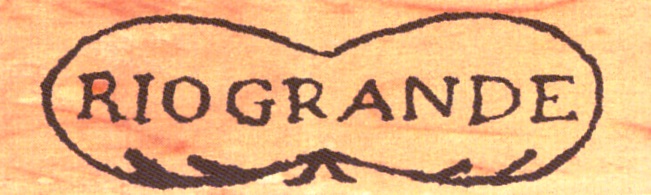

RRS-0285e entspricht Paulo Ayres Nr.1620. In schwarz und rot vorhanden; bisherige Exemplare zwischen 1842 und 1852 verwendet:

Paulo Ayres Nr. 1620
RRS-0285f entspricht Paulo Ayres Nr. 1621. Gefunden auf Marken mit Daten von 1858 bis 1876:

RRS-0285g (Samml. José A. Junges) ist ein „Französischer-Typ“: Doppelkreis, Inschrift RIO GRANDE oben und Stern zwischen Klammern unten, mit Datum in der Mitte. Benutzt zwischen 1867 und 1884.
RRS-0285h (Abb. aus dem Internet) hat einen Doppelkreis mit Inschrift RIO GRANDE oben und (I) unten, Datum in der Mitte. Einige Exemplare haben überhaupt kein Datum, bei anderen fehlt die Jahresangabe. Benutzt zwischen 1878 und 1886.
RRS-0285i (Samml. José A. Junges) hat einen Doppelkreis mit Inschrift RIO GRANDE oben und ein vierblättriges Ornament unten, wobei jedes Blatt aus drei kleinen Blättchen besteht. Spätere Exemplare sind ziemlich verschmiert und zeigen lediglich ein schwarzes Quadrat, auf einer Ecke stehend. Benutzt zwischen 1883 und 1891.
RRS-0285j (Samml. Karlheinz Wittig) hat einen Doppelkreis mit Inschrift RIO GRANDE oben und unten nichts. Datum in der Mitte. Spätere Exemplare können überhaupt kein Datum haben (Abb. v. Marcio Monteiro), bei anderen fehlt die Jahresangabe. Benutzt zwischen 1878 und 1887.
RRS-0285k (Samml. José A. Junges) hat einen Doppelkreis mit Inschrift RIO GRANDE oben und ein vierblättriges Ornament unten, wobei jedes Blatt aus drei kleinen Blättchen besteht. Verglichen zu RRS-0285i macht das Ornament hier eine waagerechte Raute. Benutzt zwischen 1883 und 1892.
RRS-0285l (Samml. José A. Junges) hat einen Doppelkreis mit Inschrift RIO GRANDE oben und ein vierblättriges Ornament unten, wobei jedes Blatt aus drei kleinen Blättchen besteht. Verglichen zu RRS-0285i und RRS-0285k ist das Ornament hier quadratisch und zeigt in der Mitte ein weißes Kreuz. Benutzt in schwarz und blau in 1889.
RRS-0285m (Samml. José A. Junges) hat einen Doppelkreis mit Inschrift RIO GRANDE oben und (S.PEDRO DO SUL) unten, mit Datum in der Mitte. Benutzt zwischen 1892 und 1894, kann dadurch republikanisch sein.

 Carimbologia