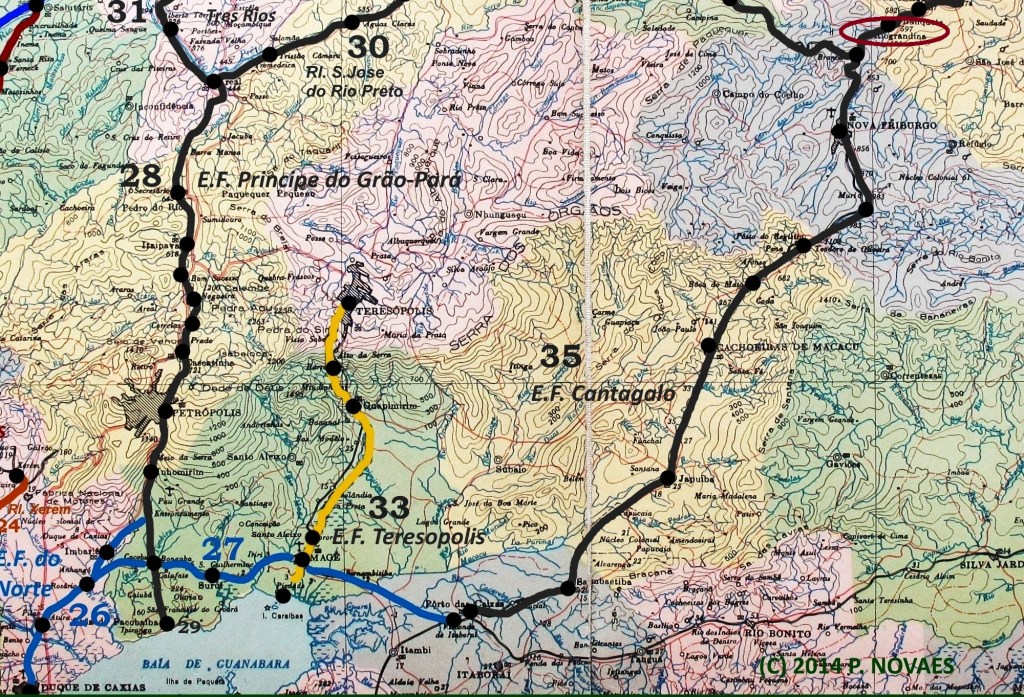
The Rio Grande train station of the Estrada de Ferro do Cantagallo railway was situated in the municipality of Nova Friburgo about 150 km northeast from Rio and started operations in May 1876, according to Ralph Giesbrecht (estacoesferroviarias.com.br). The name originated from the river: Rio Grande is an affluent to the right bank of the Paraíba do Sul River. In 1887 the railroad passed to the control of the Estrada de Ferro Leopoldina. The locality around the station grew steadily, and Estação Rio Grande became a district of Nova Friburgo in 1922. In 1943 both station and district changed their names to Riograndina. Since 1964 is the railway line off service, and the tracks have been removed (see image below).
According to the Imperial Mail Register (Tabella das Agencias do Correio do Império) of 1885, the station post office opened in 1880. One sole imperial cancel was found: RRJ-2043a (Coll. José A. Junges) presents a double circle with the inscription E. DO RIO GRANDE above and a diamond ornament below, with the date in the center. Two exemplars found for 1884.
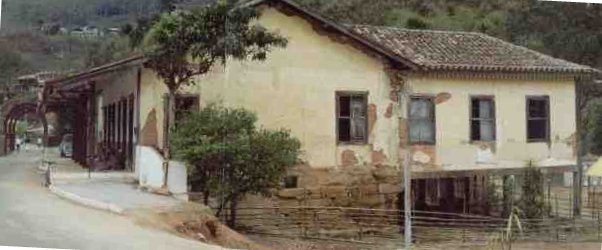
Der Bahnhof Rio Grande aus der Estrada de Ferro do Cantagallo lag im Município von Nova Friburgo, etwa 150 km nordöstlich von Rio de Janeiro entfernt, und wurde im Mai 1876 eingeweiht, laut Ralph Giesbrecht (estacoesferroviarias.com.br). Der Name erinnert an Rio Grande, einen Zufluss am rechten Ufer des Rio Paraíba do Sul. In 1887 wurde die ganze Bahnlinie Eigentum der Estrada de Ferro Leopoldina. Die Ortschaft um den Bahnhof wuchs ständig, und Estação Rio Grande wurde in 1922 ein Distrikt von Nova Friburgo. In 1943 wechselten sowohl Bahnhof als auch Distrikt den Namen zu Riograndina. Seit 1964 ist die Bahnlinie außer Betrieb, die Gleise wurden ausgerissen (siehe Abb. oben).
Das Verzeichnis der kaiserlichen Postämter (Tabella das Agencias do Correio do Império) von 1885 nennt das Jahr 1880 für die Gründung des Postamts. Nur ein Stempel der Kaiserzeit wurde bisher gefunden: RRJ-2043a (Samml. José A. Junges) zeigt einen Doppelkreis mit der Inschrift E. DO RIO GRANDE oben und einer Verzierung in Rautenform unten, dazu das Datum in der Mitte. Zwei Exemplare sind bekannt, beide aus 1884.

 Carimbologia