Print edition update of April 23, 2020
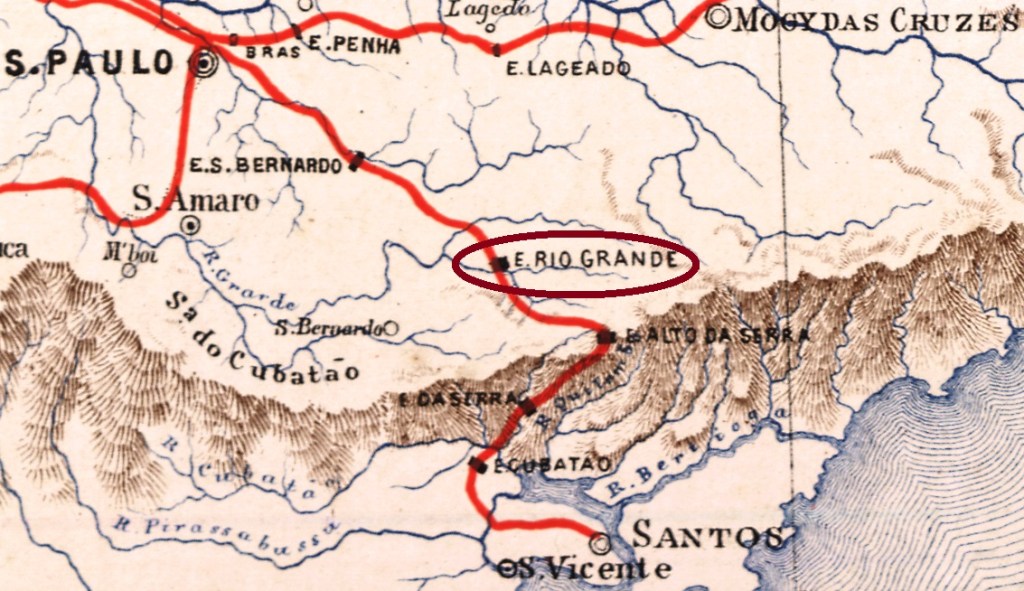
The Rio Grande in São Paulo is today better known through its Indian name Jurubatuba, which means “Happy Place”. The Jurubatuba is an affluent to the Pinheiros River, which meets the Rio Tietê in the capital, after forming the Billings water reservoir, half way between the mountains of the Serra do Mar and the metropolis.
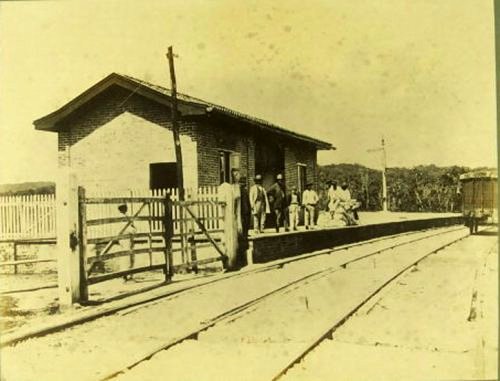
The Rio Grande train station was built in February 1867 by the São Paulo Railway, an English enterprise that linked Jundiaí to the port of Santos and thus played a decisive role in coffee commerce and export.
At the operation start the station was situated in the municipality of São Bernardo. From 1947 until 1975 its control passed to the Estrada de Ferro de Santos a Jundiaí, from 1975 until 1994 it belonged to the Rede Ferroviária Federal, and since then it is still operating as final stop of a São Paulo CPTM rail line (estacoesferroviarias.com.br). The locality around the station grew fast: between 1953 and 1963 the station was named Icatuaçu (= Good and Big River), and since 1964 the station is called Rio Grande da Serra, in the municipality of the same name.
According to the Imperial Mail Register (Tabella das Agencias do Correio do Império) of 1885, the station post office opened in 1870. One sole imperial cancel was found: RSP-1120a (Coll. Karlheinz Wittig) presents a double circle with the inscriptions RIO GRANDE above and (ESTAÇÃO) below, with the date in the centre. Used between 1886 and 1890.
Attention! Given that recent researches have shown that both station and post office of Rio Grande in São Paulo are clearly older than station and office of the same name in Rio de Janeiro (RRJ-2043), possibly the cancel images of both stations need to be switched, as soon as further evidence comes into light.
Druckausgabe-Aktualisierung vom 23. April 2020
Der Fluss namens Rio Grande in São Paulo ist heute eher durch seinen Indianernamen Jurubatuba bekannt. Der Jurubatuba ist ein Zufluss des Rio Pinheiros, der sich seinerseits mit dem Rio Tietê in der Hauptstadt trifft, nachdem er das mächtige Wasserreservoir Represa Billings zwischen dem Gebirge der Serra do Mar und der Metropole gebildet hat.
Der Rio Grande Bahnhof wurde im Februar 1867 durch die São Paulo Railway gebaut, ein englisches Unternehmen, das eine entscheidende Rolle im Kaffeehandel und -export spielte, in dem es die Erzeugerzentren um Jundiaí mit der Hafenstadt Santos verbunden hat.
Zu Betriebsbeginn lag der Bahnhof noch im Município von São Bernardo. Von 1947 bis 1975 ging die Kontrolle der Eisenbahnlinie zur Estrada de Ferro de Santos a Jundiaí, von 1975 bis 1994 zur Rede Ferroviária Federal, und seitdem wird die Linie von der CPTM aus São Paulo betreiben (estacoesferroviarias.com.br). Der Bahnhof ist nun Endstation, hat aber auch eine bewegte Geschichte: zwischen 1953 und 1963 hieß er Icatuaçu (= “Guter und Großer Fluss”) und seit 1964 nennen sich Bahnhof und Município Rio Grande da Serra.
Das Verzeichnis der kaiserlichen Postämter (Tabella das Agencias do Correio do Império) von 1885 nennt das Jahr 1870 für die Gründung des Postamts. Nur ein Stempel der Kaiserzeit wurde bisher gefunden: RSP-1120a (Samml. Karlheinz Wittig) zeigt einen Doppelkreis mit den Inschriften RIO GRANDE oben und (ESTAÇÃO) unten, dazu das Datum in der Mitte. Benutzt zwischen 1886 und 1890.
Bitte beachten: da es sich inzwischen herausgestellt hat, dass sowohl Bahnhof als auch Postamt aus Rio Grande in São Paulo wesentlich älter sind als der gleichnamige Bahnhof mit Postamt in Rio de Janeiro (RRJ-2043), möglicherweise muss die Zuordnung der Stempel beider Orte ausgetauscht werden, sobald weitere Forschungsergebnisse dies erforderlich machen.

 Carimbologia