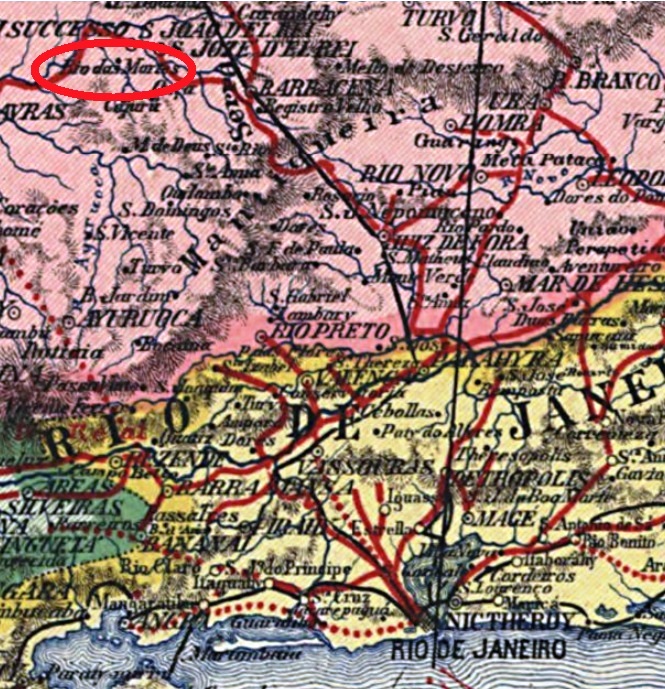
The Rio das Mortes (= River of the Deaths) here is neither the big one which flows from Mato Grosso into the Araguaia River nor the other one that titled R.W. Fassbinder’s film in 1971. Instead, it is a rather short one in a Brazilian scale, with less than 300 km extension. It emerges from the Serra da Mantiqueira in southern Minas Gerais and flows west until reaching the Furnas water reservoir near Ijaci. In spite of having been scenery to the Emboabas War (1707-09), the river name derives from the many deaths among people who tried to pass it by swimming in order to avoid the toll, at the end of 17th century. (Wikipedia)
The Rio das Mortes station was inaugurated in May 1887 by the Estrada de Ferro Oeste de Minas railway, in the so called Paraopeba Line, situated at that time in the municipality of São João d’El Rey. In 1908 the name was changed to João Pinheiro station, celebrating a Minas Gerais politician. From 1931 until 1965 the railway belonged to the Rede Mineira de Viação. In 1943, the train station was given again a new name: Congo Fino, which is a locality with African origin situated north of the actual town of Conceição da Barra de Minas. From 1965 until 1975 the railway passed to the Viação Férrea Centro-Oeste, before changing once more, to the Rede Ferroviária Federal S.A. from 1975 until 1984. (estacoesferroviarias.com.br). Now the station is demolished, and the rails have been removed.
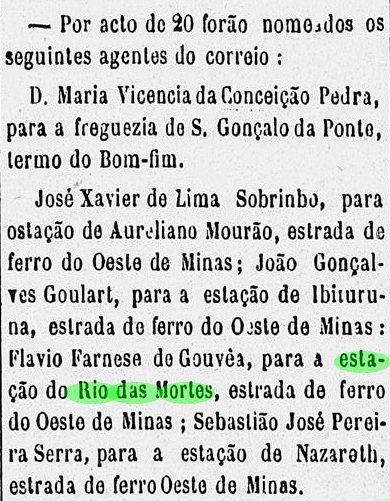
According to Paula Sobrinho (História Postal de Minas Gerais, Belo Horizonte, 1997), the station post office was created in December 1887, and the first clerk was nominated already on December 20:
One imperial cancel is known: RMG-2120a (Coll. José A. Junges) has a double circle with the inscriptions EST. DO RIO DAS MORTES above and (MINAS) below, with the date in the centre. Exemplars have been found with dates between 1887 and 1902.

Der Rio das Mortes (= Fluss der Todesfälle) hier ist weder sein großer Bruder, der von Mato Grosso kommend in den Araguaia fließt, noch sein fiktiver Namesvetter aus dem gleichnamigen Film von R.W. Fassbinder aus 1971. Stattdessen ist er ein für brasilianische Verhältnisse eher kleiner Kollege mit knapp 300 km Länge, der in der Serra da Mantiqueira im Süden von Minas Gerais entspringt, und nach Westen bis in den Furnas-Staudamm bei Ijaci fließt. Obwohl der Fluss die Szenerie für den blutigen Emboabas-Krieg (1707-09) stellte, gründet sein grausiger Name angeblich aus den vielen Todesfällen unten den Reisenden im späten 17. Jahrhundert, die ihn durchschwimmen wollten, ohne Maut zu bezahlen. (Wikipedia)
Der Bahnhof Rio das Mortes wurde im Mai 1887 durch die Estrada de Ferro Oeste de Minas, in der so genannten Paraopeba Linie, eingeweiht, und lag damals im Município von São João d’El Rey. In 1908 wechselte der Name zu João Pinheiro, um einem Politiker aus Minas Gerais die Ehre zu erweisen. Von 1931 bis 1965 gehörte die Bahnlinie der Rede Mineira de Viação. In 1943 wurde der Bahnhof abermals umbenannt: auf Congo Fino, wie die Ortschaft nördlich vom Städtchen und Verwaltungssitz Conceição da Barra de Minas heißt. Von 1965 bis 1975 wechselte der Bahnbesitz zur Viação Férrea Centro-Oeste, bevor er Eigentum der Rede Ferroviária Federal S.A. (1975-1984) wurde. (estacoesferroviarias.com.br). Nun ist das Bahnhaus abgerissen, und auch die Schienen wurden entfernt.
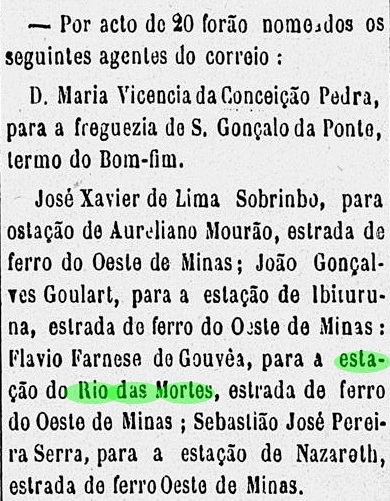
Laut Paula Sobrinho (História Postal de Minas Gerais, Belo Horizonte, 1997), entstand das Bahnhofspostamt im Dezember 1887; und der erste Postangestellte wurde am 20. d. Mts. ernannt:
Ein Stempel der Kaiserzeit ist überliefert: RMG-2120a (Samml. José A. Junges) hat einen Doppelkreis mit den Inschriften EST. DO RIO DAS MORTES oben und (MINAS) unten, dazu das Datum in der Mitte. Exemplare wurden mit Daten zwischen 1887 und 1902 gefunden.

 Carimbologia