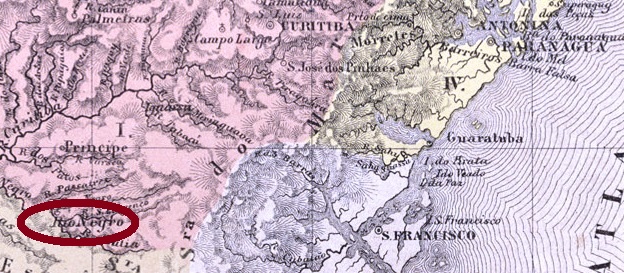
Rio Negro is today a town with about 35 thousand inhabitants on the north bank of the river with the same name, which separates the states Paraná and Santa Catarina. The locality is situated a hundred km southwest of Curitiba and was made a freguesia of the Lapa municipality as early as 1838, when Paraná still belonged to São Paulo. In 1879 it arose to a Villa, and in 1896, already in the republic, it was made a town.
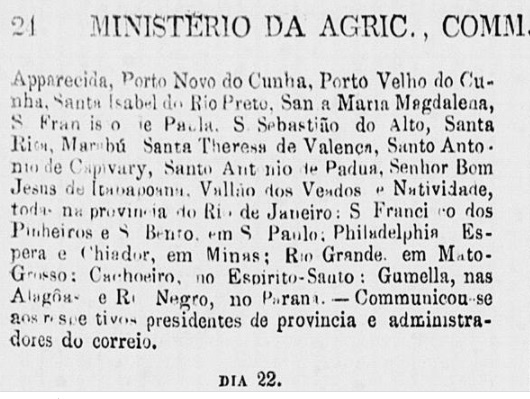
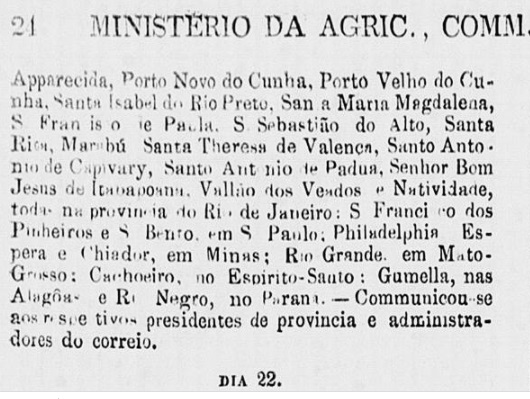
The Imperial Mail Register (Tabella das Agencias do Correio do Império) of 1885 lists the post office with creation date in 1857, but in June 1861 it was closed again, as reported by the official press:
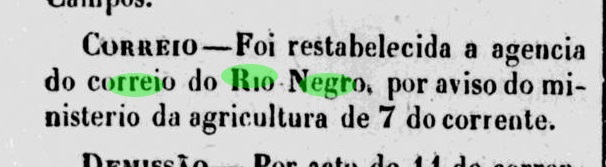
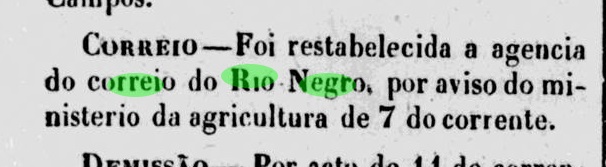
The reopening of the post office was announced in March 1863:
Four different cancellations were found, two of them manuscript, but unfortunately none from the short early period of this office. RPR-0175a (Coll. Karlheinz Wittig) features Rio Negro written with black pen on a D. Pedro emission of 1866. RPR-0175b (Coll. José A. Junges) shows a slight reduction of the former, with a manuscript R.o Negro, also in black and on a D. Pedro of 1866. This is probably the cancel shown by Paulo Ayres (Catálogo de Carimbos – Brasil Império, São Paulo, 1937) on page 147:
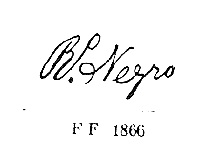
The clerk who wrote both cancels might be the same, for the calligraphy is very similar, easily recognizable through the scroll at the beginning of letter N. RPR-0175c (Coll. José A. Junges) is a double circle with RIO NEGRO above and the date in the centre. Found on stamps used between 1877 and 1889. Finally, RPR-0175d (Coll. José A. Junges) could be already republican, for it was seen just once, dated of June 1890. It shows a double circle with imprints RIO-NEGRO above and (PARANÁ) below, dated in the centre.
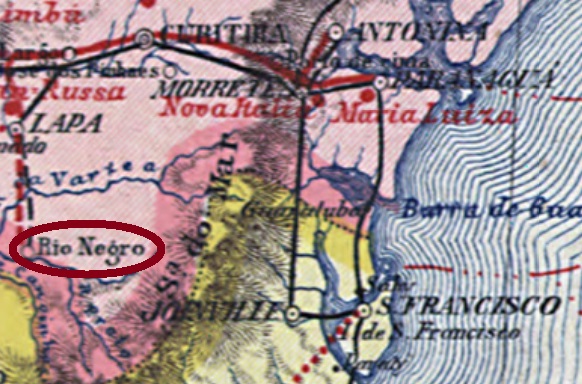
Heute ist Rio Negro ein Städtchen mit ca. 35 Tausend Einwohnern am Nordufer des gleichnamigen Flusses, der als Grenze zwischen den Bundesstaaten Paraná und Santa Catarina fungiert. Die Ortschaft liegt etwa 100 km südwestlich von der Hauptstadt Curitiba entfernt und wurde bereits in 1838 eine Freguesia, zu einer Zeit, als Paraná noch ein Teil der Provinz São Paulo war. In 1879 stieg Rio Negro zu einer Villa auf, und in 1896, schon in der Republik, erhielt der Ort das Stadtrecht.
Das Verzeichnis der kaiserlichen Postämter (Tabella das Agencias do Correio do Império) von 1885 listet dieses Postamt mit Entstehungsjahr 1857 auf, aber im Juni 1861 wurde es wieder geschlossen, wie die Amtspresse meldete:
Die Wiedereröffnung des Postamts wurde im März 1863 bekannt gegeben:
Vier verschiedene postalische Entwertungen – zwei davon handschriftlich – sind von dieser Agentur überliefert, leider keine davon aus der Frühzeit ab 1857. RPR-0175a (Samml. Karlheinz Wittig) hat Rio Negro mit der Hand in schwarzer Tinte auf eine D. Pedro-Ausgabe von 1866 geschrieben. RPR-0175b (Samml. José A. Junges) zeigt eine kleine Abkürzung vom Vorgänger, mit einem handgeschriebenen R.o Negro, auch in schwarz und auf einen D. Pedro aus 1866. Dieser ist wahrscheinlich der Stempel, den Paulo Ayres im Catálogo de Carimbos – Brasil Império (São Paulo, 1937) auf S. 147 gezeigt hat:

Der Beamte, der beide Marken beschriftet hat, könnte derselbe sein, denn die Kalligrafie ist sehr ähnlich, leicht durch den Anfangsschnörkel vom Buchstabe N zu erkennen. RPR-0175c (Samml. José A. Junges) ist ein Doppelkreis mit RIO NEGRO oben und dem Datum in der Mitte. Gefunden auf Marken, die zwischen 1877 und 1889 benutzt wurden. Der Letzte, RPR-0175d (Samml. José A. Junges), könnte bereits republikanisch sein, da er nur einmal auf eine Marke mit Datum Juni 1890 gesichtet wurde. Es zeigt einen Doppelkreis mit den Inschriften RIO-NEGRO oben und (PARANÁ) unten, dazu das Datum in der Mitte.

 Carimbologia