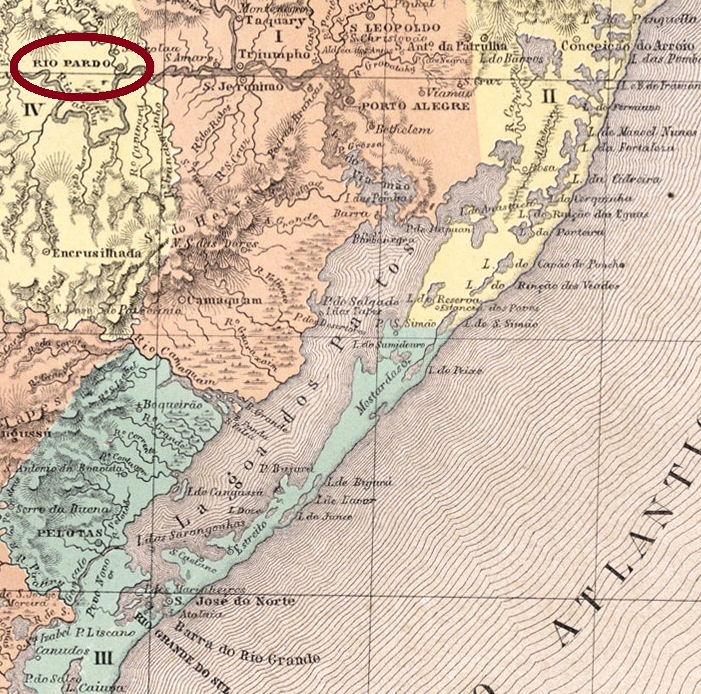
The Rio Pardo in the province of São Pedro do Rio Grande in southern Brazil is an affluent to the Jacuí River, which flows into the Lagoa dos Patos through the Lake Guaíba. The freguesia of Nossa Senhora do Rosário do Rio Pardo was founded in May 1769 on the water mouth of this Pardo River. The region is now located in central Rio Grande do Sul, but at that time it was the border between Portuguese and Spanish possessions during decades of frontier wars. Thus, the new settlement played an important role not only in defending Portuguese land but also as a bridgehead for the following territorial expansion. Rio Pardo was elevated to a Villa in April 1809 and to a town in March 1846, now it is a charming tourist destination under 200 km west from the state capital Porto Alegre.
There is also here controversial data about the creation of the post office. The Catálogo Enciclopédico de Selos e História Postal do Brasil (RHM, São Paulo, 1999) states exactly October 12, 1831, whereas the Imperial Mail Register (Tabella das Agencias do Correio do Império) of 1885 lists the agency from 1838 on. But as early as September 24, 1817, a royal document (Carta Régia) signed by D. João VI ordered a regular mail service between the provinces of S. Paulo and S. Pedro, beginning in the capital São Paulo and passing through Santos, Rio Grande and Porto Alegre until the arrival in Rio Pardo. This mail line would hardly be possible without establishing post offices on the main itinerary stops. The Carta Régia in original Portuguese can be read here:
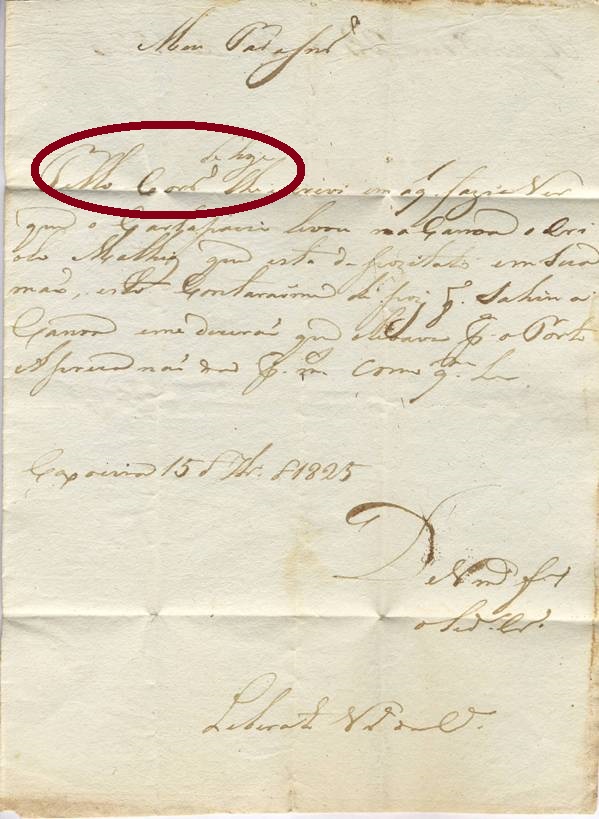
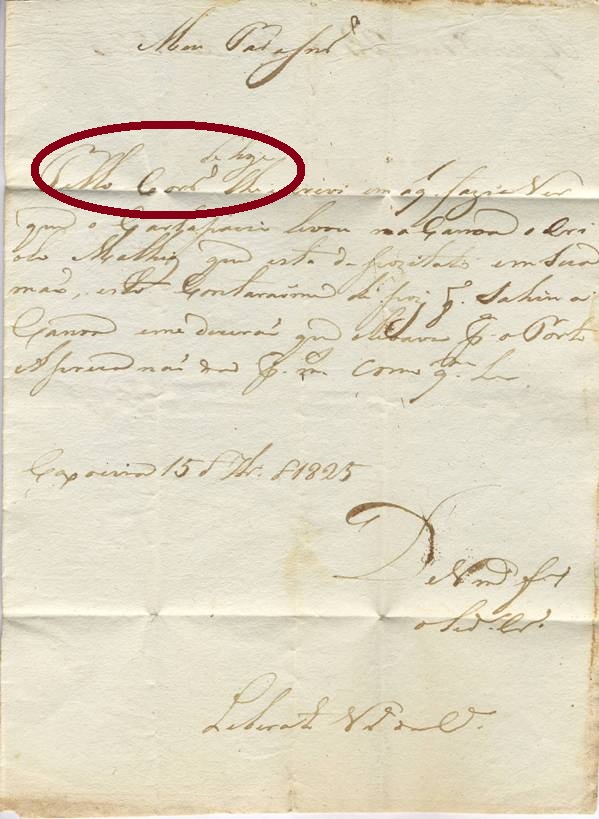
A Correio service is also referred to in this letter of September 1825 from Caxoeira (now Cachoeira do Sul) to Rio Pardo:
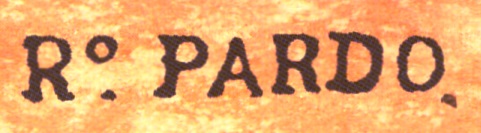
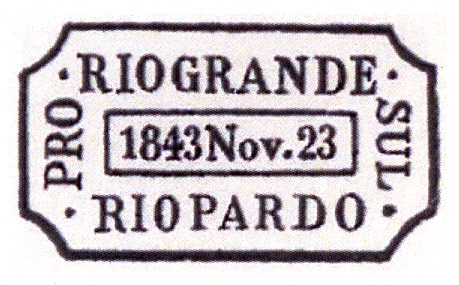
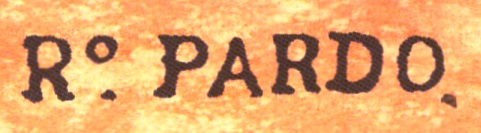
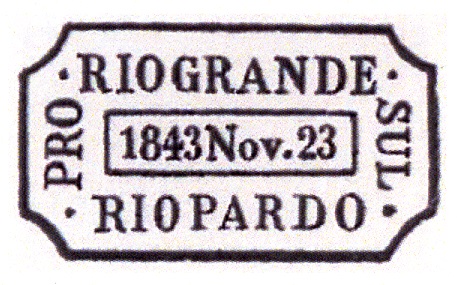
The first four known cancels (RRS-0290a to RRS-0290d) are pre-philatelic:


There must be at least one missing cancel from the following time, for the next cancellation, RRS-0290e (Coll. José A. Junges), in black and blue, dates between 1880 and 1886: a double circle with the inscriptions RIO PARDO above and (3) below, and date in the centre. The next cancel originates from the railway between Porto Alegre and Uruguaiana: RRS-0290f (Coll. José A. Junges) presents in green and violet a double ellipse with the inscriptions (…) DE PORTO ALEGRE above, **A URUGUAYANA** below, and RIO PARDO in the centre. Dates from 1885 on. Finally, RRS-0290g (FM) could be already republican: a double circle with the inscriptions RIO PARDO above and (S.PEDRO DO SUL) below, with the date inside. A sole copy was found, dated ca. 1893.
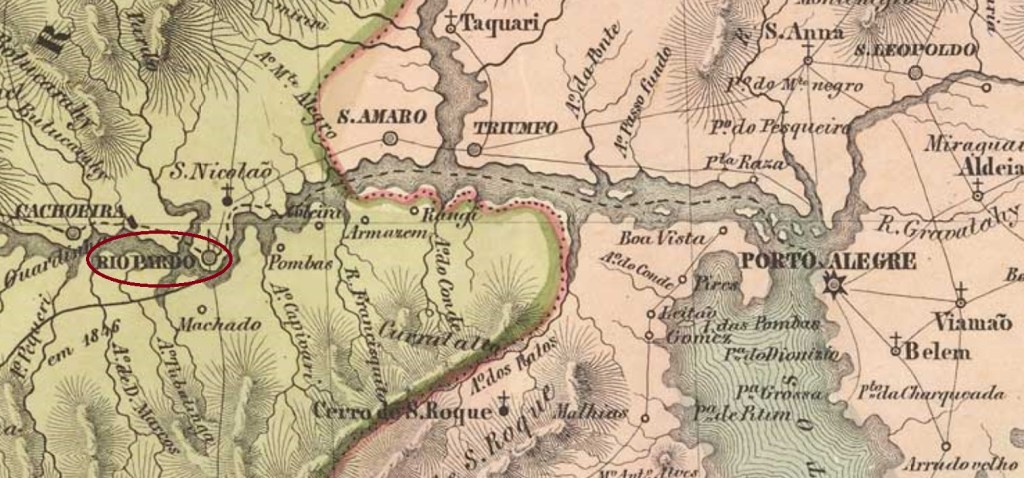
Der Fluss Rio Pardo in der südlichen Provinz von São Pedro do Rio Grande ist ein Zufluss des Jacuí, der in die Lagoa dos Patos durch den Guaíbasee mündet. Die Freguesia de Nossa Senhora do Rosário do Rio Pardo wurde im Mai 1769 an der Mündung von diesem Rio Pardo gegründet. Die Gegend liegt ziemlich zentral im heutigen Staat Rio Grande do Sul, aber damals war sie die Grenze zwischen portugiesischen und spanischen Kolonien während Jahrzehnten des Kriegs. Darum spielte die Neusiedlung eine wichtige Rolle sowohl bei der Verteidigung der Portugiesen als auch als Brückenkopf für die folgende Landgewinnung. Rio Pardo stieg zur Villa im April 1809 und zur Stadt im März 1846 auf; nun ist es ein touristisches Städtchen unter 200 km westlich der Landeshauptstadt Porto Alegre entfernt.
Über das Entstehungsdatum des Postamtes liegen widersprüchliche Angaben vor. Der Catálogo Enciclopédico de Selos e História Postal do Brasil (RHM, São Paulo, 1999) schreibt genau den 12. Oktober 1831, während das Verzeichnis der kaiserlichen Postämter (Tabella das Agencias do Correio do Império) von 1885 gibt das Jahr 1838 an. Gleichwohl wurde bereits am 24. September 1817 ein königliches Dokument (Carta Régia) durch D. João VI unterschrieben, das die Einführung einer regulären Postlinie zwischen den Provinzen von S. Paulo and S. Pedro anordnete, die in der Provinzhauptstadt São Paulo startete, durch Santos, Rio Grande und Porto Alegre passierte und deren Ende Rio Pardo war. Diese Postlinie wäre kaum oder überhaupt nicht durchführbar ohne die Gründung von Postämtern an den wichtigsten Haltestellen. Die Carta Régia kann man im portugiesischen Original hier lesen:
Ein Correio-Dienst wird ebenfalls in diesem Brief vom September 1825 aus Caxoeira (heute: Cachoeira do Sul) nach Rio Pardo erwähnt:
Die ersten vier Abstempelungen aus Rio Pardo (RRS-0290a bis RRS-0290d) stammen aus der Vorphila-Zeit:


Aus der folgenden Zeit muss es mindestens noch einen fehlenden Stempel geben, da die nächste Abstempelung, RRS-0290e (Samml. José A. Junges), Daten zwischen 1880 und 1886 vorweist: ein Doppelkreis mit der Inschrift RIO PARDO oben und eine (3) unten, dazu das Datum in der Mitte. Es folgt ein Stempel aus der Bahnlinie von Porto Alegre nach Uruguaiana: RRS-0290f (Samml. José A. Junges) kommt in grün und violett vor und zeigt eine doppelte Ellipse mit den Inschriften (…) DE PORTO ALEGRE oben, **A URUGUAYANA** unten, und RIO PARDO in der Mitte. Daten ab ca. 1885. Schließlich, RRS-0290g (FM) könnte bereits republikanisch sein: ein Doppelkreis mit den Inschriften RIO PARDO oben und (S.PEDRO DO SUL) unten, dazu das Datum in der Mitte. Nur ein Exemplar aus ca. 1893 gefunden.

 Carimbologia