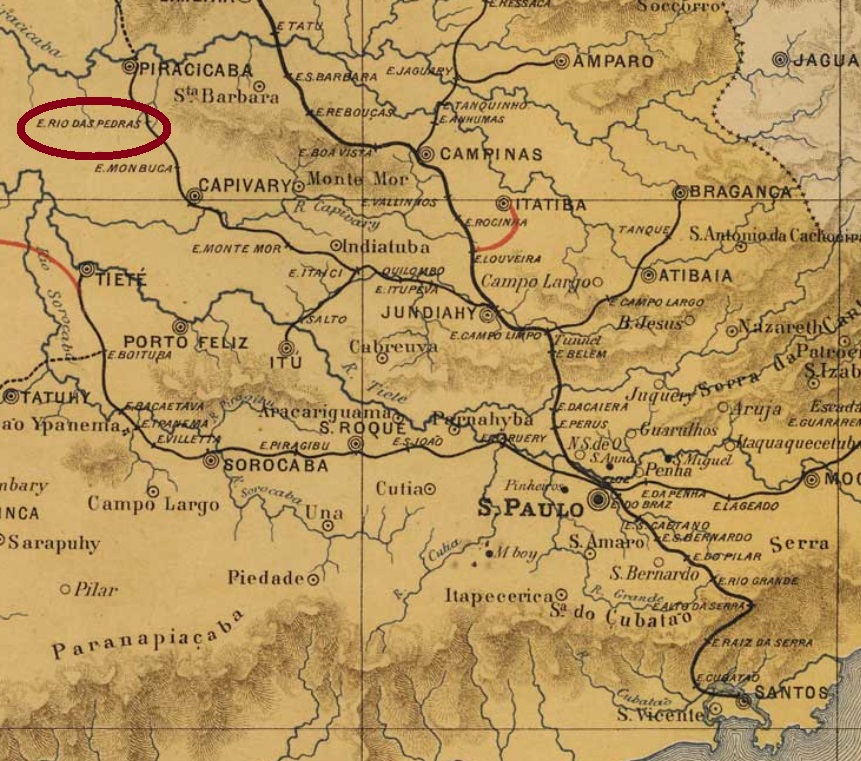
Tijuco Preto is the real name to this Rio das Pedras, a affluent to the Piracicaba River, located 160 km northwest of São Paulo. One could think the Pedras would mean Stones, as it often occurs. But the Brazilian Institute of Geography and Statistics (IBGE) tells a beautiful story about a traveller’s hostel in the ancient village, whose owner, called Pedro, had his daughters known as the Pedras… Se non è vero, è ben trovato.
Pedro’s daughters gave this way the name of the Rio das Pedras train station of the Companhia Ytuana railway, inaugurated in October 1876 in the Piracicaba branch. The settlement around it grew fast, and in April 1889 the district of Bom Jesus do Rio das Pedras was founded, which was elevated to a Villa with own municipality already in July 1894. Now it is a town with ca. 35 thousand inhabitants.
The railway control passed to the Cia. União Sorocabana e Ituana (1892-1907), followed by the Sorocabana Railway (1907-1919), the Estrada de Ferro Sorocabana (1919-1971) and by the FEPASA (1971-1984). Now the rails are removed, and the station house is demolished (estacoesferroviarias.com.br).
The station post office was created in April 1881, as reported by the press in Rio de Janeiro:

Only one imperial cancel is known, with dates between 1883 and 1891, which was already presented by Paulo Ayres (Catálogo de Carimbos – Brasil Imperio, São Paulo, 1937, p. 123):

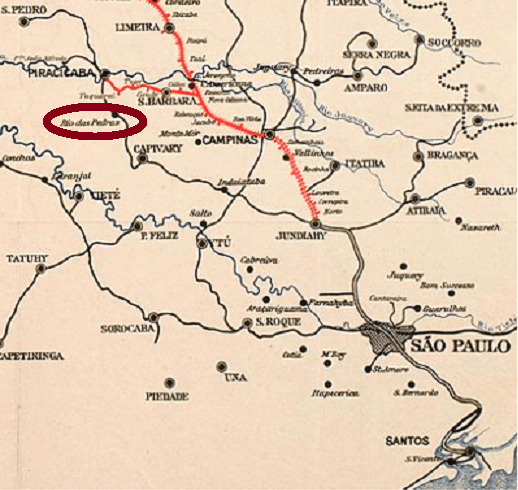
Dieser Rio das Pedras heißt eigentlich Tijuco Preto und ist ein kleiner Zufluss des Rio Piracicaba, 160 km nordwestlich von São Paulo gelegen. Man könnte annehmen, die Pedras wären die Steine im Flussbett vom Tijuco Preto. Aber die brasilianische Behörde für Geografie und Statistik (IBGE) erzählt uns die nette Geschichte, nach der ein gewisser Pedro, der dort eine Herberge für Reisende führte, einige Töchter hatte, die als Pedras bekannt wurden… Se non è vero, è ben trovato.
Nach Pedros Töchtern war auch die Bahnstation Rio das Pedras genannt, die im Oktober 1876 von der Companhia Ytuana in der Piracicaba-Abzweigung eingeweiht wurde. Die folgende Besiedlung wuchs schnell, und im April 1889 wurde der Distrikt von Bom Jesus do Rio das Pedras gegründet. Fünf Jahre später, im Juli 1894 war Rio das Pedras eine Villa im eigenen Município, und heute hat es ca. 35 Tausend Einwohner.
Die Kontrolle der Bahnlinie ging danach zu União Sorocabana e Ytuana (1892-1907) über, dann zur Sorocabana Railway (1907-1919), zur Estrada de Ferro Sorocabana (1919-1971) und schließlich zur FEPASA (1971-1984). Nun sind die Schienen ausgerissen, und das Bahnhaus gibt es auch nicht mehr. (estacoesferroviarias.com.br)
Das Bahnhofspostamt entstand im April 1881, wie die Presse aus Rio de Janeiro berichtete:

Nur ein Stempel aus der Kaiserzeit ist bekannt. Er hat Daten zwischen 1883 und 1891 und wurde bereits durch Paulo Ayres (Catálogo de Carimbos – Brasil Imperio, São Paulo, 1937, S. 123) vorgestellt:


 Carimbologia