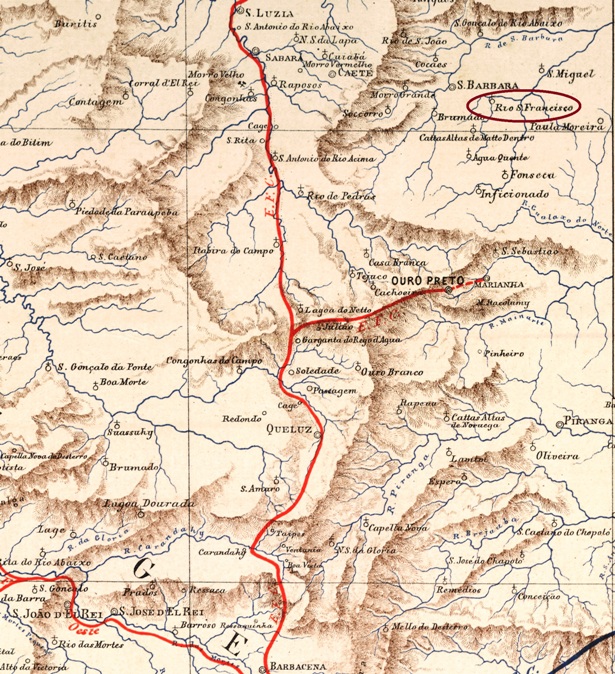
This is not the famous and mythical, over three thousand km long river which crosses both Minas Gerais and Bahia and divides Alagoas and Sergipe before reaching the Atlantic Ocean. It is a rather tiny homonymous colleague, barely visible on the map, an affluent to the Piracicaba River which gave the name to a district of the municipality of Santa Barbara, situated over 80 km north of the province capital Ouro Preto.
Rio de São Francisco was at least three times elevated to a district: in 1846, 1859 and 1873. It has kept this status until our days, but since September 1923 it is called Florália.
According to Paula Sobrinho (História Postal de Minas Gerais, Belo Horizonte, 1997), the post office was created in June 1876. Two imperial cancels are known. RMG-2130a (Coll. José A. Junges) has a double circle with the inscription R. DE S. FRANCISCO above and the date in the centre. Exemplars found used 1878-1887. RMG-2130b (Coll. José A. Junges) has a double circle with the inscription RIO DE S. FRANCISCO in somewhat bigger letters above and a cross ornament below, which consists of four diamonds. The dates are also here inside, known copies used from 1888 until 1890.
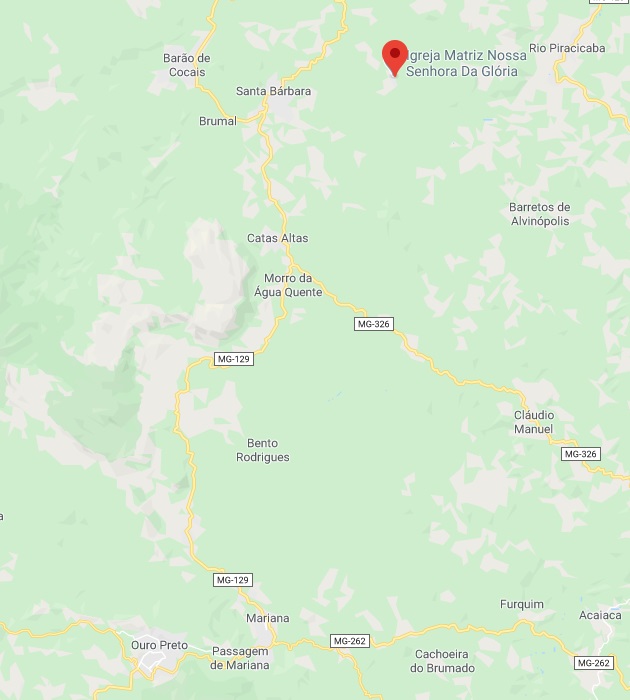
Dieser ist nicht der mythische, berühmte Fluss mit über dreitausend km Länge, der sowohl Minas Gerais als auch Bahia durchquert und Alagoas von Sergipe trennt, bevor er in die Atlantik mündet. Dieser ist ein eher kleiner Kollege, kaum auffindbar auf der Karte, der in den Piracicaba einfließt und seinen Namen einem Distrikt des Município von Santa Barbara gab, über 80 km nördlich der Provinzhauptstadt Ouro Preto gelegen.
Rio de São Francisco wurde mindestens dreimal zum Distrikt ernannt: in 1846, 1859 und zuletzt in 1873. Diesen Status erhielt die Ortschaft bis heute, allerdings – seit September 1923 – unter dem Ortsnamen Florália.
Laut Paula Sobrinho (História Postal de Minas Gerais, Belo Horizonte, 1997) entstand das Postamt im Juni 1876. Zwei Stempel aus dem Kaisserreich sind überliefert. RMG-2130a (Samml. José A. Junges) hat einen Doppelkreis mit der Inschrift R. DE S. FRANCISCO oben und dem Datum in der Mitte. Die gefundenen Exemplare wurden 1878-1887 benutzt. RMG-2130b (Samml. José A. Junges) hat einen Doppelkreis mit der Inschrift RIO DE S. FRANCISCO in etwas größeren Buchstaben wie vor oben, dazu ein kreuzförmiges Ornament unten, das aus vier kleinen Rhomben besteht. Auch hier sind die Daten (Exemplare benutzt 1888-1890) in der Mitte.

 Carimbologia