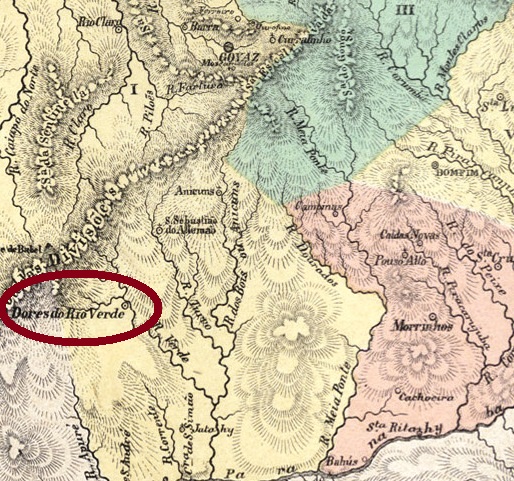
See also R. Koester: Dores do Rio Verde (Carimbologia XVI)
The district of Dores do Rio Verde was founded in August 1848, over 300 km south of the former province capital Goyaz (today Goiás Velho), to which it belonged. In November 1854, Rio Verde was elevated to a Villa, and in July 1882 it was given the town status.
R. Koester (Carimbologia XVI) asserts the post office was created in 1870, which is confirmed by the Imperial Mail Register (Tabella das Agencias do Correio do Império) of 1885. Nevertheless, there is a notice of March 1866 in the official provincial press referring directly to the post office clerk of this locality:
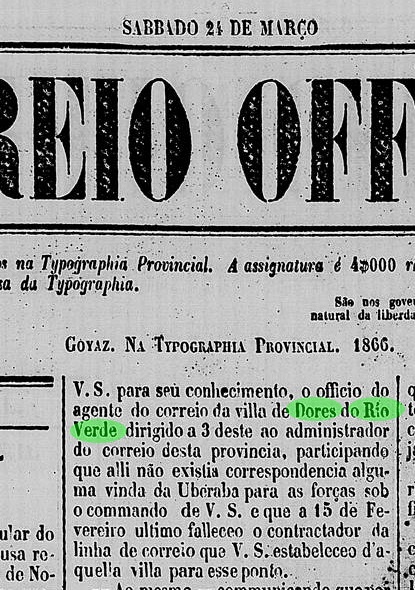
Thus, the post office must have been opened for a first time between 1860 (for it wasn’t listed in 1859) and 1866 and closed before 1870, the year it was reopened. A single imperial cancel is known: RGO-0175a (Coll. José A. Junges) has a double circle with the inscription RIO-VERDE above and a diamond ornament below, with the date in the centre. A sole copy was found, dated 1887.
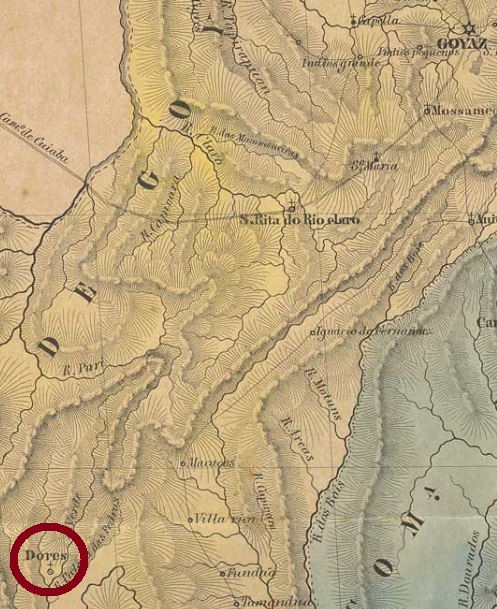
Siehe auch R. Koester: Dores do Rio Verde (Carimbologia XVI)
Der Distrikt von Dores do Rio Verde wurde im August 1848 im Verwaltungsbezirk der Provinzhauptstadt Goyaz (heute Goiás Velho) gegründet, wovon er über 300 km südlich lag. Im November 1854 stieg Rio Verde zur Villa auf, und im Juli 1882 erhielt die Ortschaft den Stadtstatus.
R. Koester (Carimbologia XVI) gibt 1870 als das Gründungsjahr fürs Postamt an, was das Verzeichnis der kaiserlichen Postämter (Tabella das Agencias do Correio do Império) von 1885 bestätigte. Gleichwohl liegt eine Nachricht des Amtsblatts für Goyaz aus März 1866 vor, in der der Postangestellte in Rio Verde erwähnt wird:
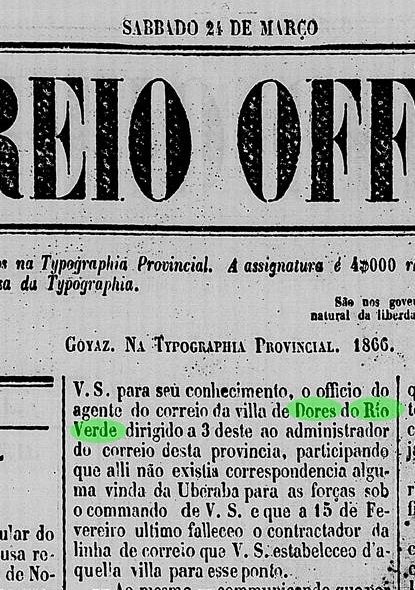
Daraus folgt, dass dieses Postamt irgendwann zwischen 1860 (da es in 1859 nicht aufgelistet war) und 1866 erstmals eröffnet wurde, um vor 1870 wieder geschlossen zu werden. Ein einziger Stempel aus der Kaiserzeit ist überliefert: RGO-0175a (Samml. José A. Junges) hat einen Doppelkreis mit der Inschrift RIO-VERDE oben und einem rautenförmigen Ornament unten, dazu das Datum in der Mitte. Ein Exemplar ist bekannt, mit Datum 1887.

 Carimbologia