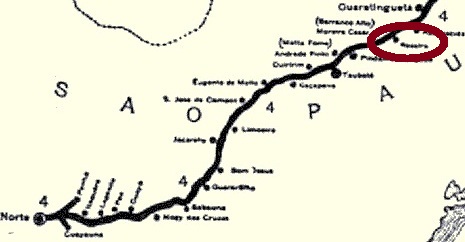
The Roseira train station was opened in March 1877 by the Estrada de Ferro do Norte railway, which linked the province capital São Paulo to the imperial Rio de Janeiro city. From 1890 until 1875 the rail line belonged to the Estrada de Ferro Central do Brasil; from then on, to the Rede Ferroviária Federal S.A., and since 1996 it is property of the MRS Logística S.A., a transport subsidiary company of the Companhia Siderúrgica Nacional steel enterprise (estacoesferroviarias.com.br).
The station post office was created in July 1877, according to the São Paulo press:

Two cancels of the imperial period are known. RSP-1140a (Coll. José A. Junges) is a French type, presenting a double circle with the inscription ROSEIRA above and the typical star between parentheses below. The central dates vary between 1884 and 1890. RSP-1140b (Coll. José A. Junges) is an ambulant rail cancel still of uncertain attribution, for it shows in the double circle the inscriptions E. (…)EIRA-S.PAULO above and C.A. below, with the date in the centre. The sole known exemplar was used in 1886.
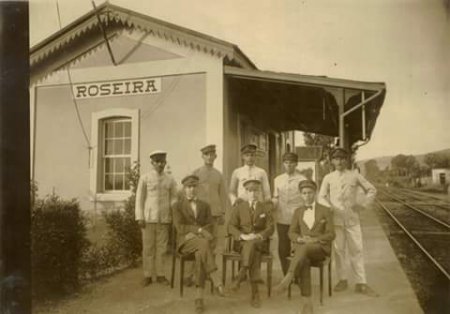
Der Bahnhof Roseira wurde im März 1877 durch die Estrada de Ferro do Norte Eisenbahngesellschaft eingeweiht, in der Linie zwischen der Provinzhauptstadt São Paulo und der kaiserliche Metropole Rio de Janeiro. Die Linie gehörte zwischen 1890 und 1975 der Estrada de Ferro Central do Brasil, danach der Rede Ferroviária Federal S.A., und seit 1996 ist sie Eigentum der MRS Logistica S.A., einer logistischen Tochtergesellschaft des Stahlkonzerns Companhia Siderúrgica Nacional (estacoesferroviarias.com.br).
Das Bahnhofspostamt entstand im Juli 1877, laut Pressemitteilung aus São Paulo:

Zwei Stempel aus der Kaiserzeit sind überliefert. RSP-1140a (Samml. José A. Junges) ist ein “französischer Typus” und zeigt einen Doppelkreis mit der Inschrift ROSEIRA oben und dem typischen Sternchen zwischen Klammern unten. Die Daten in der Mitte gehen von 1884 bis 1890. RSP-1140b (Samml. José A. Junges) ist eine Abstempelung aus dem Waggon (Correio Ambulante), deren Zuordnung noch nicht sicher ist, da hier im Doppelkreis nur die Inschrift E. (…)EIRA-S.PAULO oben und C.A. unten sichtbar sind. Das einzige bekannte Exemplar wurde 1886 benutzt.

 Carimbologia