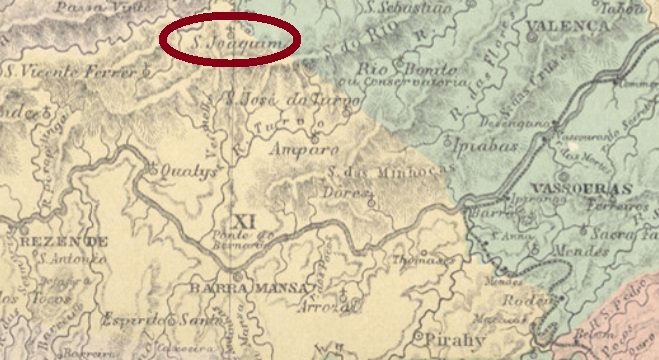
Print edition update, on December 19, 2021
Another name: Ribeirão de São Joaquim (1943)
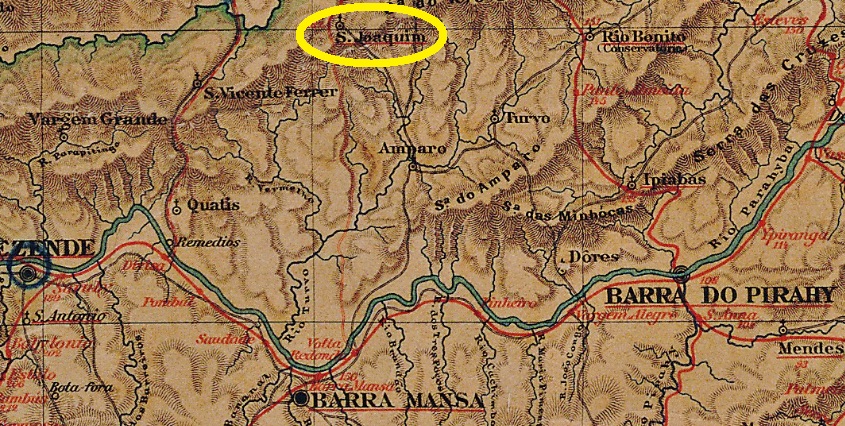
São Joaquim was from October 1851 a district in the municipality of Barra Mansa, located about 170 km northwest of the imperial capital Rio de Janeiro. In December 1943, it changed the name to Ribeirão de S. Joaquim, who has belonged to the Quatis municipality since January 1991.
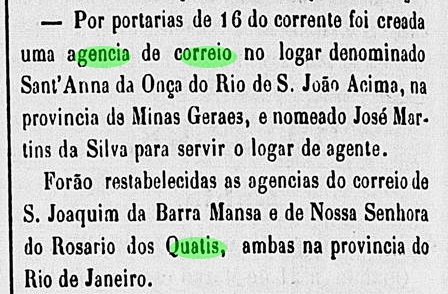
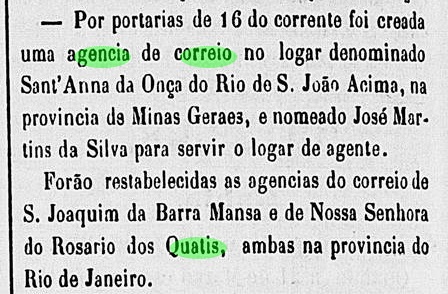
As Paulo Novaes writes in agenciaspostais.com.br, there has been a post office there since March 1860. This is confirmed by ministerial protocol:


However, the agency closed in July 1861 and did not reopen until April 1864:
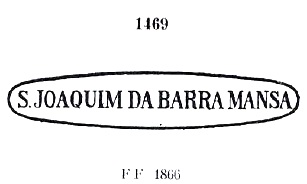
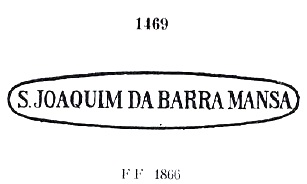
The following postmarks of the imperial period have been handed down. SRJ-1415a was in use until at least 1866, having been already presented by Paulo Ayres in Catalogo de Carimbos Brasil-Império, (S. Paulo, 1937, 1942) under No. 1469:
It was followed by SRJ-1415b (image from the internet): a double circle with the inscription S. JOAQM. DA BARA. MANSA above and a diamond-shaped ornament at the bottom, the four sides of which are open. Dates in the centre: 1885-1898.
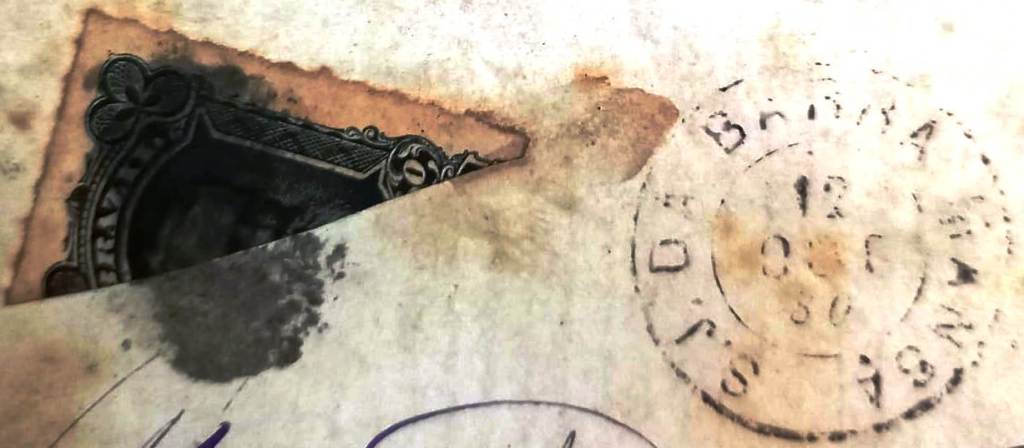
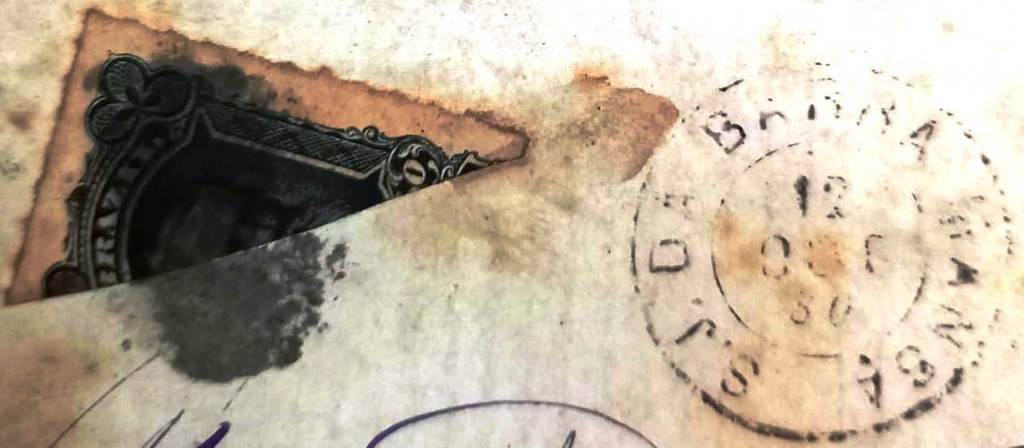
A new cancel from this locality appeared after the publication of Carimbologia S2. SRJ-1415c (Coll. Fuad Ferreira Fo.) is probably earlier than SRJ-1415b and was seen on a fragment of 1880, also showing a mute cancel on a bisected stamp:
Printausgabe-Update, am 19. Dezember 2021
Anderer Name: Ribeirão de S. Joaquim (1943)
São Joaquim war ab Oktober 1851 ein Distrikt im Município von Barra Mansa, der ca. 170 km nordwestlich der kaiserlichen Hauptstadt Rio de Janeiro lag. Im Dezember 1943 wechselte sein Name zu Ribeirão de S. Joaquim, der seit Januar 1991 dem Município von Quatis angehört.
Wie Paulo Novaes in agenciaspostais.com.br schreibt, gibt es dort ein Postamt seit März 1860. Das wird durch Ministerialprotokoll bestätigt:


Die Agentur schloss allerdings im Juli 1861 und eröffnete erst im April 1864 wieder:
Folgende Poststempel der Kaiserzeit sind überliefert. SRJ-1415a war in Gebrauch bis mindestens 1866 und wurde bereits durch Paulo Ayres in Catálogo de Carimbos Brasil-Império, (S. Paulo, 1937, 1942) unter Nr. 1469 vorgestellt:
Ihm folgte SRJ-1415b (Abb. aus dem Internet): ein Doppelkreis mit der Inschrift S. JOAQM. DA BARA. MANSA oben und einem Ornament in Rautenform unten, dessen vier Seiten offen sind. Bisherige Daten in der Mitte: 1885-1898.
Nach der Veröffentlichung von Carimbologia S2 erschien ein bisher unbekannter Stempel dieses Ortes. SRJ-1415c (Samml. Fuad Ferreira Fo.) ist wahrscheinlich älter als SRJ-1415b und wurde auf einem Fragment von 1880 gesehen, das ebenfalls einen stummen Stempel auf einer Markenhalbierung zeigt:

 Carimbologia