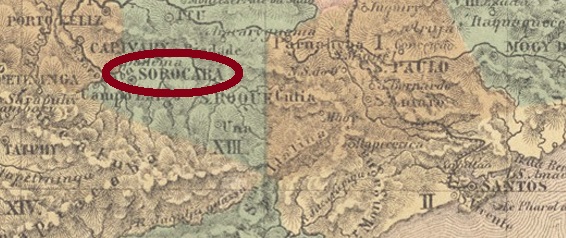
Another name: Nossa Senhora da Ponte de Sorocaba
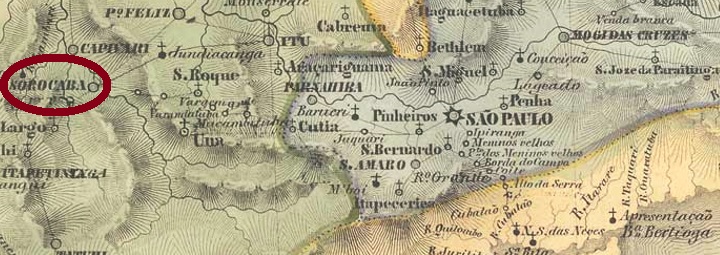
The freguesia of Nossa Senhora da Ponte de Sorocaba (Our Lady of Sorocaba Bridge) was established as early as 1654 and was located on the west bank of the Sorocaba River, 100 km west of the future provincial capital of São Paulo. The town grew very quickly and soon became Brazil’s most important transhipment point for livestock. In March 1661 Sorocaba rose to the status of a villa and in February 1842 to that of a city. The local railway station was inaugurated in July 1875 by the E.F. Sorocabana railway company and remained in operation until 1998, after changing hands several times: to the Cia. União Sorocabana e Ytuana (1892), Sorocabana Railway (1907), back to E.F. Sorocabana (1919) and finally to FEPASA (1971).
Two creation dates for the local post office have been found. Nova Monteiro, in Administrações e Agencias Postaes do Brasil Imperio (Brasil Filatelico/RJ, 1934-5; Reprint SPP 1994-1999) writes October 1839 for it, while the agency is listed in the Imperial Mail Register (Tabella das Agencias do Correio do Imperio, Rio de Janeiro, 1885) from 1846. According to this, it would have been closed in between. However, the RHM catalogue reports pre-philatelic postmarks from Sorocaba that would have been in circulation as early as around 1827. A third, earliest post office opening seems to be proven by this.
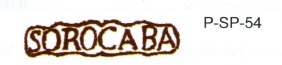
The earliest postmark is therefore SSP-1395a, as illustrated in the RHM catalogue:
SSP-1395a (RHM P-SP-54) 1827-1829
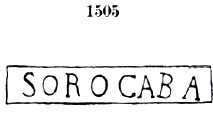
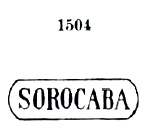
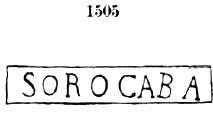
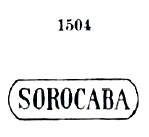
It was followed by two postmarks, SSP-1395b and SSP-1395c, which also occur in red and were introduced to us by Paulo Ayres in Catálogo de Carimbos Brasil-Império, (S. Paulo, 1937, 1942) under Nos. 1505 and 1504 respectively:
The following cancels are double circles. SSP-1395d also exists in blue and was also introduced by P. Ayres:

On SSP-1395e (Coll. Mario Celso Orsi Jr.) the above inscription is SOROCABA. The cancel also appears in violet, and the inner dates go from 1881 to 1890. SSP-1395f (Coll. José A. Junges) has the same inscription at the top, with a five-pointed star at the bottom. Dates: 1885-1888. SSP-1395g (Coll.José A. Junges) also has the same inscription at the top, but now reads (S.PAULO) at the bottom. Dates: 1885-1897. SSP-1395h (Coll. José A. Junges) has a cruciform ornament at the bottom, with the same inscription at the top. Dated 1889-1894 in the centre. SSP-1396a (Coll. Mario Celso Orsi Jr.) was intended for ambulant mail service in railway carriages. The double circle reads SOROCABA above and (C.A.) below, for Correio Ambulante. Dated 1885-1887 in the centre.
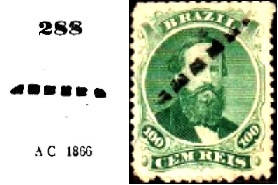
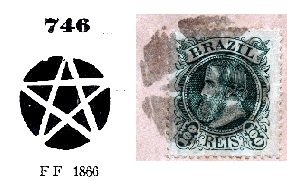
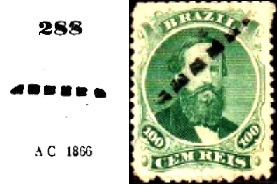
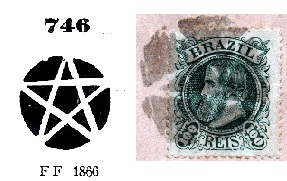
Below the many “mute” postmarks from Imperial Sorocaba, two have already been presented by P. Ayres (op. cit.) under Nos. 288 and 746:
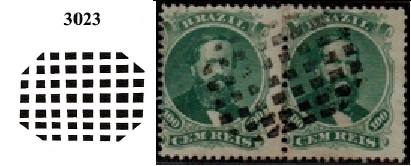
Two further postmarks were given the nos. 3023 and 3110 in Mute Cancellations of the Brazil Empire, by J. Dingler and K.W. Lopes (Brazil Philatelic Association, Rio de Janeiro, 2000):

Another one was found on a D.Pedro issue of1876 :

Anderer Name: Nossa Senhora da Ponte de Sorocaba
Die Freguesia von Nossa Senhora da Ponte de Sorocaba (Unsere Liebe Frau an der Sorocaba-Brücke) entstand bereits 1654 und lag am Westufer des Flusses Sorocaba, 100 km westlich der künftigen Provinzhauptstat São Paulo entfernt. Die Ortschaft wuchs sehr schnell und wurde bald Brasiliens wohl wichtigster Umschlagplatz für Vieh. Im März 1661 stieg Sorocaba zur Villa und im Februar 1842 zur Stadt auf. Der örtliche Bahnhof wurde im Juli 1875 von der Bahngesellschaft E.F. Sorocabana eingeweiht und blieb bis 1998 in Betrieb, nachdem die Besitzer mehrmals wechselten: zur Cia. União Sorocabana e Ytuana (1892), Sorocabana Railway (1907), zurück zur E.F. Sorocabana (1919) und schließlich zur FEPASA (1971).
Zwei Gründungsdaten fürs örtliche Postamt wurden ermittelt. Nova Monteiro schreibt in Administrações e Agencias Postaes do Brasil Imperio (Brasil Filatelico/RJ, 1934-5; Reprint SPP 1994-1999) dafür den Oktober 1839, während die Agentur im Verzeichnis der kaiserlichen Postämter (Tabella das Agencias do Correio do Imperio, Rio de Janeiro, 1885) ab 1846 aufgelistet wird. Demnach wäre sie zwischendurch geschlossen gewesen. Allerdings berichtet der RHM-Katalog über Vorphila-Poststempel aus Sorocaba, die bereits um 1827 im Umlauf wären. Eine dritte, früheste Postamteröffnung scheint dadurch belegt zu sein.
Der früheste Poststempel ist also SSP-1395a, wie im RHM-Katalog abgebildet wurde:
Ihm folgten zwei Stempel, SSP-1395b und SSP-1395c, die auch in rot vorkommen und uns durch Paulo Ayres in Catálogo de Carimbos Brasil-Império, (S. Paulo, 1937, 1942) jeweils unter den Nr. 1505 und 1504 vorgestellt wurden:
Die folgenden Stempel sind Doppelkreise. SSP-1395d gibt es auch in blau und wurde ebenfalls durch P. Ayres bekannt gemacht:

Bei SSP-1395e (Samml. Mario Celso Orsi Jr.) lautet die obige Inschrift SOROCABA. Der Stempel kommt auch in violett vor, und die inneren Daten gehen von 1881 bis 1890. SSP-1395f (samml. José A. Junges) hat oben die gleiche Inschrift, unten sieht man einen fünfzackigen stern. Daten: 1885-1888. Auch SSP-1395g (Samml. José A. Junges) hat die gleiche Inschrift oben, unten steht nun (S.PAULO) zu lesen. Daten: 1885-1897. Im SSP-1395h (Samml. José A. Junges) ist unten ein kreuzförmiges Ornament, bei gleicher Inschrift oben. Datiert 1889-1894 in der Mitte. SSP-1396a (Samml. Mario Celso Orsi Jr.) war für den ambulanten Postbetrieb im Bahnwagen betimmt. Im Doppelkreis liest man oben SOROCABA und unten (C.A.), für Correio Ambulante. Datiert 1885-1887 in der Mitte.
Unten den vielen “stummen” Poststempel aus dem kaiserlichen Sorocaba wurden zwei bereits durch P. Ayres (op. cit.) unter den Nr. 288 und 746 präsentiert:
Zwei weitere Stempel haben die Nr. 3023 und 3110 im Mute Cancellations of the Brazil Empire/ Carimbos Mudos do Brasil Império, von J. Dingler und K.W. Lopes (Brazil Philatelic Association, Rio de Janeiro, 2000) bekommen:
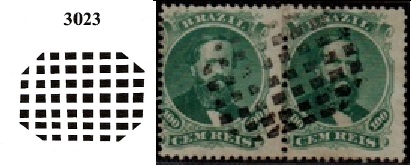

Ein weiterer wurde auf einer D. Pedro-Ausgabe von 1876 gefunden :


 Carimbologia