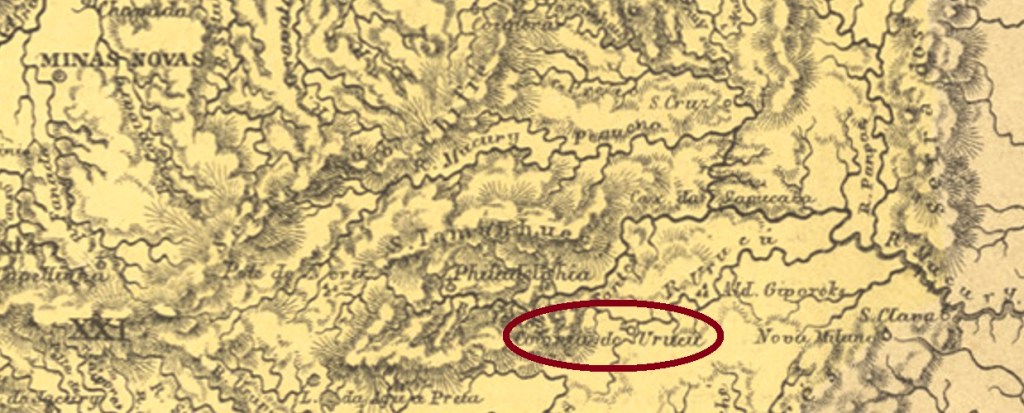
Another name: Carlos Chagas (1938)
This locality was a military colony near Minas Novas from November 1877, located at the confluence of the Urucu River and the Mucuri, 600 km northeast of the provincial capital of Ouro Preto. In September 1887, the place became a district of the Município of Theophilo Ottoni. Political emancipation took place in December 1938 as the Município of Carlos Chagas. The name commemorates the doctor, epidemiologist, and biologist (1878-1934) from Minas Gerais who, among other things, discovered and described Chagas’ disease.
Paula Sobrinho writes in Historia Postal de Minas Gerais (Belo Horizonte, 1997) that there was a post office there from October 1880. The imperial postmark is UMG-3255a (Coll. José A. Junges): a double circle with the inscription URUCÚ above and (MINAS) below. The dates in the middle were found for the period 1885-1902.
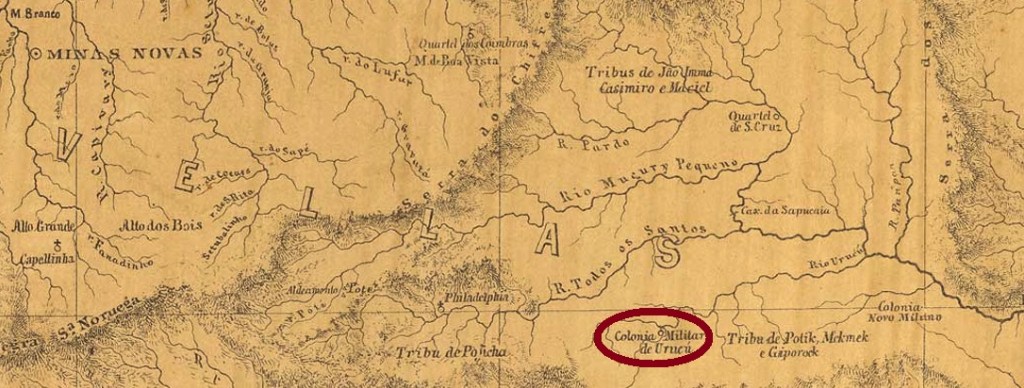
Andere Name: Carlos Chagas (1938)
Diese Ortschaft war ab November 1877 eine Militärkolonie bei Minas Novas, die an der Mündung vom Urucu-Fluss in den Mucuri lag, 600 km nordöstlich der Provinzhauptstadt Ouro Preto entfernt. Im September 1887 wurde der Ort zum Distrikt des Município von Theophilo Ottoni. Die politische Emanzipation erfolgte im Dezember 1938 als Município von Carlos Chagas. Der Name erinnert an den Arzt, Epidemiologe und Biologe (1878-1934) aus Minas Gerais, der u.a. die Chagas-Krankheit entdeckt und beschrieben hat.
Paula Sobrinho schreibt in Historia Postal de Minas Gerais (Belo Horizonte, 1997), dass es dort ab Oktober 1880 ein Postamt existierte. Der kaiserliche Poststempel ist UMG-3255a (Samml. José A. Junges): ein Doppelkreis mit der Inschrift URUCÚ oben und (MINAS) unten. Die Daten in der Mitte wurden für den Zeitraum 1885-1902 gefunden.

 Carimbologia