
Another name: Senhor Bom Jesus dos Remédios
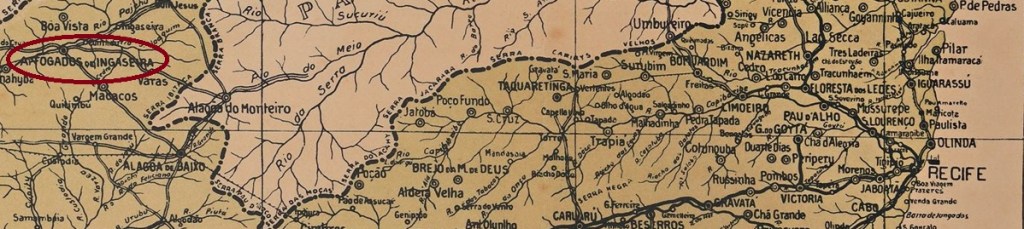
The former parish of Senhor Bom Jesus dos Remédios was established around 1800 in the Freguesia of Ingazeira, which at that time belonged to the Villa of Flores and was located on the south bank of the Pajeú River, 380 km west of the later provincial capital Recife. In May 1852, it became the Villa of Afogados de Ingazeira, which was demoted as a district in the Município of Ingazeira in May 1870, only to regain autonomy – this time as a town – in July 1909. The strange name (Drowned at Ingazeira) comes from a legend according to which a couple died trying to cross the Pajeú when the water level was high.
There had been a post office there since 1873, as can be seen from the Directory of Imperial Post Offices (Tabella das Agencias do Correio do Imperio, Rio de Janeiro, 1885). The imperial postmark is APE-0005a (Coll. Jorge L. Pedreira): a French type with the inscription AFOGADOS D’INGAZEIRA above and the typical star between brackets below. The dates in the middle – as far as recorded – go so far from 1885 to 1887.
Anderer Name: Senhor Bom Jesus dos Remédios
Die ehemalige Pfarrei Senhor Bom Jesus dos Remédios wurde um 1800 in der Freguesia von Ingazeira errichtet, die damals der Villa von Flores angehörte, und lag am Südufer des Pajeú-Flusses, 380 km westlich der späteren Provinzhauptstadt Recife entfernt. Im Mai 1852 wurde daraus die Villa von Afogados de Ingazeira, die im Mai 1870 als Distrikt im Município von Ingazeira herabgesetzt wurde, um im Juli 1909 die Autonomie – diesmal als Stadt – wieder zu erlangen. Der merkwürdige Name (Ertrunkene bei Ingazeira) entstammt einer Legende, nach der ein Ehepaar verstarb, als es versuch hatte, den Pajeú bei hohem Pegelstand zu durchqueren.
Dort gab es ein Postamt seit 1873 wie aus dem Verzeichnis der kaiserlichen Postämter (Tabella das Agencias do Correio do Imperio, Rio de Janeiro, 1885) hervorgeht. Der kaiserliche Poststempel ist APE-0005a (Samml. Jorge L. Pedreira): ein Französischer Typ mit der Inschrift AFOGADOS D’INGAZEIRA oben und dem typischen Stern zwischen Klammern unten. Die Daten in der Mitte –soweit vorhanden – gehen bisher von 1885 bis 1887.

 Carimbologia