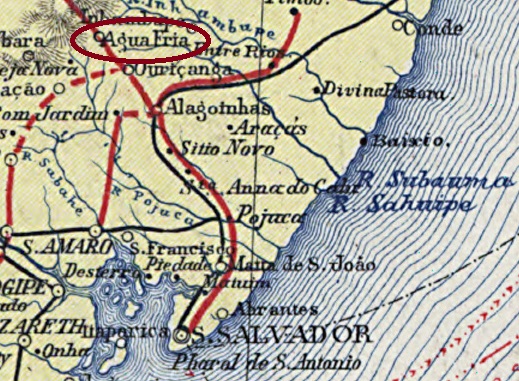
The Freguesia of São João Baptista da Agua Fria (Cold Water) was founded as early as April 1718, it belonged to the Vila of Cachoeira and was located over 150 km north of the capital Salvador da Bahia. In 1727, it was elevated to the status of Vila, but lost its autonomy at the beginning of the 19th century and finally became a district in the Município of Purificação dos Campos in May 1842. In August 1895, Agua Fria transferred as a district to the Município of Irará and emancipated itself in July 1962.
The local railway station was inaugurated in November 1880 by the E.F. da Bahia ao São Francisco. Afterwards, the line changed hands many times: in 1909 to the Cia. Viação Geral da Bahia, in 1911 to the Cie. de Chemins der Fer Fédéraux de l’Est Brésilien, in 1935 to the Viação Férrea Federal Leste Brasileiro, in 1975 to the Rede Ferroviária Federal until the end of operations in 1996. The rails are still there, but the station is now a ruin.
There had been a station post office there since April 1881, as the Rio press reports:
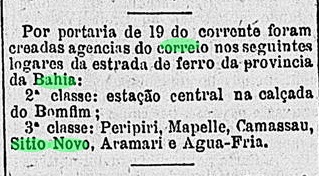
No imperial postmark has yet been seen from this station.
Please note: this blog will return ca. 29 August, after a vacation break.
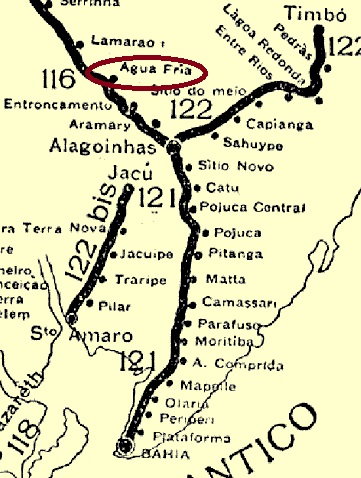
Die Freguesia von São João Baptista da Agua Fria (Kaltes Wasser) wurde bereits im April 1718 gegründet, sie gehörte der Vila von Cachoeira und lag über 150 km nördlich der Hauptstadt Salvador da Bahia entfernt. 1727 wurde der Ort zur Vila erhoben, verlor aber am Anfang des 19 Jahrhunderts seine Eigenständigkeit und wurde schließlich im Mai 1842 zu einem Distrikt im Município von Purificação dos Campos. Im August 1895 wechselte Agua Fria als Distrkt zum Município von Irará und emanzipierte sich im Juli 1962.
Der Ortsbahnhof wurde im November 1880 durch die E.F. da Bahia ao São Francisco eingeweiht. Danach wechselte die Linie oft den Besitzer: 1909 zur Cia. Viação Geral da Bahia, 1911 zur Cie. de Chemins der Fer Fédéraux de l’Est Brésilien, 1935 zur Viação Férrea Federal Leste Brasileiro, 1975 bis Betriebsende 1996 zur Rede Ferroviária Federal. Die Schienen sind noch da, aber der Bahnhof ist jetzt eine Ruine.
Ein Bahnhofspostamt gab es dort seit April 1881, wie die Presse aus Rio berichtet:
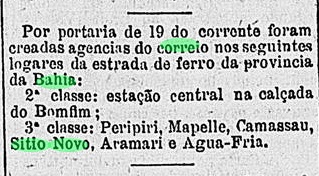
Bisher ist noch kein kaiserlicher Poststempel aus diesem Bahnhof zu sehen.
Bitte beachten: Dieser Blog macht Urlaub bis ca. 29.8.

 Carimbologia