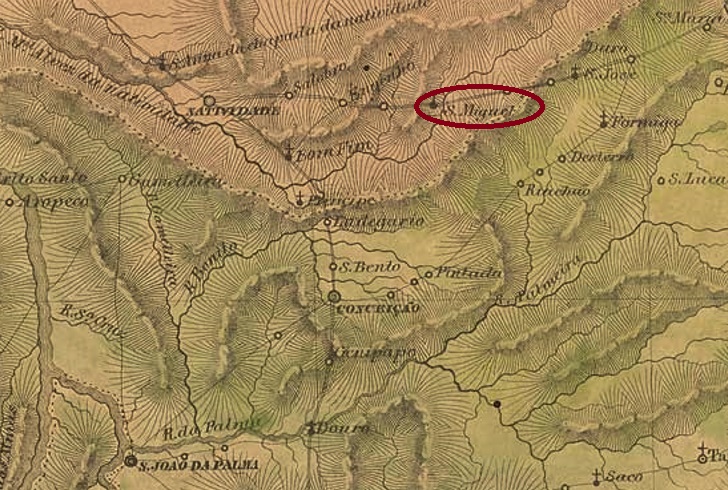
Other name: S. Miguel e Almas
This place again poses a mystery to researchers. It was founded by gold miners in the 18th century and was located near the Vila of Natividade, 770 km northeast of the later provincial capital of Goyaz (now Goiás Velho). It came to a certain prosperity in the 19th century due to the gold and diamond deposits. When these mines were exhausted, an economic decay followed, which lasted until the new boom brought about by agribusiness. Since November 1958, Almas has been a município, and since October 1988, it belongs to the state of Tocantins.
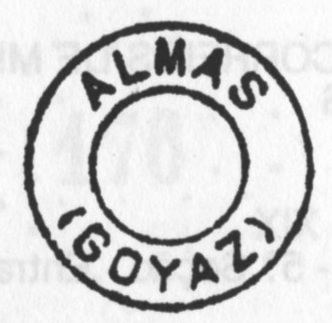
So far, the date of origin of the local post office could not be found, but it is said not to have taken place before 1887. It is possible that the agency was only established in the early Republic. The first postmark is AGO-0007a, which is shown in Carimbos Postais – século XIX by Cícero A. Almeida (Rio de Janeiro, 1989) and mentioned in Catálogo de Carimbos Brasil-Império by P. Ayres (S. Paulo, 1937, 1942):
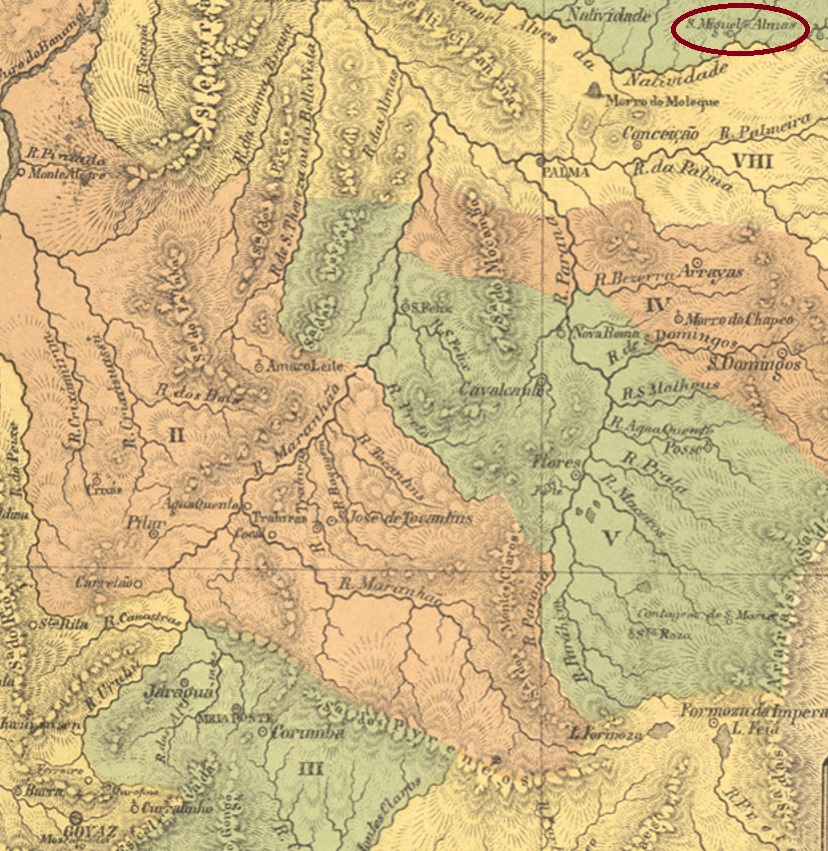
Anderer Name: S. Miguel e Almas
Dieser Ort stellt wieder ein Rätsel für die Forscher dar. Er wurde von Goldgräbern im 18. Jahrhundert gegründet und lag bei der Vila von Natividade, 770 km nordöstlich der späteren Provinzhauptstadt Goyaz (heute Goiás Velho) entfernt. Durch das Gold- und Diamantenaufkommen kam er im 19. Jahrhundert zu einem gewissen Wohlstand. Als diese Minen erschöpft waren, ein wirtschaftlicher Abstieg folgte, der bis zum Neuaufschwung durch den Agrobusiness andauerte. Seit November 1958 ist Almas ein Município, seit Oktober 1988 im Bundesstaat Tocantins.
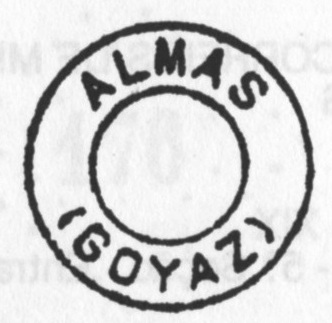
Bisher konnte das Entstehungsdatum des örtlichen Postamts nicht gefunden werden, das soll aber nicht vor 1887 stattgefunden haben. Möglicherweise wurde die Agentur erst in der frühen Republik ins Leben gerufen. Der erste Poststempel ist AGO-0007a, der durch die Abbildung in Carimbos Postais – século XIX von Cícero A. Almeida (Rio de Janeiro, 1989) sowie durch eine Erwähnung in Catálogo de Carimbos Brasil-Império von P. Ayres (S. Paulo, 1937, 1942) bekannt ist:

 Carimbologia