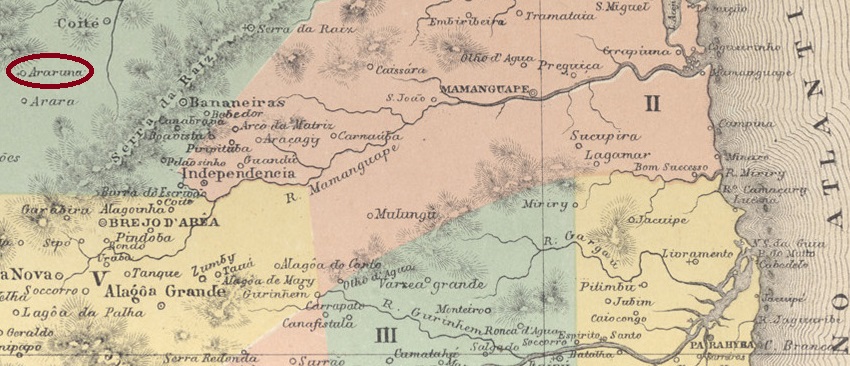
The settlement called N. Sra. da Conceição de Araruna originated around 1845 in the Município of Bananeiras and became a parish in July 1854, located 150 km northwest of the provincial capital Parahyba do Norte (today: João Pessoa). The place was declared a vila in July 1876 and has been a town since November 1938. The name comes from the Tupi-Guarani and means Black Macaw.
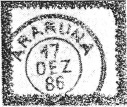
There was a post office there since April 1878, as can be read in the postal report (Relatorio dos Correios) for 1887. The oldest postmark so far, APB-0030a, has already been illustrated by R. Koester in Carimbologia II:
It was followed by APB-0030b (image from the internet): In this double circle the outer circle seems to be doubled. At the top one reads ARARUNA and at the bottom is an ornament in lozenge, formed by four small lozenges. The only specimen so far bears a date from 1908 in the centre.
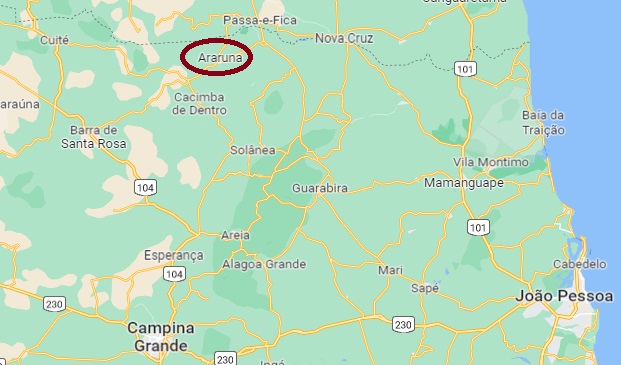
Die Siedlung mit Namen N. Sra. da Conceição de Araruna entstand um 1845 im Município von Bananeiras und wurde eine Pfarrei im Juli 1854, die 150 km nordwestlich der Provinzhauptstadt Parahyba do Norte (heute: João Pessoa) lag. Der Ort wurde im Juli 1876 zur Vila ernannt und ist eine Stadt seit November 1938. Der Name kommt aus dem Tupi-Guarani und bedeutet Schwarzer Ara.
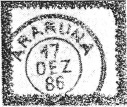
Dort gab es ein Postamt seit April 1878, wie im Postbericht (Relatorio dos Correios) für 1887 zu lesen ist. Der bisher älteste Poststempel APB-0030a wurde bereits durch R. Koester in Carimbologia II abgebildet:
Ihm folgte APB-0030b (Abb. aus dem Internet): In diesem Doppelkreis scheint der äußere Kreis verdoppelt zu sein. Oben liest man ARARUNA und unten ist ein Ornament in Raute, das aus vier kleinen Rauten gebildet wird. Das bisher einzige Exemplar trägt ein Datum aus 1908 in der Mitte.

 Carimbologia