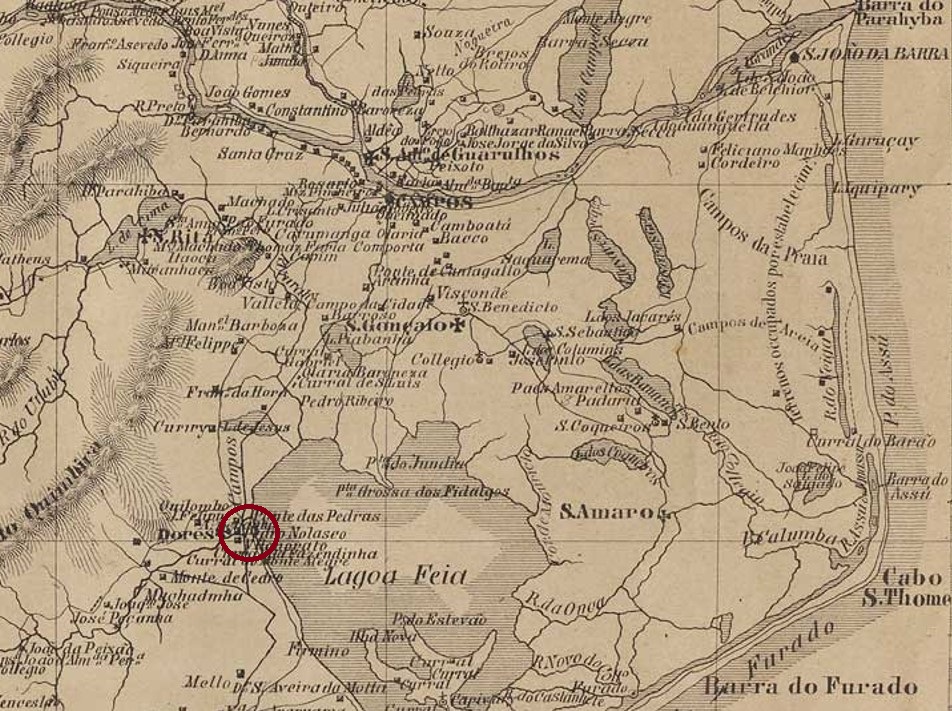
The Macabu River rises from the mountain range of the same name in the state of Rio de Janeiro and used to flow eastwards for about 120 km to its mouth in Lagoa Feia (Ugly Lake). With the construction of a hydroelectric power plant at the Tapera Dam in 1950 in the Município of Trajano de Morais, the Macabu was diverted through an underground channel into the Macaé River. However, 5 km further on, the river rises again and resumes its original direction. So, the Macabu has two sources and two mouths.
At the mouth of the river at Lagoa Feia there was a now disappeared settlement called Barra do Macabu, which belonged to the Freguesia of Dores do Macabu and was in the Município of Campos, 250 km northeast of the capital Rio de Janeiro.
The Barra do Macabu post office was created in August 1869, as Nova Monteiro writes in Administrações e Agencias Postaes do Brasil Imperio (Brasil Filatelico/RJ, 1934-5; Reprint SPP 1994-1999), but was already closed “around 1875”, as Paulo Novaes tells us in agenciaspostais.com.br. No imperial postmark from this locality has been found so far, it must be extremely rare.
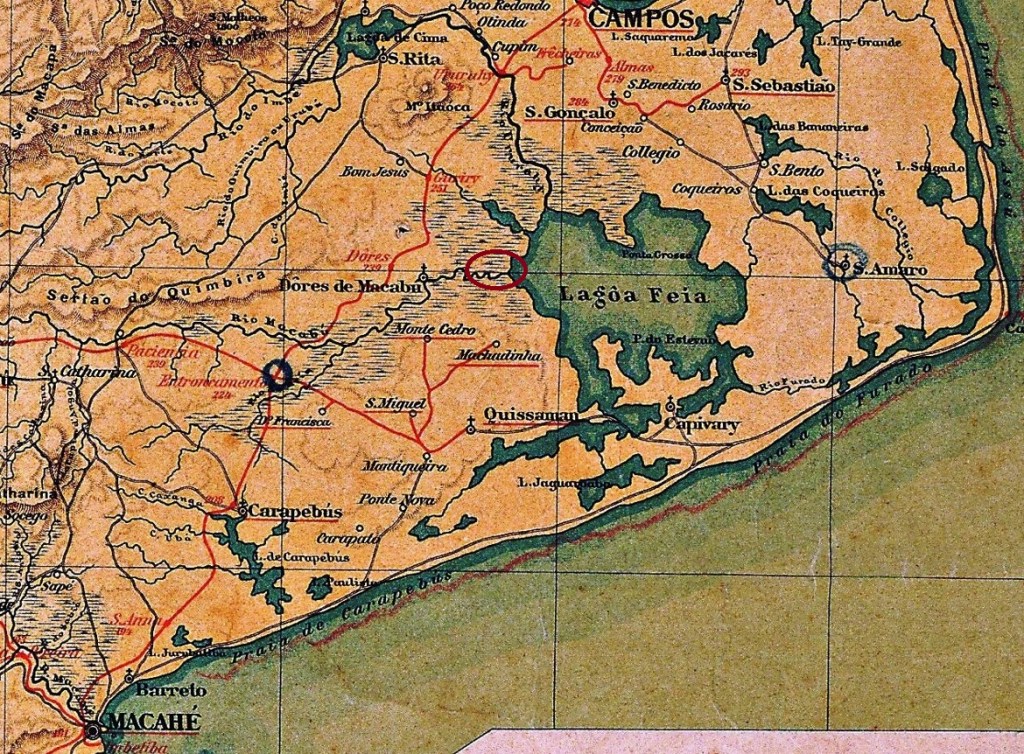
Der Fluss Macabu entspringt dem gleichnamigen Gebirge im Bundesstaat Rio de Janeiro und floß früher ostwärts ca. 120 km bis zur Mündung in die Lagoa Feia (Häßlicher See). Mit dem Bau eines Wasserkraftwerks am Tapera-Staudamm 1950 im Município von Trajano de Morais wurde der Macabu durch einen unterirdischen Kanal in den Fluss Macaé umgeleitet. Allerdings entspringt 5 km weiter der Fluss nochmals und nimmt die ursprüngliche Richtung wieder ein. Also hat der Macabu zwei Quellen und zwei Mündungen.
An der Flussmündung zur Lagoa Feia gab es eine inzwischen verschwundene Siedlung namens Barra do Macabu, die der Freguesia von Dores do Macabu angehörte und im Município von Campos lag, 250 km nordöstlich der Hauptstadt Rio de Janeiro entfernt.
Das Postamt Barra do Macabu entstand im August 1869, wie Nova Monteiro in Administrações e Agencias Postaes do Brasil Imperio (Brasil Filatelico/RJ, 1934-5; Reprint SPP 1994-1999) schreibt, wurde aber bereits “ca. 1875” geschlossen, wie Paulo Novaes uns in agenciaspostais.com.br berichtet. Bisher wurde kein kaiserlicher Poststempel aus dieser Ortschaft gefunden, er muss äußerst selten sein.

 Carimbologia