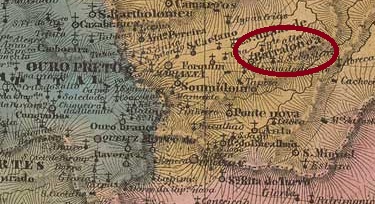
The freguesia of S. José da Barra Longa was founded as early as February 1740, it belonged to the Vila of Mariana and was located on the south bank of the river Carmo, 70 km east of the later provincial capital Ouro Preto. In April 1841, the village was promoted to a Vila, but in July 1857 it was downgraded as a district in the Município of Ponte Nova. Barra Longa then moved back to the Município of Mariana (in October 1870), returning to Ponte Nova in September 1923. Barra Longa has been an independent município since December 1938.
Two dates of origin have been found for the local post office. The first was in February 1865, as reported by the Rio press:

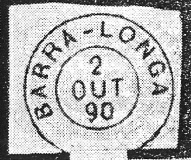
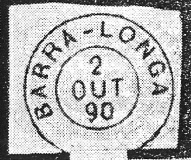
The second date is one month later and was found by Paula Sobrinho in História Postal de Minas Gerais (Belo Horizonte, 1997), and adopted by R. Koester in Carimbologia III. This could be the date of the commissioning of the agency. The only postmark in the Empire so far is BMG-0240b, found with dates from 1879 to 1890 and already shown by R. Koester (op. cit.):
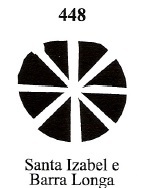
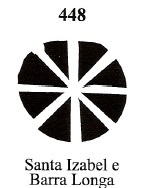
James A. Dingler and Klerman W. Lopes have also presented a mute cancellation from Barra Longa in Mute Cancellations of the Brazil Empire / Carimbos Mudos do Brasil Império (Brazil Philatelic Association, Rio de Janeiro, 2000) under No. 448, which was used from about 1878 to 1882:
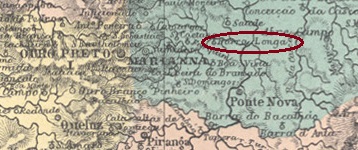
Die Freguesia von S. José da Barra Longa wurde bereits im Februar 1740 gegründet, sie gehörte der Vila von Mariana und lag am Südufer des Flusses Carmo, 70 km östlich der späteren Provinzhauptstadt Ouro Preto entfernt. Im April 1841 stieg der Ort zur Vila auf, wurde aber im Juli 1857 als Distrikt im Município von Ponte Nova herabgestuft. Danach wechselte Barra Longa zurück zum Município von Mariana (im Oktober 1870), um im September 1923 zu Ponte Nova zurückzukehren. Seit Dezember 1938 ist Barra Longa ein eigenständiger Município.
Es wurden zwei Entstegungsdaten fürs örtliche Postamt gefunden. Erstmals im Februar 1865, wie die Presse aus Rio berichtete:

Das zweite Datum liegt ein Monat später und wurde durch Paula Sobrinho in História Postal de Minas Gerais (Belo Horizonte, 1997) ermittelt, sowie von R. Koester in Carimbologia III übernommen. Das könnte das Datum der Inbetriebnahme der Agentur sein. Der bisher einzige Ortsstempel im Kaiserreich ist BMG-0240b, der mit Daten von 1879 bis 1890 gefunden und bereits durck R. Koester (op. cit.) gezeigt wurde:
James A. Dingler und Klerman W. Lopes haben auch eine stumme Entwertung aus Barra Longa in Mute Cancellations of the Brazil Empire / Carimbos Mudos do Brasil Império (Brazil Philatelic Association, Rio de Janeiro, 2000) unter Nr. 448 präsentiert, die von ca. 1878 bis 1882 verwendet wurde:

 Carimbologia