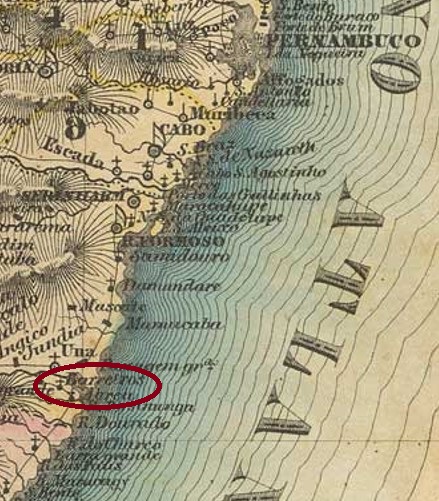
The chapel of S. Miguel dos Barreiros was built around 1720 and was located at the Vila of Serinhaem on the south bank of the Una River, over 100 km south of the provincial capital Recife. In 1786, the place became a freguesia, now belonging to the Vila of Rio Formoso. In May 1853, it was promoted to a vila in its own município, and since June 1892, Barreiros has been a town.
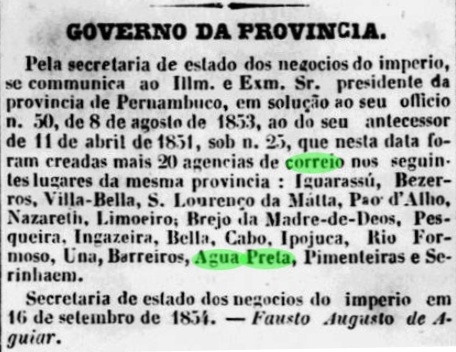
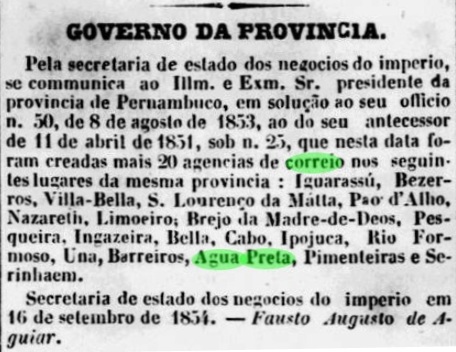
Nova Monteiro writes in Administrações e Agencias Postaes do Brasil Imperio (Brasil Filatelico/RJ, 1934-5; Reprint SPP 1994-1999) that there had been a post office there since September 1854. This is confirmed by the Recife press:
Koester, on the other hand, mentions January 1855 in Carimbologia III, which could, however, be the time when the agency started operations. The only postmark in the Empire so far is the French type BPE-0070b, which was used between about 1876 and at least 1894 and is already known by R. Koester (op. cit.):
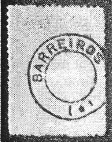
From Barreiros a mute cancel (Coll. Claudio Coelho) was also found:

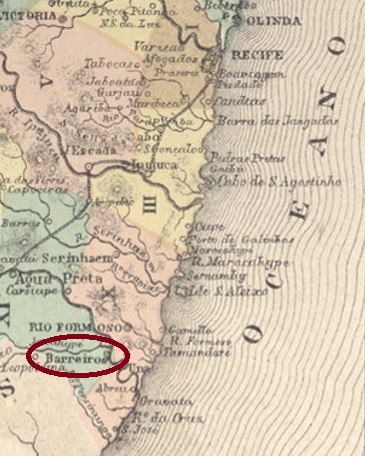
Die Kapelle von S. Miguel dos Barreiros wurde ca. 1720 errichtet und lag bei der Vila von Serinhaem am Südufer des Una-Flusses, gut 100 km südlich der Provinzhauptstadt Recife. 1786 wurde der Ort zu einer Freguesia, nun der Vila von Rio Formoso gehörend. Im Mai 1853 erfolgte der Aufstieg zur Vila im eigenen Município, und seit Juni 1892 ist Barreiros eine Stadt.
Nova Monteiro schreibt in Administrações e Agencias Postaes do Brasil Imperio (Brasil Filatelico/RJ, 1934-5; Reprint SPP 1994-1999), dass es dort seit September 1854 ein Postamt gab. Dieses wird durch die Presse aus Recife bestätigt:
Koester nennt in Carimbologia III dagegen den Januar 1855, was eher der Zeitpunkt der Inbetriebnahme der Agentur sein könnte. Der bisher einzige Poststempel im Kaiserreich ist der französische Typus BPE-0070b, der zwischen ca. 1876 und mindestens 1894 verwendet wurde und durch R. Koester (op. cit.) bereits bekannt ist:

Aus Barreiros wurde auch eine stumme Entwertung (Samml. Claudio Coelho) gefunden:


 Carimbologia