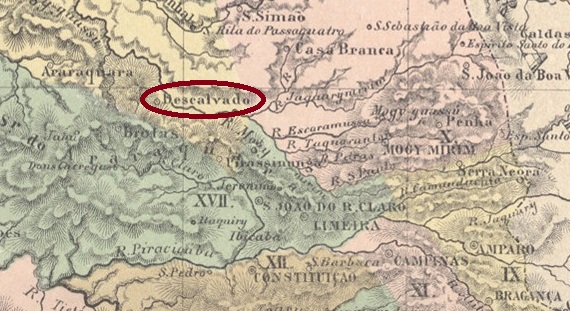
Another name: Descalvado (1908)
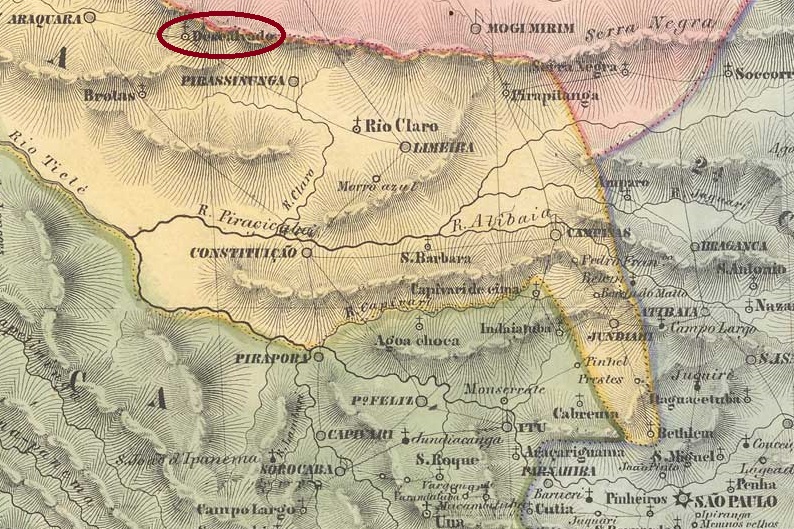
The chapel of N. Sra. de Belém was built in 1832 and was located on the west bank of the Bonito River at the Vila of Araraquara, 240 km north of the provincial capital of São Paulo. The village was elevated to Freguesia in February 1844 and passed to the Município of Rio Claro the following year. In April 1864, it was promoted to Vila in its own Município, and in April 1889, it became a town, simply called Descalvado since December 1908.
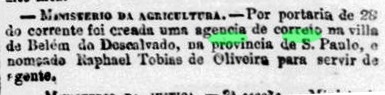
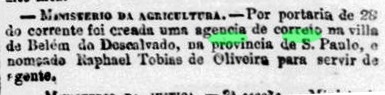
In June 1865 came the official decree for a post office on site, as reported in the capital press:
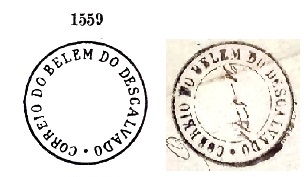
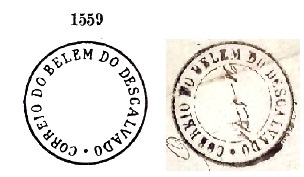
The first postmark is BSP-0145a, which also occurs in blue and dark purple, was used until about 1874 and is also known by Paulo Ayres in Catálogo de Carimbos Brasil-Império (S. Paulo, 1937, 1942) under No. 1559. However, his illustration lacks the inner circle, when compared to the original:
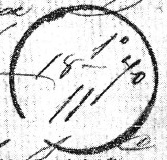
It was followed by the emergency or transitional solution BSP-0145b, used from 1870 to 1877 and already shown by R. Koester in Carimbologia IV.
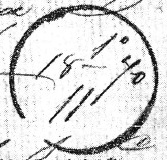
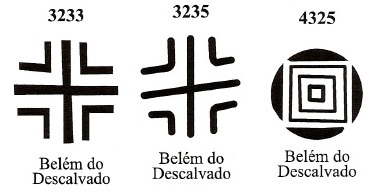
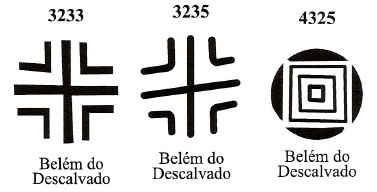
James Dingler and Klerman W. Lopes reported three mute cancellations from Belém do Descalvado, which were given the nos. BPA 3233, 3235 and 4325 in Mute Cancellations of the Brazil Empire / Carimbos Mudos do Brasil Império (Brazil Philatelic Association, Rio de Janeiro, 2000):
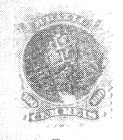
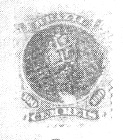
Another mute cancel was presented by R. Koester (op. cit.):
From about 1878 onwards, local postmarks bore the place name DESCALVADO.
Anderer Name: Descalvado (1908)
Die Kapelle von N. Sra. de Belém wurde 1832 errichtet und lag am Westufer des Flusses Bonito bei der Vila von Araraquara, 240 km nördlich der Provinzhauptstadt São Paulo entfernt. Die Ortschaft wurde zu Freguesia im Februar 1844 erhoben und ging im folgenden Jahr zum Município von Rio Claro. Im April 1864 erfolgte der Aufstieg zur Vila im eigenen Município, und im April 1889 die Ernennung zur Stadt, die seit Dezember 1908 einfach Descalvado heißt.
Im Juni 1865 kam die behördliche Verfügung über ein Postamt vor Ort, wie die Hauptstadtpresse berichtete:
Der erste Poststempel ist BSP-0145a, der bis ca. 1874 auch in Blau und Dunkellila Verwendung fand und auch durch Paulo Ayres in Catálogo de Carimbos Brasil-Império (S. Paulo, 1937, 1942) unter Nr. 1559 bekannt ist. Allerdings fehlt in seiner Abbildung der innere Kreis, wie man gegenüber dem Original sehen kann:
Ihm folgte die Not- oder Übergangslösung BSP-0145b, die von 1870 bis 1877 gebraucht und bereits durch R. Koester in Carimbologia IV gezeigt wurde.
Aus Belém do Descalvado meldeten James Dingler und Klerman W. Lopes drei stumme Abstempelungen, die in Mute Cancellations of the Brazil Empire / Carimbos Mudos do Brasil Império (Brazil Philatelic Association, Rio de Janeiro, 2000) die Nr. BPA 3233, 3235 und 4325 bekamen:
Einen weiteren stummen Stempel stellte R. Koester (op. cit.) vor:
Ab ca. 1878 trugen die Poststempel die Ortsbezeichnung DESCALVADO.

 Carimbologia