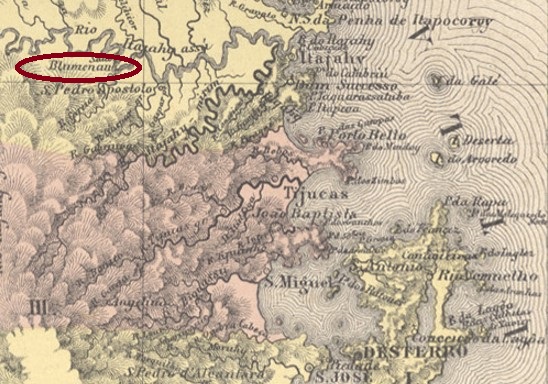
Since February 1850, this German colony existed on the south bank of the river Itajaí-Açu, 140 km northwest of the provincial capital Desterro (today: Florianópolis). The name comes from its founder, the German pharmacist and Doctor of Chemistry Hermann Blumenau (1819-1899), who returned to Germany in 1884 and died in Brunswick.

The town became a freguesia of the vila of Itajaí in July 1873, a vila in February 1880 and a town in July 1894, which today has over 350,000 inhabitants. Dr Blumenau could be proud of that.
The local post office came into being in November 1874, as R. Koester wrote in Carimbologia IV. Three postmarks from the imperial period are shown in Paulo Ayres’ Catálogo de Carimbos Brasil-Império (S. Paulo, 1937, 1942). Of these, BSC-0025a is the oldest. It was used even before the opening of the post office, as it was in use from the postage-free colonist letters until at least 1876. Known through Paulo Ayres under no. 1560:
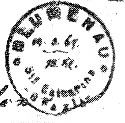
Its successor BSC-0025b has been found so far with dates from 1877 to 1893:

Unfortunately, nothing is known about BSC-0025c:

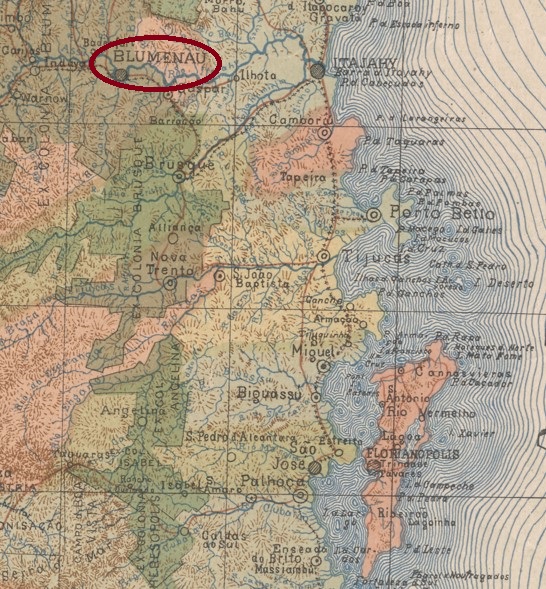
Seit Februar 1850 gab es die deutsche Kolonie am Südufer des Flusses Itajaí-Açu, 140 km nordwestlich der Provinzhauptstadt Desterro (heute: Florianópolis) entfernt. Der Name kommt von ihrem Gründer, dem deutschen Apotheker und Doktor der Chemie Hermann Blumenau (1819-1899), der 1884 nach Deutschland zurückkehrte und in Braunschweig starb.

Der Ort wurde im Juli 1873 zu einer Freguesia von der Villa von Itajaí, im Februar 1880 zur Vila und im Juli 1894 zur Stadt, die heute über 350.000 Einwohner hat. Da könnte Dr. Blumenau stolz sein.
Das örtliche Postamt entstand im November 1874, wie R. Koester in Carimbologia IV schrieb. Drei Poststempel aus der Kaiserzeit sind im Paulo Ayres‘ Catálogo de Carimbos Brasil-Império (S. Paulo, 1937, 1942) abgebildet. Davon ist BSC-0025a der älteste. Er wurde sogar vor der Postamteröffnung benutzt, da er seit der portofreien Kolonistenbriefen bis mindestens 1876 Verwendung fand. Bekannt durch Paulo Ayres unter Nr. 1560:
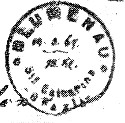
Sein Nachfolger BSC-0025b wurde bisher mit Daten von 1877 bis 1893 gefunden:

Über BSC-0025c ist leider nichts bekannt:


 Carimbologia